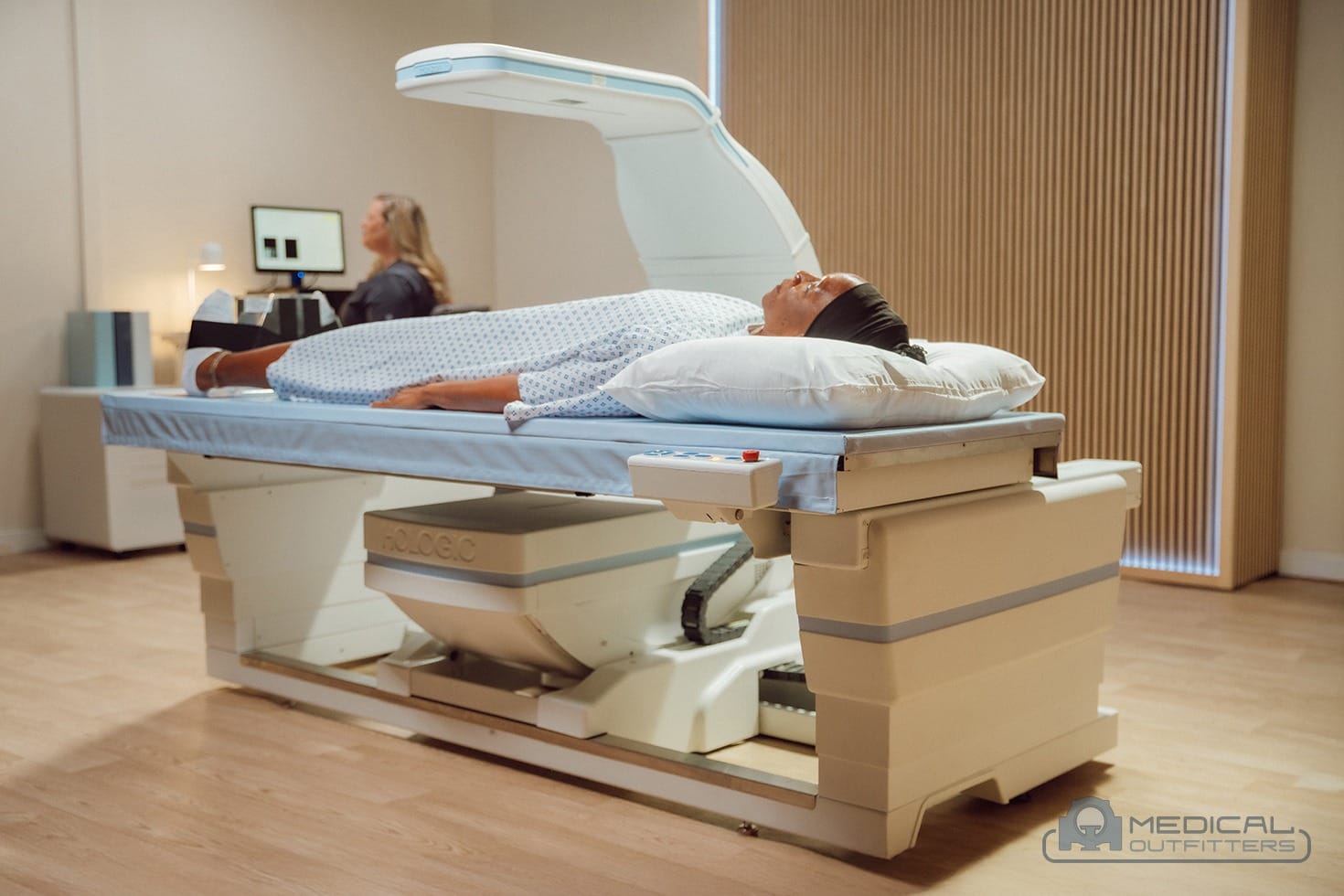
A DEXA scanner (bone densitometer) uses dual-energy X-ray absorptiometry to measure bone mineral density, the standard test for diagnosing osteoporosis and assessing fracture risk.
DEXA machine cost ranges from roughly $18,000 for a refurbished peripheral unit to over $165,000 for a new full-body central system, depending on type, condition, and software.
Looking for the price of the scan itself? A DEXA scan costs a patient roughly $100 to $600 depending on where it is done, and Medicare covers it every 24 months for qualifying patients. See DEXA scan cost below »
A bone densitometer is one of the more accessible imaging investments, with strong demand from orthopedics, endocrinology, rheumatology, and women’s health. Whether you searched for dual energy X-ray absorptiometry cost, DEXA scan machine cost or the price of a bone density test, this guide answers both sides: what the machine costs a facility, by type, brand and condition, and what the scan costs a patient.
Updated 12 October 2026. Price ranges are Medical Outfitters all-in figures reviewed 16 September 2026; this update adds the price list by model, the scan-cost tables with dated sources, the body composition section and the payback calculator, and keeps every class band unchanged. Specifications, Medicare rules and CPT references were checked against the sources cited in each section. Written by the Medical Outfitters sales and field engineering team.
- In this guide: Dual energy X-ray absorptiometry (DEXA) cost: the scan and the machine
- How much a DEXA machine costs, by type
- DEXA machine price by brand and by model
- DEXA scan cost in 2026, with and without insurance
- Body composition DEXA scanner cost
- How many scans pay for the machine, with a calculator
- Used and refurbished DEXA machines
- Frequently asked questions
- What a DEXA scanner is and what the scan is used for
- Get this guide as a PDF by email
Dual Energy X-ray Absorptiometry (DEXA) Cost: The Scan and the Machine
Dual-energy X-ray absorptiometry, written DEXA or DXA, is both the name of the test and the name of the machine, so the phrase carries two very different prices. The scan is a low-cost test: without insurance a DEXA scan typically costs $100 to $200 at an imaging center or physician office and $200 to $600 at a hospital outpatient department, Medicare covers it every 24 months for qualifying patients, and Medicare pays the clinic about $40 per study. The machine is a capital purchase: a DEXA scanner costs $18,000 to $40,000 refurbished or $40,000 to $70,000 new for a peripheral unit, and $35,000 to $85,000 refurbished or $85,000 to $165,000 new for a central, full-body system, delivered, installed and warrantied.
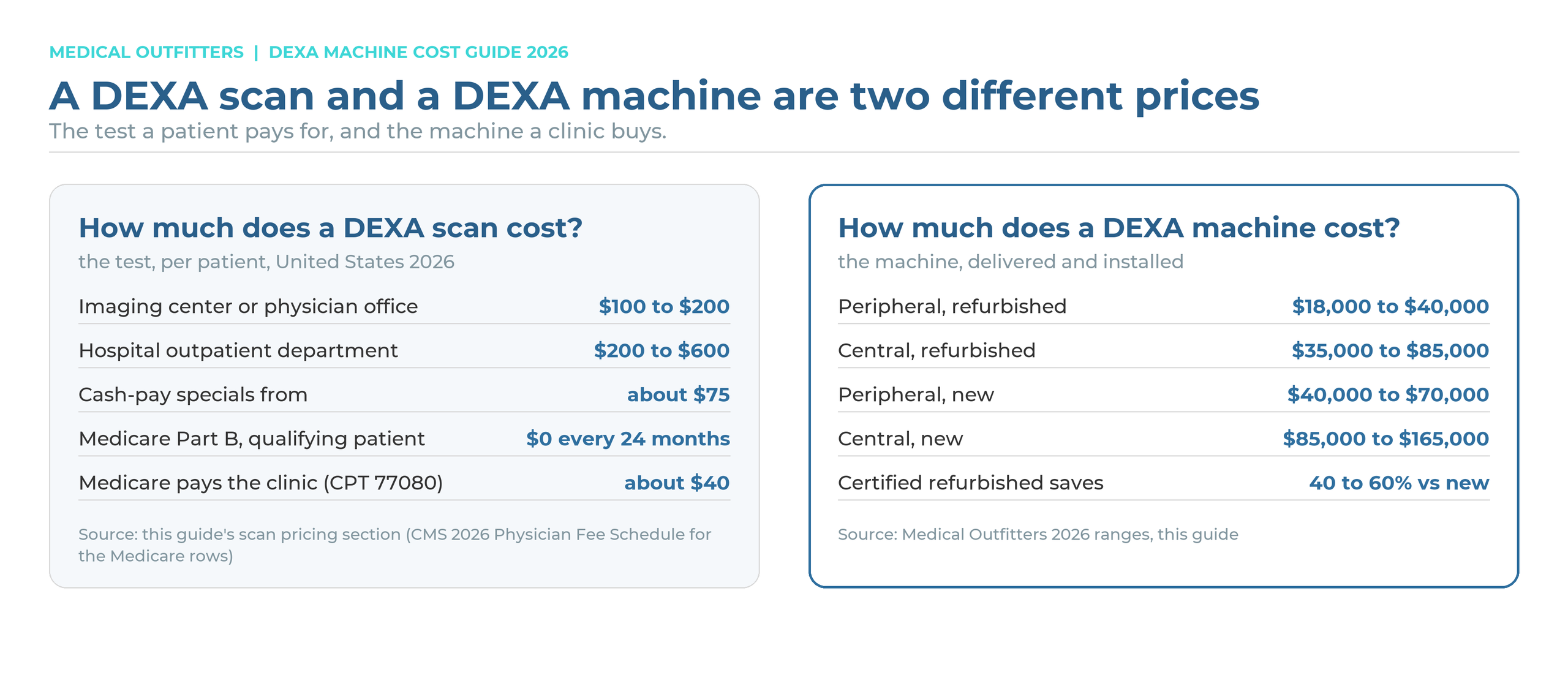
The rest of this page takes each side in turn: the machine price by type, by brand and by model, then the scan price by city, by payer and by CPT code, what a body composition DEXA costs, and the arithmetic that tells a clinic how many scans pay for the system.
How Much Does a DEXA Machine Cost?
DEXA machine cost, or DEXA scan machine cost if you search it that way (DXA scan machine and bone density scan machine mean the same equipment), is driven mainly by type (peripheral vs. central) and condition. Typical price ranges are:
The figures below are Medical Outfitters ranges for a system delivered, installed and warrantied. Headline prices published elsewhere are often for the equipment alone, before delivery, rigging, installation and current tariffs, so they read lower than a real all-in cost. Every Medical Outfitters system is quoted individually.
| DEXA Type | Refurbished | New |
|---|---|---|
| Peripheral DEXA (forearm / heel) | $18,000 to $40,000 | $40,000 to $70,000 |
| Central / full-body DEXA | $35,000 to $85,000 | $85,000 to $165,000 |
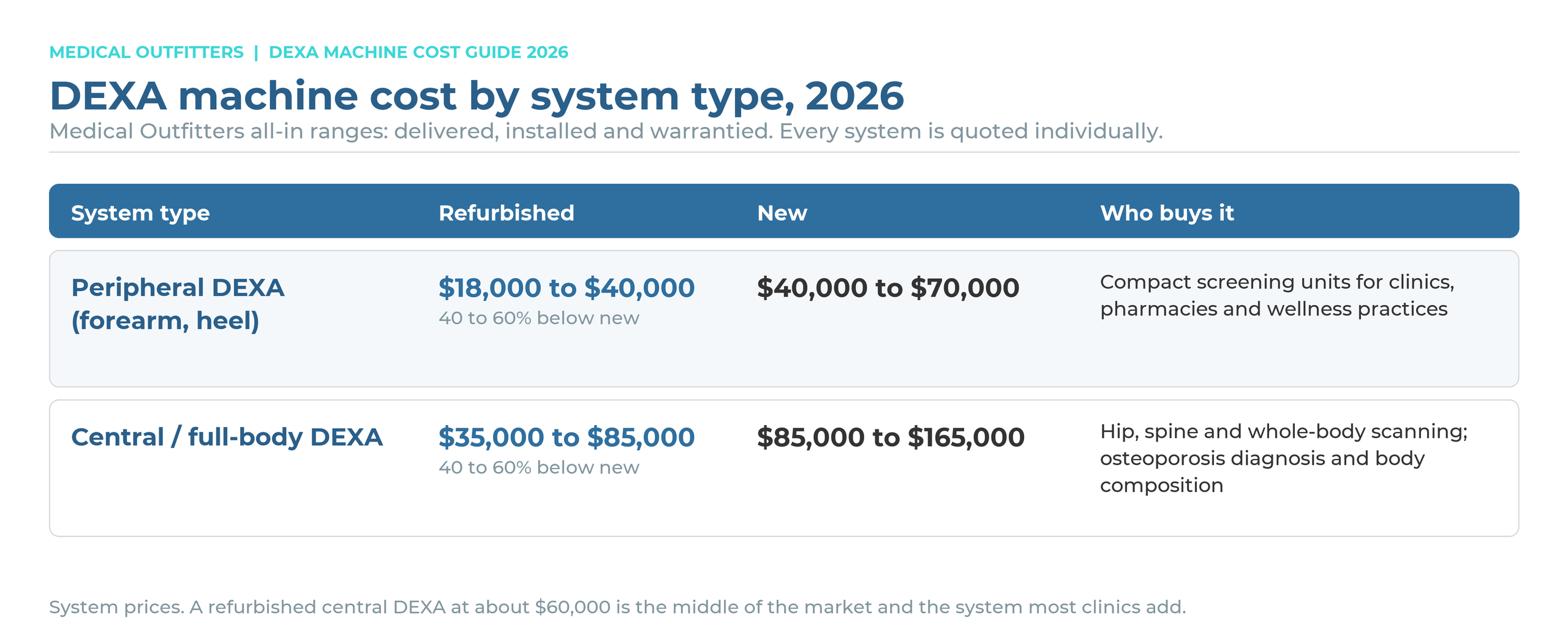
The same question arrives in many forms: DEXA scan machine cost, DEXA scanner cost, DEXA scanner price, DEXA machine price, bone density scanner cost, bone density machine cost, DXA machine cost, how much does a DEXA machine cost, how much is a DEXA scan machine, cost of a DEXA scan machine, DEXA scan equipment price. They all point at the table above. The one distinction that matters is central versus peripheral, because a hip-and-spine table and a forearm unit are different classes of purchase, and the second is condition. In dollars, most clinics adding bone density land in the refurbished central band, $35,000 to $85,000 delivered and installed.
What is the average cost of a DEXA machine?
Averages hide the class split. Across the systems we quote, a certified refurbished central DEXA at about $60,000 delivered and installed is the middle of the market and the system most clinics buy; a peripheral unit averages in the low tens of thousands refurbished; a new central system with body-composition software averages well above $100,000. An average DEXA price quoted without the system type and the condition is not a usable number.
What moves the price of a DEXA scanner
- Central vs. peripheral: a central table that scans hip, spine and whole body costs several times more than a forearm or heel unit
- Beam and detector type: fan-beam systems scan faster and cost more than pencil-beam units; pencil-beam remains accurate and is common in refurbished inventory
- Software modules: body composition, vertebral fracture assessment and trabecular bone score are licensed options that add to the price
- Condition and warranty: new with a manufacturer warranty at the top, certified refurbished with a dealer warranty in the middle, as-is used at the bottom
- Delivery, installation and training: included in Medical Outfitters pricing, and often excluded from headline prices published elsewhere
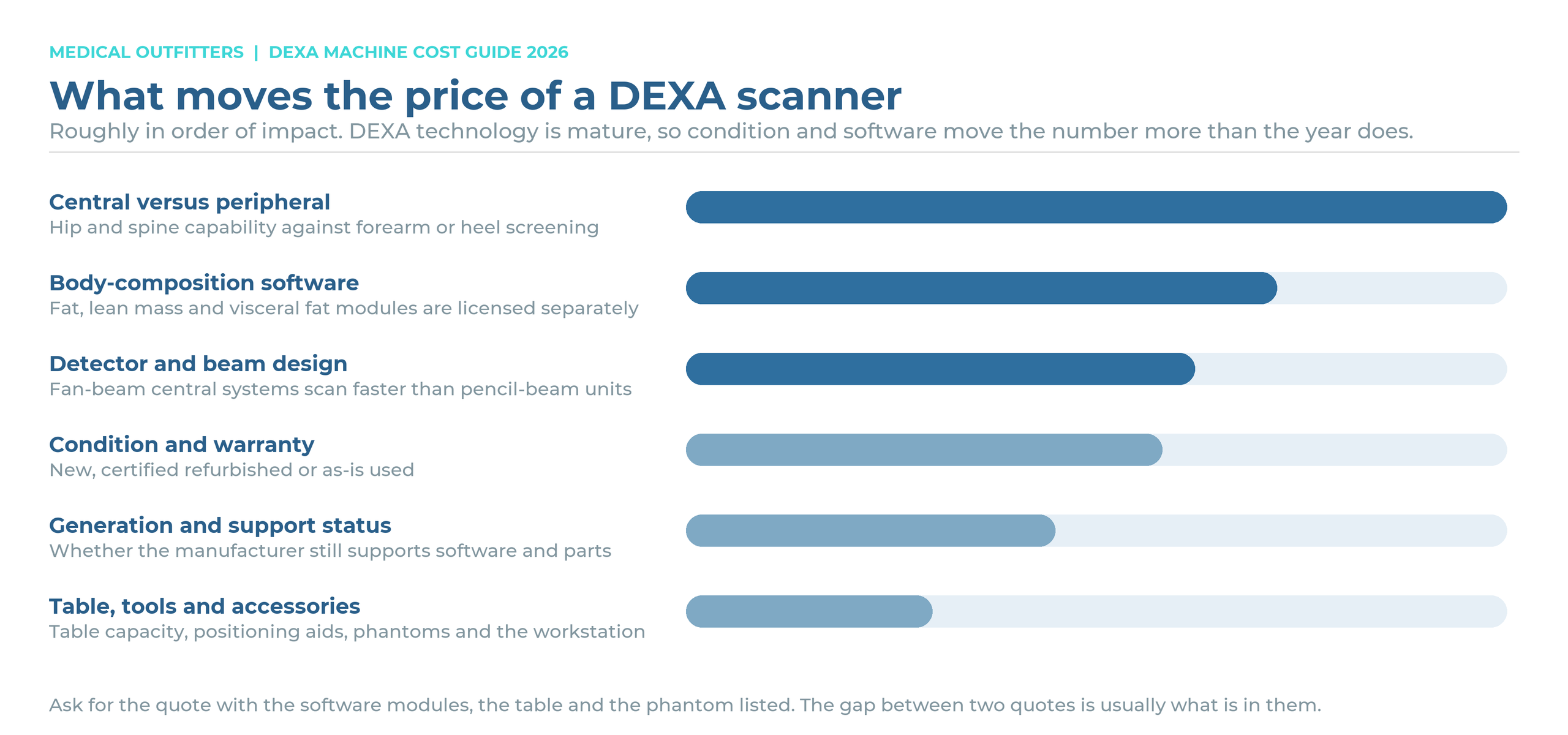
A certified refurbished DEXA scanner typically saves 40 to 60 percent versus new while delivering comparable accuracy. Browse DEXA bone density machines for sale »
Get This Guide as a PDF by Email
The print edition of the 2026 DEXA and Bone Densitometer Price Guide carries the same price ranges, model tables and figures as this page, with a cover and page numbers, formatted for printing and for sharing with a board or a finance committee. It is sent by email; fill in the form and it is on its way.
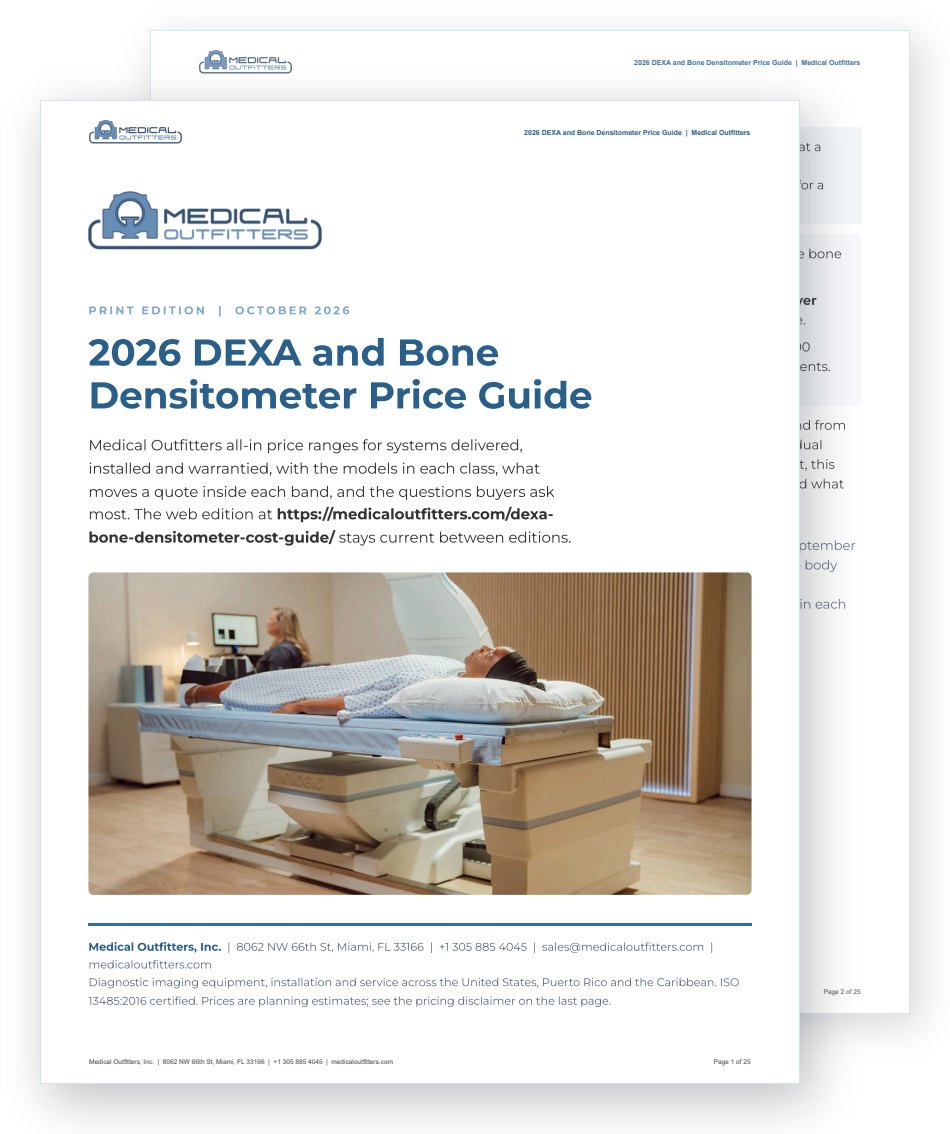
25 pages, Letter size: cover, price tables, figures, FAQ and page numbers for printing.
DEXA Machine Price by Brand: GE Lunar, Hologic and DMS
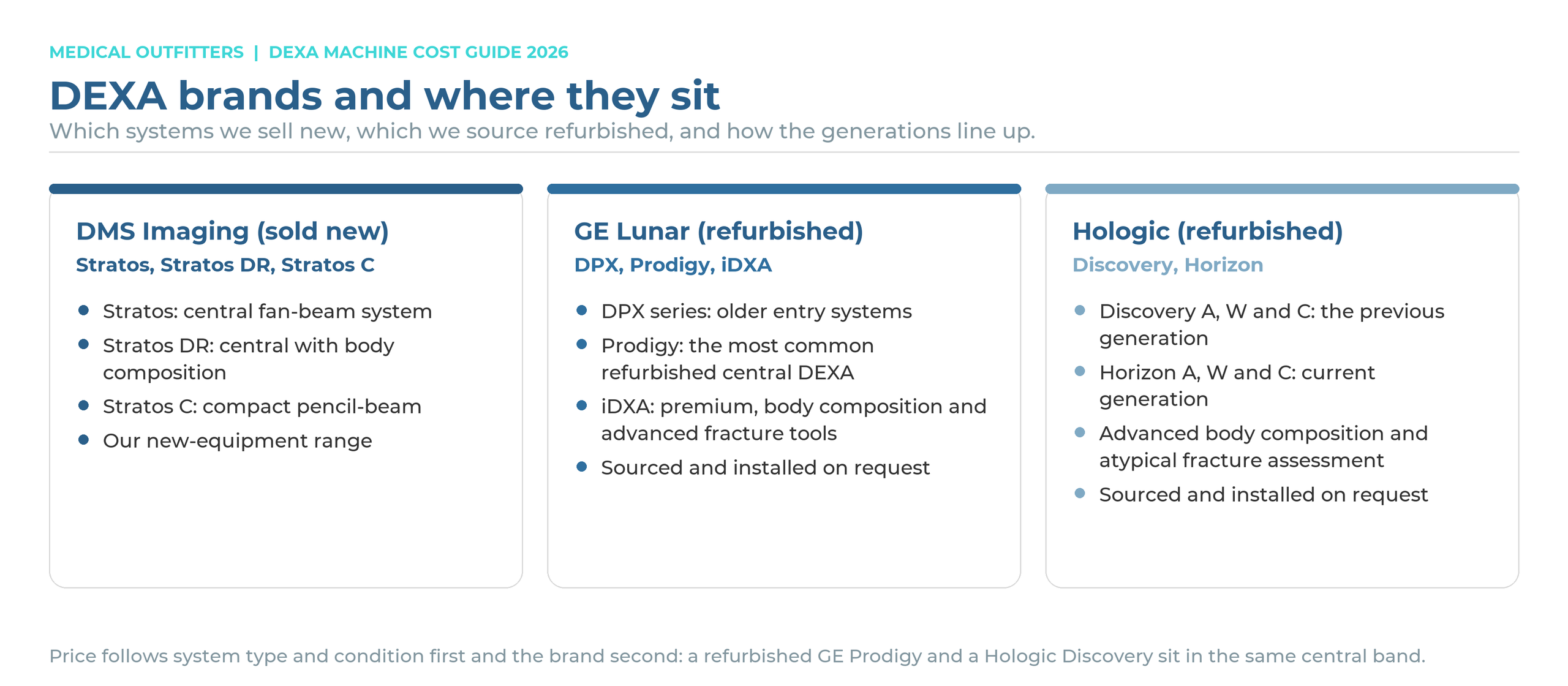
Brand moves a DEXA quote less than system type and condition do; a refurbished GE Lunar Prodigy and a refurbished Hologic Discovery sit in the same $35,000 to $85,000 central band. What separates two quotes is the generation, the software modules licensed, the detector design and how the unit was refurbished.
GE Lunar DEXA price: DPX, Prodigy and iDXA
The DPX series is the older entry point on the used market. The Prodigy is the most common refurbished central DEXA in circulation, with a deep parts and service base, and it anchors the refurbished central band. The iDXA is the premium platform with advanced body composition and fracture-assessment tools; a refurbished GE Lunar iDXA price sits toward the top of the $35,000 to $85,000 central band, and it is the system to specify when body composition is the business, not an add-on. Refurbished GE Lunar systems are sourced, inspected and installed on request.
Hologic DEXA price: Discovery and Horizon
The Discovery A, W and C are the previous generation and the workhorses of the refurbished market; the Horizon A, W and C are the current generation, with advanced body composition on the whole-body W and A tables and high-definition vertebral fracture assessment (IVA HD) on all three; the Wi and Ci are the same tables with a 64-detector array and standard IVA. A refurbished Hologic Discovery sits in the central band alongside the Prodigy; a Horizon, being newer, sits toward the top of it. Refurbished Hologic systems are sourced, inspected and installed on request.
DMS Imaging DEXA price: Stratos, Stratos DR and Stratos C (sold new)
Our new-equipment range. The Stratos is a central bone densitometer built around DMS’s Digital Fast Beam, an enhanced pencil beam, the Stratos DR adds body composition for sports medicine and wellness work, and the compact pencil-beam Stratos C fits a small room and a screening workload. The Stratos series is CE marked under the EU Medical Device Regulation (DMS announced the MDR certification on April 7, 2026); FDA clearance is pending, with the pre-submission filed in 2026, so confirm the regulatory status for your site when you request a quote. New DMS pricing follows the new column of the table: $85,000 to $165,000 for a central system and $40,000 to $70,000 for a compact unit, delivered, installed and warrantied. The ClariOsteo software flags low bone density on routine CT scans and is a screening complement, not a densitometer.
DEXA machine price by model (refurbished, delivered and installed)
The price of a DEXA machine by model, inside the class bands above. Refurbished figures are Medical Outfitters all-in ranges (delivered, installed and warrantied) for systems we source and rebuild on request; new prices are shown only for the DMS Imaging systems we sell new as the authorized dealer. Another maker’s new price is an estimate through the OEM for comparison and is not a Medical Outfitters offer. Every system is quoted individually; where in its band a unit lands depends on the software modules licensed, the X-ray source history, the table and the condition.
| Model | Maker | Class and generation | How we sell it | Refurbished, all-in | New price | More |
|---|---|---|---|---|---|---|
| DPX-NT | GE Lunar | Central, pencil beam, legacy platform | MO Select refurbished, sourced on request | $38,000 to $48,000 | Not sold new (discontinued) | Category page |
| DPX Bravo | GE Lunar | Central, pencil beam, compact office unit | MO Select refurbished, sourced on request | $42,000 to $55,000 | Not sold new by Medical Outfitters (superseded configuration) | Category page |
| Prodigy Primo | GE Lunar | Central, narrow-angle fan beam, entry Prodigy configuration | MO Select refurbished, sourced on request | $48,000 to $60,000 | Not sold new by Medical Outfitters (superseded configuration) | Category page |
| Prodigy Advance | GE Lunar | Central, narrow-angle fan beam, full enCORE feature set | MO Select refurbished, sourced on request | $55,000 to $70,000 | Not sold new by Medical Outfitters (superseded configuration) | Category page |
| Prodigy Pro (sold today as the Lunar Prodigy) | GE Lunar | Central, narrow-angle fan beam, direct-digital detector, body composition | MO Select refurbished, sourced on request | $62,000 to $75,000 | Estimated through the OEM: $90,000 to $120,000; not a Medical Outfitters offer | Category page |
| iDXA | GE Lunar | Central, premium current platform, narrow-angle fan beam, CdTe photon-counting detector, advanced body composition | MO Select refurbished, sourced on request | $72,000 to $85,000 | Estimated through the OEM: $125,000 to $165,000; not a Medical Outfitters offer | Category page |
| Discovery Ci | Hologic | Central, fan beam, compact spine and hip, without vertebral fracture assessment (previous generation) | Refurbished, sourced on request | $38,000 to $48,000 | Not sold new (discontinued; replaced by the Horizon) | Category page |
| Discovery C | Hologic | Central, fan beam, compact spine and hip with IVA (previous generation) | Refurbished, sourced on request | $42,000 to $55,000 | Not sold new (discontinued) | Category page |
| Discovery Wi | Hologic | Central, fan beam, whole body and body composition, without IVA (previous generation) | Refurbished, sourced on request | $48,000 to $60,000 | Not sold new (discontinued) | Category page |
| Discovery W | Hologic | Central, fan beam, whole body, body composition, IVA (previous generation) | Refurbished, sourced on request | $55,000 to $68,000 | Not sold new (discontinued) | Category page |
| Discovery A | Hologic | Central, fan beam, previous-generation flagship: whole body, IVA, rotating C-arm for supine lateral spine | Refurbished, sourced on request | $62,000 to $75,000 | Not sold new (discontinued) | Category page |
| Horizon Ci | Hologic | Central, current generation, compact spine and hip, 64-detector array, standard IVA | Refurbished, sourced on request | $55,000 to $68,000 | Estimated through the OEM: $85,000 to $105,000; not a Medical Outfitters offer | Category page |
| Horizon C | Hologic | Central, current generation, compact spine and hip, 128-detector array, IVA HD | Refurbished, sourced on request | $58,000 to $70,000 | Estimated through the OEM: $90,000 to $115,000; not a Medical Outfitters offer | Category page |
| Horizon Wi | Hologic | Central, current generation, whole body and body composition, 64-detector array, standard IVA | Refurbished, sourced on request | $65,000 to $78,000 | Estimated through the OEM: $100,000 to $130,000; not a Medical Outfitters offer | Category page |
| Horizon W | Hologic | Central, current generation, whole body and body composition, 128-detector array, IVA HD | Refurbished, sourced on request | $70,000 to $82,000 | Estimated through the OEM: $110,000 to $145,000; not a Medical Outfitters offer | Category page |
| Horizon A | Hologic | Central, current flagship, whole body and body composition, 216-detector array, IVA HD, rotating C-arm for supine lateral spine | Refurbished, sourced on request | $75,000 to $85,000 | Estimated through the OEM: $130,000 to $165,000; not a Medical Outfitters offer | Category page |
| Stratos | DMS Imaging | Central, Digital Fast Beam (enhanced pencil beam); spine, femur, dual femur, forearm, whole-body composition, FRAX, optional 3D-DXA | New, authorized DMS dealer | Sold new only | Sold new by Medical Outfitters: $90,000 to $120,000 | Product page |
| Stratos DR | DMS Imaging | Central, 2D fan beam, 256-element detector, about 15 seconds per site, body composition, 3D-DXA femur modeling | New, authorized DMS dealer | Sold new only | Sold new by Medical Outfitters: $125,000 to $165,000 | Product page |
| Stratos C | DMS Imaging | Compact, Digital Fast Beam pencil beam; spine, femur, dual femur, forearm, whole body and body composition in a small room | New, authorized DMS dealer | Sold new only | Sold new by Medical Outfitters: $55,000 to $70,000 (compact class) | Product page |
| Norland XR-800 and Elite (Swissray) | Norland | Central, pencil beam, budget platform; confirm US parts and service support before buying | Sourced on request | Quoted per unit inside the $35,000 to $85,000 central band | Not sold new by Medical Outfitters | Category page |
| Osteosys Dexxum T and Primus | Osteosys | Dexxum T pencil beam and Primus fan beam, budget platforms; confirm US support before buying | Sourced on request | Quoted per unit inside the $35,000 to $85,000 central band | Not sold new by Medical Outfitters | Category page |
Notes: Hologic and GE Lunar systems without a product page of their own are sourced, inspected, calibrated against a phantom and installed on request, and link to our DEXA machines for sale page until their listings exist. The Hologic C and W letters mark the compact spine-and-hip and the whole-body tables; an i suffix marks the lighter configuration of each table: without vertebral fracture assessment on the Discovery, and with the 64-detector array and standard rather than HD vertebral assessment on the Horizon. For a side-by-side of the platforms, see DEXA scanner brands and what to check when buying used.
DEXA Scan Cost in 2026: With and Without Insurance
How much is a DEXA scan?
Without insurance, a DEXA scan (bone density test) typically costs $100 to $200 at an independent imaging center or physician office and $200 to $600 at a hospital outpatient department. CoveredUSA’s national pricing guide (May 15, 2026) puts the 2026 national average at $175 without insurance, with most quotes between $80 and $300, a low of about $65 at mobile and community screening events and a high of about $600 at a hospital outpatient department. A second survey, CareCredit’s 2025 cost study (published October 2, 2026), puts the national average at $235 with a range of $182 to $411 and a Florida average of $237; the gap between the two surveys is the mix of hospital and imaging-center prices each one counts. The same test on the same type of machine costs two to four times more in a hospital setting because hospital billing carries facility overhead that has nothing to do with bone density testing.
| Where the scan is done | Typical cash price | Notes |
|---|---|---|
| Independent imaging center or physician office | $100 to $200 | The most common setting; cash-pay specials from about $75 (CoveredUSA, May 15, 2026: imaging center $100 to $250, physician office $100 to $200) |
| Hospital outpatient department | $200 to $600 | Facility fees raise the price of the same test (CoveredUSA, May 15, 2026) |
| Medicare Part B, qualifying patient | $0 | Once every 24 months, provider accepting assignment |
| Medicare payment to the clinic (CPT 77080) | About $39 (2026 national amount) | 2026 national amount under the Physician Fee Schedule, see the CPT table below |
DEXA scan cost without insurance by city
Cash prices move with the city and the setting more than with the machine. The figures below are published self-pay prices on the date shown; call before you book, because the same provider can list two prices for the same scan.
| City | Cash price for a DEXA scan | Setting | Source |
|---|---|---|---|
| Miami, FL | $92 to $106 | Imaging centers, prepaid cash price | MDsave, as of October 12, 2026 |
| Orlando, FL | $91 to $103 | Imaging centers, prepaid cash price | MDsave, as of October 12, 2026 |
| Tampa, FL | $91 to $103 | Imaging centers, prepaid cash price | MDsave, as of October 12, 2026 |
| Jacksonville, FL | $91 to $103 | Imaging centers, prepaid cash price | MDsave, as of October 12, 2026 |
| Florida, statewide | $91 to $326 | Imaging centers and hospitals; Naples and Key West at the top | MDsave, as of October 12, 2026 |
| Atlanta, GA | $89 to $219 | Imaging centers to a regional hospital | MDsave, as of October 12, 2026 |
| Houston, TX | $104 to $292 | Imaging centers to hospital imaging | MDsave, as of October 12, 2026 |
| Dallas, TX | $100 to $182 | Regional hospitals | MDsave, as of October 12, 2026 |
| Chicago, IL | $92 to $193 | Imaging centers to hospital imaging | MDsave, as of October 12, 2026 |
| New York, NY | $94 to $154 | Imaging centers in the metro area | MDsave, as of October 12, 2026 |
| Los Angeles, CA | $96 to $148 | Imaging centers | MDsave, as of October 12, 2026 |
| Phoenix, AZ | $91 to $135 | Imaging centers | MDsave, as of October 12, 2026 |
| New Hampshire, hospital vs imaging center | $152 to $529 at hospitals; $263 to $461 at imaging centers | State price-transparency estimates for CPT 77080, uninsured | NH HealthCost, data April 2024 to June 2025 |
| Wellington, FL, hospital-system imaging center | $509 | Baptist Health Diagnostic Imaging, booked through Instalab | Instalab, as of October 12, 2026 |
DEXA scan cost with insurance
With insurance, a bone density test is usually covered when it is ordered for a clinical reason: menopause-related risk, long-term steroid use, a prior fracture, or monitoring osteoporosis treatment. Medicare Part B covers a bone mass measurement once every 24 months, or more often when medically necessary, and the patient pays nothing when the provider accepts assignment. Commercial plans generally follow the same logic, with the plan’s usual deductible and copay applying. Body-composition DEXA for fitness or wellness is a self-pay service priced by the provider. Whether you search for the price of a DEXA scan, bone density test price, BMD test cost, DEXA test price or the cost of a bone density test, the answer depends far more on where the scan is done than on the machine itself.
What Medicare pays: DEXA CPT codes and 2026 rates
Medicare pays physicians and imaging centers under the Physician Fee Schedule. The 2026 national amounts below come from the CMS Indicators for 2026 file (modified October 1, 2026) at the 2026 conversion factor of $33.40 set in the CY 2026 final rule (October 31, 2025), before the 2 percent sequestration reduction; the non-facility and facility amounts are the same for the three bone density codes because the work sits in the technical component. Hospital outpatient departments bill under the outpatient prospective payment system instead, at $106.81 for 77080 and 77085 and $88.91 for 77081 in 2026 (Hologic 2026 bone densitometry coding guide, from the CMS OPPS addenda), which is one reason the same scan costs more in a hospital.
| CPT code | What it bills | 2026 Medicare national amount, non-facility (CMS Physician Fee Schedule) | 2026 Medicare, facility | Note |
|---|---|---|---|---|
| 77080 | DXA bone density study, axial skeleton (hips, pelvis, spine): the standard osteoporosis test | $39.41 global ($9.35 professional, $30.06 technical) | $39.41 (same) | 1.18 RVU; hospital outpatient departments bill under OPPS at $106.81 |
| 77081 | DXA bone density study, appendicular skeleton (forearm, wrist, heel): the peripheral test | $31.73 global ($9.35 professional, $22.38 technical) | $31.73 (same) | 0.95 RVU; OPPS $88.91 |
| 77085 | Axial DXA including vertebral fracture assessment, one code for both | $54.44 global ($14.36 professional, $40.08 technical) | $54.44 (same) | 1.63 RVU; OPPS $106.81; the stand-alone VFA code 77086 still exists and is not covered under the screening benefit |
| 76499 | Unlisted diagnostic radiographic procedure, the code many providers use for a body composition DEXA | Contractor priced (status C), no national amount | Contractor priced | Priced case by case by the Medicare contractor, by report; almost always billed to the patient instead |
Medicare Part B covers a bone mass measurement once every 24 months, or more often when medically necessary, for people who meet one of its conditions (an estrogen-deficient woman at risk of osteoporosis, X-ray signs of osteoporosis, osteopenia or a vertebral fracture, long-term steroid therapy, primary hyperparathyroidism, or monitoring of osteoporosis drug therapy), and the patient pays nothing when the provider accepts assignment. For Florida, Puerto Rico and the US Virgin Islands the Medicare contractor is First Coast Service Options, whose bone mass measurement page (September 22, 2026) confirms that the deductible and coinsurance are waived for the screening benefit and that the stand-alone VFA code 77086 is not covered under it. 77085 did not replace 77086: both codes arrived in 2015 when the old VFA code 77082 was retired (AAPC, November 3, 2014).
Body composition DEXA scan cost
A body composition DEXA is self-pay almost everywhere. Published prices run from $40 a scan in BodySpec’s mobile vans to $374 at a Miami clinic booked through Instalab (prices as shown on October 12, 2026); dedicated body composition clinics cluster at $75 to $150 a scan, packages and memberships bring a repeat scan under $100, and imaging centers and concierge bookings run $150 to $230. Insurance does not cover it, and providers either bill the patient directly or use the unlisted code 76499, which Medicare prices case by case.
| Provider | City | Self-pay price | What it buys | Source |
|---|---|---|---|---|
| BodySpec (mobile vans) | Los Angeles, Seattle, San Francisco, Austin, Dallas; Miami and Tampa on a waitlist | From $40 a scan | Monthly, quarterly and one-time plans | bodyspec.com, as of October 12, 2026 |
| DexaFit Denver | Denver, CO | $99 | DEXA plus resting metabolic rate $179; three-service bundle $289 | denver.dexafit.com, 2026 prices |
| DexaFit Las Vegas | Las Vegas, NV | $139 | Annual plan $399 for four scans ($100 a scan) | dexafit.com, as of October 12, 2026 |
| DexaFit Nashua | Nashua, NH | $119 | Twelve-scan pack $999 ($83 a scan) | nashua.dexafit.com, as of October 12, 2026 |
| Composition ID | Washington DC, Tysons, Houston, Orlando, Scottsdale, College Park | From $150 | Bundle discounts | Composition ID cost guide, July 3, 2026 |
| Fitnescity (400-plus partner sites) | Nationwide | $100 to $330 | Per location; Quest listing from $100 | fitnescity.com, 2026 |
| Orlando clinics booked through Instalab | Orlando, FL | $139 to $228 | Shewmaker Medical $139, Composition ID $148, SimonMed $204, DexaFit Orlando $228; totals include the physician order and reviewed results | instalab.com, as of October 12, 2026 |
| Miami clinics booked through Instalab | Miami, FL | $178 to $374 | DexaFit Aventura $178, Infinity Delta $374 | instalab.com, as of October 12, 2026 |
| Barnard Medical Center | Washington, DC | $200 | Single scan | pcrm.org, 2026 |
| Albany Internal Medicine (Privia) | Albany, GA | $75 | Multi-scan packages offered | myprivia.com, 2026 |
| Missouri State University body composition lab | Springfield, MO | $100 public; $75 students and staff | Physician order required | missouristate.edu, 2025 |
How to get a cheaper DEXA scan
- Book at an independent imaging center or a physician office rather than a hospital outpatient department: the same test on the same type of machine costs two to four times more under a hospital facility fee, which is what the New Hampshire transparency figures above show side by side.
- Ask for the cash price before you hand over an insurance card: prepaid marketplace prices at Florida imaging centers ran $91 to $106 as of October 12, 2026 (MDsave), well under most hospital and insured rates.
- Use the Medicare screening benefit on its schedule: once every 24 months at $0 when the provider accepts assignment, and more often when a qualifying condition applies.
- With commercial insurance, confirm the bone density benefit and whether the deductible applies first; insured rates typically run 150 to 300 percent of the Medicare amount (CareRoute, May 6, 2026), so a cash price can be cheaper than an unmet deductible.
- Bring the order from the physician who will act on the result, so the scan is read once and billed once; a repeat ordered elsewhere is a second bill.
- For body composition, buy a package or a membership rather than single scans: DexaFit’s four-scan annual plan in Las Vegas works out to $100 a scan against $139 for one, and its twelve-scan pack in Nashua to $83.
- Mobile and community screening events run about $65 to $150 (CoveredUSA, May 15, 2026) and are the cheapest route to a peripheral or screening scan.
DEXA scan cost in Florida, Puerto Rico and the Caribbean
In Florida, imaging-center cash prices for a bone density scan ran $91 to $106 in Miami, Orlando, Tampa and Jacksonville on MDsave as of October 12, 2026, with a statewide spread of $91 to $326 (Naples and Key West at the top), a hospital-system imaging center in Wellington listing $509 through Instalab, and a Florida average of $237 in CareCredit’s 2025 study. In Puerto Rico and the US Virgin Islands, Original Medicare pays through First Coast Service Options, the same contractor as Florida, under the same screening rules and the same national amounts; we found no published cash price at a Puerto Rico imaging center and no Plan Vital or Medicare Advantage price list, so ask the center for its self-pay price before you book. Across the Caribbean, published prices are rare: the Cayman Islands Health Services Authority added a GE Lunar iDXA in March 2024 (Radio Cayman) without a published fee, and Dominican Republic clinics quote on request (Bookimed, October 11, 2026). For the clinic side, the machine prices on this page apply across Florida, Puerto Rico and the Caribbean, with delivery and installation quoted per site.
That Medicare row matters if you run a practice. Medicare pays the clinic a few tens of dollars for an axial DEXA study, while commercial payers and cash patients pay considerably more. The gap between a cash price and the Medicare rate is why a DEXA scanner is a volume business, and why the machine price has to be judged against the number of scans it will run, which the payback section covers. It also means a search for dual energy X-ray absorptiometry cost can mean two very different numbers: the cost of the scan for a patient, above, and the cost of the scanner for a clinic, in the machine tables.
Body Composition DEXA Scanner Cost
A body composition DEXA scanner is a central system with the body composition software module: the GE Lunar iDXA (refurbished $72,000 to $85,000, delivered and installed), the Hologic Horizon W ($70,000 to $82,000) and Horizon A ($75,000 to $85,000), the Prodigy Pro ($62,000 to $75,000) and, sold new, the DMS Stratos DR ($125,000 to $165,000). The module reports fat mass, lean mass, visceral fat and regional composition on the same scan that measures bone, which is why sports medicine, bariatric and wellness practices buy the same table an osteoporosis clinic buys and run it twice as hard.
Patients pay for these scans themselves: published self-pay prices run about $75 to $150 per scan at named providers (the table in the scan-cost section), with packages and memberships below that. The volume math: at a self-pay price of about $112 per body composition scan (the middle of the published range) and 20 scans a week, the $75,000 equipment line of a refurbished Horizon W or iDXA is recovered in about 8 months; at 40 scans a week in about 4 months, before technologist time, service and space. A bone density practice that adds body composition runs the same table twice as hard without a second room.
What DEXA scan equipment is on the quote
- The scanner: table, scanning arm, X-ray source and detector, with the serial number, year basis and source history stated
- Software and licenses: bone density with reference databases, and the modules you need (body composition, vertebral fracture assessment, trabecular bone score, FRAX), each named so you know what transfers
- Workstation and printer: the acquisition workstation, monitor, reporting software and DICOM or PACS connection
- Calibration phantom: the spine phantom used for daily quality control and the acceptance test at installation
- Delivery, installation and training: freight, placement, calibration, applications training and the state X-ray device registration support, all inside a Medical Outfitters quote
- Warranty and service: the written warranty term and what the first service year covers
Types of DEXA Machines
Central / Full-Body DEXA
The clinical standard, measuring the hip, spine, and whole body. Used for osteoporosis diagnosis and body composition. Higher cost, larger footprint.
Peripheral DEXA (pDEXA)
Compact units that measure the forearm, heel, or finger. Lower cost and portable, ideal for screening in clinics and pharmacies.
For a side-by-side of the GE Lunar, Hologic and DMS platforms, see our guide to DEXA scanner brands and what to check when buying used.
How Many DEXA Scans Pay for the Machine?
How much is a DEXA scanner, really? The practical way to read DEXA scanner machine cost is in scans, not dollars. Take a certified refurbished central DEXA at $60,000 delivered and installed, the middle of our refurbished range. At Medicare’s roughly $40 per study, the equipment cost is recovered after about 1,500 scans. With a payer mix that averages $80 per scan, it takes about 750. Technologist time, quality-control phantoms, service and floor space sit on top of that, so read the table as the equipment line only.
| Scans per week | Months to recover $60,000 at $40 per scan | Months to recover $60,000 at $80 per scan |
|---|---|---|
| 10 | About 35 | About 17 |
| 20 | About 17 | About 9 |
| 40 | About 9 | About 4 |
| 60 | About 6 | About 3 |
DEXA payback calculator
Put in your numbers and the calculator shows how many scans, and how many months, recover the equipment line. The table above is the same arithmetic for a $60,000 system.
At 20 scans a week and $80 per scan, a $60,000 system is recovered after 750 scans, about 9 months.
Equipment line only. Technologist time, service, quality-control phantoms and space sit on top. Medicare pays about $40 for an axial study; use your payer mix for the revenue figure.
Two things follow. First, a refurbished DEXA at $35,000 to $85,000 usually pays back faster than the headline machine price suggests, because bone density has steady referral demand from orthopedics, endocrinology, rheumatology, OB/GYN and primary care. Second, the same arithmetic explains why a $165,000 new central system is a hospital or high-volume imaging center purchase, and why a peripheral unit at $18,000 to $40,000 is the entry point for a clinic or pharmacy that mainly screens. Send us your expected volume and payer mix and we will run the numbers on a specific system.
New vs. Refurbished DEXA Machines
A new DEXA offers the latest software, body-composition features, and a full manufacturer warranty. A certified refurbished DEXA delivers the same diagnostic accuracy for far less, fully inspected and warrantied. Because DEXA technology is mature and stable, refurbished systems are an especially strong value and a popular way for clinics to add bone-density testing. Refurbished typically saves 40 to 60 percent versus new. The words on the quote matter as much as the number:
- As-is used: the lowest price; the unit is tested as it stands, the software licenses are whatever transferred, and the buyer arranges calibration and service. It suits a site with a service arrangement already in place
- Cosmetic refurbishment: cleaned and repainted with a new table pad; the detector, the X-ray source and the calibration have not been re-verified. Ask what was done; if the answer is covers and paint, price it as a used system
- Certified refurbished (MO Select): detector and X-ray source verified, calibration checked against a phantom, software confirmed and licensed, worn parts replaced, delivered, installed and warrantied in writing. This is what the refurbished column of the price table describes
Refurbished versus OEM certified are not the same thing; ask who did the work and what the warranty covers.
Used DEXA Machine Cost and What to Check
How much does a used DEXA machine cost?
A used DEXA price depends on the generation, the software modules that transfer, the calibration history and, on fan-beam central systems, the condition of the X-ray source and detector, more than on the year. A certified refurbished central DEXA runs $35,000 to $85,000 delivered and installed, 40 to 60 percent below new; a refurbished peripheral unit $18,000 to $40,000. As-is used systems sit below those bands for buyers with their own service arrangement.
What to check before buying a used DEXA
- Phantom QC history: the daily or weekly spine-phantom scans are the machine's diary; a gap in them is a gap in what you know about the detector
- Software and licenses: body composition, vertebral fracture assessment and trabecular bone score are licensed modules; confirm in writing which transfer with the system
- Generation and support status: whether the manufacturer still supports the software and supplies parts matters more than the model year
- X-ray source and detector: on fan-beam central systems ask for the service history of both; on pencil-beam units the mechanics of the scanning arm
- Table, capacity and accessories: table weight rating, positioning aids, the calibration phantom and the workstation should all be on the quote
- Delivery, installation and training: included in a Medical Outfitters quote; often missing from a headline used price
Used and refurbished DEXA machines for sale
Current stock, including refurbished GE Lunar and Hologic systems sourced on request and the new DMS Stratos line, is on our DEXA machines for sale page. If you are replacing a densitometer rather than adding one, the unit you retire may be worth something against the new one; we buy used imaging equipment.
DEXA Scanners We Carry
Medical Outfitters carries new and refurbished bone densitometers:
- DMS Imaging Stratos: the Stratos bone densitometer, the Stratos DR for central bone density and body composition, and the compact pencil-beam Stratos C
- GE Lunar Prodigy and iDXA: MO Select refurbished, sourced on request, with the bands in the price list by model
- Hologic Discovery and Horizon: refurbished, sourced on request, inspected, calibrated and installed with a written warranty
You may also encounter Norland and Osteosys bone densitometers on the used market. Our team can help you source and compare these systems as well. Tell us what you are looking for »
The inspection itself, phantom history, software licenses, source and detector condition, is walked through step by step in what to check when buying a used bone densitometer.
DEXA Installation and Requirements
DEXA scanners use very low radiation, so siting is simpler than CT or MRI, but you still need adequate space, a level floor, and trained technologists. A central table needs room for the gantry arm to travel and for the technologist to position the patient; a peripheral unit sits on a bench or cart. Most states register a bone densitometer as an X-ray device and may ask for a shielding evaluation, which the low dose usually satisfies in a standard room; the physicist's report, technologist training and the daily phantom QC routine are the compliance lines to budget. Medical Outfitters handles delivery, installation, and operator guidance. Learn about delivery and logistics »
DEXA Service and Maintenance
DEXA systems need periodic calibration and quality-control phantom scans to keep readings accurate and compliant. Medical Outfitters provides service, repair, and parts. Learn about our service and repair options »
How to Choose the Right DEXA Machine
Match the system to your specialty, patient volume, and whether you need body composition. Key takeaways:
- Peripheral DEXA for low-cost screening in clinics and pharmacies
- Central / full-body DEXA for osteoporosis diagnosis and body composition
- Refurbished for 40 to 60% savings with comparable accuracy
- Confirm software includes the body-composition modules you need
Frequently Asked Questions
- How much does a DEXA machine cost?
- A DEXA machine costs about $18,000 for a refurbished peripheral unit and up to $165,000 or more for a new full-body central system. A refurbished central DEXA typically runs $35,000 to $85,000.
- What is a DEXA scan?
- A DEXA (dual-energy X-ray absorptiometry) scan measures bone mineral density using two low-dose X-ray beams, and is the standard test for diagnosing osteoporosis and assessing fracture risk.
- What is the difference between peripheral and central DEXA?
- Central DEXA measures the hip, spine, and whole body for osteoporosis diagnosis and body composition, while peripheral DEXA measures the forearm or heel for lower-cost screening.
- Is a refurbished DEXA machine worth it?
- Yes. DEXA technology is mature and stable, so a certified refurbished system delivers the same accuracy for 40 to 60 percent less than new, provided it is inspected and warrantied.
- What is a DEXA scan used for?
- A DEXA scan is used to diagnose osteoporosis, assess fracture risk, monitor bone-density treatment, and measure body composition such as fat and lean mass.
- How much is a DEXA scan?
- A DEXA scan is $100 to $200 at an independent imaging center or physician office and $200 to $600 at a hospital outpatient department without insurance, $0 under Medicare Part B for a qualifying patient every 24 months, and the plan's copay with commercial insurance. Cash-pay specials start at about $75.
- How much does a DEXA scan cost?
- A DEXA scan typically costs $100 to $200 without insurance at an imaging center or physician office and $200 to $600 at a hospital outpatient department, with a national average cash price of about $175. Medicare Part B covers the test once every 24 months for qualifying patients at no cost when the provider accepts assignment.
- How much does a DEXA scan cost with insurance?
- With insurance, a bone density scan ordered for a clinical reason is usually covered; the patient pays the plan's deductible and copay. Medicare Part B covers a bone mass measurement once every 24 months, more often when medically necessary, at $0 when the provider accepts assignment. Body composition scans for fitness are self-pay.
- Does Medicare cover a DEXA scan?
- Yes. Medicare Part B covers a bone mass measurement once every 24 months, or more often when medically necessary, for patients who meet its criteria, such as estrogen-deficient women at risk of osteoporosis, patients on long-term steroid therapy, or patients being monitored on osteoporosis treatment. The patient pays nothing when the provider accepts assignment.
- Is a bone density test the same as a DEXA scan?
- Yes. A bone density test, BMD test and DEXA or DXA scan are the same examination: dual-energy X-ray absorptiometry of the hip and spine, or of the forearm or heel on a peripheral unit.
- How many DEXA scans does it take to pay for the machine?
- As a rule of thumb, a $60,000 refurbished central DEXA is recovered after about 1,500 scans at Medicare's roughly $40 per study, or about 750 scans with a payer mix averaging $80. At 20 scans a week that is roughly 17 months at Medicare rates and 9 months at the blended rate, before technologist time, service and space.
- How much does a DEXA scanner cost?
- A DEXA scanner costs $35,000 to $85,000 refurbished or $85,000 to $165,000 new for a central hip-and-spine system, and $18,000 to $40,000 refurbished or $40,000 to $70,000 new for a peripheral unit, delivered, installed and warrantied. The price list by model on this page gives the band for each system.
- How much does a DEXA scan machine cost?
- A DEXA scan machine costs $18,000 to $40,000 refurbished or $40,000 to $70,000 new for a peripheral forearm or heel unit, and $35,000 to $85,000 refurbished or $85,000 to $165,000 new for a central, full-body system, delivered, installed and warrantied. A refurbished central DEXA at about $60,000 is the middle of the market.
- What does dual-energy X-ray absorptiometry cost?
- It depends which price you mean. The scan costs a patient about $100 to $200 at an imaging center and $200 to $600 at a hospital outpatient department, with Medicare covering it every 24 months and paying the clinic about $40. The machine costs a facility $18,000 to $165,000 depending on type and condition.
- What is the DXA cost for a scan and for a machine?
- DXA cost means two things. The scan costs a patient about $100 to $200 at an imaging center and $200 to $600 at a hospital, or $0 under Medicare Part B every 24 months. The machine costs a clinic $35,000 to $85,000 refurbished and $85,000 to $165,000 new for a central system.
- How much does a bone density scanner cost?
- A bone density scanner is a DEXA machine: $18,000 to $40,000 refurbished for a peripheral forearm or heel unit and $35,000 to $85,000 refurbished for a central hip-and-spine system, delivered, installed and warrantied; new systems run $40,000 to $165,000 by type.
- What is the price of a DEXA scanner?
- By type and condition: peripheral $18,000 to $40,000 refurbished and $40,000 to $70,000 new; central $35,000 to $85,000 refurbished and $85,000 to $165,000 new. Software modules such as body composition, the table and the calibration phantom should be listed on the quote.
- What is the GE Lunar iDXA price?
- A refurbished GE Lunar iDXA price is $72,000 to $85,000 delivered, installed and warrantied, the top of the $35,000 to $85,000 central-DEXA band because it is the premium platform with advanced body composition and fracture-assessment tools; the Prodigy anchors the middle of the same band. Both are sourced, inspected and installed on request.
- How much does a Hologic Horizon or Discovery cost?
- A refurbished Hologic Discovery runs $38,000 to $75,000 by trim (Ci, C, Wi, W, A) and a refurbished Horizon $55,000 to $85,000 (Ci to A), delivered, installed and warrantied; the current generation sits toward the top of the $35,000 to $85,000 central band. Both are sourced, inspected and installed on request with a written warranty on every refurbished system we deliver.
- How much does a body composition DEXA scan cost?
- A body composition DEXA scan costs about $75 to $150 self-pay at the providers listed in this guide, with packages and memberships below that; insurance rarely covers it. The scanner behind it is a central DEXA with the body composition module: a refurbished iDXA or Horizon W at $70,000 to $82,000 to $85,000, or a new DMS Stratos DR at $125,000 to $165,000.
- How much does a used DEXA machine cost?
- A certified refurbished central DEXA runs $35,000 to $85,000 and a refurbished peripheral unit $18,000 to $40,000, delivered and installed. As-is used systems sit below those bands. Check the phantom QC history, which software licenses transfer and whether the platform is still supported before you buy.
- Where can I buy a used or refurbished DEXA machine?
- Medical Outfitters sells the DMS Stratos line new and sources refurbished GE Lunar and Hologic bone densitometers on request, inspected, calibrated, delivered and installed with a written warranty. Current stock is on our DEXA machines for sale page, and we buy and trade in used systems.
- How much is a bone density machine?
- The same as a DEXA machine, because a bone density machine, bone densitometer and DEXA or DXA scanner are the same equipment: $18,000 to $70,000 for a peripheral unit and $35,000 to $165,000 for a central system depending on condition.
- What is the average cost of a DEXA scan?
- About $100 to $200 at an independent imaging center or physician office and $200 to $600 at a hospital outpatient department without insurance, with cash-pay specials from about $75. Medicare covers a qualifying patient's scan every 24 months and pays the clinic about $40 per study under the 2026 Physician Fee Schedule.
- How much does a DEXA machine cost to run?
- The lines after the purchase are small by imaging standards: a service contract, the daily or weekly phantom QC, the technologist's time and a low power draw. There is no contrast, no cryogen and no tube-replacement event on the scale of a CT, which is why a DEXA pays back on modest volume.
What Is a DEXA Scanner? DEXA Scan Machine, Bone Density Machine and Bone Densitometer Explained
A DEXA (dual-energy X-ray absorptiometry) scanner, sometimes written DXA, passes two low-dose X-ray beams through the body and measures how much each is absorbed by bone versus soft tissue. The result is a precise bone mineral density (BMD) reading used to diagnose osteoporosis, monitor treatment, and estimate fracture risk. Modern systems also measure body composition (fat, lean mass, and visceral fat).
The names are interchangeable: a DEXA scanner, a DXA machine, a DEXA scan machine, a bone density machine, a bone density scanner and a bone densitometer are the same piece of equipment, a low-dose dual energy X-ray system with a table, a scanning arm and software that turns the two energies into a bone mineral density and a T-score. Peripheral units measure the forearm or heel; central systems measure the hip, the spine and, with the right software, the whole body.
What Is a DEXA Scan Used For?
- Osteoporosis diagnosis: measuring bone mineral density at the hip and spine
- Fracture risk assessment: identifying patients who need treatment
- Treatment monitoring: tracking bone density over time
- Body composition: fat, lean mass, and visceral fat analysis for sports medicine and wellness
Medical Outfitters sells new Fujifilm, Esaote and DMS Imaging systems as an authorized dealer and certified refurbished GE and Siemens systems through MO Select, with delivery and installation included in every quote. Browse DEXA machines for sale, browse CT scanners for sale, browse used and refurbished MRI machines for sale and browse X-ray machines for sale; every listing shows the model, year basis, condition and availability with a quote form.
From peripheral screening units to full-body central systems, Medical Outfitters helps you spec, buy, or lease the right bone densitometer, new or refurbished. Serving the US, Puerto Rico, and the Caribbean.