
Service & Repairs
At Medical Outfitters, we know that downtime impacts both revenue and patient trust. That’s why we provide prompt, expert service to keep your imaging equipment operating at peak performance.
Our service engineers are available 24/7 to keep your imaging equipment performing without interruption.
Service Plans Built for Your Needs
There’s no one-size-fits-all service plan available at Medical Outfitters. Instead, we listen to our clients and build custom plans. You’ll get just what you, and your valuable equipment, need.
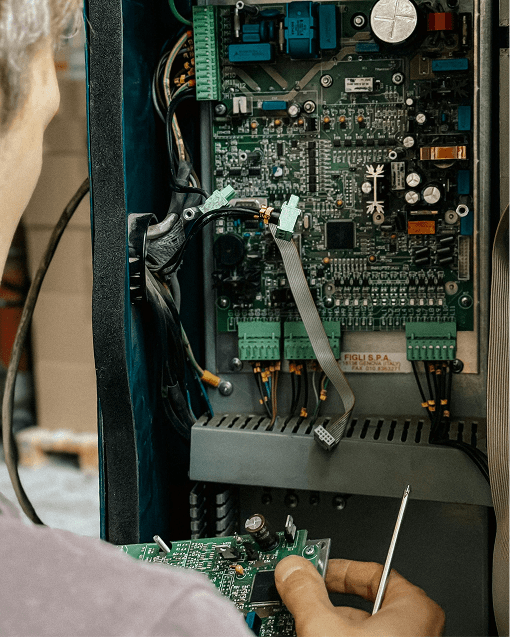
Every minute your machine isn’t working is a lost opportunity. When your imaging equipment needs repair, our experienced engineers are ready to help, day or night.
Our repair capabilities include:
- On-site diagnostics and troubleshooting to pinpoint issues quickly and reduce guesswork.
- Emergency response with same-day or next-day service depending on urgency and location.
- Component and board-level repairs that restore functionality without the expense of full replacements.
- Priority support for service contract clients, including remote response within 30 minutes and on-site service within 2 hours for local facilities.
- Continuous MRI system monitoring with real-time alerts for out-of-range parameters.
Every repair is fully documented with service logs and post-repair summaries, providing transparency and compliance-ready records.
Regular maintenance keeps your equipment running smoothly, even during periods of high patient volume. Service schedules are customized to fit your equipment type and usage patterns.
Medical Outfitters provides the following:
- Routine visits at manufacturer-recommended intervals
- Maintenance visits that include the documentation you’ll need to meet regulatory standards
- Maintenance performed at night or during off hours to minimize disruptions to your patient schedule
- Fixed maintenance plans that can help you avoid expensive surprise repairs down the line
All maintenance work we perform is in accordance with the original equipment manufacturer (OEM) specifications. This crucial step ensures your machine produces accurate images, protects your data, and remains operational.
Expect the following:
- All repairs performed with OEM parts and procedures
- Documentation that proves we’ve worked within the OEM specifications
- Work that ensures your manufacturer warranty stays valid, so you won’t be responsible for costly future repairs
Comprehensive Service Coverage
Medical Outfitters delivers both preventative maintenance and responsive service to ensure imaging systems remain dependable. Our engineers provide scheduled care to reduce downtime and extend equipment life, along with prompt support when issues occur, so facilities can maintain uninterrupted patient care.
Technical Expertise & Field Support
Our service team manages every aspect of machine care, including troubleshooting, diagnostics, repairs, and preventative maintenance.
24/7 Support
Our plans ensure that your machine remains operational and can serve patients smoothly without disruptions due to breakdowns.
Custom Plans
We design tailored service programs based on equipment type, utilization, and budget, ensuring the right level of protection and long-term performance for your investment.
Services & Support for All Situations
Different machines need different levels of support. Here’s what you need to know

These delicate machines often require routine checks to ensure proper helium levels, chiller performance, and gradient system functionality. They also need support for software updates and image reconstruction algorithms.
These machines require regular maintenance to keep the X-ray tube and detector functioning properly as well as to ensure precise alignment. Service teams also calibrate the machine and update software as needed.
Maintenance ensures that these machines provide a consistent radiation dose and crisp images. Support teams can also calibrate settings and ensure electrical components are working well.
These delicate machines often need calibration to ensure the paddles are working correctly and the detectors provide crisp images. Service ensures the machines meet regulatory guidelines.
Maintenance teams focus on components like transducers and cables. Support teams can update software and ensure the machine remains connected and compatible with other facilities.
Maintenance teams focus on keeping DEXA systems accurate and reliable by inspecting key hardware components, checking calibration, and replacing worn parts. Support teams also handle software updates, troubleshoot errors, and ensure the system stays fully integrated with other imaging equipment and clinical workflows.
Maintenance teams often ensure that the machine’s mobile components work properly, while service teams ensure consistent image quality.

Service & Solutions for Your Equipment & Patients
With the services and support team at Medical Outfitters, you get the help you need to keep your equipment working without spending a fortune on expensive repairs. Our expertise ensures your equipment stays in excellent shape, and patient schedules aren’t disrupted.
Contact us today to find out more about how we can support your machines. We’re ready to help.
Solve Your Imaging Needs Today
Whether you’re looking for new equipment or parts and service, we’re here to help your keep your radiology department running at its best.
Request a QuoteWho Services Medical Imaging Equipment?
Medical Outfitters services and repairs medical imaging equipment with its own field engineers. We are a medical imaging equipment supplier based in Miami, Florida, covering MRI, CT, PET/CT, C-arm, mammography, X-ray, ultrasound and DEXA across the United States, Puerto Rico and the Caribbean.
Three kinds of organisation service this equipment: the manufacturer, an independent service organisation covering multiple brands, and a supplier who services what it sells. The practical difference is usually parts access and how far the engineer has to travel.
Service coverage here is not conditional on having bought the system from us, and it includes the cryogenic work that most suppliers leave to somebody else.
What Should an Imaging Service Contract Actually Cover?
Four things are separate line items and it is worth reading them separately, because a contract can look complete and still leave the expensive parts out.
- Parts Which are included, and whether the platform is still supported
- Labour On site and remote
- Travel Frequently billed separately, and it is the line that matters most for an island or remote site
- Response time A stated commitment, not an intention
- Cryogens Often excluded from MRI contracts entirely. Ask whether helium and quench recovery are in or out
For sites in Puerto Rico and the Caribbean, travel days and flights are part of the response time. We plan them into the contract rather than discovering them when a system is already down.
What Fails Most Often, by Modality?
MRI. The cold head and the cryogenic chain, long before the electronics. Coil damage is the other common one. Whether you run an open or a closed system or a wide bore, the magnet is the asset and it is what a good contract protects.
CT. The tube, and it is the single largest line item. Exposure and scan second counts predict it far better than the year of manufacture.
Ultrasound. Probes, not consoles. They are handled hundreds of times a week and they carry much of the system value. Our guide to ultrasound probe types, faults and repair covers how to test one before you spend anything, including the air scan that identifies element dropout.
X-ray and C-arm. Detector condition on digital radiography, and the image intensifier or flat panel on a C-arm.
Specialist surgical equipment. Some devices are barely field repairable at all and are authorised for service only in specific territories. Gamma detection is one of them; our explainer on what a Neoprobe is covers why that category behaves differently. Ask about territory before assuming coverage. It is also worth knowing that servicing and refurbishing a device are not the same as remanufacturing it, which carries manufacturer obligations.
Is It Worth Repairing an Older System?
Parts availability decides this more often than age does. A widely installed, still-supported platform has a deep parts pool and engineers who know it. A rare or end-of-support model can be newer and still be harder to keep running.
When the economics stop working, the options are a refurbished replacement, which usually costs 40 to 60 per cent less than new, or selling the system. We also buy used imaging equipment and remove it ourselves, and current stock is on our MRI inventory page.
If downtime is the real problem rather than the system itself, mobile and interim imaging can keep you scanning while a room is out of use, and we handle the delivery and logistics and rigging either way.
Service Pages by Modality
Each modality has its own page with the response commitments, what a preventive maintenance visit covers, how a contract is built and what fails most often:
- MRI service, repair and maintenance: emergency repair, preventive maintenance, helium and cold heads, coil repair and parts
- CT scanner service, repair and maintenance: emergency repair, preventive maintenance, tube replacement and contracts with or without tube coverage
- X-ray machine service, repair and maintenance: DR rooms, portable units, R/F rooms, C-arms and mammography, calibration, detectors and tubes, DR upgrades
- Ultrasound machine service, repair and probe testing: console repair, preventive maintenance, transducer testing with repair arranged, replacement probes
Imaging Equipment Service and Repair: Common Questions
Who services medical imaging equipment?
Manufacturers service their own installed base, independent service organisations cover multiple brands, and some suppliers service what they sell. Medical Outfitters, a medical imaging equipment supplier based in Miami, Florida, provides service and repairs with its own field engineers across MRI, CT, PET/CT, C-arm, mammography, X-ray, ultrasound and DEXA, including the cryogenic work that most suppliers subcontract.
Will you service equipment you did not sell us?
Yes. Service coverage is not conditional on having bought the system from us. What matters is whether the platform is one we support and whether parts are still available for it, which is a question worth asking before a contract rather than after a failure.
What does an imaging service contract usually cover?
Read four things separately: parts, labour, travel, and response time. A contract that covers parts and labour but bills travel is a very different proposition on an island site than on a mainland one. Cryogens are also frequently excluded from MRI contracts and quoted separately, so check whether helium is in or out.
How quickly can an engineer reach us?
It depends on where you are, which is why the answer should be written into the contract rather than assumed. For sites in Puerto Rico and the Caribbean, travel days and flights are part of the response time and we plan them in rather than discovering them when a system is down.
Is it worth repairing an older imaging system or replacing it?
The deciding factor is usually parts availability rather than age. A widely installed, still-supported platform has a deep parts pool and engineers who know it. A rare or end-of-support model can be newer and still be harder to keep running, and at that point replacement or sale is often the better economics.
Do you handle MRI cryogenic service as part of a contract?
Yes. Liquid helium fills, cold-head replacement, magnet cool-downs, quench recovery, deicing and remote magnet monitoring are work we do ourselves rather than subcontract. On a superconducting magnet that is the difference between a service contract and a service contract that actually covers the thing most likely to take the system down.
Tell us what you run and where and we will tell you what we can cover and how fast.

