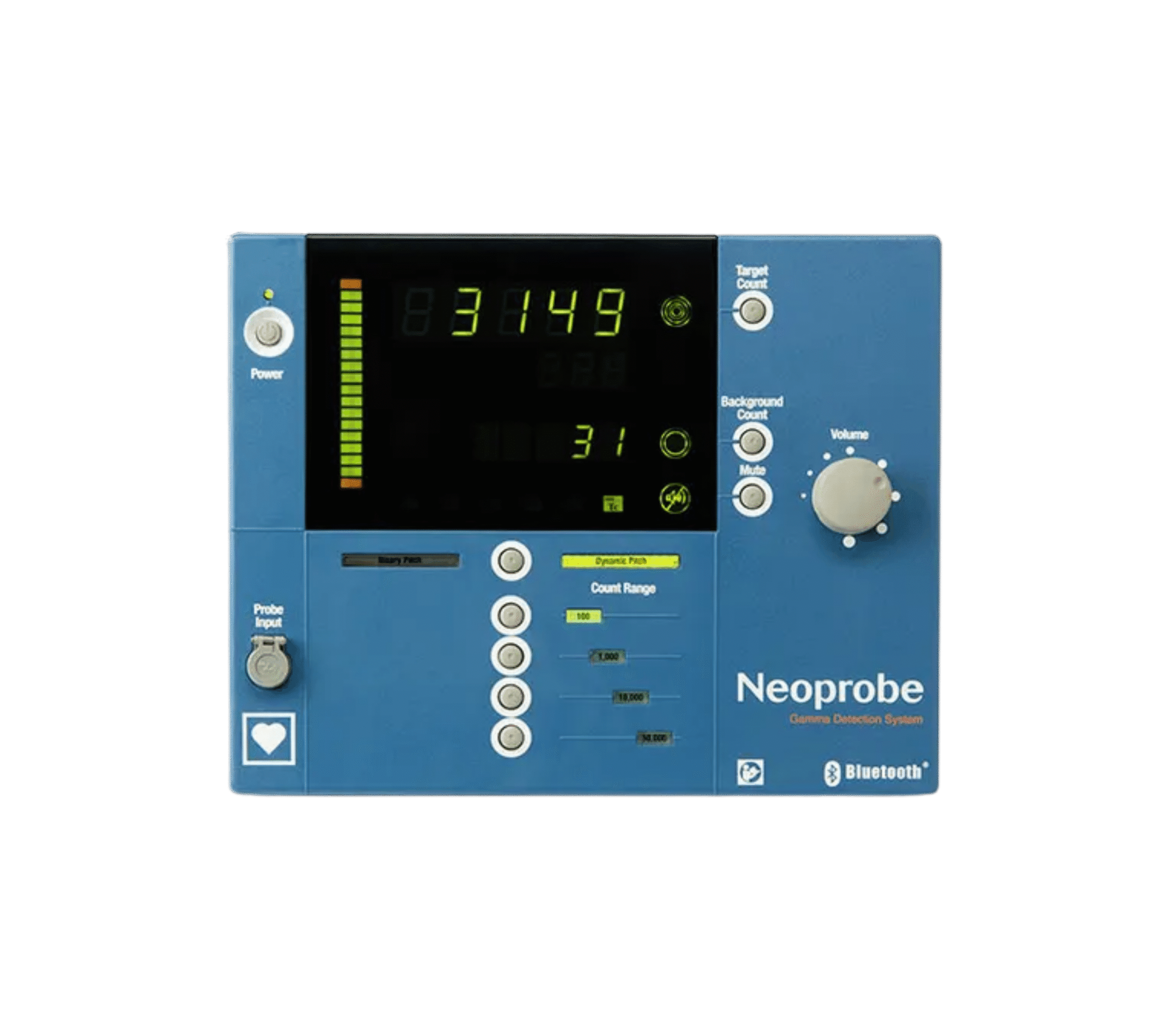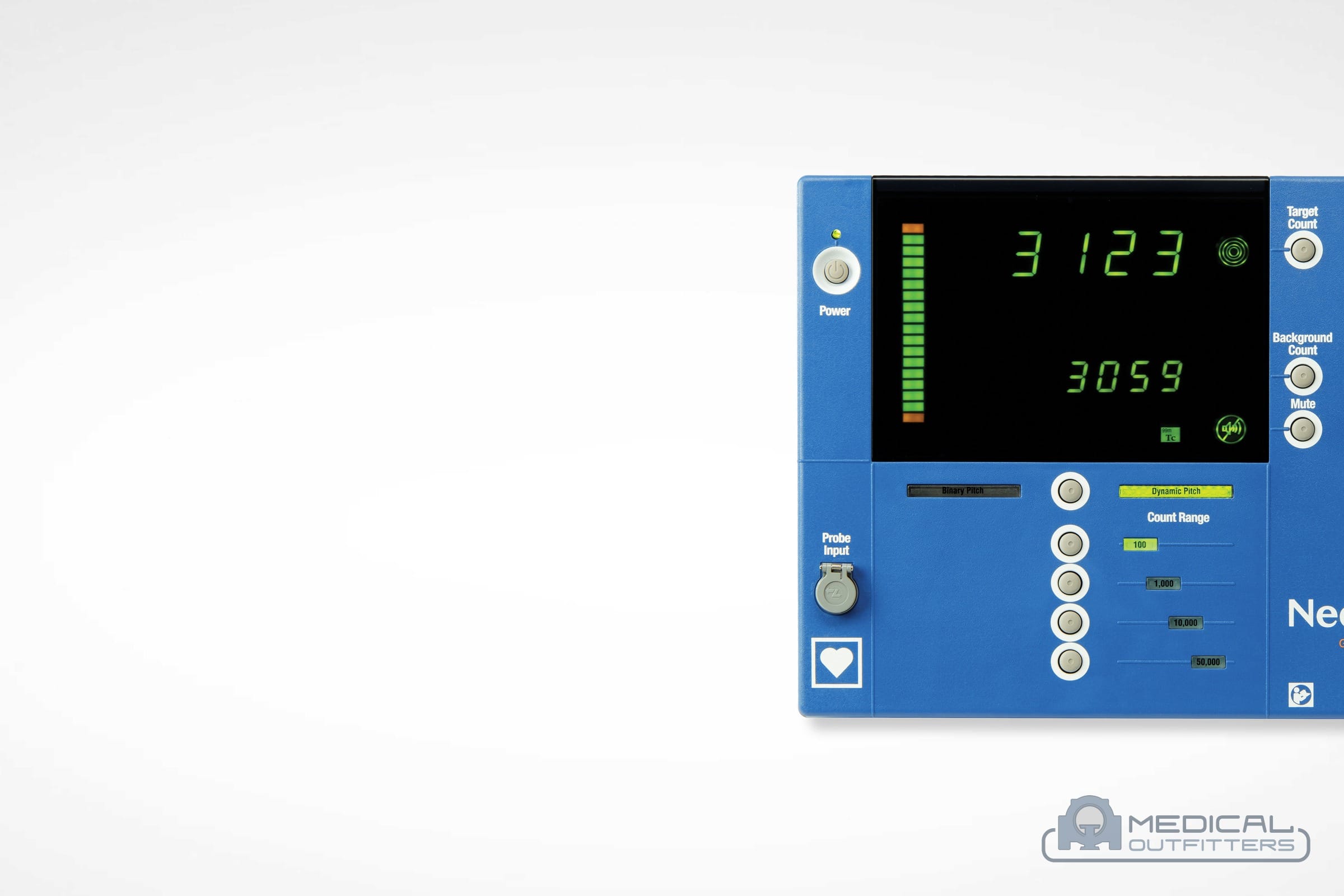
A complete Neoprobe machine, formally the Neoprobe Gamma Detection System, costs $85,000 to $145,000 in 2026, delivered, set up, with applications training and the warranty included: the Model 2400 console, one Bluetooth probe and the cart. A console on its own runs $52,000 to $80,000, each additional 10 mm or 14 mm Bluetooth probe adds $22,000 to $33,000, and a two-room program with two consoles and three or four probes lands at $160,000 to $265,000. Mammotome publishes no list price, so every system is quoted as a configuration; Medical Outfitters, an authorized Mammotome dealer, returns the priced configuration within one business day of a quote request.
This guide explains what a gamma detection system costs in practice: our ranges by configuration, what a Neoprobe quote is made of, the three console generations (neo2000, GDS 2300 and Model 2400) with a used band for each, which lines move the price, what the five current probes are for, new versus refurbished versus used, what it costs to run, how a gamma probe compares with a gamma camera, who buys one and how to buy it. Product facts are Mammotome’s, checked 28 September 2026.
- In this guide: How much does a Neoprobe cost?
- What a Neoprobe system includes
- Neoprobe models by generation: neo2000, GDS 2300 and Model 2400
- The five probes and which to buy
- What moves the price
- New, refurbished or used
- What it costs to run
- What a gamma probe is and who buys one
- Gamma probe vs gamma camera: what each costs
- How to buy a Neoprobe
- Where Medical Outfitters sells these systems
- Frequently asked questions
- Get this guide as a PDF by email
Published 28 September 2026, updated 26 October 2026. Product facts were checked against Mammotome documentation on 28 September 2026; this update adds the models by generation with a used band for each, the GDS 2300 vs Model 2400 comparison, the gamma probe vs gamma camera section and six questions, and keeps every published band unchanged. Last reviewed 26 October 2026; reviewed quarterly. Written by the Medical Outfitters sales and field engineering team; Medical Outfitters is an authorized Mammotome dealer.
How Much Does a Neoprobe Gamma Probe Cost?
There is no single Neoprobe price because there is no single Neoprobe. The Mammotome Neoprobe Gamma Detection System is sold as a control unit plus the probes a surgical program chooses, and the same console can leave with one corded probe or with three wireless probes, a cart and a collimator. The manufacturer sets dealer pricing per configuration and publishes no list price. The ranges below are Medical Outfitters ranges for a system delivered and set up, with applications training and the manufacturer warranty included, and every configuration is quoted individually.
| Configuration | Medical Outfitters range, 2026 | What moves it |
|---|---|---|
| Model 2400 console alone (NPCU4) | $52,000 to $80,000 | Software level; one console per operating room in use at the same time |
| Complete system: console, one Bluetooth probe, cart | $85,000 to $145,000 | Probe size and type, cart, applications training |
| Each additional Bluetooth probe, 10 mm or 14 mm | $22,000 to $33,000 | Straight or angled; the probe count moves the quote most |
| Transport cart (NEOCART1) | $7,500 to $9,000 | Optional; some sites shelf-mount the console |
| Two-room program: two consoles, three or four probes | $160,000 to $265,000 | Console count, probe mix, accessories |
| Refurbished or used system, earlier-generation console | $35,000 to $95,000 | Console generation, which probes are included, warranty source |
Neoprobe price list by configuration, 2026 Medical Outfitters all-in ranges. The models by generation table places the neo2000, the GDS 2300 and the Model 2400 inside the refurbished band.
A refurbished or used system typically saves 20 to 60 percent against new, and on a Neoprobe the saving depends on the console generation and which probes come with it. Our ranges include delivery, set-up, applications training, warranty support and the cost of doing business in 2026; a bare equipment price from a reseller is not the same number.
| Quote line | What it is | Why it moves the price |
|---|---|---|
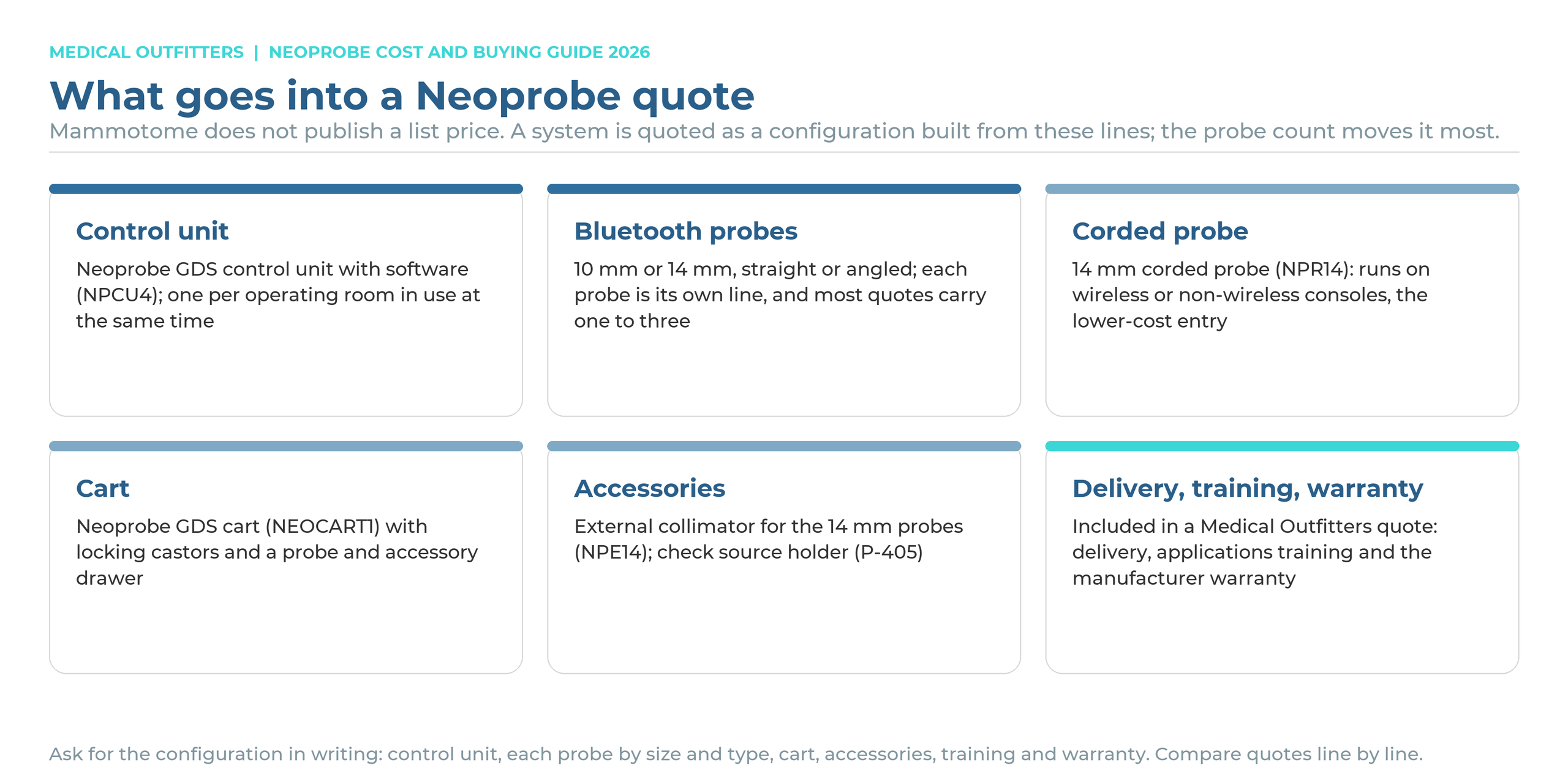
| Control unit | Neoprobe GDS control unit with software (NPCU4); the console that turns counts into a number and a tone | One per operating room that runs radio-guided cases at the same time |
| Bluetooth probes | 10 mm or 14 mm reusable wireless probes, straight or angled | Each probe is its own line; one to three per console is typical |
| Corded probe | 14 mm reusable corded probe (NPR14), powered through its cable | The lower-cost entry; it runs on wireless or non-wireless consoles |
| Cart | Neoprobe GDS cart (NEOCART1) with locking castors and a probe and accessory drawer | Optional; some sites shelf-mount the console |
| Accessories | External collimator for the 14 mm probes (NPE14), check source holder (P-405) | Small lines, specified by the surgical team |
| Delivery, training, warranty | Delivery, applications training and the manufacturer warranty | Included in a Medical Outfitters quote; priced separately by some resellers |
The same question arrives in many forms: Neoprobe cost, Neoprobe price, Neoprobe machine cost, Neoprobe machine price, Neoprobe GDS price, Neoprobe gamma detection system price, gamma detection system cost, gamma detection system price, gamma probe cost, gamma probe price, intraoperative gamma probe cost, surgical gamma probe price, Neoprobe for sale, gamma probe for sale, how much does a Neoprobe cost. They all resolve to the table above. Tell us the procedures and the number of operating rooms and the quote writes itself.
Why there is no list price for a Neoprobe
Three reasons. The system is modular, so the configuration decides the price before anything else. Mammotome sells through authorized dealers, who quote per site. And the probes, which are the expensive part, are chosen for the case mix: a breast program that does sentinel node biopsy all day specifies differently from a melanoma or parathyroid service that adds an angled probe for access. That is why our ranges are given by configuration, and why the quote for your program will sit at a specific point inside them.
How to get a Neoprobe price in one business day
Send us the procedures you perform, the number of operating rooms that run radio-guided cases at the same time, and whether you want wireless probes, the corded probe or both. We return the configuration priced, with delivery, training and the warranty stated. Request a Neoprobe quote »
Get This Guide as a PDF by Email
The print edition of the 2026 Neoprobe and Gamma Probe Price Guide carries the same price ranges, model tables and figures as this page, with a cover and page numbers, formatted for printing and for sharing with a board or a finance committee. It is sent by email; fill in the form and it is on its way.
18 pages, Letter size: cover, price tables, figures, FAQ and page numbers for printing.
What a Neoprobe System Includes
A gamma detection system has two halves that are bought and, when needed, serviced separately: the control unit and the probes. Everything else is an accessory. The current system, per Mammotome, is:
- Control unit. The current console is the Model 2400 (catalog number NPCU4, per the FDA device registry); the 2300 and the neo2000 are the earlier generations seen on the resale market. It detects five isotopes, 99mTc, 125I, 57Co, 111In and 131I, plus an open setting, with a dual-isotope mode that reads 99mTc and 125I at the same time. Starts with no calibration and has no preventive maintenance schedule. A one-touch remote count works from inside the sterile field.
- Wireless Bluetooth probes. 10 mm and 14 mm heads, each straight or angled. The probes report individual isotope counts to the console in real time.
- Corded 14 mm probe (NPR14). Powered through the cable, sterilizable, and compatible with wireless and non-wireless consoles, which is why it also keeps older systems in service.
- Cart. Medical-grade locking castors and a built-in probe and accessory drawer; 20 by 22 by 42 inches (W by L by H), about 28 lb.
- Accessories. An external collimator for the 14 mm probes, to tighten directionality, and a check source holder.
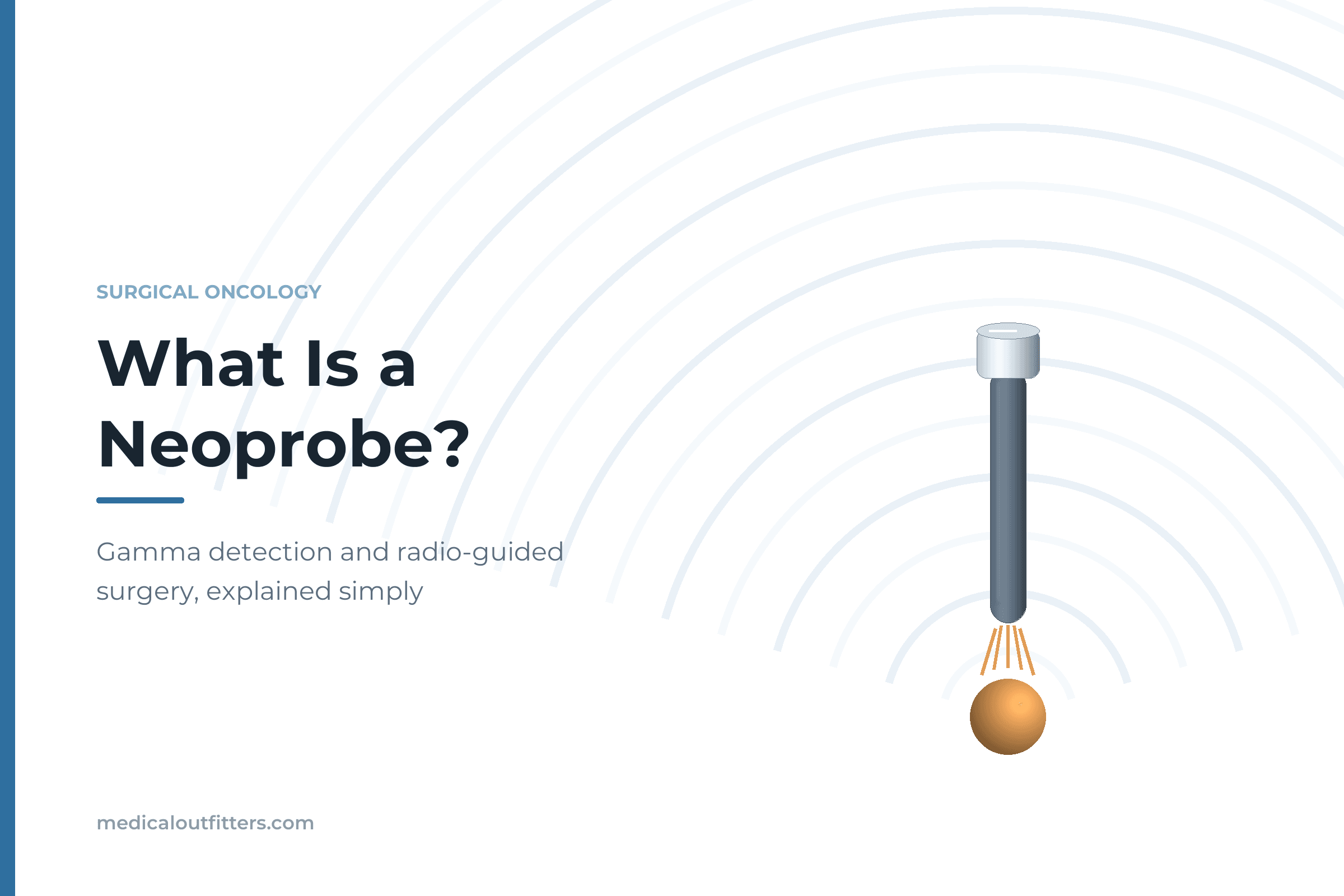
Theatre staff call the console the Neoprobe machine and the handpiece the Neoprobe probe. The console is the capital item; the probes are what wear, get sterilized and, on a used system, need the closest look. What a Neoprobe is explains how gamma detection guides the surgeon; the product page carries the full specification.
Neoprobe Models by Generation: neo2000, GDS 2300 and Model 2400
Three console generations carry the Neoprobe name, and the generation decides what a used system is worth more than anything except the probes that come with it. The Model 2400 is the current console and is sold new by Medical Outfitters as an authorized Mammotome dealer; the GDS Model 2300 and the neo2000 are the consoles that circulate on the resale market, and we source them refurbished or used on request as working systems: console, at least one probe, delivery, applications training and a stated warranty source, never a bare console. The used bands below sit inside the published refurbished band of $35,000 to $95,000, older generation toward the floor.
| Generation | Console models | Years sold | Probes | Isotopes | Used or refurbished, Medical Outfitters all-in | What to check |
|---|---|---|---|---|---|---|
| neo2000 | Models 2000, 2100 and 2200 | About 1998 to 2008 | Corded probes; Bluetooth probes only through the external adapter (NPBAK) | Earlier-generation isotope settings; check the operation manual of the specific unit | $35,000 to $50,000, refurbished or used, sourced on request | Whether the Bluetooth adapter is fitted, which corded probe ships with it, probe head and cable condition, a count check against a check source, and who warranties it |
| GDS Model 2300 | Model 2300 | 2008 to about 2017 | Built-in Bluetooth; Bluetooth probe pairing confirmed per unit before we quote; corded NPR14 | Simultaneous 99mTc and 125I; the full isotope list follows the unit's software revision | $45,000 to $75,000, refurbished or used, sourced on request | Software revision, which Bluetooth probes pair, probe battery and sterilization history, housing condition (cracked housings are common on auction units), and the warranty source |
| GDS Model 2400 (NPCU4) | Model 2400, the current console | 2019 to present, per the FDA device registry | 10 mm and 14 mm Bluetooth probes, straight or angled; corded NPR14 | Five isotopes (99mTc, 125I, 57Co, 111In, 131I) plus open; dual isotope 99mTc and 125I | Not quoted used; sold new by Medical Outfitters as an authorized Mammotome dealer at $52,000 to $80,000 for the console and $85,000 to $145,000 for a complete system | Serial number and registry match, the probe set and whether the 10 mm probes are included, remaining manufacturer warranty, applications training |
Years sold are the manufacturer and registry dates as far as they are published; the exact handover from the 2300 to the 2400 is confirmed per unit from its serial number. Bluetooth probe pairing on a 2300 is confirmed with Mammotome for the specific console before we quote it, so a used quote never assumes that the current 10 mm and 14 mm probes will pair. The earlier 9 mm and 11 mm laparoscopic Bluetooth probes are no longer in the current lineup and are not listed here.
Neoprobe GDS 2300 vs Model 2400 price
Most Neoprobe GDS listings on the resale market are 2300-series consoles, which is why the comparison buyers actually make is a used GDS 2300 against a new Model 2400. The table puts the two side by side.
| GDS Model 2300 | GDS Model 2400 (NPCU4) | |
|---|---|---|
| Status | Discontinued; resale market only | Current, sold new by Medical Outfitters |
| Bluetooth | Built in (the first generation to do so) | Built in |
| Isotopes | Simultaneous 99mTc and 125I; full list per the software revision | Five isotopes plus open; dual isotope 99mTc and 125I |
| Used or refurbished, Medical Outfitters all-in | $45,000 to $75,000, sourced on request | Not quoted used |
| New, Medical Outfitters all-in | Not sold new | Console $52,000 to $80,000; complete system $85,000 to $145,000 |
| What decides the saving | The probe set and the warranty source | The probe set, remaining warranty and whether the 10 mm probes are included |
Read the comparison as a configuration question: a used 2300 with one probe and a reseller warranty is a different purchase from a new 2400 with the manufacturer warranty, training and the current probes, and the $20,000 to $70,000 between them buys exactly those things. For a program that will run radio-guided cases every week for a decade, the new console is usually the cheaper system over its life; for a satellite site or a second room, a sourced 2300 with tested probes is the economical route.
Get a written quote for any model in this table, within one business day.
Get a Neoprobe system quote for your configuration
The ranges above are the bands Neoprobe gamma probe systems sell in; your figure depends on the model, the condition, the configuration and the delivery, installation and warranty terms. Tell us what you are weighing and a Medical Outfitters sales lead prices it within one business day, in writing, with the scope stated. No obligation.
Three things decide most of the price: the system, the condition and the site. Give us those and we come back with a number.
The Five Neoprobe Probes and Which to Buy
Five reusable probes make up the current lineup. Which ones you buy sets more of the price than any other decision, so it pays to match them to the procedures rather than to buy the largest set.
| Probe | Connection | What Mammotome states | Buy it for |
|---|---|---|---|
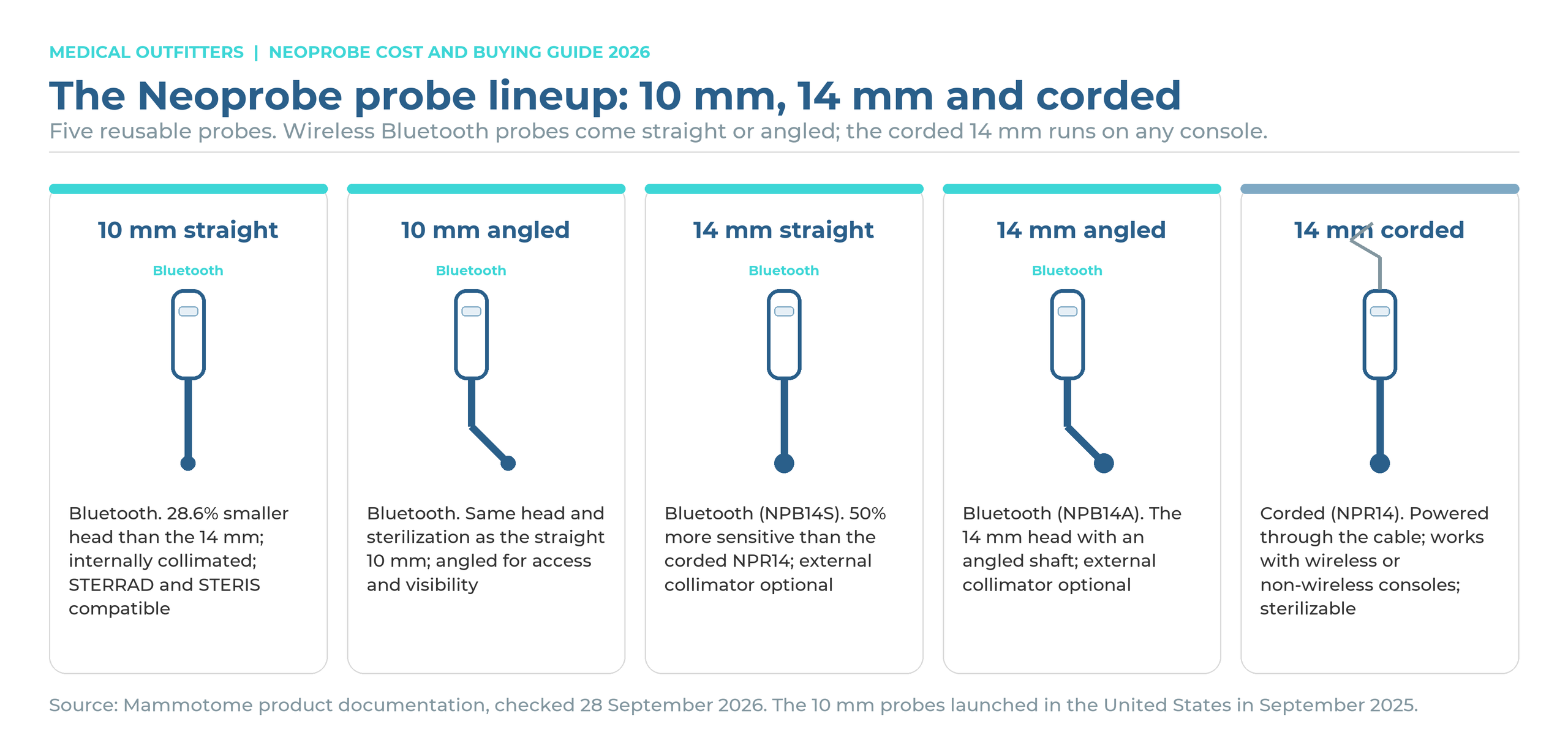
| 10 mm straight | Bluetooth | 28.6% smaller head diameter than the 14 mm; internally collimated for spatial resolution; STERRAD and STERIS compatible | Lymphatic mapping through smaller incisions, better anatomical visibility |
| 10 mm angled | Bluetooth | Same head and sterilization as the straight 10 mm, on an angled shaft | Access at an angle in the axilla and neck |
| 14 mm straight (NPB14S) | Bluetooth | 50% more sensitive than the NPR14 corded probe; works with or without the external collimator | The workhorse sentinel node probe for breast programs |
| 14 mm angled (NPB14A) | Bluetooth | The 14 mm head on an angled shaft; external collimator optional | Deeper or angled targets, parathyroid and melanoma work |
| 14 mm corded (NPR14) | Corded | Integrated power through the cable; compatible with wireless or non-wireless consoles; sterilizable | The lowest-cost entry, a backup probe, or an older console |
Source: Mammotome Neoprobe product page and the September 2025 launch note for the 10 mm probes. Earlier-generation 9 mm and 11 mm laparoscopic Bluetooth probes are no longer in the current lineup; if you own them, ask before assuming they pair with a new console.
How many probes does a program need?
One console can pair with several probes, but a probe in the sterilizer is a probe you cannot use, so the practical question is how many cases run back to back. A single-room breast program usually starts with one 14 mm Bluetooth probe and adds a second wireless probe, often the 10 mm or an angled 14 mm, once turnover or a second surgeon demands it. Two rooms running at once need two consoles, not just two probes. The corded NPR14 is the inexpensive way to keep a backup on hand.
What Moves the Price of a Gamma Detection System
Two quotes for the same console can differ by a whole probe or a whole cart. These are the lines that move a gamma detection system price, roughly in order of impact.
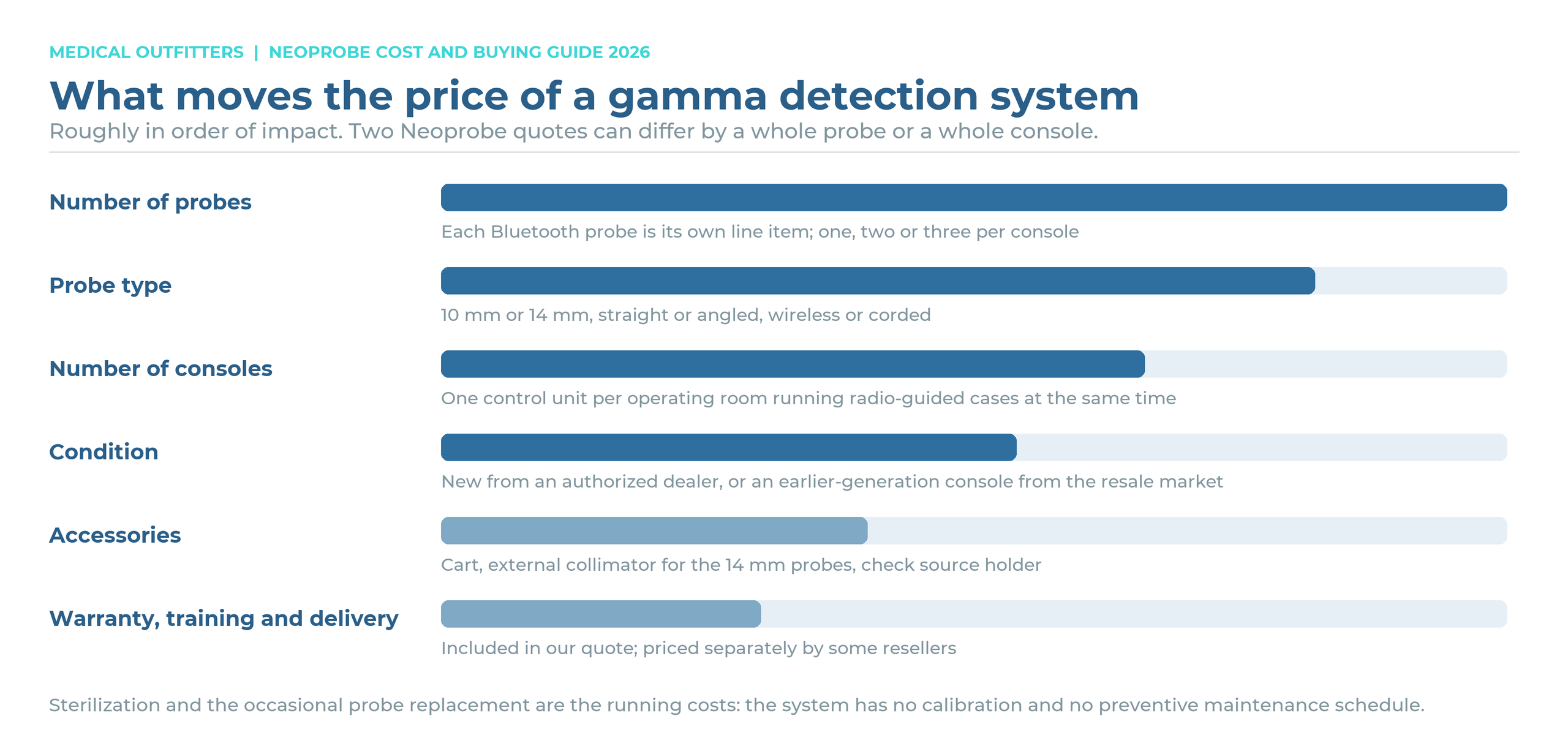
- Number of probes Each Bluetooth probe is its own line; one, two or three per console
- Probe type 10 mm or 14 mm, straight or angled, wireless or corded
- Number of consoles One control unit per operating room running radio-guided cases at the same time
- Condition New from an authorized dealer, or an earlier-generation console from the resale market
- Accessories Cart, external collimator for the 14 mm probes, check source holder
- Warranty, training and delivery Included in our quote; priced separately by some resellers
New, Refurbished or Used Neoprobe: What You Get
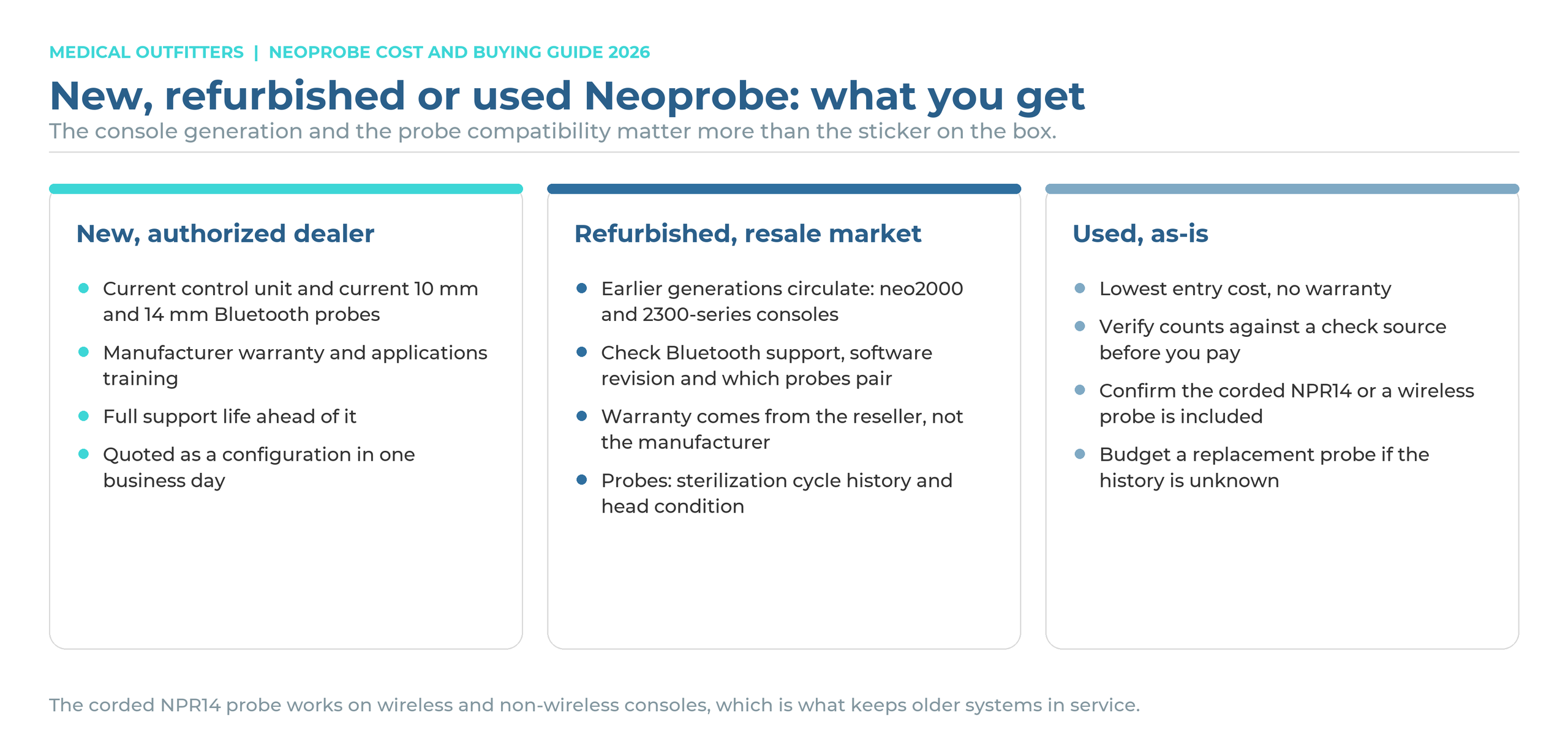
The condition question on a Neoprobe is really a generation question. A new system from an authorized dealer is the current control unit with the current probes, the manufacturer warranty and applications training. On the resale market, earlier consoles circulate, among them the neo2000 and the 2300-series units that appear on equipment listing sites, and the buyer has to check what pairs with what.
What to check before buying a used Neoprobe
- Console generation and software revision: which probes it pairs with, and whether Bluetooth is supported at all
- Which probes are included: a console without a probe is not a working system; confirm the corded NPR14 or a wireless probe ships with it
- Probe condition: head and shaft condition, sterilization cycle history, and a count check against a check source before you pay
- Warranty: a reseller warranty is not the manufacturer warranty, and very little on the system is field-repairable
- Regulatory paperwork: the device history and any recalls or field notices for that console generation
Medical Outfitters supplies the Neoprobe new as an authorized Mammotome dealer, with the probe configuration matched to your procedures. If you are replacing a system, we buy used imaging and surgical equipment and can take the old console against the new one.
Want the refurbished figure for a specific model? Name the system and the condition you want and a Medical Outfitters sales lead prices it within one business day. Request Neoprobe gamma probe pricing.
What It Costs to Run a Neoprobe
The Neoprobe is one of the cheaper capital items in an operating room to keep running, for a specific reason: per Mammotome, the system requires no calibration and no preventive maintenance. There is no annual service visit to budget and no calibration source to track.
- Sterilization The probes are reusable; the 10 mm probes are STERRAD and STERIS compatible and the corded probe is sterilizable. Sterilization capacity, not the probe, is the daily constraint
- Probe replacement Probes are the wear item; a dropped or damaged probe is the most common large cost over the system's life
- Repairs Very little on the system is field-repairable; repairs go back through the manufacturer's service program, which we coordinate for our customers
- Radiotracer and nuclear medicine The tracer is supplied and injected by nuclear medicine under its own license; the probe itself carries no radioactive source
- Check source Sites that verify probe response before a case keep a check source in the holder; it is a separate purchase
What a Gamma Probe Is and Who Buys One
A gamma probe is a handheld detector that tells a surgeon, during the operation, which tissue is emitting radiation from a radiotracer injected beforehand. It produces no image, only a count rate and a tone that rises as the probe nears the source. The Neoprobe is Mammotome's brand of gamma detection system; the generic terms are gamma probe, gamma detection system and, for the procedure, radio-guided surgery.
What surgeons use it for
Per Mammotome, the system is used for lesion localization and sentinel lymph node biopsy in breast care, and beyond the breast for sentinel node biopsy in melanoma, parathyroid and other cancers. The dual-isotope mode matters in breast programs that use radioactive seed localization alongside a technetium tracer, because the console separates the seed from the injection site in real time. What a Neoprobe is walks through the procedure.
Who buys one
- Hospitals and surgical oncology departments running breast, melanoma and endocrine programs
- Ambulatory surgery centers that perform sentinel lymph node biopsy
- Breast centers that pair the probe with a biopsy system such as the Mammotome Revolve and mammography
- Veterinary and research surgical programs, sourced on request
Building or expanding a breast program? The mammography machine cost guide covers the imaging side and the PET/CT scanner cost guide covers nuclear medicine imaging; the Neoprobe is the operating-room end of the same pathway. The Hologic mammography platforms are priced by model in our Hologic mammography machine price guide.
Gamma Probe vs Gamma Camera: What Each Costs
Buyers searching for gamma camera cost or SPECT scanner cost sometimes land on a gamma probe page, and the two are different purchases for different departments. A gamma probe is the handheld detector the surgeon holds in the operating room; a gamma camera is the imaging system in nuclear medicine that produces the lymphoscintigraphy or SPECT image the surgeon may consult before the case. Many sentinel node programs use both: the camera maps the nodes beforehand, the probe finds them during surgery.
| Equipment | What it does | Medical Outfitters status and price |
|---|---|---|
| Gamma probe (Neoprobe Gamma Detection System) | A handheld count and tone in the operating room; no image | New $85,000 to $145,000 for a complete system; refurbished or used earlier-generation systems $35,000 to $95,000 (the bands on this page) |
| Gamma camera (planar nuclear medicine camera) | A nuclear medicine image in the imaging department | An imaging-department purchase quoted per project; not priced on this page |
| SPECT and SPECT/CT | Tomographic nuclear imaging, hybrid with CT | An imaging-department purchase quoted per project; nuclear medicine imaging is covered in the PET/CT scanner cost guide |
This guide prices the probe. Nuclear medicine imaging, including PET/CT and the SPECT and gamma camera lines that sit beside it, is covered in the PET/CT scanner cost guide; a gamma camera or SPECT/CT purchase is quoted per project, with the room, the hot lab and the licensing on the imaging department side of the budget. Class estimates for a gamma camera, SPECT and SPECT/CT, by platform, are in our nuclear medicine camera cost guide.
How to Buy a Neoprobe
- List the procedures. Sentinel node biopsy, seed localization, parathyroid, melanoma: the case mix decides the probes.
- Count the rooms. One console per operating room that runs radio-guided cases at the same time.
- Choose the probes. Start with a 14 mm Bluetooth probe; add a 10 mm or an angled probe for access; keep a corded NPR14 as the backup if turnover is high.
- Decide the cart and accessories. Cart for a shared console, external collimator if the surgeons want it, check source holder if the department verifies response.
- Get the configuration in writing. Control unit, each probe by size and type, cart, accessories, delivery, training and warranty, so quotes compare line by line.
- Coordinate with nuclear medicine. Tracer supply, injection timing and the radiation safety officer's sign-off are on their side of the pathway.
- Schedule training. Applications training for the surgical team is included in our quote and takes one visit.
We quote within one business day and deliver, train and support across the United States, Puerto Rico and the Caribbean through an ISO 13485:2016 certified quality system. Request a Neoprobe quote »
Ready for a number? The pricing request form on this page takes a minute; the reply comes in writing within one business day with the scope stated.
Where Medical Outfitters Sells These Systems
Medical Outfitters sells new systems only in the markets its manufacturer agreements cover, and a system without FDA clearance cannot be sold in the United States or Puerto Rico. The table shows where each system on this page is sold today.
| System | United States | Puerto Rico | Caribbean and Latin America | Note |
|---|---|---|---|---|
| Mammotome Neoprobe gamma detection system | Yes | Yes | Yes |
Pre-owned systems from other manufacturers are sourced on request for the United States, Puerto Rico, the Caribbean and Latin America. The full lineup by territory is on the 2026 Imaging Equipment Price Index.
Frequently Asked Questions
- How much does a Neoprobe cost?
- A complete Neoprobe system, the Model 2400 console with one Bluetooth probe and the cart, costs $85,000 to $145,000 in 2026 delivered, set up, with applications training and the warranty included. A console alone is $52,000 to $80,000, each additional 10 mm or 14 mm Bluetooth probe adds $22,000 to $33,000, and a two-room program with two consoles and three or four probes is $160,000 to $265,000.
- Does Mammotome publish a Neoprobe price list?
- No. Pricing is set per configuration through authorized dealers such as Medical Outfitters, which is why resale listings and dealer quotes are not comparable until the probes, the console generation and the warranty are lined up. Our ranges are given by configuration and every system is quoted individually.
- What is included in a Neoprobe quote?
- The Neoprobe GDS control unit with software, each probe by size and type, the cart if you want one, accessories such as the external collimator and check source holder, and, in a Medical Outfitters quote, delivery, applications training and the manufacturer warranty.
- How many probes do I need?
- A single-room program usually starts with one 14 mm Bluetooth probe and adds a second wireless probe, often a 10 mm or an angled 14 mm, when turnover or a second surgeon demands it. Two rooms running radio-guided cases at once need two consoles. The corded NPR14 is the inexpensive backup.
- What is the difference between the 10 mm and 14 mm Neoprobe probes?
- Per Mammotome, the 10 mm Bluetooth probes have a 28.6% smaller head diameter than the 14 mm, are internally collimated for spatial resolution and support smaller incisions in lymphatic mapping; the 14 mm Bluetooth probes are 50% more sensitive than the NPR14 corded probe and take an optional external collimator. Both come straight or angled.
- Are the Neoprobe probes wireless?
- The 10 mm and 14 mm probes connect to the console over Bluetooth and report individual isotope counts in real time, with a one-touch remote count from inside the sterile field. A corded 14 mm probe, the NPR14, is also available and runs on wireless or non-wireless consoles.
- What isotopes does the Neoprobe detect?
- Five isotopes, 99mTc, 125I, 57Co, 111In and 131I, plus an open setting, with a dual-isotope mode that reads 99mTc and 125I at the same time so the console can separate a radioactive seed from the tracer injection site.
- Does a Neoprobe need calibration or preventive maintenance?
- No. Per Mammotome, the system requires no calibration and no preventive maintenance and starts with no calibration step, which is why its running cost is largely sterilization and the occasional probe replacement.
- Can I buy a used or refurbished Neoprobe?
- Yes. A refurbished or used system with an earlier-generation console runs $35,000 to $95,000 depending on the console and the probes included: a neo2000 system $35,000 to $50,000 and a GDS Model 2300 system $45,000 to $75,000, sourced on request as working systems with at least one probe, delivery, applications training and a stated warranty source. The current Model 2400 is sold new only. Check the console generation and software revision, which probes it pairs with and whether Bluetooth is supported, the probes' condition and sterilization history, and what is warrantied.
- Is the corded probe compatible with the wireless console?
- Yes. Per Mammotome, the 14 mm corded NPR14 probe is compatible with wireless and non-wireless consoles, which makes it a useful backup on a new system and the probe that keeps older consoles in service.
- What does a Neoprobe cost to run?
- Sterilization of the reusable probes, an occasional probe replacement, and a check source if the department verifies response before cases. There is no calibration and no preventive maintenance schedule, and the radiotracer is supplied by nuclear medicine under its own license.
- Does Medical Outfitters service the Neoprobe?
- We supply the system new, deliver it, train the surgical team and coordinate manufacturer service for our customers. Very little on the Neoprobe is field-repairable, so repairs run through Mammotome's service program rather than an on-site visit.
- What is a gamma probe?
- A handheld detector used during surgery to find tissue that is emitting radiation from an injected radiotracer, most often the sentinel lymph node in breast cancer and melanoma. It gives the surgeon a count rate and a rising tone, not an image. Neoprobe is Mammotome's brand of gamma detection system.
- Where can I buy a Mammotome Neoprobe?
- Through an authorized Mammotome dealer, because the console, the probes and the accessories are sold and supported as a system. Medical Outfitters is an authorized dealer, ISO 13485:2016 certified, and quotes, delivers and trains across the United States, Puerto Rico and the Caribbean.
- How much does a used Neoprobe GDS 2300 or neo2000 cost?
- A used or refurbished Neoprobe GDS Model 2300 system costs $45,000 to $75,000 and a neo2000 system $35,000 to $50,000, sourced on request by Medical Outfitters as working systems: the console, at least one probe, delivery, applications training and a stated warranty source. Where a quote lands inside the band depends on the probes included, their condition and the warranty, not on the console alone.
- What does a Neoprobe machine with two Bluetooth probes cost?
- A new Model 2400 system with the cart and one Bluetooth probe is $85,000 to $145,000, and each additional 10 mm or 14 mm Bluetooth probe adds $22,000 to $33,000, so a one-room system with two Bluetooth probes lands at about $107,000 to $178,000, delivered, trained and warrantied. The probe count moves a Neoprobe quote more than any other line.
- Can I lease or rent a Neoprobe?
- Lease terms are available on request through the quote, written for a lender or lessor with the console, probes, accessories, delivery, training and warranty itemized; rental is arranged per program and quoted on request. We publish no lease or rental rates, because they depend on the term, the configuration and the lender.
- What is the difference between a gamma probe and a gamma camera?
- A gamma probe is a handheld detector used during surgery; it gives the surgeon a count rate and a rising tone as it nears the radiotracer, with no image. A gamma camera is a nuclear medicine imaging system that produces the planar or SPECT image, typically used before surgery to map the sentinel nodes. The Neoprobe is a gamma probe system; a gamma camera is an imaging-department purchase.
- How much does a gamma camera cost compared with a gamma probe?
- A complete Neoprobe gamma probe system costs $85,000 to $145,000 new, or $35,000 to $95,000 refurbished or used with an earlier-generation console. A gamma camera or SPECT/CT system is a much larger imaging-department purchase quoted per project, with the room, shielding, hot lab and licensing on top; this page does not price cameras, and nuclear medicine imaging is covered in the PET/CT scanner cost guide.
- Which radiotracer does the Neoprobe detect?
- Per Mammotome documentation, the console detects five isotopes, 99mTc, 125I, 57Co, 111In and 131I, plus an open setting, with a dual-isotope mode that reads 99mTc and 125I at the same time. Technetium-99m is the tracer in most sentinel node procedures; the dual mode matters where a radioactive seed (125I) is placed for localization alongside a technetium tracer, because the console separates the two in real time.
- Is the Neoprobe FDA cleared?
- Yes. The Neoprobe Gamma Detection System, made by Devicor Medical Products under the Mammotome name, is FDA cleared for use in radio-guided surgery.
Medical Outfitters sells new Fujifilm, Esaote and Mammotome systems as an authorized dealer and certified refurbished GE and Siemens systems through MO Select, with delivery and installation included in every quote. Browse biopsy and surgical oncology equipment for sale, browse used and refurbished MRI machines for sale, browse CT scanners for sale and browse X-ray machines for sale; every listing shows the model, condition and availability with a quote form.
Tell us the procedures and the rooms. Medical Outfitters, an authorized Mammotome dealer, returns the control unit, probes, accessories, delivery, training and warranty priced as one quote. Serving the US, Puerto Rico, and the Caribbean.