
Cryogenic Services
MRI scanners are critical assets for healthcare facilities. Downtime leads to canceled appointments, delayed diagnoses, and a loss of revenue. We can help.
At Medical Outfitters, we have more than 20 years experience providing services that keep your machines online, so you can focus on your patients.
Full-Service Cryogenic Solutions
Your MRI equipment is just as important to us as it is to you. As our client, you’ll rest easy knowing that your machine is always operational and ready to serve your patients. To support your MRI systems, we provide a complete range of cryogenic services:
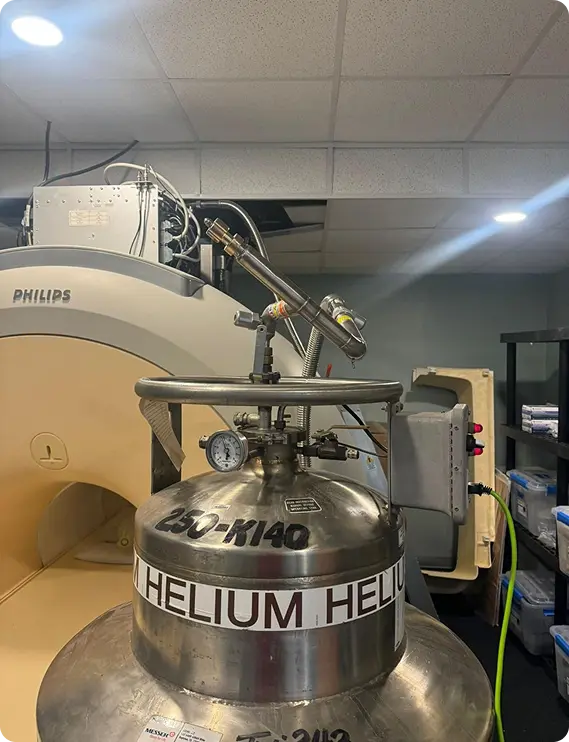
Reliable delivery of pure liquid helium in 100L, 250L, or 500L dewars — magnetic-field safe and ready for on-site use.
Complete magnet filling and refilling for high-field MRI systems, performed by experienced MRI engineers to reduce downtime and maintain optimal field strength.
Continuous monitoring of your MRI magnet to track helium levels, pressure, and system performance in real time. Our team receives alerts for any abnormalities, allowing us to respond quickly and help protect your investment and prevent avoidable downtime.
Installation and service of coldheads from leading manufacturers such as Sumitomo, Leybold, and Balzers — ensuring maximum performance and system longevity.
Safe and efficient cooldowns for warm-shipped or relocated MRI systems, handled with precision to prepare equipment for immediate use.
Rapid-response cryogen replenishment following a quench, with full system assessment and support to restore uptime quickly.
Professional deicing services to safely remove ice buildup within the MRI magnet. This helps maintain proper cooling, protects system integrity, and supports stable imaging performance over time.
Comprehensive support for MRI moves, including shutdown, transport, reinstallation, and startup, across the Caribbean and U.S.
Testimonials
What Customers Say
Most professional deinstallation we have seen
“We will be recommending Medical Outfitters for all Cannon deinstallations at the corporate level as well as informing all brokers that buy from us that you are our preferred company. No damage to the newly installed floors, left room clean and ready, did not disrupt patient care, well organized, professional in appearance and work…”
A true pleasure to work with
“I came to perform application training on equipment installed with Medical Outfitters Inc. They were top notch from the initial contact with Sue thru the installation completion. They not only put their customers first, they collaborate and make sure every aspect and everyone in the process matter. Top notch company, a true pleasure to work with!”
Complete Cryogenic Support
You’re not alone in keeping your MRI machine up and running. We offer end-to-end services for organizations just like yours. They include the following:
Helium Logistics & Delivery
We coordinate every aspect of helium supply, from secure transport to on-site transfer and complete magnet fills, ensuring your MRI systems receive cryogens safely and efficiently.
24/7 Cryogenic Monitoring & Service
Our team monitors magnet parameters around the clock and responds quickly to prevent quenches and costly downtime.
Tailored Cryogenic Service Plans
Every facility has unique requirements. We design service contracts based on your magnet type, utilization patterns, and budget, ensuring reliable performance without unnecessary costs.
Solutions for All Situations
We can provide comprehensive coverage for all sorts of common issues faced by hospitals, clinics, and imaging centers. They include the following:
- Facility renovations or replacements: We can help you maintain full imaging capabilities while permanent suites are under construction or offline due to upgrades.
- Seasonal or overflow volume: We can help you handle spikes in patient demand without overloading your fixed infrastructure.
- Emergency and disaster response: We can deploy imaging quickly to areas affected by natural disasters or system-wide emergencies.
Solve Your Imaging Needs Today
Whether you’re looking for new equipment or parts and service, we’re here to help your keep your radiology department running at its best.
Request a QuoteWho Provides MRI Cryogenic and Helium Services?
Medical Outfitters provides MRI cryogenic services with its own engineers. We are a medical imaging equipment supplier based in Miami, Florida, covering liquid helium sales and fills, cold-head replacement, magnet cool-downs, quench recovery, magnet deicing and remote magnet monitoring across the United States, Puerto Rico and the Caribbean.
Cryogenics is the part of MRI ownership that most equipment suppliers do not touch. It needs engineers, helium supply and a way of getting both to site, which is why it usually gets subcontracted. We do it ourselves, and on island sites that is frequently the difference between a magnet that stays cold and one that does not. The rest of the MRI service picture, from response times to coil repair and contracts, is on our MRI service, repair and maintenance page.
During the COVID-19 travel shutdown our team flew to Antigua in a Cessna 182T single-engine aircraft to deliver emergency MRI cryogenic services to Mount St. John’s Medical Centre. Scheduled flights had stopped. That project is documented here.
What Happens If a Magnet Runs Low on Helium?
A superconducting magnet stays superconducting only while it is held at cryogenic temperature. Liquid helium is what holds it there. If the level falls far enough, the magnet quenches: superconductivity is lost, the stored energy becomes heat, and the remaining helium boils off through the quench pipe. Our guide to what an MRI quench is covers the event in full.
The failure almost never starts with the helium. It starts with the cold head, the mechanical refrigerator that recondenses boil-off. When a cold head degrades, the magnet quietly begins consuming helium it should be recovering. Caught early it is a scheduled replacement. Caught late it is a fill, a cool-down, a ramp and lost scanning days.
- Liquid helium sales and fills Supply and the engineer to put it in
- Cold-head replacement Planned maintenance, not a repair
- Magnet cool-downs Bringing a warm magnet back to temperature
- Quench recovery Fill, cool, ramp and verify
- Magnet deicing Clearing ice from the cold head sleeve
- Remote magnet monitoring Helium level, cold head and temperatures watched continuously
How Do Helium Costs Differ by System and Location?
Two variables drive it. The first is the magnet: older designs boil off continuously and need topping up on a manufacturer-set schedule, while modern zero-boil-off and sealed designs recondense their own helium and can run for years without a fill. A sealed helium system removes the line item almost entirely and needs no quench pipe.
The second is where the magnet sits. On the mainland a helium delivery is a logistics problem with a lot of options. On an island it is a shipping problem with few, which is why the interval and the monitoring matter more there. Our guide to MRI installation in Puerto Rico and the Caribbean covers what else changes.
Helium is a finite, globally traded commodity and supply has been volatile, which the USGS helium statistics track. Ask us for the interval and the plan against your specific magnet rather than a general figure, because a general figure is wrong for most systems. Tell us what you run and we will work from the actual platform.
MRI Cryogenics and Helium: Common Questions
Why does an MRI machine need liquid helium?
A superconducting MRI magnet only stays superconducting while it is held at cryogenic temperature, and liquid helium is what holds it there. Lose the helium and the magnet loses superconductivity, which is a quench. The helium is not a consumable in the way contrast or film is; it is what keeps the magnet a magnet.
How often does an MRI need a helium fill?
It depends entirely on the magnet. Older designs boil off helium continuously and need topping up on a schedule set by the manufacturer. Modern zero-boil-off and sealed magnets recondense their own helium and can run for years without a fill provided the cold head and compressor are working. The interval is a property of the specific system, so check it against your magnet rather than a general rule.
What is a cold head and why does it need replacing?
The cold head is the mechanical refrigerator that keeps the magnet cold and recondenses boiled-off helium. It runs continuously for the life of the system and wears out. When it degrades, helium boil-off rises and the magnet starts consuming helium it should be recovering, so cold-head replacement is planned maintenance rather than a repair.
What happens when an MRI quenches?
The magnet loses superconductivity and the stored energy turns to heat, boiling the liquid helium off rapidly. That helium vents through the quench pipe. Recovery means refilling the magnet, cooling it back down and ramping the field back up, then verifying image quality. It is recoverable, but it is not a small event.
Can a magnet be monitored remotely?
Yes. Remote magnet monitoring watches helium level, cold head performance and system temperatures continuously, so a failing cold head is caught while it is still a scheduled replacement rather than after the helium has gone. On a site that is hours away by air, that difference is the whole argument for monitoring.
Do you provide cryogenic service outside the mainland United States?
Yes. We provide cryogenic services across the United States, Puerto Rico and the Caribbean. During the COVID-19 travel shutdown our team flew to Antigua in a Cessna 182T single-engine aircraft to deliver emergency MRI cryogenic services to Mount St. John’s Medical Centre, because scheduled flights had stopped.
What is magnet deicing?
Moisture that finds its way into the cold head sleeve freezes there and stops the cold head seating and operating properly. Deicing removes that ice so the refrigeration path works again. It is a recurring issue on some systems and is usually cheaper to address early than to let it progress into helium loss.
We also handle de-installation, rigging and relocation and ongoing service and repairs, and cryogen work is part of those jobs rather than a separate contract.

