Reviewed 23 September 2026. Facts, specifications and regulatory references on this page were checked against primary sources.
Every facility that owns a superconducting MRI is one cooling failure away from a very bad week. A quench empties the magnet of liquid helium in seconds, collapses the magnetic field, and takes the scanner out of service until an engineer can restore it. It is rare. It is also one of the most expensive unplanned events in diagnostic imaging, and one of the least understood.
Most explanations stop at the definition. This one goes further, because the part that actually affects a facility is not the physics. It is the downtime.
The MRI Quench at a Glance
- A superconducting MRI magnet is always on: the static field stays at full strength with the console off, overnight and during a power cut. Source: ACR Manual on MR Safety
- The field is removed only by a controlled ramp-down performed by an engineer, which recovers the helium, or by a quench, which vents it. Source: ACR Manual on MR Safety
- Magnetic resonance imaging accounted for about 15 percent of United States helium use in 2025. Source: USGS Mineral Commodity Summaries 2026
- Cleaners, contractors, security staff and first responders are non-MR personnel and must be screened and escorted before entering the magnet room. Source: ACR Manual on MR Safety
What an MRI Quench Actually Is
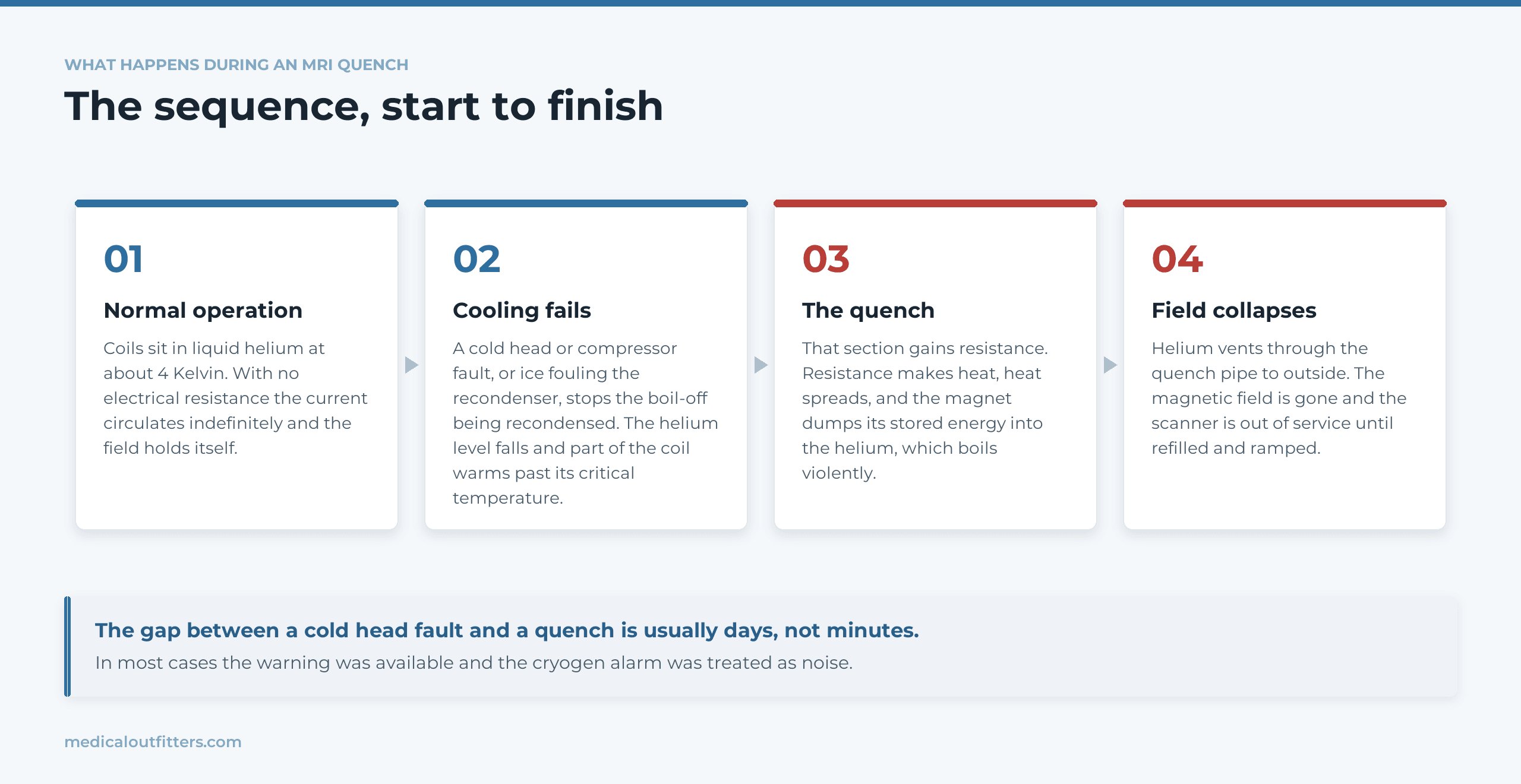
Superconducting MRI magnets are unlike almost anything else in a hospital. One carries an enormous electrical current through coils cooled to roughly 4 Kelvin, about minus 269 degrees Celsius. At that temperature the coils have no electrical resistance at all, so the current circulates indefinitely and the magnetic field sustains itself without drawing any power. Liquid helium is what holds the coils at that temperature, and a closed-cycle refrigerator called the cold head continuously recondenses what boils off.
What happens inside the magnet
A quench is what happens when that stops working. A section of coil rises above its critical temperature and stops superconducting. It suddenly gains resistance, resistance generates heat, and the heat spreads. Within seconds the magnet dumps its entire stored energy into the helium bath, which boils violently and escapes as gas. The field collapses, the cryogens are gone, and the scanner is down.
Deliberate versus accidental quenches
Quenches happen in two ways. Deliberately, when someone presses the quench button in an emergency. Quenching an MRI magnet on purpose is a safety action of last resort, not a way of switching the scanner off. Or accidentally, which most often traces back to the cooling chain: a failed cold head or compressor, a chiller or water supply problem, or a prolonged power outage that leaves the cooling system idle long enough for the helium to fall.
The common thread in all of these instances is temperature. Anything that causes a temperature rise within the superconductor will produce a quench, including ice.
Atmospheric gas that works its way into the cryogenic vessel freezes inside the cryostat, forming a solid material that resembles ice but is actually solidified gas. This material can move around the cryostat and reach difficult-to-access areas. Specifically, ice can block the magnet turret or vent path and foul the cold head sleeve, which raises cryostat pressure and reduces the system’s ability to reliquefy helium gas until the magnet vents or quenches.
Many accidental quenches are preventable, because a failing cold head or a falling helium level shows up in the alarms well before the event.
How long a magnet survives a cold head fault depends on the system and its helium level, anything from hours on a low-margin zero boil-off magnet to days or weeks on one with a full reserve, which is why the alarm has to be acted on the same day. In many cases the warning was available: helium level and cold head alarms usually precede an accidental quench.
The Magnet Is Never Actually Off
This is one of the most misunderstood facts in MRI ownership, and it lies behind many of the projectile incidents that end in an emergency quench.
A superconducting magnet does not need mains power to hold its field. Once it has been ramped up, the current circulates in a closed superconducting loop and simply stays there. Switching off the console does not reduce the field. Shutting down the room does not reduce the field. A power cut does not reduce the field. The magnet is at full strength overnight, at weekends, during maintenance, and while the building is empty.
There are only two ways to remove it: a controlled ramp down performed by an engineer, which recovers the helium, or a quench, which does not. Everything else leaves the field exactly where it was.
The practical consequence is that every ferromagnetic object carried into that room is a projectile risk at all hours, not just during clinic. Many of the incidents that force an emergency quench involve people who assumed the scanner was off because nothing was running. Cleaners, contractors, security staff, maintenance teams and emergency responders are the usual groups involved, which is why the ACR Manual on MR Safety treats them as non-MR personnel who must be screened and escorted. Controlling that door outside working hours matters as much as anything on the service schedule.
The Quench Pipe and the Quench Button
Two pieces of hardware decide how a quench plays out, and both are routinely misunderstood. The MRI quench vent and the quench button do very different jobs, and confusing them is expensive.
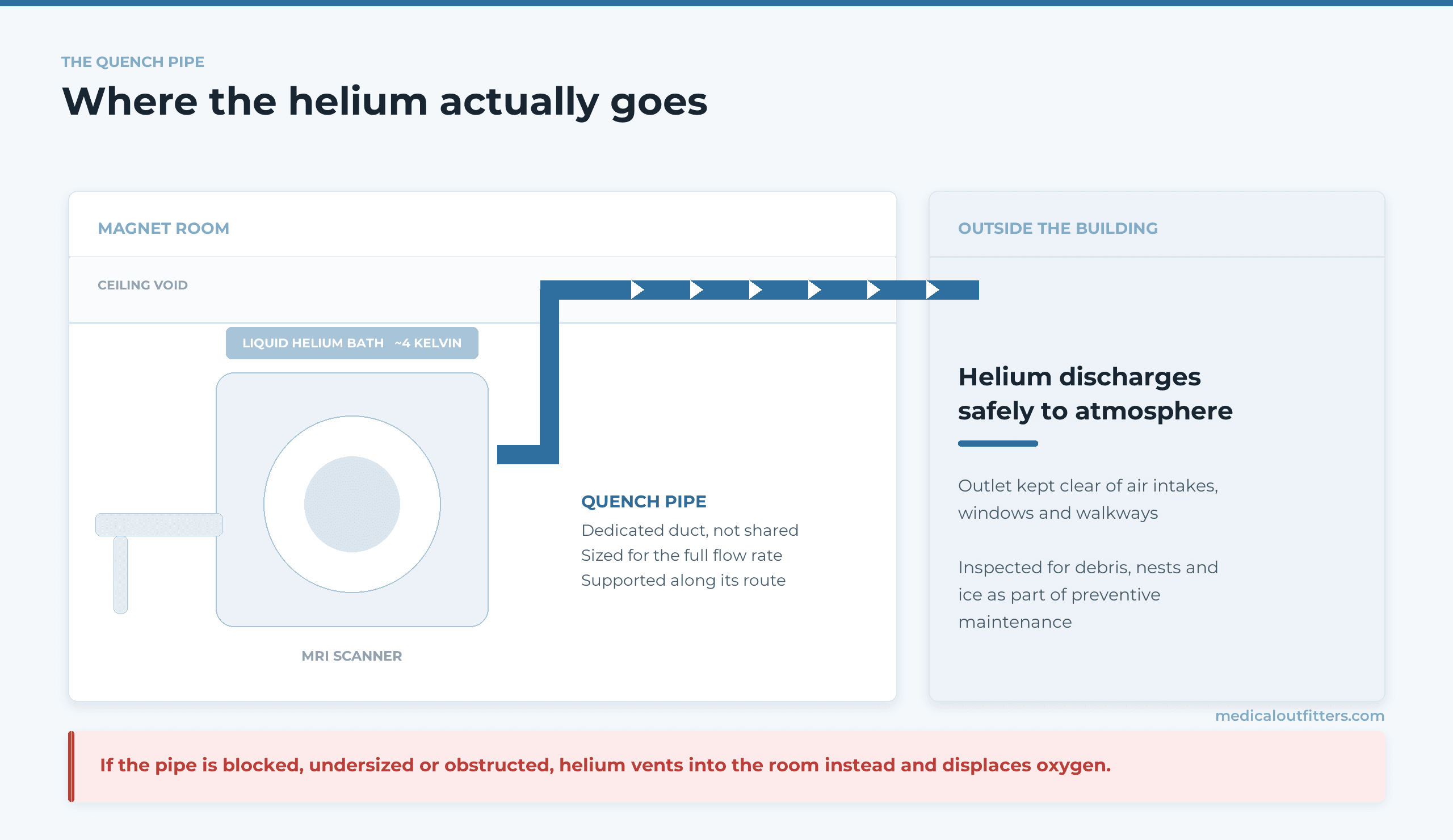
The quench pipe: where the helium goes
The quench pipe, also called the quench vent, is a dedicated duct running from the magnet through the building to a discharge point outside. Its only job is to carry vaporised helium out of the scan room. Helium expands roughly seven hundred times in volume as it turns from liquid to gas, so the pipe has to move a very large amount of very cold gas very quickly. A quench pipe that is blocked, corroded, undersized or obstructed at the outlet will not clear it fast enough, and the helium will go into the magnet room instead. That is what turns a safe engineered event into an oxygen displacement hazard. Outlets need checking for debris, nests and ice, and any building work near the route should be reviewed before it starts.
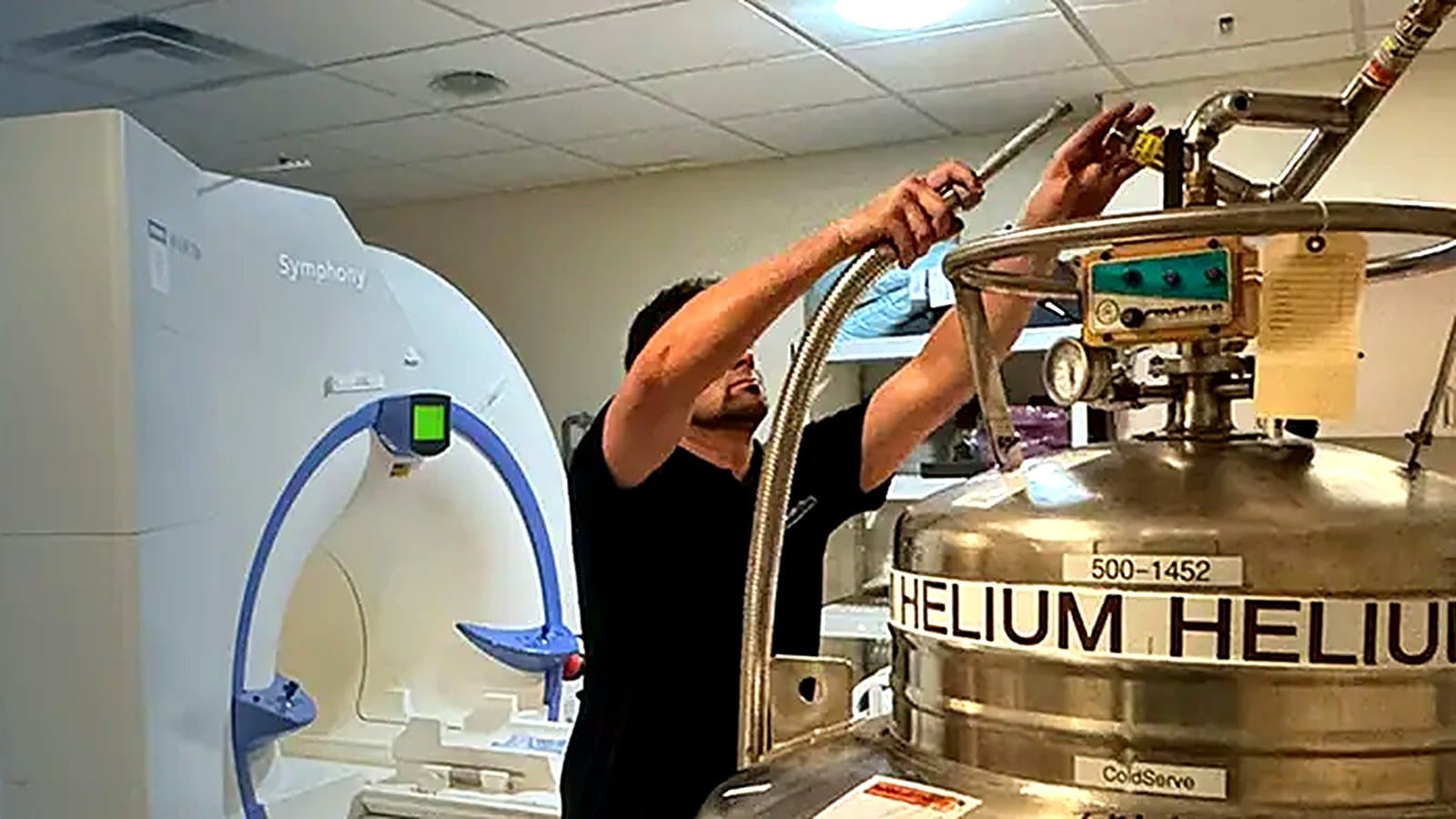
We filmed this on a decommissioned magnet during one of our own de-installations. The system had already been quenched at the facility and partially stripped, and a significant volume of liquid helium was still in the cryostat when the vacuum port cap came off. What follows is what that much helium does when it leaves a cryostat at once.
MRI Cryostat Vacuum Lost, filmed by Medical Outfitters on a decommissioned magnet. Now picture it in a working scan room, with a patient on the table and a quench pipe that cannot clear the flow.
The quench button is not an emergency power off
The quench button, often labelled magnet stop or emergency rundown, deliberately triggers a quench and collapses the field within seconds. It exists for one situation: when the magnetic field itself is the danger, most commonly a person pinned or crushed by a ferromagnetic object that has been pulled into the bore. Pressing it to stop a scan, silence an alarm or cut power puts the scanner out of service for days and costs a full helium refill and ramp. Everyone who works in that control room should be able to tell the difference without thinking about it.
What a Quench Costs a Facility
Recovery is a sequence, not a service call. The room has to be ventilated and oxygen levels confirmed before anyone re-enters. An engineer then has to establish why the magnet quenched, because refilling a magnet with an unresolved cold head fault simply buys another quench. Whatever failed has to be repaired, and parts have their own lead times. A quenched MRI does not come back the same day. Then liquid helium is delivered, the magnet is refilled, ramped back up under controlled conditions, shimmed, and put through quality assurance before the first patient.
Why is helium so expensive?
Helium is not manufactured. It is extracted as a by-product of natural gas production, from a small number of fields where it has collected over geological time, and once it escapes it leaves the atmosphere for good. That makes it genuinely finite, and it leaves global supply resting on a handful of plants. When one of them goes offline the market moves sharply, which is why the industry has lived through several named helium shortages in the past two decades. Anyone asking is helium expensive is really asking about that fragility, because liquid helium cost tracks supply disruption far more closely than it tracks demand.
MRI and helium are tied together more tightly than most other uses. Scanners are among the largest single consumers of liquid helium in the world, and a conventional superconducting magnet holds somewhere in the region of one to two thousand litres. A quench puts most of that into the sky in a few minutes. It is worth knowing that newer sealed and low-cryogen MRI magnets hold a small fraction of that volume, which changes the exposure considerably.
Why downtime is the real cost
The helium is only one line on that invoice. Engineering time and parts can be as large again. But the number that actually hurts is the scanning days lost while the magnet is down, and depending on parts and helium availability that can run from several days to weeks. That revenue does not come back.
- Room made safe Ventilation and confirmed oxygen levels before re-entry
- Root cause found Refilling without fixing the fault only buys another quench
- Repair completed Cold head or compressor replacement, subject to parts lead time
- Helium delivered and refilled Scheduled against supply, not against your calendar
- Magnet ramped and shimmed Controlled re-energising followed by full QA
- Lost scanning days Usually the largest cost of the entire event
How Facilities Avoid One
A falling helium level is the earliest warning any facility gets, and it is usually the one that gets ignored. Cryogen alarms deserve the same urgency as a clinical alarm. The MRI cold head, often written coldhead, is a wear item that loses efficiency gradually, and replacing a cold head on a planned visit costs a fraction of a quench and its downtime. The wider cooling chain matters too: compressor, chiller and water supply all need reliable power, and it is worth knowing exactly what happens to your magnet during an extended outage.
The rest is discipline rather than engineering. Inspect the quench pipe outlet. Review any building work near its route, which is something our installation and rigging team assesses during site planning. Control the magnet room door outside clinic hours. Train every person who enters the control room on what the quench button does and what it is not. Newer sealed magnets hold far less helium in a closed system and change this calculation considerably, which is worth weighing if you are already evaluating a replacement.
Medical Outfitters provides cryogenic services including cryofills and cold MRI storage, and our service team handles cold head replacement, helium fills and ramp support across the United States, Puerto Rico and the Caribbean. If your helium levels have been trending down, or you are not certain when your cold head was last serviced, that is the conversation to have now rather than after a quench.
MRI Quenching: Questions We Get Asked
What is an MRI quench?
An MRI quench is the sudden loss of superconductivity in the magnet, which causes the liquid helium cooling it to boil off rapidly and vent out of the building. The magnetic field collapses within seconds. A quench can be triggered deliberately in an emergency or happen accidentally through a cooling system failure.
Is an MRI magnet always on?
Yes. A superconducting MRI magnet stays energised continuously, including overnight, at weekends and when the console is switched off. Powering down the system does not remove the magnetic field. The field is only removed by a quench or a controlled ramp down, which is why safety screening applies at all times.
What does the MRI quench button do?
The quench button, sometimes labelled magnet stop or emergency rundown, deliberately quenches the magnet and collapses the field within seconds. It is reserved for genuine emergencies such as a person pinned by a ferromagnetic object. It is not an emergency power off and should never be pressed to stop a scan.
Where does the helium go during a quench?
Vaporised helium is carried out of the magnet room through the quench pipe, a dedicated vent that discharges outside the building. If the pipe is blocked, undersized or incorrectly routed, helium can escape into the room instead and displace the oxygen.
Is an MRI quench dangerous?
It can be. Liquid helium expands roughly seven hundred times as it vaporises, so a quench that vents into the scan room instead of outside can displace oxygen and create an asphyxiation risk. Escaping gas is also extremely cold. With a correctly installed quench pipe the process is designed to be safe, and the room should be evacuated immediately.
How long is an MRI down after a quench?
Usually days, and sometimes weeks when parts or helium have to be shipped in, rather than hours. The magnet cannot be refilled until the underlying fault is found and repaired, and parts have their own lead times. Once helium is delivered the magnet still has to be ramped, shimmed and put through quality assurance before the first patient.
Can an MRI quench be prevented?
Most accidental quenches trace back to the cooling chain, particularly cold head or compressor failure, or to helium falling below a safe level. Ice is the other cause: atmospheric gas that works its way into the cryogenic vessel solidifies inside the cryostat, and can block the vent path or foul the cold head sleeve. Monitoring helium levels, servicing the cold head on schedule and responding quickly to cryogen alarms prevent many of them.
What safety procedures are involved when an MRI magnet quenches?
Get everyone out of the magnet room and the control room, keep the doors open so escaping helium and displaced oxygen can clear, and do not re-enter until the room is confirmed safe. If a person was pinned by a ferromagnetic object, the emergency quench is what frees them, and medical care comes first. Then notify the service provider, because the magnet is now warm and cannot be restarted without an engineer. The ACR Manual on MR Safety sets out the site-level procedure, and every facility should have it written into its MR safety policy and drilled.
What causes an MRI magnet to quench and how is it handled?
Anything that lets part of the superconducting coil rise above its critical temperature: a failed cold head or compressor, a chiller or water supply failure, a long power outage that leaves the cooling system idle, ice in the cryostat blocking the vent path, or a deliberate press of the quench button in an emergency. Handling it means the safety steps above, then an engineer inspects the magnet, the helium is refilled, the magnet is re-cooled and ramped back to field, and the system is re-shimmed and tested before patients return. That sequence is why a quench costs days to weeks of downtime rather than hours.
How is helium vented during an MRI quench?
As the coil goes resistive, the stored energy boils the liquid helium almost instantly and it expands into a very large volume of cold gas. The gas is routed out of the cryostat through the quench pipe, a dedicated duct from the magnet to a discharge point outside the building, above roof level and away from air intakes. The pipe has to be sized and routed for that surge, kept clear of ice and obstructions and inspected on a schedule, because a blocked or undersized vent lets helium back into the room, where it displaces oxygen.
How much liquid helium does an MRI use?
It depends on the age and design of the magnet more than on the field strength. Older magnets boil off helium continuously and need scheduled refills, modern zero boil-off magnets recondense it internally and use very little in normal operation, and sealed low-helium designs run on a fraction of a conventional charge. Because the honest figure is a property of the individual magnet and its service history, we quote it per system rather than publish an average. For scale, magnetic resonance imaging accounted for about 15 percent of United States helium use in 2025 according to the USGS.
Related Articles