DEXA scan cost is a question with two honest answers, because the same words describe two different bills. The patient’s bill is the price of the bone density test itself: a few minutes on a padded table while a low-dose X-ray arm passes over the hip and spine, read by a physician and priced anywhere from about $90 at a Florida imaging center to more than $500 at a hospital-system outpatient department. The clinic’s bill is the price of the machine that runs the test, a capital purchase measured in tens of thousands of dollars. This article answers the patient question first and in full: how much a DEXA scan costs without insurance by setting and by city, what each exam type costs by CPT code, what Medicare and commercial plans cover and what they pay, why the same test varies by a factor of five, and how to pay less. It then turns to the clinic side, with the all-in machine bands from the Medical Outfitters DEXA cost guide and the arithmetic that tells a practice how many scans pay for the system.
Medical Outfitters sells new DMS Imaging Stratos bone densitometers as the authorized dealer and sources refurbished GE Lunar and Hologic systems through the MO Select line, delivered, installed and warrantied across the United States, Puerto Rico and the Caribbean. This article is written for the patient who has been handed an order for a bone density test and wants to know what it will cost, and for the practice administrator, radiology manager or physician owner who wants to understand the revenue side of the exam before deciding whether to add a DEXA scanner to the practice. The figures below come from CMS, Medicare.gov, the US Preventive Services Task Force, RadiologyInfo, the International Society for Clinical Densitometry, Hologic’s 2026 coding guide, CoveredUSA’s dated price survey and the Medical Outfitters DEXA and bone densitometer cost guide, each named where it is used.
- Without insurance: $100 to $200 at an imaging center or physician office and $200 to $600 at a hospital, national average about $175, per CoveredUSA (May 15, 2026); prepaid marketplace prices at Florida imaging centers ran $91 to $106 on October 12, 2026, per the Medical Outfitters guide.
- By exam type: cash ranges of $100 to $300 for the hip and spine study (77080), $65 to $150 for a peripheral scan (77081) and $150 to $400 for a hip and spine study with vertebral fracture assessment (77085), per CoveredUSA; a body composition DEXA is self-pay at $40 to $374.
- Medicare: $0 to a qualifying patient once every 24 months, more often when medically necessary, per Medicare.gov; the 2026 Physician Fee Schedule pays $39.41 for 77080 and hospital outpatient departments bill $106.81 under OPPS, per CMS figures in Hologic’s 2026 coding guide.
- Commercial insurance: screening for women 65 and older and younger postmenopausal women at increased risk carries a USPSTF grade B (January 14, 2025), which Marketplace and most other plans must cover without a copay or coinsurance, per HealthCare.gov; diagnostic scans follow the plan’s deductible and copay.
- The machine: a refurbished central DEXA runs $35,000 to $85,000 and a new one $85,000 to $165,000, delivered, installed and warrantied; a peripheral unit starts at $18,000 refurbished, per the Medical Outfitters DEXA cost guide, and a $60,000 system is recovered after about 750 scans at $80 a scan.
DEXA Scan Cost Without Insurance: By Setting and by City
The single biggest driver of a bone density test’s cash price is where it is done, not which machine does it. CoveredUSA’s DEXA pricing guide (May 15, 2026) puts the cash price at $100 to $200 at a physician office, $100 to $250 at an independent imaging center, $200 to $600 at a hospital outpatient department and $65 to $150 at a mobile unit or community screening event, with a national average of about $175 and most quotes between $80 and $300. The same guide notes that hospital outpatient departments charge two to four times the independent-center price for the same study, and that urban areas and high-cost states such as California, New York and Hawaii run $50 to $100 above smaller metro areas. The DEXA scan cost section of the Medical Outfitters guide records a second survey, CareCredit’s 2025 cost study (published October 2, 2026), at a national average of $235 with a range of $182 to $411; the gap between the two surveys is the mix of hospital and imaging-center prices each one counts.
| Where the scan is done | Typical cash price | Source |
|---|---|---|
| Physician office | $100 to $200 | CoveredUSA, May 15, 2026 |
| Independent imaging center | $100 to $250; prepaid marketplace prices from about $91 | CoveredUSA, May 15, 2026; MDsave prices in the Medical Outfitters guide, October 12, 2026 |
| Hospital outpatient department | $200 to $600 | CoveredUSA, May 15, 2026 |
| Mobile unit or community screening | $65 to $150 | CoveredUSA, May 15, 2026 |
| National average, all settings | About $175 (CoveredUSA) or $235 (CareCredit 2025 study) | CoveredUSA, May 15, 2026; CareCredit study recorded in the Medical Outfitters guide |
City prices show the same spread in sharper focus. The Medical Outfitters guide lists prepaid cash prices read on MDsave on October 12, 2026: $92 to $106 in Miami, $91 to $103 in Orlando, Tampa and Jacksonville, $91 to $326 across Florida as a whole with Naples and Key West at the top, $89 to $219 in Atlanta, $104 to $292 in Houston, $100 to $182 in Dallas, $92 to $193 in Chicago, $94 to $154 in New York, $96 to $148 in Los Angeles and $91 to $135 in Phoenix. In each city the low number is an imaging center and the high number is a hospital or hospital-owned imaging department. New Hampshire’s state price-transparency tool, cited in the same guide, estimated the uninsured price of CPT 77080 at $152 to $529 at hospitals and $263 to $461 at imaging centers for the period April 2024 to June 2025, and a Florida hospital-system imaging center in Wellington listed $509 through the Instalab booking service on October 12, 2026. A patient paying cash who books at an independent center instead of a hospital department saves, on those figures, several hundred dollars for the same scan on the same class of machine. Whether the search is for bone density scan cost without insurance, bone density test cost or DEXA scan price, the same two tables answer it: the setting first, then the city.

DEXA Scan Price by Exam: Hip and Spine, Peripheral, Vertebral Fracture Assessment and Body Composition
A DEXA scan is not one exam but four, and the price follows the CPT code on the order. The standard osteoporosis test is CPT 77080, a bone density study of the axial skeleton (hips, pelvis and spine), which CoveredUSA (May 15, 2026) prices at $100 to $300 cash. CPT 77081 is the appendicular or peripheral study of the forearm, wrist or heel, at $65 to $150 cash; RadiologyInfo describes peripheral devices as the smaller, portable units found in drugstores and mobile health vans, useful for screening but less useful for tracking treatment. CPT 77085 is the hip and spine study with a vertebral fracture assessment (VFA) added in the same visit, at $150 to $400 cash; RadiologyInfo notes that the VFA, a lateral spine image taken on the densitometer, adds only a few minutes to the exam. The fourth exam, a body composition DEXA that reports fat, lean and bone mass, has no dedicated covered code; the Medical Outfitters guide notes that providers either bill the patient directly or use the unlisted code 76499, which Medicare prices case by case, and that published self-pay prices ran from $40 in BodySpec’s mobile vans to $374 at a Miami clinic on October 12, 2026, with dedicated body composition clinics clustered at $75 to $150.
| CPT code | What it bills | Cash price range (CoveredUSA, May 15, 2026) | 2026 Medicare, clinic (CMS Physician Fee Schedule) | 2026 Medicare, hospital outpatient (CMS OPPS) |
|---|---|---|---|---|
| 77080 | DXA bone density, axial skeleton (hips, pelvis, spine): the standard osteoporosis test | $100 to $300 | $39.41 global ($9.35 professional, $30.06 technical), 1.18 RVU | $106.81, APC 5522 |
| 77081 | DXA bone density, appendicular skeleton (forearm, wrist, heel): the peripheral test | $65 to $150 | $31.73 global, 0.95 RVU | $88.91, APC 5521 |
| 77085 | Axial DXA including vertebral fracture assessment, one code for both | $150 to $400 | $54.44 global ($14.36 professional, $40.08 technical), 1.63 RVU | $106.81, APC 5522 |
| 76499 | Unlisted diagnostic radiographic procedure, used by many providers for body composition DEXA | $40 to $374 self-pay (Medical Outfitters guide, October 12, 2026) | Contractor priced (status C), no national amount | Not a covered screening benefit |
The Medicare columns come from the CMS 2026 Physician Fee Schedule relative value file at the 2026 conversion factor of $33.4009 for clinicians outside an advanced alternative payment model, as recorded in the CPT table of the Medical Outfitters guide, and from the OPPS addenda as summarized in Hologic’s 2026 bone densitometry coding and reimbursement guide. Hologic’s guide prints the same three codes at $39.61, $31.89 and $55.05 because it applies the $33.5675 conversion factor for qualifying APM participants; both figures are national averages before geographic adjustment and before the 2 percent sequestration reduction. CMS set the two conversion factors in the CY 2026 final rule of October 31, 2025, at $33.40 (up 3.26 percent) and $33.57 (up 3.77 percent). The non-facility and facility amounts are the same for the three bone density codes because nearly all of the value sits in the technical component, which is the machine, the technologist and the room.
Two things in the table matter to anyone reading a bill. First, a hospital outpatient department is paid roughly two and a half times what a physician office is paid by Medicare for the same 77080 study ($106.81 against $39.41), and cash prices follow the same shape, which is why the setting matters more than the machine. Second, the stand-alone vertebral fracture assessment code, 77086, still exists and is not covered under the Medicare screening benefit, per the First Coast Service Options bone mass measurement page cited in the Medical Outfitters guide; a VFA ordered for a clinical reason is billed with 77085 in the same visit.

Does Medicare Cover a DEXA Scan? The 24-Month Rule and What It Pays
Medicare Part B covers a bone mass measurement once every 24 months, or more often if medically necessary, for people who meet one or more of five conditions listed on Medicare.gov: a woman whose doctor finds she is estrogen-deficient and at risk for osteoporosis based on her medical history and other findings; X-rays showing possible osteoporosis, osteopenia or vertebral fractures; current or planned treatment with prednisone or similar steroid drugs; a diagnosis of primary hyperparathyroidism; or monitoring to see whether osteoporosis drug therapy is working. Medicare.gov states that the patient pays nothing for the test if the doctor or other health care provider accepts assignment. For Florida, Puerto Rico and the US Virgin Islands the Medicare contractor is First Coast Service Options, whose bone mass measurement page (September 22, 2026), cited in the Medical Outfitters guide, confirms that the deductible and coinsurance are waived for the screening benefit.
A scan that falls outside the benefit, for example a repeat inside 24 months without a documented medical reason, or a scan for a patient who meets none of the conditions, is handled as an ordinary Part B service. For those, Medicare.gov’s general rule applies: the patient pays 20 percent of the Medicare-approved amount after the Part B deductible, which CMS set at $283 for 2026 (announced November 14, 2025). On a $39.41 approved amount in a physician office, the coinsurance is under $8; on a $106.81 hospital outpatient rate it is about $21, before the deductible. Medicare Advantage plans must cover the preventive scan at no cost, but their rules for additional scans vary by plan, as CoveredUSA notes. The practical advice for a Medicare patient is to confirm with the ordering physician that one of the five conditions is documented on the order, and to ask the facility whether it accepts assignment, before the scan rather than after.
From the clinic’s side of the desk, the Medicare rate is the floor of the revenue picture. The Medical Outfitters guide works the arithmetic in its payback section: at Medicare’s roughly $40 per axial study, a certified refurbished central DEXA at $60,000 delivered and installed is recovered after about 1,500 scans, and with a payer mix that averages $80 per scan after about 750, before technologist time, quality-control phantoms, service and floor space. A bill to raise the Medicare floor exists: the Increasing Access to Osteoporosis Testing for Medicare Beneficiaries Act, introduced in the House and Senate as H.R. 3517 and S. 1943 per the sponsors’ press releases, would set a $98 minimum payment for the DXA test. As of this article it has not been enacted, and the 2026 rates above stand.
DEXA Scan Cost With Insurance: Screening Rules, Deductibles and Copays
With commercial insurance, the cost of a DEXA scan depends on whether the plan classifies it as preventive screening or as a diagnostic test. The US Preventive Services Task Force recommendation of January 14, 2025 gives a grade B to osteoporosis screening to prevent osteoporotic fractures in women 65 years or older, and a grade B to screening in postmenopausal women younger than 65 who are at increased risk for an osteoporotic fracture as estimated by clinical risk assessment; for men it issues an I statement, finding the evidence insufficient to assess the balance of benefits and harms. Under the Affordable Care Act, HealthCare.gov lists bone density screening for all women over 65 years or women 64 years and younger who have gone through menopause among the women’s preventive services that Marketplace plans and many other plans must cover without charging a copayment or coinsurance, even before the deductible is met, while noting that $0 cost is not guaranteed in all cases. A woman who meets the screening definition, scanned at an in-network facility with the order written as screening, should therefore see no bill.
Everything else is diagnostic. A scan ordered because of a fracture, long-term steroid use, a vertebral abnormality on an X-ray, or to monitor treatment is covered by most plans when the clinical reason is documented, but it runs through the plan’s usual cost sharing: the deductible first, then the copay or coinsurance. The Medical Outfitters guide, citing CareRoute (May 6, 2026), puts typical insured contract rates at 150 to 300 percent of the Medicare amount, so an in-network diagnostic DEXA might be allowed at roughly $60 to $120 in a physician office and $160 to $320 at a hospital outpatient department; a patient with an unmet deductible pays that allowed amount in full, and a patient who has met it pays the coinsurance share. In that situation, a cash price at an independent imaging center of about $91 to $106, as the Florida MDsave figures above show, can be lower than the insured price at a hospital, which is why the guide’s first piece of advice is to ask for the cash price before handing over the insurance card.

Three questions settle most insurance surprises before they happen. Is the order written as screening or diagnostic, and does the patient meet the plan’s screening definition? Is the facility in network, and is it billed as a physician office, an imaging center or a hospital outpatient department? And has the deductible been met this year? Under the No Surprises Act, as CoveredUSA notes, a self-pay or uninsured patient is entitled to a good faith estimate before the scan and may dispute a final bill that exceeds the estimate by more than $400. The Medical Outfitters guide collects the same advice in its how to get a cheaper DEXA scan list.
Why the Same Bone Density Test Costs $90 at One Door and $500 at Another
The machine is not the reason. A hospital outpatient department and an independent imaging center run the same two classes of system, a central fan-beam densitometer from GE Lunar, Hologic or DMS Imaging for hip and spine studies and, occasionally, a peripheral unit for forearm screening, and the exam takes the same 10 to 30 minutes on either. The differences are structural. A hospital department bills a facility fee on top of the professional read, and Medicare itself pays it under a separate system, the outpatient prospective payment system, at $106.81 for 77080 against $39.41 under the physician fee schedule; commercial contracts follow the same split, and cash chargemaster prices are set against the higher base. CoveredUSA’s two-to-four-times finding and the New Hampshire transparency figures ($152 to $529 at hospitals) in the Medical Outfitters guide are the same effect measured two ways.
Geography adds a layer. CMS adjusts every Medicare payment by locality, so the national $39.41 is higher in San Francisco and lower in rural Alabama, and commercial and cash prices track local costs; CoveredUSA puts the urban and high-cost-state premium at $50 to $100 per scan. The exam type adds another: a 77085 study with vertebral fracture assessment is priced about 40 percent above a plain 77080 under the fee schedule ($54.44 against $39.41) and carries a wider cash range ($150 to $400 against $100 to $300). The billing route adds the last: a prepaid marketplace price, a facility’s published self-pay price, an insured allowed amount and a chargemaster list price can be four different numbers for one scan at one address, which is why the Medical Outfitters guide’s city table notes that the same provider can list two prices for the same scan.
What a patient can do about it is short. Book at an independent imaging center or physician office rather than a hospital department. Ask for the cash price and the insured price and compare them against the deductible. Use the Medicare screening benefit on its 24-month schedule, or the commercial screening benefit when the USPSTF definition is met, with the order written that way. Bring the order from the physician who will act on the result so the scan is read once and billed once. Ask for the good faith estimate. And for a body composition scan, buy a package rather than single scans: the Medical Outfitters guide records DexaFit’s four-scan annual plan in Las Vegas at $100 a scan against $139 for one, and its twelve-scan pack in Nashua at $83. For context on how the DEXA price compares with other imaging exams, the Medical Outfitters posts on CT scan cost and MRI scan cost use the same sources; a DEXA at $100 to $200 cash is among the least expensive imaging studies a patient can buy.
What a DEXA Scan Involves, Who Should Have One and How Often
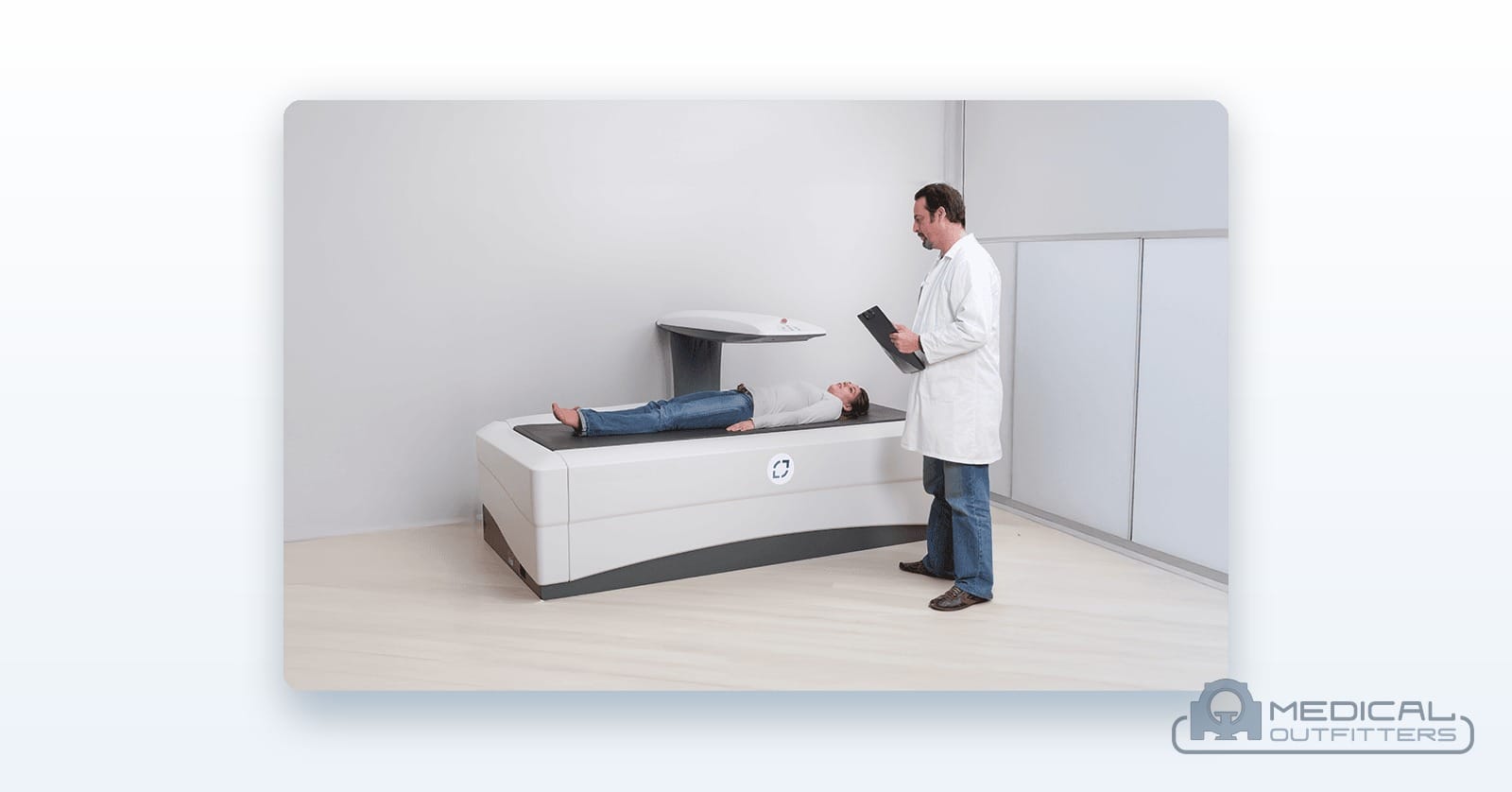
Dual-energy X-ray absorptiometry passes two low-dose X-ray beams through the bone and measures how much each is absorbed; the difference gives bone mineral density, reported as a T-score against a young adult reference. RadiologyInfo gives the cutoffs: a T-score of minus 1 and above is normal, between minus 1.1 and minus 2.4 is osteopenia or low bone mass, and minus 2.5 and below is osteoporosis. The exam is usually completed within 10 to 30 minutes depending on the equipment and the body parts examined, per RadiologyInfo, and the scan itself is short on current systems: Hologic’s Horizon page gives about 10 to 30 seconds for a bone density scan and about 2 minutes for a body composition assessment, on a table rated for patients up to 500 pounds. The radiation dose is extremely small, per RadiologyInfo, less than one tenth the dose of a standard chest X-ray and less than a day’s exposure to natural radiation. Preparation is light: eat normally, skip calcium supplements for at least 24 hours before the exam, wear loose clothing without metal zippers, belts or buttons, and tell the technologist about any barium exam or contrast injection in the previous 10 to 14 days, or any possibility of pregnancy. For a fuller explanation of the exam and the machine, see what is a DEXA scan.
Who should have one is defined by the professional societies rather than by price. The 2023 Adult Official Positions of the International Society for Clinical Densitometry list women aged 65 and older, postmenopausal women under 65 with a risk factor for low bone mass, men aged 70 and older, men under 70 with a risk factor for low bone mass, adults with a fragility fracture, adults with a disease or condition associated with low bone mass or bone loss, adults taking medications associated with bone loss, anyone being considered for drug therapy, and anyone being treated, to monitor the effect of treatment. RadiologyInfo’s list is similar in plainer words: post-menopausal women not taking estrogen, those who are tall (over 5 feet 7 inches) or thin (under 125 pounds), people with a personal or maternal history of hip fracture or smoking, men with conditions linked to bone loss such as rheumatoid arthritis or chronic kidney or liver disease, people taking corticosteroids, and anyone who has fractured a bone after only mild trauma. How often to repeat it is individualized, per the ISCD positions, according to age, sex, fracture risk and treatment history; Medicare’s 24-month interval is a payment rule, not a clinical one, and the ISCD says a follow-up scan should be done if a fracture has occurred or new risk factors have developed, without delaying treatment.
One rule from both RadiologyInfo and the ISCD bears on cost: results from different machines cannot be compared directly, so a patient who is being monitored on treatment should return to the same facility and the same densitometer. A cheaper scan elsewhere is a new baseline, not a follow-up, and it can cost a second scan to re-establish the trend. For a clinic, the same rule is a reason to keep the machine, its calibration phantom and its quality-control history together through a sale or a replacement, which is covered in the Medical Outfitters guide to DEXA scanner brands and buying used.
What the DEXA Machine Behind the Scan Costs a Clinic
A patient’s $175 scan runs on a machine that cost the facility somewhere between $18,000 and $165,000. The Medical Outfitters DEXA cost guide, with price ranges reviewed September 16, 2026, puts a peripheral DEXA (forearm or heel) at $18,000 to $40,000 refurbished and $40,000 to $70,000 new, and a central, full-body DEXA at $35,000 to $85,000 refurbished and $85,000 to $165,000 new, each figure delivered, installed and warrantied, with applications training and the state X-ray device registration support inside the quote. Those are all-in figures; headline prices published elsewhere are often for the equipment alone, before freight, installation and current tariffs, and read lower than a real cost. The guide’s machine cost section and its price list by model give the detail; the table below reproduces the central systems most often quoted.
| System | Maker and how Medical Outfitters sells it | Refurbished, all-in (Medical Outfitters guide) | New price |
|---|---|---|---|
| Peripheral DEXA, forearm or heel | Any maker, refurbished; DMS Stratos C compact unit sold new | $18,000 to $40,000 | $40,000 to $70,000 (DMS, sold new) |
| Central DEXA, class band | GE Lunar and Hologic refurbished through MO Select, sourced on request; DMS Stratos and Stratos DR sold new | $35,000 to $85,000 | $85,000 to $165,000 (DMS, sold new) |
| Hologic Discovery Ci | Hologic, refurbished, sourced on request | $38,000 to $48,000 | Not sold new (discontinued) |
| GE Lunar Prodigy Advance | GE Lunar, MO Select refurbished, sourced on request | $55,000 to $70,000 | Not sold new by Medical Outfitters |
| Hologic Horizon Ci | Hologic, refurbished, sourced on request | $55,000 to $68,000 | Estimated list $85,000 to $105,000 through Hologic; not a Medical Outfitters offer |
| GE Lunar Prodigy Pro | GE Lunar, MO Select refurbished, sourced on request | $62,000 to $75,000 | Estimated list $90,000 to $120,000 through GE; not a Medical Outfitters offer |
| Hologic Horizon W (body composition) | Hologic, refurbished, sourced on request | $70,000 to $82,000 | Estimated through Hologic; not a Medical Outfitters offer |
| GE Lunar iDXA (body composition) | GE Lunar, MO Select refurbished, sourced on request | $72,000 to $85,000 | Estimated list $125,000 to $165,000 through GE; not a Medical Outfitters offer |
| DMS Imaging Stratos DR (body composition) | DMS Imaging, sold new by Medical Outfitters as the authorized dealer | Not applicable | $125,000 to $165,000 |
The scan price and the machine price meet in the payback arithmetic. At $80 net per scan, a blend of Medicare, commercial and cash patients, the guide’s $60,000 refurbished central system is recovered after 750 scans: about 17 months at 10 scans a week, about 9 months at 20 and about 4 months at 40, equipment line only. At Medicare’s $40 it takes twice as long. A body composition line changes the picture because the scans are self-pay: at about $112 per scan, the middle of the published range, and 20 scans a week, the guide puts the $75,000 equipment line of a refurbished Horizon W or iDXA at about 8 months to recover. Which system to buy follows from the exam mix: a hip and spine practice is served by any central system in the $35,000 to $85,000 band; a practice that wants body composition needs the licensed module, which on a used system must transfer in writing; and a screening-only clinic or pharmacy can start with a peripheral unit. The body composition scanner section of the guide and the DMS Stratos DR listing cover the module and the new-system option; the radiology equipment cost table sets the DEXA bands beside every other modality.
Price the Scan, or Price the Scanner, With Medical Outfitters
If you are a patient, the numbers above are the ones to carry to the phone: $100 to $200 at an independent center, $200 to $600 at a hospital, $0 under Medicare every 24 months when you qualify and the provider accepts assignment, and no copay for a screening scan under most commercial plans when you meet the USPSTF definition. If you run a practice, the same numbers are the revenue line against a machine that costs $35,000 to $85,000 refurbished or $85,000 to $165,000 new, delivered, installed and warrantied. The DEXA and bone densitometer cost guide has the full price list by brand and model and a payback calculator; the bone densitometry category lists the DMS Stratos systems sold new and the refurbished GE Lunar and Hologic systems sourced on request; the refurbished equipment page explains the MO Select standard; and installation and service cover the system after the sale. Send your expected weekly volume and payer mix through the contact page and the team will price a specific system against it.
- CoveredUSA, DEXA Scan Cost in 2026 (May 15, 2026): cash price ranges by setting and by CPT code, the national average, the urban premium and the No Surprises Act note. coveredusa.org/en/cost/dexa-scan
- Medicare.gov, Bone mass measurements: the 24-month rule, the five qualifying conditions and the $0 cost when the provider accepts assignment. medicare.gov/coverage/bone-mass-measurements
- CMS, Calendar Year 2026 Physician Fee Schedule Final Rule fact sheet (October 31, 2025): the two 2026 conversion factors and their changes. cms.gov, CY 2026 PFS final rule fact sheet
- Hologic, 2026 Bone Densitometry Coding and Reimbursement Guide: 2026 RVUs and national average Medicare rates for 77080, 77081, 77085 and 77086, and the OPPS APC assignments and rates. hologic.com, 2026 coding guide (PDF)
- US Preventive Services Task Force, Osteoporosis to Prevent Fractures: Screening (January 14, 2025): the grade B recommendations for women and the I statement for men. uspreventiveservicestaskforce.org, osteoporosis screening
- HealthCare.gov, Preventive care benefits for women: bone density screening in the no-cost preventive services list. healthcare.gov/preventive-care-women
- RadiologyInfo (ACR and RSNA), Bone Densitometry (DEXA, DXA): exam time, dose, preparation, central versus peripheral systems, who should be tested and T-score cutoffs. radiologyinfo.org/en/info/dexa
- International Society for Clinical Densitometry, 2023 Adult Official Positions: indications for bone density testing and follow-up intervals. iscd.org, 2023 Adult Positions (PDF)
- Medical Outfitters, DEXA and Bone Densitometer Cost and Price Guide (2026): all-in machine bands, the price list by model, the city price table, the CPT table and the payback arithmetic. medicaloutfitters.com, DEXA cost guide
- DEXA and bone densitometer cost guide (2026)
- DEXA scan cost with and without insurance, by city
- DEXA CPT codes and 2026 Medicare rates
- How much a DEXA machine costs
- Body composition DEXA scanner cost
- How many DEXA scans pay for the machine
- What is a DEXA scan? How it works, accuracy and cost
- DEXA scanner brands compared and buying used
- DEXA scan machines and bone densitometers for sale
- DMS Stratos DR: bone density and body composition, sold new
- Refurbished medical imaging equipment: the MO Select standard
- Radiology equipment cost in 2026, every modality
- How much does a CT scan cost in 2026?
- How much does an MRI scan cost in 2026?
- Price a DEXA system against your volume and payer mix
DEXA Scan Cost: Common Questions
How much does a DEXA scan cost?
About $100 to $200 without insurance at an independent imaging center or physician office and $200 to $600 at a hospital outpatient department, with a national average of about $175, per CoveredUSA's pricing guide of May 15, 2026. Medicare Part B covers the test once every 24 months for qualifying patients at $0 when the provider accepts assignment, per Medicare.gov, and pays the clinic $39.41 for the standard hip and spine study under the 2026 Physician Fee Schedule.
How much is a DEXA scan without insurance?
CoveredUSA (May 15, 2026) puts the cash price at $100 to $200 at a physician office, $100 to $250 at an independent imaging center, $200 to $600 at a hospital outpatient department and $65 to $150 at a mobile unit or community screening, with most quotes between $80 and $300. Prepaid marketplace prices at Florida imaging centers ran $91 to $106 in Miami, Orlando, Tampa and Jacksonville on October 12, 2026, per the Medical Outfitters DEXA cost guide.
Does Medicare cover a DEXA scan?
Yes. Medicare Part B covers a bone mass measurement once every 24 months, or more often if medically necessary, for people who meet one of five conditions on Medicare.gov: an estrogen-deficient woman at risk for osteoporosis, X-rays showing possible osteoporosis, osteopenia or vertebral fractures, current or planned steroid treatment, primary hyperparathyroidism, or monitoring of osteoporosis drug therapy. The patient pays nothing if the provider accepts assignment.
How much does a DEXA scan cost with insurance?
A screening scan for a woman 65 or older, or a younger postmenopausal woman at increased risk, carries a USPSTF grade B (January 14, 2025) that Marketplace and most other plans must cover without a copay or coinsurance, per HealthCare.gov. A diagnostic scan runs through the plan's deductible and copay; insured contract rates typically sit at 150 to 300 percent of the Medicare amount, per CareRoute as cited in the Medical Outfitters guide, so an unmet deductible can cost more than a cash price at an imaging center.
What does Medicare pay for a DEXA scan in 2026?
Under the 2026 Physician Fee Schedule at the $33.40 conversion factor, Medicare pays $39.41 for the hip and spine study (CPT 77080), $31.73 for a peripheral study (77081) and $54.44 for a hip and spine study with vertebral fracture assessment (77085), national amounts before geographic adjustment, per the CMS relative value file as recorded in the Medical Outfitters guide. Hospital outpatient departments bill under OPPS at $106.81 for 77080 and 77085 and $88.91 for 77081, per Hologic's 2026 coding guide.
Why does a bone density test cost so much more at a hospital?
Because a hospital outpatient department bills a facility fee and is paid under a separate Medicare system: $106.81 for CPT 77080 under OPPS against $39.41 under the physician fee schedule in 2026, per the CMS figures in Hologic's coding guide. Commercial contracts and cash prices follow the same split, which is why CoveredUSA finds hospital prices two to four times the independent-center price and New Hampshire's transparency tool shows $152 to $529 at hospitals, per the Medical Outfitters guide.
How long does a DEXA scan take, and how much radiation is it?
The exam is usually completed within 10 to 30 minutes depending on the equipment and the body parts examined, per RadiologyInfo, and the scan itself takes about 10 to 30 seconds on a current system such as the Hologic Horizon, per Hologic's product page. RadiologyInfo puts the dose at less than one tenth that of a standard chest X-ray and less than a day's natural background exposure. Skip calcium supplements for 24 hours before the scan and wear clothing without metal.
What does the DEXA machine behind the scan cost?
The Medical Outfitters DEXA cost guide puts a peripheral DEXA at $18,000 to $40,000 refurbished and $40,000 to $70,000 new, and a central, full-body system at $35,000 to $85,000 refurbished and $85,000 to $165,000 new, delivered, installed and warrantied. A $60,000 refurbished central system is recovered after about 750 scans at $80 net per scan, about 9 months at 20 scans a week, equipment line only; at Medicare's roughly $40 it takes about 1,500 scans.
Related Articles