How much does an ultrasound cost? Less than almost any other imaging exam, and the answer still depends on three things: who is paying (Medicare, a commercial insurer or the patient in cash), where the exam is done (an independent imaging center, a physician’s office, a hospital outpatient department or an emergency room) and what is scanned (a thyroid or a limited abdominal exam sits at the low end, a bilateral venous duplex or an echocardiogram at the high end). Ultrasound uses no radiation, needs no contrast for most exams and takes a sonographer and a machine rather than a shielded room, which is why its prices are low and why it is the exam most often done in a doctor’s office. This guide lays out the 2026 ultrasound cost by exam type, by setting and by payer, explains what Medicare pays and why hospitals charge more, covers pregnancy ultrasound cost separately, and then turns to the facility side: what the ultrasound machine behind the exam costs and how few exams it takes to pay for it.
Medical Outfitters sells new Fujifilm ARIETTA, Lisendo and Sonosite ultrasound systems as an authorized dealer, rebuilds GE and Siemens systems through its MO Select refurbished line, sources Philips, Canon, Mindray and Samsung systems refurbished on request, and services systems and tests probes across the United States, Puerto Rico and the Caribbean. The exam prices below are the revenue side of that purchase; the ultrasound machine cost and buying guide is the cost side. This article is written for the facility owner, practice administrator and sonography manager pricing a system, and it answers the patient’s question plainly on the way.
- Without insurance: about $150 to $450 at an independent imaging center, $150 to $500 in a physician’s office and $400 to $1,200 in a hospital outpatient department, with a national median near $350 (CoveredUSA, May 2026).
- Medicare: about $114 for a complete abdominal ultrasound (CPT 76700), $105 for a complete pelvic (76856), $118 for a transvaginal (76830) and $184 for a bilateral leg venous duplex (93970) under the 2026 physician fee schedule, per the CMS relative value file at the $33.4009 conversion factor; the patient pays 20 percent after the $283 Part B deductible.
- With commercial insurance: negotiated ultrasound prices averaged 245 percent of Medicare in the Health Care Cost Institute’s April 2026 brief, and insured patients typically owe $0 to $250 out of pocket (CareRoute, May 2026).
- Pregnancy: about $100 to $400 at an imaging center, $150 to $500 at an OB office and $300 to $1,000 at a hospital per scan, with the 18 to 22 week anatomy scan at $150 to $600 (CoveredUSA, October 2026).
- The machine: $15,000 to $40,000 for a refurbished portable system and $30,000 to $90,000 for a refurbished cart, against $35,000 to $70,000 and $90,000 to $200,000 new, delivered, installed and warrantied, per the Medical Outfitters ultrasound cost guide; Medicare pays the same per exam on either.
How Much Does an Ultrasound Cost in 2026? Prices by Exam Type and Setting
Start with the cash price, because it is the number most people mean when they ask how much is an ultrasound. CoveredUSA’s May 2026 ultrasound cost guide, which draws on the CMS 2026 Medicare fee schedules, hospital price-transparency files and FAIR Health consumer data, puts a diagnostic ultrasound at $150 to $1,000 without insurance, with a national median of about $350: roughly $150 to $450 at an independent imaging center, $150 to $500 in a physician’s office or clinic, $400 to $1,200 in a hospital outpatient department and $75 to $200 on a sliding fee scale at a federally qualified community health center. CareRoute’s May 2026 ultrasound cost guide, built on CMS fee schedules, Healthcare Bluebook fair-price estimates and national self-pay databases, lands on a similar $100 to $1,000 overall range and puts freestanding centers 40 to 65 percent below hospitals for the same exam.
The exam type moves the price next. A thyroid or a limited abdominal exam is a single organ with a short protocol; a complete abdominal exam covers the liver, gallbladder, pancreas, spleen, kidneys and aorta; a bilateral venous duplex of the legs adds Doppler measurements on both sides and takes the longest. CoveredUSA’s 2026 cash ranges by exam and CPT code are in the table below, with the 2026 Medicare physician fee schedule payment for each code, calculated from the CMS 2026 relative value file at the $33.4009 conversion factor before geographic adjustment.
| Ultrasound exam | CPT code | Cash price, 2026 | Medicare 2026, imaging center |
|---|---|---|---|
| Thyroid, head and neck soft tissue | 76536 | $100 to $400 | $108.55 |
| Abdominal, limited | 76705 | $150 to $500 | about $110 |
| Abdominal, complete | 76700 | $200 to $800 | $114.23 |
| Pelvic, complete | 76856 | $150 to $700 | $105.21 |
| Transvaginal | 76830 | $150 to $500 | $117.57 |
| Breast, complete | 76641 | $150 to $500 | about $120 |
| Obstetric, first trimester | 76801 | $200 to $800 | about $127 |
| Obstetric, 18 to 22 week anatomy | 76805 | $250 to $900 | $135.94 |
| Venous duplex, both legs | 93970 | $250 to $1,500 | $184.04 |
| Echocardiogram, complete with Doppler | 93306 | $200 to $1,000 office; $1,000 to $3,000 hospital | $197.85 |
Sources: cash ranges from CoveredUSA’s May 2026 ultrasound guide (76536 to 93970), CareRoute’s May 2026 guide (transvaginal) and CareRoute’s September 2026 echocardiogram guide (93306). Medicare figures to the cent are from the CMS 2026 physician fee schedule relative value file (FastRVU lookups) and, for 93306, from the American Society of Echocardiography’s comparison of the CMS 2026 final rule; the “about” figures are CoveredUSA’s rounded Medicare rates. Insured patients pay a share of a negotiated rate instead of these prices, which the next sections explain.
Two patterns in those numbers matter more than any single figure, and both come down to imaging center vs hospital pricing. First, the hospital column runs two to three times the imaging-center column for the identical exam, which CoveredUSA attributes to the 2026 CMS price-transparency data and which the Health Care Cost Institute’s April 2026 imaging brief confirms nationally: in its 2022 commercial claims, Level 1 imaging averaged $227 at hospital outpatient departments against $61 in physician offices, about 3.7 times higher. Second, the Medicare column is flat. Medicare pays within about $30 of the same amount for a thyroid, a pelvic, an abdominal and a transvaginal exam, and only the Doppler studies and the echocardiogram climb above $180. That flatness is the key to the ultrasound price question: the exam is cheap to produce, so the spread in the cash column is almost entirely about where it is done and who is billing.
What Medicare Pays for an Ultrasound: The Fee Schedule and the Hospital Rate
Medicare ultrasound payment works two different ways depending on where the exam is done, and those two numbers anchor every other ultrasound price in the market. In an independent imaging center or a physician’s office, the exam is paid under the Medicare Physician Fee Schedule as one global payment that covers both the technical component (the machine, the sonographer, the room and the supplies) and the professional component (the radiologist’s or physician’s interpretation). For 2026 the fee schedule’s conversion factor is $33.4009 per relative value unit, per CMS. Applied to the CMS 2026 relative value file, that gives a national payment of $114.23 for a complete abdominal ultrasound (CPT 76700, 3.42 RVUs), $105.21 for a complete pelvic ultrasound (CPT 76856, 3.15 RVUs), $117.57 for a transvaginal ultrasound (76830, 3.52 RVUs), $108.55 for a thyroid and neck soft-tissue exam (76536, 3.25 RVUs), $135.94 for a second or third trimester obstetric exam (76805, 4.07 RVUs) and $184.04 for a bilateral venous duplex of the legs (93970, 5.51 RVUs), all before the geographic adjustments that move each figure a few percent either way. The American Society of Echocardiography’s comparison of the final rule puts a complete transthoracic echocardiogram with Doppler (93306) at $197.85, split into a $67.51 professional component and a $130.34 technical component.
In a hospital outpatient department, Medicare splits the bill. The physician’s interpretation is paid from the fee schedule at the facility rate, and the hospital is paid separately for the technical side under the Hospital Outpatient Prospective Payment System. CMS set the 2026 outpatient conversion factor at $91.415 and kept the seven imaging payment groups without structural change, according to the American College of Radiology’s summary of the final rule released November 21, 2025. General ultrasound codes sit in the lowest of those groups: Level 2 imaging without contrast (APC 5522), which holds the complete abdominal exam, pays $106.81 in 2026 per the ACR summary, up from $106.34 in 2025, and the Society for Vascular Ultrasound’s summary of the rule places most vascular duplex studies in the Level 2 and Level 3 groups. Add the physician’s reading to the hospital’s payment and Medicare’s total for a hospital-based ultrasound lands above the imaging-center rate for the same code, which is the starting point for the far larger gap that commercial prices show.
Two Medicare rules sit behind these rates and matter to anyone who owns a machine. Medicare’s national coverage determination for diagnostic ultrasound, NCD 220.5, covers the exam when it is reasonable and necessary for the patient’s condition and lists the organ systems and uses it pays for; the ordering physician’s indication, not the machine, decides whether the claim is paid. And because ultrasound exams are on the CMS list of shoppable services, a hospital must publish what it charges for them, which the self-pay section below covers. The exam is paid at the same rate whatever the age of the system, as long as the images and the report meet the standard, which is the fact that makes the refurbished-versus-new decision in the last section so one-sided for routine work.
Ultrasound Cost With Insurance: Deductibles, Coinsurance and Copays
For an insured patient the cost of an ultrasound is the negotiated rate between the facility and the insurer, and the bill is a share of that rate set by the plan. Under Original Medicare the arithmetic is fixed: Part B pays 80 percent of the approved amount and the patient pays 20 percent after the annual Part B deductible, which CMS set at $283 for 2026, up $26 from 2025. On the national fee-schedule rates above, 20 percent of a $114.23 complete abdominal exam is about $23, and CoveredUSA puts the Medicare patient’s share of the same exam at about $44 in a hospital outpatient department because the facility payment is added. A Medicare Supplement plan usually covers that 20 percent; a Medicare Advantage plan replaces it with the plan’s own diagnostic-imaging copay, stated in its summary of benefits.
Commercial insurance pays more than Medicare for ultrasound, though by a smaller multiple than for the other modalities. The Health Care Cost Institute’s April 2026 brief, using 2022 employer-sponsored insurance claims, found ultrasound prices averaging 245 percent of Medicare nationally, against 257 percent for CT, 307 percent for MRI and 314 percent for X-ray, and estimated that paying Medicare rates would have lowered employer spending on ultrasound by $2.7 billion. The same brief found hospital outpatient imaging prices two to four times physician-office prices for the same service level. How much of the negotiated rate reaches the patient depends on the plan, and CareRoute’s May 2026 guide puts the overall insured out-of-pocket range at $0 to $250:
- Copay plan, deductible met: a flat diagnostic-imaging copay; CareRoute puts the insured share of an abdominal, pelvic or thyroid ultrasound at $50 to $200 and of a vascular study at $75 to $250.
- Coinsurance plan, deductible met: typically 20 percent of the negotiated rate. CareRoute’s worked example is a $300 billed charge negotiated down to $180, of which the patient owes $36.
- High-deductible plan, deductible not met: the full negotiated rate, the $180 in that example, until the deductible is satisfied.
The hospital setting adds a line. When an ultrasound is done in a hospital outpatient department, the hospital’s facility fee, which CareRoute puts at $200 to $800 or more, is billed on top of the professional fee and carries its own cost sharing. That is why two patients with the same plan and the same exam can see bills several hundred dollars apart, and why insurers increasingly steer members to freestanding centers and physician offices for scheduled ultrasound. Prior authorization is less common for ultrasound than for CT and MRI, but some plans require it for vascular studies and echocardiography, and an exam done without it can be denied, leaving the patient with the cash price.
Ultrasound Cost Without Insurance: Cash Prices, Chargemasters and Your Rights
A self-pay patient faces two very different numbers. The chargemaster price is the hospital’s list price, the one printed on an itemized bill before any discount. When Hospital Pricing Specialists analyzed the machine-readable price files of 2,078 United States hospitals in 2021, as reported by AuntMinnie, a complete abdominal ultrasound appeared in about 85 percent of the files, with an average hospital cash price of about $745 nationally, from $319 in New Jersey to $2,295 in Florida. The cash or self-pay price is what the same facility accepts from a patient paying directly, and CareRoute puts it 30 to 60 percent below the billed rate, with an abdominal ultrasound available for as little as $100 to $200 at cash-pay rates; CoveredUSA’s pregnancy guide puts hospital self-pay discounts at 20 to 60 percent off the chargemaster. Nobody should pay a chargemaster price for a scheduled ultrasound, and the first question to ask any facility is its self-pay rate for the exact CPT code.
Two federal rules give the self-pay patient leverage. Under the CMS Hospital Price Transparency rule at 45 CFR part 180, in force since January 1, 2021, every hospital must publish a machine-readable file of its standard charges, including the gross charge, the discounted cash price and the payer-specific negotiated rates, plus a consumer-friendly display of at least 300 shoppable services, and ultrasound exams are among the most frequently reported items in those files. CMS tightened the file requirements in the CY 2026 outpatient final rule, with enforcement of the new elements starting April 1, 2026, per the CMS fact sheet of November 21, 2025. The second rule is the No Surprises Act, in force since January 1, 2022. Any provider that schedules a service for an uninsured or self-pay patient at least three business days ahead must give a written Good Faith Estimate of the expected charges, and must give one on request, according to CMS. If the final bill is at least $400 more than the estimate, the patient can take it to the federal patient-provider dispute resolution process. For an ultrasound, the estimate should list the exam, the interpretation and any facility fee separately.
The practical sequence for a self-pay patient is short. Ask the ordering physician for the exact CPT code and whether a Doppler or a transvaginal component is needed, because each adds a code. Call two or three accredited imaging centers, the ordering practice itself if it has a machine, and the hospital, and ask each for its self-pay price for that code, all-in, including the reading. Ask about prompt-pay discounts for payment on the day. Then book the lowest all-in price at a site the physician will accept images from. For a routine abdominal, pelvic, thyroid or musculoskeletal exam, the physician’s office or an independent center is almost always the answer; CoveredUSA’s October 2026 guide puts the saving from choosing an independent center over a hospital at $200 to $600 per scan.
Pregnancy Ultrasound Cost: By Trimester, Setting and Who Pays
Pregnancy ultrasound cost is the most searched version of the question, and it follows the same pattern as every other exam with one difference: most of the scans are done in the obstetrician’s own office rather than in a radiology department. CoveredUSA’s October 2026 pregnancy ultrasound guide, drawn from the CMS 2026 fee schedule look-up, FAIR Health benchmarks and KFF cost data, puts the cash price at $100 to $400 at an independent imaging center, $150 to $500 at an OB/GYN or maternal-fetal medicine office and $300 to $1,000 in a hospital outpatient department, with a national median near $300 per scan. By exam, it lists a limited dating or viability scan at $100 to $300, an early transvaginal scan at $150 to $450, the standard anatomy scan at 18 to 22 weeks at $150 to $600, a detailed anatomy or growth scan for a high-risk pregnancy at $300 to $1,000, a transvaginal add-on during another scan at $50 to $150 and an elective 3D or 4D keepsake scan at $60 to $250. CareRoute puts a single OB scan at $200 to $500 uninsured in either an OB office or an imaging center, and reports bundled self-pay maternity packages that cover every scan of the pregnancy at $2,000 to $4,000.
How many scans a pregnancy involves decides the total. The American College of Obstetricians and Gynecologists’ patient guidance says a standard ultrasound exam is typically done between 18 and 22 weeks to check the fetus’s anatomy, position and growth, with exams in the first trimester or later in pregnancy added when there is a medical reason; MedlinePlus notes that a first-trimester scan may be done during the first 12 weeks, that the transvaginal approach is more likely early in pregnancy, and that the number of scans depends on whether an earlier scan or blood test found something that needs follow-up. On CoveredUSA’s office prices, a low-risk pregnancy with one dating scan and one anatomy scan runs about $250 to $1,100 in cash; a high-risk pregnancy with monthly growth scans can run several times that, which is where the bundled packages come in.
For the insured, the payer rules differ from a diagnostic ultrasound. Medicare’s 2026 fee schedule pays about $120 for a standard obstetric exam at an office rate and $135.94 for the 18 to 22 week anatomy exam (76805) per the CMS relative value file, though few pregnant patients are on Medicare. Medicaid covers pregnancy care in every state and pays the facility’s Medicaid rate with little or no patient cost sharing. Under the Affordable Care Act, maternity and newborn care is an essential health benefit that every marketplace and employer plan must cover, but CoveredUSA notes that routine pregnancy ultrasound is not a graded preventive service under the US Preventive Services Task Force, so deductibles, copays and coinsurance can still apply, and the keepsake scans are never covered. RadiologyInfo, the patient site of the ACR and the RSNA, states that standard diagnostic ultrasound has no known harmful effects on the patient, embryo or fetus and should be performed only when medically indicated, which is the clinical reason an obstetrician does not add scans for reassurance alone.
For the practice, the arithmetic is unusual: an OB office that owns its machine bills the technical and professional components itself, on a system that sits in an exam room and is used between visits. Our guide to ultrasound transducer types explains the curvilinear, endocavity and 3D/4D volume probes an obstetric system needs, and the probe section of the ultrasound cost guide prices them.
Why Ultrasound Prices Vary So Much From One Building to the Next
The cost of an ultrasound spreads wider, in proportion to the Medicare rate, than CT or MRI: a $114 Medicare exam is sold for $150 in one building and $1,200 in another across town, on a machine of the same class. Four things explain most of the spread.
Site of service. The hospital outpatient payment system pays a facility fee that the physician fee schedule does not, and commercial insurers negotiate from the hospital’s higher base. The Health Care Cost Institute’s 2022 data put hospital outpatient imaging prices two to four times physician-office prices for the same level of service, and ultrasound is the exam most often done in an office, so the gap shows up on more bills than for any other modality. A hospital also carries an emergency department, round-the-clock staffing and uncompensated care in its cost structure, and imaging prices help carry them. A physician’s office or a freestanding center carries none of that and competes on price.
The exam and its components. A limited exam, a complete exam, a Doppler study and a transvaginal view each carry their own CPT code, and a single visit can bill two or three of them: a pelvic exam plus a transvaginal view, or an abdominal exam plus a Doppler of the vessels. CoveredUSA’s exam table runs from $100 for a thyroid to $1,500 for a bilateral venous duplex for that reason, and a quote that names one code may not be the bill. Our explainer on how to choose an ultrasound probe covers why each exam uses a different transducer and frequency.
Who reads it. In a radiology department a radiologist interprets the exam and bills the professional component; in an obstetric, cardiology, vascular or emergency setting the treating physician often performs and interprets the exam at the point of care and bills a global code. The reading is the same line on the bill either way, but it moves between providers, and a patient quoted a technical-only price by an imaging center will see the radiologist’s fee arrive separately.
What is in the price. Some quotes include the interpretation, the add-on views and the facility fee; others leave one or more out. A low headline number that excludes the reading is not a lower price. The Good Faith Estimate exists to make the components visible, and any buyer, patient or payer, should compare all-in figures only.
For a facility planning a system, the lesson is the same one CT and MRI teach, with the stakes reversed: reimbursement per exam is a known, slowly moving number set by CMS and a handful of insurers, and it is small, so the economics of ultrasound are won on volume, room utilization and keeping the probes working, not on the exam price.
What the Ultrasound Machine Costs and How Fast the Exam Pays for It
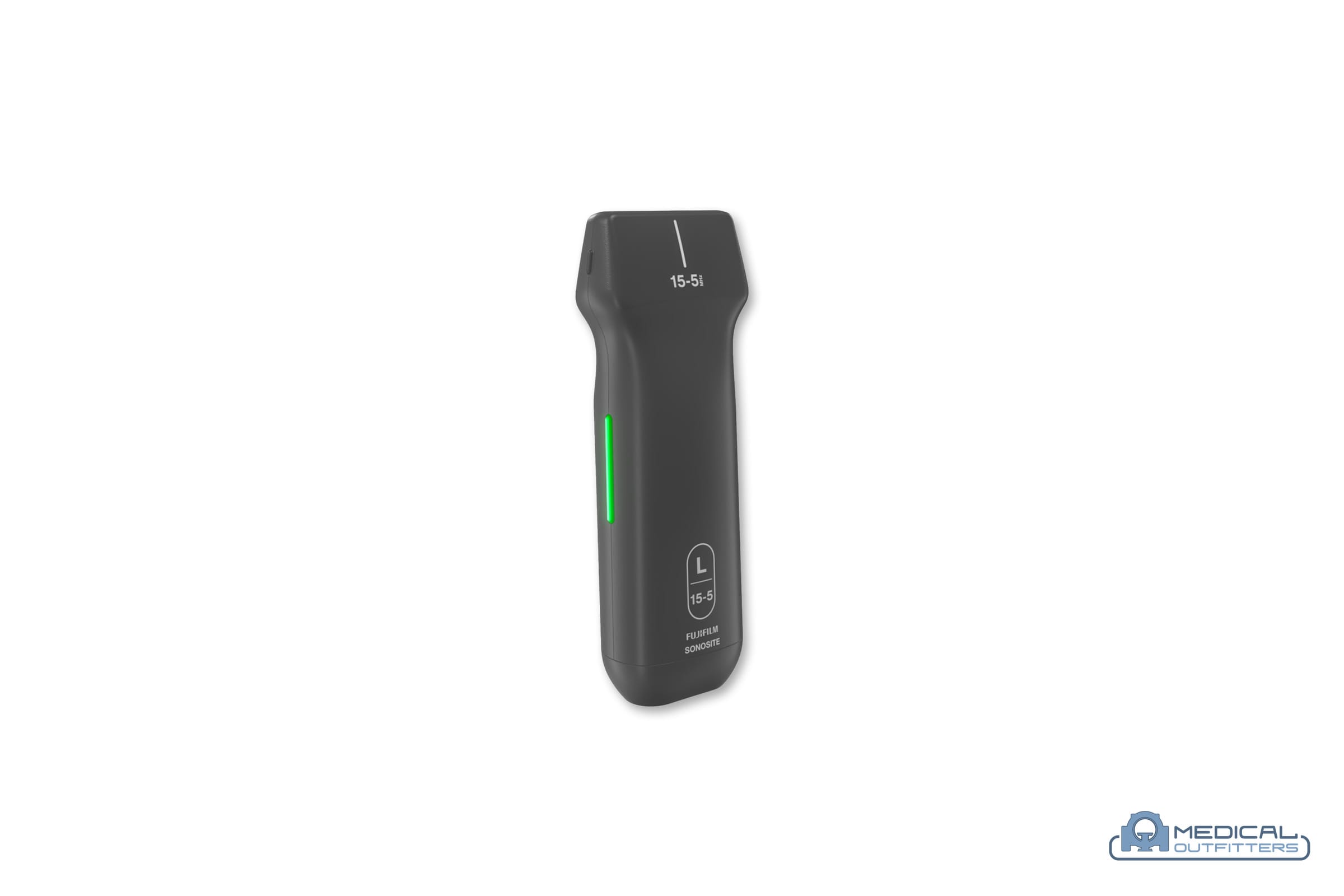
Every ultrasound price above is revenue to the practice or facility that owns the machine, and the machine is the least expensive imaging system a facility buys. The Medical Outfitters ultrasound machine cost guide puts the system price, delivered, installed and warrantied, at $15,000 to $40,000 for a refurbished portable or compact system and $30,000 to $90,000 for a refurbished cart-based or premium system, against $35,000 to $70,000 and $90,000 to $200,000 new. A typical clinic purchase, a refurbished portable or compact cart, lands at $20,000 to $40,000 per the guide, a refurbished hospital cart at $50,000 to $75,000, and a certified refurbished system saves 40 to 60 percent against new. Handheld scanners are a market reference in the guide at $4,000 to $12,000 refurbished and $9,000 to $18,000 new; Medical Outfitters does not currently supply them. Those are Medical Outfitters all-in figures and they sit above the equipment-only prices published elsewhere, which the guide lists for comparison.
| System class | Refurbished, all-in | New, all-in | Examples in the guide |
|---|---|---|---|
| Handheld, point of care | $4,000 to $12,000 | $9,000 to $18,000 | Market reference only; not supplied |
| Portable and compact | $15,000 to $40,000 | $35,000 to $70,000 | Sonosite ZX, Edge II, M-Turbo; GE Logiq e, Venue |
| Cart-based and premium | $30,000 to $90,000 | $90,000 to $200,000 | ARIETTA 650 to 850; GE Logiq E10, Voluson E10; Philips EPIQ |
| Cardiovascular cart | $60,000 to $90,000 | $140,000 to $200,000 | Lisendo 880; GE Vivid E95; Philips EPIQ CVx |
Source: Medical Outfitters Ultrasound Machine Cost and Buying Guide (2026). GE and Siemens systems come refurbished through MO Select; Fujifilm ARIETTA, Lisendo and Sonosite systems are sold new as an authorized dealer; Philips, Canon, Mindray and Samsung systems are sourced refurbished on request. New prices for brands Medical Outfitters does not sell new are the guide’s estimates through the manufacturer.
The payback arithmetic is why so many practices own a machine rather than refer the exam out. Take a refurbished compact cart at $45,000, inside the guide’s cart band, and two levels of net revenue per exam after the interpretation: $75, about two thirds of the 2026 Medicare global rate for a complete abdominal exam, and $120, closer to a commercial blend. At $75 net the equipment line is recovered after 600 exams; at $120 net, after 375. On a five-day schedule of about 21.7 scanning days a month, that is roughly 12 weeks at ten exams a day and $75 net, or about 8 weeks at $120 net; a practice doing six exams a day recovers it in 20 weeks at the lower figure. The chart below is our arithmetic on the guide’s band and shows the equipment line only: the sonographer, the room, the service contract, the probes and the interpretation sit on top.
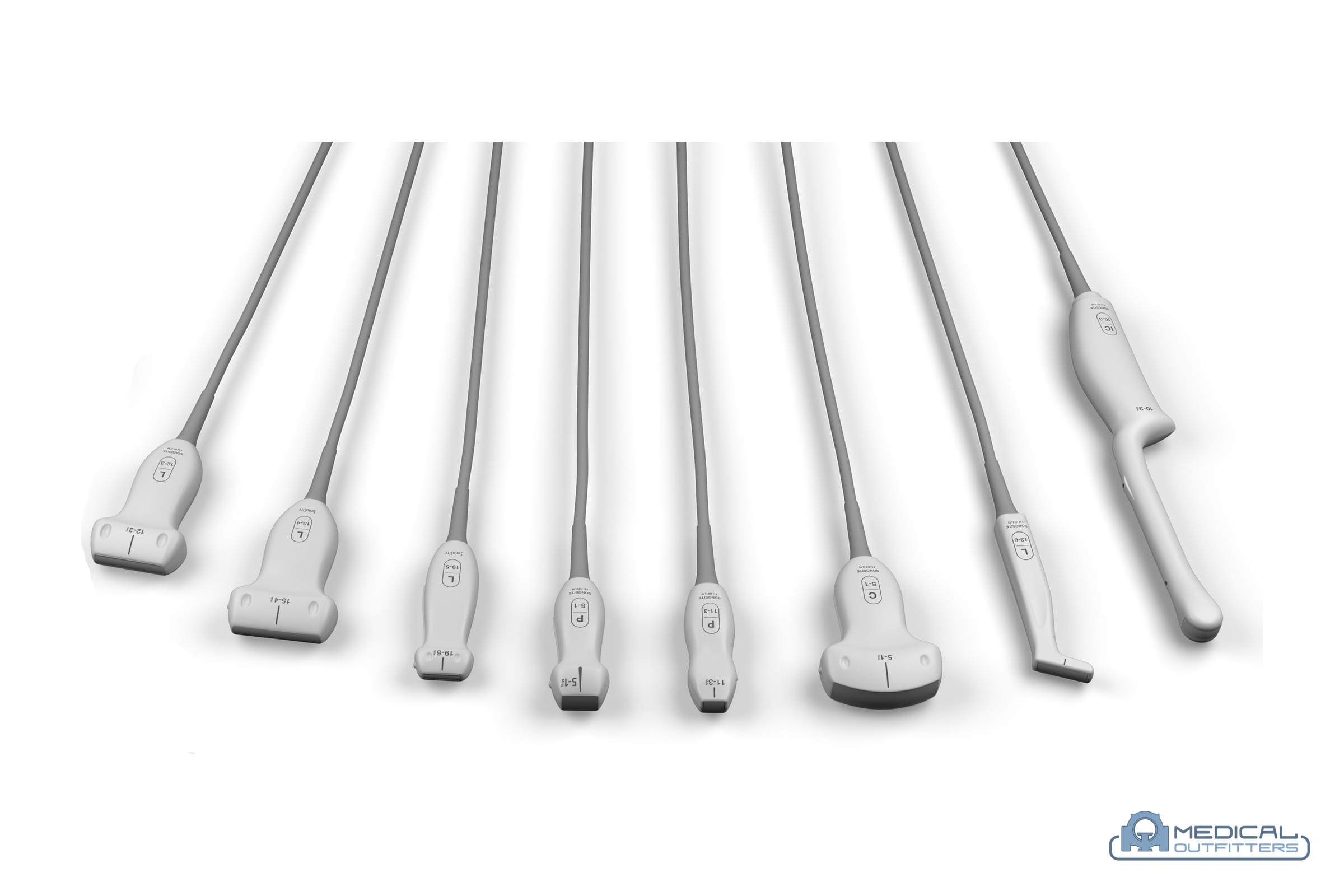
Probes are the running cost that decides whether that arithmetic holds. The guide prices a new transducer at $3,000 to $30,000 depending on type, a tested refurbished one at $1,000 to $15,000 and a repair at $400 to $6,000, and a cart system with four or five probes carries a large share of its value in the probes. Cables, connectors and lenses fail from daily handling, a dropped endocavity probe is a four-figure event, and a transesophageal probe for echo costs $15,000 to $30,000 new per the guide. The ultrasound service page describes the probe testing Medical Outfitters runs before money is spent, a visual inspection, air scans for element dropout, phantom checks and electrical safety testing, and the four service plan shapes it offers; our guide to ultrasound probe types, failures and repair covers what goes wrong and what it costs.
For a facility choosing between new and refurbished, the exam price often settles it. Medicare pays the same $114.23 for a complete abdominal exam at an imaging center under the 2026 fee schedule whether the images come from a new cart or a refurbished one, so for routine abdominal, pelvic, thyroid, musculoskeletal and vascular work a refurbished system earns the same revenue per exam at roughly half the purchase price. A new system earns its premium in the newest image processing, the widest probe catalog, a long factory warranty and, for cardiac and obstetric work, the newest 3D and 4D volume tools. Model-level pricing for the common platforms is in the model section of the cost guide and the portable ultrasound machine price guide, and the new Fujifilm line on the site runs from the Sonosite ZX to the ARIETTA 850 DeepInsight and the cardiovascular Lisendo 880.
Pricing the Exam and the Machine With Medical Outfitters
If you arrived here as a patient, the short version is to ask for the CPT code, call the ordering practice and an accredited independent imaging center for their self-pay prices, and insist on a Good Faith Estimate. If you arrived as a practice owner, administrator or sonography manager, the exam prices on this page are your revenue side, and the ultrasound machine cost and buying guide is the cost side: bands by system class, model-level prices, what a quote includes and what probes cost to run. Current systems are in our ultrasound machines category and on the ultrasound machines for sale page, the MO Select standard is described on the refurbished imaging equipment page, and every modality’s price bands sit side by side in our radiology equipment cost table. The same question for the other modalities is answered in how much a CT scan costs and how much an MRI scan costs. Send us your expected exams per day, the exam mix and your payer mix and we will run the payback on a specific system, delivered, installed and warrantied, with the probes tested: contact Medical Outfitters.
- CoveredUSA, “Ultrasound Cost” (updated May 17, 2026): cash ranges by exam and CPT code, by setting, rounded Medicare rates, Part B cost-sharing examples, price-transparency and Good Faith Estimate notes. coveredusa.org
- CoveredUSA, “Pregnancy Ultrasound Cost” (October 7, 2026): pregnancy scan prices by setting and exam, self-pay discount ranges, ACA and Medicaid notes. coveredusa.org
- CareRoute, “How Much Does an Ultrasound Cost in 2026?” (updated May 2026) and “How Much Does an Echocardiogram Cost?” (September 2026): ranges by exam type with and without insurance, echo prices by setting, facility fees, worked coinsurance example. careroute.ai
- CMS 2026 Medicare Physician Fee Schedule relative value file, via FastRVU lookups for CPT 76700, 76856, 76830, 76536, 76805 and 93970: RVUs and national payments at the $33.4009 conversion factor. fastrvu.com
- American Society of Echocardiography, CY 2026 MPFS final rate comparison: CPT 93306 global, professional and technical payments. asecho.org
- American College of Radiology, CY 2026 HOPPS final rule summaries: 2026 outpatient conversion factor and the APC 5522 payment rate. acr.org
- Health Care Cost Institute, “Imaging Services are the Second Most Common Outpatient Service” (April 2026): commercial ultrasound prices at 245 percent of Medicare, hospital outpatient versus office prices, the $2.7 billion estimate. healthcostinstitute.org
- AuntMinnie, “Abdominal ultrasound priciest in Fla., cheapest in NJ” (June 16, 2021), reporting the Hospital Pricing Specialists analysis of 2,078 hospital price files. auntminnie.com
- CMS, Hospital Price Transparency fact sheet for the CY 2026 OPPS final rule (November 21, 2025), the 2026 Part B deductible announcement (November 14, 2025) and the No Surprises Act Good Faith Estimate page. cms.gov
- RadiologyInfo (ACR and RSNA), general and obstetric ultrasound pages, and MedlinePlus, pregnancy ultrasound: how the exam works, uses, and the safety statements. radiologyinfo.org
- Medical Outfitters, Ultrasound Machine Cost and Buying Guide (2026) and the ultrasound service page: system and probe price bands, how each brand is sold, probe testing and service plans. medicaloutfitters.com
- Ultrasound machine cost and buying guide (2026)
- Portable ultrasound machine price guide (2026)
- Ultrasound machines: new Fujifilm, refurbished GE, Siemens and Philips
- Ultrasound machines for sale
- Ultrasound machine service, repair and probe testing
- Refurbished medical imaging equipment: the MO Select standard
- How to choose an ultrasound probe
- Ultrasound transducer types explained
- Ultrasound probes and transducers: types, failures and repair
- How much does a CT scan cost in 2026?
- How much does an MRI scan cost in 2026?
- Radiology equipment cost: every modality in one table
- Fujifilm Sonosite ZX point-of-care ultrasound
- Fujifilm ARIETTA 850 DeepInsight ultrasound
- Run the payback on a specific ultrasound system
Ultrasound Cost: Common Questions
How much does an ultrasound cost in 2026?
About $150 to $1,000 without insurance, with a national median near $350, according to CoveredUSA's May 2026 pricing guide: roughly $150 to $450 at an independent imaging center, $150 to $500 in a physician's office and $400 to $1,200 in a hospital outpatient department. Medicare's 2026 fee schedule pays about $114 for a complete abdominal ultrasound and $105 for a complete pelvic ultrasound at an imaging center, per the CMS relative value file, and insured patients typically owe $0 to $250 out of pocket, per CareRoute.
How much is an ultrasound without insurance?
Ask for the self-pay price, not the list price. CoveredUSA's May 2026 guide puts a complete abdominal ultrasound at $200 to $800 cash, a pelvic at $150 to $700 and a thyroid at $100 to $400, with independent imaging centers at $150 to $450 for most exams against $400 to $1,200 at a hospital. CareRoute puts cash prices 30 to 60 percent below billed charges. Under the No Surprises Act every self-pay patient scheduled three or more business days ahead is entitled to a written Good Faith Estimate, and a bill $400 or more above it can be disputed.
How much does an ultrasound cost with insurance?
A share of the rate your insurer negotiated. The Health Care Cost Institute's April 2026 brief found commercial ultrasound prices averaging 245 percent of Medicare, so roughly $260 to $290 for a pelvic, abdominal or transvaginal exam on our arithmetic. With the deductible met you pay a copay of about $50 to $200 or 20 percent coinsurance, which CareRoute's example puts at $36 on a $180 negotiated rate; under an unmet high deductible you pay the full negotiated rate. A hospital adds a facility fee of $200 to $800 or more with its own cost sharing.
How much does Medicare pay for an ultrasound?
Under the 2026 Medicare Physician Fee Schedule, at a conversion factor of $33.4009, the CMS relative value file gives a national payment of $114.23 for a complete abdominal ultrasound (76700), $105.21 for a complete pelvic (76856), $117.57 for a transvaginal (76830), $108.55 for a thyroid and neck exam (76536) and $184.04 for a bilateral leg venous duplex (93970). The patient pays 20 percent after the $283 Part B deductible. In a hospital outpatient department the hospital is paid an APC rate, $106.81 for Level 2 imaging in 2026 per the ACR, and the physician bills the interpretation separately.
How much does a pregnancy ultrasound cost?
CoveredUSA's October 2026 pregnancy guide puts a scan at $100 to $400 at an independent imaging center, $150 to $500 at an OB/GYN office and $300 to $1,000 at a hospital outpatient department, with a national median near $300. A dating scan runs $100 to $300, the 18 to 22 week anatomy scan $150 to $600, a detailed or growth scan $300 to $1,000 and an elective 3D or 4D keepsake scan $60 to $250. CareRoute reports bundled self-pay packages covering every scan of the pregnancy at $2,000 to $4,000. Marketplace plans cover maternity care, but cost sharing can still apply to each scan.
Why does an ultrasound cost more at a hospital than at an imaging center or doctor's office?
Because the hospital is paid under a different system and negotiates from a higher base. Medicare pays hospitals a facility payment under the outpatient prospective payment system that offices and freestanding centers do not receive, and the Health Care Cost Institute found hospital outpatient imaging prices two to four times physician-office prices in 2022 commercial claims, 3.7 times for the lowest imaging level. A 2021 analysis of 2,078 hospital price files reported by AuntMinnie found average hospital cash prices for an abdominal ultrasound from $319 in New Jersey to $2,295 in Florida. The machine and the images can be the same.
How much does an ultrasound machine cost?
The Medical Outfitters ultrasound machine cost guide puts a refurbished portable or compact system at $15,000 to $40,000 and a refurbished cart-based or premium system at $30,000 to $90,000, against $35,000 to $70,000 and $90,000 to $200,000 new, all delivered, installed and warrantied, with a cardiovascular cart such as the Fujifilm Lisendo 880 at $140,000 to $200,000 new. Probes add $3,000 to $30,000 each new or $1,000 to $15,000 tested refurbished. Fujifilm ARIETTA, Lisendo and Sonosite systems are sold new; GE and Siemens come refurbished through MO Select.
How many ultrasound exams does it take to pay for a machine?
On our arithmetic for a refurbished compact cart at $45,000, inside the Medical Outfitters guide's cart band, the equipment line is recovered after 600 exams at $75 net revenue per exam or 375 exams at $120 net. At ten exams a day, five days a week, that is roughly twelve weeks or eight weeks. The sonographer, the room, the probes and their repairs, the service contract and the interpretation sit on top, so the machine is the smallest part of the budget and probe care is the cost that decides the economics.