Updated 28 September 2026. Price ranges are Medical Outfitters all-in figures reviewed 16 September 2026; specifications and regulatory references were checked against manufacturer documentation and primary sources. Written by the Medical Outfitters sales and field engineering team.
A PET/CT scanner costs $200,000 to $450,000 for a refurbished entry-level system, $450,000 to $800,000 for a refurbished mid-tier time-of-flight system, and $500,000 to $4 million or more for a new scanner, delivered, installed and warrantied. Detector generation and condition set the band; the CT slice count, software and the room set where in the band a quote lands.
These are Medical Outfitters ranges for a working system, not equipment-only figures, which is why they sit above headline prices published elsewhere. A PET/CT is among the most capital-intensive imaging purchases a facility makes, and the scanner is only part of the project: shielding, a hot lab, uptake rooms and a daily tracer supply come with it. This guide gives you the price by tier, the models in each tier, what moves the number, what a quote includes, what the suite and the isotope cost you, and what a PET scan pays.
- In this guide: PET/CT scanner cost by tier, new and refurbished
- The tiers, with the GE, Siemens, Philips and Canon models in each
- What moves the price of a PET/CT scanner
- What a PET/CT price includes
- Used and refurbished PET/CT prices
- Shielding, hot lab, uptake rooms and licensing
- Where the tracer comes from: radiopharmacy or cyclotron
- What it costs to run a PET/CT
- Mobile PET/CT: rent, lease or buy
- How much a PET scan costs (the exam, not the machine)
- How to choose the right PET/CT for your budget
- Frequently asked questions
- Get this guide as a PDF by email
How Much Does a PET/CT Scanner Cost?
PET/CT scanner cost is driven by detector technology, slice count of the CT component, and condition. The figures below are Medical Outfitters ranges for a system delivered, installed and warrantied. Headline prices published elsewhere are often for the equipment alone, before delivery, rigging, installation and current tariffs, so they read lower than a real all-in cost. Every Medical Outfitters system is quoted individually. Typical system price ranges are:
| PET/CT Tier | Refurbished | New |
|---|---|---|
| Entry / older PET/CT | $200,000 – $450,000 | $500,000 – $950,000 |
| Mid-tier PET/CT | $450,000 – $800,000 | $1,100,000 – $2,000,000 |
| Premium / new-generation PET/CT | $800,000 – $1,500,000 | $2,200,000 – $4,000,000 |
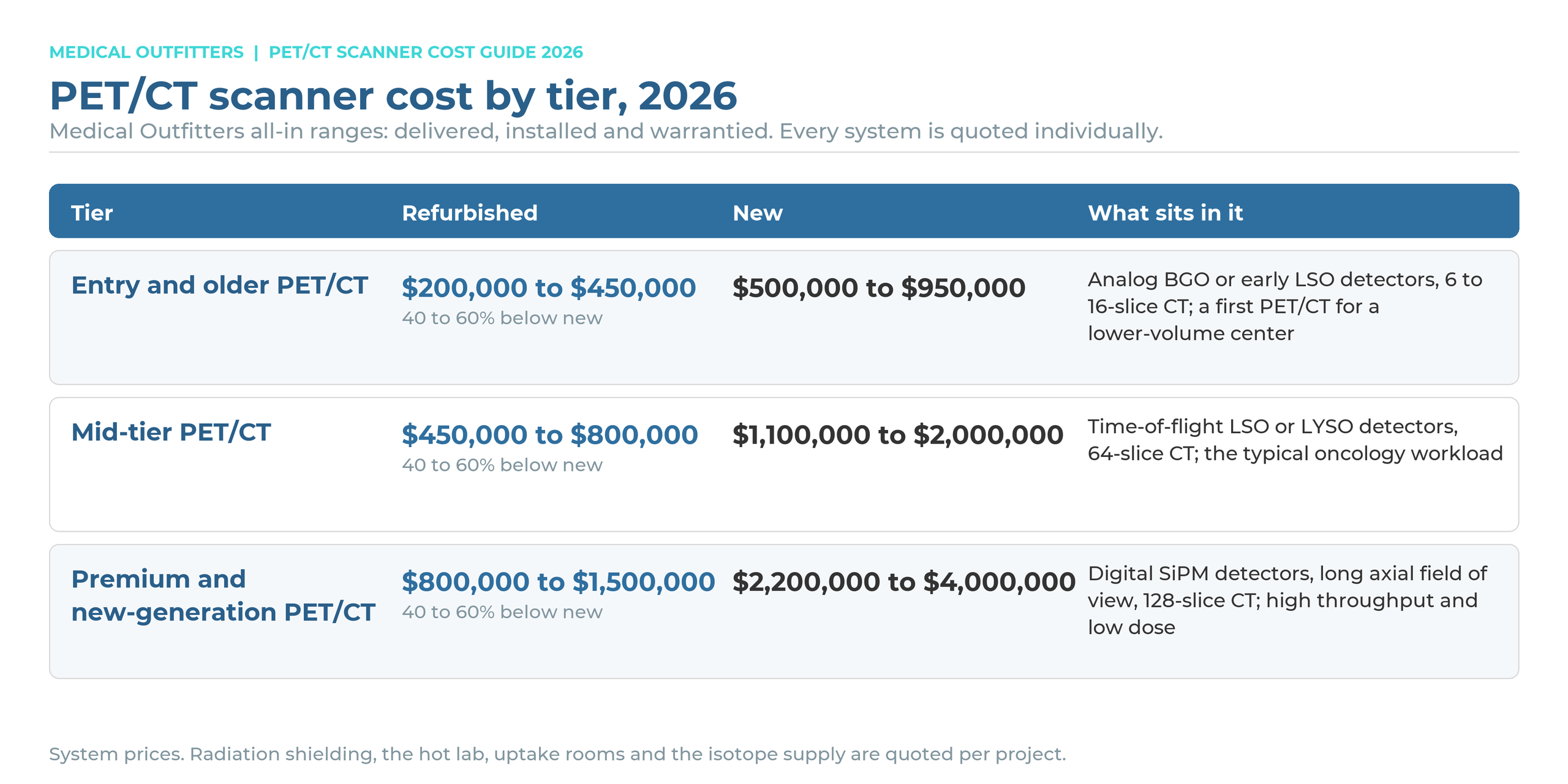
These are system prices. Full project cost adds radiation shielding, hot-lab setup, and isotope supply. A certified refurbished PET/CT typically saves 40–60% versus new. Request a PET/CT scanner quote »
The same question arrives in many forms: PET scanner cost, PET scanner price, cost of a PET scanner, PET scan machine cost, price of a PET scan machine, PET/CT scanner price, PET CT scan machine cost, positron emission tomography machine cost, how much does a PET scan machine cost, how much is a PET/CT scanner. They all point at the table above. The one distinction that matters is the detector generation, because an analog entry-level system and a digital time-of-flight system are different classes of purchase, and the second is condition. In dollars, most freestanding centers adding PET land in the refurbished mid-tier band, $450,000 to $800,000 delivered and installed.
What is the average cost of a PET/CT scanner?
Averages hide the tier split. Across the systems we quote, the refurbished mid-tier band is the center of the market, $450,000 to $800,000 delivered and installed, because a time-of-flight system with a 64-slice CT covers the oncology workload a center is built around. An entry-level refurbished system averages in the low-to-mid six figures; a new digital system averages well over two million dollars. An average PET/CT price quoted without the detector generation and the condition is not a usable number.
Get This Guide as a PDF by Email
The print edition of the 2026 PET/CT Scanner Price Guide carries the same price ranges, model tables and figures as this page, with a cover and page numbers, formatted for printing and for sharing with a board or a finance committee. It is sent by email; fill in the form and it is on its way.
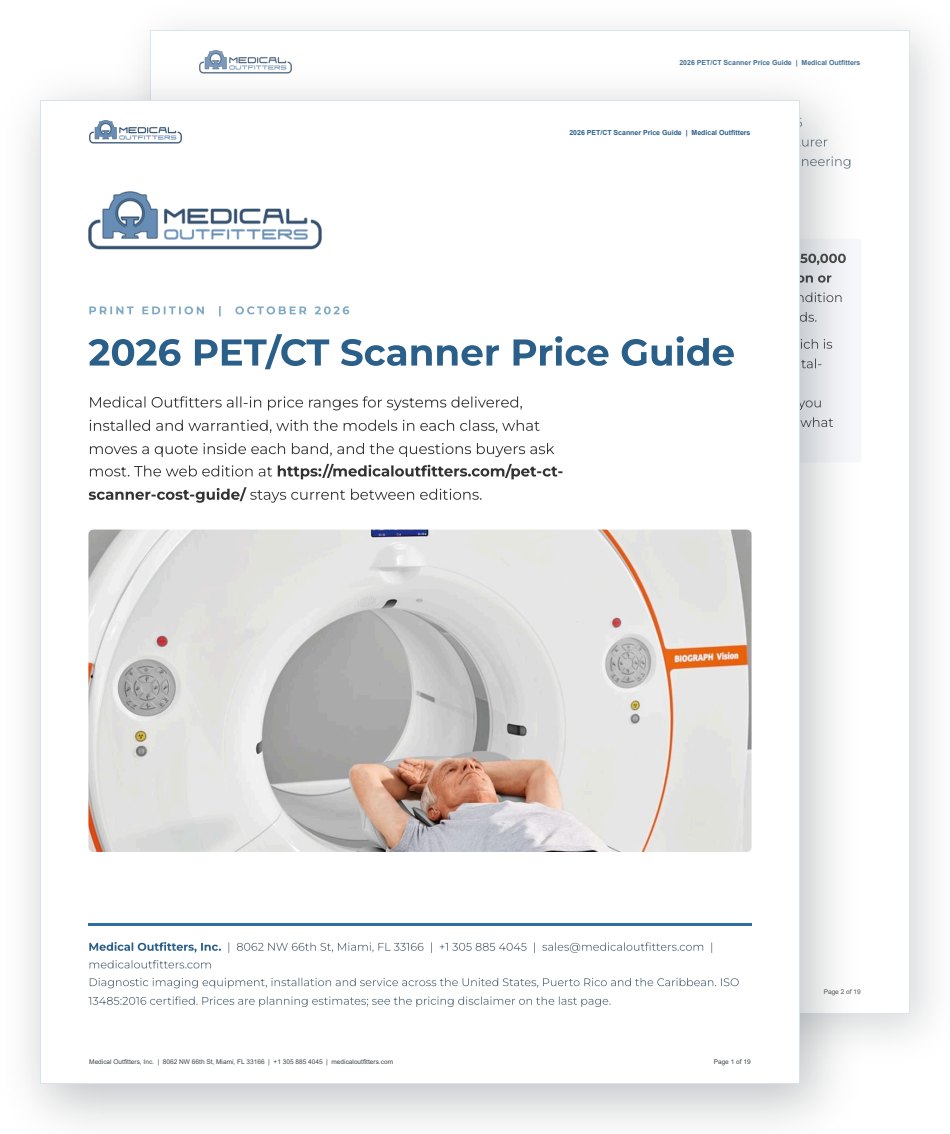
19 pages, Letter size: cover, price tables, figures, FAQ and page numbers for printing.
PET/CT Price Tiers, With the Models in Each
Model names make the table concrete. The scanners below are grouped by the tier they are bought in; the price band is the tier band from the table, not a per-model list price, because the same model can be quoted at either end of its band depending on detector history, CT tube life, software and condition.
Entry and older PET/CT: $200,000 to $450,000 refurbished, $500,000 to $950,000 new
Analog BGO or early LSO detectors on a 6 to 16-slice CT. The GE Discovery ST and STE, the Siemens Biograph 6 and 16, and the Philips Gemini GXL sit here. They still image well for routine oncology staging, and they are the way a lower-volume center adds PET capability for the price of a good CT. Check detector uniformity, the age of the CT tube and whether the manufacturer still supports the software before you buy one.
Mid-tier PET/CT: $450,000 to $800,000 refurbished, $1,100,000 to $2,000,000 new
Time-of-flight LSO or LYSO detectors on a 64-slice CT: the GE Discovery 600, 610, 690 and 710, the Siemens Biograph TruePoint and Biograph mCT, and the Philips Gemini TF and Ingenuity TF. This is the typical oncology workload tier and the system most freestanding centers buy refurbished, because time-of-flight reconstruction shortens scan times and lowers the injected dose without the price of a digital platform.
Premium and new-generation PET/CT: $800,000 to $1,500,000 refurbished, $2,200,000 to $4,000,000 new
Digital silicon-photomultiplier detectors, long axial fields of view and 64 to 128-slice CT: the GE Discovery MI, Discovery MI DR and Omni Legend, the Siemens Biograph Vision, Vision Quadra and Horizon, the Philips Vereos, the Canon Cartesion Prime and the United Imaging uMI series. High throughput, the lowest dose per study and the sensitivity that PSMA, amyloid and cardiac protocols reward. A hospital or high-volume network purchase; refurbished digital systems are beginning to appear on the used market as first owners upgrade.
PET/CT scanner price by brand
Brand moves a quote less than detector generation does. GE HealthCare: the Discovery family from the ST through the 690, 710 and IQ to the digital MI, with the largest used market and the widest parts availability. Siemens Healthineers: the Biograph series from the 6 and 16 through TruePoint and mCT to the digital Vision; strong time-of-flight lineage and a deep installed base. Philips: Gemini GXL and TF, Ingenuity TF and the digital Vereos; we have de-installed and removed Philips TF PET/CT systems for hospital clients. Canon: Celesteion and the Cartesion Prime, a smaller but established presence. United Imaging: the uMI series, a newer entrant with long axial field-of-view designs. Medical Outfitters sources, compares and installs refurbished PET/CT systems from these manufacturers; tell us the tier and the clinical focus and we will shortlist two or three systems.
What Affects the Price of a PET/CT Scanner?
Two PET/CT scanners of the same age can be several hundred thousand dollars apart. These are the things that move a PET/CT scanner cost, roughly in order of impact.
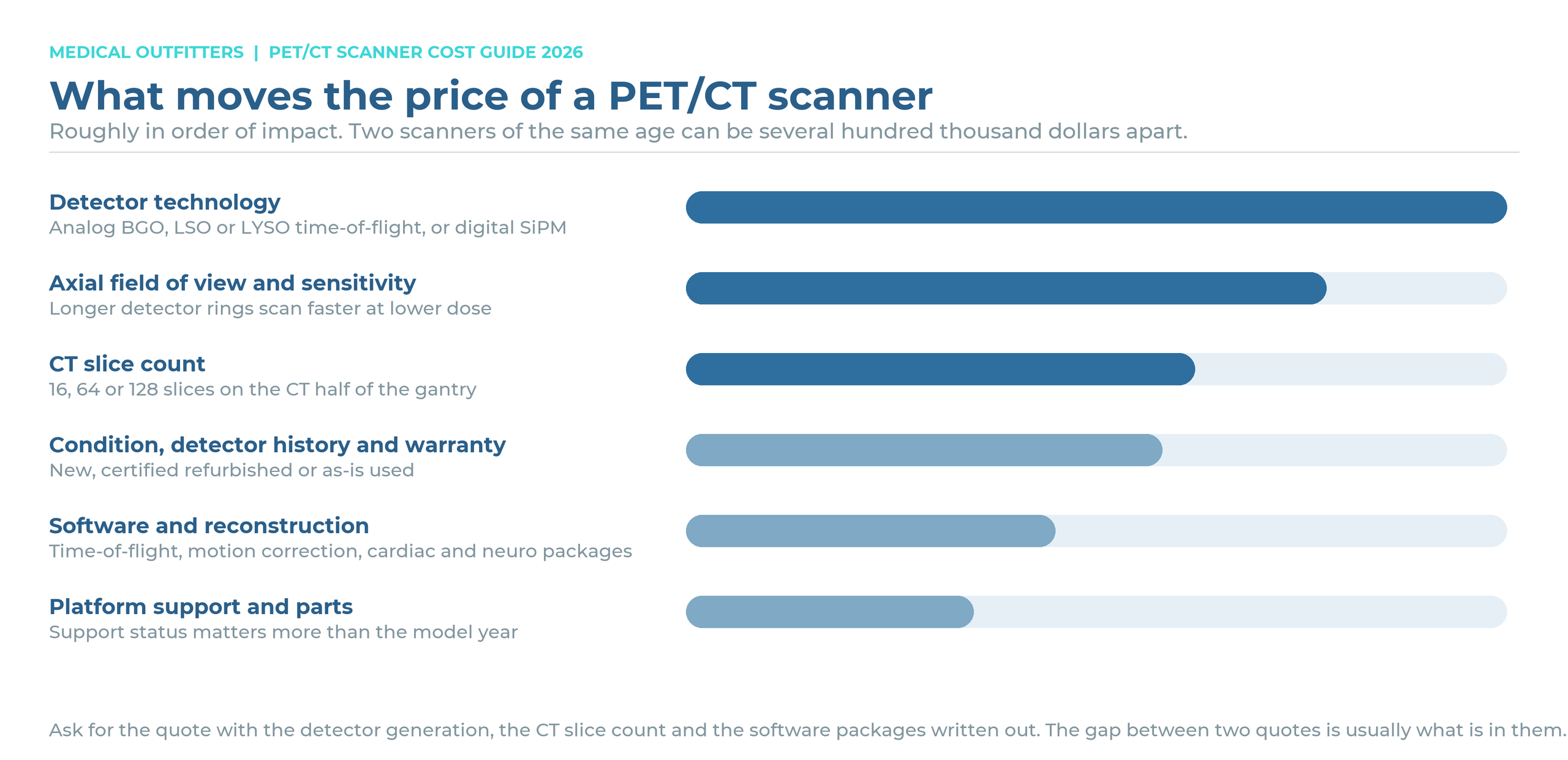
- Detector technology The biggest factor. Analog BGO, time-of-flight LSO or LYSO, and digital silicon-photomultiplier detectors are three price classes before anything else is considered
- Axial field of view and sensitivity Longer detector rings see more of the patient per bed position, so they scan faster at a lower injected dose; sensitivity is the spec that decides throughput
- CT slice count 16, 64 or 128 slices on the CT half of the gantry, which sets whether the system can double as a diagnostic CT and how fast the attenuation scan runs
- Condition, detector history and warranty New with a manufacturer warranty at the top, certified refurbished with a dealer warranty in the middle, as-is used at the bottom; on PET the detector calibration history matters as much as the CT tube
- Software and reconstruction Time-of-flight, motion correction, cardiac, neuro and PSMA packages are licensed options priced separately and do not always transfer with a used system
- Platform support and parts Whether the manufacturer still supports the software and supplies detector modules matters more than the year of manufacture
Ask for the PET/CT quote with the detector generation, the CT slice count and the software packages written out. A bare system price and a working configuration are different numbers, and the gap between two quotes is usually what is in them rather than the scanner.
What Is Included in a PET/CT Scanner Price?
The table above gives system prices. When you compare quotes, compare the scope as well as the number, because on PET/CT the project around the scanner is larger than on any other modality except MRI.
- Quoted with the system Gantry with PET and CT components, patient table, acquisition and reconstruction consoles, the software packages listed, the CT tube as specified, and calibration sources for commissioning
- Quoted per project Radiation shielding for the scan room, uptake rooms and hot lab; the hot lab fit-out with dose calibrator and shielded storage; contrast injector for the CT; electrical work and cooling; floor loading checks; rigging and delivery; applications training; the physicist’s shielding design and survey; the radioactive materials license; and the first service contract
Medical Outfitters prices are all-in for a system delivered, installed and warrantied, which is why they sit above the equipment-only figures published elsewhere. We handle delivery, rigging and installation with our own crews across the United States, Puerto Rico and the Caribbean, and if you are replacing a system rather than adding one, the scanner you retire may be worth something against the new one; we buy used imaging equipment.
How Much Does a Used or Refurbished PET/CT Scanner Cost?
A used PET/CT price depends on three things before the model name: the detector generation, the detector calibration history, and the CT tube life remaining. A refurbished PET/CT from Medical Outfitters, which means inspected, tested to specification and warrantied, runs 40 to 60 percent below the new price of the same tier: roughly $200,000 to $450,000 for an entry system and $450,000 to $800,000 for a mid-tier time-of-flight system, delivered and installed. As-is used systems sit below that, for buyers who have their own service arrangement and can absorb a detector module or tube replacement.
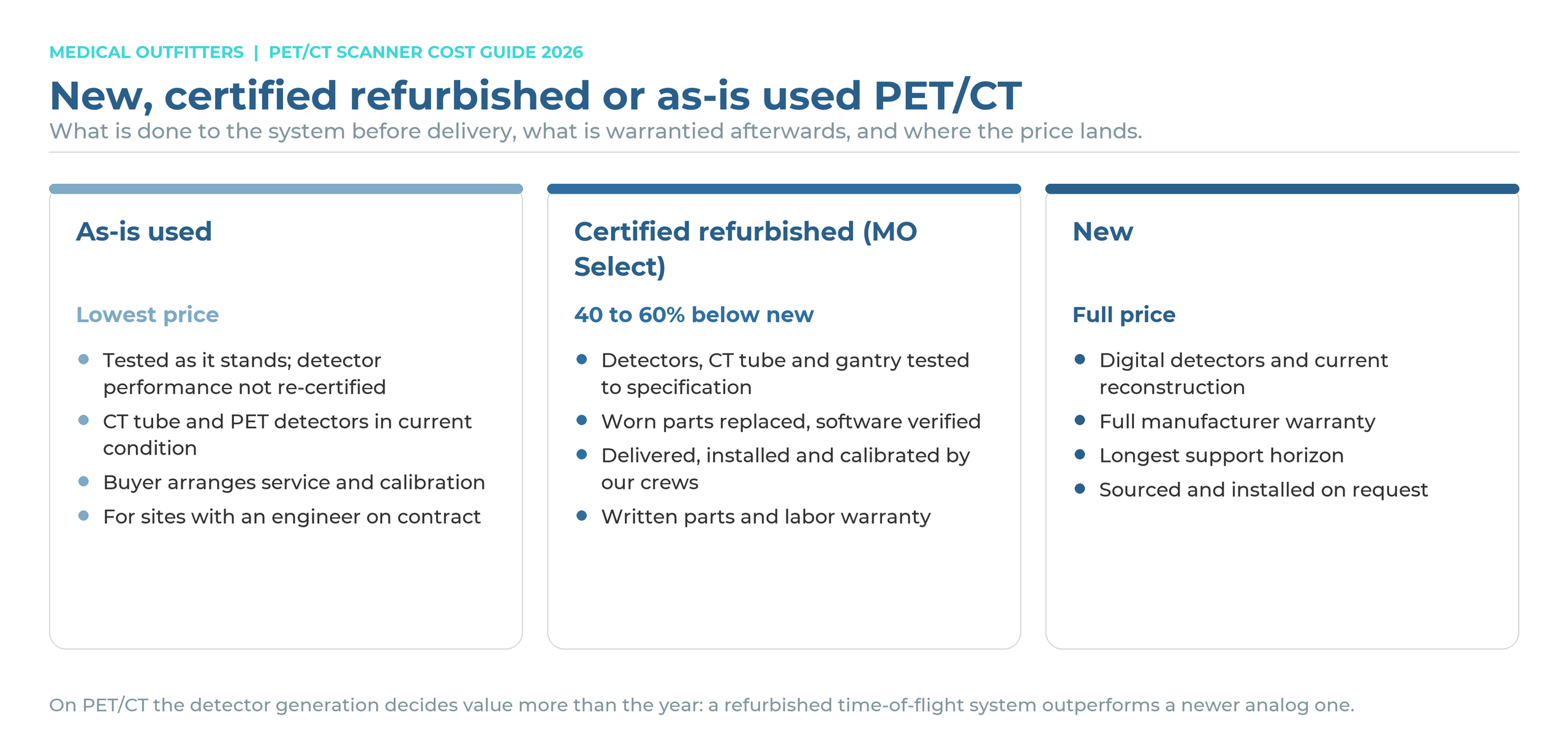
As-is used
The lowest price. The scanner is tested and inspected as it stands, the detectors and CT tube are sold in their current condition, and the buyer arranges service and calibration. It suits a site with a physicist and an engineer on contract; it is the wrong first PET/CT for a new center.
Cosmetic refurbishment
Some sellers clean and repaint a system and call it refurbished. The detectors have not been re-certified and the CT tube has not been assessed. Ask what was done; if the answer is covers and paint, price it as a used system.
Certified refurbished (MO Select)
Detectors, CT tube and gantry tested to specification, worn parts replaced, software verified, delivered, installed and calibrated by our own crews, and covered by a written parts and labor warranty. This is the MO Select standard and it is what the refurbished column of the price table describes. Because PET/CT systems are so capital-intensive, refurbished is often the only way for smaller centers to add the capability, and a refurbished time-of-flight system outperforms a newer analog one. Refurbished versus OEM certified are not the same thing; ask who did the work and what the warranty covers.
Shielding, Hot Lab, Uptake Rooms and Licensing
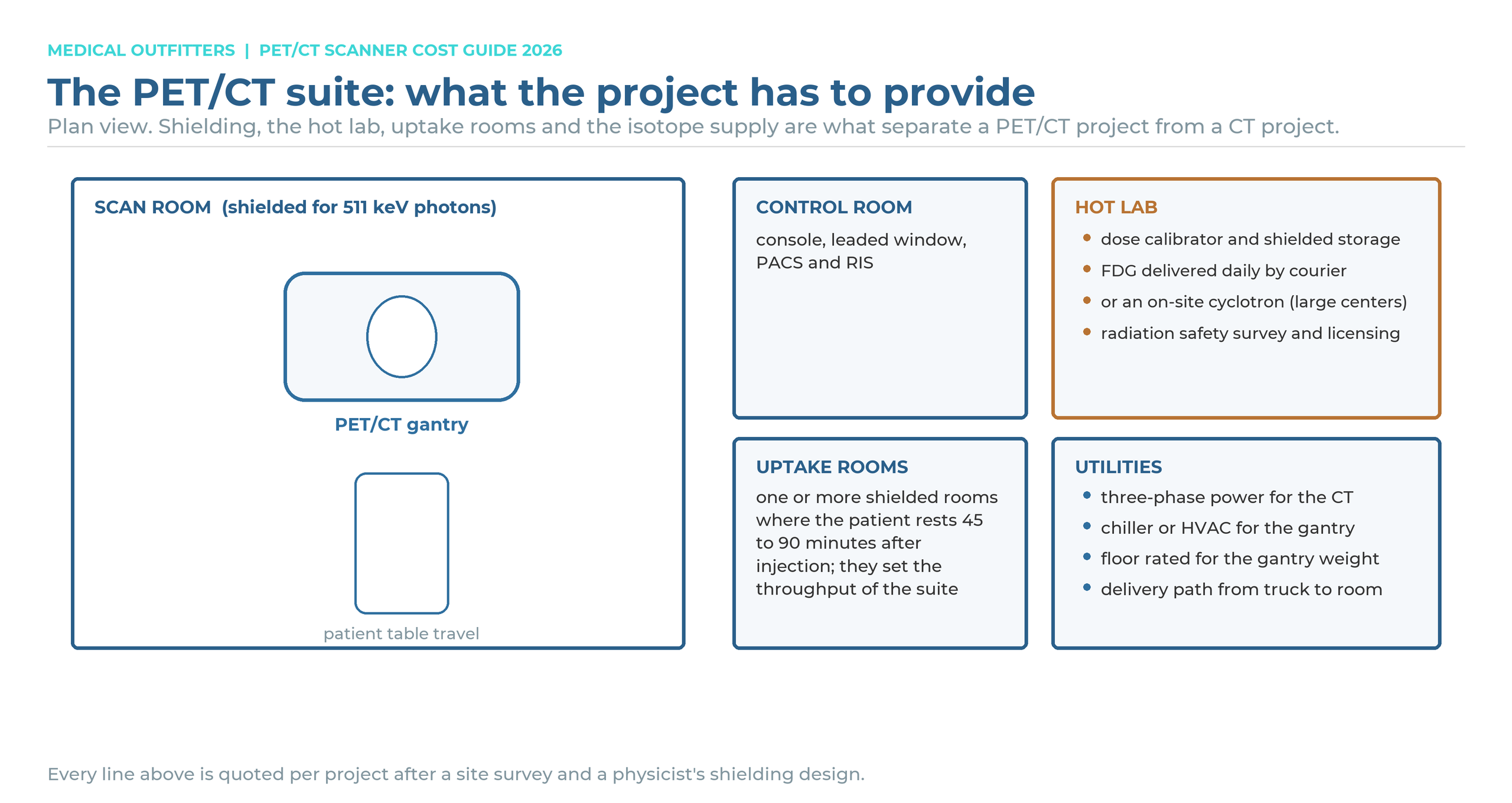
The purchase price is the first line of the project. What separates a PET/CT project from a CT project is everything around the scanner: heavier shielding, a hot lab, uptake rooms, a radiation safety program and a license. None of these are in an equipment-only quote, and all of them are quoted per project because no two sites are alike.
Shielding
PET tracers emit 511 keV annihilation photons, far more penetrating than the X-rays a CT room is shielded for, so the scan room, the uptake rooms and the hot lab need a physicist’s shielding design with thicker lead or concrete than a diagnostic CT room. An existing CT room rarely converts without added shielding; a room that has never held imaging equipment is designed from scratch.
Hot lab and uptake rooms
The hot lab is where doses are received, measured in a dose calibrator and stored behind shielding until injection. The uptake rooms are where an injected patient rests, typically 45 to 90 minutes, while the tracer distributes. Because every patient occupies an uptake room for longer than the scan itself, the number of uptake rooms sets how many patients a day the scanner can image; one room throttles a fast scanner.
Power, cooling, floor loading and delivery
The CT half of the gantry draws a large, brief load on every exam and needs dedicated three-phase power, a chiller or adequate HVAC for the gantry heat, and a floor that carries the combined gantry weight. Door widths, turns and the path from the truck to the room are checked before delivery day. Medical Outfitters manages delivery, rigging and installation as part of every purchase, and on a replacement project we de-install and remove the old system. Learn about installation and rigging »
Licensing, safety program and accreditation
A PET/CT site holds a radioactive materials license from its state or the NRC, names a radiation safety officer, and runs the surveys, wipe tests and dose records the license requires. Non-hospital facilities must also be accredited by a CMS-designated organization to bill Medicare for the technical component of advanced diagnostic imaging, which covers PET alongside CT, MRI and nuclear medicine, a requirement in force since 1 January 2012. Budget the physicist, the license application and the accreditation survey with the room, not after it.
Where the Tracer Comes From: Radiopharmacy or Cyclotron
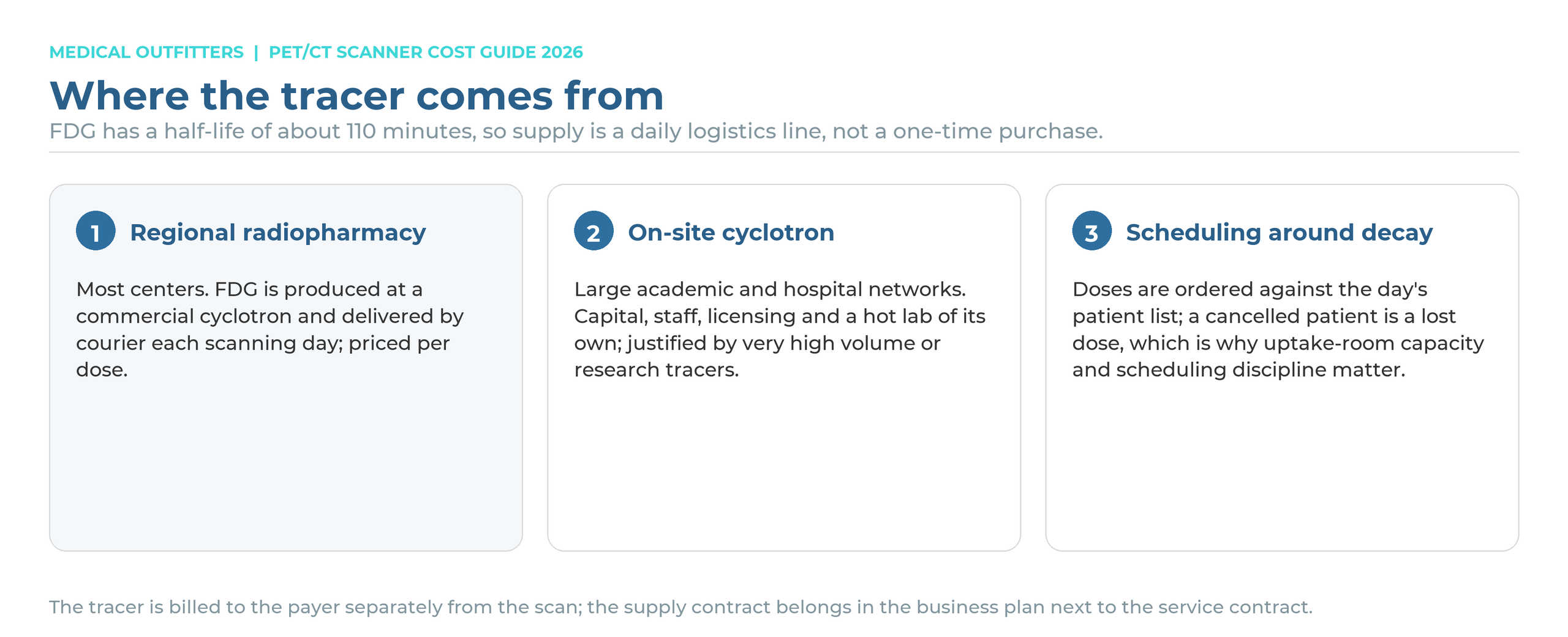
FDG, the glucose analog used for most oncology PET, has a half-life of about 110 minutes. That single fact shapes the business: the tracer cannot be stockpiled, it is bought per dose against the day’s patient list, and the supply chain is a running cost that belongs in the plan next to the service contract.
Regional radiopharmacy
Most centers buy FDG and other tracers from a commercial radiopharmacy with its own cyclotron, delivered by courier each scanning day and priced per dose. It needs no capital beyond the hot lab, and it is the route we assume for a freestanding center unless the volume says otherwise.
On-site cyclotron
Large academic and hospital networks that run several scanners, research tracers or very high volumes sometimes install a cyclotron. It brings its own capital, staffing, licensing and a radiopharmacy of its own, and it is justified by volume and research, not by a single scanner.
Scheduling around decay
Doses are ordered against a confirmed patient list, and a cancelled patient is a lost dose, which is why uptake-room capacity and scheduling discipline matter as much as the scanner’s speed. The tracer is billed to the payer separately from the scan; according to CoveredUSA’s July 2026 national pricing guide the FDG dose adds $300 to $1,200 to the imaging fee, which is the revenue line the supply contract sits against.
How Much Does It Cost to Run a PET/CT Scanner?
The PET/CT price is the first line of a ten-year budget. The lines that follow it:
- Service contract Priced per year as a percentage of the system value, with or without the CT tube and detector modules; on PET the detector cover is the line to read carefully
- Tracer supply A per-dose cost on every scanning day, matched by a separately billed revenue line
- Calibration and quality control Daily and quarterly PET calibrations against sealed sources that are themselves replaced on a schedule, plus the CT quality checks and the physicist’s annual survey
- Staff A nuclear medicine technologist or a PET-credentialed CT technologist, the radiation safety officer’s time, and the reading radiologist
- Power, cooling and consumables The CT tube’s power draw, room cooling, contrast for the CT and the hot-lab consumables
For most sites the service contract, the tracer contract and staffing dominate, and together they are why a PET/CT department is planned on volume before it is planned on the scanner. Build the service quote into the purchase decision rather than after it; our service and repair team covers systems we sold and systems bought elsewhere.
Mobile PET/CT: Rent, Lease or Buy
A mobile PET/CT is a full scanner installed in a trailer with its own shielding, hot-lab space and uptake area. Hospitals use them to add PET days without building a suite, to cover a room rebuild, or to share one scanner across several sites on a schedule; smaller centers use them to test demand before committing to a fixed installation.
Mobile PET/CT cost: rent, lease or buy
Three routes exist. Renting by the day or week fits a trial or a cover period; leasing fits a multi-year shared-service model; buying a mobile unit fits a network that will keep it busy. The scanner inside follows the tier bands above; the trailer, its shielding, the site pad, power hookup and transport are quoted per project, and the tracer is delivered to the trailer like any other site. Tell us the days per month you expect and we will say whether a mobile route or a fixed room fits, and quote it; our mobile imaging page covers the service.
How Much Does a PET Scan Cost? (The Exam, Not the Machine)
Many readers arrive at this page asking a different question: not what the machine costs, but what the exam costs. They are two different prices, and the exam price is what the scanner earns.
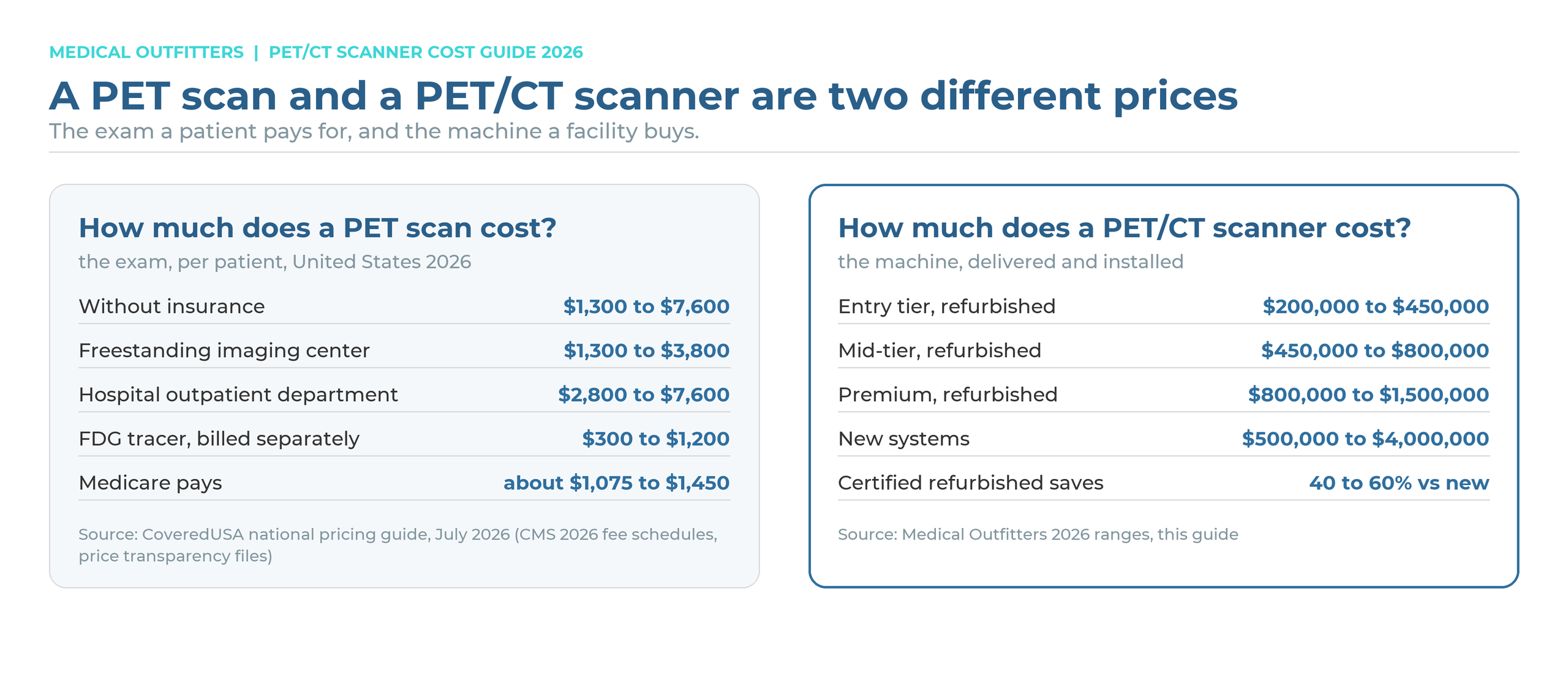
According to CoveredUSA’s July 2026 national pricing guide, which draws on the CMS 2026 fee schedules, hospital price-transparency files and national cash-price data, a PET scan typically costs $1,300 to $7,600 without insurance in 2026: about $1,300 to $3,800 at a freestanding imaging center and $2,800 to $7,600 in a hospital outpatient department, with the FDG tracer billed separately at $300 to $1,200. Medicare pays about $1,075 for the scan at a freestanding center and about $1,450 in a hospital outpatient department, with the patient owing coinsurance after the Part B deductible.
For a facility, those numbers are the revenue side of the purchase decision. A PET/CT is reimbursed at several times a CT exam, which is why a refurbished mid-tier system in a center with the oncology referrals to fill it pays back faster than its price suggests, and why the uptake rooms, not the scanner, usually cap the revenue. If you are pricing the scanner rather than the scan, the table at the top of this page is the answer, and a quote takes a day.
For the patient side in full, including what insurance and Medicare cover, the tracer charge and how prices differ by setting, see our article how much a PET scan costs in 2026.
What Is a PET/CT Scanner and What Is It Used For?
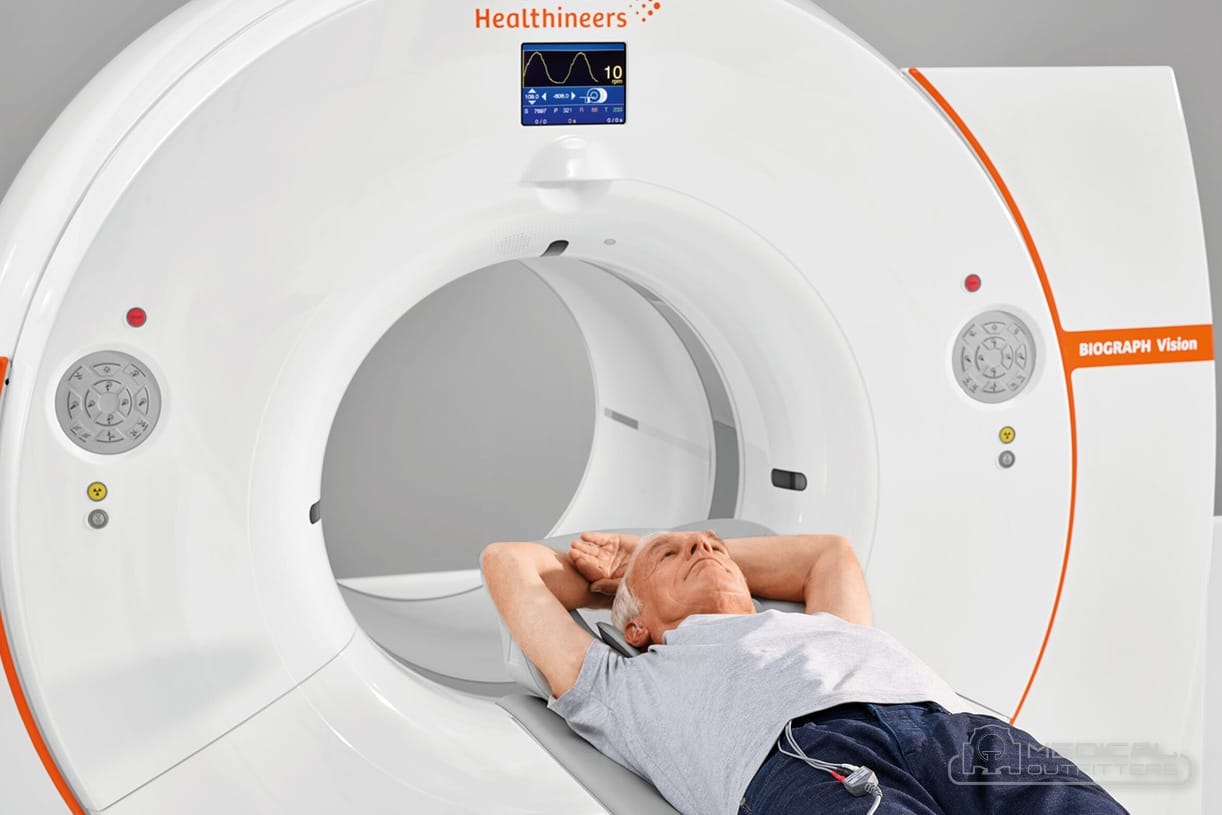
A PET/CT scanner merges two technologies in one gantry. The PET component detects gamma rays emitted by a radioactive tracer to map metabolic activity, revealing where cells are most active, which is critical in cancer detection. The CT component adds high-resolution anatomical detail and corrects the PET data for tissue density. Together they pinpoint disease with far more accuracy than either scan alone.
A patient receives a small dose of a radiotracer, commonly FDG (a glucose analog). Active tissues such as tumors absorb more tracer and emit more signal. The PET detectors capture that signal while the CT builds the anatomical map, and software fuses the two into a single image. Detector type and crystal technology drive both image quality and price.
PET scan vs CT scan vs SPECT
- PET/CT: combines metabolic (PET) and anatomical (CT) imaging, the gold standard for oncology staging. A PET scan vs a CT scan is the difference between seeing where disease is active and seeing what it looks like
- CT: X-ray anatomy only, fast and detailed but without metabolic information. See our CT scanner cost guide, and MRI vs CT for the other common comparison
- SPECT: a different nuclear technique using single-photon tracers, often paired with CT (SPECT/CT) for cardiac and bone studies; a SPECT or SPECT/CT camera is a separate price class, quoted individually
What is a PET/CT scanner used for?
- Oncology: detection, staging, restaging and treatment response across most solid tumors and lymphoma; PSMA PET for prostate cancer is the fastest-growing indication
- Cardiology: myocardial perfusion and viability
- Neurology: amyloid and tau imaging in dementia, epilepsy focus localization
- Infection and inflammation: fever of unknown origin, vasculitis, device infection
Gamma Detection and Nuclear Medicine Equipment
Beyond PET/CT, nuclear medicine relies on gamma detection systems for procedures such as sentinel lymph node mapping and tumor localization. Medical Outfitters supplies the Neoprobe gamma detection system, a trusted tool for intraoperative and surgical nuclear medicine; what a Neoprobe is explains the procedure. Our Neoprobe cost and buying guide covers what the system costs and how to configure the probes. SPECT and SPECT/CT gamma cameras for cardiac and bone imaging are a separate purchase from PET/CT and are quoted individually; ask us for current availability.
Ready to shortlist systems? Our PET/CT scanner buying guide walks through the purchase in order: the case mix you need to serve, detector generations and time-of-flight, sizing the CT half, what the suite and tracer supply require, and a buyer’s checklist to take into every quote.
How to Choose the Right PET/CT Scanner for Your Budget
Match the system to your case volume, clinical focus, and budget. By facility type:
- Freestanding imaging center adding PET: a refurbished mid-tier time-of-flight system, $450,000 to $800,000, with two uptake rooms and a radiopharmacy contract; this is the purchase most centers make
- Hospital oncology department: mid-tier or premium digital, sized to the referral base, with the CT slice count the department will use for diagnostic CT on the same gantry
- Cardiology or neurology practice: a mid-tier system with the cardiac or neuro software licensed, where the referral volume supports a dedicated scanner; otherwise a shared or mobile route
- Networks and academic centers: premium digital systems with long axial fields of view, and the cyclotron question answered on volume and research, not on a single scanner
- Testing demand: a mobile PET/CT on a rental or lease before a fixed suite is built
Key takeaways:
- Entry / older systems for lower-volume centers adding PET/CT capability
- Mid-tier time-of-flight systems for the typical oncology imaging workload
- Premium digital PET/CT for high throughput and the finest detail
- Refurbished for 40–60% savings with comparable performance
- Plan shielding, hot lab, uptake rooms and isotope supply early to avoid delays
Pricing a CT, an MRI or a DEXA as well? See the CT scanner cost guide, the MRI machine cost guide and the DEXA cost guide. Florida buyers can see delivery and installation routes on our Florida imaging equipment page.
PET/CT Installation, Service and Maintenance
A PET/CT suite needs careful planning: radiation shielding, a hot lab for handling radiotracers, uptake rooms, structural support, and a reliable isotope supply chain. Medical Outfitters manages de-installation, rigging, site preparation, and installation. Learn about installation and rigging »
PET/CT systems require specialized preventive maintenance, detector calibration, and parts support to stay reliable and compliant. Medical Outfitters provides imaging service, repair, and parts for systems we sold and systems bought elsewhere. Learn about our service and repair options »
Frequently Asked Questions
- How much does a PET/CT scanner cost?
- A PET/CT scanner costs about $200,000 for a refurbished entry-level system and up to $4 million or more for a new premium scanner, delivered and installed. A refurbished mid-tier time-of-flight PET/CT, the most common purchase, typically runs $450,000 to $800,000.
- How much does a PET scanner cost?
- The same as a PET/CT scanner, because nearly every PET scanner sold today is a PET/CT: $200,000 to $450,000 refurbished for an entry system, $450,000 to $800,000 refurbished for a mid-tier time-of-flight system, and $800,000 to $1,500,000 refurbished or $2,200,000 to $4,000,000 new for a premium digital system.
- What is the price of a PET/CT scanner by tier?
- Refurbished: entry $200,000 to $450,000; mid-tier $450,000 to $800,000; premium $800,000 to $1,500,000. New: entry $500,000 to $950,000; mid-tier $1,100,000 to $2,000,000; premium $2,200,000 to $4,000,000. All figures are Medical Outfitters all-in ranges, delivered, installed and warrantied.
- How much does a PET scan machine cost?
- A PET scan machine costs $200,000 to $1,500,000 refurbished and $500,000 to $4,000,000 new depending on detector generation and the CT slice count. Most freestanding centers buy a refurbished time-of-flight system at $450,000 to $800,000.
- What is the average cost of a PET/CT scanner?
- The center of the market is the refurbished mid-tier band, $450,000 to $800,000 delivered and installed. An average quoted without the detector generation and the condition is not usable, because an analog entry system and a digital scanner are different classes of purchase.
- How much does a used PET/CT scanner cost?
- A used PET/CT price depends on the detector generation, the detector calibration history and the CT tube life more than on the year. Refurbished, inspected and warrantied systems from Medical Outfitters run 40 to 60 percent below new, and as-is used systems sit below that for buyers with their own service arrangement.
- Is a refurbished PET/CT scanner worth it?
- Yes. A certified refurbished PET/CT saves 40 to 60 percent versus new with comparable performance, provided it is fully inspected and backed by warranty. A refurbished time-of-flight system will outperform a newer analog one, so buy the detector generation, not the model year.
- How much does a new digital PET/CT cost?
- A new premium digital PET/CT such as a GE Discovery MI, Siemens Biograph Vision or Philips Vereos costs $2,200,000 to $4,000,000 delivered, installed and warrantied; a new mid-tier system costs $1,100,000 to $2,000,000.
- How much does a GE Discovery or Siemens Biograph PET/CT cost?
- By tier, like every brand: a refurbished GE Discovery ST or Siemens Biograph 16 sits in the $200,000 to $450,000 band, a refurbished Discovery 690, 710 or Biograph mCT in the $450,000 to $800,000 band, and a refurbished Discovery MI or Biograph Vision in the $800,000 to $1,500,000 band.
- How much does a mobile PET/CT cost?
- The scanner inside a mobile unit follows the tier bands; the trailer, its shielding, the site pad, power hookup and transport are quoted per project, for rental by the day, a multi-year lease or purchase. Tell us the scanning days per month you expect and we will quote the route that fits.
- How much does a PET scan cost?
- The exam, not the machine: according to CoveredUSA’s July 2026 national pricing guide, a PET scan typically costs $1,300 to $7,600 without insurance in the United States, about $1,300 to $3,800 at a freestanding imaging center and $2,800 to $7,600 in a hospital outpatient department, with the FDG tracer billed separately at $300 to $1,200. Medicare pays about $1,075 to $1,450 depending on the setting.
- How much does the FDG tracer cost?
- FDG is bought per dose from a radiopharmacy on each scanning day because its half-life is about 110 minutes. It is billed to the payer separately from the scan; CoveredUSA’s July 2026 guide puts the billed tracer at $300 to $1,200 per study. The supply contract price is quoted by the radiopharmacy against your expected volume.
- Do we need a cyclotron to run a PET/CT?
- No. Most centers buy tracers from a regional radiopharmacy that runs its own cyclotron and delivers doses by courier each scanning day. An on-site cyclotron is a large-network or research decision justified by volume, not by a single scanner.
- What does a PET/CT scanner quote include?
- With the system: the gantry, patient table, consoles, the software packages listed, the CT tube as specified and commissioning sources. Per project: shielding for the scan room, uptake rooms and hot lab, the hot-lab fit-out, contrast injector, electrical work and cooling, rigging and delivery, applications training, the physicist’s shielding design, the radioactive materials license and the first service contract. Medical Outfitters quotes are all-in for a system delivered, installed and warrantied.
- What does a PET/CT room need?
- A scan room shielded for 511 keV photons, which is heavier than a CT room; a control room with a leaded window; a hot lab with a dose calibrator and shielded storage; one or more shielded uptake rooms; dedicated three-phase power, cooling for the gantry, a floor rated for its weight and a delivery path. A physicist designs the shielding before the quote is final.
- How much does PET/CT shielding cost?
- It is quoted per project after a physicist’s design, because it depends on the room’s position, the neighbouring occupancy, the number of uptake rooms and the expected patient volume. An existing CT room rarely converts without added shielding; budget it with the room, not after it.
- How many uptake rooms does a PET/CT need?
- Enough that the scanner is never waiting on a patient who is still resting. Each injected patient occupies an uptake room for roughly 45 to 90 minutes, longer than the scan itself, so two uptake rooms per scanner is the usual starting point for a full schedule.
- What is the difference between PET/CT and SPECT?
- PET/CT uses positron-emitting tracers for high-resolution metabolic imaging, while SPECT uses single-photon tracers and is commonly used for cardiac and bone studies, often paired with CT as SPECT/CT. A SPECT camera is a separate, lower price class from a PET/CT scanner.
- What is the difference between a PET scan and a CT scan?
- A PET scan shows metabolic activity using a radiotracer, while a CT scan shows anatomical detail using X-rays. A PET/CT scanner combines both in one system for more accurate diagnosis, and a PET scan is reimbursed at several times the rate of a CT exam.
- What is a PET/CT scanner used for?
- PET/CT is used primarily in oncology for cancer detection, staging and treatment response, including PSMA PET for prostate cancer, as well as in cardiology for perfusion and viability, in neurology for amyloid and epilepsy imaging, and for infection and inflammation.
- Who makes PET/CT scanners?
- GE HealthCare (Discovery family, Omni Legend), Siemens Healthineers (Biograph series), Philips (Gemini, Ingenuity, Vereos), Canon (Celesteion, Cartesion Prime) and United Imaging (uMI series). Medical Outfitters sources, compares and installs refurbished systems from these manufacturers.
- How long does a PET/CT scanner last?
- Plan on a ten-year budget. Detector generation and platform support decide useful life more than the year of manufacture: a time-of-flight system with current software support remains clinically competitive long after an analog system of the same age.
Medical Outfitters sells new Fujifilm and Esaote systems as an authorized dealer and certified refurbished GE and Siemens systems through MO Select, with delivery and installation included in every quote. Browse CT scanners for sale, browse used and refurbished MRI machines for sale and browse X-ray machines for sale; every listing shows the model, year basis, condition and availability with a quote form. Used and refurbished MRI inventory is also listed on our used MRI machines for sale page.
Medical Outfitters helps you source, install and service refurbished PET/CT systems and supplies the Neoprobe gamma detection system. Serving the US, Puerto Rico, and the Caribbean.