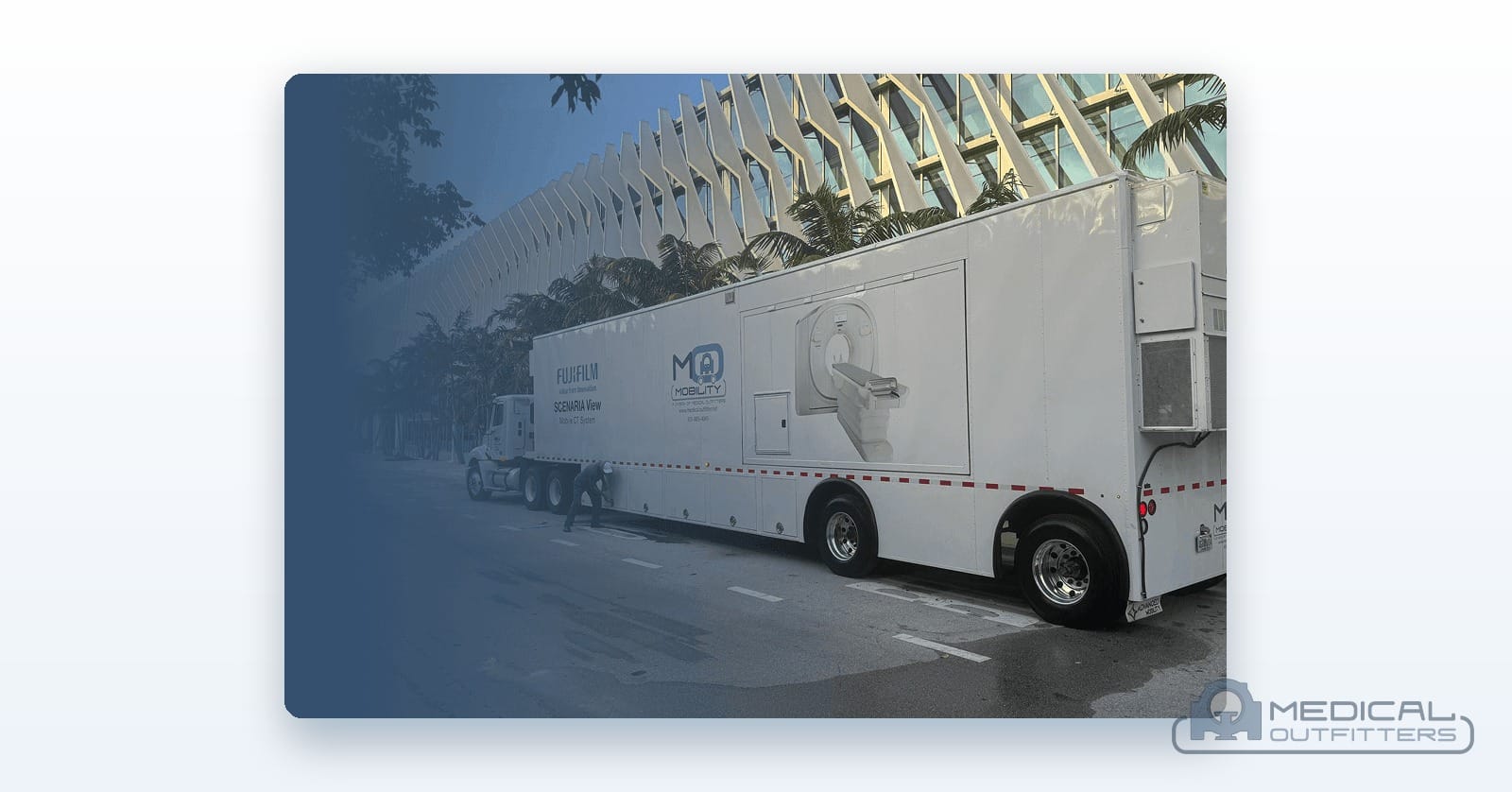
Mobile CT rental is the fastest way to keep scanning when a CT room is out of service, and one of the most expensive ways to own CT capacity over the long run. A hospital whose tube has failed, an imaging center rebuilding its suite, a system replacing a scanner or a rural network testing demand at a new site all face the same question: what does a mobile CT scanner rental cost per month, what does the monthly fee actually buy, and at what point would the money have been better spent on a scanner of your own? This guide answers all three with published 2026 rates, the line items a rental quote should show, the site work that sits outside any quote (pad, three-phase power, shielding plan, PACS link), the Medicare and state rules that apply to a mobile CT unit, and the arithmetic that tells you when renting beats buying. Every number names its source, and every price on this page is a planning figure, not a quote.
Medical Outfitters sells, installs and services medical imaging equipment across the United States, Puerto Rico and the Caribbean, and its MO Mobility program supplies mobile MRI, mobile CT and mobile PET/CT systems for short and long-term rental, as described on our mobile imaging solutions page. We sell Fujifilm CT systems new as an authorized dealer and refurbished GE and Siemens scanners through MO Select. This article is written for hospital administrators, imaging center owners and radiology managers deciding between an interim CT rental, a lease and a purchase.
- Monthly rent: about $12,000 to $22,000 for 4 to 16 slices, $25,000 to $32,000 for 32 to 64 slices and $32,000 to $40,000 for 128 slices and up (Cube Mobile Imaging published averages).
- Term: twelve-month contracts are discounted against month-to-month; dealer listings on DOTmed in October 2026 quote one-year minimums with service included.
- Not in the fee: the concrete pad, the three-phase power connection, the network drop, the state shielding plan and registration, and the staff, unless the contract says otherwise.
- Rules: Medicare’s CT coverage determination (NCD 220.1) treats a scan on a mobile unit like a scan on a fixed one, and non-hospital suppliers billing the technical component must hold CMS-approved CT accreditation.
- Rent or buy: twelve months of 64-slice rent ($300,000 to $384,000) is roughly the price of a refurbished 64-slice scanner ($175,000 to $375,000 installed, per the Medical Outfitters CT cost guide), so rent covers gaps and buying covers years.
Mobile CT Rental Cost in 2026: Monthly Rates by Slice Count
Mobile CT rental is priced per month, and three things move the rate: the scanner’s slice count, the length of the term and how much service the provider carries. Slice count comes first because it decides which scanner, and therefore which capital value, sits inside the trailer. Cube Mobile Imaging, a provider of mobile CT rentals, publishes average monthly rates by class, and they are the clearest public benchmark for a CT scanner rental in the United States:
| Scanner class in the trailer | Average monthly rent | Twelve months at that rate | Typical work |
|---|---|---|---|
| 4 to 16 slice | $12,000 to $22,000 | $144,000 to $264,000 | Routine head, chest, abdomen and trauma cover |
| 32 to 64 slice | $25,000 to $32,000 | $300,000 to $384,000 | General hospital and imaging center work, CT angiography |
| 128 slice and up | $32,000 to $40,000 | $384,000 to $480,000 | Cardiac, stroke and high-volume programs |
Source: Cube Mobile Imaging, “Can My Facility Use a Mobile CT Scanner?”, May 25, 2023 (average monthly rates by slice count). The twelve-month column is simple multiplication, before any annual discount.
Live listings land inside those bands. On DOTmed, the largest US marketplace for used imaging equipment, a dealer listing posted on October 1, 2026 offers a refurbished Siemens SOMATOM Definition mobile CT trailer at $27,500 per month on a twelve-month term, with a minimum rental term of one year and “comprehensive servicing of the machine” included in the rate. That is the middle of Cube’s 32 to 64 slice band, and it shows how the market prices a full-service interim CT rental: one monthly figure for the trailer, the scanner and the service, with a minimum term that protects the provider’s delivery and set-up cost.
Term moves the rate next. Cube notes that a twelve-month rental is generally discounted against the monthly rate for the same make and model, because the provider moves and commissions the trailer less often. Short interim cover of a few weeks or months sits at the top of each band and may carry a separate transport and set-up charge; a contract of a year or more sits toward the bottom. The same pattern holds for mobile MRI, where the Medical Outfitters guide to mobile MRI purchase versus rental describes rates falling with term length and rising sharply for short interim cover.
Service level is the third variable. A rental that includes preventive maintenance, parts, the X-ray tube and a guaranteed on-site response time costs more than one that leaves repairs to the renter, and the difference matters most in CT, where the tube is the most expensive consumable on the system, as the Medical Outfitters CT scanner cost guide explains. Before comparing two quotes, confirm that both include the tube.
What a Mobile CT Scanner Rental Includes, and What It Does Not
Two mobile CT scanner rental quotes with the same monthly figure can cover very different things. Cube Mobile Imaging lists the fees that come with a rental: a refundable security deposit, a transportation fee for moving the unit to and from the facility (with an extra charge for expedited delivery), and a system set-up fee for the CT engineer who prepares the unit for patients and works with the facility’s IT team on the PACS connection. Cube adds that these fees are often built into the monthly rate, and that the quote should always state whether they are added or included. The table below sorts the usual lines.
| Usually in the monthly fee | Often a separate line | Almost always the facility’s cost |
|---|---|---|
| The trailer and the CT scanner | Transport to and from the site | The concrete pad or plates under the landing gear |
| Preventive maintenance and repairs | Set-up, calibration and PACS connection | The three-phase power connection and the network drop |
| Service response (a stated number of hours) | Security deposit | State registration and the shielding plan |
| Applications training on the protocols | Technologists, if offered at all | Contrast, injector syringes and other consumables |
Sources: Cube Mobile Imaging rental fee and site preparation guides; DOTmed dealer rental listings, October 2026. The split varies by provider, so ask for it in writing.
The DOTmed listings show what a full-service rate looks like: the October 2026 Siemens Definition listing includes the mobile unit and comprehensive servicing in the monthly rate and states that technicians will be on site within four hours of a fault. That response promise is worth reading closely in any quote, because a mobile CT that is down for two days is the same as no CT at all for an emergency department that depends on it.
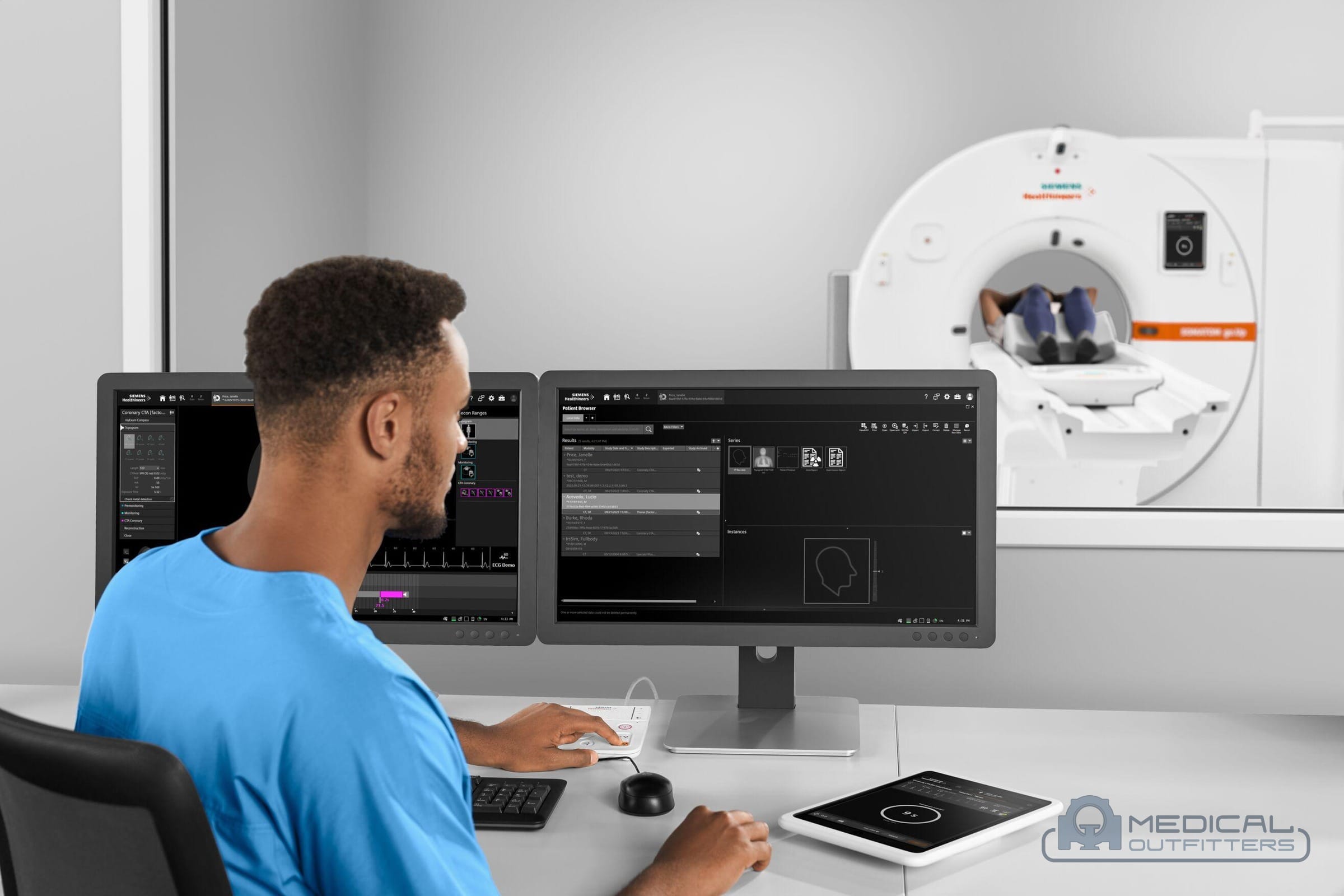
Staffing is the line most often misread. Most CT rentals supply the equipment and its service, not the technologists who run it; the facility’s own registered CT technologists scan the patients, and the facility remains responsible for the exam. Consumables follow the same rule: Cube’s site guide reminds renters to plan for injector syringes, contrast and printer supplies, and to check that their stretchers fit the trailer’s patient lift before the first emergency patient arrives. A clear mobile CT rental quote names each of these, and the cheapest monthly figure is not the cheapest rental if the transport, set-up and deposit are added on top.
What a Mobile CT Unit Is: Trailer, Scanner, Power and Patient Access
A mobile CT unit is a standard diagnostic CT scanner installed in a purpose-built semitrailer, with its own shielded scan room, control area, climate control and electrical cabinet. The scanner inside is not a special mobile model: the DOTmed listings show the same platforms found in hospital rooms, GE LightSpeed, Optima and Revolution systems, Siemens SOMATOM Definition, Toshiba and Canon Aquilion and Philips scanners, packaged in trailers of around 46 to 48 feet. Medicare requires exactly that: under National Coverage Determination 220.1 for computed tomography, scans on a mobile unit must be performed on types of CT equipment approved for use as stationary units.
The trailer is engineered around the scanner. It carries the gantry, table and electronics cabinets secured for the road and stands on landing legs when parked. Slide-out sections, often called pop-outs, widen the patient side once the unit is set up; one DOTmed listing for a mobile GE LightSpeed 16 describes a four-by-eighteen-foot pop-out with entry into the gantry room. Patients reach the scan room up steps or on a hydraulic lift, and Cube’s site guide warns that some hospital stretchers are too long for the lift platform, so the lift length should be checked with the provider before the trailer arrives.
Power is the part of the unit most sites underestimate. A CT scanner draws a large, brief load on every rotation, and a trailer needs a dedicated three-phase shore connection to run it. Cube’s guide states that a mobile CT requires three-phase power, that the voltage differs by trailer, and that a specific connector, most commonly made by Russellstoll, is often required, so an electrician may need to fit a matching receptacle before delivery. The trailer’s own cabinet then feeds the scanner, the chiller or air conditioning and, on some units, an uninterruptible power supply; one DOTmed listing for a mobile GE BrightSpeed Elite includes a PowerWare 9150 UPS.
The scan room is shielded inside the trailer walls, but the shielding was designed for the trailer, not for your parking lot. A CT scanner scatters radiation through the walls, floor and roof at levels a physicist calculates against the occupancy of whatever is next to it: a waiting room, an office window, a public sidewalk. That is why most states treat a mobile CT parked at a site as a radiation installation in its own right, as the next sections explain, and why the location of the pad matters as much as its strength.
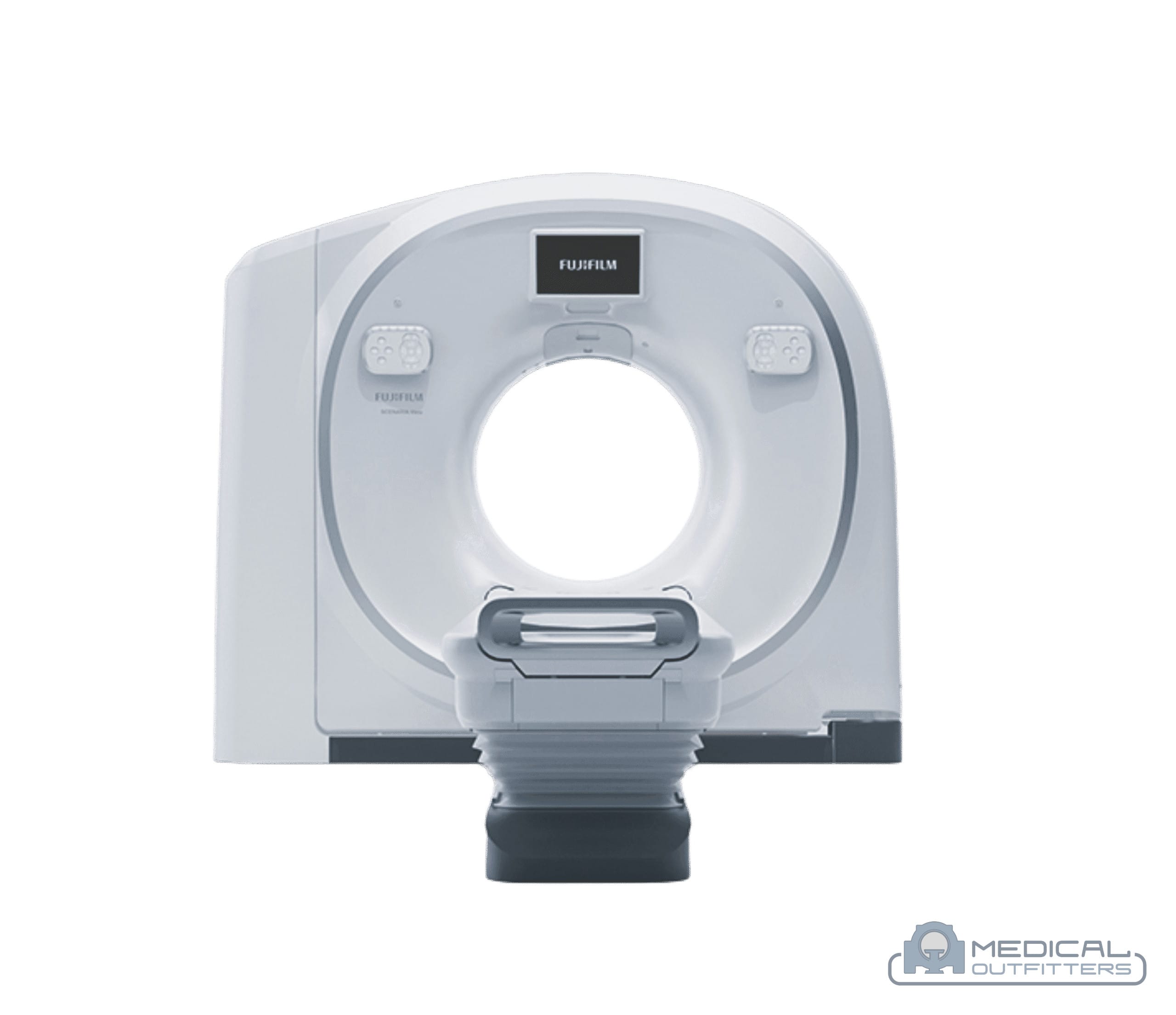
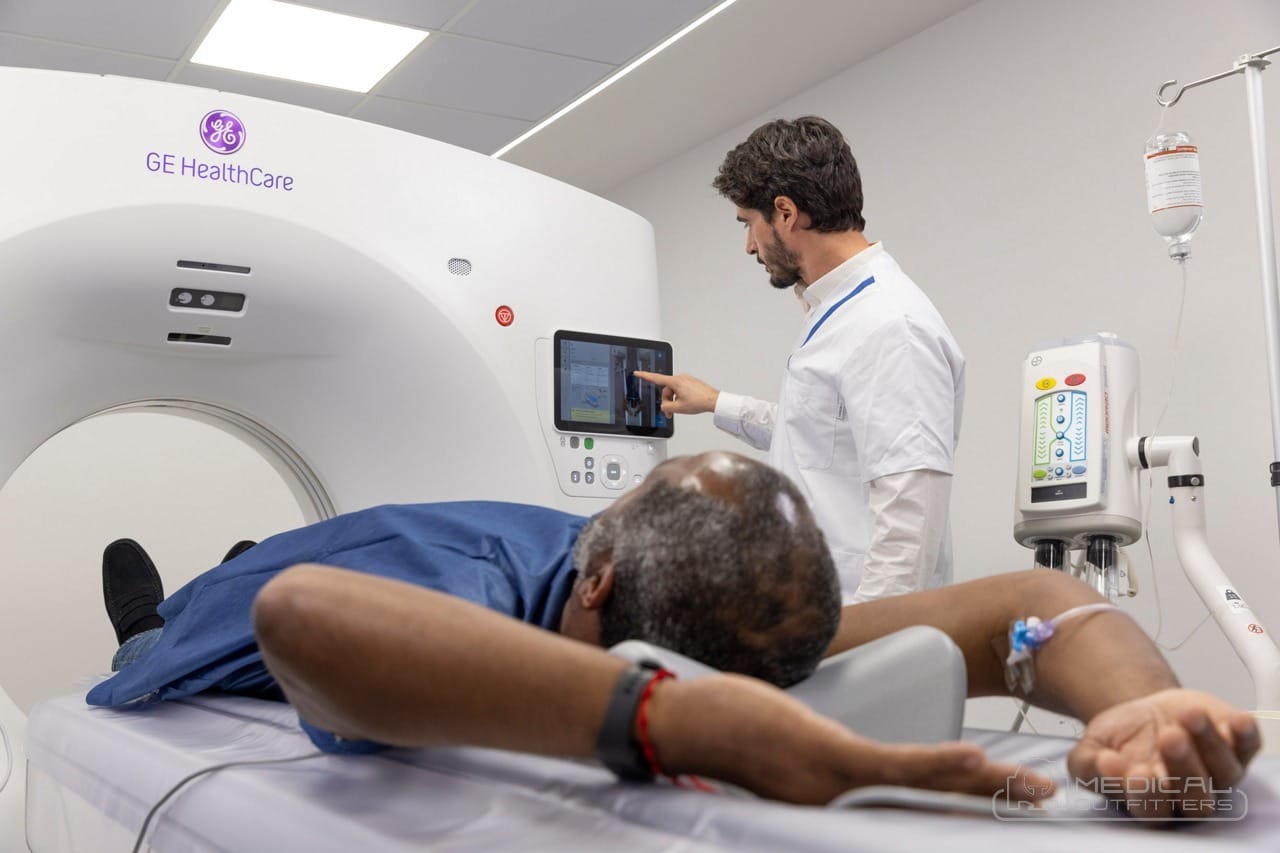
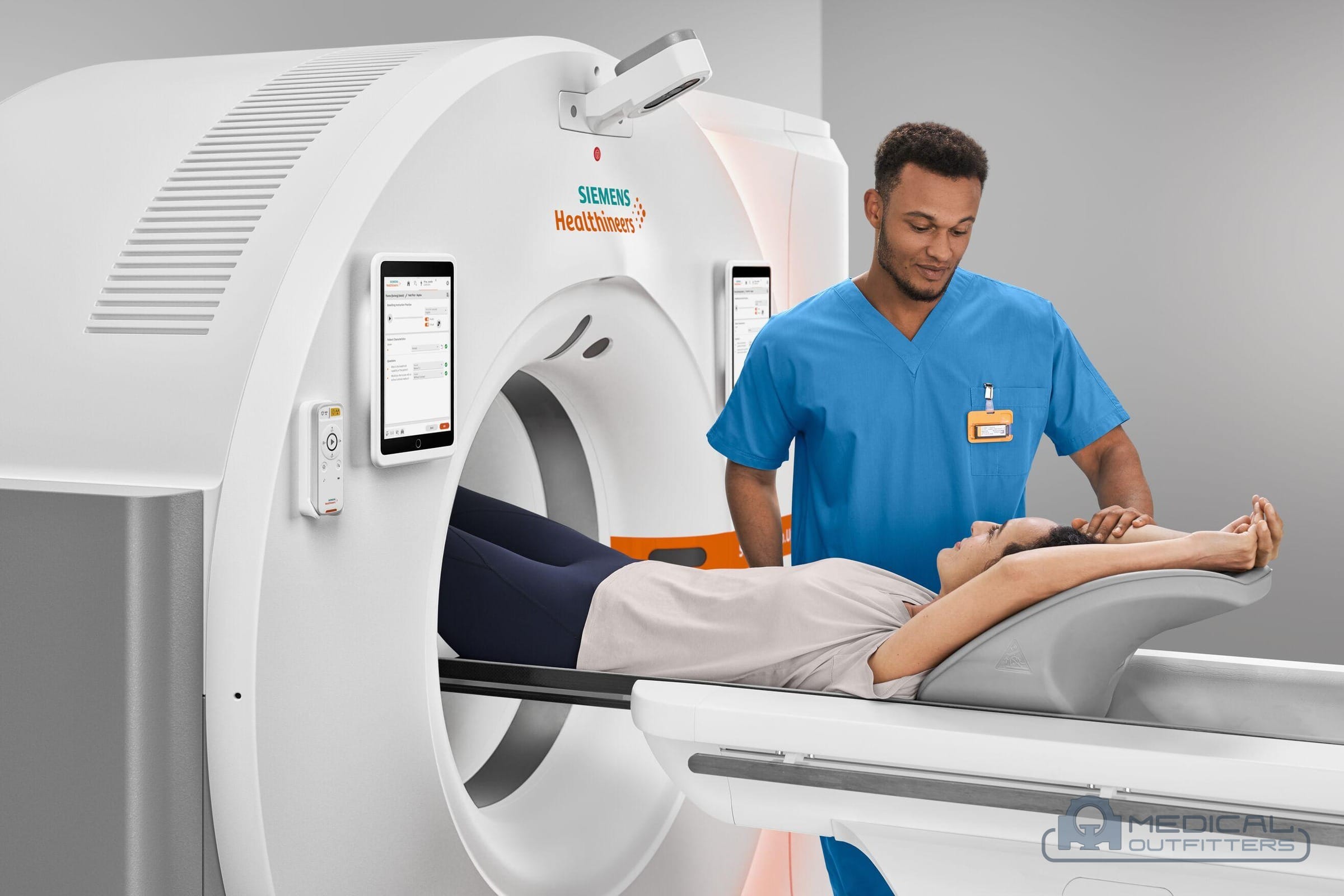
Inside, the work is identical to a fixed CT room. The technologist positions the patient, runs the protocol from the console and sends the images over the network to the hospital’s PACS, where the radiologist reads them. Our explainer on what a CT scan machine is covers the gantry, tube and detector that the trailer carries, and the guide to CT scanner types by slice count explains why a 16-slice and a 64-slice trailer rent at different rates.
Mobile CT Trailer Site Requirements: Pad, Power, Network and Shielding
The rental fee covers the mobile CT trailer; the site it parks on is the facility’s job, and it is the part that decides whether the unit scans on day one. Cube Mobile Imaging’s site preparation guide, written for facilities about to receive a mobile CT rental, sets out the checklist, and every item on it is the same whoever owns the trailer.
The pad. The surface must be as flat as possible and strong enough to carry the trailer’s weight so it can be leveled. Concrete is the best option. Asphalt can sink under the landing legs, especially in summer heat, and where there is no concrete, steel plates under the legs spread the load; ask the provider whether it supplies them. Check clearance from the building, landscaping and overhead power lines, and leave room for the pop-outs, awnings and the patient ramp or lift.
Power and data. A three-phase supply at the voltage and amperage the provider’s spec sheet states, with the matching connector, and a network connection run to the outside of the building beside the power connection, per Cube. An IT team member should be on site the day the trailer arrives to work with the set-up engineer on the PACS connection, and should attend applications training to confirm that the protocols send correctly.
The patient route. Walk the path from the building to the trailer the way a patient on a stretcher would. Patients in a rainy climate walk outdoors unless the site provides a canopy or a covered corridor, and an emergency patient needs a stretcher that fits the lift.
The shielding plan and registration. State radiation control programs regulate where a mobile unit operates. In South Carolina, for example, the state’s Regulatory Guide B10 for hospitals requires a shielding plan for any mobile or portable unit used in a single location for more than five consecutive days, and a facility registration approval before any X-ray producing equipment is installed. Other states set their own thresholds, and Cube notes that some states also require a certificate of need for added CT capacity. Call the state radiation control program early: a physicist’s shielding plan and survey take time, and a trailer that arrives before the paperwork cannot scan.
The sequence in the figure is the general order of a mobile CT deployment, drawn from Cube’s site guide and the state rules above; the provider’s site drawing and the state program set the details for each site. Medical Outfitters handles delivery and rigging through its delivery and logistics and installation and rigging teams, and for fixed rooms our guide to moving an MRI or CT scanner covers the same planning on the building side.
Medicare, Accreditation and State Rules for a Mobile CT Unit
A mobile CT unit is billed and regulated like a fixed scanner, with a few rules of its own. The federal starting point is National Coverage Determination 220.1, Computed Tomography, in the Medicare National Coverage Determinations Manual. It states that CT scans performed on mobile units are subject to the same Medicare coverage requirements as scans on stationary units, that each scan must be medically necessary for the individual patient, that the unit must comply with applicable state radiation control laws, and that mobile units must also meet certain health and safety requirements recommended by the Health Resources and Services Administration.
The same determination splits responsibility by setting. In a hospital, the hospital must assume responsibility for the quality of scans furnished to its inpatients and outpatients on the mobile unit, with a radiologist or other qualified physician in charge who holds similar privileges at the hospital. In an ambulatory setting such as a freestanding clinic, the procedure must be performed by, or under the direct personal supervision of, a radiologist or other qualified physician, and the facility must keep a record of the attending physician’s order for each scan performed on the mobile unit. NCD 220.1 also allows Medicare contractors to request evidence of state radiation control compliance from mobile unit owners with their first claims.
Accreditation is the second rule. Since January 1, 2012, under the accreditation requirement of the Medicare Improvements for Patients and Providers Act (CMS MLN Matters MM7079), Medicare has paid the technical component of advanced diagnostic imaging (CT, MRI and nuclear medicine, including PET) only to suppliers accredited by a CMS-approved organization. The CMS accreditation page lists four for advanced imaging: the American College of Radiology, the Intersocietal Accreditation Commission, The Joint Commission and RadSite, and states that the requirement does not apply to hospitals or critical access hospitals. For mobile units, CMS clarified that a supplier using a mobile imaging company’s services but billing Medicare for the technical component must itself be accredited, as reported in the Journal of Nuclear Medicine Technology in June 2011. In practice, a hospital renting a mobile CT bills under its own hospital rules, while a freestanding imaging center or physician practice renting one needs its own CT accreditation to bill Medicare.
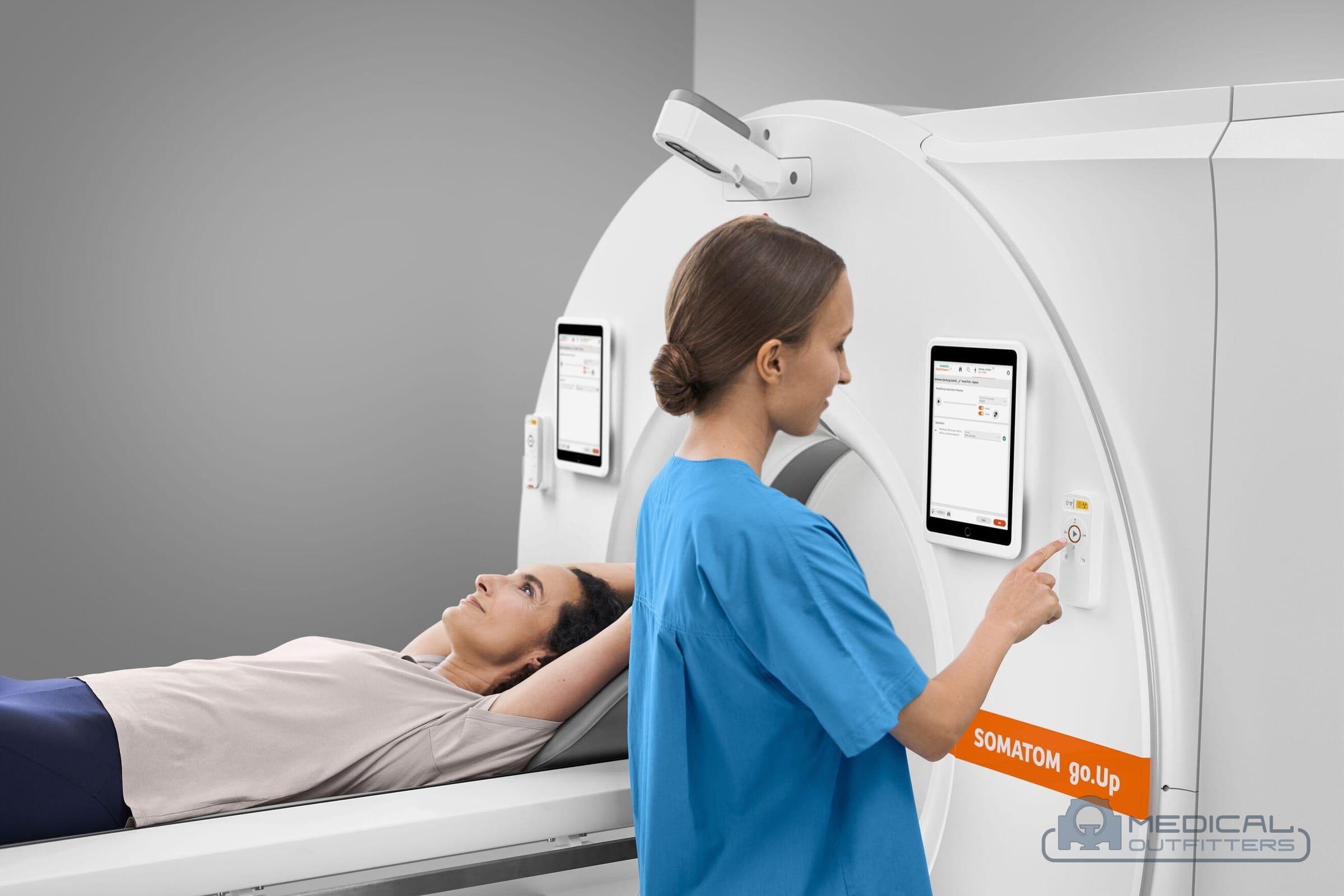
Dose rules come with the scanner, not the trailer. The Medical Outfitters CT cost guide notes that CT scanners which do not meet the NEMA XR-29 dose-optimization standard carry a Medicare payment reduction of 15 percent on applicable exams from 2017 onward, under CMS Survey and Certification letter 16-19. An older scanner in a rental trailer is not exempt, so ask the provider to confirm XR-29 compliance in writing before you sign. A rental that saves a few thousand dollars a month and cuts reimbursement on every exam is not a saving.
State rules complete the picture. Registration of the unit, notice of each new operating location, a shielding plan or survey for each site and the qualifications of the operators are set by the state radiation control program, and they differ from state to state. Ask the provider which states the unit is already registered in, and ask your state program what it needs from you as the facility.
Interim CT Rental: Tube Failure, Room Replacement and Volume Surges
An interim CT rental makes sense when the need is real but temporary, and the Medical Outfitters mobile imaging page lists the situations in which facilities use one: renovations or replacements, seasonal or overflow volume, rural or remote service and emergency or disaster response. Cube adds two more: testing a market before buying a scanner, and bridging to the next fiscal year when the capital budget for a new scanner is not yet available, because rental is an operating expense rather than a capital one.
A failed tube or a down scanner. A hospital with one CT cannot send emergency patients across town for a week. If a tube replacement or a major repair is days away, a mobile CT on the pad keeps the emergency department and inpatients scanning. The CT scanner service team can tell you whether the fix is days or weeks, which decides whether a rental is worth its transport and set-up charges.
A room replacement. Replacing a fixed scanner means removing the old system, often modifying the room, installing and calibrating the new one and passing the physicist’s survey. A mobile CT parked outside covers the gap. Match the rental term to the construction schedule plus a margin, because construction runs late more often than early.
A volume surge. A backlog the existing scanner cannot clear, a seasonal population, or a screening program such as low-dose CT lung cancer screening can justify a second scanner for months rather than years. Cube notes that one unit can also rotate between several low-volume sites, a few days at each.
A trial before buying. The Medical Outfitters mobile imaging page describes renting as a way to test-drive a machine before you buy it. A new outpatient site or a hospital adding CT to a satellite campus can prove the volume with a rented trailer, then size the purchase to what the referrals actually delivered.
Where the need is permanent, a rental is the wrong tool, and the next section shows why. The CT scan cost guide gives the revenue side for any of these cases: what Medicare and commercial payers pay per exam, and how that compares with a month of rent.
When Renting Beats Buying a CT Scanner, and When It Does Not
The rent or buy answer is set by the term. A rental turns a capital purchase into a monthly expense, carries the service risk for you and can be gone when the need ends. A purchase costs more on day one and less every month after that. The crossing point comes quickly in CT because refurbished scanners are inexpensive relative to a year of rent. The Medical Outfitters CT scanner cost guide puts a refurbished 16-slice system at $85,000 to $185,000 and a refurbished 64-slice at $175,000 to $375,000, delivered, installed and warrantied. Set those against Cube’s published monthly rates:
| Class | Refurbished purchase, installed (MO guide) | Assumed monthly rent (Cube band) | Months of rent that equal the purchase |
|---|---|---|---|
| 16-slice | $85,000 to $185,000 | $17,000 (middle of $12,000 to $22,000) | About 5 to 11 months |
| 64-slice | $175,000 to $375,000 | $28,500 (middle of $25,000 to $32,000) | About 6 to 13 months |
| 128-slice | $350,000 to $625,000 | $36,000 (middle of $32,000 to $40,000) | About 10 to 17 months |
Illustrative arithmetic: the purchase band divided by the middle of the rental band. The purchase figures exclude the room, shielding, power and the service contract, which a fixed installation adds; the rental figures exclude transport, set-up and the facility’s pad and power.
The comparison is not like for like, and the table says so: a purchased scanner needs a room or a trailer, a service contract and a tube budget, while a rental includes service and arrives in its own shielded box. Those costs move the crossing point out but do not erase it. The Medical Outfitters mobile MRI guide, working through the same comparison for magnets with service and cryogens counted on the owned unit, puts the break-even between renting and owning at 24 to 36 months of continuous use. The CT figures above cross sooner because a refurbished CT scanner costs less than a year of CT rent; adding a room, a service contract and a tube budget moves the crossing point out, so treat a CT rental that runs past twelve to eighteen months as a sign that a purchase or a lease should be priced.
That leaves a simple rule. Rent for a gap with an end date: a tube replacement, a room rebuild, a season, or a pilot that has to prove itself. Lease or rent-to-own when the scanner is likely to stay but the capital is not there this year. Buy when the need is permanent: a refurbished 64-slice installed in a fixed room is the lowest cost per exam over its life, and a mobile trailer you own is the answer when the scanner must serve several sites. The related guides on CT scanner brands compared and the used imaging equipment inspection checklist cover what to check before buying.
Pricing a Mobile CT Rental or Purchase With Medical Outfitters
Medical Outfitters supplies mobile CT, mobile MRI and mobile PET/CT systems through MO Mobility for short and long-term rental, and sells CT scanners new and refurbished for a permanent room. The mobile imaging solutions page describes the rental program, the CT scanner cost guide gives the purchase bands by slice count, and the CT scanners category lists the current Fujifilm and MO Select systems. The refurbished imaging equipment page explains the MO Select standard, our mobile MRI buy or rent guide works through the same decision for magnets, and the PET/CT scanner buying guide covers mobile PET/CT. Send us the site, the term, the slice class you need and the date the unit has to scan, and we will price a rental and a purchase side by side: contact Medical Outfitters.
- Cube Mobile Imaging, “Can My Facility Use a Mobile CT Scanner?”, May 25, 2023: average monthly rental rates by slice count, twelve-month discounts, deposit, transport and set-up fees, use cases. cubemobileimaging.com
- Cube Mobile Imaging, “How to Prepare your Site for a Mobile CT Rental”, March 15, 2023: three-phase power, connector, pad, network, patient lift and state requirements. cubemobileimaging.com
- DOTmed, refurbished Siemens Definition CT mobile rental listing, October 1, 2026: $27,500 per month on a twelve-month term, one-year minimum, servicing included, four-hour on-site response. dotmed.com
- CMS, National Coverage Determination 220.1, Computed Tomography: coverage, equipment, supervision and record rules for mobile CT units. cms.gov
- CMS, Accreditation of Advanced Diagnostic Imaging Suppliers: approved accreditation organizations and the hospital exemption. cms.gov
- Journal of Nuclear Medicine Technology, “ICANL Report”, June 2011: the CMS clarification that suppliers using a mobile imaging company and billing the technical component must be accredited. tech.snmjournals.org
- South Carolina Department of Environmental Services, Regulatory Guide B10, Complying With Title B: Hospitals: shielding plan for mobile units used more than five consecutive days, registration before installation. des.sc.gov
- Medical Outfitters, CT Scanner Cost and Price Guide (2026) and Mobile Imaging Solutions: purchase bands, XR-29 rule and the rental program. medicaloutfitters.com
- Mobile imaging solutions: mobile CT, MRI and PET/CT rental
- CT scanner cost and price guide (2026)
- CT scanners: new Fujifilm and MO Select refurbished
- Mobile MRI: buy or rent?
- CT scanner service, repair and maintenance
- How much does a CT scan cost in 2026
- What is a CT scan machine
- CT scanner types by slice count
- CT scanner manufacturers compared
- Refurbished medical imaging equipment: the MO Select standard
- How to move an MRI or CT scanner
- Delivery and logistics
- Price a mobile CT rental or purchase
Mobile CT Rental: Common Questions
How much does mobile CT rental cost per month?
About $12,000 to $40,000 a month in 2026, depending mainly on slice count. Cube Mobile Imaging publishes average monthly rates of $12,000 to $22,000 for a 4 to 16 slice trailer, $25,000 to $32,000 for 32 to 64 slices and $32,000 to $40,000 for 128 slices and up. A DOTmed dealer listing in October 2026 offers a refurbished Siemens Definition trailer at $27,500 a month on a one-year term, with servicing included.
What is included in a mobile CT scanner rental?
Usually the trailer, the CT scanner, preventive maintenance, repairs and a stated service response time. Transport to and from the site, set-up and calibration, the PACS connection and a refundable security deposit are often separate lines, and Cube Mobile Imaging advises that the quote state whether each is added or included. The pad, the power connection, the network drop, state registration, technologists and consumables are normally the facility's own cost.
Is there a minimum term for a mobile CT rental?
It depends on the provider. Short interim rentals of a few weeks or months exist and sit at the top of the rate bands, often with transport and set-up charged separately. Many dealer listings on DOTmed in October 2026 state a minimum rental term of one year. Cube Mobile Imaging notes that a twelve-month rental is generally discounted against the monthly rate for the same make and model.
What does a site need for a mobile CT trailer?
A flat, strong surface, ideally concrete, or steel plates under the landing legs; three-phase power at the trailer's voltage with the matching connector, commonly a Russellstoll; a network connection beside the power connection for PACS; clearance for pop-outs, awnings and the ramp or lift; and a safe patient route. Cube Mobile Imaging's site guide lists each, and the state radiation control program may require a shielding plan.
Does Medicare cover CT scans done on a mobile unit?
Yes. Under National Coverage Determination 220.1, CT scans on mobile units are subject to the same Medicare coverage requirements as scans on stationary units, must be medically necessary, must be performed on CT equipment approved for stationary use and must comply with state radiation control laws. In a freestanding setting the scan must be performed by or under the direct personal supervision of a radiologist or other qualified physician.
Does a facility renting a mobile CT need accreditation?
A freestanding imaging center or physician practice that bills Medicare for the technical component of CT must be accredited by a CMS-approved organization: the ACR, the IAC, The Joint Commission or RadSite. CMS clarified that a supplier using a mobile imaging company but billing the technical component must itself be accredited. The CMS page states that the requirement does not apply to hospitals or critical access hospitals.
When is renting a CT scanner better than buying one?
When the need has an end date: a tube replacement, a room rebuild, a seasonal surge or a pilot at a new site. Twelve months of 64-slice rent at Cube's published rates is $300,000 to $384,000, while the Medical Outfitters CT cost guide puts a refurbished 64-slice at $175,000 to $375,000 installed. A rental that runs past twelve to eighteen months is a signal to price a purchase or a lease.
Does Medical Outfitters rent mobile CT scanners?
Yes. Through MO Mobility, Medical Outfitters supplies mobile MRI, mobile CT and mobile PET/CT systems for short and long-term rental, with each unit maintained by its team for the rental period, across the United States, Puerto Rico and the Caribbean. It also sells Fujifilm CT systems new and refurbished GE and Siemens scanners through MO Select, so a rental and a purchase can be priced side by side.
Related Articles