Rent a mobile MRI when the unit will run for less than about two years or the volume is uncertain. Buy a mobile MRI unit when it will run for three years or more at steady volume and you have, or will contract for, your own service. Between those points, a lease or rent-to-own on a refurbished mobile 1.5T is usually the best answer. The break-even between mobile MRI rental and owning a mobile MRI trailer typically lands at 24 to 36 months of continuous use.
The reason the answer depends on term is that a mobile MRI trailer is a large fixed cost with a small variable one. Once the pad is poured and the power is connected, the trailer costs roughly the same to run whether it scans ten patients a day or twenty. Rental converts that fixed cost into a monthly fee and hands the service risk to someone else, which is exactly right for interim cover and exactly wrong for a scanner that will sit on the same pad for a decade.
This guide is for the hospital, imaging center or physician group weighing a mobile MRI purchase against a rental. It explains what a mobile MRI unit is, what a mobile MRI trailer costs to buy and to rent, what the used mobile MRI for sale market looks like, the site work behind the pad, the break-even arithmetic, and the situations where each option wins.
- A mobile MRI is a full 1.5T scanner in a 48-foot RF-shielded trailer. Image quality is the same as the fixed version of the same magnet.
- Buying a refurbished mobile 1.5T is a mid-six-figure purchase; a new one is seven figures. Mobile MRI rental runs tens of thousands of dollars a month, falling with term length.
- The site costs the same whoever owns the trailer: pad, 480V three-phase power, quench clearance, docking corridor, network and permits.
- Break-even is 24 to 36 months. Below it, rent. Above it, buy or lease. Rotating between sites favours owning.
Medical Outfitters sells refurbished mobile MRI units, provides mobile MRI services and mobile imaging, and handles delivery, siting, cryogens and ongoing service with its own crews across the United States, Puerto Rico and the Caribbean. The fixed and mobile magnets discussed below are on our MRI machines for sale page and in the MO Select refurbished program.
Mobile MRI Purchase vs Rental at a Glance
| Option | What you pay | Who carries service | Typical term | Best for |
|---|---|---|---|---|
| Buy refurbished | Mid six figures for trailer and 1.5T magnet, quoted per unit | You, through a service contract | 7 to 12 years of use | Permanent docking, steady volume, multi-site rotation |
| Buy new | Seven figures | You, usually with an OEM contract | 10 to 15 years | Hospital systems that want current 1.5T platforms and OEM support |
| Lease or rent-to-own | Monthly payment; equity builds or a purchase option applies | Shared or included | 3 to 7 years | Growing centers that expect to keep the unit but want to preserve capital |
| Rent, long term | Tens of thousands per month, lower end | Provider | 12 to 36 months | New programs proving volume before a fixed install |
| Rent, short term or interim | Tens of thousands per month, upper end, plus mobilisation | Provider | Weeks to 12 months | Cover during construction, a magnet swap or a quench recovery |
Medical Outfitters quotes each mobile unit individually because the magnet model, coil package, software options, trailer age and generator condition move the mobile MRI scanner price more than any rule of thumb. The ranges above are the industry’s, not a price list. Our MRI machine cost and buying guide explains what moves the number.
What a Mobile MRI Unit Actually Is
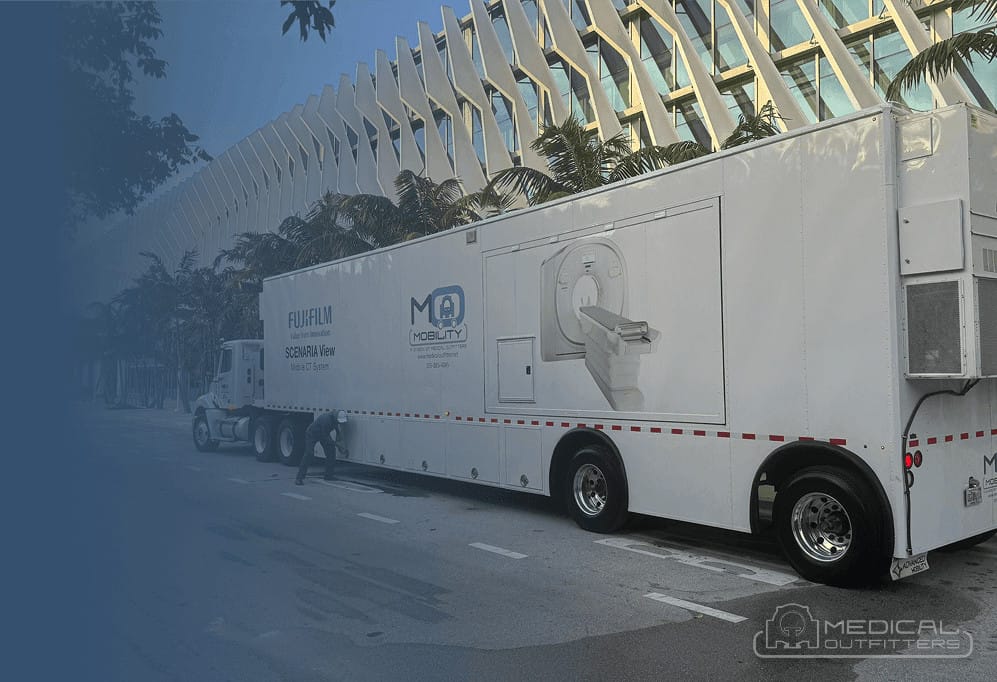
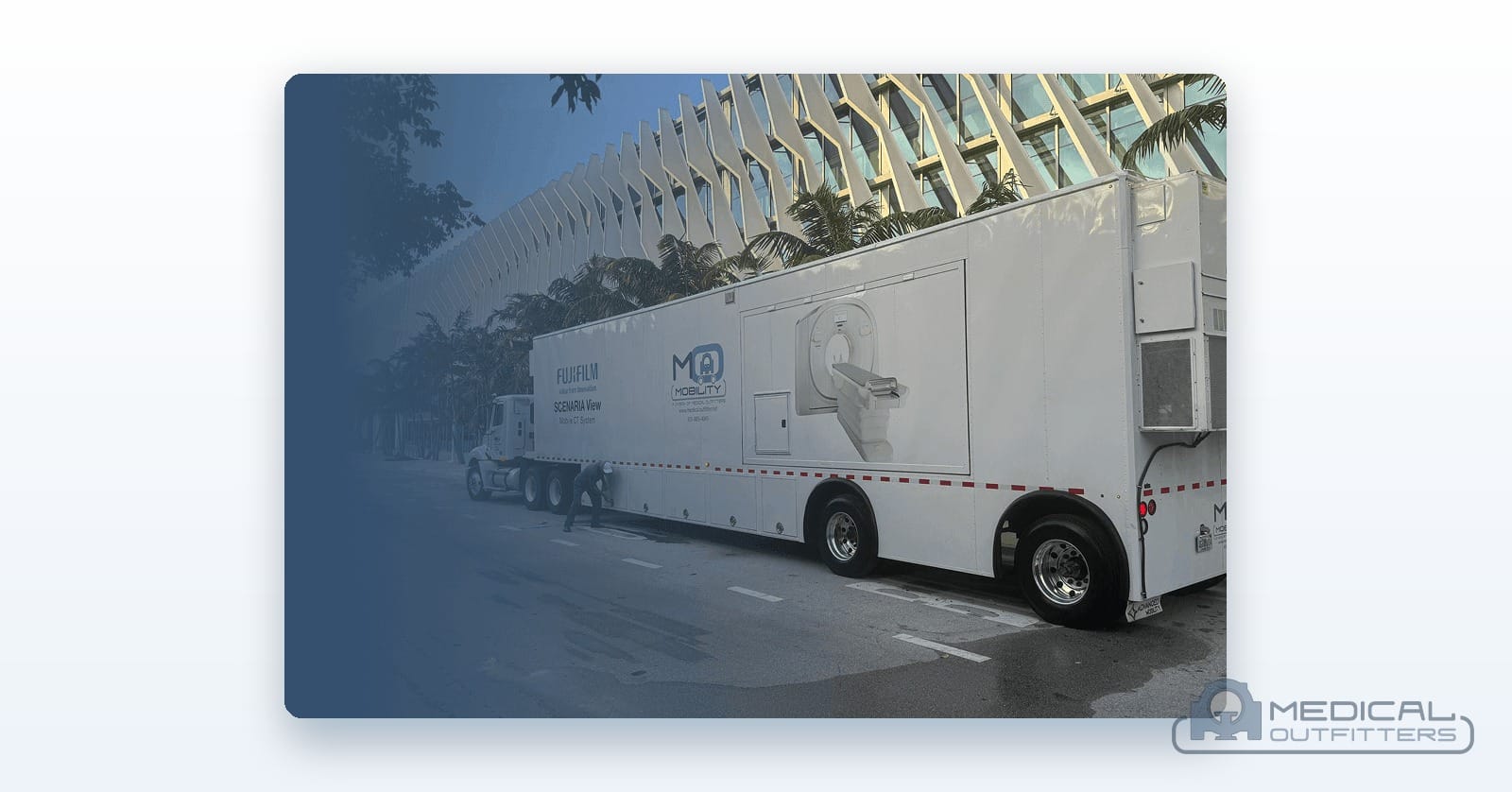
A mobile MRI is a standard superconducting magnet, almost always 1.5T, installed in a purpose-built 48-foot trailer that is 8.5 feet wide and about 13.5 feet tall. The trailer body is the RF-shielded room. The magnet sits over the rear axles, with the equipment cabinets, chiller and RF filters toward the front and a small control room and patient area beside the magnet. On some trailers a slide-out section widens the patient side when the trailer is parked. Loaded, the unit weighs roughly 30 to 36 tonnes, 65,000 to 80,000 pounds, which is why the pad matters.
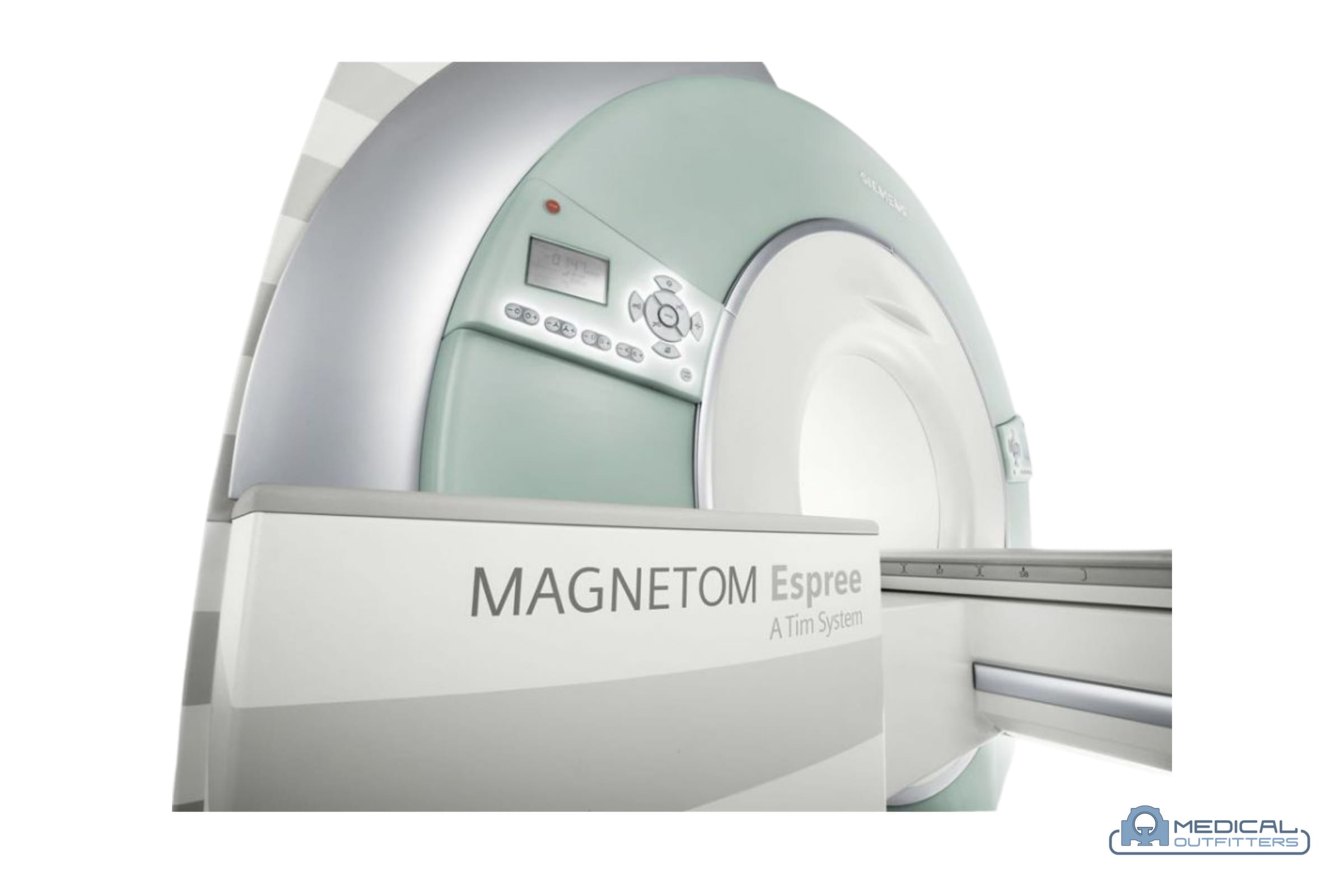
The magnets inside are the same wide-bore and closed-bore platforms found in hospitals: the Siemens MAGNETOM Aera and Espree, the GE Signa HDxt and Optima MR450w on the refurbished side, and current 1.5T platforms on the new side. Image quality is identical to the fixed version. What differs is the packaging: the magnet is mounted and braced for road transport, the quench vent exits through the trailer roof, and power comes from a shore connection at the pad or an onboard generator when the unit is in transit or at a site without a connection.
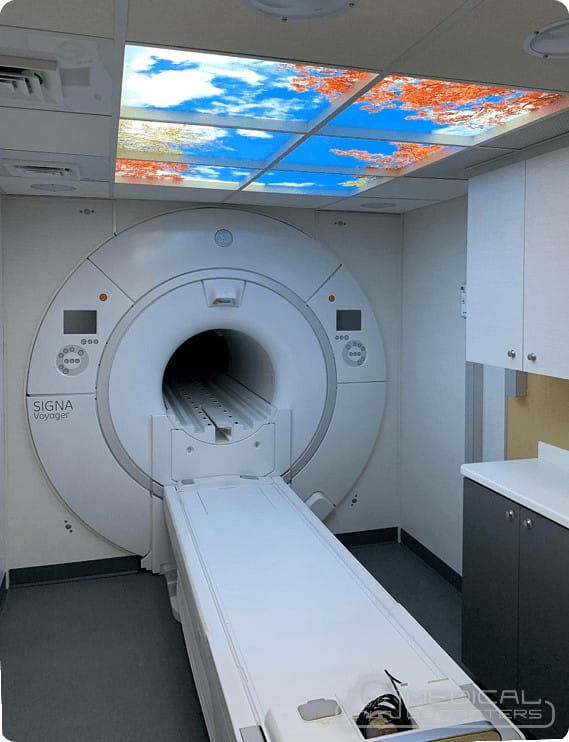
Because the trailer is already shielded, a mobile MRI is also the fastest way to add a magnet to a site that has no suite. Many rural hospitals and outpatient centers dock a mobile MRI unit permanently, connect it through a corridor to the building, and never build a fixed room. For them the buy-or-rent question is really a build-or-buy question, and the trailer usually wins.
Mobile MRI Machine Cost: What a Trailer Costs to Buy
Three things are being bought: the magnet, the trailer, and the refurbishment that makes them a working unit. Each has its own range.
| Component | What drives the cost | Industry range |
|---|---|---|
| Magnet and system | Platform (Aera, Espree, HDxt, MR450w), age, gradient package, coils, software licences | The largest share; refurbished 1.5T systems sit in the low to mid six figures on their own |
| Trailer | Age, shielding condition, slide-out, generator hours, DOT inspection status | A fraction of the magnet; a sound used trailer without a magnet is a five-figure to low-six-figure purchase |
| Refurbishment | Cold head, helium fill, coil testing, software update, cosmetic and DOT work, warranty | Included in a dealer’s price; a private purchase pays for it separately |
| Delivery and commissioning | Distance, island shipping for Puerto Rico and the Caribbean, ramp-up, calibration, physicist testing | Five figures; more for sea freight |
| Site work | Pad, power, canopy or corridor, data, permits | Same whether you buy or rent; often overlooked in the comparison |
The total mobile MRI machine cost for a refurbished 1.5T with a written warranty is a mid-six-figure purchase; a new mobile unit from the manufacturer is seven figures. What you get for the money on a properly refurbished unit is described on our refurbished medical imaging equipment page: a new or rebuilt cold head, tested coils, current software, a DOT-inspected trailer and a warranty backed by our own engineers. A private-party purchase without those items is cheaper up front and, in our experience, rarely cheaper by year two.
Ask for the helium and cold-head history first. A mobile magnet lives a harder life than a fixed one. Road vibration, generator power and repeated moves all show up in the helium log. A unit whose helium level has been stable for two years on its current cold head is a unit that has been looked after. Our guide to how long an MRI machine lasts explains what else to check.
Used Mobile MRI for Sale: What Is on the Market
In our experience most listings for a used mobile MRI for sale fall into three groups. The largest is 1.5T Siemens and GE units from the 2008 to 2016 generation, Aera, Espree, Signa HDxt and Optima MR450w magnets in trailers of similar age, coming off mobile-imaging fleets as those fleets refresh. These are the sweet spot: proven platforms, deep parts supply, and enough life left to justify a proper refurbishment. The second group is older 1.5T units in tired trailers, where the magnet may be sound but the shielding, generator and slide-out need money; those are for buyers with their own engineering. The third, small group is late-model and 3T mobile units, which command the highest used prices.
When a mobile MRI machine for sale is worth pursuing, the inspection is the same one we run on any MRI machine for sale, plus the trailer: helium level and cold-head history, every coil on a phantom, software version and transferable licences, RF-shield integrity of the trailer body, generator hours, axle and landing-gear condition, and a current DOT inspection. A used mobile MRI from a dealer that refurbishes, installs and warranties the unit removes most of the risk in that list; a private or auction purchase leaves it with you.
Mobile MRI Rental: What a Unit Costs to Rent
Mobile MRI rental is priced per month, and the rate falls with the term. Short-term and interim rental, the unit that covers a hospital while its fixed magnet is replaced or its suite is rebuilt, sits at the top of the range and usually carries a mobilisation fee for delivery and set-up. Twelve-month and longer contracts sit at the bottom, and multi-year contracts approach lease economics. Across the industry the monthly figure is in the tens of thousands of dollars for a 1.5T unit.
What the fee includes matters as much as the number. A full-service rental typically covers the trailer, the magnet, preventive maintenance, cryogens, repairs, applications training and PACS integration, with technologists available as a paid option. It does not cover the pad, power, network, patient transport, the corridor or canopy, or state permits. Those are the same costs an owner pays, which is why the fair comparison is rental fee against ownership cost, with the site costs on both sides of the ledger.
A third model, shared mobile MRI services, puts one unit on a route between two or three facilities on fixed days. Each site pays for its days, none carries the whole unit, and the provider handles everything on wheels. For a clinic that needs two days of MRI a week, it is the cheapest way to offer the modality at all.
Buying vs Renting a Mobile MRI Over Five Years
The index above uses a refurbished purchase as 100 and adds the running costs each option carries. Three things fall out of it.
Renting on annual contracts costs roughly double owning a refurbished unit over five years. The premium buys flexibility and a provider who carries the service risk. That is worth paying while volume is unproven and not worth paying once it is.
Short-term interim rental is roughly three times. It is the right answer for a six-month magnet swap or a construction delay, and a poor one for anything that becomes permanent. A hospital that has been “temporarily” renting for three years has paid for the unit at least once.
The site costs are the same in every column. Pad, power, corridor and permits do not care who owns the trailer. If a site will keep a mobile magnet for years, that money is better spent once and well.
The crossing point between the rental and ownership lines, allowing for a service contract and cryogens on the owned unit, lands between 24 and 36 months at published rental rates. Beyond it, each further month of rental is a month of payments on a unit you do not own.
What the Site Needs Before the Mobile MRI Trailer Arrives
A mobile MRI needs less than a fixed suite and more than a parking space. The checklist below is what Medical Outfitters’ delivery and logistics team confirms before a unit ships.
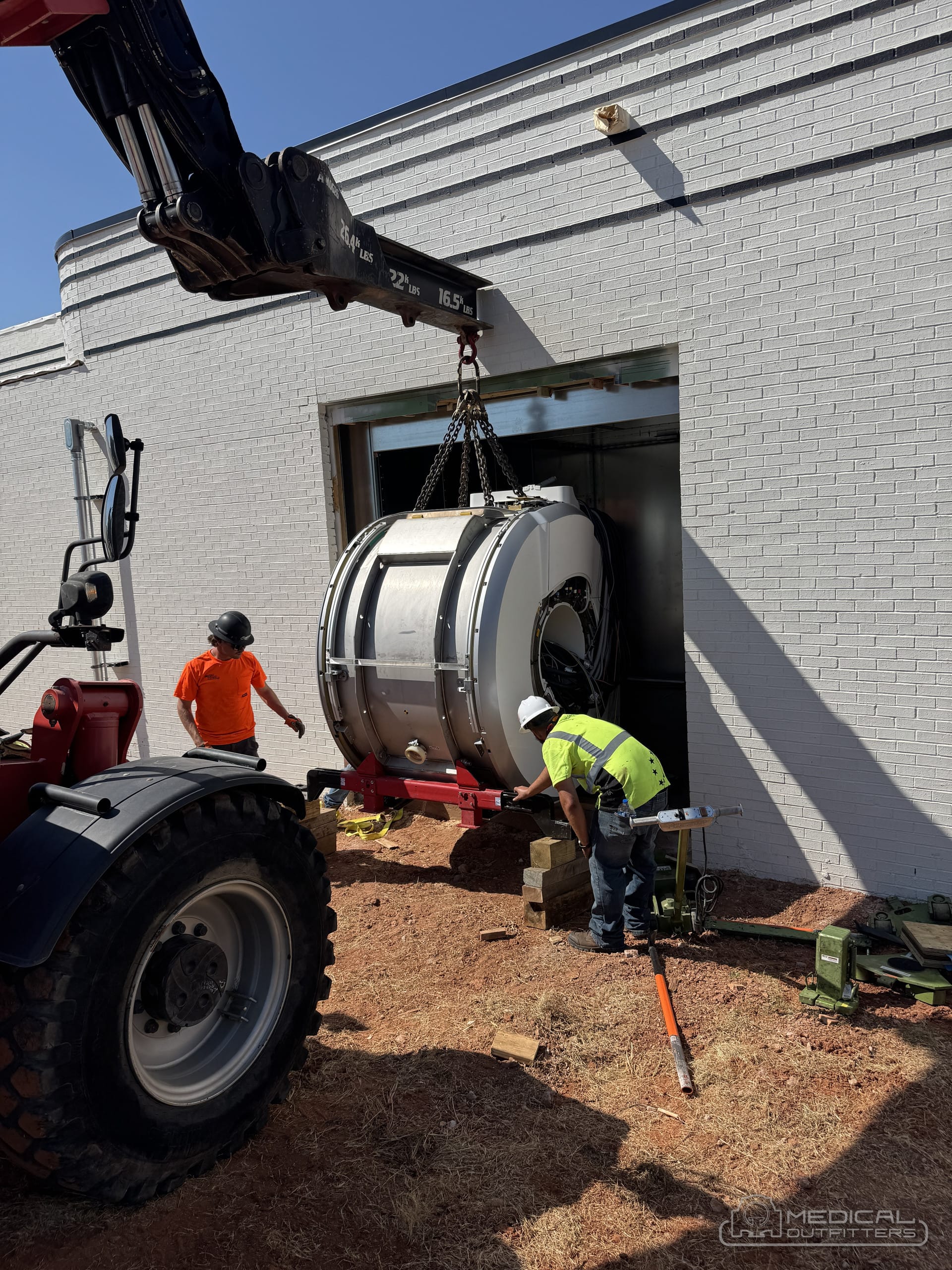
- The pad. A level, reinforced concrete pad or engineered surface rated for the axle and landing-gear loads, with room for the slide-out and the tractor to manoeuvre. Fixed docking sites add a canopy or an enclosed corridor to the building.
- Power. A 480V three-phase shore connection with a lockable disconnect, sized to the magnet’s specification. Generator operation is for transit and emergencies, not for daily scanning.
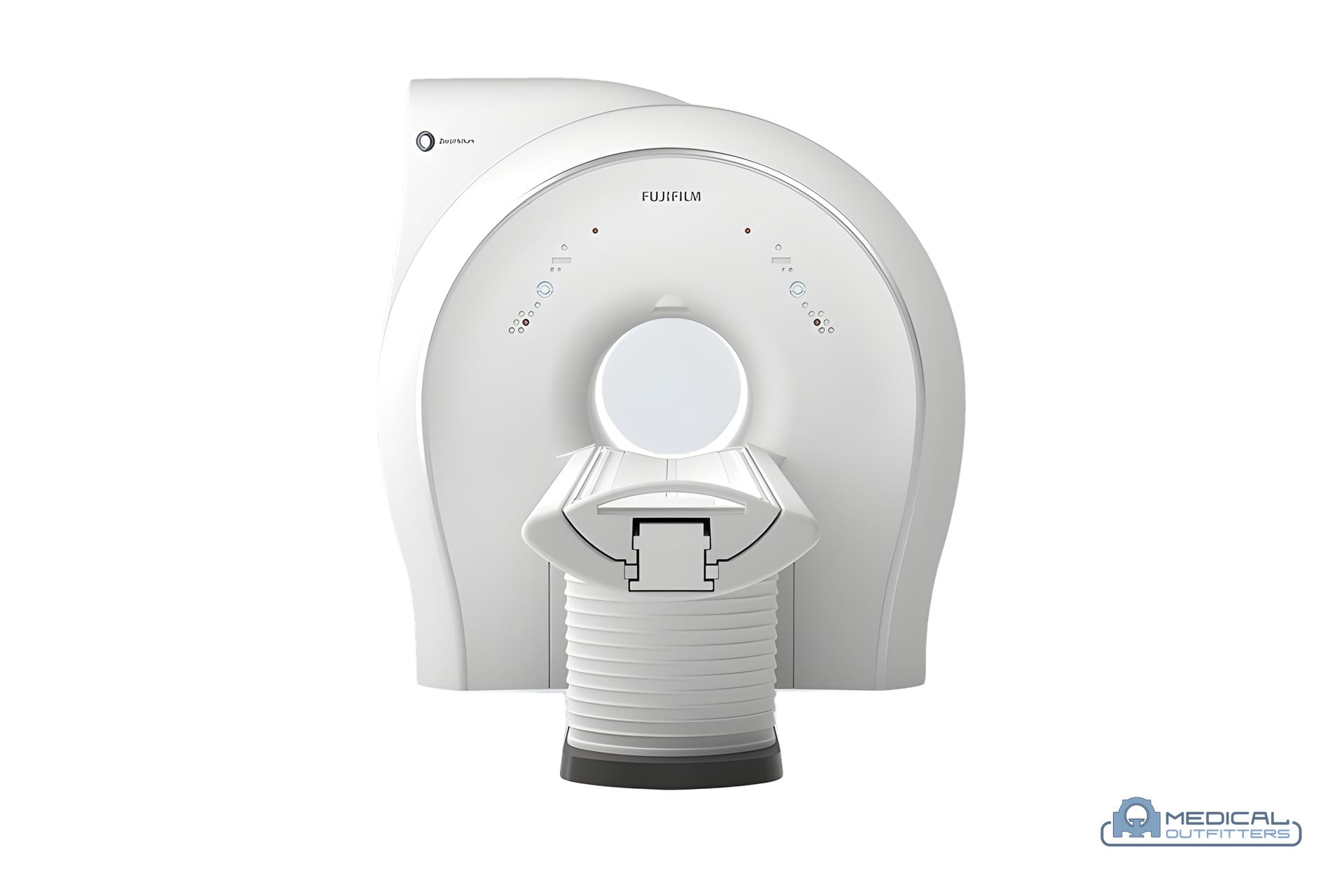
- Quench clearance. The vent exits through the roof; the area above and around it must be clear of windows, air intakes and walkways. Our guide to what an MRI quench is explains why. A zero-helium magnet such as the Fujifilm Echelon Smart ZeroHelium removes the vent from the checklist entirely.
- The 5-gauss line. The magnet’s fringe field extends outside the trailer. Parking, walkways and adjacent rooms inside that line need controlled access and signage.
- Network and PACS. A hard-wired connection to the facility network for image transfer, worklist and remote service.
- Patient access. Lift or ramp, weather protection, a route for stretchers, restroom access, and ADA compliance for a permanently docked unit.
- Permits. Facility licensing where the state requires it (a few states also register MRI units with their radiation control programs), local zoning or building permits for a permanent dock, certificate-of-need review where a state requires it, and road permits for the move itself.
Island sites add sea freight, port handling and a cryogen plan for the crossing. Our guide to MRI installation in Puerto Rico and the Caribbean covers what that involves, and the same crews that handle fixed installations handle mobile docking through our installation and rigging service, with helium and cold-head work from our cryogenic service team.
Buy or Rent a Mobile MRI: The Decision
Rent for interim cover, for a pilot program that has to prove volume, or when the organisation cannot carry a magnet on its balance sheet this year. Negotiate the term you actually expect and a purchase option in case it becomes permanent.
Lease or rent-to-own when the unit is likely to stay but capital is tight. The payment builds toward ownership, the service contract is bundled, and the unit is yours when the volume has paid for it.
Buy when the unit will be docked or rotated for three years or more, when the organisation already has a service relationship, and when the same magnet could later move into a fixed suite. A refurbished mobile 1.5T from MO Select comes with the warranty, cryogenic support and installation that make ownership a smaller risk than it sounds.
And if the question is really whether to build a fixed suite or dock a trailer, the honest answer is that a permanently docked mobile MRI unit is a legitimate long-term MRI department. It is cheaper and faster than construction, it is upgradeable by swapping the trailer, and the magnet inside it is the same one the hospital across town has in a room. Our guide to wide-bore vs open vs closed MRI covers which magnet belongs in it.
For a quote on a refurbished mobile MRI or a mobile MRI rental, contact Medical Outfitters with the site, the expected volume and the term. We serve the whole United States, Puerto Rico and the Caribbean, with our home base and fastest response in Florida.
- Mobile MRI and mobile imaging services
- MRI machines for sale, fixed and mobile
- MO Select refurbished MRI systems (and used mobile units)
- Fujifilm Echelon Smart ZeroHelium (no helium, no quench pipe)
- MRI machine cost and buying guide
- Delivery and logistics for mobile units
- Installation, rigging and de-installation
- Cryogenic service for mobile magnets
- MRI installation in Puerto Rico and the Caribbean
- Mobile MRI in Florida
- Request a mobile MRI quote or rental
Mobile MRI Purchase and Rental: Common Questions
How much does a mobile MRI trailer cost?
A refurbished mobile MRI, trailer and 1.5T magnet together, typically sells in the mid six figures depending on the magnet's age, coils and software. A new mobile 1.5T unit is a seven-figure purchase. A trailer alone, without the magnet, is a fraction of that. Medical Outfitters quotes each unit individually because coil packages and software options move the price.
How much does it cost to rent a mobile MRI?
Industry rental rates for a mobile 1.5T MRI run in the tens of thousands of dollars per month, with short-term interim rentals at the top of the range and multi-year contracts at the bottom. Rates usually include the trailer, magnet, service and cryogens but not the pad, power, staff or patient transport.
When does buying a mobile MRI beat renting?
Buying beats renting once the unit will run for more than roughly 24 to 36 months at steady volume. Below that, especially for interim cover during construction or a magnet replacement, renting is cheaper and carries less risk.
What does a site need for a mobile MRI trailer?
A level reinforced concrete pad or approved parking surface, a 480V three-phase power connection with a disconnect, a clear route for a 48-foot trailer, a quench vent clearance zone, data connectivity to PACS, a patient corridor or canopy, and a marked 5-gauss line. State facility licensing and, in some states, certificate-of-need rules apply.
Can a mobile MRI be used as a permanent scanner?
Yes. Many rural hospitals and outpatient centers dock a mobile MRI permanently as a lower-cost alternative to building a shielded suite. The trailer is already RF-shielded, so the site work is the pad, power, a docking corridor and the quench vent.
Does Medical Outfitters sell and service mobile MRI units?
Yes. Medical Outfitters sells refurbished mobile MRI units, provides mobile imaging services and handles delivery, siting, cryogens and ongoing service across the United States, Puerto Rico and the Caribbean.
Related Articles