MRI room shielding requirements come down to five things. Every MRI room needs RF shielding: a continuous copper or galvanized-steel enclosure on all six sides, with a shielded door, a shielded window, filtered power and waveguides for every pipe and duct, tested to roughly 100 dB of attenuation before the magnet is delivered. Magnetic shielding, steel plate in the walls or floor, is added when the magnet’s fringe field would cross into spaces that must stay below 5 gauss or would disturb magnetically sensitive equipment nearby. Superconducting magnets also need a quench pipe to the outside air. Every magnet needs a site survey for vibration, electromagnetic interference and floor loading before any of it is designed. And the whole package is designed for one specific magnet, not for “an MRI”.
That last point is the rule that saves money. Fringe-field contours, quench-pipe diameter, floor loads and cable penetrations all differ between models, and a room built for a generic MRI is a room that gets rebuilt. Choose the magnet, then design the MRI room.
This guide explains why each requirement exists, how the numbers are set, how MRI shielding changes between a 0.3T open magnet, a 1.5T wide-bore and a 3T, what the rest of the MRI room requirements look like, and who is responsible for what. It is written for the administrator, architect or contractor planning an MRI suite, and for the buyer who wants to know what the room will cost before committing to the magnet.
- RF shielding keeps radio noise out. The scanner listens for signals at 12 to 128 MHz, a range shared with shortwave, FM radio, television and aircraft radio. Without a Faraday cage the images are full of stripes.
- Magnetic shielding keeps the field in. It is about the 5-gauss line and the neighbours, not about image quality.
- The 5-gauss line is a safety boundary for pacemakers and implants. It must fall inside controlled space, including the floors above and below.
- Quench pipe, floor loading and a vibration survey round out the list. Permanent-magnet and zero-helium systems skip the quench pipe entirely.
Medical Outfitters installs new Fujifilm and Esaote MRI systems and refurbished GE and Siemens magnets through MO Select across the United States, Puerto Rico and the Caribbean, and coordinates the shielding contractor, its construction partner MO Development and its own rigging crew for the rooms it delivers to. The magnets referenced below are on our MRI machines for sale page.
MRI Room Shielding Requirements at a Glance
| Requirement | What it is | Who specifies it | When it applies |
|---|---|---|---|
| RF shielding | Copper or steel Faraday cage on all six sides; door, window, filters, waveguides; about 100 dB attenuation across the scanner’s frequencies | Magnet manufacturer’s siting manual; built and tested by the shielding vendor | Every MRI, every field strength |
| Magnetic shielding | Steel plate in walls, floor or ceiling to pull the fringe field in | Physicist or vendor from the fringe-field survey | When the 5-gauss line would leave controlled space |
| 5-gauss line control | Signage, access control and layout so the 0.5 mT contour stays in Zones III and IV | ACR safety guidance; the facility’s MRI safety officer | Every MRI |
| Quench vent pipe | Insulated duct from the magnet to outside air, sized per the manufacturer, with a safe discharge point | Magnet manufacturer; mechanical engineer | Superconducting magnets with a helium bath |
| Structural and vibration | Floor loading for a 3 to 8 tonne cylindrical magnet, or roughly 15 tonnes for an open permanent-magnet or 1.2T open system, on a small footprint; vibration and EMI within the manufacturer’s limits | Structural engineer; vibration and EMI site survey | Every MRI; strictest at 3T |
Two of these five, magnetic shielding and the quench pipe, are the ones that surprise budgets. RF shielding is expected. Magnetic shielding can add steel by the tonne when a 3T sits near an occupied floor, and an MRI quench pipe can need a route through three storeys of an existing building.
What an MRI Suite Looks Like
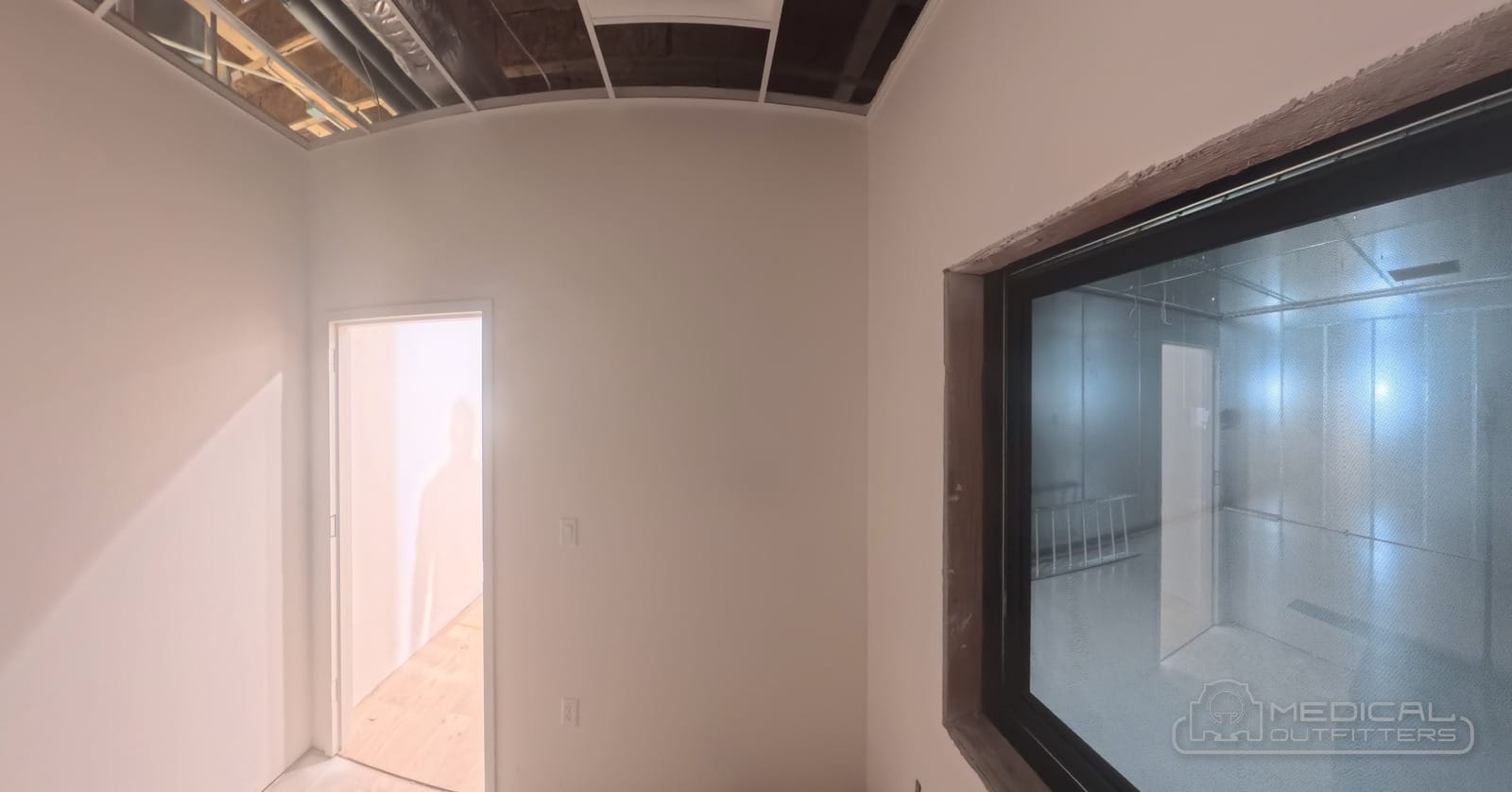
An MRI suite is three rooms. The magnet room holds the magnet, the table and nothing ferrous. The control room holds the console, behind an RF-shielded window. The equipment room holds the gradient and RF amplifiers, the chiller connection, the helium compressor for the cold head, the RF filter panel and the electrical distribution. The RF shield encloses the magnet room only; everything that crosses it, power, data, medical gases, HVAC ducts, the quench pipe, the chilled-water lines to the magnet, passes through a filter or a waveguide that keeps the cage continuous.
Around the suite the American College of Radiology’s four zones apply: Zone I is public space, Zone II is where patients are screened, Zone III is the controlled area whose access is restricted, and Zone IV is the magnet room itself. The 5-gauss line must fall inside Zones III and IV.
RF Shielding for an MRI Room: The Faraday Cage
An MRI scanner works by exciting hydrogen protons with a radio pulse and listening for the faint signal they return. The signal frequency is set by the field strength: about 12.8 MHz at 0.3T, 51 MHz at 1.2T, 63.9 MHz at 1.5T and 127.7 MHz at 3T. That is the FM broadcast band and its neighbours, and the signal the scanner is listening for is millions of times weaker than the radio noise around it. The RF shield is a Faraday cage that keeps that noise out.
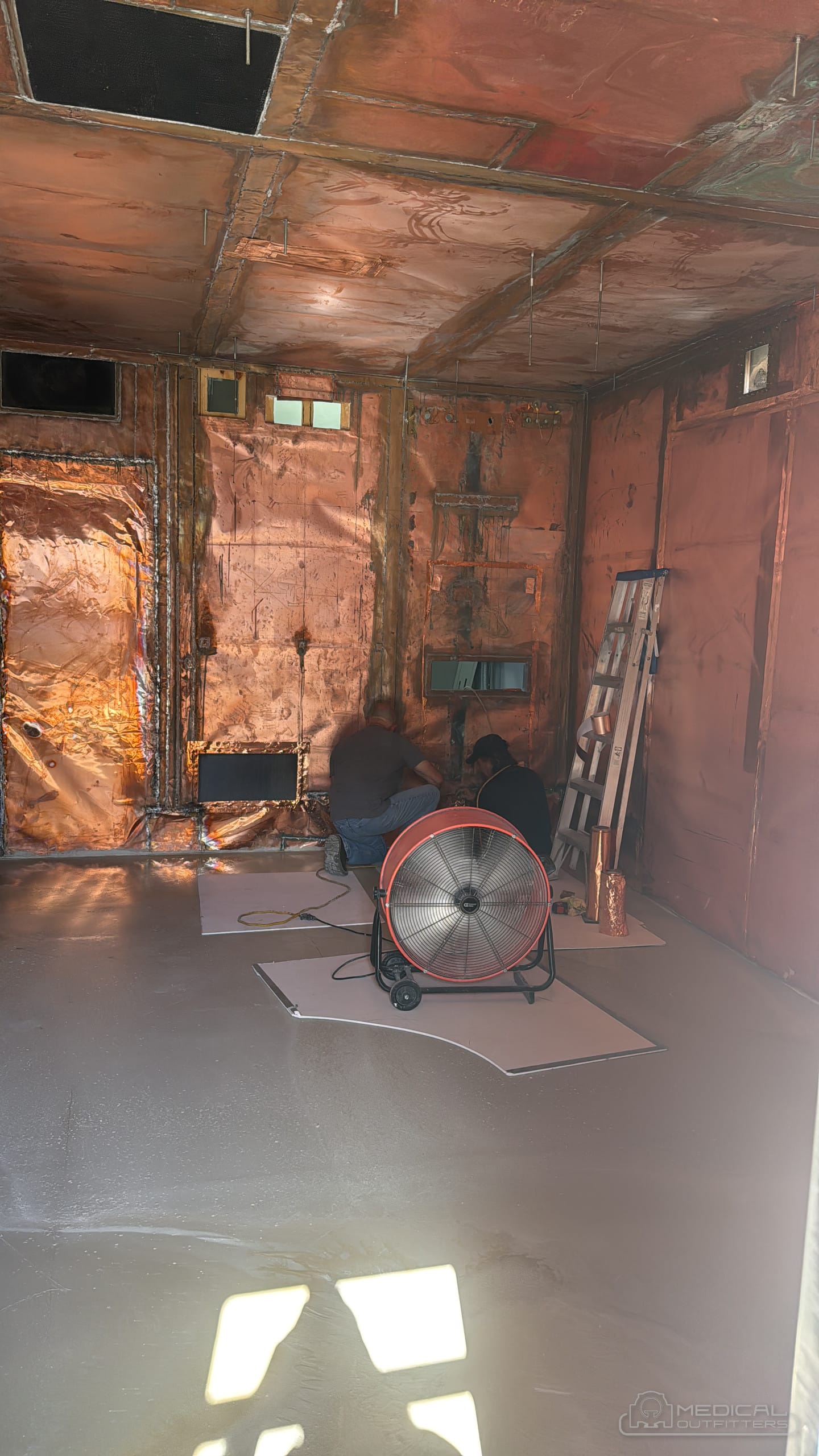
The shield is built as a continuous conductive box: copper sheet or galvanized steel panels on a frame, soldered or clamped at every seam, on the floor, the ceiling and all four walls. The door is the weak point, so it carries a finger-stock or pneumatic seal, and the window between the magnet room and the console is a wire mesh sandwiched in glass. Every penetration is a potential leak, which is why power comes in through RF filters, ducts pass through honeycomb waveguides, and non-conductive pipes cross through waveguide tubes sized so that the frequency of interest cannot propagate. Prefabricated RF-shielded rooms from specialist shielding vendors assemble the same cage from factory-built panels, which shortens construction on new suites and island sites.
The performance specification is attenuation in decibels across the scanner’s operating band. Manufacturers typically call for about 100 dB, and the shielding vendor tests the finished room, before the magnet arrives, with a transmitter outside and a receiver inside at a range of frequencies and positions. The test certificate is part of the installation documentation; a room that fails is repaired and retested, because a leak found after the magnet is at field is a leak found in the images.
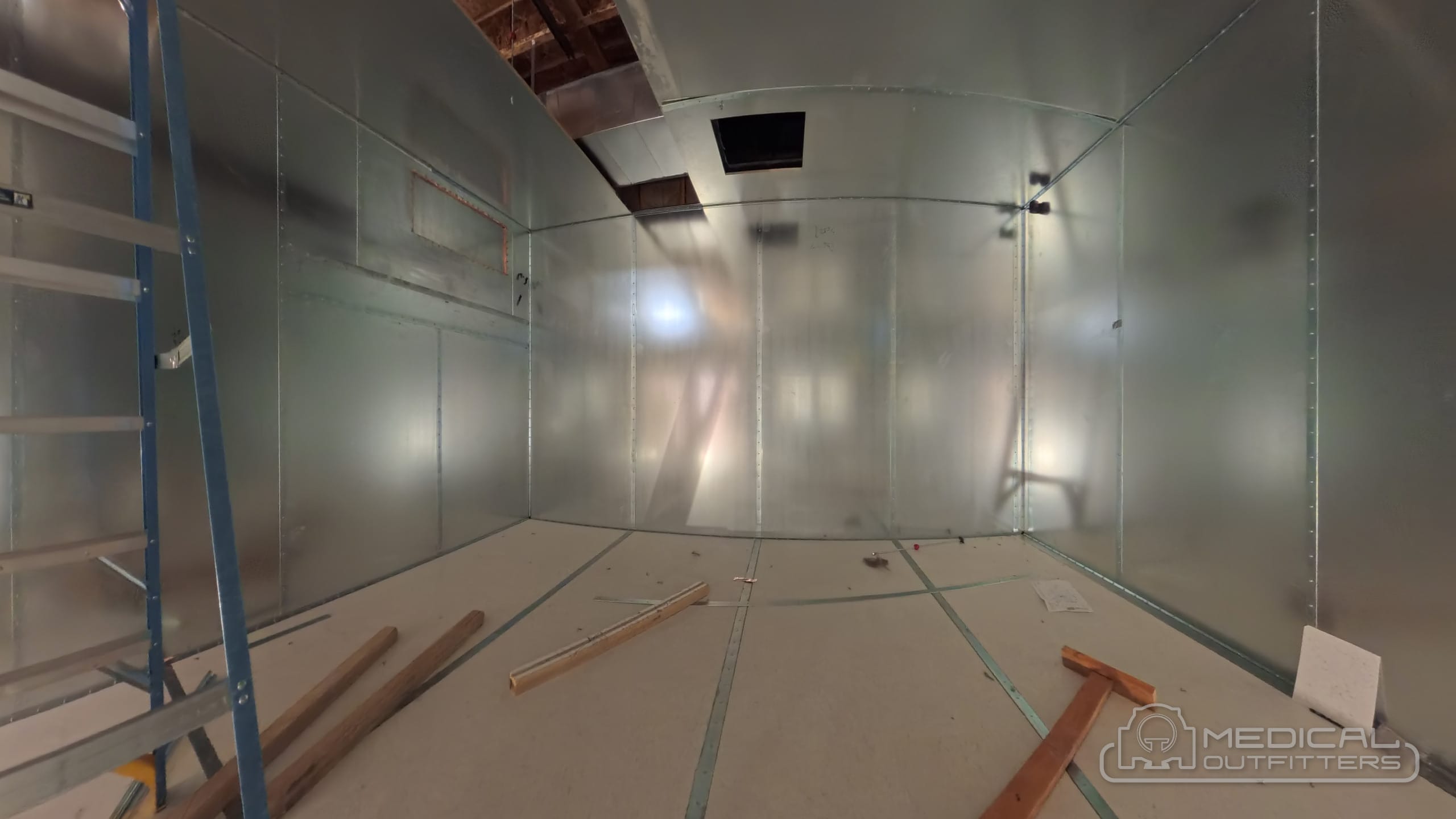
Everything that comes later is a penetration. The most common RF failure in a working suite is not in the original build. It is the network cable, medical-gas outlet or new duct that a later contractor pushed through the shield without a filter or waveguide. Any change to an MRI room’s envelope goes through the shielding vendor.
Magnetic Shielding and the 5-Gauss Line
A superconducting magnet’s field does not stop at the bore. It extends around the magnet as a fringe field that weakens with distance, and the siting manual maps it as contours: the 5-gauss line, the 1-gauss line, and so on, in three dimensions, because the field extends through the floor and the ceiling as well as the walls.
The 5-gauss line, 0.5 millitesla, is the traditional safety boundary. The ACR’s 2024 manual draws its hazard area at 9 gauss and accepts the 5-gauss convention. Above 5 gauss, cardiac pacemakers and other implanted devices can malfunction, so access inside it must be controlled. Modern magnets are actively shielded, with a second set of superconducting coils that cancel most of the external field, and on a 1.5T magnet such as the Fujifilm ECHELON Smart or a refurbished Siemens MAGNETOM Aera the 5-gauss contour usually falls within a few metres of the isocentre, often inside the magnet room. On a 3T, and on some older or unshielded magnets, it can reach past the walls, into the floor above or the room next door.
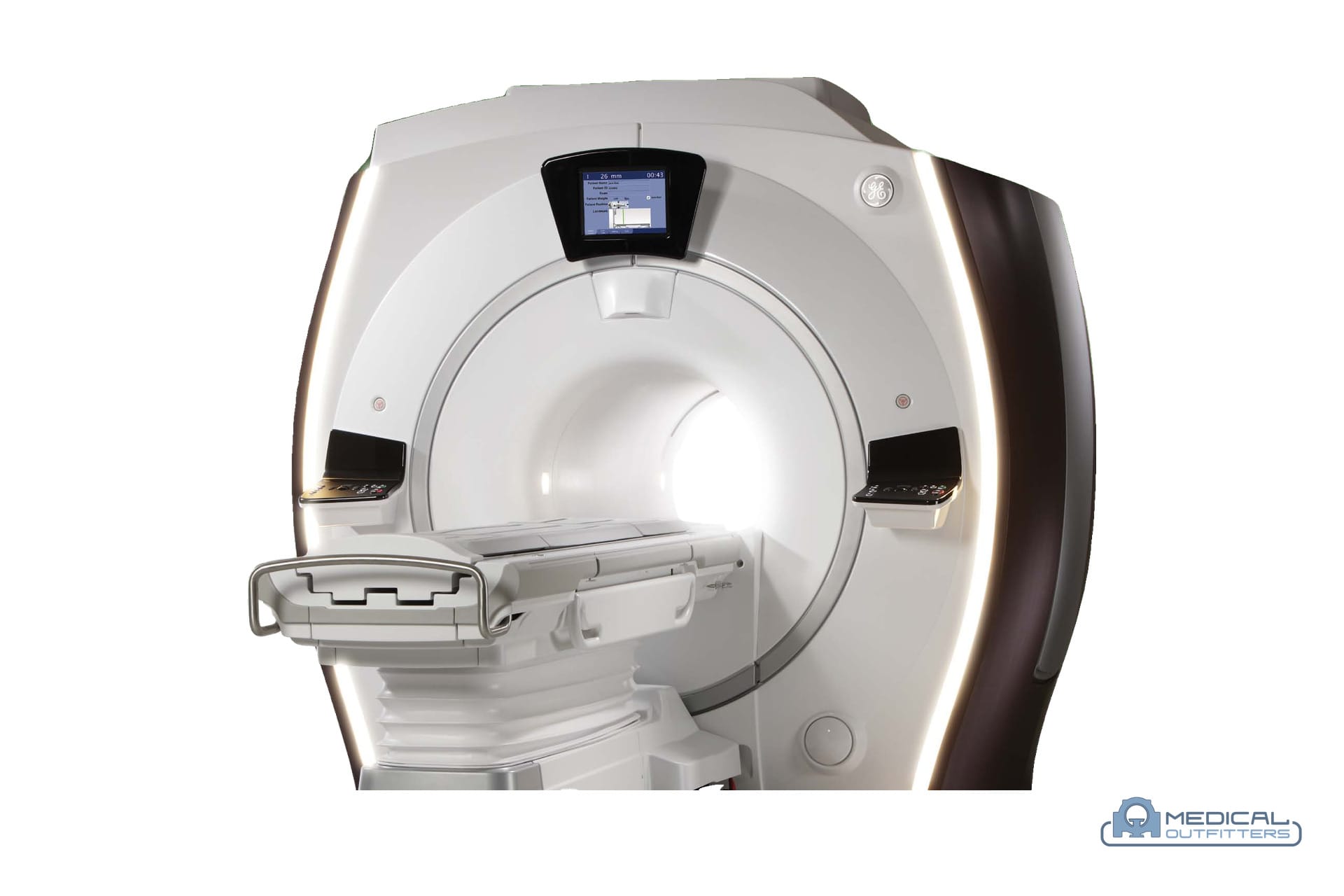
When the contour crosses into a space that cannot be controlled, a corridor, an office, a parking level, the answer is magnetic shielding: steel plate fixed to the wall, floor or ceiling on the side that needs it, sized by the physicist or the vendor from the fringe-field data. It is not thin. A 3T near an occupied floor can need plate 12 to 25 mm thick over a substantial area, and the plate itself changes the field inside the bore, which the installation engineer corrects at shimming. The structural engineer needs to know about it early: steel by the tonne on a wall is a structural load, and a magnet moved half a metre on the plan can remove the need for it altogether.
The fringe field also matters in the other direction. Elevators, vehicles, structural steel that moves, and large electrical loads near the magnet disturb the field and show up as artifacts. The vibration and electromagnetic-interference survey, done before the room is designed, catches those. Our guide to MRI installation in Puerto Rico and the Caribbean walks through the survey for a new site.
How MRI Shielding Requirements Change With Field Strength
Permanent-magnet open systems, 0.3T to 0.4T. The Fujifilm AIRIS Vento and APERTO Lucent use permanent magnets: no helium, no quench pipe, no cold head, and a fringe field that stays close to the magnet. They still need an RF room, at a lower frequency, and a floor that carries a heavy magnet. They are the simplest MRI systems to site in terms of infrastructure, with no quench pipe, chiller or magnetic shielding, but at roughly 15 tonnes the magnet itself is heavier than a 1.5T cylindrical magnet, so the floor structure still has to be checked.
1.2T open superconducting. The Fujifilm Oasis Velocity is superconducting, so it needs a quench pipe and cryogen access, and its vertical-field design has a fringe field of its own shape. It is also the heaviest magnet in the lineup, so the slab is the first question.
1.5T closed and wide bore. The ECHELON Smart, the Siemens MAGNETOM Espree and Aera, and the GE Optima MR450w and Signa HDxt are the standard case: RF room at 64 MHz, quench pipe, chiller, a 5-gauss line that is usually inside the room on an actively shielded magnet, and magnetic shielding only where the layout demands it. The Echelon Smart ZeroHelium removes the quench pipe from this class.
3T. The Siemens MAGNETOM Skyra and GE Discovery MR750w double the field and the shielding questions with it: a 128 MHz RF room, a larger fringe field, stricter vibration and EMI limits, more steel when a neighbour is close, and a higher floor load. A 3T on an upper floor of an existing building is possible and expensive; a 3T on a ground-floor slab at the edge of the building is the easy version.
The MRI Quench Pipe
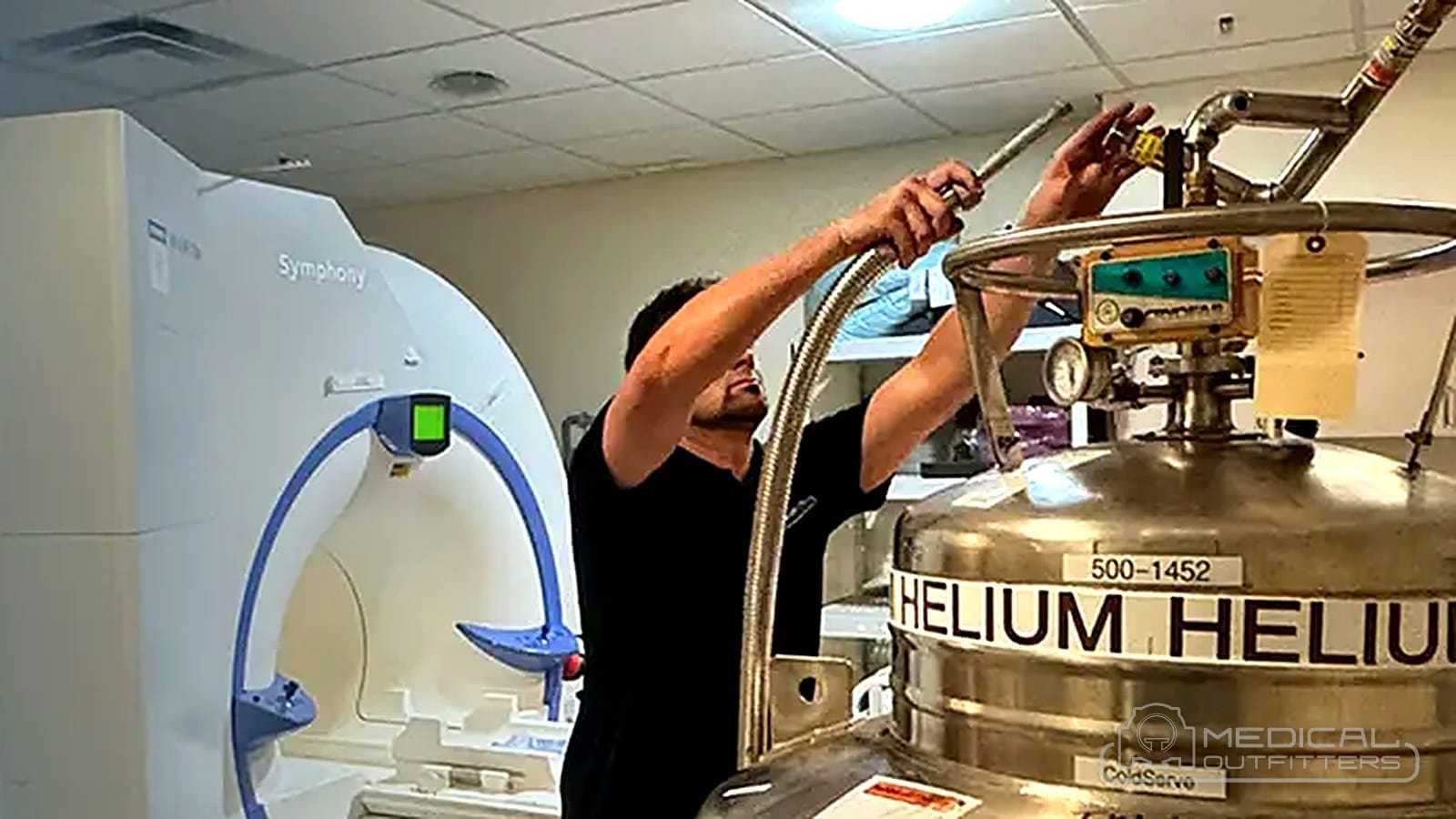
A superconducting magnet holds 1,000 to 2,000 litres of liquid helium. If the magnet quenches, that helium boils off in a minute or two and expands roughly 750 times into gas. The quench pipe carries it outside. The manufacturer specifies the pipe’s diameter, its maximum length and number of bends, its insulation, and the discharge point: away from windows, air intakes, walkways and anything a cloud of cold gas could harm. Building it wrong risks the magnet, the room and the people in it, so the pipe is inspected at installation and annually after. Our guide to what an MRI quench is covers the event itself, and the cryogenic service page covers the maintenance that keeps it from happening.
The pipe is also the reason an MRI room in an existing building needs an early conversation with the mechanical engineer. A route to the roof through three occupied floors is a design problem; a route through an exterior wall at ground level is a morning’s work. A zero-helium magnet removes the conversation.
Floor Loading, Vibration and the Route In
A 1.5T magnet weighs three to five tonnes and a 3T six to eight, on a footprint of a few square metres, and the magnet arrives on skates that concentrate that load further. The structural engineer confirms the slab or the floor structure for the static load and the rigging path for the transient one. Isolation pads under the magnet, and sometimes a separate isolated slab, control vibration; the survey sets the limits and the design meets them.
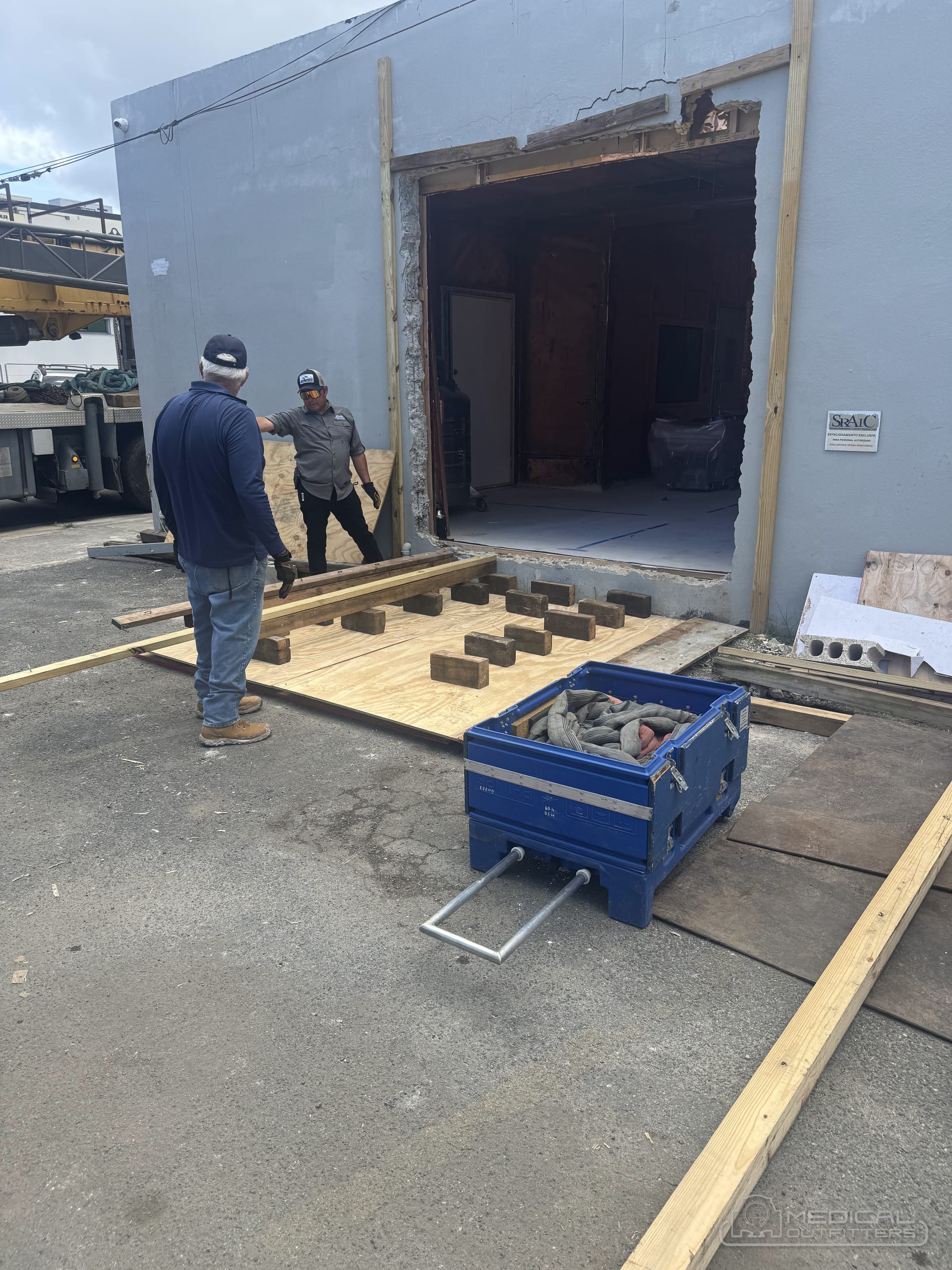
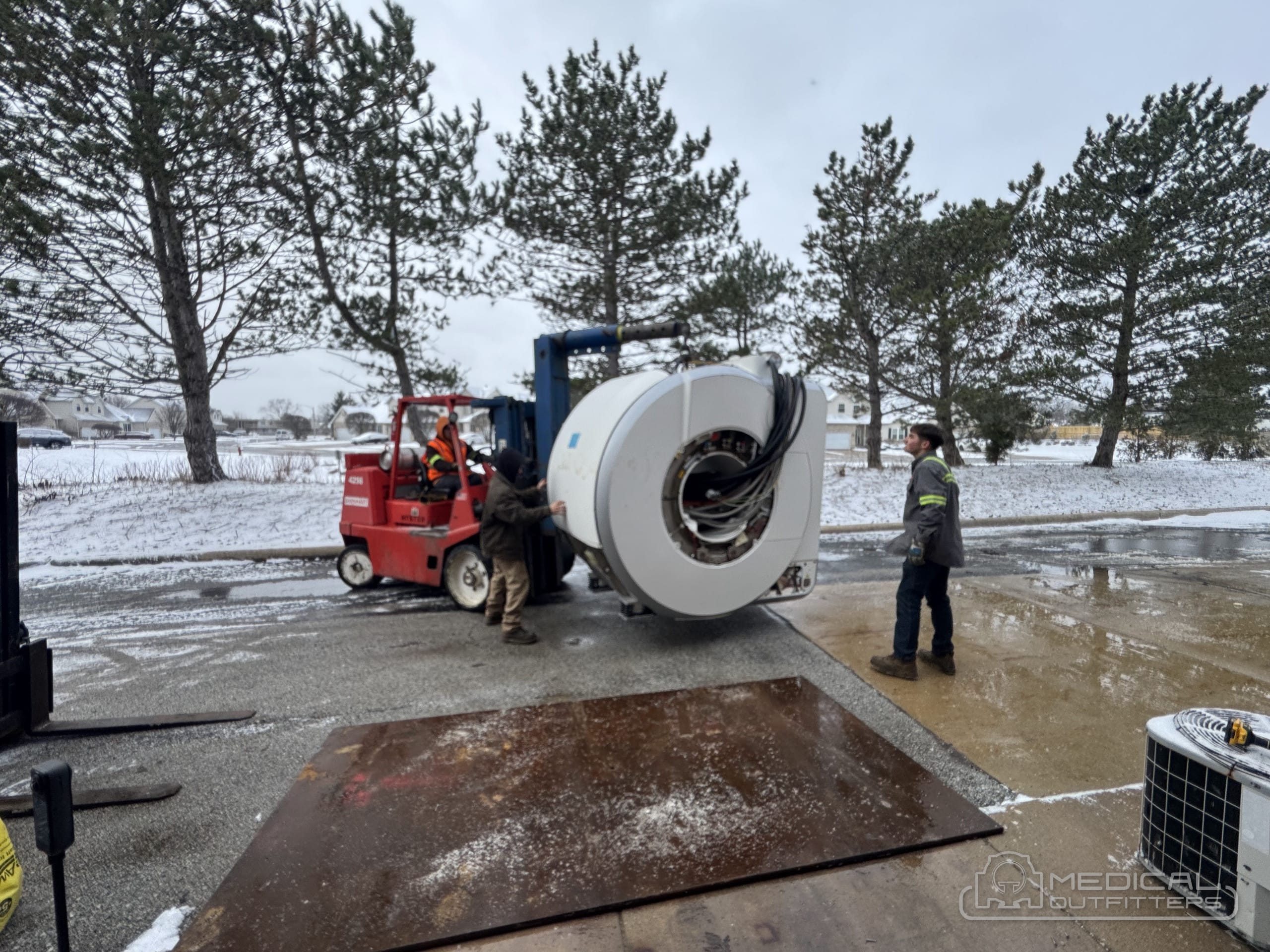
The route in is part of the room design. The magnet needs an opening, a removable wall panel, a door of sufficient size or a crane hatch, and a path from the street to the room that carries the load. Rooms that are finished before the magnet’s route is planned are rooms with a wall cut out later. Medical Outfitters’ installation and rigging team surveys the route before the room is built, and our guide to how to move an MRI or CT scanner covers the rigging itself.
MRI Room Requirements Beyond Shielding: Size, Power and Chiller
Shielding is the part of the room that is unique to MRI, but it is not the whole specification. The magnet room itself is typically sized at 30 to 40 square metres for a 1.5T system, larger for a 3T or an open 1.2T magnet, with ceiling height set by the magnet’s covers and the crane hatch if one is used. The equipment room needs three-phase power sized to the gradient amplifiers, a dedicated chilled-water supply or a packaged chiller, and HVAC that keeps the electronics within their temperature and humidity limits. The control room needs the RF window, the console and the network connection, and the suite needs a patient screening area, a changing room and storage for ferrous items outside Zone IV.
Every one of those numbers comes from the magnet’s siting manual, which is why the sequence matters: choose the magnet, receive the manual, then design. The manual for a compact current-generation system such as the ECHELON Smart is different from the manual for a refurbished wide-bore Siemens, and both are different from the Oasis Velocity’s. Our MRI machine cost and buying guide gives the broad industry ranges for the room alongside the magnet, and our note on clinical facility development in the US and Caribbean covers the construction side.
Responsibilities, Sequence and Cost
| Step | Owner | Output |
|---|---|---|
| 1. Choose the magnet | Buyer with dealer | The siting manual that everything else is designed from |
| 2. Site survey | Physicist or vendor | Vibration, EMI and fringe-field report; magnetic-shielding requirement |
| 3. Suite design | Architect, structural and mechanical engineers | Room layout, zones, floor design, quench-pipe route, power and chiller |
| 4. RF room build and test | Shielding contractor | Test certificate at the specified attenuation |
| 5. Delivery, rigging, ramp-up | Dealer’s crews | Magnet at field, shimmed to specification |
| 6. Acceptance | Physicist | ACR phantom results; safety program; signage |
The RF room is a significant line in any MRI budget, magnetic shielding can add to it, and the quench pipe and structural work depend on the building. Because all three scale with the magnet and the site, the honest answer to “what does MRI shielding cost” is a survey. If you are planning a suite, contact Medical Outfitters with the building plans and the magnets you are considering. We will tell you which one sites most easily in that building, coordinate the survey and the shielding vendor, and deliver to a certified room, in Florida and across the United States, Puerto Rico and the Caribbean.
- MRI machines for sale
- Fujifilm Echelon Smart ZeroHelium (no quench pipe)
- Fujifilm Oasis Velocity 1.2T open MRI
- Fujifilm AIRIS Vento 0.3T permanent-magnet MRI
- Fujifilm APERTO Lucent 0.4T open MRI
- MRI installation and rigging
- MRI installation in Puerto Rico and the Caribbean
- MRI quench and the quench pipe
- Clinical facility development
- Send us your floor plan
MRI Room Shielding Requirements: Common Questions
What shielding does an MRI room need?
Every MRI room needs RF shielding, a continuous copper or galvanized-steel enclosure on all six sides with a shielded door, window, filters and waveguides. Magnetic shielding, steel plate in walls or floors, is added when the fringe field would cross into spaces that must stay below 5 gauss or would disturb magnetically sensitive equipment nearby. Superconducting magnets also need a quench vent pipe.
What is the 5-gauss line and why does it matter?
The 5-gauss line (0.5 millitesla) marks where the magnet's stray field is strong enough to affect pacemakers and other implants. Access inside it must be controlled, which is why it should fall within the magnet room or a controlled area, including the floors above and below.
How much RF attenuation does an MRI room need?
Manufacturers typically specify about 100 dB of attenuation across the scanner's operating frequencies, roughly 10 to 130 MHz depending on field strength. The shield vendor tests the finished room and provides a certificate that the installer needs before the magnet is delivered.
Do open MRI machines need shielding?
Yes, every MRI needs an RF-shielded room. Low-field permanent-magnet open systems such as the Fujifilm AIRIS Vento and APERTO Lucent do not need a quench pipe and rarely need magnetic shielding, which makes them the simplest MRI systems to site.
How thick are MRI room walls?
Thickness depends on what is needed. RF shielding itself is thin sheet copper or steel on a frame. Magnetic shielding, when required, adds steel plate that can be anywhere from a few millimetres to 25 mm or more in the walls or floor nearest the magnet, sized from the fringe-field survey.
Who is responsible for MRI room shielding?
The shielding contractor designs and builds the RF room to the manufacturer's siting specification, the physicist or vendor performs the magnetic and vibration site survey, and the equipment dealer coordinates delivery to the certified room. Medical Outfitters manages this sequence for the MRI systems it installs.
Related Articles