For a new imaging center that will scan a general mix of neuro, spine, musculoskeletal and body referrals, a 1.5T wide-bore MRI is the right first magnet. It matches a closed-bore system on image quality, accepts the bariatric and anxious patients a 60 cm bore turns away, and holds its resale value. An open MRI is the right first magnet when bariatric, pediatric, claustrophobic or weight-bearing referrals will dominate, and the 1.2T Fujifilm Oasis Velocity has made that a far stronger option than it was a decade ago. A closed 60 cm bore is now a second-unit or budget choice.
That is the short version of the wide-bore vs open vs closed MRI decision. The long version matters because the three designs differ in field strength, scan time, siting, helium, and the referrals they win and lose, and because the wrong first magnet is the most expensive mistake a new center can make. Open MRI machines have also changed: a 1.2 Tesla open MRI like the Oasis Velocity is a different instrument from the 0.3T open systems that gave “open MRI” a reputation for soft images.
This guide is for the physician group, hospital or investor planning a new outpatient imaging center. It explains how each design works, compares them row by row, walks through patient comfort, image quality, siting and cost, covers what a used open MRI for sale and an open MRI machine cost look like today, and ends with a decision path and a shortlist of new and refurbished models for each design.
- Wide-bore means a 70 cm opening on a standard superconducting 1.5T or 3T magnet. Image quality equals a closed bore at the same field strength.
- Open MRI means a vertical-field magnet open on the sides, from 0.25T extremity units to the 1.2T Oasis Velocity. Best comfort; longer scans at low field.
- Closed bore means 60 cm. Cheapest on the refurbished market, tightest for patients, and no longer the default for a first magnet.
- Buy for the referral mix, then decide new or refurbished for the budget. Both are available for every design.
Medical Outfitters sells new Fujifilm and Esaote MRI systems as an authorized dealer, sells refurbished GE and Siemens wide-bore and closed-bore magnets through MO Select, and installs and services all of them with its own crews across the United States, Puerto Rico and the Caribbean. Every model in the shortlist at the end of this guide is on our MRI machines for sale page.
Wide-Bore vs Open vs Closed MRI at a Glance
| Design | Field strength | Patient opening | Strengths | Compromises | Examples |
|---|---|---|---|---|---|
| Closed bore | 1.5T or 3T | 60 cm tube, 150 to 170 cm long | Lowest refurbished cost; proven platforms; smallest magnet room | Claustrophobia, bariatric limits, more sedation and refusals | GE Signa HDxt, Siemens MAGNETOM Symphony and Avanto |
| Wide bore | 1.5T or 3T | 70 cm tube, 125 to 175 cm long | Same image quality as closed; accepts most patients; strong resale | Costs more than closed on the used market | Siemens MAGNETOM Espree, Aera, Skyra; GE Optima MR450w, Discovery MR750w |
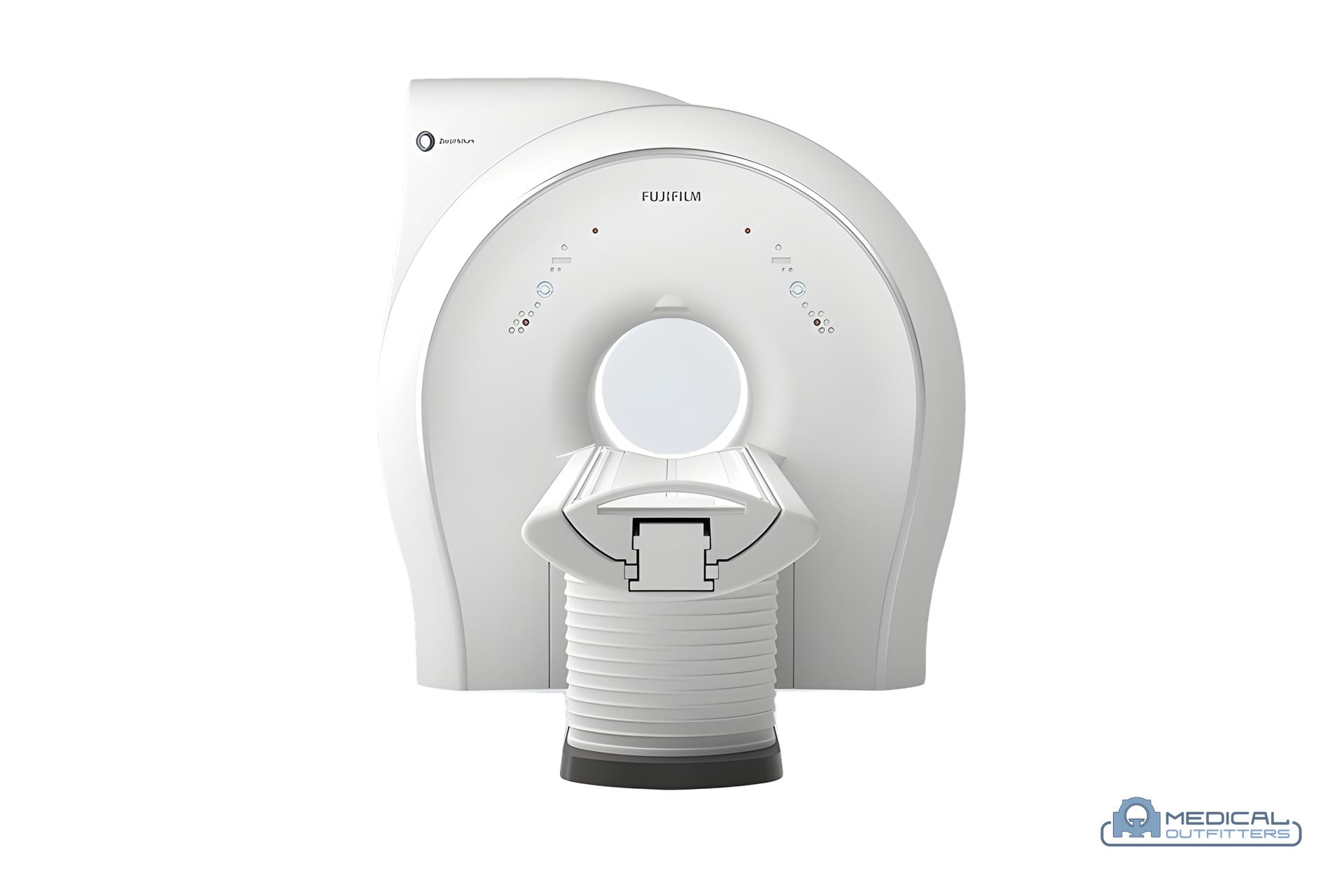
| Compact 1.5T, current generation | 1.5T | Short, patient-friendly bore with AI workflow | New platform at the start of its support life; zero-helium option | New-system price | Fujifilm ECHELON Smart, Echelon Smart ZeroHelium |
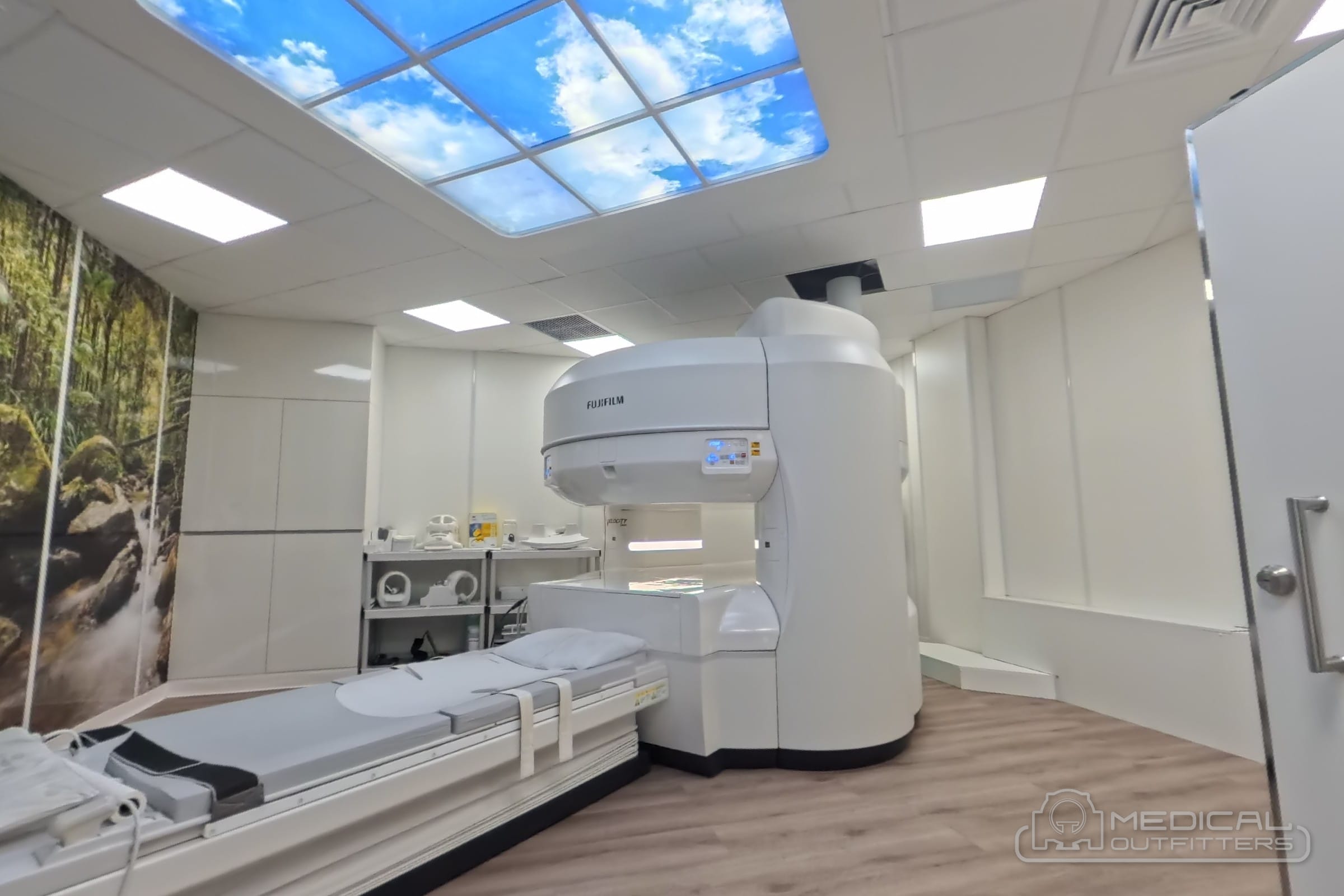
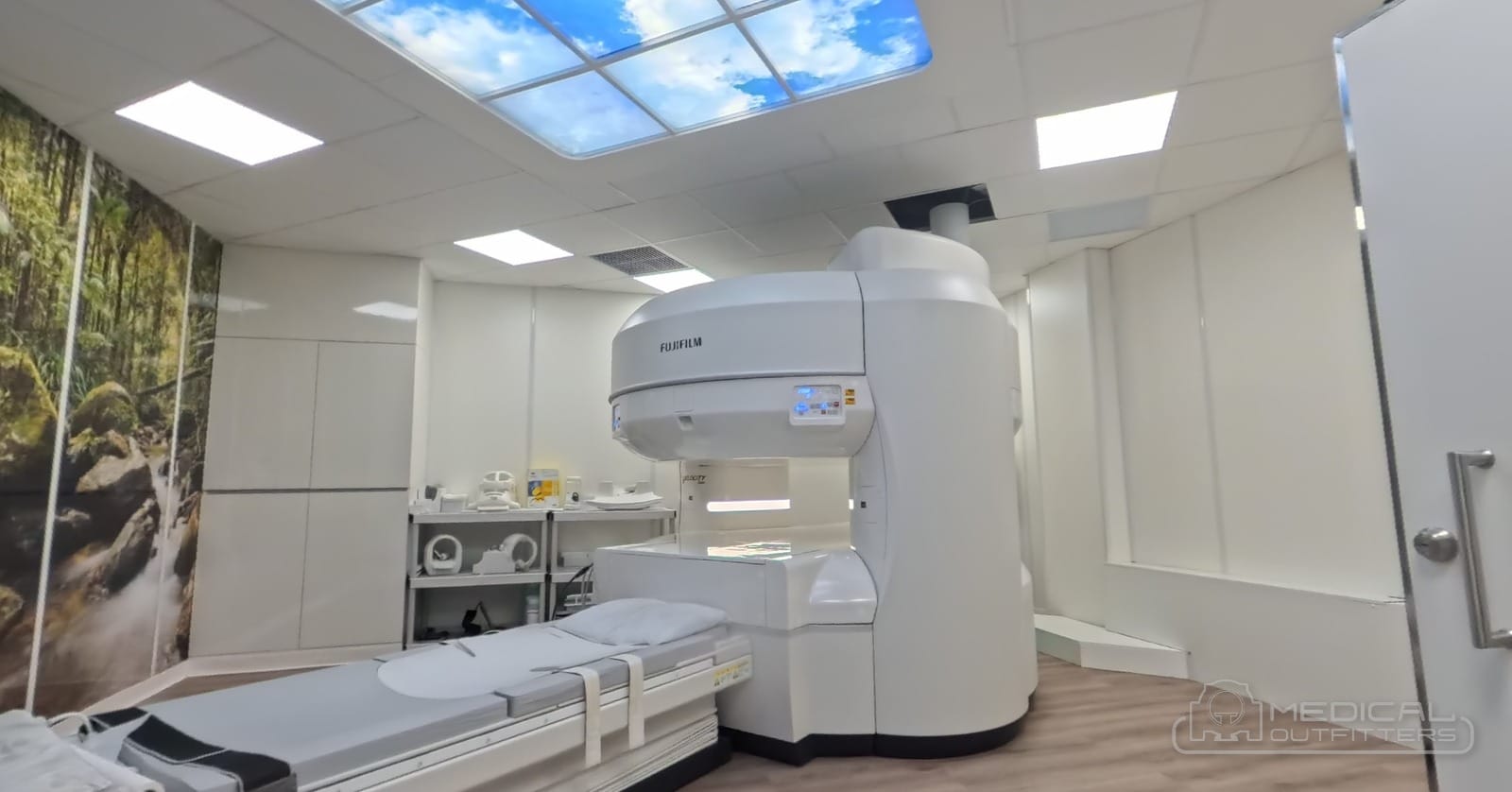
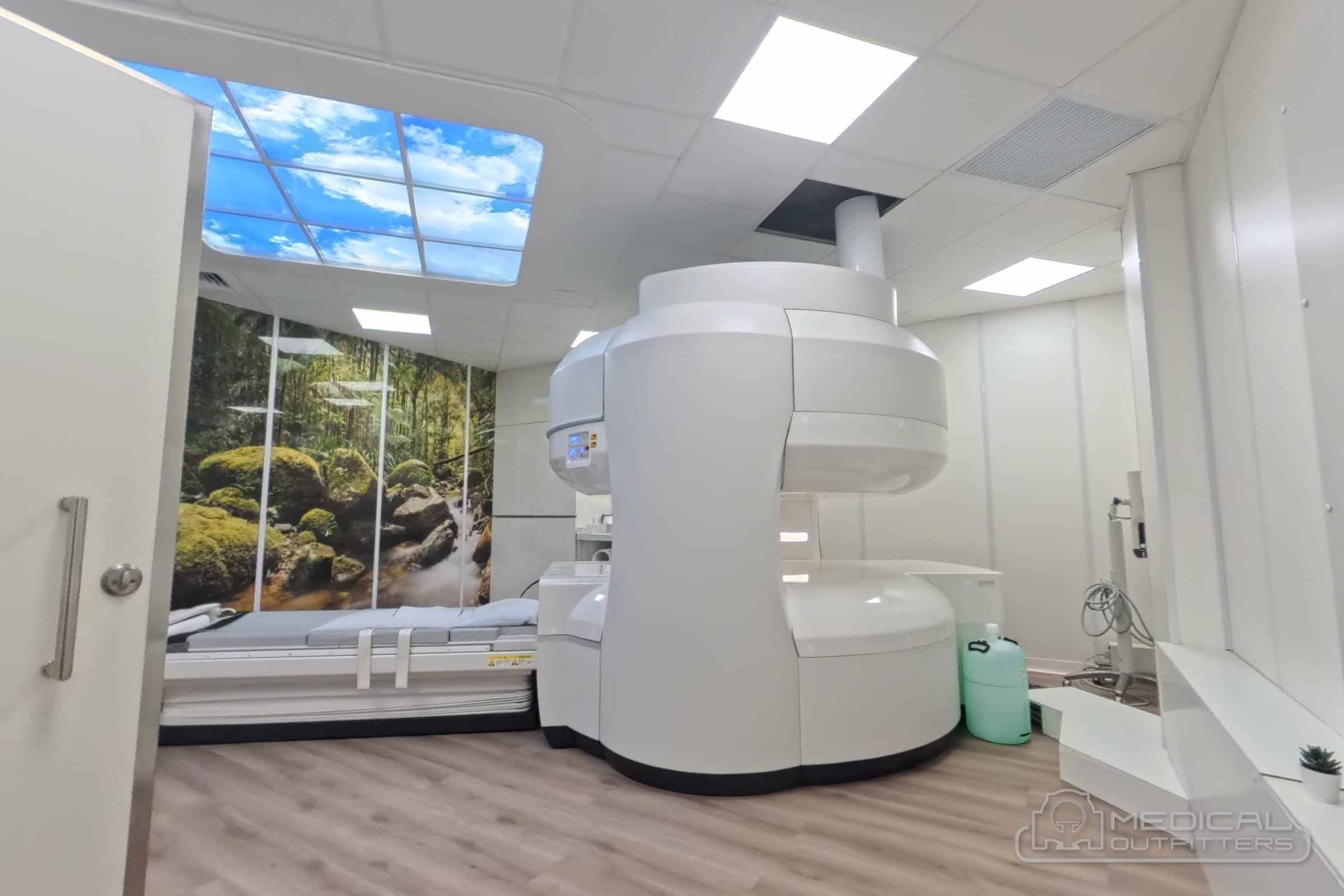
| Open, high field | 1.2T | Open 270 degrees; vertical field | Near-1.5T image quality with open comfort; bariatric to 300 kg; pediatric | Heaviest magnet; longest scan times of the high-field options | Fujifilm Oasis Velocity |
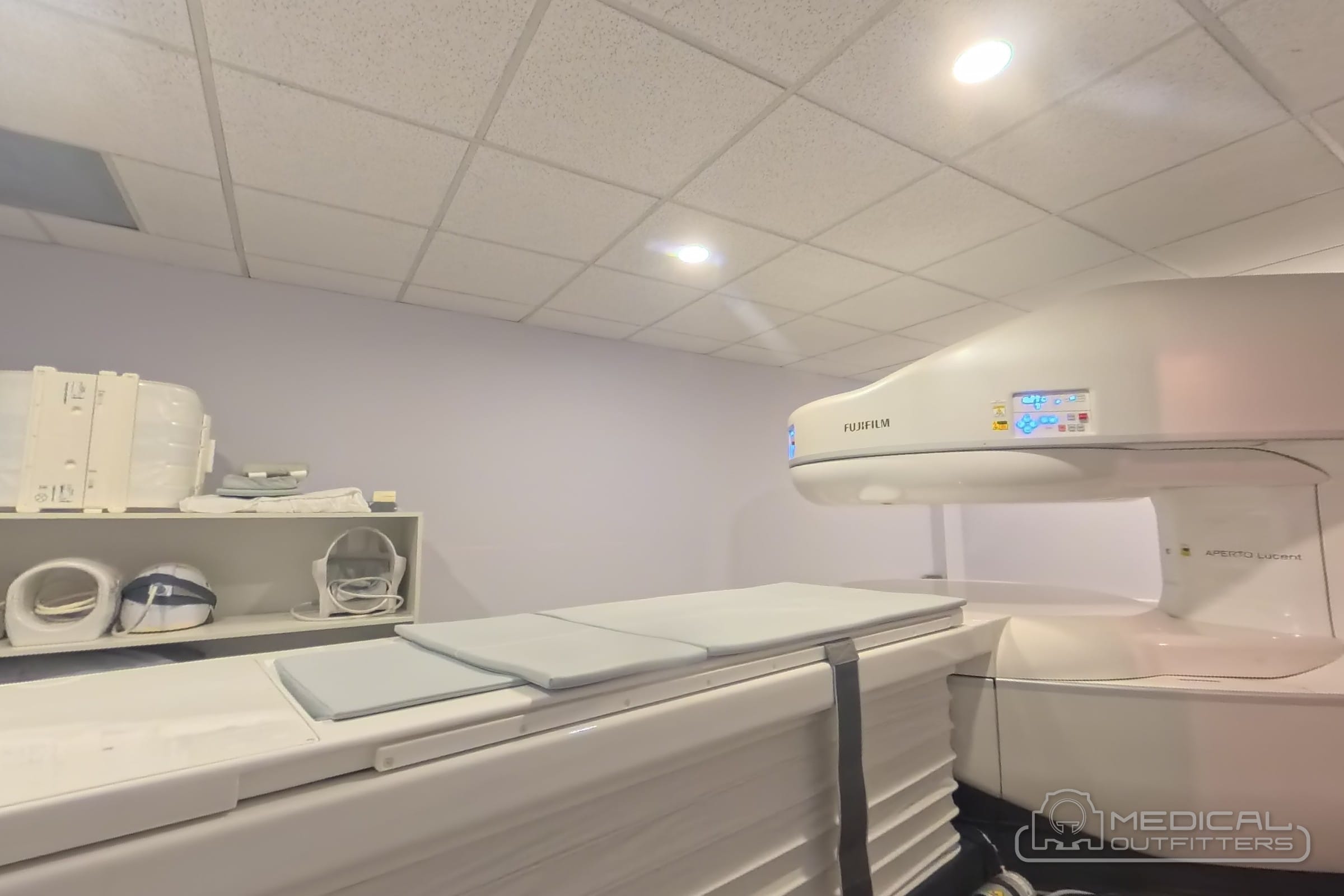
| Open, low field | 0.3T to 0.4T | Open sides; permanent magnet | No helium, no quench pipe, simplest siting, lowest running cost | Longer scans, fewer advanced sequences | Fujifilm AIRIS Vento, APERTO Lucent |
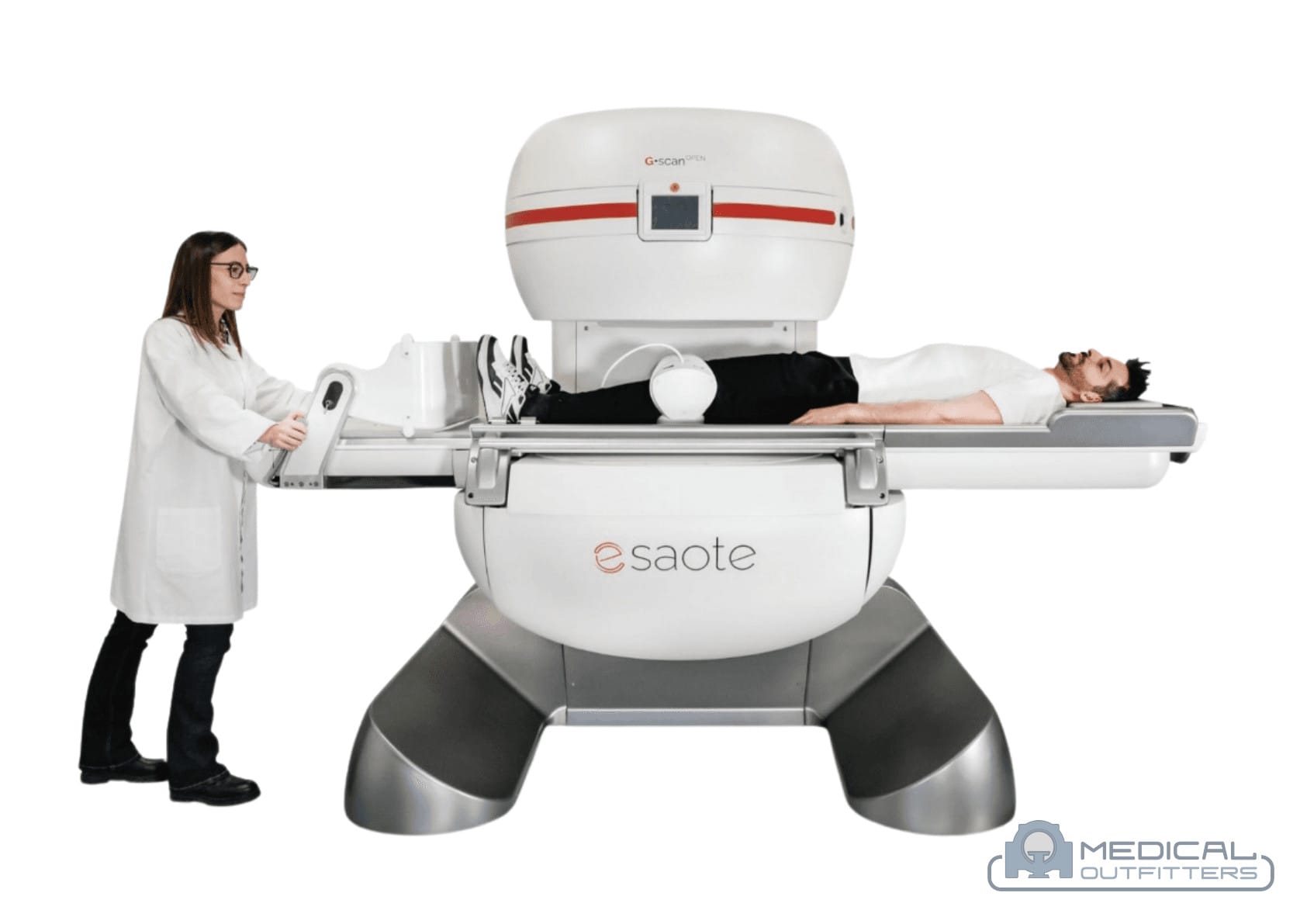
| Extremity and weight-bearing | 0.25T to 0.31T | Limb or spine only; tilting table on G-scan | Small room, standard power, standing scans no other design can do | Not a whole-body scanner | Esaote G-scan, S-scan, O-scan |
A note on language. “Open bore” is a marketing name some manufacturers use for a 70 cm wide-bore magnet; it is not an open MRI. When a referrer or a patient asks for an open MRI machine, they mean the vertical-field design with open sides.
How Each MRI Design Works
Closed bore MRI: the original superconducting tunnel
A closed-bore MRI is a superconducting solenoid: a cylindrical coil cooled by liquid helium, with the patient inside the cylinder. The horizontal field is uniform and strong, 1.5T or 3T, which is what gives closed magnets their signal-to-noise and their short scan times. The compromise is the 60 cm tube the patient lies in, often more than 150 cm long, with the face a few centimetres from the wall of the bore. Roughly one patient in ten finds that difficult and one in fifty cannot complete the exam.
Wide bore MRI: the same magnet with a bigger opening
A wide-bore MRI is the same superconducting design with the bore opened to 70 cm and the magnet shortened, in many cases to about 125 cm. The Siemens MAGNETOM Espree introduced the format in 2004, and the Aera, Skyra, GE Optima MR450w and Discovery MR750w made it the standard hospital magnet of the following decade. Ten centimetres of extra diameter, and on the shortest magnets such as the 125 cm Espree some 25 to 35 centimetres less length, change the patient experience far more than the numbers suggest: shoulders fit, larger patients fit, and on the Espree Siemens quotes 60 percent of routine exams with the head outside the bore. Our guide to wide bore MRI systems covers the individual models, and the current Fujifilm generation, the ECHELON Smart with SynergyDrive and the ECHELON Smart ZeroHelium, brings a compact footprint and low running cost to a current 1.5T platform.
Open MRI: a vertical field between two poles
An open MRI puts the magnet above and below the patient rather than around them, so the field runs vertically and the sides are open. Low-field open systems use permanent magnets, which need no helium and no quench pipe, at 0.3T to 0.4T. The Fujifilm Oasis Velocity uses a superconducting vertical-field magnet at 1.2T, which is why this Fujifilm open MRI produces images that stand comparison with 1.5T closed systems while remaining open on 270 degrees. The vertical field also suits solenoid receive coils, which partly offsets the lower field strength.
Extremity and weight-bearing MRI: a fourth category worth knowing
Dedicated extremity magnets image a knee, ankle, hand or shoulder in a small permanent magnet with the patient sitting beside it. The Esaote G-scan goes further: its magnet and table tilt from horizontal to upright, so the spine and joints are imaged under load, which no closed, wide-bore or conventional open magnet can do. The S-scan covers joints and spine in a fraction of the room, and the O-scan is the compact extremity unit. They are not first magnets for a general center, but for an orthopedic or sports-medicine practice they are often the right only magnet.
Wide-Bore vs Open vs Closed MRI, Row by Row
Field strength. Signal-to-noise rises roughly in step with field strength, so a 0.3T magnet has to trade resolution, slice thickness and much longer scan times to approach what a 1.5T magnet produces in a few minutes, and some sequences, notably modern diffusion, perfusion, cardiac and prostate protocols, are only practical at 1.5T and above. The 1.2T Oasis Velocity sits close enough to 1.5T that it runs a general outpatient schedule; 0.3T and 0.4T open MRI machines do not.
Patient opening. Sixty centimetres, seventy centimetres, or open. The wide-bore step is the one that changes a center’s refusal and sedation rate; the open step is the one that wins the patients who will not enter any tube.
Image quality and speed. Closed and wide-bore magnets at the same field strength are equivalent. Open magnets trade image quality or scan time for comfort, and how much they trade depends entirely on field: a little at 1.2T, a lot at 0.3T.
Footprint and siting. All three need an RF-shielded room. Wide-bore and closed magnets need a quench pipe, a chiller and a magnet room sized to their fringe field; a 1.2T open magnet is the heaviest of the group and usually wants a ground-floor slab; permanent-magnet open systems need neither helium nor a quench pipe and are the simplest to site. Our guide to MRI installation in Puerto Rico and the Caribbean covers what the room, power and rigging involve for each.
Helium and service. Superconducting magnets of any shape need a cold head replaced every three to five years and helium monitoring; permanent magnets do not. The Echelon Smart ZeroHelium removes the helium question from a 1.5T tunnel system as well, which matters on islands and anywhere helium delivery is slow.
Patient Comfort and the Referrals You Keep
A new imaging center lives on referrals, and referrals follow the patients who complete their exams. Three groups decide the design question.
Claustrophobic and anxious patients. Published rates of claustrophobic reactions in closed magnets run around 5 to 15 percent, with 1 to 2 percent of exams abandoned. Wide-bore and open magnets both reduce those numbers, but neither eliminates them: in the one randomized trial that compared the designs head to head in anxious patients, an open 1.0T magnet cut claustrophobic events from 39 to 26 percent against a short-bore 1.5T, a difference that did not reach significance. If the local competition runs closed magnets, a wide-bore or open MRI is a marketing advantage on its own. Our earlier guide to open MRI vs closed MRI goes deeper on the patient experience.
Bariatric patients. A 60 cm bore and a table rated around 150 to 200 kg exclude a meaningful share of the adult population in many US markets. Wide-bore tables carry about 250 kg with the extra diameter to match, and the Oasis Velocity carries about 300 kg with no bore at all. A center that cannot scan large patients sends those referrals to the hospital and often loses the referring practice with them.
Pediatric and weight-bearing patients. Children image better with a parent beside them, which an open magnet allows. Orthopedic and spine practices increasingly want standing or loaded imaging, which among the systems we sell only the tilting G-scan provides. Neither group fills a general center’s schedule, but either can anchor a specialist one.
Open MRI Machine Cost, Throughput and Resale
Purchase price is only the first number. A magnet’s economics are throughput, running cost and what it is worth when the center upgrades.
Throughput. A 1.5T wide-bore or closed magnet runs a 20 to 30 minute general slot. A 1.2T open magnet runs a somewhat longer slot on the same protocols; a 0.3T open magnet can need twice the time. Over a ten-hour day that difference is several exams, and over a year it is the payment on the magnet. AI reconstruction such as SwiftMR narrows the gap on any of them by cutting scan time up to half.
Running cost. Superconducting magnets carry a cryogen and cold-head budget; permanent magnets do not. Service contracts on refurbished GE and Siemens wide-bore platforms are competitive because the platforms are common and parts are plentiful. Our guide to how long an MRI machine lasts covers what each subsystem costs to keep alive.
Resale. Wide-bore 1.5T magnets hold value best because every buyer wants one. Closed 60 cm magnets are cheapest to buy and cheapest to sell. Open 1.2T systems are a smaller market on both sides, which is exactly why a used open MRI for sale is worth a close look when one appears.
How much does an open MRI machine cost? Medical Outfitters quotes each system individually, because coil packages, software options and refurbished condition move the number more than the design does. The MRI machine cost and buying guide gives the broad industry ranges for new and refurbished systems of each design, from a 0.3T open MRI machine to a 3T wide bore, and it is the honest starting point for anyone comparing an open MRI machine cost against a wide-bore quote.
Used Open MRI for Sale: What to Look For
Searches for a used open MRI for sale turn up three very different things: 0.3T to 0.4T permanent-magnet systems, mid-field open magnets such as the 0.6T Fonar Upright and the 1.0T Philips Panorama, and certified pre-owned 1.2T Oasis systems. They are not the same purchase. A low-field open MRI is cheap to buy and cheap to run, needs no helium and sites almost anywhere, but it limits the schedule to routine musculoskeletal and spine work at longer scan times. A certified pre-owned Oasis Velocity is a high-field open MRI machine with the same 1.2T magnet, coils and software as a new one, rebuilt to Fujifilm’s standard and warranted, at a lower capital cost.
Whichever you consider, check the same things we check before we sell one: the helium and cold-head history on a superconducting unit, every coil on a phantom, the software version and the licences that transfer, and who will install and service it. A used open MRI from a dealer that refurbishes, installs and warranties the system removes most of the risk; a private-party purchase leaves it with you.
Which MRI Should a New Imaging Center Buy First?
Start with a list of the practices that will refer to the center and the exams they order. Then follow the path.
If the mix is general, which for most new outpatient centers means brain, spine, knees, shoulders, abdomen and oncology follow-up, buy a 1.5T wide-bore magnet, or the current Fujifilm 1.5T platform if the budget allows new. Choose 3T only if a neuro, prostate or research referral base justifies the higher purchase, siting and service cost; for most community centers 1.5T earns more per dollar.
If the mix is bariatric, pediatric or claustrophobic, or if the local hospitals already run closed magnets and the center’s pitch is comfort, buy the 1.2T open Oasis Velocity first and plan a wide-bore magnet as the second unit. A certified pre-owned Oasis Velocity makes that first step cheaper.
If the budget is tight or the center is an extremity practice, a refurbished closed 1.5T such as the GE Signa HDxt delivers full 1.5T image quality for the least capital, and an Esaote S-scan or O-scan covers joints and spine in a fraction of the room.
MRI Models to Shortlist for Each Design
| Design | New (authorized dealer) | Refurbished (MO Select) | Best for |
|---|---|---|---|
| 1.5T, current generation | Fujifilm ECHELON Smart with SynergyDrive, Echelon Smart ZeroHelium | See wide bore and closed rows | First magnet in a general center buying new |
| Wide bore 1.5T | On request | Siemens MAGNETOM Espree, Aera, GE Optima MR450w | First magnet in a general center buying refurbished |
| Wide bore 3T | On request | Siemens MAGNETOM Skyra, GE Discovery MR750w | Neuro, prostate, research referral base |
| Open 1.2T | Fujifilm Oasis Velocity | Oasis Velocity certified pre-owned | Bariatric, pediatric, claustrophobic centers |
| Open 0.3 to 0.4T | Fujifilm AIRIS Vento, APERTO Lucent | On request | Lowest running cost, simplest siting |
| Closed 1.5T | On request | GE Signa HDxt | Second unit, budget first unit |
| Extremity and weight-bearing | Esaote G-scan, S-scan, O-scan | On request | Orthopedic and sports-medicine practices |
Whichever row you land in, the center will need the same things around the magnet: an RF room certified before delivery, a rigging plan, a cryogen plan for a superconducting system, and a service partner with engineers on the platform. Medical Outfitters provides the rigging plan, the cryogen plan and the service with the system, and coordinates the RF room through its construction partner, quoted separately. Contact us with your referral mix and site plans for a recommendation and a quote, and see our MRI machines for sale in Florida page if the center is in our home state.
- MRI machines for sale, including open MRI
- Fujifilm Oasis Velocity 1.2T open MRI
- Certified pre-owned Oasis Velocity open MRI
- Fujifilm Echelon Smart ZeroHelium 1.5T
- Fujifilm AIRIS Vento 0.3T open MRI
- Fujifilm APERTO Lucent 0.4T open MRI
- Esaote G-scan weight-bearing MRI
- Esaote S-scan extremity MRI
- MO Select refurbished wide-bore MRI (Siemens, GE)
- Open MRI and wide-bore MRI cost guide
- Open MRI vs closed MRI
- Wide bore MRI systems explained
- MRI machines for sale in Florida
Model price guides by design
Each of the platforms below has its own price guide with the configurations it was built in, our 2026 refurbished range delivered, installed and warrantied, and what to check on a used unit. The range is the fastest way to see what a design decision costs.
| Design | Model | Refurbished range, 2026 |
|---|---|---|
| Open, 0.3T permanent magnet | Hitachi AIRIS II, Elite, Mate and Vento (Fujifilm) | $300,000 to $525,000; new AIRIS Vento $600,000 to $950,000 |
| Closed, 60 cm, 1.5T | GE Signa HDxt | $475,000 to $675,000 |
| Wide bore, 70 cm, 1.5T, earlier platform | Siemens MAGNETOM Espree | $475,000 to $700,000 |
| Wide bore, 70 cm, 1.5T | GE Optima MR450w | $600,000 to $900,000 |
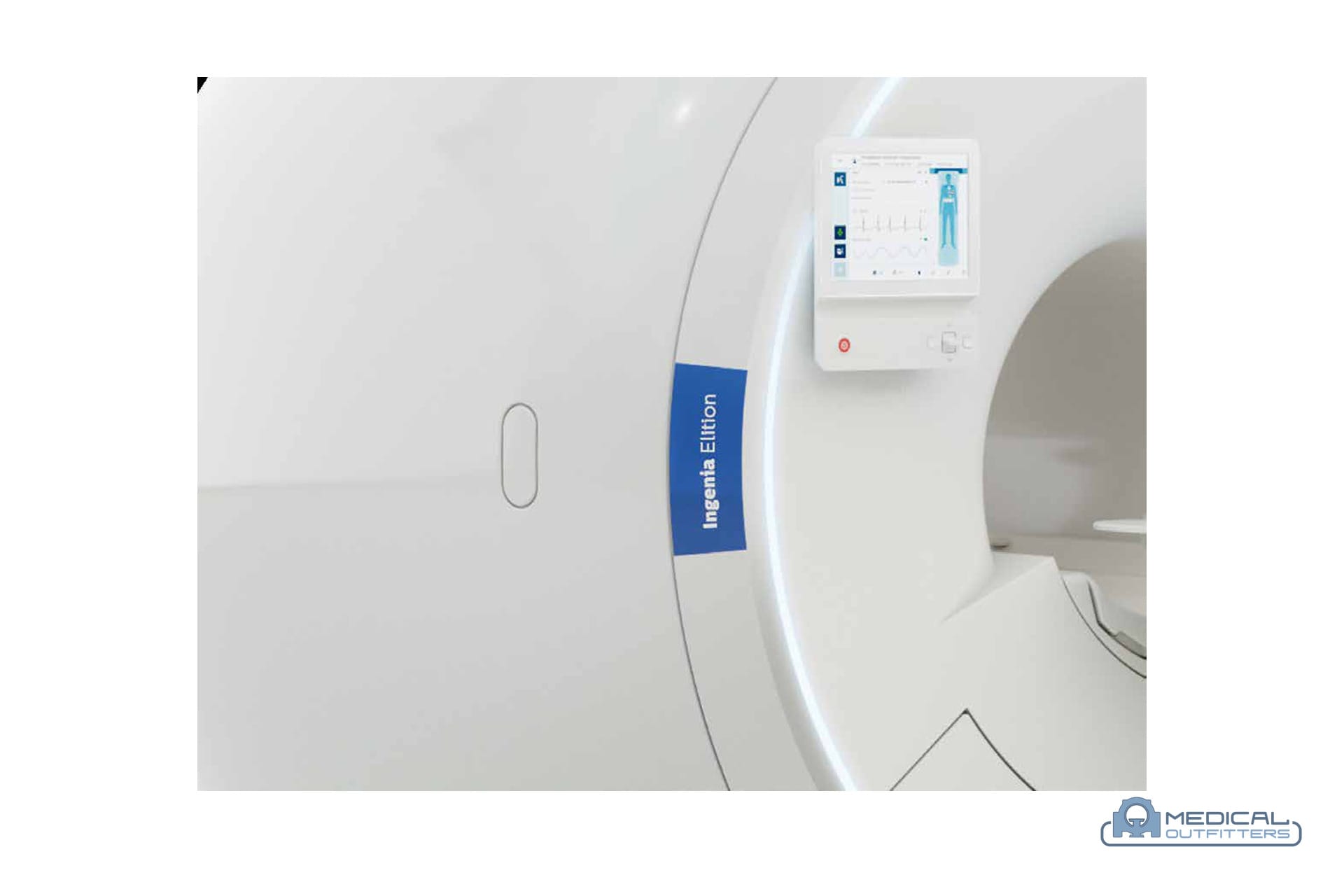
| Wide bore, 70 cm, 1.5T, digital coils | Philips Ingenia 1.5T | $600,000 to $975,000 |
| Wide bore, 70 cm, 1.5T | Siemens MAGNETOM Aera | $650,000 to $975,000 |
| Wide bore, 70 cm, 3T | Siemens MAGNETOM Skyra | $1,000,000 to $1,600,000 |
| Wide bore, 70 cm, 3T | GE Discovery MR750w | $1,100,000 to $1,750,000 |
A wide-bore 1.5T prices inside the 1.5T band and an open 0.3T inside the open band; the 1.2T OASIS Velocity sits between them as a new system. The manufacturers behind these designs are compared in MRI manufacturers compared, and the field-strength question in 1.5T vs 3T MRI.
Wide-Bore, Open and Closed MRI: Common Questions
What is the difference between wide-bore, open and closed MRI?
A closed MRI has a 60 cm cylindrical bore. A wide-bore MRI has the same superconducting design with a 70 cm bore and a shorter magnet. An open MRI uses a vertical-field magnet with the sides open, at lower field strength, from 0.25T extremity units to the 1.2T Fujifilm Oasis Velocity.
Is a wide-bore MRI as good as a closed MRI?
Yes. At the same field strength a 70 cm wide-bore magnet produces the same image quality as a 60 cm closed magnet. Modern wide-bore systems such as the Siemens MAGNETOM Aera, Skyra and GE Optima MR450w are the standard hospital and outpatient magnets of the last decade.
Which MRI is best for claustrophobic patients?
An open MRI is best for severely claustrophobic and bariatric patients. A wide-bore 70 cm magnet with a short bore handles most anxious patients without sedation, which is why many centers choose wide-bore first and add an open magnet only if the referral base demands it.
What MRI should a new imaging center buy first?
For a general-purpose center, a 1.5T wide-bore system is the safest first purchase: it covers neuro, spine, musculoskeletal, body and oncology work, accepts larger patients and holds resale value. A 1.2T open magnet is the right first unit when bariatric, pediatric or weight-bearing referrals dominate.
Do open MRI machines need helium?
Low-field open MRI systems such as the Fujifilm AIRIS Vento (0.3T) and APERTO Lucent (0.4T) use permanent magnets and need no helium or quench pipe. Higher-field open systems such as the 1.2T Oasis Velocity are superconducting and use a cryogen system like a closed magnet.
Can I buy a refurbished wide-bore MRI?
Yes. Refurbished Siemens MAGNETOM Espree, Aera and Skyra and GE Optima MR450w and Discovery MR750w wide-bore systems are available through Medical Outfitters' MO Select program with a written warranty, installation and service by our own engineers.
How much does a wide-bore MRI cost compared with an open MRI?
A refurbished wide-bore 1.5T runs $475,000 to $975,000 delivered, installed and warrantied (Espree, Optima MR450w, Ingenia, Aera), a wide-bore 3T $1,000,000 to $1,750,000 (Skyra, Discovery MR750w), and a refurbished 0.3T open system $300,000 to $525,000 (AIRIS); a new Fujifilm AIRIS Vento is $600,000 to $950,000. The wide-bore premium buys high-field image quality with most of the patient access of an open design.
Related Articles