A typical 1.5T MRI magnet weighs between 3 and 6 tonnes (about 6,600 to 13,000 lb), a 3T wide-bore magnet between 5.8 and 7.5 tonnes, and an open MRI with a permanent or vertical-field magnet 15 tonnes or more. The whole system in operation, with the patient table, covers and the equipment-room cabinets, adds another one to two tonnes. The exact figure is published by the manufacturer for every model, and it matters less as a total than as a set of point loads on the floor under the magnet’s feet, which is why every MRI installation starts with a loading diagram and a structural engineer.
This guide gives MRI machine weights by model from manufacturer data sheets, explains why a low-field open magnet weighs three times as much as a 1.5T superconducting one, covers what the weight means for the floor, the slab and the building, and shows what it takes to move one, with the rigging photos and videos from Medical Outfitters’ own installations in Florida, Oklahoma, Puerto Rico and the Caribbean.
- 1.5T closed and wide-bore magnets: about 3.1 tonnes (Siemens MAGNETOM Aera, Philips Ingenia) up to 5.8 tonnes (Fujifilm Echelon Synergy gantry, GE Signa HDxt with cryogens).
- 3T magnets: about 5.8 tonnes for the Siemens MAGNETOM Skyra magnet, 7.3 tonnes for the system in operation.
- Open magnets: 15.7 tonnes for the Hitachi AIRIS II 0.3T and the Fujifilm Oasis 1.2T; a 0.7T open superconducting magnet from the same family weighed 41.7 tonnes.
- What decides the installation: point loads under the magnet feet, the delivery route, and whether the magnet travels cold or ramped down.
MRI Machine Weight by Model
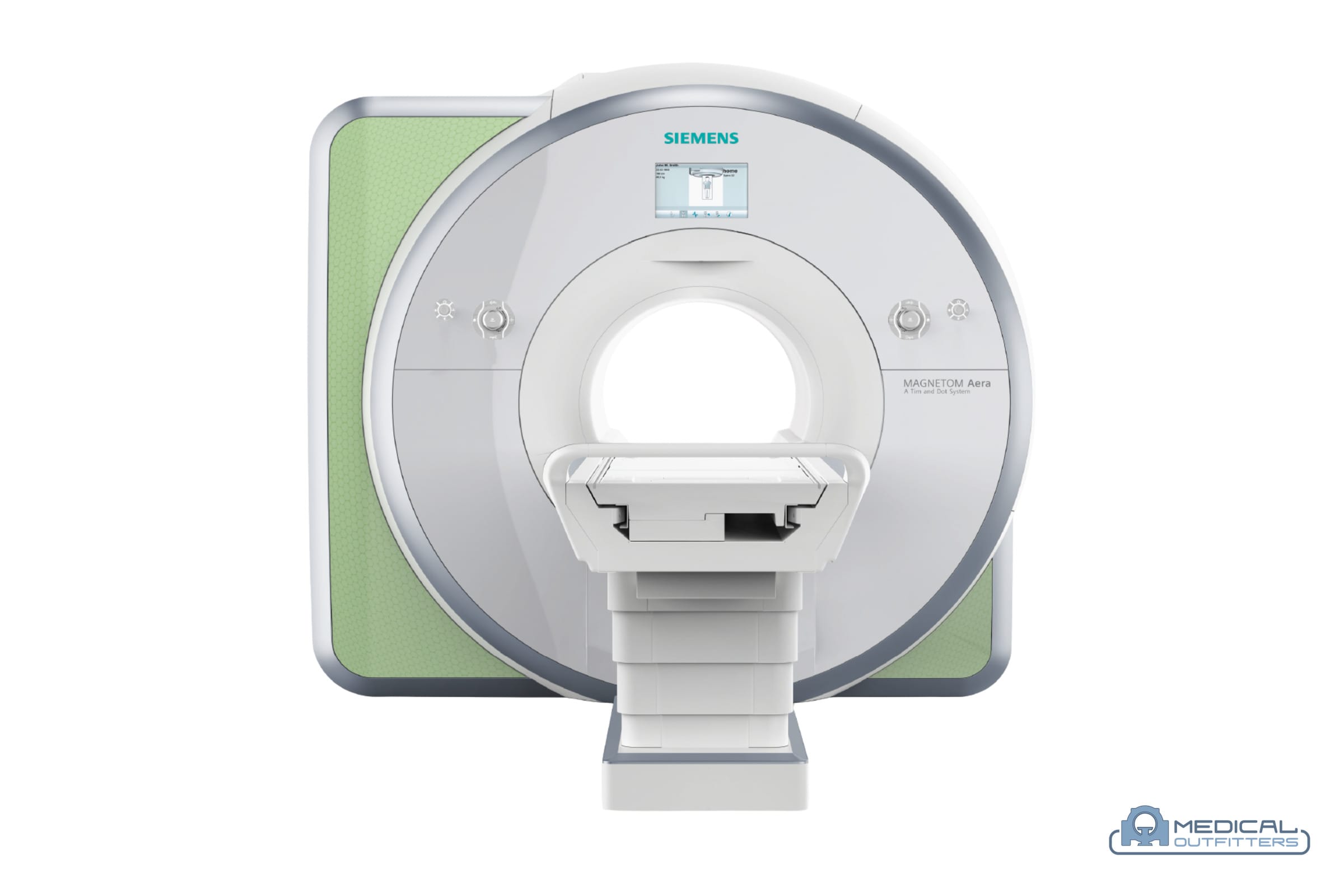
Manufacturers quote weight in different ways, which explains most of the apparent contradictions online. A data sheet may give the magnet alone, the magnet with its cryogens, the gantry including covers, or the complete system in operation. Siemens, for example, lists the MAGNETOM Aera magnet and gantry at 3,121 kg in its specification tables and the system weight in operation at 4.8 tonnes on its product page. Both are right. The table shows the figure each source gives and what it includes.
| Model | Field and design | Weight | What the figure covers |
|---|---|---|---|
| Philips Ingenia 1.5T | 1.5T, 70 cm wide bore, superconducting | 3,060 kg | Magnet, per Philips |
| Siemens MAGNETOM Aera | 1.5T, 70 cm wide bore, superconducting | 3,121 kg magnet; 4.8 t system | Magnet and gantry per data sheet; system in operation per Siemens |
| Siemens MAGNETOM Espree | 1.5T, 70 cm wide bore, superconducting | About 3,800 kg | Magnet, dealer comparison data |
| GE Optima MR450w | 1.5T, 70 cm wide bore, superconducting | 5,322 kg | Magnet, GE site planning data |
| GE Signa HDxt 1.5T | 1.5T, 60 cm bore, superconducting | 5,532 kg | Magnet with cryogens and gradient coil, GE technical data |
| Fujifilm (Hitachi) Echelon Synergy | 1.5T, 70 cm wide bore, superconducting | 5,800 kg | Gantry, Fujifilm data sheet |
| Siemens MAGNETOM Skyra | 3T, 70 cm wide bore, superconducting | 5,768 kg magnet; 7.3 t system | Magnet and gantry per data sheet; system in operation per Siemens |
| Fujifilm (Hitachi) Oasis | 1.2T open, vertical-field superconducting | 15,700 kg | Magnet, Hitachi comparison data |
| Hitachi AIRIS II | 0.3T open, permanent magnet | 15,700 kg | Gantry, Hitachi specification |
| Hitachi Altaire | 0.7T open, superconducting | 41,700 kg | Magnet, Hitachi specification; no longer sold |
The figures come from manufacturer data sheets and site planning documents or, where marked, from dealer comparison tables that reproduce them; the loading diagram in the current site planning guide for the exact configuration is the document a structural engineer works from. Two things stand out. First, the two lightest 1.5T magnets on the list, the Ingenia and the Aera, are also two of the most modern: actively shielded magnets with compact cryostats and small helium volumes weigh less than the generation before them. Second, field strength is a poor predictor of weight. A 3T Skyra magnet weighs about the same as a 1.5T Signa HDxt, and a 0.3T open magnet weighs three times either.
Why Some MRI Machines Weigh Three Times as Much as Others
Superconducting magnets make their field with a coil of niobium-titanium wire carrying current with no resistance, kept at about 4 kelvin in a bath of liquid helium inside a vacuum-insulated cryostat. The coil, the cryostat, the helium and the shielding coils that pull the stray field in close account for most of a 1.5T or 3T magnet’s three to six tonnes. The patient table, the gradient coil inside the bore and the body RF coil are the rest.
Permanent and vertical-field magnets produce their field with blocks of magnetised material and an iron yoke that carries the flux across the gap the patient lies in. Iron is the only way to hold and shape a vertical field that is open on two or three sides, and iron is heavy: a 0.3T or 0.4T open magnet weighs 15 to 17 tonnes, and the open superconducting magnets that pushed vertical-field designs to 0.7T and 1.2T weigh more still, because they add a cryostat to the yoke. Our guide to wide-bore vs open vs closed MRI covers what each design buys the patient and the facility; weight is one of the reasons the wide-bore 1.5T has displaced open magnets for most new imaging centers.
Extremity and specialty systems are the exception at the light end. A dedicated extremity scanner or a tilting MSK system has a small magnet and a small footprint, which is why Esaote quotes a 23 square meter room and under 3 kW of power for the G-scan Brio.
Shielding changes the number. An actively shielded magnet carries extra superconducting coils and weighs more than an unshielded one of the same field, but it needs far less steel in the room. Older passively shielded designs put the iron on the magnet instead. Either way, the room’s RF shield and any magnetic shielding steel are separate from the magnet weight, and our article on MRI room shielding requirements covers them.
Floor Loading: What the Weight Means for the Building
A magnet does not spread its weight evenly. It stands on three or four feet, and the site planning guide gives the load on each foot in kilonewtons or pounds, together with the dynamic loads during the rigging, when the magnet may rest on two skates or on a single lifting point. A structural engineer takes those figures, the slab thickness and reinforcement, and the path from the truck to the room, and signs off the installation or specifies the work needed.
On a ground-floor slab-on-grade the question is usually settled by the slab: a reinforced concrete slab in the 200 to 300 mm range under the magnet, often with a thickened pad or added reinforcement under the feet, is the common result, and most site planning guides express the design floor capacity as a uniform load that older slabs may not meet without the pad. On a suspended floor, an upper story or a building with a basement under the magnet room, the engineer looks at the beams and may add steel; MRI suites on upper floors are routine in hospitals but they are designed, not assumed. Vibration from nearby roads, rail or heavy plant is checked at the same time, because a magnet that moves is a magnet that images badly.
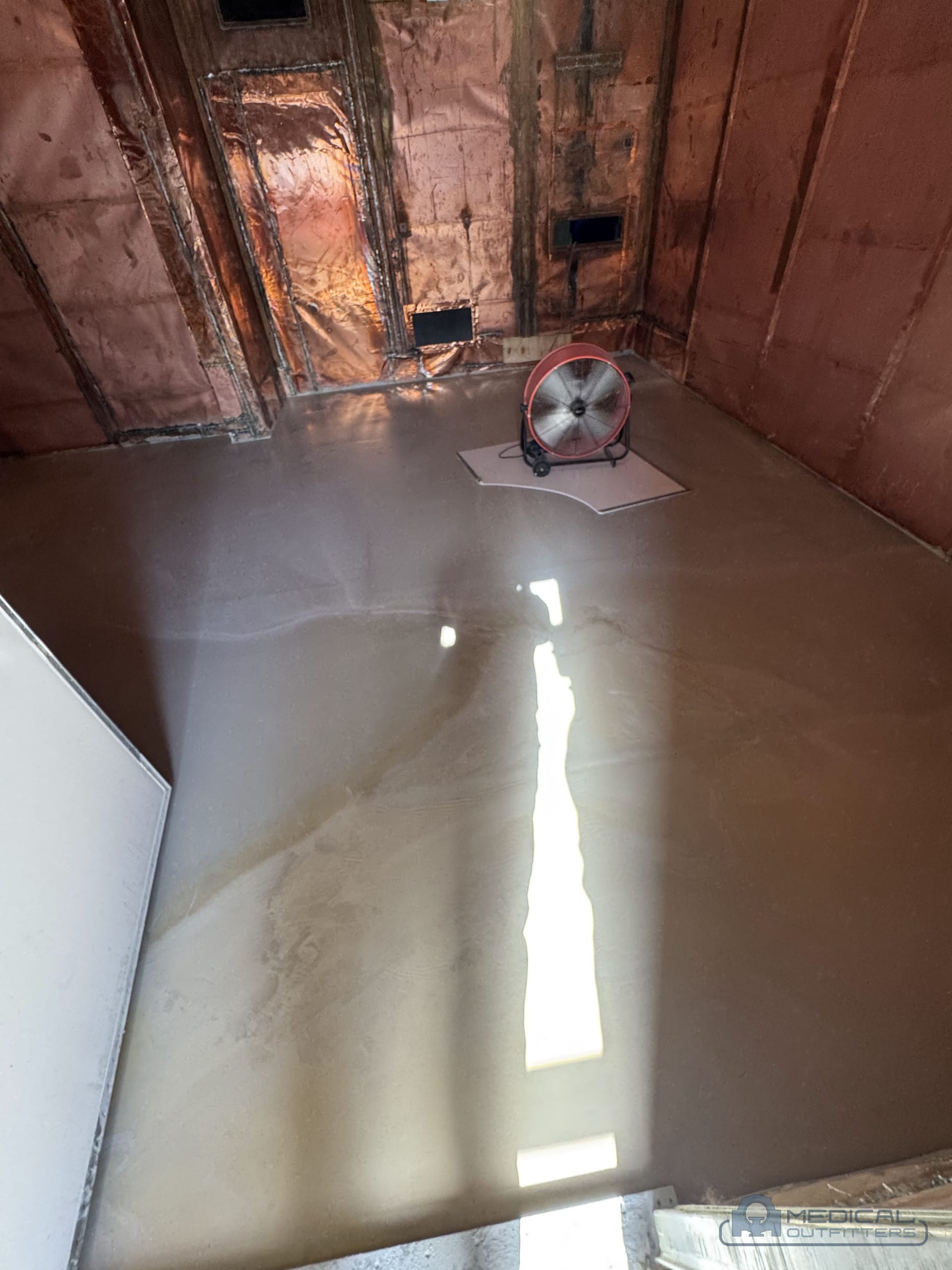
The path matters as much as the room. Every corridor, floor, lift and ramp between the delivery point and the magnet room carries the magnet on its skates at some point, and a floor rated for people is not a floor rated for a five-tonne point load on four small wheels. Steel plates, temporary supports and, where there is no interior route, a crane through a wall opening are the standard answers, which is why Medical Outfitters surveys the route before quoting the rigging.
How an MRI Machine Is Moved
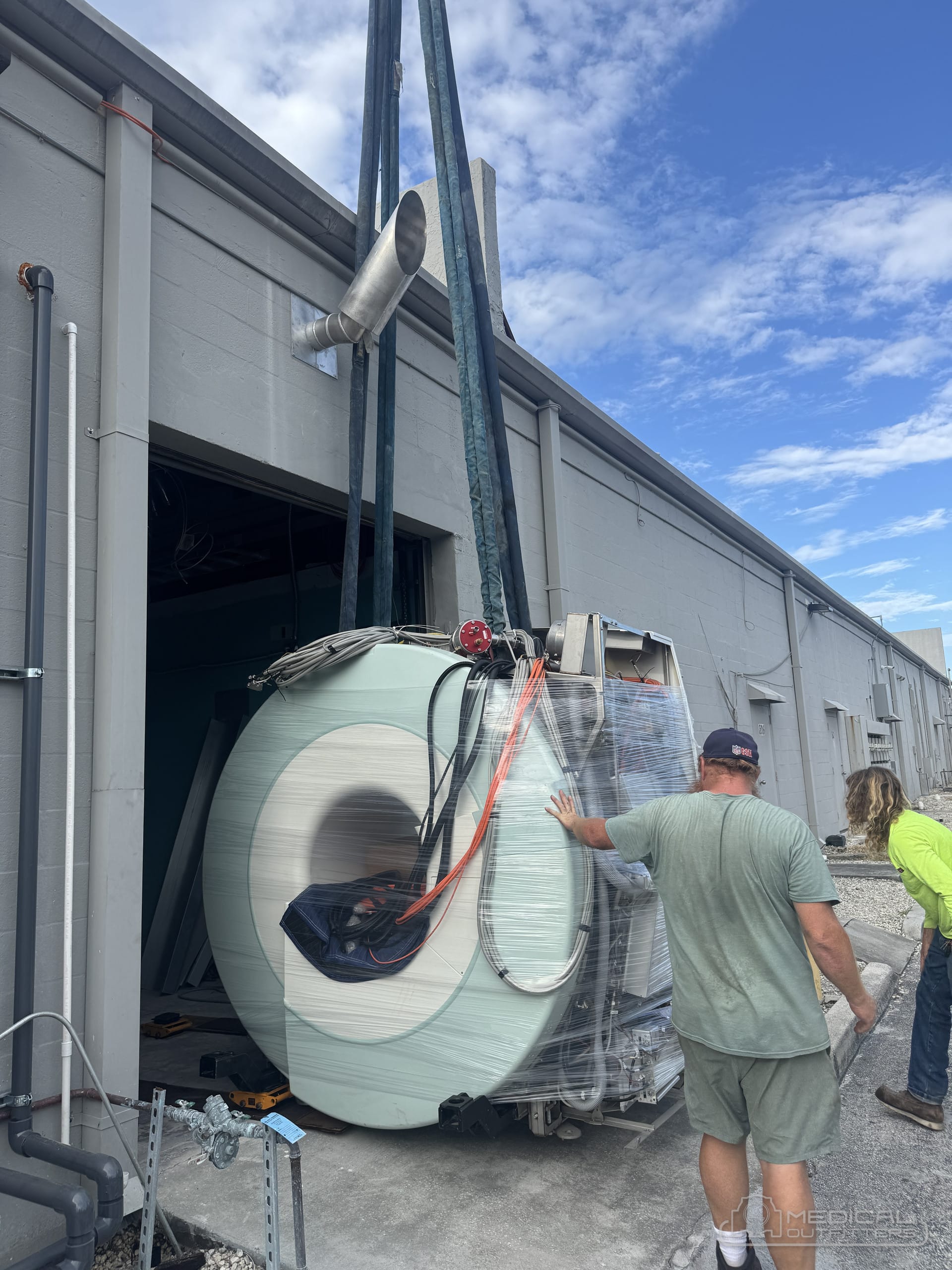
The weight sets the equipment, the route sets the method. A magnet leaves the factory or the previous site on a flatbed, wrapped and strapped, and arrives at the new building to be lifted off by crane or forklift and set on air skates or rollers for the last meters. Where the magnet room has no interior route wide enough, which is most of them, a wall or window opening is left in the shell and the magnet is craned or driven in on a telehandler through it, as in the delivery photographs on this page. Ceiling height, door width, corridor turns and the floor rating along the route are measured before the truck is booked.
A superconducting magnet travels either at field, cold and full of helium, or ramped down. Keeping it cold on the road, with a mobile compressor or a battery-powered cold head, saves a helium fill and days of ramping and shimming at the new site; ramping down is safer on a long or uncertain route. Our guide to how to move an MRI or CT scanner covers the ramp-down decision, the helium and the quench risk in detail.
We transport your MRI magnet without liquid helium loss: a Medical Outfitters magnet transport, filmed by our crew
Island and overseas work adds the ship, the port and the customs route to the plan. Medical Outfitters has delivered magnets across the Caribbean, including a crane lift of an Esaote G-scan in Grand Cayman and a permanent-magnet MAGNETOM C! that traveled from Korea to California, both filmed by our crews.
Esaote G-scan rigging in Grand Cayman, filmed by Medical Outfitters
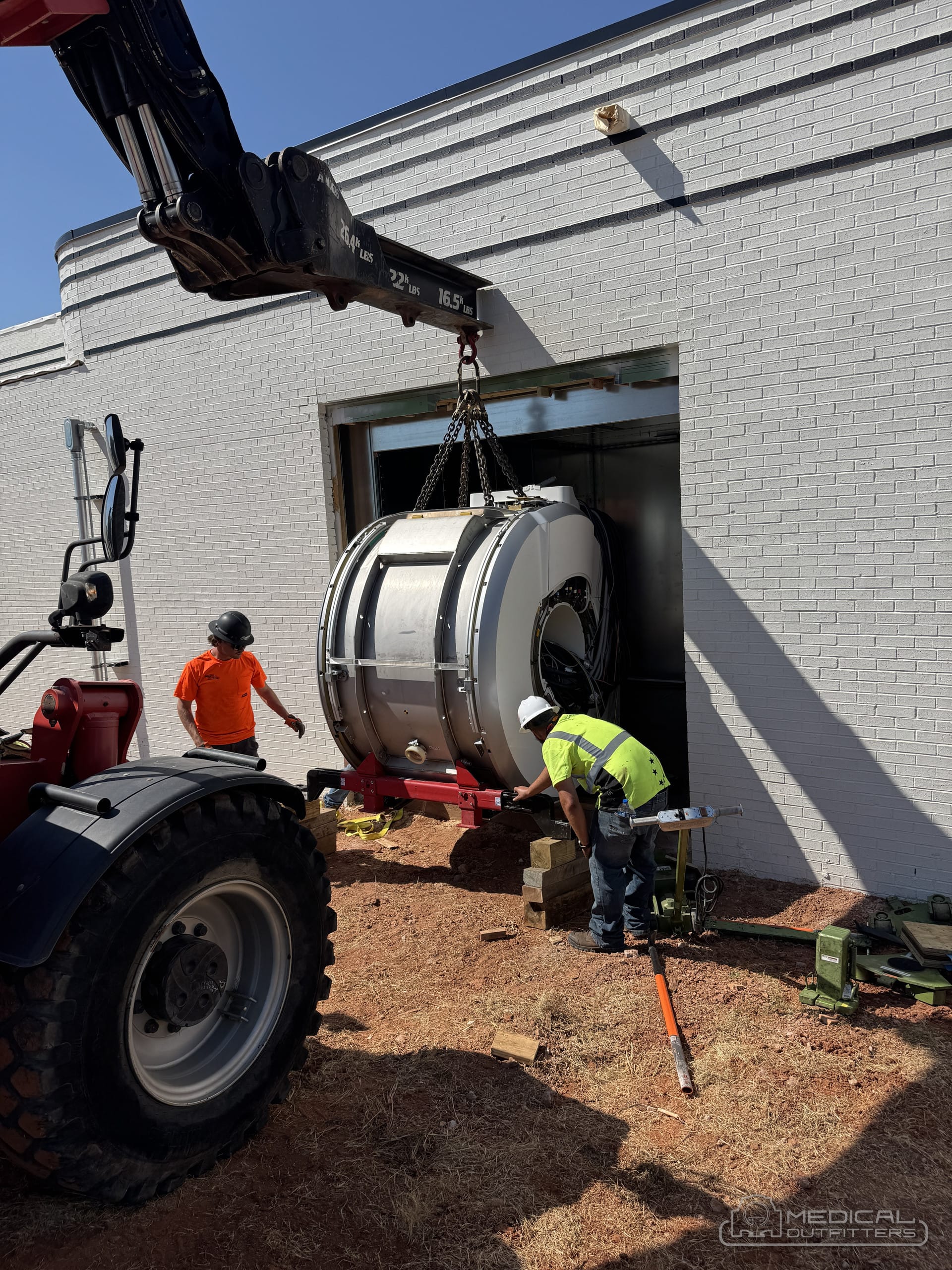
Weight, Rigging and the Price of an MRI Installation
Rigging is quoted per project because the weight is only one variable. A 3-tonne Aera on a ground floor with a wide door is a forklift job; a 15-tonne open magnet on the second floor of an older building is a crane, a structural package and a weekend. The route survey, the structural review, the crane or telehandler, the skates and plates, the crew and the insurance are itemised in every Medical Outfitters installation quote, and our MRI machine cost and price guide explains where rigging sits in the total alongside the magnet, the room and the service contract.
Weight is also a reason refurbished magnets are chosen carefully. The lightest 1.5T magnets on the market, the Ingenia and the Aera, are also among the most recent, and a 1.5T system that fits an existing slab and route without structural work can save more in construction than the price difference between two magnets. Our used and refurbished MRI machines page lists the systems we currently have, and the model guides for the Siemens MAGNETOM Aera, MAGNETOM Espree, MAGNETOM Skyra, GE Signa HDxt, GE Optima MR450w, Philips Ingenia and Hitachi AIRIS cover each system’s configuration and siting.
Medical Outfitters sells new Fujifilm MRI systems as an authorized dealer, refurbished GE and Siemens magnets through MO Select, and installs every one with its own rigging and engineering crews from Miami across the United States, Puerto Rico and the Caribbean. Our MRI service team handles the de-installation at the other end, and our note on MRI installation in Puerto Rico and the Caribbean covers the island logistics. For a route survey and a loading review before you buy, contact us.
- How to move an MRI or CT scanner
- MRI machine cost and price guide (2026)
- Used and refurbished MRI machines for sale
- MRI machines for sale: refurbished GE and Siemens, new Fujifilm and Esaote
- MRI machines: new, refurbished and used
- MRI service, repair and maintenance
- MRI room shielding requirements
- Wide-bore vs open vs closed MRI
- Siemens MAGNETOM Aera price guide
- Siemens MAGNETOM Skyra price guide
- GE Optima MR450w price guide
- Philips Ingenia price guide
- Fujifilm OASIS Velocity 1.2T open MRI
- MRI installation in Puerto Rico and the Caribbean
- Request a route survey
MRI Machine Weight: Common Questions
How much does an MRI machine weigh?
Most 1.5T MRI magnets weigh between 3 and 6 tonnes, about 6,600 to 13,000 lb: the Philips Ingenia 1.5T magnet is 3,060 kg and the Siemens MAGNETOM Aera magnet 3,121 kg, while the GE Optima MR450w is 5,322 kg and the Signa HDxt 5,532 kg with cryogens. The complete system in operation, with table, covers and cabinets, adds one to two tonnes. Open and permanent-magnet systems weigh 15 tonnes and more.
How much does a 3T MRI machine weigh?
The Siemens MAGNETOM Skyra 3T magnet is listed at 5,768 kg and the system in operation at 7.3 tonnes, and other 3T wide-bore magnets sit in the same 6 to 10 tonne band. A 3T magnet is not automatically far heavier than a 1.5T: the Skyra magnet weighs about the same as a 1.5T Signa HDxt.
Why do open MRI machines weigh so much more?
Open and vertical-field magnets hold and shape their field with blocks of magnetised material and an iron yoke rather than a compact superconducting coil, and iron is heavy. A 0.3T Hitachi AIRIS II weighs 15,700 kg, a 1.2T Fujifilm Oasis about the same, and the 0.7T Hitachi Altaire weighed 41,700 kg.
Can an MRI be installed on an upper floor?
Yes, routinely in hospitals, but it is designed rather than assumed. A structural engineer takes the manufacturer's loading diagram, which gives the point load under each foot and the dynamic loads during rigging, and checks the beams, the slab and the route; steel is added where needed and the magnet is craned to a window or carried by a lift rated for it.
What is the difference between magnet weight and system weight?
Manufacturers quote the magnet alone, the magnet with cryogens, the gantry with covers, or the whole system in operation, and the figures differ by one to two tonnes. Siemens lists the MAGNETOM Aera magnet and gantry at 3,121 kg and the system in operation at 4.8 tonnes; both are correct for what they include. The loading diagram, not the headline weight, is what the structural engineer uses.
How do you move an MRI machine?
On a flatbed to the site, then by crane, forklift or telehandler to the building, and on air skates or rollers for the last meters, often through a wall or window opening left in the shell. A superconducting magnet travels either cold and at field, with a mobile compressor keeping the cold head running, or ramped down for a long or uncertain route. The route is surveyed door by door before the truck is booked. A mobile coach moves with its magnet at field; what one weighs loaded and what the pad needs is in our mobile MRI rental, lease and purchase guide.
How much weight can an MRI table hold?
Most current 1.5T and 3T systems are rated for 250 kg (550 lb) on the table, the GE Discovery MR750w for 227 kg (500 lb), and the Fujifilm Oasis Velocity open MRI for 300 kg (660 lb) on its 83 cm wide table. The patient weight limit is separate from the magnet weight and is set by the table drive and the bore.
Does the weight matter when buying a refurbished MRI?
Yes, because the two lightest 1.5T magnets on the market, the Philips Ingenia and the Siemens Aera, are also among the most recent, and a magnet that fits an existing slab and route without structural work can save more in construction than the price difference between two systems. Medical Outfitters surveys the route and reviews the loading diagram before quoting any MRI.
Related Articles