A used CT scanner is the cheapest route to CT capacity and the easiest place to buy a problem. Two 64-slice scanners of the same model and year can look identical in a listing and differ by the price of an X-ray tube, a set of software licenses or a Medicare payment reduction that follows the scanner into your billing. This used CT scanner buying guide walks through the checks in the order a buyer should make them: what a used CT scanner costs by slice count and model, which slice count the referral mix needs, how to read the tube’s count, how to test the detector, which licenses and operating systems retire a scanner early, what the service history and the manufacturer’s support status tell you, what de-installation, rigging and installation add, and what a refurbished CT scanner with a warranty includes that a private sale does not. Every number names its source, and every price here is a planning figure, not a quote.
Medical Outfitters sells new Fujifilm CT scanners as an authorized dealer and refurbished GE and Siemens CT scanners through MO Select, its in-house refurbishment program, as described on the CT scanners for sale page. Every scanner is delivered and installed by its own engineers across the United States, Puerto Rico and the Caribbean. This guide is written for hospital administrators, imaging center owners, radiology managers and physician groups weighing a used CT scanner against a refurbished one with a warranty, or against a new system.
- Price: refurbished 16 to 32-slice $85,000 to $185,000, 64-slice $175,000 to $375,000, 128-slice $350,000 to $625,000, delivered, installed and warrantied (Medical Outfitters CT scanner cost guide, 2026).
- The tube first: ask for the count in the unit the maker uses, scan seconds for Siemens, Philips and Canon, mAs for GE, and compare it with the rating of that tube model, not the scanner brand (Radiology Oncology Systems tube chart, March 2026).
- The detector on a phantom: water within plus or minus 7 HU and uniformity within 5 HU across the field are the ACR accreditation criteria; ring artifacts that calibration does not clear point to the detector.
- Licenses and XR-29: cardiac, iterative reconstruction and slice-count options are licenses that do not always transfer, and a scanner without the four XR-29 attributes carries a 15 percent Medicare technical-component reduction (CMS Transmittal 3402).
- Paperwork and logistics: full service history, FDA Form 2579 on reassembly, state registration, a physicist’s shielding plan, and one to three weeks door to door for the move (Medical Outfitters relocation guide).
Used CT Scanner Price in 2026: By Slice Count and by Model
Slice count sets the band, and the tube, the licenses, the console generation and the detector move the price inside it. The Medical Outfitters CT scanner cost and price guide, reviewed in September 2026, publishes its refurbished bands as all-in figures: freight, rigging, installation and calibration by Medical Outfitters crews, image-quality testing, applications training, a written parts and labor warranty and current tariffs are inside the number, and the quote states the tube’s condition and which software licenses transfer. The guide notes that equipment-only figures published elsewhere run lower because they leave those items out.
| Slice class | Refurbished, installed (MO guide) | New, installed (MO guide) | Typical work |
|---|---|---|---|
| 16 to 32-slice | $85,000 to $185,000 | $350,000 to $525,000 | Routine head, chest, abdomen, orthopedics, urgent care |
| 64-slice | $175,000 to $375,000 | $625,000 to $975,000 | General hospital and imaging center work, CT angiography, cardiac |
| 128-slice | $350,000 to $625,000 | $1,050,000 to $1,650,000 | Cardiac, stroke, high-volume and dual-energy programs |
| 256-slice and higher | $625,000 to $1,500,000 | $1,750,000 to $2,900,000 and up | Academic, cardiac and whole-organ perfusion |
Source: Medical Outfitters CT Scanner Cost and Price Guide (2026). The new column is the guide’s comparison band; Medical Outfitters sells Fujifilm CT scanners new and GE and Siemens scanners refurbished.
The model guides on the site narrow the bands further, and they show what a used CT scanner price looks like once the configuration is known; they are also the quickest way to read the used CT scanners for sale on any dealer’s list, because the same four price movers apply to every one. The GE LightSpeed guide lists a refurbished LightSpeed 16 at $95,000 to $160,000, a LightSpeed Pro 32 at $150,000 to $225,000 and a LightSpeed VCT 64-slice at $175,000 to $325,000. The GE BrightSpeed guide puts a BrightSpeed Elite 16-slice at $110,000 to $185,000, with Select units at the lower end. The GE Optima CT660 guide lists a base 64-slice at $225,000 to $300,000, a unit with the ASiR and cardiac packages and a later console at $275,000 to $375,000, and one with the 128-slice option at $350,000 to $475,000. For Canon, which Medical Outfitters does not sell new and sources refurbished on request, the Aquilion guide lists an Aquilion 64 at $175,000 to $250,000 and an Aquilion Prime at $350,000 to $450,000.
Every one of those guides names the same price movers in the same order: tube condition, which the LightSpeed guide calls the largest cost item on a used CT; the options and licenses, such as cardiac packages and the ASiR license; the console generation, because a later console carries current software; and the detector’s condition, since a calibrated detector with no dead channels is priced differently from one needing repair. Those four items are the body of this guide. For the revenue side of the arithmetic, what Medicare and commercial payers pay per exam, see our guide to how much a CT scan costs.
Which Slice Count a Used CT Scanner Needs
Start with the studies, not the listings. Block Imaging’s used CT buying questions, updated in October 2021, put it plainly: cardiac studies need at least a 64-slice machine, while a practice doing non-angiographic work may be able to use a 4-slice. In between, a 16-slice system covers routine head, chest, abdomen and musculoskeletal work for an urgent care, an orthopedic group or a small hospital, and a 64-slice covers CT angiography, trauma and most general hospital protocols. Our guide to CT scanner types by slice count works through the protocols tier by tier, and the CT scanner manufacturers compared guide maps the model names to the tiers.
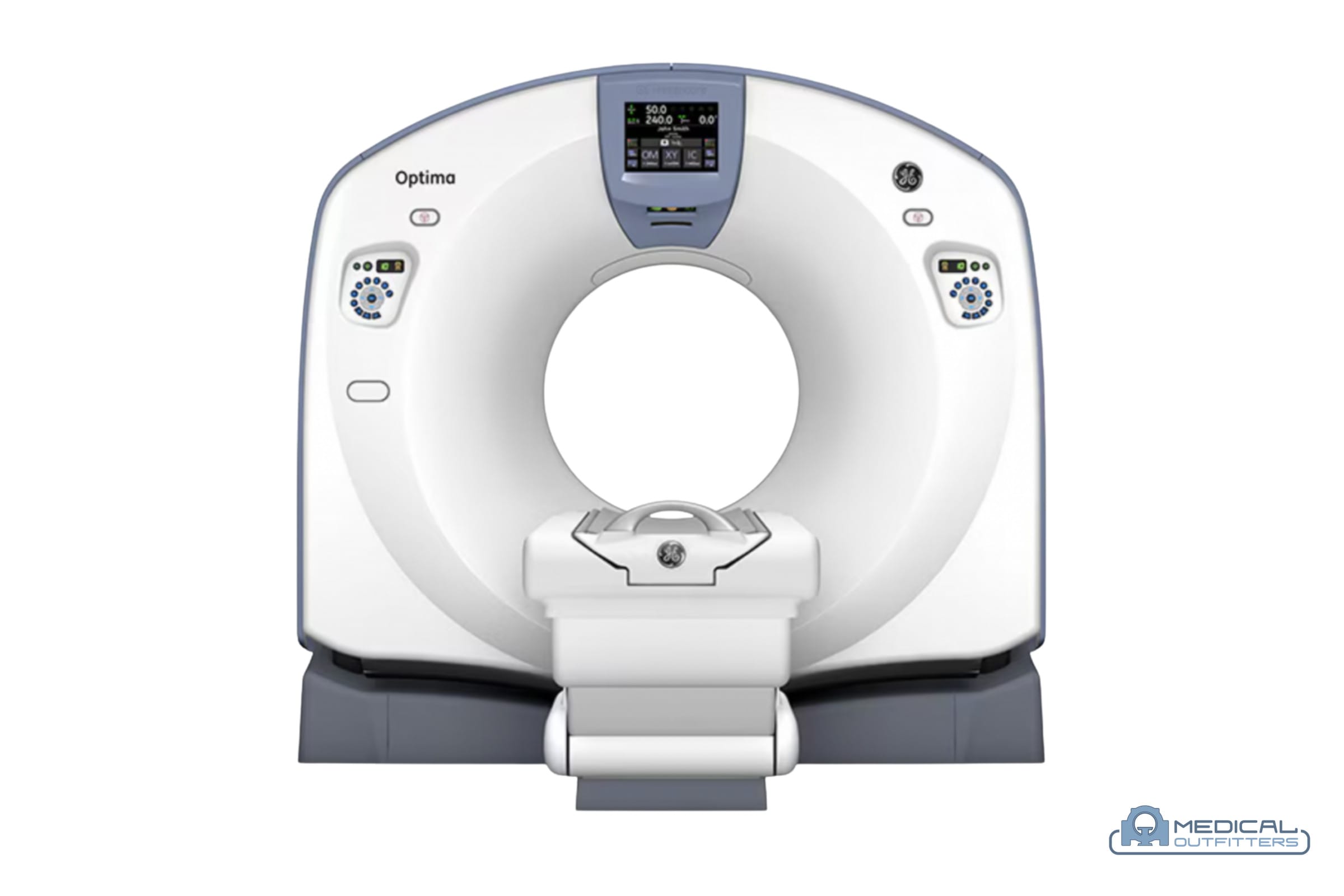
On the used market the tiers map to platforms. The 16-slice tier is the GE BrightSpeed Elite and LightSpeed 16, the Siemens SOMATOM Emotion 16 and Scope, and the Canon Aquilion 16. The 64-slice tier is the GE LightSpeed VCT and Optima CT660, the Siemens SOMATOM Sensation 64 and Definition AS, the Philips Brilliance 64 and Ingenuity, and the Canon Aquilion 64 and Prime. The 128-slice and higher tier is the GE Revolution family, the Siemens Definition Edge and Flash, the Philips iCT and the Canon Aquilion Prime SP and ONE. The current MO Select inventory on the CT scanners page lists the GE BrightSpeed 16, the GE LightSpeed 16 to 64, the GE Optima CT660 64-slice and the Siemens SOMATOM Scope 16, with the new Fujifilm Supria 32, Supria 128 and SCENARIA View 128 alongside them.
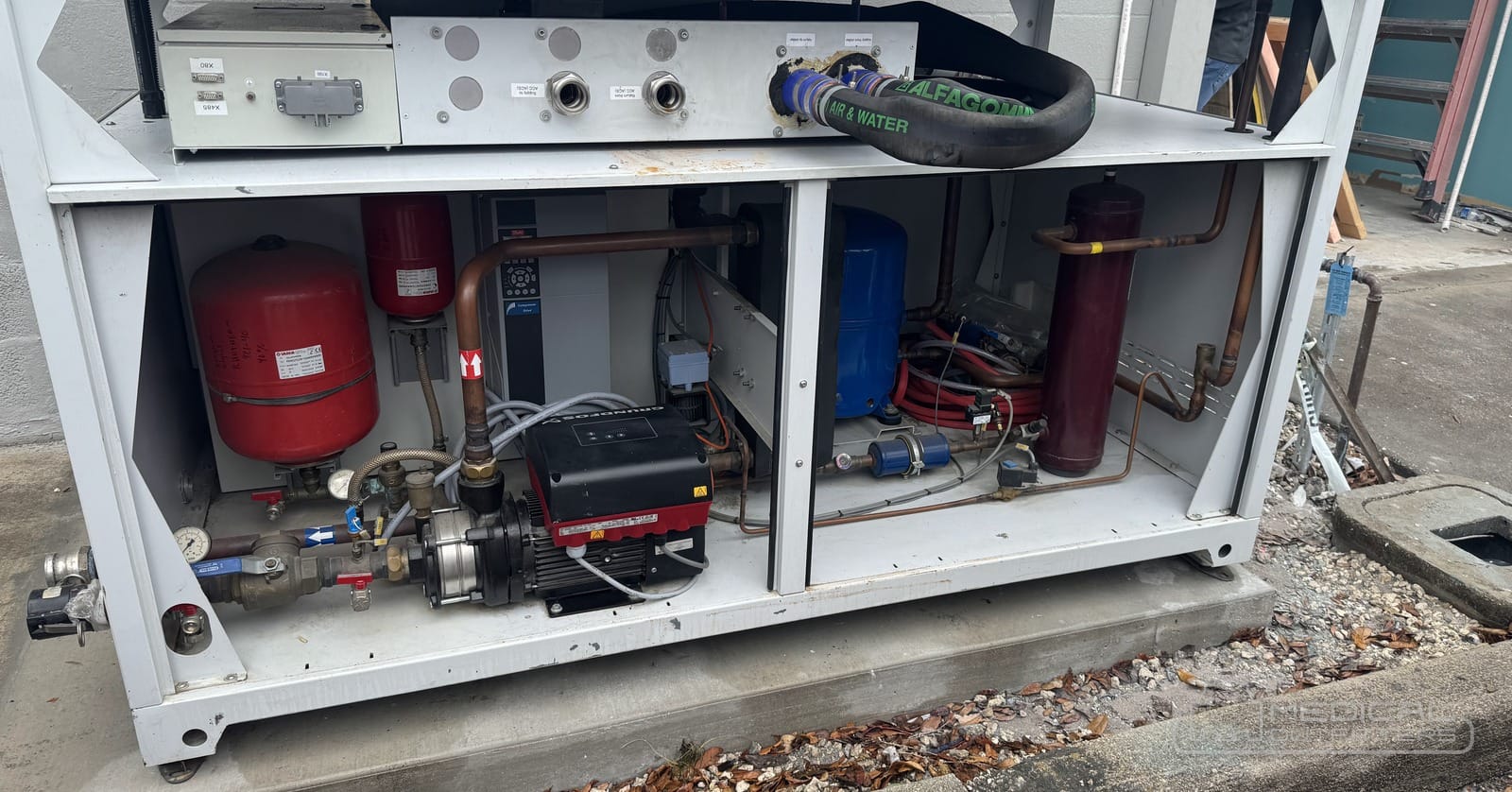
Two practical filters narrow the list before any inspection. The first is cooling: Block Imaging notes that asking whether the facility can handle a chiller could eliminate 25 to 50 percent of the options on the market, because many 64-slice and higher platforms are water-cooled and need a chiller loop that an older building may not have. The second is the room: a 128-slice scanner’s gantry, power draw and heat load are larger than a 16-slice scanner’s, and a room built for one does not automatically take the other. Our explainer on what a CT scan machine is covers the gantry, tube, detector and console that the rest of this guide inspects.
Buy one tier above the current need if the budget allows, and not two. The gap between a refurbished 16-slice and a refurbished 64-slice in the Medical Outfitters guide is roughly $90,000 to $190,000 across the bands, and it buys CT angiography and cardiac work that a 16-slice cannot do. The gap from 64 to 128 buys speed, dose features and dual-energy options that a general outpatient center may never bill for.
Tube Life on a Used CT Scanner: Scan Seconds, mAs and the Rating
The X-ray tube is the most expensive consumable on a CT scanner and the single largest service event in its life, which is how the Medical Outfitters CT cost guide describes it, and it is the first thing to ask about on any used CT scanner. A tube is rated for a quantity of use, not a number of years, and the console keeps the running total. The unit depends on the maker: the Radiology Oncology Systems CT tube comparison chart, updated in March 2026, notes that Canon, Siemens and Philips count scan seconds, the seconds the tube spent producing X-rays on patients, while GE counts mAs, which also captures the power that ran through the tube. Ask for the count in the maker’s own unit, the tube’s installation date, and the arc history from the error log, and compare the count with the rating of that tube model.
| Tube (maker) | Scanners it fits | Typical life rating | Source |
|---|---|---|---|
| Performix MX200 (GE) | LightSpeed 16, BrightSpeed Edge and Elite, Optima CT540 | 120M to 150M mAs | Radiology Oncology Systems chart, March 2026 |
| Performix VCT (GE) | LightSpeed VCT, LightSpeed Pro 32, Optima CT580 | 150M to 180M mAs | Radiology Oncology Systems chart, March 2026 |
| Performix 40 Plus (GE) | Optima CT660 | 180M to 250M mAs | Radiology Oncology Systems chart, March 2026 |
| Dura 202 and Dura 422 (Siemens) | SOMATOM Emotion single-slice to 16 | 300,000 to 400,000 and 400,000 to 500,000 scan seconds | Block Imaging, May 2025 |
| Straton Z (Siemens) | SOMATOM Sensation 40 and 64 | 900,000 to 1.2M scan seconds | Radiology Oncology Systems chart, March 2026 |
| Straton MX P46 (Siemens) | Definition AS, AS+, Edge, Flash | 600,000 scan seconds | Radiology Oncology Systems chart, March 2026 |
| MRC 600 and MRC 800 (Philips) | Brilliance 6 to 64, Ingenuity | 800,000 to 1.6M scan seconds | Block Imaging, May 2025 |
| CXB-750D (Canon) | Aquilion 16, 64, Prime first generation | 600,000 to 800,000 scan seconds | Radiology Oncology Systems chart, March 2026 |
| CXB-750G (Canon) | Aquilion Prime and Prime SP | 800,000 to 1M scan seconds | Radiology Oncology Systems chart, March 2026 |
Ratings are the typical end-of-life figures published by the two dealers named; actual life varies with workload, cooling and handling. The Block Imaging figures equate the Dura 202 to roughly two to three years and the MRC tubes to four to seven years at mid-range volume.
The rating is a ceiling, not a promise. A six-year study of forty Performix Ultra tube changes on ten GE LightSpeed scanners, published by Erdi in Radiologic Technology in 2013, found tube lives of 7 to 48 months and 16.7 to 239.9 kAs against a warranty limit of 70 kAs or 12 months, with a mean of 19.2 months; seven of the forty tubes fell short of the warranty. The same tube model lasted seven times longer in one scanner than in another, and the authors could not pin the failures on a single cause. That is why the count on the seller’s console matters more than the model year, and why a used CT scanner with no documented count is priced as if the tube were at the end of its life.
Price the tube into the offer. Block Imaging’s May 2025 figures put a used Philips MRC 600 at $40,000 to $65,000 and an MRC 800 at $55,000 to $85,000, before the engineer, the calibration and the shipping, and the GE and Siemens tubes on the platforms above sit in the same order of magnitude. The Optima CT660 guide states that a new or low-hour Performix tube moves the price of the system, that the tube’s install date, scan seconds and coverage terms are stated on the quote, and that the MO Select warranty includes stated tube coverage. Ask any seller for the same three things in writing: the count, the date and the coverage.
Detector, Generator and the Phantom Test
The detector is the second large part that wears, and unlike the tube it has no counter. Detector channels fail one at a time, and a failed channel produces a ring artifact in every image until the channel is mapped out or the module is replaced. The GE model guides on this site price a calibrated detector with no dead channels differently from one needing repair for that reason. The test is the same one every accredited facility runs: a phantom.
Ask the seller to warm up the scanner, run the daily air calibration, then scan a water phantom while you watch, and bring a medical physicist or a field engineer if you can. The ACR’s CT accreditation overview, revised in February 2026, tells sites to scan their water phantom and check the CT number of water, the absence of artifacts and the uniformity across the field of view before proceeding with any accreditation scan, and to stop and call the field service engineer or physicist if any of the three fails. The numbers come from the ACR’s CT phantom testing instructions, revised November 2022: the CT number of water must sit between minus 7 and plus 7 HU, and all five uniformity regions must be within plus or minus 5 HU of the center region, with a 5 to 7 HU difference a minor deficiency and more than 7 HU a major one. For low-contrast performance the ACR requires a contrast-to-noise ratio above 1.0 for the adult head and adult abdomen protocols. A used CT scanner that cannot pass those three tests on the seller’s floor will not pass them on yours.
Then look at the images, not the numbers. Ring artifacts that remain after calibration point at the detector, streaks and noise that climb at the same technique point at the tube, and a band or a step across a helical series points at the data acquisition system or the slip ring. Export a study to a laptop DICOM viewer and read the header: station name, calibration dates and software version should match what the seller has told you. Our used imaging equipment inspection checklist covers the same phantom tests for every modality.
The generator and the cooling get a shorter check. Confirm the generator’s rating matches the tube and the protocols you will run, listen to the gantry at full rotation for bearing noise, and check every hose and chiller connection for leaks and for the crust old leaks leave behind. A water-cooled platform needs a chiller at the new site, and the Block Imaging note above about chillers removing a quarter to half the market is a reminder to settle the cooling question before falling for a scanner.
The checklist above is the CT-specific version of the six-group list in our inspection guide. Most of the items take minutes; the phantom test takes an hour; the paperwork group takes as long as the seller needs to produce the file, which is itself a finding.
Software Licenses, Operating Systems and XR-29 on a Used CT Scanner
Software retires more CT scanners than hardware does, and on a used CT scanner it hides in three places: the licensed options, the operating system and the dose standard.
Licenses. Cardiac gating and analysis, iterative reconstruction, dual energy, perfusion, advanced visualization and, on some platforms, the slice count itself are software licenses tied to the scanner’s serial number. The Medical Outfitters CT cost guide lists cardiac, dual energy, iterative dose reduction, perfusion and advanced visualization as licensed options priced separately and notes that they do not always transfer with a used system. The Optima CT660 guide gives the concrete case: ASiR, the cardiac packages and the 128-slice option were sold as licenses and options, ASiR was optional on early builds and standard on later ones, and Medical Outfitters confirms the installed licenses on each unit before quoting. Ask for the license list printed from the console, in writing, with the dealer’s or manufacturer’s confirmation that each one transfers, and ask for the service keys or passwords a field engineer needs; a scanner missing them is a scanner with a bill attached.
Operating system. The console runs a version of Windows that Microsoft supported for a time and the hospital’s IT department will tolerate for a shorter one. Microsoft ended support for Windows 7 on January 14, 2020, and its lifecycle page states that Windows 10 Home and Pro reached end of support on October 14, 2025. A used CT scanner whose console still runs either will connect to a PACS and scan patients, but it will fail the network security review at most hospitals and some imaging groups, and the fix is a console or software upgrade priced by the manufacturer, if one exists for that platform. GE HealthCare’s Continuity program, described on its service enablers page, offers computing hardware and system software upgrade options over the lifecycle of its imaging systems; ask the seller which console generation the scanner has and whether such an upgrade has been applied. Siemens Healthineers files the DICOM conformance statements for the SOMATOM Sensation, Definition, Emotion, Perspective and Scope under a page titled SOMATOM Legacy Systems; the page does not state a support status, so a support status letter for the serial number is the only reliable answer for any brand.
XR-29. NEMA XR-29-2013, Standard Attributes on CT Equipment Related to Dose Optimization and Management, names four attributes, as summarized by Canon Medical Systems and the Medical Imaging and Technology Alliance: DICOM radiation dose structured reporting, pediatric and adult reference protocols, CT dose check, and automatic exposure control. CMS Transmittal 3402, issued November 6, 2015 under Change Request 9250 to implement section 218(a) of the Protecting Access to Medicare Act, reduced payment on the technical component of CT services billed under the physician fee schedule by 5 percent in 2016 and 15 percent in 2017 and subsequent years when the equipment does not meet each attribute; claims for such scans must carry the CT modifier, the beneficiary is not liable for the reduction, and the attestation is verified as part of the facility’s periodic accreditation. The reduction has no end date. A used CT scanner that predates the standard may have been upgraded by the manufacturer, or may not be upgradeable at all, and the difference is 15 percent of every Medicare technical-component payment the scanner ever earns. Get the manufacturer’s written confirmation of XR-29 compliance for the serial number before the price is agreed.
Service History, Manufacturer Support and Parts
A complete service file is the best evidence of a well-kept scanner there is. Ask for every preventive-maintenance report, repair invoice and error log the seller has, and read them for the tube and detector events, the arc counts, the calibrations and the software updates. A file from a single service provider with no gaps is worth paying for; a missing file is a risk you are pricing. Our inspection checklist puts the paperwork group first for that reason, and adds the title check: confirm the seller owns the scanner outright, because leased systems and systems under an OEM financing agreement cannot be sold clean.
Then ask who will support it. The manufacturer’s support status for the serial number, the console generation and the software version decide whether the OEM, an independent service organization or a dealer will maintain it, and at what cost. Spare parts are the practical test: Block Imaging advises asking how available spare parts are for the model, noting that a vendor can usually answer immediately or with a quick call to the warehouse. The Medical Outfitters CT cost guide states that the company stocks more than 20,000 parts and prices CT service contracts per year as a percentage of system value, with or without tube coverage and with or without parts, which it describes as the buyer’s choice of exposure to a bad year. The CT scanner service page describes the contract options.
The service contract decision follows the tube count. A used scanner with a young, documented tube can run on a contract without tube coverage for a year or two; a scanner with a tube past mid-life, or with no documented count, is the case where tube coverage earns its premium, because the next large bill is already visible. Settle the contract before the purchase, not after, and have the seller’s tube count written into it.
De-installation, Rigging, Installation and the Paperwork
The price of a used CT scanner is the price of the scanner plus the price of getting it working in your room, and the second number is rarely in the listing. Our guide to how to move an MRI or CT scanner lays out the CT sequence. Before power-down, the crew records serial numbers, software licenses and configuration, because the scanner is recommissioned to that record. De-installation takes one to two days: the tube is parked in its transport position, the gantry is locked, the table and console are separated, and the detector and slip ring are protected. The gantry weighs 1.5 to 2.5 tonnes and travels on an air-ride trailer, because a CT tube is a vacuum vessel with a rotating anode and road shock can damage its bearings or its seal. Transport takes days to two weeks, rigging in and set-up two to four days, and calibration, QA and training two to three days, for one to three weeks door to door. The guide puts the typical cost of a CT move in the tens of thousands of dollars, driven by distance, crane access and room construction.
At the new site the engineer runs the tube warm-up and checks for arcing before any imaging, then recalibrates the detector and slip ring, starting with air calibrations and a water phantom for Hounsfield accuracy, noise and uniformity, before the physicist’s acceptance tests. The room needs lead shielding sized by a physicist for the new layout and workload, dedicated three-phase power, a chiller or an air-cooled condenser for the gantry, and a floor that carries it; much of that work can be done while the scanner still runs at the old site. Medical Outfitters handles the move through its installation, rigging and de-installation team.
Three pieces of paperwork follow a used CT scanner to its new room. First, the FDA report of assembly: under 21 CFR 1020.30, the assembler who installs a certified diagnostic X-ray system, including a reassembled one, files Form FDA 2579 within 15 days of completing the assembly, with copies to the purchaser and, where applicable, to the state radiation control agency, certifying that the system meets the federal standards in 21 CFR 1020.30 through 1020.33; the form itself has boxes for reassembly of a fully certified system and for a mixed system. Second, state registration of the X-ray machine at the destination and the physicist’s shielding plan and acceptance survey, which the state radiation control program sets. Third, Medicare accreditation: a freestanding imaging center or physician practice billing Medicare for the technical component of CT must be accredited by one of the four CMS-approved organizations, the American College of Radiology, the Intersocietal Accreditation Commission, The Joint Commission or RadSite, and the CMS accreditation page states that the requirement does not apply to hospitals or critical access hospitals. A used scanner changes hands, but each of those obligations starts again with the new owner.
Refurbished CT Scanners: What MO Select Refurbishment and the Warranty Include
The difference between a used CT scanner and a refurbished CT scanner is who has done the checks above and who carries the risk afterwards. A private or auction purchase is cheaper on the invoice and puts every item in this guide on the buyer. A dealer that refurbishes, installs and warranties the scanner has already run the checklist and is paid, in part, to be wrong at its own expense.
The refurbished medical imaging equipment page describes the MO Select program in those terms. Each system is stripped, renewed where it needs renewing and tested against the manufacturer’s specification in Medical Outfitters’ own facility before it is crated. For CT, the page states that tube condition is documented rather than described. Warranty is included rather than sold as an add-on, with the term and coverage agreed in writing before purchase. Rigging, delivery and installation are done by the company’s own team, which carries the service afterwards rather than subcontracting it, with same-day or next-day parts dispatch from Miami and containerized shipping of full systems for island and Latin American customers. The CT platforms in the program are the GE Optima CT660, LightSpeed and BrightSpeed and the Siemens SOMATOM Scope; Canon and Philips scanners are sourced refurbished on request, as the Aquilion guide states, and are not sold new.
Compare the refurbished quote with a new one before signing. The Medical Outfitters CT cost guide’s new bands, $350,000 to $525,000 for a 16 to 32-slice and $625,000 to $975,000 for a 64-slice, buy a new tube, a current console, every license at the start of its life and a manufacturer’s warranty, and for a remote site or a hard-running program that can be the better arithmetic. Medical Outfitters sells the Fujifilm Supria 128 and the Fujifilm SCENARIA View new as an authorized dealer, and for a need with an end date, the mobile CT scanner rental guide prices the third route.
Whatever the route, write the comparison the way the guides on this site do: slice count, tube count and coverage, license list, console and operating system, XR-29 status, service history, support status, what the price includes from freight to training, and the warranty’s term and response time. A used CT scanner that scores well on every line at a lower price is a good purchase. One that scores well on the price alone is a tube, a license and a 15 percent Medicare reduction waiting to be discovered.
Buying a Used or Refurbished CT Scanner With Medical Outfitters
Medical Outfitters sells refurbished GE and Siemens CT scanners through MO Select and new Fujifilm CT scanners as an authorized dealer, and delivers, installs and services every one across the United States, Puerto Rico and the Caribbean. The CT scanner cost guide gives the bands by slice count, the CT scanners for sale page lists the current MO Select and Fujifilm systems, the refurbished imaging equipment page explains the MO Select standard, and the CT scanner service page covers contracts with and without tube coverage. The CT scanner manufacturers compared and CT scanner types by slice count guides help match a platform to the referral mix. Send us the model, serial number, tube count and license list of any used CT scanner you are considering, or the slice count and site you need, and we will quote a refurbished system delivered, installed and warrantied beside it: contact Medical Outfitters.
- Medical Outfitters, CT Scanner Cost and Price Guide (2026), and the GE LightSpeed, GE BrightSpeed, GE Optima CT660 and Canon Aquilion price guides: refurbished and new bands, what the price includes, price movers, licensed options. medicaloutfitters.com
- Medical Outfitters, Refurbished Medical Imaging Equipment and How to Move an MRI or CT Scanner: the MO Select process and warranty terms; CT de-installation, transport, rigging and recommissioning timelines. medicaloutfitters.com
- Radiology Oncology Systems, CT Scanner X-Ray Tube Comparison Chart, updated March 17, 2026: tube models, scanners fitted and typical end-of-life ratings in scan seconds and mAs. oncologysystems.com
- Block Imaging, CT Tube Lifespan articles (Dura 202 and 422; MRC 600 and 800), updated May 28, 2025, and More Questions to Ask Before You Buy a Used CT Scanner, updated October 6, 2021: tube ratings and used tube prices; slice count, chiller and spare parts questions. blockimaging.com
- Erdi, Y. E., Computed tomography X-ray tube life analysis: a multiyear study, Radiologic Technology 84(6), 2013: forty Performix Ultra tube changes, warranty limit, measured life in months and kAs. synapse.mskcc.org
- American College of Radiology, CT Accreditation Program, Phantom Testing: CT (revised November 9, 2022) and Overview of the CT Phantom (revised February 2026): CT number, uniformity and contrast-to-noise criteria; the water phantom pre-check. accreditationsupport.acr.org
- CMS, Transmittal 3402, Change Request 9250, November 6, 2015, Payment Reduction for Computed Tomography Diagnostic Imaging Services: the XR-29 reduction of 5 percent in 2016 and 15 percent from 2017, the CT modifier and the codes affected; Canon Medical Systems, NEMA XR-29-2013 summary: the four attributes. cms.gov
- FDA, Diagnostic X-Ray Reports of Assembly (Form FDA 2579): the 15-day filing rule and copies to the purchaser and state; Microsoft, Windows 10 Home and Pro lifecycle: end of support October 14, 2025; CMS, Accreditation of Advanced Diagnostic Imaging Suppliers: the four approved organizations and the hospital exemption. fda.gov
- CT scanner cost and price guide (2026)
- CT scanners for sale: new Fujifilm and MO Select refurbished GE and Siemens
- Refurbished medical imaging equipment: the MO Select standard
- CT scanner service, repair and tube coverage
- Used imaging equipment inspection checklist
- CT scanner types by slice count
- CT scanner manufacturers compared
- How to move an MRI or CT scanner
- What is a CT scan machine
- How much does a CT scan cost in 2026
- GE Optima CT660 price guide
- GE LightSpeed CT price guide
- GE BrightSpeed CT price guide
- Canon Aquilion CT price guide
- Price a refurbished CT scanner
Used CT Scanners: Common Questions
How much does a used CT scanner cost?
About $85,000 to $185,000 installed for a refurbished 16 to 32-slice system, $175,000 to $375,000 for a 64-slice and $350,000 to $625,000 for a 128-slice in 2026, per the Medical Outfitters CT scanner cost guide, with freight, rigging, installation, calibration, applications training and a written warranty inside the figure. Inside each band the tube's remaining life, the software licenses, the console generation and the detector's condition move the price. Equipment-only listings run lower because they leave the installation out.
What should I check before buying a used CT scanner?
Six things, in order: the tube's count and installation date against the rating of that tube model; the detector on a water phantom, with the ACR criteria of water within 7 HU and uniformity within 5 HU; the license list and whether each option transfers; the console's operating system and the manufacturer's support status for the serial number; NEMA XR-29 compliance in writing; and the full service history. Then settle who de-installs, moves, installs and warranties it, in writing, before the price is agreed.
How do I check the tube on a used CT scanner?
Ask for the count in the maker's own unit, scan seconds for Siemens, Philips and Canon and mAs for GE, with the installation date and the arc history from the error log, and compare it with the published rating for that tube model: 800,000 to 1.6 million scan seconds for a Philips MRC tube, or 180 million to 250 million mAs for the Performix 40 Plus on a GE Optima CT660. A tube with no documented count is priced as if it were at the end of its life.
Do software licenses transfer with a used CT scanner?
Not always. Cardiac gating and analysis, iterative reconstruction such as ASiR, dual energy, perfusion, advanced visualization and, on some platforms, the slice count itself are licenses tied to the scanner's serial number, and the Medical Outfitters CT cost guide notes they do not always transfer with a used system. Ask for the license list printed from the console and the dealer's or manufacturer's written confirmation that each one transfers, plus the service keys a field engineer needs.
What is NEMA XR-29 and does it apply to a used CT scanner?
NEMA XR-29-2013 names four dose attributes: DICOM dose structured reporting, pediatric and adult reference protocols, CT dose check and automatic exposure control. Under CMS Transmittal 3402, CT scans on equipment lacking any attribute carry the CT modifier and a reduction on the technical component of 5 percent in 2016 and 15 percent from 2017 onward, with no end date. The rule follows the scanner to its new owner, so get the manufacturer's written confirmation of compliance for the serial number before buying.
How many slices does a used CT scanner need?
Block Imaging's used CT buying questions put cardiac studies at a minimum of 64 slices, while non-angiographic work may be done on a 4-slice system. In practice a 16-slice scanner covers routine head, chest, abdomen and musculoskeletal work for an urgent care, an orthopedic group or a small hospital, and a 64-slice covers CT angiography, trauma and general hospital protocols. The Medical Outfitters guide to CT scanner types by slice count matches protocols to each tier.
What does it cost to move and install a used CT scanner?
The Medical Outfitters relocation guide puts a CT move in the tens of thousands of dollars, driven by distance, crane access and room construction, and at one to three weeks door to door: one to two days to de-install, days to two weeks in transit on an air-ride trailer, two to four days to rig in and two to three days for calibration, QA and training. The new room needs a physicist's shielding plan, three-phase power, a chiller or condenser and state registration.
What is the difference between a used and a refurbished CT scanner?
Who has run the checks and who carries the risk. A used scanner from a private sale or an auction is cheaper on the invoice and leaves the tube, detector, license, software and paperwork checks to the buyer. A refurbished CT scanner from Medical Outfitters' MO Select program is stripped, renewed where needed and tested against the manufacturer's specification in its own facility, has its tube condition documented, and is delivered, installed and warrantied by the company's own team, with the warranty term agreed in writing before purchase.
Related Articles