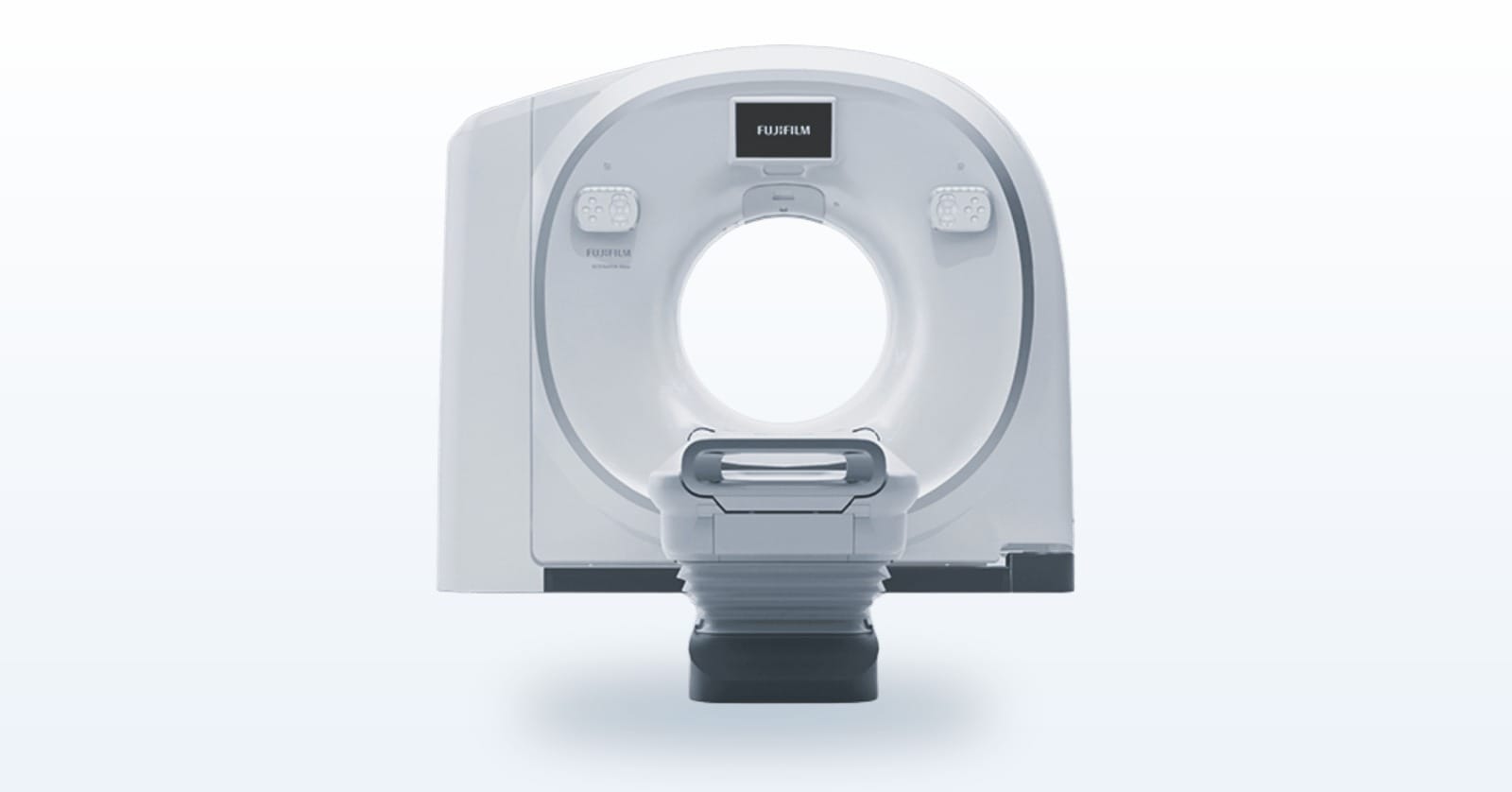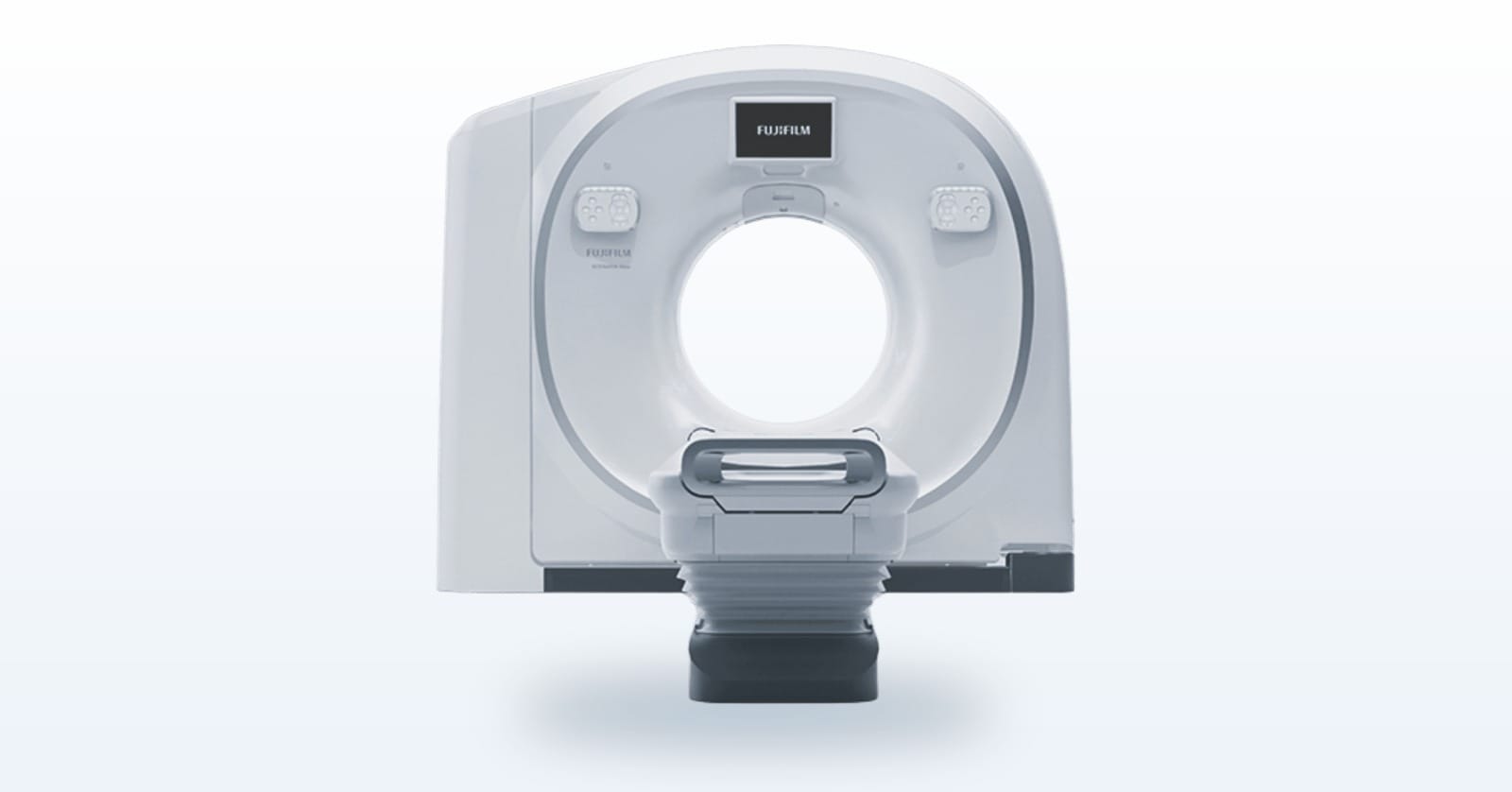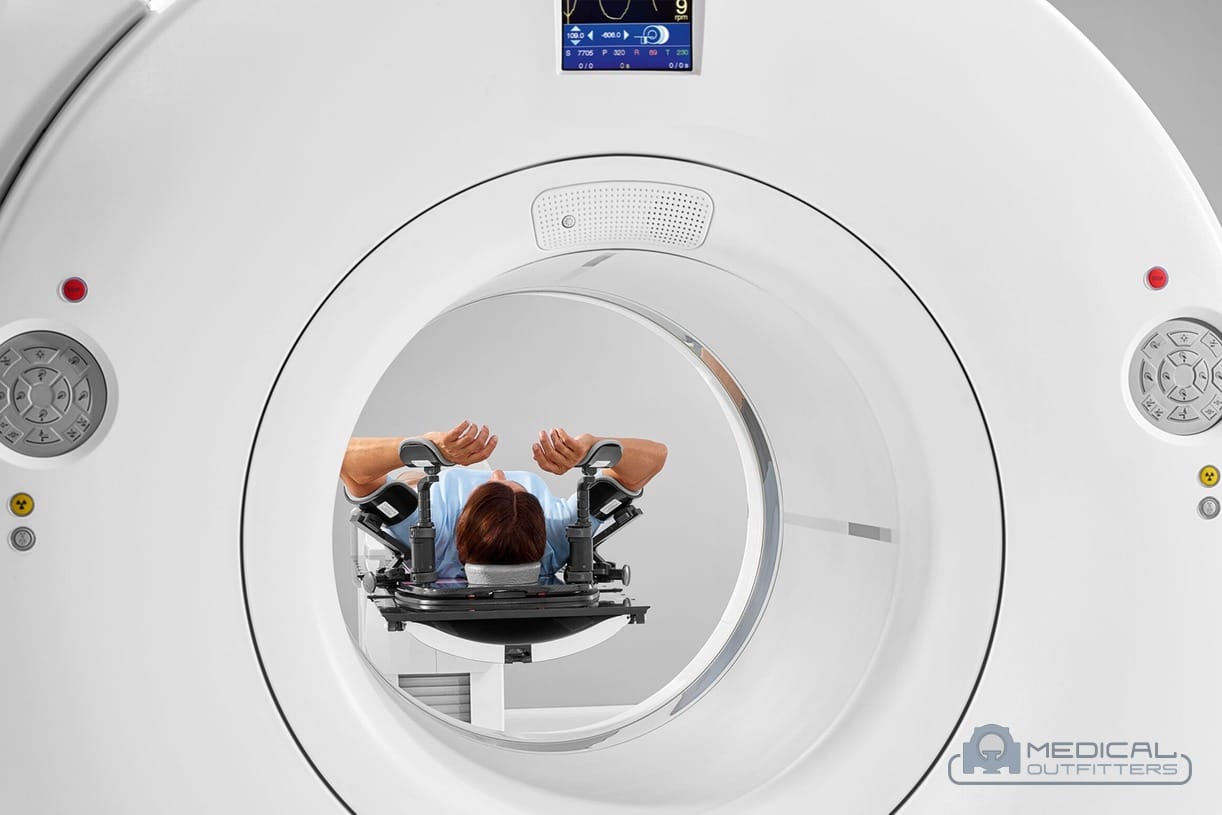
A PET/CT scanner purchase is decided by five things in this order: the case mix the program will bill for, the PET detector generation (BGO, LSO/LYSO time-of-flight, or digital), the CT half’s slice count, the suite around the scanner (hot lab, uptake rooms and shielding), and the tracer supply and radioactive-materials licence that take longer to arrange than the scanner does. New digital PET/CT scanners are multi-million-dollar purchases; a refurbished PET/CT scanner with time-of-flight detectors from Siemens or GE costs a fraction of that and is the value sweet spot for most community hospitals and imaging centers.
PET/CT is the most logistically demanding modality a facility can add. The scanner is only the middle of the project. Around it sit a radiochemistry supply chain with a 110-minute half-life, a shielded suite with rooms most departments have never built, a licence from the NRC or an agreement state, and an accreditation requirement before the first claim is paid. Buyers who start with the scanner and work outward run late; buyers who start with the tracer and the licence and work inward open on time.
This PET/CT scanner buying guide is for the hospital, oncology practice or imaging center planning that project. It covers the purchase path, the detector generations and what time-of-flight actually does, how to size the CT, what the suite needs, what a used PET/CT scanner for sale should be checked for, the PET CT scan machine price question, service and uptime, and licensing and accreditation.
- Start with tracer supply and the RAM licence. Both take months and neither depends on which scanner you buy.
- Buy time-of-flight on a refurbished scanner. LSO or LYSO detectors with time-of-flight are the minimum on the used market. Among new systems, GE’s BGO-based Discovery IQ and Omni Legend are the exceptions that trade time-of-flight for sensitivity and price.
- Size the CT for how it will be used: 16 slices for attenuation correction and localisation, 64 or more if it will also be a diagnostic CT.
- The suite is the schedule. Hot lab, uptake rooms, shielding and a physicist’s plan take longer than procurement.
Medical Outfitters installs and services PET/CT systems, supplies them as mobile units and sources them on request, alongside the new Fujifilm and refurbished GE and Siemens CT scanners it sells and installs across the United States, Puerto Rico and the Caribbean. The broad industry ranges are in our PET/CT scanner cost and buying guide; this article covers the decisions behind the number.
The PET/CT Scanner Purchase Path, in Order
The order matters more than it does for any other scanner. A CT can be bought, sited and running in weeks. A PET/CT program is gated by the slowest of its parts, and the slowest parts are the licence, the tracer contract and the suite. Treat the scanner decision as one workstream among four and run them in parallel.
Define the Case Mix
Oncology is the reason most PET/CT programs exist: FDG staging, restaging and treatment response across lymphoma, lung, colorectal, head and neck, melanoma and more. It sets the baseline: a whole-body FDG scan from skull base to mid-thigh in a handful of bed positions, several times a day. Cardiac PET, myocardial perfusion with rubidium or ammonia and viability with FDG, adds a cardiac workflow and possibly a generator. Neurology adds amyloid, tau and fluorodopa (F-DOPA) imaging and their tracers. Prostate-specific tracers have reshaped urologic oncology and need their own supply arrangement.
The case mix decides the rest: how much sensitivity the program needs, whether the CT will be diagnostic, which tracers the hot lab must handle, how many uptake rooms the schedule needs, and what the accreditation will cover. Write it down before talking to a vendor.
PET Detector Generations and Time-of-Flight
A PET detector converts the 511 keV photons from positron annihilation into light in a scintillator crystal and then into an electrical signal. Three generations are on the market at once.
BGO analog. Bismuth germanate crystals with photomultiplier tubes. Very sensitive to the photons but slow, so no time-of-flight. The GE Discovery ST and STE and the newer Discovery IQ use BGO. They produce good clinical images at longer bed times and are the cheapest systems on the refurbished market.
LSO and LYSO with time-of-flight. Lutetium-based crystals are fast enough to measure the tiny difference in arrival time between the two annihilation photons and place each event along its line of response. Time-of-flight improves contrast and lesion detection, especially in large patients, and shortens scans. The Siemens Biograph mCT, the GE Discovery 690 and 710 and the Philips Ingenuity TF are the workhorses of this generation and the core of the refurbished PET/CT market.
Digital, silicon photomultiplier. The photomultiplier tubes are replaced by silicon photomultipliers coupled directly to the crystals (one-to-one on the Philips Vereos), which sharpens timing to roughly 210 to 380 picoseconds depending on the system, raises sensitivity and enables the shortest scans and lowest doses. The Siemens Biograph Vision, GE Discovery MI and Philips Vereos lead this generation; they are mostly bought new.
The buying rule is simple: for a refurbished PET/CT, time-of-flight is the minimum. Among new systems, GE’s BGO-based Discovery IQ and Omni Legend are the exceptions that trade time-of-flight for sensitivity and price. Between LSO/LYSO time-of-flight and digital, the question is volume and budget. A community program scanning ten to fifteen patients a day is well served by a refurbished Biograph mCT or Discovery 710; an academic or high-volume program will want the digital scanner’s throughput and sensitivity.
Sizing the CT Half of a PET/CT
The CT in a PET/CT does two things: it provides the attenuation map that corrects the PET data, and it provides the anatomy the PET findings are localised on. Sixteen slices do both perfectly well, and many excellent PET/CT scanners have 16-slice CTs.
The CT can also be a diagnostic scanner. If the program wants to run contrast-enhanced diagnostic CT in the same session, use the scanner for cardiac CT angiography or for radiation-therapy planning, or use the CT for general imaging when the PET schedule is light, then 64 slices or more, a faster rotation and a larger tube are worth paying for. The GE Discovery 710, sold with 16-, 64- and, rarely, 128-slice CTs, is the common refurbished example. Our guide to CT scanner types by slice count explains what each tier adds, and the CT scanner brands compared guide covers the CT platforms by manufacturer.
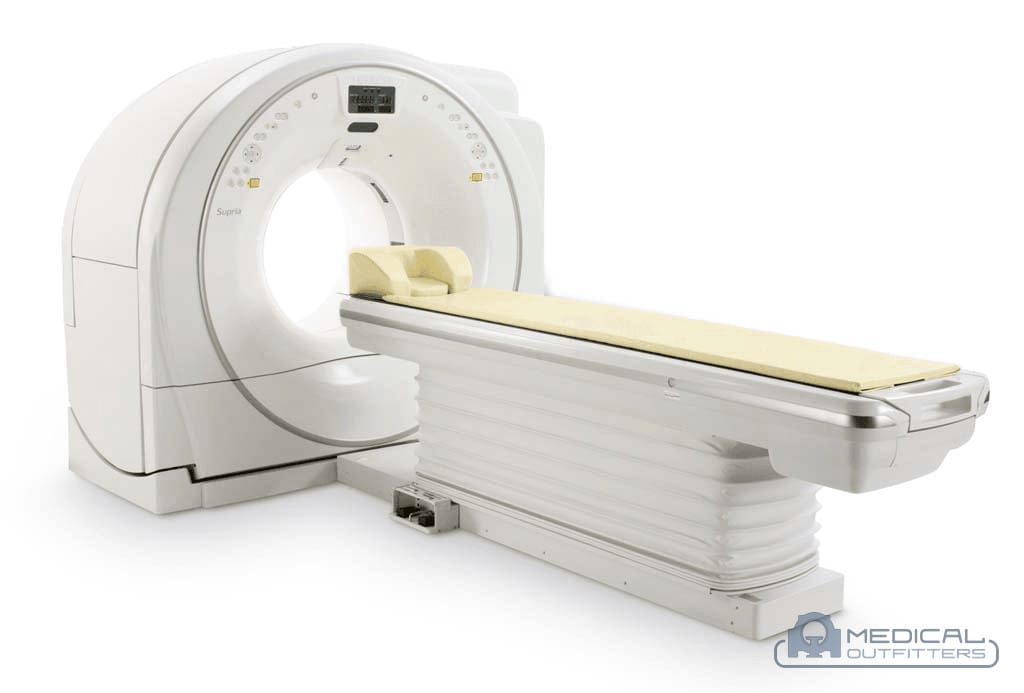
Whatever the slice count, the CT’s X-ray tube is the largest consumable in the system. On a refurbished PET/CT, ask for the tube’s scan seconds and installation date exactly as you would on a stand-alone Fujifilm Supria True64 (128-slice reconstruction) or a refurbished GE or Siemens CT from MO Select.
What the PET/CT Suite Needs
The suite is the part of a PET/CT project that most surprises a department that has only built CT and MRI rooms.
| Space | Purpose | What it needs |
|---|---|---|
| Scan room | The PET/CT itself | Shielding designed by a physicist for both the CT X-rays and the 511 keV photons from injected patients; three-phase power; chiller; floor loading for a gantry heavier than a CT |
| Hot lab | Receiving, assaying and drawing up tracers | Shielded storage, dose calibrator, fume hood or shielded drawing station, survey meters, secure access, waste storage for decay |
| Injection and uptake rooms | Patients rest 45 to 90 minutes after injection while the tracer distributes | One to three shielded, quiet, dimly lit rooms with recliners; the schedule sets the count |
| Patient restroom | Injected patients void before scanning | Dedicated, shielded, adjacent to uptake rooms; separate from staff facilities |
| Control room and reading | Operation and interpretation | Console, PACS integration, fusion workstation |
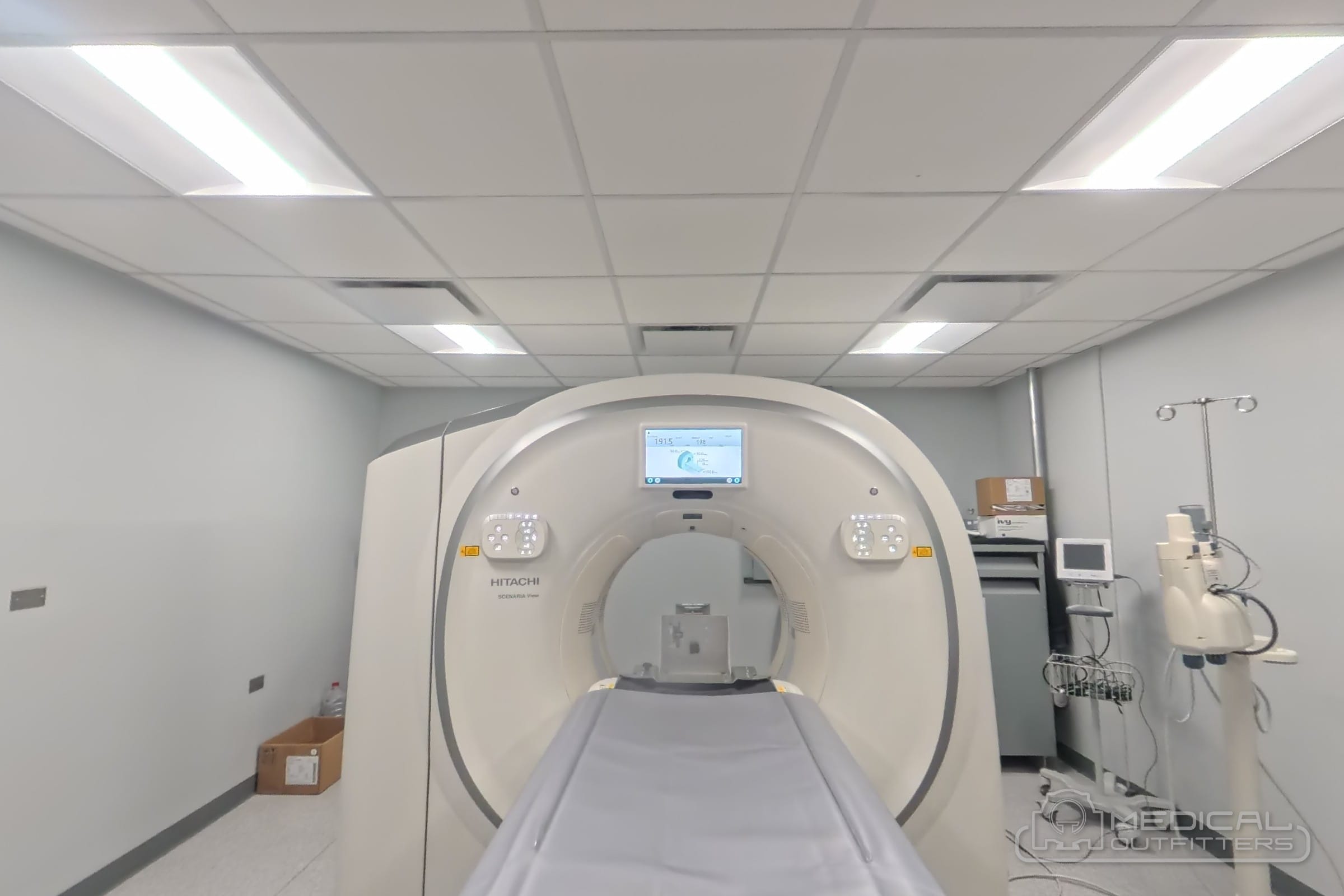
Shielding for a PET/CT is a different calculation from a CT room. The 511 keV photons from an injected patient are far more penetrating than CT X-rays, and the patient is a radiation source from injection until they leave, so the uptake rooms, corridors and restroom are shielded as well as the scan room. The physicist’s plan, based on the expected number of patients and the layout, decides the lead or concrete in each wall. It is designed before the floor plan is fixed, not after.
The gantry itself is heavier and longer than a CT’s, which affects the floor and the rigging route. Our guide to how to move an MRI or CT scanner covers the rigging side, our installation and rigging team handles the delivery, and our note on clinical facility development in the US and Caribbean covers construction.
Tracer Supply
FDG has a half-life of 110 minutes. It is made in a cyclotron, shipped by courier, and loses half its activity every two hours, so a program’s tracer supply is a radius on a map. Within a couple of hours’ drive of a commercial radiopharmacy, daily deliveries are routine and the schedule can be built around them. Beyond it, deliveries are less frequent, doses are ordered larger to allow for decay, and the schedule bends to the courier. Islands and remote sites plan air freight or, at scale, their own cyclotron.
Other tracers have their own supply models: rubidium for cardiac PET comes from an on-site generator; some prostate and neurology agents ship from a smaller number of production sites and need earlier ordering. Contract the supply before the scanner is ordered, and build the site with the deliveries in mind: a receiving route to the hot lab that does not cross public space.
New vs Refurbished PET/CT Scanner, and the Price Question
The refurbished PET/CT market is deep in the LSO/LYSO time-of-flight generation. Siemens Biograph mCT systems and GE Discovery 690, 710 and IQ systems come off lease and out of upgrading academic centers in good numbers, and a properly refurbished one delivers clinical images that a community program’s referrers will not distinguish from a new scanner’s. Digital systems are still mostly new.
What a refurbishment should include on a used PET/CT scanner for sale: detector block testing and replacement of failed blocks, a normalisation and calibration against the manufacturer’s phantoms, the CT tube’s condition documented or the tube replaced, software brought to a supported version with the reconstruction options licensed, cosmetic and mechanical work on the gantry and table, and a written warranty with response times. Our refurbished medical imaging equipment page describes the MO Select standard, and the refurbished versus OEM certified guide explains where the two overlap and where they differ.
On the PET/CT scanner price itself, the PET CT scan machine price every buyer asks about first: new digital systems are multi-million-dollar purchases, refurbished time-of-flight systems sell for a fraction of that, and the number moves with detector generation, CT slice count, tube condition, software options and warranty. Medical Outfitters quotes each configuration individually; the PET/CT scanner cost guide gives the industry’s broad ranges to budget against.
Ask about the detector blocks. A PET ring is made of a few hundred detector blocks (144 to 192 on a Biograph mCT, 256 on a Discovery 690), and a refurbished scanner’s value lies in how many are original, how many were replaced, and what the daily quality-control sinogram looks like. A seller who can show a clean daily QC and a block-replacement history is selling a scanner; one who cannot is selling a risk.
Service, Licensing and Accreditation
Service and uptime
A PET/CT that is down on a scanning day strands injected patients and a day’s worth of decaying tracer. The service contract needs to cover the PET detectors, the CT tube and the software, with a response time written in, and the facility needs a plan for the days the scanner is down: a partner site or a mobile PET/CT on call. Medical Outfitters’ service and repair contracts are written that way.
Licensing and staff
The program needs a radioactive-materials licence from the NRC or the agreement state, naming an authorised user and a radiation safety officer, before any tracer is delivered. The CT is registered as an X-ray device. The program needs a qualified medical physicist, certified nuclear medicine technologists, and reading physicians credentialed in PET. The licence application is often the longest lead item.
Installation and accreditation
The scanner is rigged into the finished, shielded room, calibrated against the manufacturer’s phantoms, and accepted by the physicist. Accreditation by the ACR, the Intersocietal Accreditation Commission, The Joint Commission or RadSite follows, with phantom images and clinical cases. Medicare requires it before it pays the technical component in physician offices and imaging centers (hospitals are exempt), and many private payers follow suit. Plan the first scanning weeks around gathering the accreditation cases.
The PET/CT Buyer’s Checklist
- Case mix written down, with expected daily volume by tracer.
- Tracer supply contracted, with delivery schedule and pricing.
- RAM licence application filed, with authorised user and RSO named.
- Physicist’s shielding plan for scan room, hot lab, uptake rooms and restroom.
- Scanner specified: time-of-flight detector generation, CT slice count, reconstruction options, software licences.
- Refurbished scanner inspected: daily QC, block history, CT tube count, software version.
- Service contract with response times and a downtime plan.
- Rigging route and floor loading confirmed for the gantry.
- Accreditation plan and the reading physicians’ credentials in place before the first patient.
For a quote on a refurbished PET/CT scanner, or on the new Fujifilm and refurbished GE and Siemens CT scanners we sell from the same platforms, contact Medical Outfitters. We install and service across the United States, Puerto Rico and the Caribbean, from our base in Florida, and our CT scanner cost guide and PET/CT scanner cost guide give the industry ranges to budget against.
- PET/CT scanner cost and buying guide
- CT scanners for sale
- Fujifilm Supria True64 CT scanner
- Fujifilm SCENARIA View 64/128 CT scanner
- MO Select refurbished GE and Siemens systems
- Refurbished medical imaging equipment
- CT scanner types by slice count
- CT scanner brands compared
- PET/CT rigging and installation
- Service and repair contracts
- Clinical facility development
- Request a PET/CT quote
PET/CT Scanner Buying: Common Questions
How much does a PET/CT scanner cost?
New digital PET/CT scanners are multi-million-dollar purchases, and refurbished time-of-flight systems sell for a fraction of that depending on age, detector class and CT configuration. Our PET/CT scanner cost guide covers the broad industry ranges; Medical Outfitters quotes each configuration individually.
What is time-of-flight PET and do I need it?
Time-of-flight PET measures the tiny difference in arrival time of the two annihilation photons to localise each event along its line of response. It improves contrast and lesion detection, especially in large patients, and shortens scans. Any refurbished PET/CT bought today should have it, and among new systems only GE’s BGO-based Discovery IQ and Omni Legend do without it.
How many CT slices does a PET/CT need?
Sixteen slices are enough for attenuation correction and anatomical localisation. Choose 64 slices or more if the CT will also be used for diagnostic contrast-enhanced studies, cardiac work or radiation-therapy planning.
What does a PET/CT room need?
A shielded scan room, a hot lab for tracer handling, one or more shielded uptake rooms, an injection area, a dedicated patient restroom, and a physicist-designed shielding plan. The scan room also needs the CT's three-phase power, chiller and floor loading.
Can I buy a refurbished PET/CT scanner?
Yes. Refurbished Siemens Biograph mCT and GE Discovery 690, 710 and IQ systems are widely available. Medical Outfitters sources, installs and services used PET/CT systems on request and supplies mobile PET/CT units, with warranty terms agreed in writing for each system.
What licences do I need to operate a PET/CT?
A radioactive materials licence from the NRC or your agreement state, a registered X-ray device, a qualified medical physicist, certified nuclear medicine technologists and, for Medicare reimbursement outside a hospital, accreditation of the PET/CT program by ACR, IAC, The Joint Commission or RadSite.
Related Articles