Published 2 November 2026. The refurbished resale bands are the class bands published on Medical Outfitters’ equipment cost guides and its 2026 Imaging Equipment Price Index as read on 2 November 2026; the recovery shares are Medical Outfitters estimates of what a used unit recovers against those bands, printed so that a seller can place a unit before asking for a figure, and every unit is quoted individually. The regulatory notes cite the Florida Department of Health, the FDA, the ACR, the HIPAA Security Rule, NIST and the Federal Highway Administration as read on the same day. Written by the Medical Outfitters sales and field engineering team.
What a used imaging system is worth is a share of what it will sell for refurbished. Medical Outfitters prices a unit it intends to own: it buys the system, removes it with its own crews, rebuilds and tests it, and resells it delivered, installed and warrantied through MO Select. The gap between the resale band and the offer is the work in between: de-installation, transport, refurbishment, the tube, detector or cold head reserve, testing, installation, the warranty and the margin. The estimated recovery table below shows how large the share is by modality, age band and condition, so a seller can read where a unit sits before asking for a figure. No dollar offer is printed on this page; every unit is quoted individually after its details and, where needed, an inspection.
This guide covers the resale bands, the estimated recovery by age and condition, what moves the number, selling by modality, the process, trade-in against sale against consignment, de-installation, the paperwork, when to sell and what Medical Outfitters buys. It puts the arithmetic behind our shorter note on who buys used imaging equipment.
- In this guide: What is used imaging equipment worth? The resale bands behind every offer
- Estimated recovery by modality, age band and condition
- What moves the number
- Selling by modality: X-ray, ultrasound, CT, MRI, C-arm, mammography, DEXA and PET/CT
- How to sell used imaging equipment: the process
- Trade-in vs outright sale vs consignment
- De-installation, rigging and transport
- Paperwork, patient data and compliance
- When to sell
- What Medical Outfitters buys, and where your unit goes
- Six mistakes that lower the number
- Tell us about your unit
- Frequently asked questions
What Is Used Imaging Equipment Worth in 2026? The Resale Bands Behind Every Offer
Used imaging equipment is worth what a buyer can resell it for, less what it costs that buyer to get it from your room to a new one, working and warrantied. Medical Outfitters publishes the resale half of that equation on its cost guides: the refurbished class band for every modality it buys. The table gathers those bands; the recovery section shows what share of the band a used unit recovers by age and condition. Neither is an offer; a unit is quoted individually.
| Modality | Refurbished resale band (Medical Outfitters, delivered, installed and warrantied) | Where the band is published |
|---|---|---|
| X-ray | Portable or handheld DR $12,000 to $35,000; mobile DR cart $40,000 to $90,000; fixed DR room $60,000 to $135,000 | X-ray machine cost guide |
| Ultrasound | Handheld $4,000 to $12,000; portable or compact $15,000 to $40,000; cart-based or premium $30,000 to $90,000 | Ultrasound machine cost guide |
| CT | 16 to 32-slice $85,000 to $185,000; 64-slice $175,000 to $375,000; 128-slice $350,000 to $625,000; 256-slice and higher $625,000 to $1,500,000 | CT scanner cost guide |
| MRI | Open or low-field $300,000 to $525,000; 1.5T $475,000 to $975,000; 3T $1,000,000 to $1,900,000 | MRI machine cost guide |
| C-arm | Mini or extremity $45,000 to $85,000; full-size mobile $55,000 to $135,000; 3D and premium vascular $125,000 to $240,000 | C-arm machine cost guide |
| Mammography | 2D digital (FFDM) $40,000 to $95,000; 3D tomosynthesis $95,000 to $225,000 | Mammography machine cost guide |
| DEXA | Peripheral $18,000 to $40,000; central or full-body $35,000 to $85,000 | DEXA bone densitometer cost guide |
| PET/CT | Entry or older $200,000 to $450,000; mid-tier $450,000 to $800,000; premium or new-generation $800,000 to $1,500,000 | PET/CT scanner cost guide |
Refurbished resale bands by modality: the class bands published on the Medical Outfitters cost guides and the 2026 Imaging Equipment Price Index as read on 2 November 2026. The band is what a refurbished system sells for, not what a used one is bought for.
The three questions behind every offer
- Which modality and class? The class sets the band, and a unit cannot recover more than its class resells for refurbished.
- How old is it? The year of manufacture places the platform in a generation, which decides whether it is wanted refurbished this year or priced on support status and parts.
- What condition is it in, and how does it come out? Working under contract, working out of contract, or de-installed and in need of repair; then the route to the street, because the buyer’s removal cost comes off the number.
Appraisers separate fair market value installed, the asset in place and operational, from orderly liquidation value, what it brings with reasonable time to find a buyer, and forced liquidation value, an immediate sale. A refurbished band is close to the first; an offer for a used unit in its room is closer to the second; a unit that must be out by Friday is priced nearer the third. The same question arrives as what is my used mri worth, used mri machine value, used ct scanner value and imaging equipment trade-in value, and the answer is the same arithmetic: the resale band for the class, the share for the age and condition, and the route out of the building.
Estimated Recovery by Modality, Age Band and Condition
The table prints the estimated share of the refurbished resale band that a used system recovers, by modality, by age band from the year of manufacture and by condition. The shares are Medical Outfitters estimates, derived from the gap the CT, MRI and ultrasound guides publish between an equipment-only figure and an all-in band, and they are labeled estimated because no unit is priced from a table. The figure a seller receives is the share applied to the class band for the specific unit, confirmed in writing after the inspection.
| Modality and age band | Working, under contract | Working, out of contract | De-installed or needs repair |
|---|---|---|---|
| CT, 0 to 5 years | 40 to 55% | 30 to 45% | 15 to 30% |
| CT, 6 to 10 years | 30 to 45% | 20 to 35% | 10 to 25% |
| CT, over 10 years | 20 to 30% | 10 to 25% | 5 to 15% |
| MRI, 0 to 5 years | 35 to 50% | 25 to 40% | 10 to 25% |
| MRI, 6 to 10 years | 25 to 40% | 15 to 30% | 5 to 20% |
| MRI, over 10 years | 15 to 25% | 10 to 20% | 5 to 10% |
| X-ray, 0 to 5 years | 40 to 55% | 30 to 45% | 15 to 30% |
| X-ray, 6 to 10 years | 30 to 40% | 20 to 30% | 10 to 20% |
| X-ray, over 10 years | 15 to 25% | 10 to 20% | 5 to 10% |
| C-arm, 0 to 5 years | 45 to 60% | 35 to 50% | 15 to 30% |
| C-arm, 6 to 10 years | 35 to 45% | 25 to 35% | 10 to 25% |
| C-arm, over 10 years | 20 to 30% | 15 to 25% | 5 to 15% |
| Ultrasound, 0 to 5 years | 45 to 60% | 35 to 50% | 15 to 30% |
| Ultrasound, 6 to 10 years | 30 to 40% | 20 to 30% | 10 to 20% |
| Ultrasound, over 10 years | 15 to 25% | 10 to 15% | 5 to 10% |
| Mammography, 0 to 5 years | 40 to 55% | 30 to 45% | 15 to 25% |
| Mammography, 6 to 10 years | 30 to 40% | 20 to 30% | 10 to 20% |
| Mammography, over 10 years | 15 to 25% | 10 to 20% | 5 to 10% |
| DEXA, 0 to 5 years | 40 to 55% | 30 to 45% | 15 to 25% |
| DEXA, 6 to 10 years | 30 to 40% | 20 to 30% | 10 to 20% |
| DEXA, over 10 years | 15 to 25% | 10 to 20% | 5 to 10% |
| PET/CT, 0 to 5 years | 35 to 50% | 25 to 40% | 10 to 25% |
| PET/CT, 6 to 10 years | 25 to 35% | 15 to 25% | 5 to 15% |
| PET/CT, over 10 years | 15 to 25% | 10 to 15% | 5 to 10% |
Estimated recovery as a percentage of the refurbished resale band for the unit’s class (the table above), by age band and condition; Medical Outfitters estimates as of 2 November 2026, printed for orientation, not as an offer; each share applies to the class band of that modality (slice class, field strength, system type, format, 2D or 3D, peripheral or central, tier).
How to read the three conditions
- Working, under contract. In clinical use under a service contract or current manufacturer support, with the service file and the consumable logs complete.
- Working, out of contract. In use but off contract, on unsupported software, or with gaps in the file; the buyer prices the inspection risk.
- De-installed or needs repair. Out of the room, in storage, or with a failed tube, a quenched or warm magnet, a dead detector or faulty probes; priced on the platform, the parts and the work it needs.
Where the shares come from
Three guides publish the arithmetic. The CT scanner cost guide prints an equipment-only figure estimated at $120,000 to $225,000, comparison only, against its $175,000 to $375,000 all-in band at 64 slices, so a refurbished scanner on a loading dock already reads about 55 to 75 percent of the band, and a used scanner in its room sits below that by removal, the tube reserve, refurbishment, testing, the warranty and the margin. The MRI machine cost guide prints an equipment-only figure estimated at $150,000 to $450,000, comparison only, against $475,000 to $975,000 at 1.5T, about 40 to 45 percent at the midpoints, because the all-in price carries ramp-down, cryogens, rigging and ramp-up; that is why an MRI recovers the smallest share. The ultrasound machine cost guide prints an equipment-only figure estimated at $15,000 to $75,000, comparison only, against $30,000 to $90,000 for a cart, about 70 to 75 percent, with no de-installation, which is why ultrasound and C-arms start highest and fall fastest as probes and detectors age. X-ray, mammography and DEXA follow the CT pattern with a lighter removal; PET/CT follows the MRI pattern because the removal is a project and the used market is thin.
The table cannot price a specific unit, because the tube count, the license list and the route out are not in it, and it cannot replace an inspection, which is where most of the difference between two offers for the same model comes from. Tell us about the unit and we will place it in writing; our used imaging equipment inspection checklist is the survey we run on it.
What Moves the Number: Age, Hours, Tube and Detector, Software, Service History, Access, Rigging and Demand
Inside a cell, ten things move a unit up or down, and most are numbers the seller already has: on the data plate, in the last service report, in the system’s own logs.
| What moves the number | What we ask for | How it moves the share |
|---|---|---|
| Age and generation | Year of manufacture, model, platform generation | Sets the row; a current platform recovers the most, a platform past its generation is priced on support and demand |
| Hours and usage | Tube seconds or mAs, exposures, cold head hours, patient volume | A lightly used unit sits at the top of its row; one near the end of its consumable drops a column |
| Tube and detector | Tube date and count; detector age, flat-field and phantom results; image intensifier or flat panel | The largest line on CT, X-ray, C-arm and mammography; a tube or detector near end of life is priced as a replacement |
| Magnet, cold head and helium | Helium level and trend, cold head hours, quench history | Decide the column on an MRI; a quenched or warm magnet is priced on the platform and the parts |
| Probes and coils | Probe count and ages; every coil tested | Probes carry much of an ultrasound's value, coils a large part of an MRI's; damaged ones are priced out |
| Software and licenses | Version and support status; licensed options in writing, and whether they transfer | Supported software and transferable licenses hold the share; unsupported or non-transferable moves a unit down a column |
| Service history | PM reports, repair invoices, error logs, physics surveys | A complete file from one provider is the best evidence of a well-kept system; gaps are priced as risk |
| De-installation access | Floor, door widths, wall or roof opening, route to the street | The buyer's removal cost comes off the number; a ground floor with a door costs least |
| Rigging and transport | Distance, island or overseas route, cryogen plan, permits | The further and heavier the move, the more of the band it consumes |
| Market demand per platform | How many of that model are wanted refurbished this year | A deep used market recovers more than a rare or end-of-support model of the same age |
What moves the recovery share inside a cell of the table above; the consumable’s log (tube, detector, cold head and helium, probes) decides most of it, as the inspection checklist explains for a buyer.
The order matters. On a CT the tube decides the column before the slice count decides anything, which is why our used CT scanner buying guide opens with the scan-second count; on an MRI the helium trend and the cold head hours decide it, as the used MRI machine buying guide sets out; on an ultrasound the probes are the value. Access comes last in the list and first on the day: a unit three floors up behind a wall that has to come out is worth less than the same unit on a ground floor with a door, because someone pays for the wall.
Selling by Modality: X-ray, Ultrasound, CT, MRI, C-arm, Mammography, DEXA and PET/CT
The same question arrives as sell used imaging equipment, sell used medical imaging equipment, sell used x ray equipment, sell used x-ray machine, sell used ultrasound machine, sell used mri machine, sell used ct scanner, sell used c-arm, sell used mammography machine, sell used dexa machine and trade in imaging equipment, and the answer is the recovery table read for that modality. What differs is which component carries the value and how the unit comes out.
Sell used X-ray equipment
If you want to sell used x ray equipment, the detector carries most of the value and its age and image quality decide the offer; the generator and tube come next. A DR room comes out in a day and a cart rolls out, so the removal takes little from the number. The band is the system-type band on the X-ray machine cost guide and the portable X-ray guide; an analog room or a cart without a DR panel is priced below it.
Sell used ultrasound machine
To sell used ultrasound machine consoles for the best share, sell them with every probe: the probes carry much of the value, each is tested on a phantom for cracked lenses and dead elements, and a console without its probes is priced as a carrier. Ultrasound ships on a pallet, so the share starts high and falls with the age of the probes and the support status of the software. The band is the class band on the ultrasound machine cost guide; our note on refurbished ultrasound machines covers the checks.
Sell used CT scanner
To sell used ct scanner systems well, send the tube’s scan-second or mAs count and its installation date with the first email: the tube is the largest line in the arithmetic, and a scanner near the end of its tube is priced as a tube replacement. Licenses that transfer hold the share; the slice class sets the band on the CT scanner cost guide. A CT comes out through a door in most buildings and moves crated on an air-ride truck.
Sell used MRI machine
What is my used mri worth is the question we hear most, and the answer starts with the magnet: a cold magnet with a healthy helium trend, a recent cold head and no unexplained quench sits in the first two columns; a warm or quenched magnet is priced on the platform, the coils and the parts. Then the coil set, the software and licenses, and the route out, because a magnet leaves through an RF door, a wall panel or a roof opening and travels ramped down with its helium plan. To sell used mri machine systems at the top of the cell, sell while the magnet is cold and on contract. The band is the field-strength band on the MRI machine cost guide; our guides to how an MRI is moved and how much an MRI machine weighs cover the removal.
Sell used C-arm
To sell used c-arm systems, name the format (mini, full-size or 3D), the detector (image intensifier or flat panel), the generator and the tube count, and whether the brakes, the battery and the arm’s movement are right. A C-arm needs no de-installation and the common platforms hold a deep parts pool, and the band is the format band on the C-arm machine cost guide; the used C-arm buying guide lists the checks a buyer runs.
Sell used mammography machine
To sell used mammography machine units, send the detector’s last flat-field and phantom results, the tube’s exposure count, the license list (tomosynthesis, synthesized 2D, contrast, biopsy) and whether the licenses transfer, with the paddle set, the biopsy hardware and the QC and physics records. The band is the 2D or 3D band on the mammography machine cost guide.
Sell used DEXA machine
To sell used dexa machine units, send the model, the software version and options, the detector type and the last QC phantom results. Densitometers run a long service life on the same software family, so a supported unit over ten years old still recovers a share, and the table crates in a morning. The band is the peripheral or central band on the DEXA bone densitometer cost guide; our note on DEXA scanner brands and buying used covers the checks.
Sell used PET/CT
A PET/CT is priced on its detector technology (BGO, LSO or LYSO, or digital SiPM), its time-of-flight and reconstruction licenses, the CT tube’s count and the platform’s age, and its removal is a project: the hot lab and the radiation safety paperwork are cleared before the gantry moves. The used market is thin, so demand for the platform weighs more than on any other modality. The band is the tier band on the PET/CT scanner cost guide; the PET/CT buying guide explains the detector generations.
How to Sell Used Imaging Equipment: From the First Email to Payment
Selling a system to Medical Outfitters is six steps, and only the first needs anything from you before we have seen the unit. Send what you have rather than waiting until the list is complete.
| Step | What happens | Timing |
|---|---|---|
| 1. Tell us about the unit | Make, model, year, software and licenses, condition, usage counts, location, route out and photographs; a partial picture is enough. | Same day, through the contact page. |
| 2. Desk valuation | We place the unit in its resale band by age and condition and come back with where it sits and the open questions. | Usually quick once we have the details. |
| 3. Inspection | A field engineer checks the consumable's log, phantom images, licenses, the service file and the route out, on site or by remote session. | Scheduled around your clinical calendar. |
| 4. Written offer | A firm figure for that unit, stating who de-installs, rigs and transports, what the seller provides, payment terms and the removal date. | After the inspection. |
| 5. De-installation and removal | Our crews ramp down, disconnect, cable, package, rig and load the system; cryogens, containers and freight are part of the job. | Basic MRI magnet rigging in three to five hours; the full de-installation over a day or more. |
| 6. Payment and paperwork | Payment on the agreed terms, a bill of sale, the data-sanitization record and the state and accreditation notices the seller files. | On the terms in the offer. |
How to sell used imaging equipment to Medical Outfitters, from the first email to payment; the removal is scheduled around your clinical calendar, and the offer states who does every line of it.
What to send with the first email
- Make, model and year of manufacture, from the data plate
- Software version and licensed options
- Condition and any known faults
- Usage counts: tube seconds or exposures, cold head hours and helium level, probe ages
- Service history and the last PM report
- Location, floor, door widths and the route out; island sites say so early
- Photographs of the system, the room and the route out
- Owned outright, leased or financed, and any lien

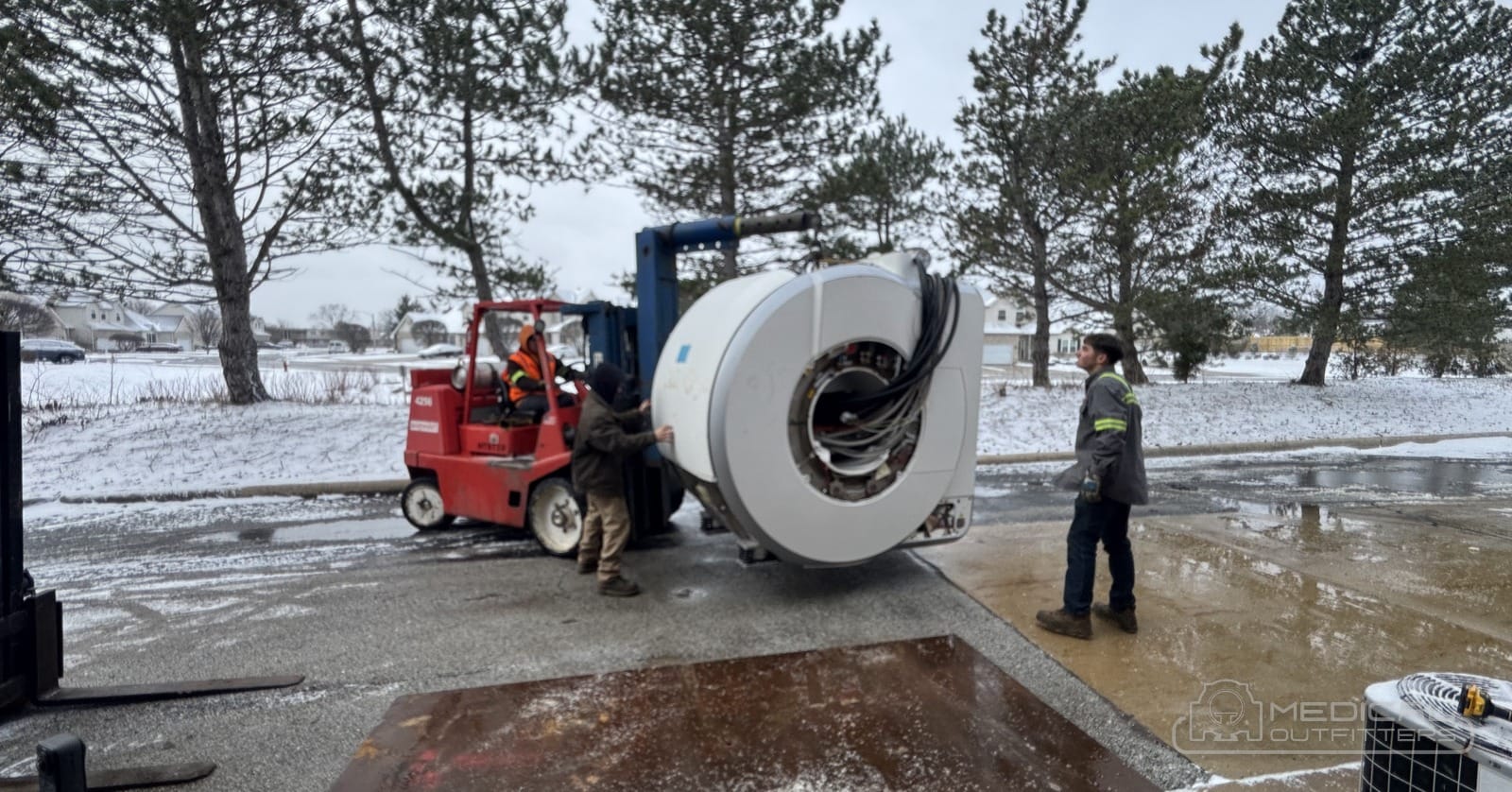
The inspection is the step sellers underestimate: the survey our inspection checklist describes for a buyer, run from the other side. A declared fault is priced as a known quantity; a fault found on site is priced as a surprise, which is the most common reason an offer moves between the desk valuation and the written figure. The Orlando de-installation in the photograph is what step five looks like on a real site, and our project record shows the rest.
Trade-In vs Outright Sale vs Consignment
Three routes exist for a unit coming out of service, and they do not pay the same way or at the same time: a credit against the system you are buying, cash after removal, or a share of a later sale.
| Trade-in | Outright sale | Consignment | |
|---|---|---|---|
| What you get | A credit against the system you buy from Medical Outfitters | Cash on the terms in the written offer | A share of the eventual sale, paid when the unit sells |
| When the money arrives | At the purchase, off the invoice | On the agreed terms after removal | Weeks to months later, when a buyer is found |
| Who removes it | Our crews, timed to the new installation | Our crews, around your calendar | Agreed per unit; the room usually stays occupied until the sale |
| Risk the seller keeps | None once the credit is agreed | None once the offer is accepted | Market risk: a lower price, or no sale |
| Best for | A replacement project: one crew out, one crew in | A closure, a consolidation or a unit leaving with no replacement | Rare or specialist units where a specific buyer is worth waiting for |
| Wrong when | You are not buying a replacement | You want to wait for a specific buyer | The room is needed, the magnet is still consuming helium, or cash is needed now |
Trade-in versus outright sale versus consignment for a used imaging system; Medical Outfitters takes trade-ins against the systems it sells and buys units outright.
A trade-in and an outright sale are the same valuation with a different settlement: what changes is whether the share arrives as a reduction of the new invoice or as a payment. The trade-in’s advantage is the changeover: one crew removes the old system and installs the new one, and the helium, rigging and freight are planned as one job. An outright sale is the route for a closure, a consolidation or a unit leaving with no replacement. Consignment is agreed case by case for rare or specialist units where a specific buyer is worth waiting for; it is the wrong route when the room is needed, when a magnet is still consuming helium, or when cash is needed now. Whichever route you take, ask the question that decides the net figure: who de-installs, rigs and transports the unit, and at whose cost.
De-Installation, Rigging and Transport: Who Does What
Many companies that will buy a used scanner are brokers, and a broker expects the seller to arrange the de-installation and rigging; that is where a sale price quietly turns into a net cost. Medical Outfitters de-installs, ramps down, disconnects, cables, packages, rigs and loads the system with its own crews, handles the cryogenics and the freight, and the offer states that scope in writing.
| Modality | What the de-installation involves | Who does what |
|---|---|---|
| MRI | Ramp-down to zero field with a helium plan, coils tested and crated, table and cabinets disconnected, the RF door removed or a wall panel cut, the magnet rigged out on skates or a crane, air-ride transport | Our crews, cryogenic engineers and logistics; the seller releases the room and the route |
| CT and PET/CT | Tube parked, gantry locked, table and console separated, detector and slip ring protected, serial numbers and licenses recorded before power-down; a PET/CT adds the hot-lab clearance | Our crews; the seller clears the radiation safety paperwork on a PET/CT |
| X-ray room and mammography | Tube column, stand, table and generator disconnected and crated, detector and workstation packed separately; a mammography unit adds the paddles, biopsy hardware and QC records | Our crews, usually in a day; the seller files the state notice and the accreditation withdrawal |
| C-arm, mobile X-ray, ultrasound and DEXA | Rolled out on their own wheels or crated on a pallet; probes, batteries and accessories inventoried; a DEXA table unbolted and crated | Our crews or a scheduled carrier; the seller sanitizes the patient data before the unit leaves |
De-installation, rigging and transport by modality; the scope is in every Medical Outfitters offer, and the installation, de-installation and rigging and delivery and logistics pages describe the same crews at work.
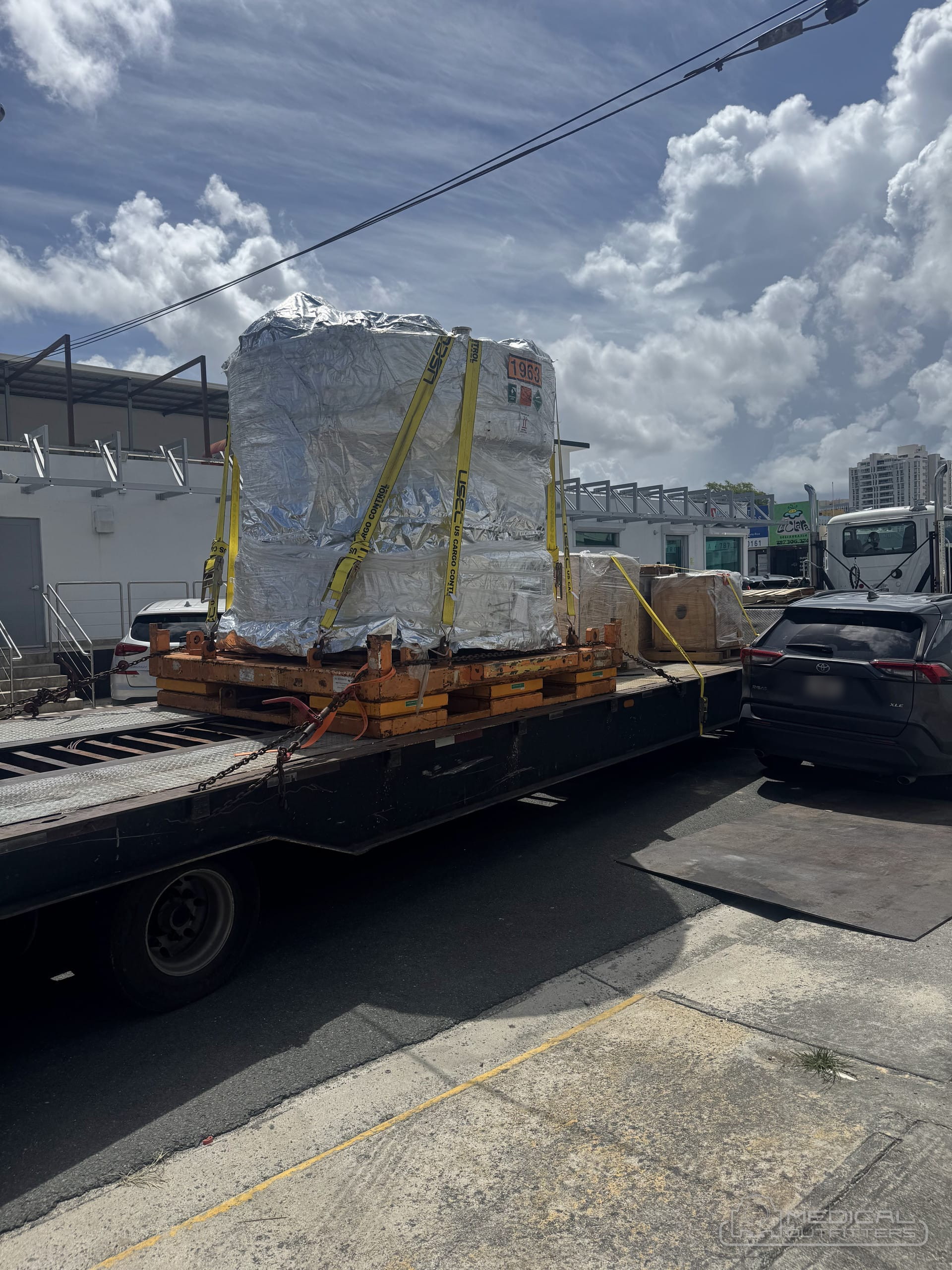
Three public rules shape the transport. Liquid helium travels as a regulated cryogenic liquid (helium, refrigerated liquid, UN1963, hazard class 2.2), so the magnet moves with its helium plan and the placards the carrier needs, as the cryogenics page explains. On the Interstate system a vehicle may not exceed 80,000 pounds gross without a state permit, and states issue special permits for nondivisible loads such as a magnet, so the route is surveyed and the permits pulled before the date is set. And a system leaving the mainland for Puerto Rico clears as a domestic movement with no customs duty, while the wider Caribbean applies its own duty and consumption tax. Our guide to moving an MRI or CT scanner puts de-installation, rigging and transport of a 1.5T MRI in the tens of thousands of dollars; that cost sits inside the buyer’s arithmetic, and it is the largest reason an MRI recovers a smaller share of its band than a C-arm that rolls out on its own wheels.
Paperwork, Patient Data and Compliance Before the Unit Leaves
A used imaging system leaves a building with a paper trail, and most of it is the seller’s to complete; the offer lists which items Medical Outfitters prepares and which the seller files.
| Item | What it is | Source |
|---|---|---|
| Patient data | Every console, workstation and drive holding protected health information has the data removed before the unit leaves or is reused, as the HIPAA Security Rule's device and media controls require, following the NIST media-sanitization guidelines; we provide the record | 45 CFR 164.310(d); NIST SP 800-88 Rev. 2 |
| Title and liens | The seller owns the system outright, or the lessor's or lender's payoff and release are in hand before the sale | The inspection checklist |
| State radiation-machine notice | A registered X-ray, CT, mammography, C-arm or DEXA unit: in Florida the seller reports the sale, transfer or disposal to the Department of Health within 15 days; other states run their own periods | Florida Administrative Code 64E-5.511 |
| Mammography accreditation | A unit withdrawn from service is withdrawn from the facility's accreditation; a unit moved to another facility is accredited again | ACR accreditation support; FDA MQSA guidance |
| Cryogens and hazmat | Liquid helium travels as a regulated cryogenic liquid (UN1963, class 2.2); the magnet moves with its helium plan and placards | NOAA CAMEO Chemicals (UN1963) |
| Oversize transport | A magnet or gantry on a trailer may exceed the 80,000 pound Interstate gross limit; states issue special permits for nondivisible loads, and the route is surveyed first | 23 CFR 658.17 |
| Servicing versus remanufacturing | Refurbishing and servicing a device are not remanufacturing; the FDA's 2024 guidance draws the line | FDA, Remanufacturing of Medical Devices (May 2024) |
Paperwork, patient data and compliance before a used imaging system leaves; the sources are the public rules and guidance as read on 2 November 2026, and the state notice periods differ outside Florida.
Two of these decide more than the rest. The patient data must go, with the proof that it went; the service keys, licenses and calibration files must stay, or the unit loses the value they carry. And the title must be clean: an undisclosed lien surfaces at de-installation.
When to Sell: Timing Around Contracts, Consumables and Replacement
Timing moves a unit between columns of the recovery table more often than negotiation does. Five moments decide it.
| Moment | Why it matters |
|---|---|
| Before the service contract ends | On contract with a current PM and a complete file, a unit sits in the first column; a year off contract it has moved one. |
| Before the consumable fails | A tube, cold head or detector near the end of its life is still a working-unit sale; after the failure it is a repair-column sale. |
| At the replacement decision | Price the trade-in and the outright sale with the new quote, so one crew removes the old system and installs the new one. |
| At a closure or consolidation | Sell the department as one transaction; a whole-department offer is simpler to price and to remove. |
| While the magnet is cold | An MRI in storage or warm loses value every week; a magnet sold at field, with its helium plan, recovers more than the same magnet after a quench. |
The replacement project is the moment most sellers meet. Price the trade-in and the outright sale with the new quote, so that the removal, the delivery and the room work are one schedule and one crew; the radiology equipment cost table puts every modality’s refurbished and new bands side by side for that conversation, and refurbished versus OEM certified explains what happens to your unit after we buy it.
What Medical Outfitters Buys, and Where Your Unit Goes
Who buys used imaging equipment? We do, and we remove it ourselves. Medical Outfitters is a medical imaging equipment supplier based in Miami, Florida, and it purchases MRI, CT, PET/CT, C-arm, mammography, X-ray, ultrasound and DEXA systems across the United States, Puerto Rico and the Caribbean, single systems and whole departments. What we buy is resold through our own inventory, rebuilt through MO Select or sourced for buyers who ask for the platform, so we price a system we intend to own rather than a margin on someone else’s transaction.
- MRI. Open, wide-bore and standard-bore systems, 0.3T to 3T, working or quenched.
- CT. All slice counts; tube condition drives the offer, then the licenses.
- PET/CT. Complete systems; detector technology, the CT tube and the platform’s demand.
- C-arm. Image intensifier and flat-panel systems, mini, full-size and 3D.
- Mammography. 2D and 3D tomosynthesis; the detector and the license list carry the value.
- X-ray. Digital radiography rooms, detectors, mobile carts and portables.
- Ultrasound. Consoles and probes; the probes hold much of the value.
- DEXA. Bone densitometry systems, peripheral and central.
A system with a failed tube, a quenched magnet or a dead detector still has value, in the parts and the platform; tell us what is wrong rather than leaving it out. Cross-border removals add customs and freight steps, and we hold a Puerto Rico legal entity for that work. Current stock is on our products pages and the used MRI machines for sale page; the Florida page covers removal and delivery from our Miami warehouse.
Six Mistakes That Lower the Number
Six things lower the number more often than age does, and all six are avoidable.
- Leaving a known fault out. It is found on inspection and priced as a surprise; declared, it is priced as a known quantity.
- Accepting a price without asking who removes the system. A price that leaves de-installation, rigging and transport to you is a gross figure; the net is what you keep.
- Letting the contract lapse before the sale. The file stops, the PM record ends and the unit moves a column.
- Selling the probes, coils or workstation separately. A console without its probes or a magnet without its coils is priced as a shell.
- Wiping nothing, or wiping everything. Patient data must go; service keys, licenses and calibration files must stay.
- Waiting until the room is needed. A unit sold with time to inspect and schedule recovers more than one that must be out by Friday.
Tell Us About Your Unit
Tell us what you have and we will come back with where it sits, then a written offer after the inspection. A partial description is enough to start.
Send what you have from this list through the contact page, with photographs of the system, the room and the route out:
- Make, model and year; software version and licensed options
- Condition and known faults; tube, detector, cold head and helium, or probe counts and ages
- Service history and the last PM report; owned, leased or financed
- Location, floor and the route out of the building; island sites say so early
- Whether you are replacing the system, closing the room or selling a department
Buying rather than selling? The 2026 Imaging Equipment Price Index prices every modality new and refurbished, and the refurbished medical imaging equipment page explains what a Medical Outfitters system includes.
Selling Used Imaging Equipment: Frequently Asked Questions
- How much is my used MRI machine worth?
- A share of the refurbished resale band for its field strength: $300,000 to $525,000 for an open or low-field system, $475,000 to $975,000 at 1.5T and $1,000,000 to $1,900,000 at 3T delivered, installed and warrantied, set by the magnet's age, the helium trend and cold head hours, the coil set, the software and licenses, and the route out. MRI recovers the smallest share of any modality because the all-in price carries ramp-down, cryogens, rigging and ramp-up. Medical Outfitters quotes it per unit; the recovery section shows how the share moves.
- How much is a used CT scanner worth?
- A share of the refurbished band for its slice class, $85,000 to $185,000 at 16 to 32 slices, $175,000 to $375,000 at 64 slices, $350,000 to $625,000 at 128 slices and $625,000 to $1,500,000 at 256 slices and higher, with the tube's scan-second count deciding the condition column before anything else, then the licenses that transfer and the age of the platform. Each scanner is quoted individually once the tube count and the license list are in hand.
- Who buys used imaging equipment?
- Medical Outfitters does: it purchases MRI, CT, PET/CT, C-arm, mammography, X-ray, ultrasound and DEXA systems across the United States, Puerto Rico and the Caribbean, removes them with its own crews and resells them refurbished through its own inventory, so it prices a system it intends to own. Many other companies in this market are brokers who expect the seller to arrange the removal, which is the first question to ask anyone who makes an offer.
- Do I have to arrange de-installation myself?
- Not with Medical Outfitters. We de-install, ramp down, disconnect, cable, package, rig and load the system ourselves, handle the cryogenics where a magnet is involved and the freight afterwards, and the written offer states that scope. Many buyers in this market are brokers who expect the seller to arrange removal, which is where a sale price turns into a net cost.
- What do you need to give me an offer?
- Make, model and year, software version and licensed options, condition and known faults, usage counts (tube exposures or scan seconds, cold head hours and helium level, probe ages), the service history, the location and the route out, photographs, and whether the unit is owned, leased or financed. Send what you have; the desk valuation starts from a partial picture and the inspection fills the rest.
- Will you buy a system that is not working?
- Often, yes. A system with a failed tube, a quenched magnet or a dead detector still has value in the parts and in the platform, and it is priced in the de-installed or needs-repair column of the recovery table. Tell us what is wrong rather than leaving it out: a known fault is priced as a known quantity, and a fault found on site as a surprise.
- Is a trade-in worth more than an outright sale?
- The valuation is the same: a trade-in applies the unit's share of the resale band as a credit against the system you are buying from Medical Outfitters, and an outright sale pays the same share in cash on the agreed terms after removal. The trade-in's advantage is the changeover, one crew removing the old system and installing the new one; the outright sale is the route when there is no replacement.
- How long does it take to sell used imaging equipment?
- The offer is usually quick once we have the system details, and the removal is scheduled around when you can release the room. Basic MRI magnet rigging is normally completed within three to five hours depending on the weight, with the full de-installation scheduled over a day or more; a CT comes out in a day or two, an X-ray room in a day, and a C-arm, ultrasound or DEXA unit ships on a pallet.
- Do you buy imaging equipment in Puerto Rico and the Caribbean?
- Yes. Medical Outfitters operates across the United States, Puerto Rico and the Caribbean and holds a Puerto Rico legal entity. A system leaving the mainland for Puerto Rico clears as a domestic movement with no customs duty; the wider Caribbean applies its own duty and consumption tax, and island removals add freight routing and crane access, so tell us the location early.
- What happens to the patient data on the system?
- It is removed before the unit leaves or is reused. The HIPAA Security Rule's device and media controls require procedures for the final disposition of electronic protected health information and its removal from media before reuse, and the NIST media-sanitization guidelines (SP 800-88) set out the clear, purge and destroy methods; we provide the record. The service keys, licenses and calibration files stay with the system.
- Do I need to notify the state or an accreditation body when I sell an X-ray or mammography unit?
- Usually. Radiation machines are registered with the state: in Florida, anyone who sells, transfers, relocates or disposes of one notifies the Department of Health within 15 days under Rule 64E-5.511, and other states run their own notice periods. A mammography unit permanently withdrawn from service is withdrawn from the facility's accreditation, and a unit moved to a different facility goes through accreditation again.
- Can I sell used ultrasound probes, MRI coils or a workstation on their own?
- You can, but a system sells for more complete. Probes carry much of an ultrasound system's value and coils a large part of an MRI's, so a console without its probes or a magnet without its coils is priced as a shell, and a workstation sold separately takes the licenses and calibration files the next owner needs.
- What is the difference between the refurbished resale band and the offer for my unit?
- The band is what the system sells for after Medical Outfitters has bought it, removed and transported it, rebuilt and tested it, delivered, installed and warrantied it. The offer is the share of that band left after all of that work and the margin, set by the unit's age, condition and route out. The guides publish the band; the recovery section shows the share; the written offer, after inspection, is the number.
- Should I sell before the service contract ends?
- Yes, where you can. A unit sold while it is on contract, with a current PM report and a complete file, sits in the working, under contract column; the same unit a year off contract has moved a column, and a tube or cold head that fails in the meantime moves it again. The best moment is the replacement decision, when the trade-in or the sale is priced with the new quote and one crew handles the changeover.
Medical Outfitters buys used MRI, CT, PET/CT, C-arm, mammography, X-ray, ultrasound and DEXA systems, removes them with its own crews and resells them refurbished, delivered, installed and warrantied; the systems we hold today are on the products pages. Browse equipment for sale →
Whether you are replacing one system, closing a room or consolidating a department, Medical Outfitters will tell you where the unit sits, inspect it, make a written offer and remove it with its own crews, with the cryogens, rigging and freight in the same scope. Serving the US, Puerto Rico and the Caribbean.