How do you move an MRI machine? An MRI is moved by ramping the magnet down to zero field, keeping it cold with liquid helium, de-installing the coils, table and electronics, rigging the three-to-eight-tonne magnet out through the shield-room opening, transporting it on an air-ride trailer and reinstalling it in a new RF-shielded room, where it is ramped back up, shimmed and calibrated. A CT scanner is moved the same way minus the magnet steps: no ramp-down, no helium, a lead-lined room instead of an RF one, and a tube and detector that need care and recalibration rather than cryogens.
Both are routine jobs for a medical equipment rigging crew and expensive mistakes for anyone else. The magnet is a pressure vessel full of liquid helium at minus 269 degrees Celsius; the CT gantry is a precision instrument with a fragile X-ray tube and a detector aligned to fractions of a millimetre. Neither forgives being pushed through a doorway by a general mover.
This guide is for the hospital, imaging center or practice that needs an MRI relocation or a CT scanner relocation: to a new building, a new site across town, or a new owner across the sea. It covers the site survey, the magnet ramp-down and helium plan, de-installation, rigging and transport, reinstallation, the CT-specific steps, realistic timelines, what drives the cost, and how to choose an imaging equipment rigging company.
- An MRI move is a rigging job plus a cryogenic one. The magnet is ramped down but stays cold; helium is topped off before and after.
- Plan 4 to 8 weeks door to door for an MRI, 1 to 3 weeks for a CT, before any construction at the new site.
- The new site needs its room first. An RF shield room certified for the MRI, or a physicist-approved lead-lined room for the CT, before the truck rolls.
- Cost is driven by distance, crane access, helium and the room, not by the equipment’s purchase price. In our experience, moves run from tens of thousands to the low six figures.
Medical Outfitters relocates MRI and CT systems with its own rigging, de-installation and installation crews, its own cryogenic service team and its own delivery and logistics operation across the United States, Puerto Rico and the Caribbean. One party carries the job from ramp-down to handover, which is the arrangement we recommend whoever does the work.
Moving an MRI vs Moving a CT Scanner at a Glance
| Superconducting MRI | CT scanner | |
|---|---|---|
| Heaviest piece | Magnet, roughly 3 to 5 tonnes at 1.5T, 6 to 8 tonnes at 3T | Gantry, 1.5 to 2.5 tonnes |
| Preparation | Ramp-down by an engineer; helium top-off; cold transport plan | Park the gantry and tube; secure the slip ring; drain cooling if required |
| Room at the new site | RF-shielded room, certified before delivery; quench pipe; magnetic survey | Lead-lined room per physicist plan; three-phase power; chiller |
| Crew | Riggers, cryogen technician, OEM-trained field engineer | Riggers and a field engineer |
| Timeline door to door | 4 to 8 weeks | 1 to 3 weeks |
| Main risks | Quench, helium loss, magnet drift, shield-room damage | Tube shock, detector misalignment, slip-ring damage |
| Cost drivers | Distance, crane, helium volume, whether the RF room exists | Distance, crane, tube condition, room readiness |
The comparison hides one thing worth saying plainly: the cheapest MRI move is the one where the destination room was designed for that specific magnet before the move was booked. Every week a magnet waits on a truck or in storage is a week of helium boil-off and a week without revenue.
Before the Move: Survey, Route and Permits
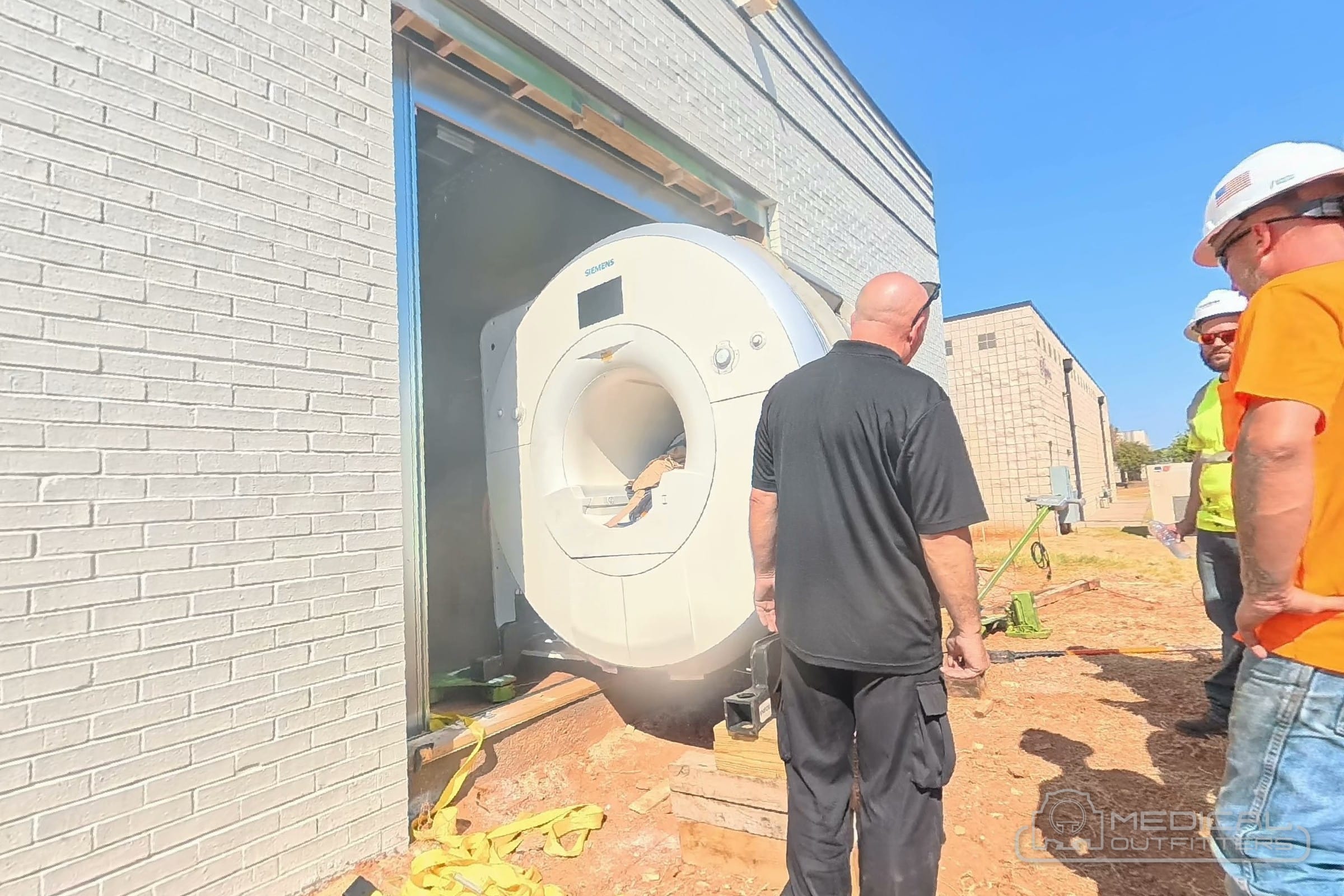
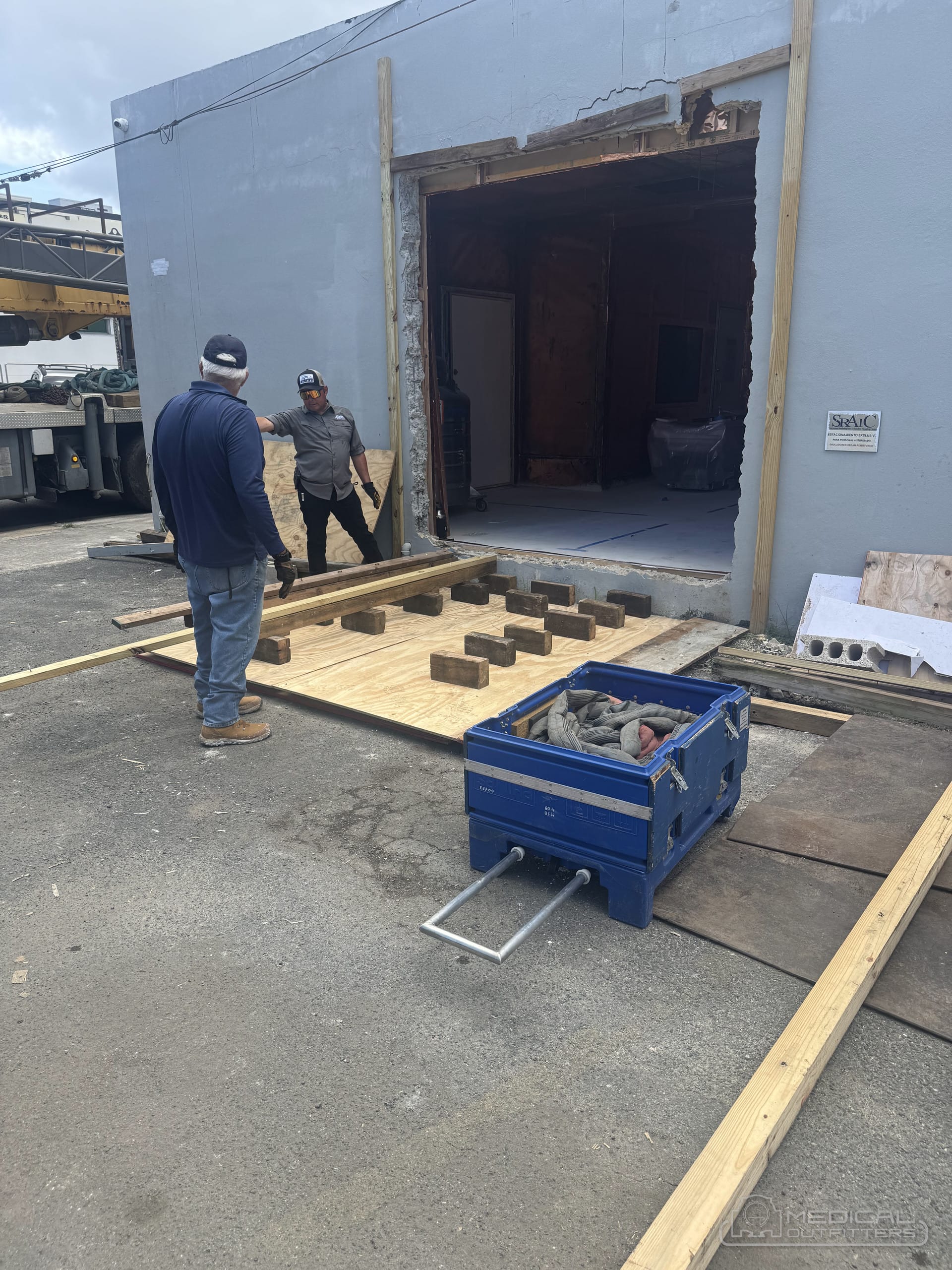
Every relocation starts with two site surveys, one at each end. At the origin the crew measures the shield-room opening, the corridors, doors and floor loads between the magnet and the street, and confirms whether the magnet leaves through a door, a removed wall panel or a crane opening in the roof or an exterior wall. At the destination the same questions run in reverse, plus the state of the new room, the power, the chiller connection and the quench pipe route. The RF room, quench pipe and magnetic survey the new room needs are the same ones any new MRI installation needs, and they are done before the magnet is booked.
The route survey covers the road. A magnet on an air-ride trailer is an oversized load in some jurisdictions, needs permits and sometimes escorts, and cannot sit for days at a port or a state line. For Puerto Rico and the Caribbean the survey includes sea freight: container or roll-on roll-off, the port handling, and a cryogen plan that covers the crossing. Our guide to MRI installation in Puerto Rico and the Caribbean covers what that involves.
Permits are filed at this stage: road permits for the load, building permits for any wall or roof opening, and, at the destination, the state radiation-machine registration for a CT and whatever certificate-of-need or state approval the MRI needs at its new address. In certificate-of-need states, relocating a scanner between sites can itself need review.
Magnet Ramp-Down and the Helium Plan
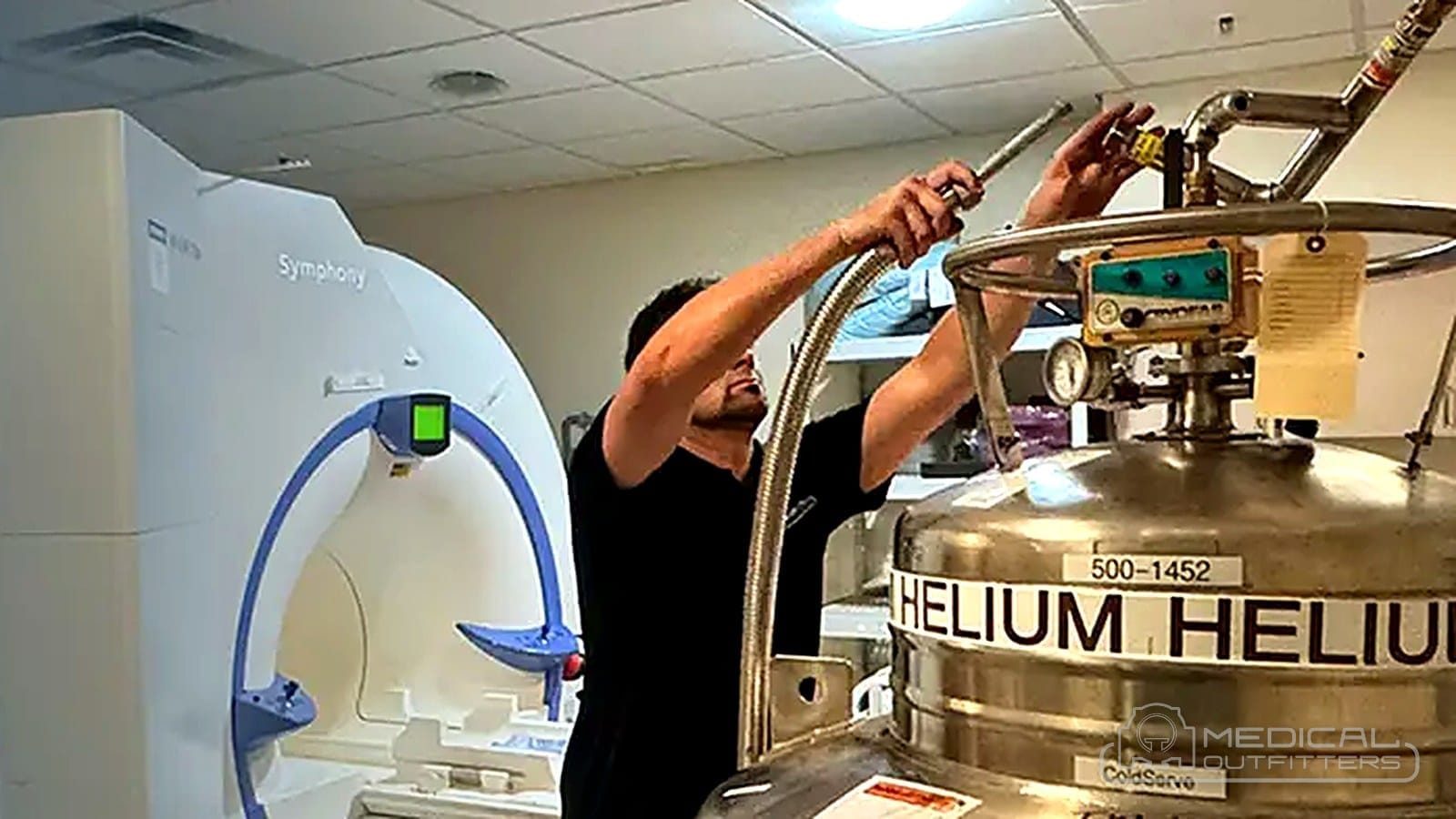
A superconducting magnet cannot be moved at field. The fringe field would pull every ferrous tool and truck part toward it, and the forces on the coil during transport could quench it. So the field engineer ramps the magnet down: the current in the coil, hundreds of amps, is drawn out through a resistor bank over several hours until the field is zero. Some helium boils off during the ramp, which is why the helium plan starts before the ramp does.
The magnet then stays cold. It travels with its liquid helium on board, and the crew’s job is to keep the level high enough that the vessel never warms. On a modern zero-boil-off magnet with the cold head disconnected for transport, the helium boils off slowly, and the crew plans a top-off within the window the manufacturer specifies, or on a long move keeps the cold head running from a generator-powered compressor. Letting the magnet warm to room temperature means a full cool-down and a 1,000 to 2,000 litre fill at the other end, and weeks added to the schedule; it is done only when a magnet has been in storage or has quenched. Our guide to what an MRI quench is explains what that fill costs and why the crew works so hard to avoid it. Sealed and zero-helium magnets such as the Fujifilm Echelon Smart ZeroHelium take the cryogen plan out of a relocation altogether, which is one reason they suit island sites.
Cold head off, clock on. The moment the cold head is disconnected the magnet starts losing helium. A well-planned move has the helium topped off the day before ramp-down, the transport window agreed in writing, and a cryogen technician at the destination when the truck arrives. That is the difference between a top-off and a refill.
MRI De-installation
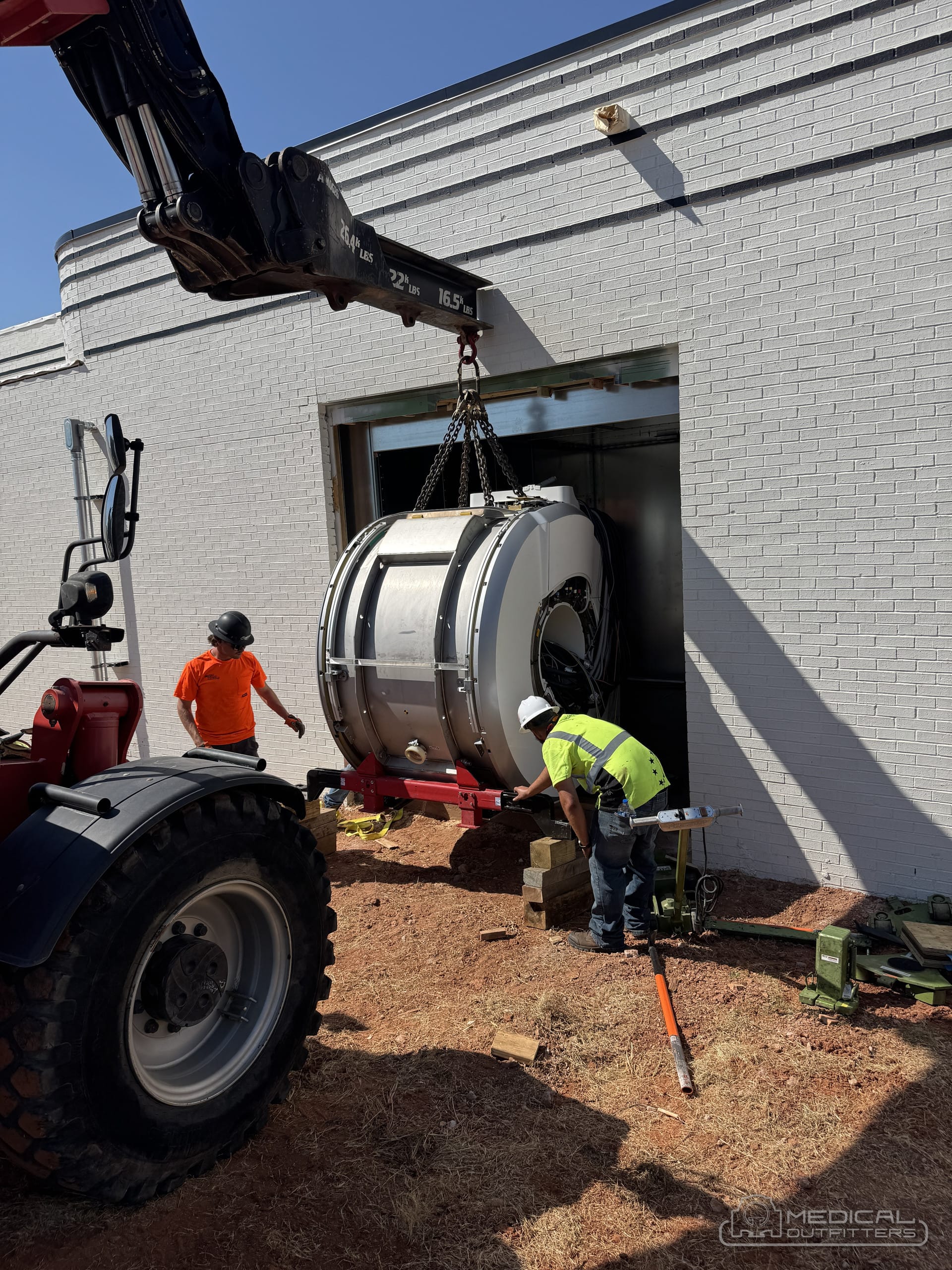
With the field at zero, the crew takes the system apart in the reverse of how it was built. RF coils are inspected, tested and crated first, because coil damage from a move is easy to miss until the coil is next used. The patient table, covers, cable trays and shim sets follow, each labelled and photographed. The equipment-room cabinets, gradient amplifiers, RF amplifiers, chiller and filter panel, are powered down, disconnected, and crated with their cables. Then the shield-room opening is made: the RF door is removed or a wall panel is cut, and the shield is repaired afterwards if the origin room will be reused.
A CT de-installation follows the same discipline with different parts: the tube is parked in its transport position, the gantry is locked, the table and console are separated, and the detector and slip ring are protected. On both modalities the crew records serial numbers, software licences and configuration before power-down, because the system will be recommissioned to that record.
MRI Rigging and Transport
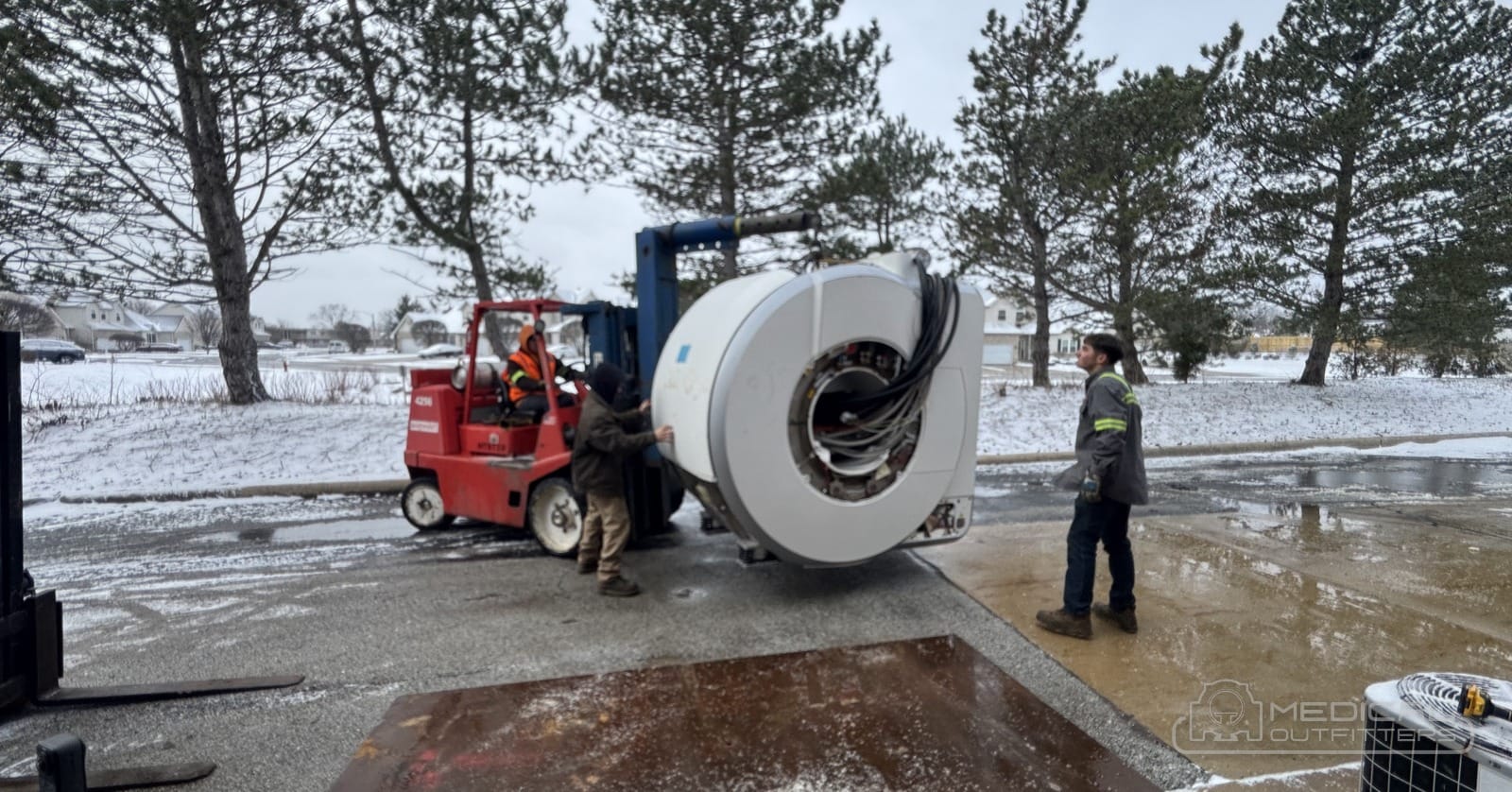
Rigging is the part most people picture: the magnet on skates or a gantry, jacked, rolled, and lifted by crane through the opening onto the trailer. The imaging equipment rigging crew handles a cold magnet as a pressure vessel rather than a steel box, spreads the load across floors that were never rated for a point load of several tonnes, and moves at the pace of the survey, not the schedule. A magnet dropped an inch is a magnet that may never shim to specification again.
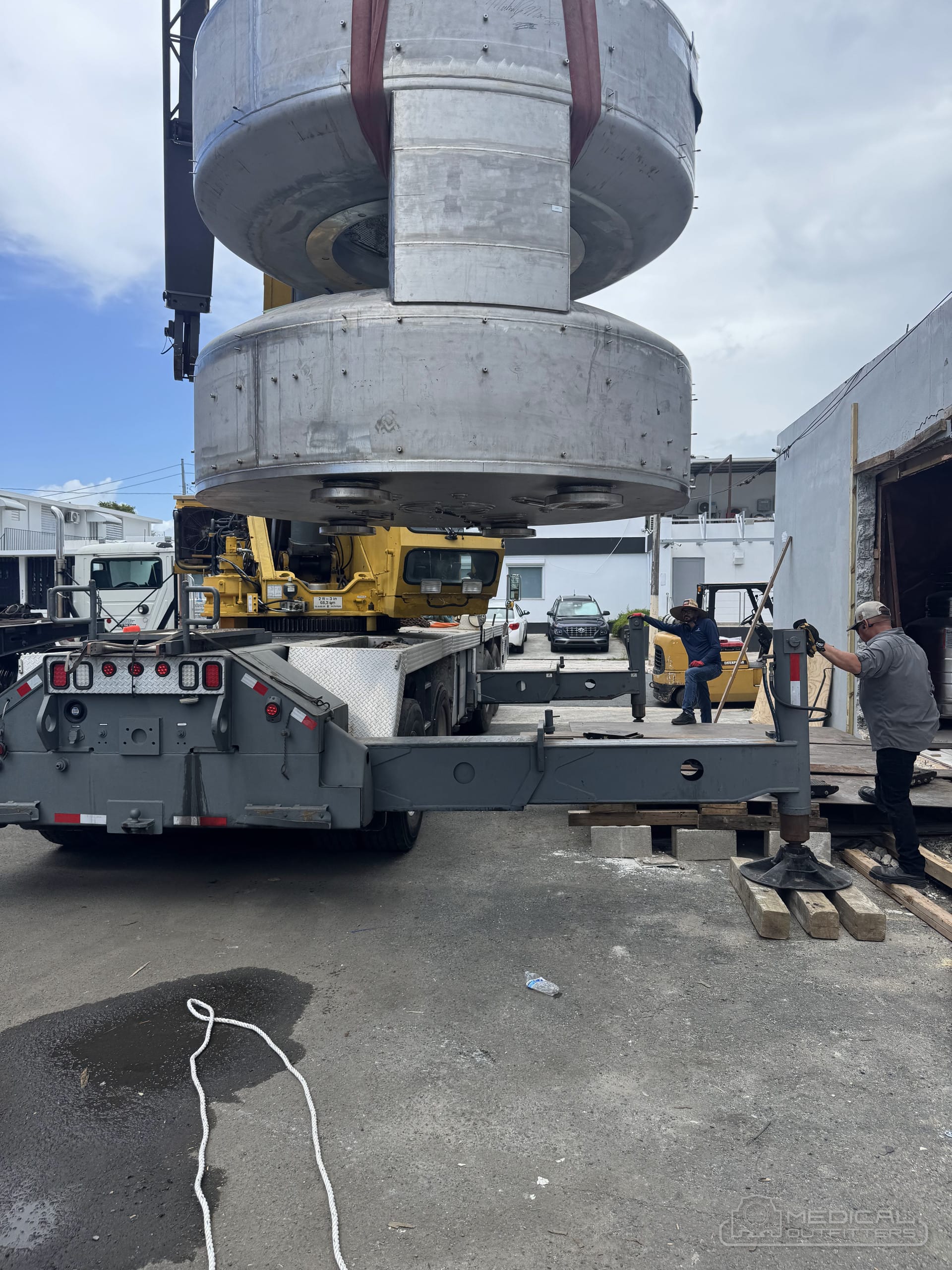
Transport is by air-ride, climate-controlled trailer. Air-ride suspension keeps road shock off the cryostat, the coil and, on a CT, the tube and detector. The helium level is checked at every stop. Where a magnet crosses water, it ships in a container or on a roll-on roll-off vessel with the cryogen plan written into the booking, and a technician meets it at the port. Medical Outfitters’ delivery and logistics team runs those crossings between Florida, Puerto Rico and the islands routinely, and island moves are a significant part of what we do.
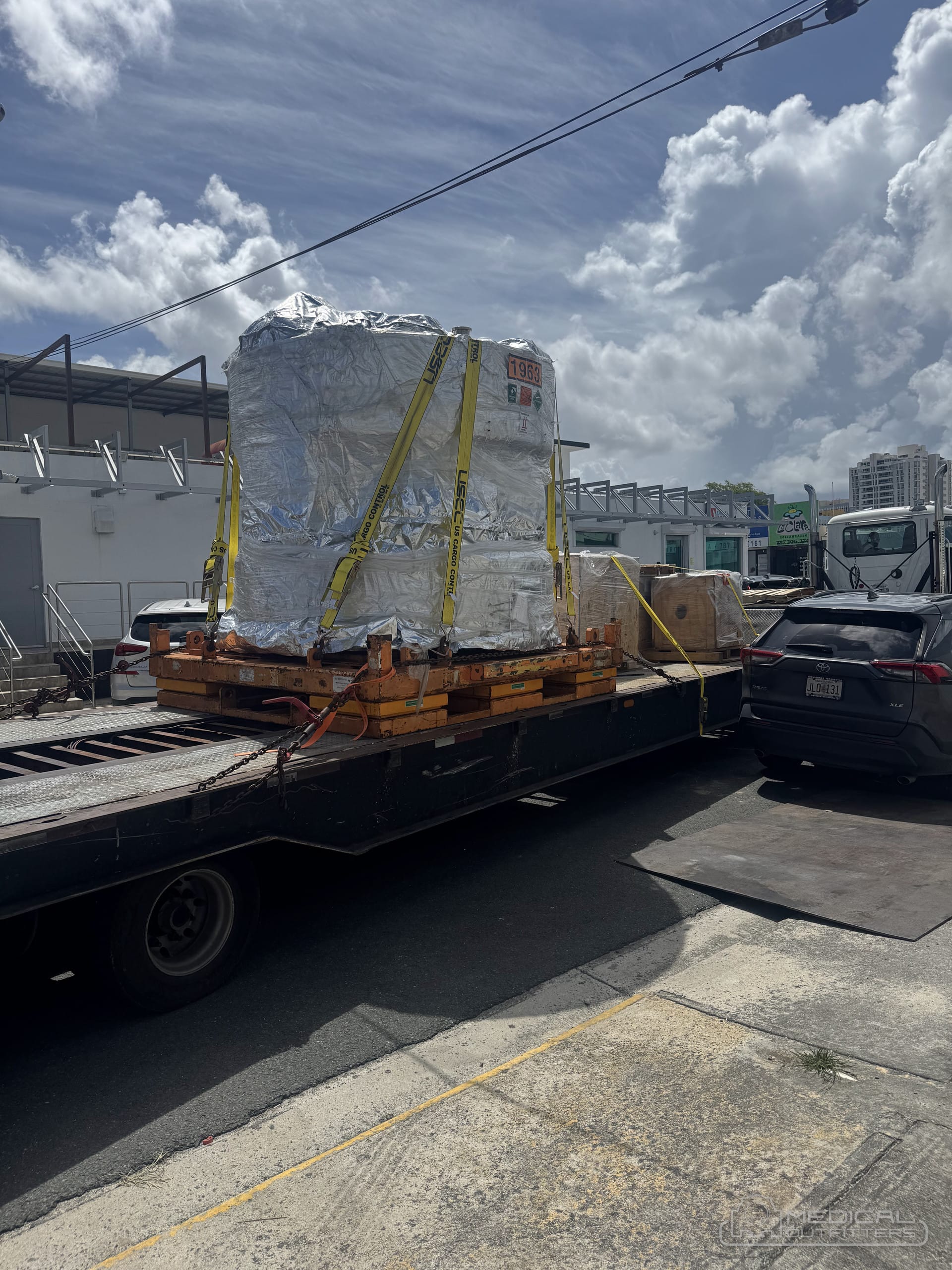
Insurance deserves its own line. The load should be insured in transit to its full replacement value, by the mover, in writing, before it leaves the building.
MRI Installation, Ramp-Up and Calibration at the New Site
The destination room is certified before the magnet arrives: the RF shield tested and signed off by the shielding vendor, the magnetic and vibration survey done, the quench pipe installed and inspected, power and chiller connected. The magnet is rigged in, set on its isolation pads and levelled to the manufacturer’s tolerance, and the cryogen technician tops off the helium and reconnects the cold head.
Ramp-up reverses the ramp-down: current is fed into the coil over several hours until the field reaches strength. Then the engineer shims. Passive shimming places small iron pieces around the bore to correct the field for the new room’s steel; active shimming adjusts the shim coil currents; together they bring the field homogeneity back to specification, which can take a day or more in a room with a lot of structural steel. Coils are tuned, gradients calibrated, the table and RF door tested, and the physicist runs the ACR phantom series before the first patient.
The last step is handover: applications training for the technologists, the service documentation, and the warranty. Every MO Select system ships with a written warranty whose term and coverage are agreed in writing before purchase. For a pure relocation, ask for the warranty terms in writing with the quote.
Moving a CT Scanner: What Is Different
A CT scanner relocation is a heavy-equipment move without the cryogenic layer, and it is correspondingly faster and cheaper. Three things need particular care.
The X-ray tube. A CT tube is a vacuum vessel with a rotating anode, and road shock can damage its bearings or its seal. The tube is parked, the gantry locked, and the trailer’s air-ride suspension does the rest. After the move the engineer runs the tube warm-up and checks for arcing before any imaging.
The detector and slip ring. The detector array is aligned to the tube to fractions of a millimetre and the slip ring carries power and data across the rotating gantry. Both are checked and recalibrated after the move: air calibrations, then a water phantom for Hounsfield accuracy, noise and uniformity, then the physicist’s acceptance tests.
The room. A CT needs lead shielding sized by a physicist for the new room’s layout and workload, three-phase power, a chiller or air-cooled condenser, and a floor that carries the gantry. None of this is exotic, and much of it can be built while the scanner is still working at the old site, which is why a CT move can be measured in weeks. Our guides to CT scanner types by slice count and the CT scanners for sale page cover the systems we deliver, install and relocate, from the new Fujifilm Supria 128 and SCENARIA View to the refurbished GE Optima CT660.
Medical Equipment Rigging: Who Should Move an MRI or CT
Searches for medical equipment rigging turn up three kinds of company: general machinery riggers, specialist medical rigging firms, and imaging dealers with their own crews. General riggers can lift anything but do not carry cryogen technicians or field engineers, so an MRI move with them needs two more contractors and three sets of responsibility. Specialist medical riggers know the magnets and the rooms but hand the system back to whoever services it. A dealer with its own rigging, cryogenic and engineering teams carries the job end to end and is accountable for the images at the other end.
Whichever you choose, ask five questions: who ramps the magnet down and up, who supplies and monitors the helium, who insures the load in transit and to what value, who calibrates and tests before the first patient, and who answers the phone if the field will not shim at the new site. Medical Outfitters answers the ramp-down, helium, calibration and support questions with its own people and names the insurer in the quote, which is what “imaging equipment rigging” means when we use the phrase.
MRI Relocation Timelines and What Drives the Cost
| Item | MRI | CT | What moves the number |
|---|---|---|---|
| Survey, engineering, permits | 1 to 2 weeks | 1 week | Certificate-of-need review; road permits; port bookings |
| Ramp-down and de-installation | 3 to 5 days | 1 to 2 days | Crane opening versus door; shield repair at origin |
| Transport | Days to 2 weeks | Days to 2 weeks | Distance; sea freight for islands; escorts |
| Rigging in, ramp-up, shimming | 1 to 2 weeks | 2 to 4 days | Room readiness; helium; steel in the new building |
| Calibration, QA, training | 3 to 5 days | 2 to 3 days | Physicist availability; accreditation requirements |
| Typical total cost | Tens of thousands for de-install and rigging; low six figures with a new RF room, helium and ramp-up | Tens of thousands | Distance, crane access, helium volume, room construction |
Medical Outfitters quotes every move after the survey, because two magnets of the same model can differ widely in price depending on whether one leaves through a door and the other through the roof. The ranges above are the industry’s shape, not a price list.
When moving beats replacing, and when it does not
A move is worth it when the system has years of supported life left and the destination room is already suitable. It is often not worth it when the magnet is twelve or more years old, the manufacturer has ended support, or the new site needs a room built anyway. In that case the money spent moving an old magnet is a down payment on a newer one, and the old system has a buyer: our note on who buys used medical imaging equipment explains how we value a system coming out of service, and our guide to how long an MRI machine lasts covers the age question. A new Fujifilm Echelon Synergy, a refurbished wide-bore Siemens MAGNETOM Aera from our MRI machines for sale page, delivered to a room designed for it, is frequently the cheaper move. For a site that needs a magnet during the gap, a mobile MRI rental covers it, and the MRI machine cost guide and CT scanner cost guide put the replacement numbers in context.
For a relocation quote, contact Medical Outfitters with the model, both addresses and photographs of the current room. We move systems across the whole United States, Puerto Rico and the Caribbean, with our crews based in Florida.
- MRI and CT rigging, de-installation and installation
- Delivery and logistics, including sea freight
- Cryogenic service: helium, ramp-down, ramp-up
- MRI machines for sale
- CT scanners for sale
- MO Select refurbished systems, delivered and installed
- What is an MRI quench?
- MRI installation in Puerto Rico and the Caribbean
- Who buys used medical imaging equipment?
- MRI machine cost guide
- CT scanner cost guide
- Request a relocation quote
Moving an MRI or CT Scanner: Common Questions
Can an MRI machine be moved?
Yes. A superconducting MRI is moved by ramping the magnet down, keeping it cold with liquid helium, de-installing the coils, table and electronics, rigging the 3 to 8 tonne magnet out, transporting it on an air-ride trailer and reinstalling it in a new RF-shielded room. It is routine work for a specialist crew and a bad idea for a general mover.
How much does it cost to move an MRI machine?
In our experience, de-installation, rigging and transport of a 1.5T MRI typically runs into the tens of thousands of dollars, and a full relocation with a new RF room, helium, ramp-up and calibration can reach the low six figures. Distance, crane access, helium volume and whether the shield room already exists drive the number. Medical Outfitters quotes moves after a site survey.
Does an MRI have to be ramped down to move it?
Yes. The magnetic field is ramped to zero before the magnet is moved. The magnet stays cold, with liquid helium on board, so that it can be ramped back up at the new site without a full cool-down. Letting the magnet warm up means a far longer and more expensive re-commissioning.
How long does it take to move an MRI?
Plan on 4 to 8 weeks door to door for a superconducting MRI, not counting construction of the new suite: about a week to de-install, transport time, a week to rig in and ramp up, and several days of shimming, calibration and physicist testing. A CT scanner moves in 1 to 3 weeks.
Is a CT scanner easier to move than an MRI?
Much easier. A CT has no magnet or helium, weighs 1.5 to 2.5 tonnes at the gantry, and needs a lead-lined room rather than an RF-shielded one. The main risks are shock to the X-ray tube and detector alignment, so the gantry travels on an air-ride trailer and is recalibrated after the move.
Who moves MRI machines?
Specialist medical imaging rigging companies and dealers with their own crews. Medical Outfitters uses its own rigging, cryogenic and field-engineering teams for de-installation, transport and installation across the United States, Puerto Rico and the Caribbean, which keeps one party responsible from ramp-down to handover.
Related Articles