A cath lab is the room where a hospital treats the heart without opening the chest. A doctor threads a thin tube through a blood vessel in the wrist or the groin, up into the heart, and works from the inside while an X-ray system films every move. That is the whole idea, and everything in the room exists to support it.
This guide explains what a cath lab is, what a cath lab does, and what is actually in one. It also covers single plane against biplane, the difference between a cath lab and an EP lab, the room a cath lab needs, and what a cath lab costs to buy and to build. We sell imaging equipment and we build interventional rooms, so the detail here is the detail buyers ask us for.
- Cath lab meaning: short for cardiac catheterization laboratory, sometimes written cath lab or catheterization lab.
- What it is: a procedure room built around a fixed X-ray angiography system, a floating table and a hemodynamic monitoring system.
- What it does: coronary angiograms, angioplasty and stenting, structural heart work, pacemakers, and peripheral vascular procedures.
- Who builds one: Medical Outfitters builds and equips complete cath labs through the Integromed IntSy modular room system.
What Does Cath Lab Stand For?
Cath lab stands for cardiac catheterization laboratory. You will also see it written as catheterization lab, cardiac cath lab, or simply the cath lab. The name comes from the catheter, which is the instrument the whole room is designed around.
The cath lab definition that matters clinically is simple. It is a sterile procedure room with a fixed X-ray imaging system, built so a physician can put a catheter into a blood vessel and steer it to the heart under live imaging. The National Heart, Lung, and Blood Institute describes the procedure itself as threading a long, thin, flexible tube through a blood vessel in the arm, groin or neck and up to the heart.
Because the catheter travels inside the vessel, the physician cannot see it directly. Instead the X-ray system shows it, frame by frame, on monitors above the table. That live imaging is the reason a cath lab is an imaging room first and an operating room second.
What Is a Cath Lab in a Hospital?
In a hospital, the cath lab sits inside the cardiology service, usually near the emergency department and the intensive care unit. That location is deliberate. A patient having a heart attack needs the cath lab quickly, so the route from the ambulance bay to the table is kept as short as the building allows.
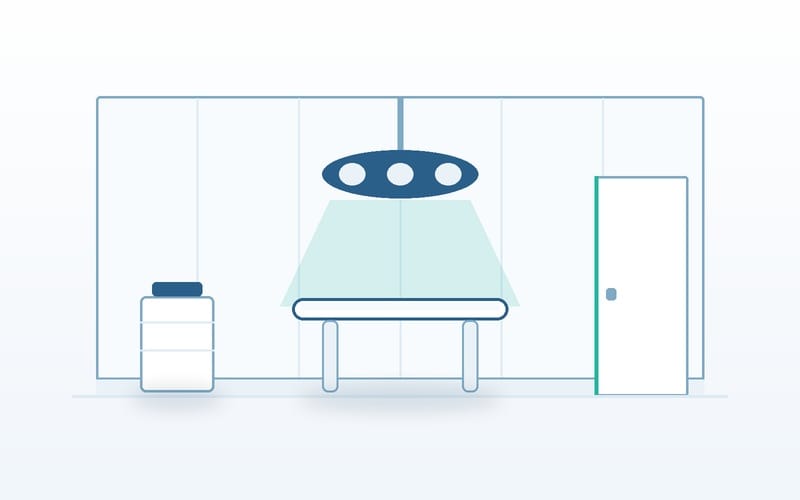
A cath lab is more than one room. The procedure room holds the imaging system and the table. Next to it sits a control room behind leaded glass, where the team drives the imaging and records the case. Behind that, an equipment room holds the generator, the computing and the cooling. Larger programmes run several labs off a shared control corridor.
What Does a Cath Lab Do?
In short, a cath lab does two jobs. It diagnoses, and it treats. Often it does both in the same visit, which is the reason the room exists at all.
On the diagnostic side, the most common study is the coronary angiogram. Contrast is injected through the catheter and the X-ray system films it moving through the coronary arteries, so a narrowing shows as a gap in the flow. Cleveland Clinic describes these as X-ray movies of the contrast moving through the heart. The same catheter also measures pressures inside the chambers, which is where the hemodynamic system earns its place.
Treatment in the same visit
On the treatment side, however, the list is longer:
- Angioplasty and stenting. A balloon opens the narrowed artery and a stent holds it open.
- Structural heart procedures. Valve repair and replacement delivered by catheter rather than by open surgery.
- Device implants. Pacemakers and defibrillators, placed under live imaging.
- Peripheral vascular work. The same technique applied to arteries in the legs, kidneys and elsewhere.
- Emergency treatment. Opening the blocked artery during a heart attack, which is the most time critical thing the room does.
Naturally, each of those needs a different mix of imaging, so the equipment list below is not optional extras. It is what makes the room usable across the whole range.
Cath Lab Equipment List: What Is Actually in the Room
Buyers usually arrive asking about the cath lab machine, meaning the imaging system. That system is the largest line on the quote, but it is roughly half of what the room needs. Here is the full cath lab equipment list, grouped the way a project actually gets costed.
The imaging system
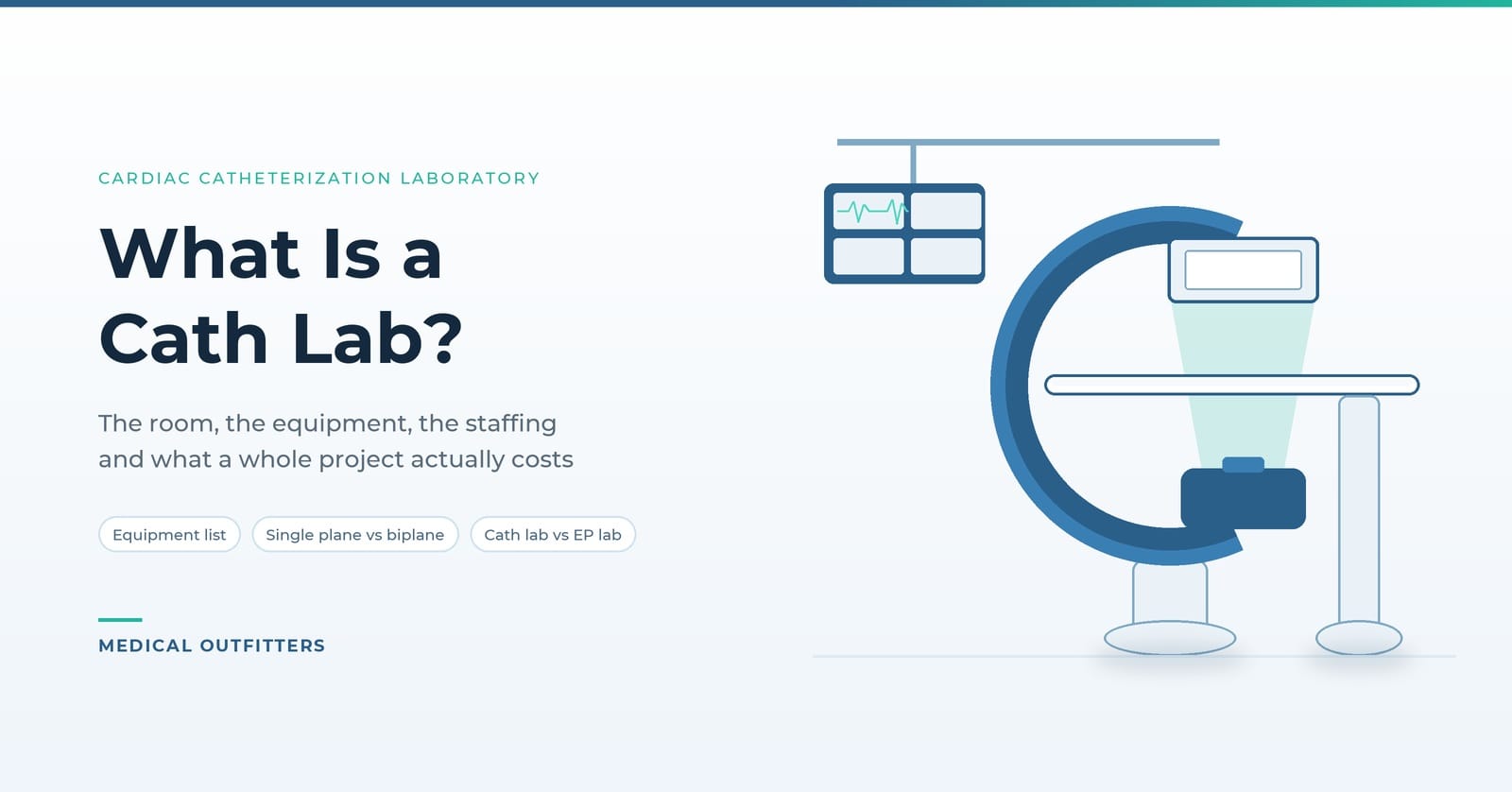
The imaging system is a fixed C-arm carrying an X-ray tube on one end and a flat panel detector on the other. It is mounted to the floor or the ceiling, and it rotates around the patient so the team can see the heart from any angle without moving the patient. That is the part that separates a cath lab from a mobile C-arm, which we cover further down.
Measurement and monitoring
Meanwhile, the hemodynamic monitoring system is the second pillar. Cath lab hemodynamic monitoring systems record pressures, ECG and oxygen saturation through the case, and they produce the record that goes into the patient file. You meet this split by product name: GE HealthCare sells Mac-Lab for hemodynamic recording and CardioLab for electrophysiology, with ComboLab merging the two, while Siemens sells Sensis with a HemoBox or a combined ComboBox. Intravascular imaging such as IVUS in the cath lab, along with OCT and pressure wire measurements, adds a view from inside the artery itself.
Safety and reporting
Then there is everything that makes the room safe and usable. Radiation shielding, because the team stands next to the beam for hours. Boom mounted displays, so the physician reads the images without turning away from the patient. A crash cart and a defibrillator, because the room treats unstable patients. Finally, reporting, which is where a cardiovascular information system such as Fujifilm Synapse CV collects the images and the measurements into one record.
Single Plane or Biplane?
First, the basics. A single plane cath lab has one C-arm. A biplane cath lab has two, one working from the side and one from overhead, firing together so the team sees two angles from a single contrast injection.
That matters for three reasons. First, contrast dose. Two views from one injection means less contrast, which protects the kidneys on long cases. Second, time. Complex anatomy is understood faster when you are not repositioning for every view. Third, certain work is genuinely hard without it.
So who actually needs biplane? In practice it is the programmes where contrast and time are tightest:
- Paediatric cardiology. A biplane pediatric cath lab is close to standard, because small patients tolerate the least contrast.
- Neurointerventional work. Cerebral vessels are fine and tortuous, and two planes reduce the guesswork.
- Complex structural and electrophysiology cases, where the catheter path is not a simple one.
Biplane costs more to buy, needs a bigger room and a stronger ceiling, and adds a second detector to service. Plan for roughly 200 square feet of extra floor area, and for a heavier electrical supply. Under the National Electrical Code, a feeder serving simultaneous biplane work has to be sized at 100 per cent of the momentary demand of each unit, rather than the diversity the code allows elsewhere. A general adult coronary programme usually does not need it. Philips positions its biplane configuration specifically at neuro interventions, which is a fair summary of where the demand sits.
Cath Lab vs EP Lab: What Actually Differs
To begin with, an EP lab is an electrophysiology lab. Both rooms look similar from the door, and plenty of hospitals run EP cases in a cath lab. However, the work is different, and so is the kit.
In practice, a cath lab is built around blood flow. It asks whether an artery is open, and it opens it. An EP lab is built around electrical signals. It asks where an abnormal rhythm starts, and it destroys that spot with heat or cold.
What each room adds
The practical consequences are these. An EP lab needs a three dimensional mapping system, an ablation generator and a recording system that a pure cath lab does not have. It also needs more room. The Heart Rhythm Society recommends 500 square feet of clear floor area for a complete EP laboratory, with 350 square feet as the absolute minimum, and says outright that an EP lab needs more space than an angiographic laboratory. Staff have to work from both sides of the table and reach the patient’s upper chest for device implants.
One thing that is often claimed as a difference is not one. A radiolucent tabletop is a property of the imaging system, so both rooms have it. What genuinely differs is fluoroscopy reliance. Three dimensional mapping lets an EP team locate catheters without X-ray, so a modern EP lab often leans on fluoroscopy less than a complex structural cath lab does.
For a buyer, the question is usually whether one room can do both. The answer is often yes, provided the imaging system and the table are specified for the longer, lower dose fluoroscopy that EP work involves.
Who Makes the Fixed Imaging Systems
In fact, four manufacturers build most of the fixed angiography systems you will be quoted. Their current families are worth knowing by name, because the used market is described in the same terms.
| Manufacturer | Current family | Notes |
|---|---|---|
| Philips | Azurion | A Philips cath lab is the most common thing buyers ask us to compare against. Biplane configuration aimed at neuro. |
| Siemens Healthineers | ARTIS icono | Sold as icono.vision and icono.explore, with ARTIS pheno.vision as the robotic option. |
| GE HealthCare | Allia IGS | Allia IGS Pulse is the current image chain for invasive cardiology. |
| Canon Medical | Alphenix | Includes the Alphenix 4D CT configuration that pairs angiography with CT in one room. |
Medical Outfitters does not sell fixed angiography systems from these four. What we do is the room around them, plus the mobile fluoroscopy that many programmes run alongside. That distinction is worth being clear about before you ask us for a quote.
What the Room Itself Needs
Above all, a cath lab is a construction project as much as an equipment purchase. Four things drive the build.
Space
Space. The procedure room has to take the imaging system, the table at full travel, an anaesthesia position, and a team of five or six working around the patient. Code sets the floor in some states. The California Building Code requires a cardiac catheterization procedure room of at least 400 square feet, excluding the control room. The Facility Guidelines Institute, which most states follow, sets no square footage for a cath lab at all, so do not assume a national minimum exists. Manufacturers publish their own numbers, and they run higher in practice. GE gives 369 square feet as a minimum for the Allia IGS 7 and about 640 square feet as typical. Add the control room and the equipment room on top of that.
Structure and shielding
Structure. Ceiling mounted systems hang from steel, not from a suspended ceiling. The manufacturer publishes a site planning drawing, and the building either meets it or gets reinforced.
Shielding. The room is designed by a medical physicist, who specifies the lead in the walls, the leaded glass in the control window, and the ceiling suspended shield over the table. Lead glasses for cath lab staff, table skirts and thyroid shields cover the rest, because the team stands beside the beam all day rather than stepping behind a wall.
Power and services
Services. Three phase power, dedicated cooling, medical gases and network capacity. The electrical numbers surprise people. A fixed system draws only about 14 to 18 kVA continuously, but its momentary demand during a digital subtraction run is 100 to 162 kVA, which is why the supply is sized on the pulse rather than the average. Cooling is the other one. Around 85 per cent of the heat a cath lab rejects lands in the equipment room rather than the procedure room, roughly 28,000 BTU per hour at typical clinical use, so that room needs its own unit and its own thermostat.
This is the part we are actually hired for. We build and equip complete cath labs through the Integromed IntSy modular room system, which delivers the room as prefabricated wall, ceiling and utility panels rather than as traditional construction. Our installation and rigging crews handle the equipment side.
What Is Actually Required, and What Is Not
A surprising amount of what people believe is mandatory is not, and one thing that genuinely is gets forgotten.
Not required. The American College of Radiology runs no accreditation programme for cardiac catheterization, angiography or interventional work, so a cath lab cannot be ACR accredited. The federal imaging accreditation rule does not reach it either. That rule covers advanced diagnostic imaging, which the Centers for Medicare and Medicaid Services defines as MRI, CT and nuclear medicine, and it expressly excludes fluoroscopy. It also does not apply to hospitals at all.
Required. The machine is registered with the state radiation control programme, the facility meets the Medicare Conditions of Participation, and the equipment meets the FDA performance standard. There is one more that lands on whoever installs the system rather than on the hospital. Under 21 CFR 1020.30(d), the assembler has to complete Form FDA 2579 and get it to the purchaser, and to the state where applicable, within 15 days of finishing the assembly. That applies to a single certified component as much as to a whole system, so it is worth asking any installer whether they file it.
Hybrid Operating Room or Interventional Room?
Similarly, a hybrid operating room is a full operating theatre with a fixed imaging system in it. A cath lab is an imaging room that happens to be sterile. The difference sounds academic until you price them.
A hybrid OR has to meet operating room standards for air changes, layout and sterile workflow, so it is larger and more expensive than a cath lab with the same imaging system. The Facility Guidelines Institute sets 600 square feet as the minimum for a hybrid operating room, against 400 square feet for a standard operating room, and hospitals that have built them commonly report 900 square feet or more in practice. In return, a surgical team can convert to an open procedure in the same room rather than moving the patient.
Hospitals build them when cases genuinely cross the line, such as valve work and complex aortic repair. If your caseload is coronary, a cath lab is the right room. We supply both configurations through the same modular system, along with the large format surgical displays these rooms run on.
What Does a Cath Lab Cost?
Here, two numbers matter, and people usually conflate them. There is the cost of the imaging system, and there is the cost of the finished room. The second is the one that decides a budget.
The imaging system is the headline. A new fixed angiography system from one of the four manufacturers above is a seven figure purchase, and a refurbished one is a fraction of that. Because a used cath lab for sale is priced on its detector, its tube history and its software support status, two systems of the same model can sit far apart on price.
Meanwhile, the room is the other half. Construction, shielding, structural work and the services above frequently match or exceed the equipment line, which is why we quote the two together rather than separately.
What whole projects have actually cost
You do not have to guess at this, because some states publish it. Virginia reviews every new cath lab and its staff reports break out construction, equipment and design fees line by line, with the hospital named. Four recent projects:
| Project | Construction | Equipment | Total capital cost |
|---|---|---|---|
| Inova Fairfax, add one lab to an existing suite | $3,616,215 | $1,956,715 | $6,254,596 |
| VCU Medical Center, add one paediatric lab | $2,539,491 | $3,283,721 | $6,205,961 |
| Sentara Woodbridge, new freestanding outpatient facility | $2,650,531 | $2,104,976 | $7,106,389 |
| Mary Washington, retrofit of an existing EP lab | $1,049,400 | $2,328,700 | $3,521,088 |
Two things fall out of that table. The equipment is only about a third to a half of the total, so a quote for the imaging system alone tells you less than half the story. And the retrofit came in 44 per cent below the new build-outs, because it reused a room that was already shelled and shielded. If you have a suitable room, that gap is the single largest saving available to you.
Mobile cath lab rental and modular cath lab rental exist as bridges while a room is built, though they are a different commercial conversation from owning.
For equipment we do publish ranges on, our C-arm cost guide covers mobile fluoroscopy, and the used C-arm buying guide covers what to check before buying one. For a cath lab specifically, ask us and we will quote the room and the equipment as one project.
Where a Mobile C-Arm Fits Alongside a Fixed Room
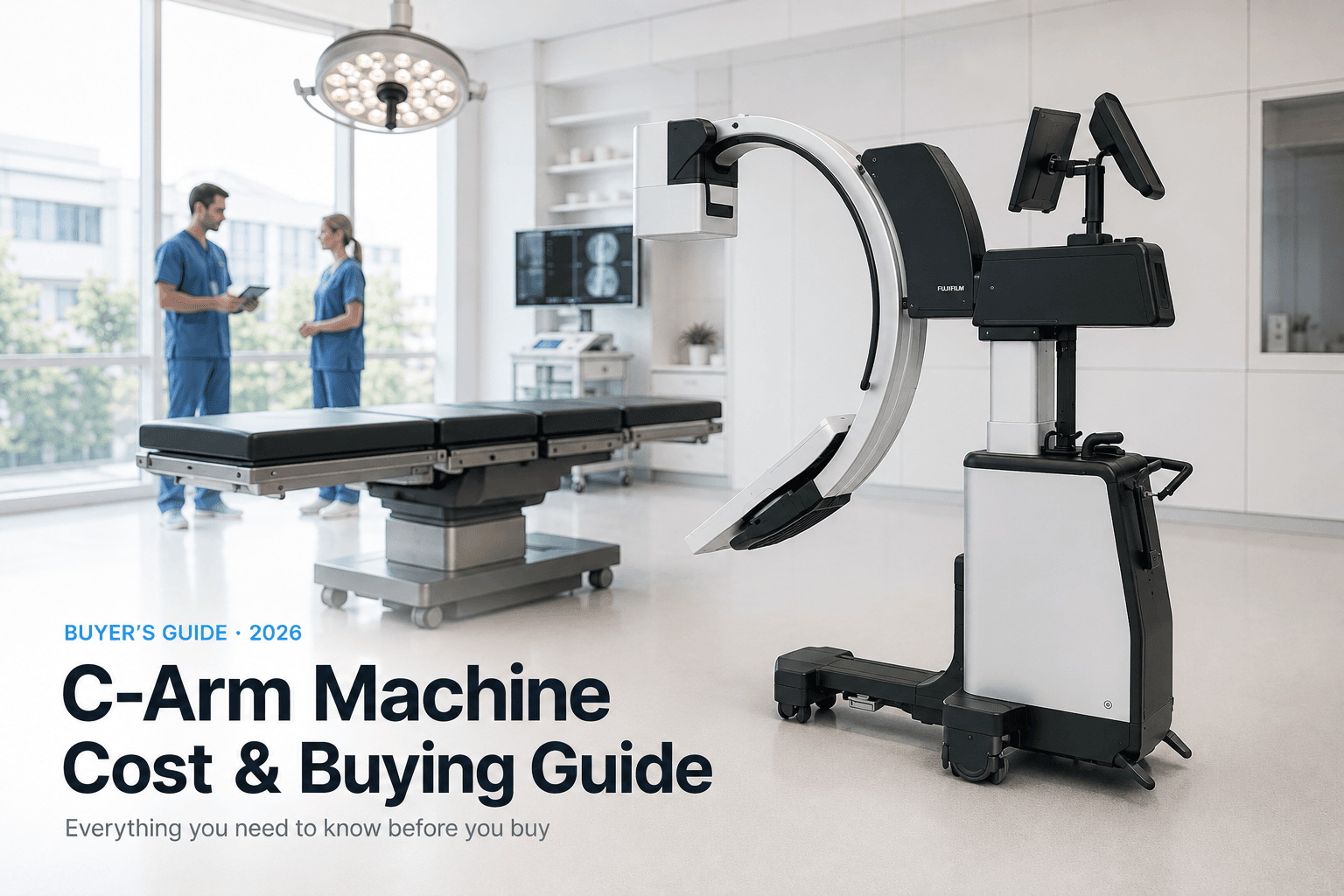
Finally, a mobile C-arm is not a cath lab, and it should not be sold as one. The tube output, the detector size and the table are all built for a different job. Nevertheless, mobile fluoroscopy sits alongside interventional programmes constantly.
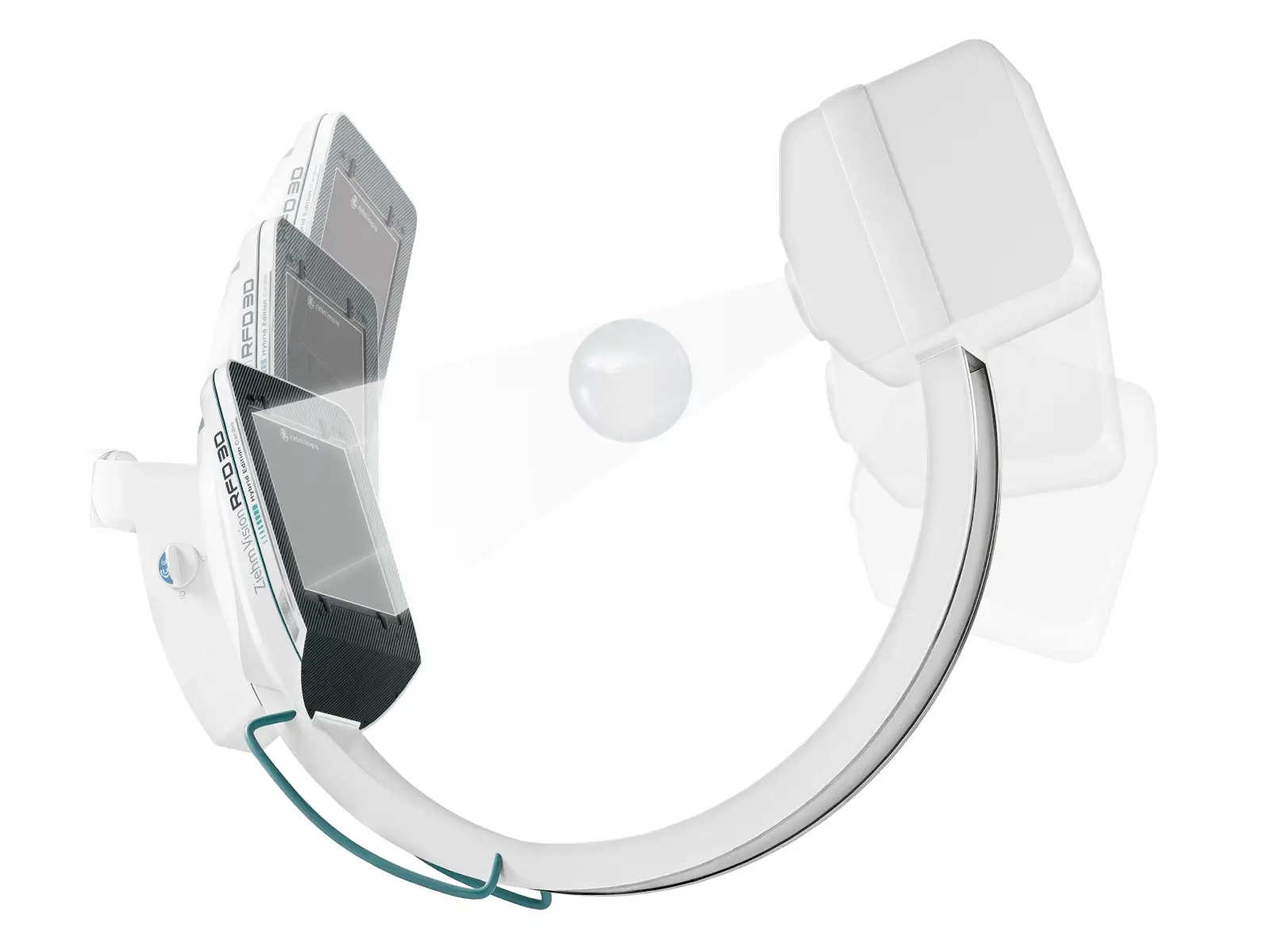
Vascular access, pacemaker work in a smaller centre, theatre cases that need imaging occasionally, and cover while a fixed room is down. Those are the jobs a mobile system does well. From our range that means the Ziehm Vision RFD 3D where intraoperative 3D is needed, the Ziehm Vision FD for general vascular work, and the Fujifilm Persona C. Ziehm systems are available for sale in the Caribbean.
You can browse the full range on our fluoroscopy machines page.
Where to go next
- Modular cath labs, hybrid ORs and turnkey rooms
- Fluoroscopy machines for sale
- Ziehm Vision RFD 3D mobile C-arm with intraoperative 3D
- Ziehm Vision FD mobile C-arm
- Fujifilm Persona C mobile fluoroscopy system
- Fujifilm Synapse CV cardiology PACS
- LG 4K surgical displays for interventional rooms
- C-arm machine cost and buying guide
- Used C-arm buying guide
- Installation, rigging and de-installation
- Our turnkey project record
- Scope a cath lab with our team
Philips, Siemens Healthineers, GE HealthCare and Canon Medical are trademarks of their respective owners. Medical Outfitters builds and equips interventional rooms and supplies mobile fluoroscopy.
Planning a cath lab, a hybrid OR or an interventional suite? Contact Medical Outfitters and we will scope the room and the equipment together.
Questions We Get Asked
What is a cath lab?
A cath lab is a cardiac catheterization laboratory. It is a sterile procedure room built around a fixed X-ray angiography system, a floating table and a hemodynamic monitoring system. In it, a physician puts a catheter into a blood vessel and steers it to the heart under live imaging.
What does cath lab stand for?
Cath lab stands for cardiac catheterization laboratory. You will also see catheterization lab, cardiac cath lab, or just the cath lab. The name comes from the catheter, which is the thin flexible tube the whole room is designed around.
What does a cath lab do?
A cath lab both diagnoses and treats. Diagnostically it produces coronary angiograms and measures pressures inside the heart. Therapeutically it delivers angioplasty and stenting, structural heart procedures, pacemaker and defibrillator implants, peripheral vascular work, and emergency treatment during a heart attack.
What is the difference between a cath lab and an EP lab?
A cath lab is built around blood flow and asks whether an artery is open. An EP lab is built around electrical signals and asks where an abnormal rhythm starts. An EP lab therefore adds a three dimensional mapping system, an ablation generator and a recording system. The Heart Rhythm Society also advises 500 square feet of clear floor area for a complete EP laboratory, more than a typical cath lab.
What is a biplane cath lab?
A biplane cath lab has two C-arms rather than one, working from the side and from overhead, so the team sees two angles from a single contrast injection. That reduces contrast dose and saves time. A biplane pediatric cath lab is close to standard, and neurointerventional programmes specify it, but a general adult coronary programme usually does not need it.
What equipment is in a cath lab?
The fixed angiography system and flat panel detector, a floating radiolucent table, a hemodynamic monitoring and recording system, a contrast injector, boom mounted displays, intravascular imaging such as IVUS and OCT, ultrasound for access, a crash cart and defibrillator, radiation shielding, and a cardiovascular information system for reporting.
Who makes the fixed imaging systems?
Four manufacturers build most fixed angiography systems. Philips makes the Azurion family, Siemens Healthineers makes ARTIS icono, GE HealthCare makes Allia IGS, and Canon Medical makes Alphenix. Medical Outfitters does not sell these fixed systems. We build and equip the room around them, and we supply mobile fluoroscopy alongside.
How much does a cath lab cost?
Two numbers matter. A new fixed angiography system is a seven figure purchase, and a refurbished one is a fraction of that, priced on its detector, tube history and software support status. The room itself, meaning construction, shielding, structural work and services, frequently matches or exceeds the equipment line, so we quote the room and the equipment together.
Related Articles