What is a CT scan machine, and what does a facility actually buy when it buys one? From the waiting room a CT scan machine looks like a large white ring with a table sliding through it. Inside the covers it is an X-ray tube, a high-voltage generator, a detector array and a set of collimators mounted on a frame that turns several times a second, fed by a patient table that moves with millimeter precision and controlled by a console that turns raw measurements into images. Every one of those parts decides what the machine can do, how long it lasts and what it costs. This guide explains the parts, how a CT scanner works from the moment the technologist presses start, what slice counts mean, the types of CT machine on the market (fixed, wide-bore, mobile, portable, cone beam and photon-counting), the room it needs, how long it lasts, and what one costs new and refurbished.
Medical Outfitters sells new Fujifilm CT scanners as an authorized dealer and refurbished GE and Siemens systems through MO Select, our refurbishment program, and installs and services them across the United States, Puerto Rico and the Caribbean. We wrote this for facility owners, administrators, radiology managers and clinicians who want to understand the machine before they price one. When you are ready for numbers, the CT scanner cost and price guide has the full bands.
- What it is: an X-ray tube and detector array rotating inside a gantry, a moving table, and a computer that reconstructs cross-sectional slices.
- How it works: a fan-shaped beam passes through the patient, detectors measure what is left, and hundreds of angles per rotation become an image.
- Slice count: the number of detector rows read in one rotation; 16, 64 and 128 slices are three different classes of machine and price.
- Types: fixed diagnostic scanners, wide-bore systems, CT in a mobile trailer, portable point-of-care units, cone beam CT and photon-counting CT.
- Cost: $85,000 to $185,000 for a refurbished 16-slice and $175,000 to $375,000 for a refurbished 64-slice, delivered and installed, per the Medical Outfitters CT cost guide.
What Is a CT Scan Machine?
CT stands for computed tomography: imaging in slices, computed rather than captured directly. A plain X-ray sends one beam through the body onto one detector and produces a flat shadow in which every structure sits on top of every other. A CT scan machine takes the same kind of X-ray measurement from hundreds of angles around the body and lets a computer work out what lies at each point inside it, so the result is a stack of thin cross-sections that can be scrolled through, reformatted in any plane or rendered in three dimensions.
The older name, CAT scan, means computed axial tomography, from the early machines that scanned one axial slice at a time. A CAT scan machine, a CT machine, a CT scanner machine and a computed tomography scanner are the same equipment, and the exam is the same exam. The first clinical CT scan was performed on 1 October 1971 at Atkinson Morley’s Hospital in London on a prototype built by Godfrey Hounsfield’s team at EMI, according to the IEEE milestone record, and Hounsfield shared the 1979 Nobel Prize in Physiology or Medicine with Allan Cormack, whose mathematics underpinned the reconstruction. Today, the FDA notes, a scanner completes a full rotation in a second or less.
CT is now one of the most used imaging tests in medicine. A study by Rebecca Smith-Bindman and colleagues in JAMA Internal Medicine (April 2025) counted about 93 million CT examinations in the United States in 2023, performed on about 61.5 million patients. That volume is why CT is a core purchase for hospitals, imaging centers, emergency departments and, increasingly, outpatient and specialty practices, and why CT and MRI are often bought for the same building; the clinical difference between the two is laid out in our MRI vs CT scan comparison.
The Parts of a CT Machine
Every diagnostic CT scanner, whichever manufacturer built it, is assembled from the same seven parts. Knowing them is the fastest way to read a quote, because the price of a used or new machine follows the condition and capability of the first three.
| Part | What it does | What it means for a buyer |
|---|---|---|
| Gantry | The ring-shaped housing that holds the rotating frame, with the bore the patient passes through | Bore size (70 cm standard, 80 cm and up wide-bore) and rotation speed set which patients and exams the machine handles |
| X-ray tube and generator | The tube makes the beam; the generator supplies the high voltage and current | The tube is the largest consumable; generator power (kW) matters most for cardiac, trauma and large patients |
| Detector array | Curved rows of detector elements opposite the tube that measure the X-rays leaving the body | Number of rows and total width decide the slice count and how much anatomy each rotation covers |
| Collimators and filters | Shape the beam to the slice width and the body, and reject scattered radiation | Part of how a scanner manages dose; newer designs scatter less |
| Slip ring | Carries power and data across the rotating joint so the frame can spin continuously | What makes helical (spiral) scanning possible; a wear item on older systems |
| Patient table | Moves the patient through the bore at a set speed during the scan | Weight limit and scan range decide who can be scanned and how far |
| Console and reconstruction computer | Where the technologist sets the protocol; the computer turns raw data into images | Software level (dose reduction, cardiac, dual energy) is licensed and does not always transfer with a used system |
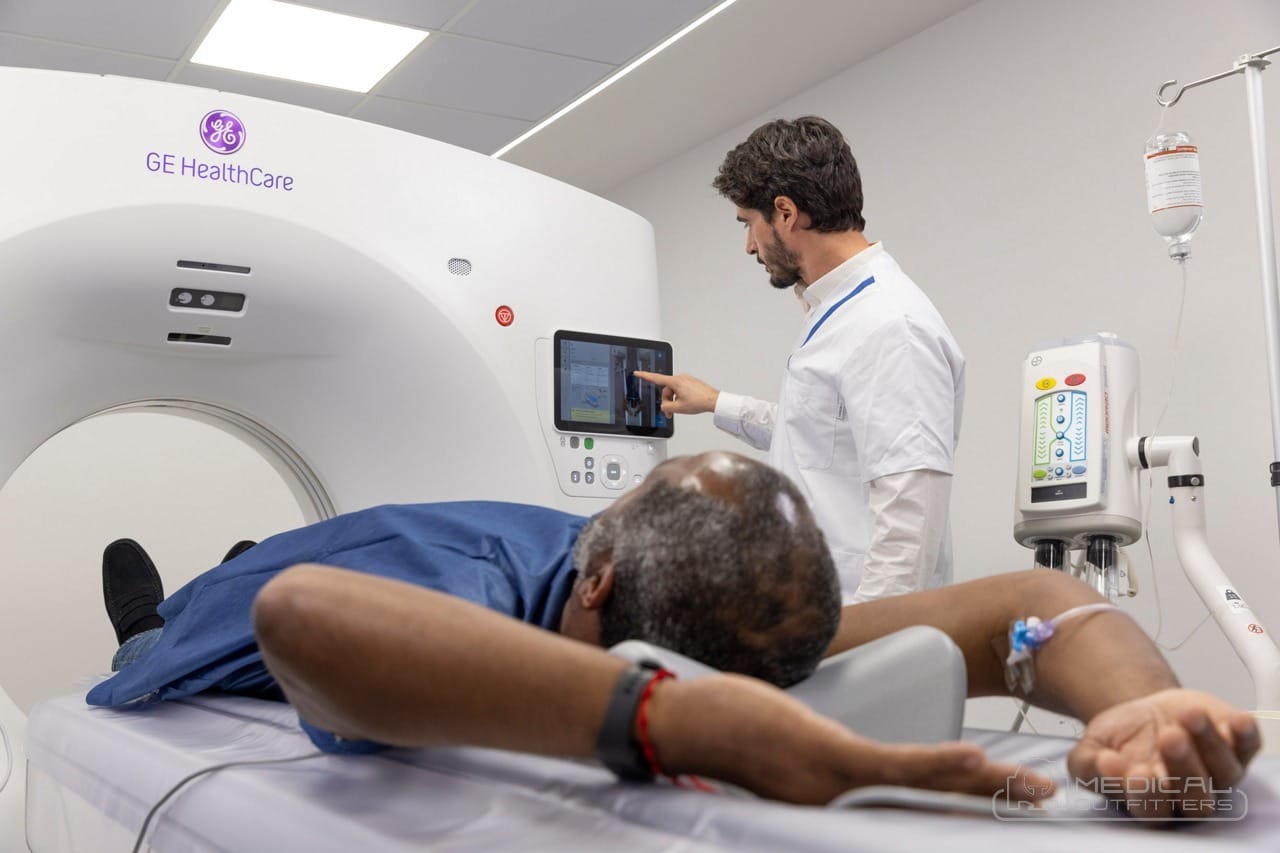
Around the scanner sit the accessories that make it a working CT suite: a contrast injector, an advanced visualization workstation, the connection to PACS and the radiology information system, and the room itself. The Medical Outfitters CT cost guide separates the items quoted with the system (gantry, table, console, workstation, software and tube) from the items quoted per project (injector, shielding, electrical work, cooling, rigging, training and the first service contract), and that split is the first thing to check on any CT quote.
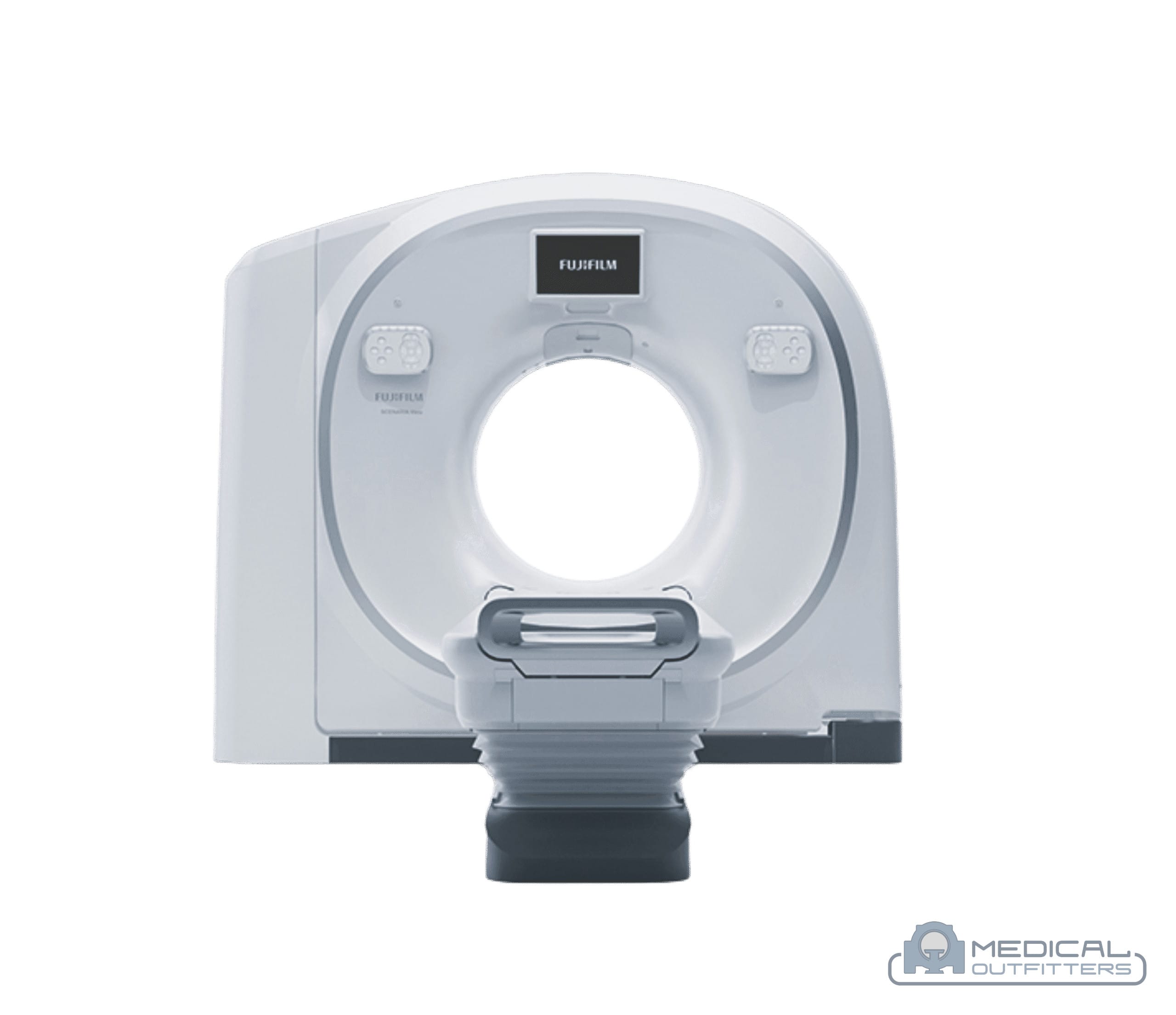
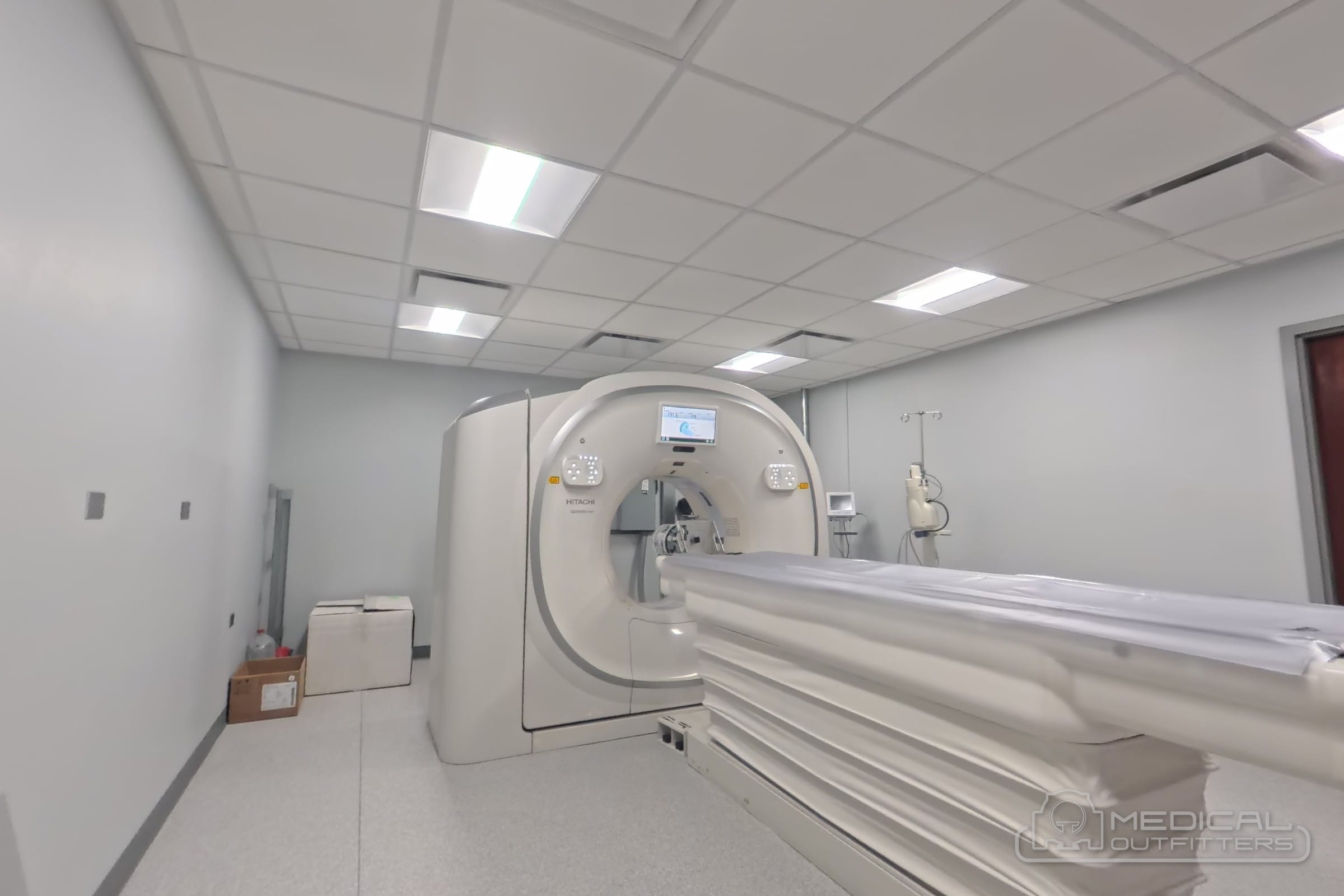
A current example shows how the numbers fit together. Fujifilm’s US product page for the SCENARIA View, which we sell new, lists an 80 cm gantry aperture, a fastest rotation of 0.35 seconds, 64 detector rows covering 40 mm and reconstructing up to 128 slices per rotation, and an 84 kW generator. At the top of the market, the FDA 510(k) summary for the GE Revolution CT describes 256 detector rows with 160 mm of coverage and an 80 cm bore, enough to image the whole heart in one rotation.
How Does a CT Scanner Work?
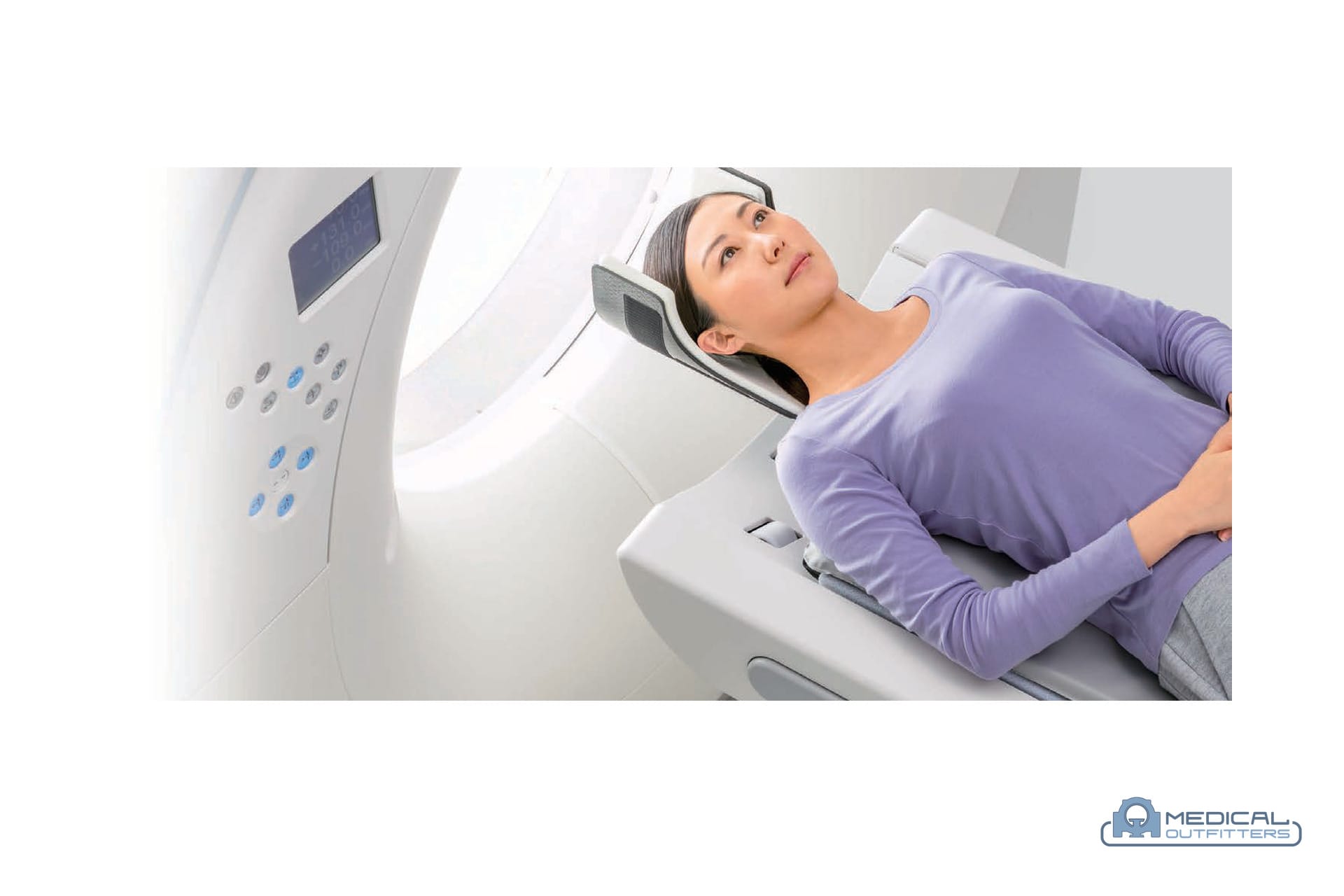
The FDA’s description of CT is the simplest place to start: a motorized table moves the patient through a circular opening; inside it an X-ray source produces a narrow, fan-shaped beam while it rotates around the patient; detectors in rows opposite the source record the X-rays that pass through the body; and a computer combines the many snapshots taken at different angles into cross-sectional images. The steps below follow one exam through the machine.
Positioning and the scout. The technologist positions the patient on the table and runs a quick, low-dose scout image with the tube parked, a flat X-ray that looks like a radiograph. The scan range for the exam is drawn on the scout, and modern scanners use it to set the tube current automatically for the patient’s size.
The rotation. The gantry spins the tube and the detector array together at a constant speed. On a helical scan the table moves through the bore at the same time, so the beam traces a spiral through the body and covers the scan range in a few seconds. Each detector element measures how much of the beam survived its path; dense bone absorbs a lot, air almost none, and soft tissues sit in between.
Reconstruction. The computer takes the hundreds of projections from each rotation and calculates the attenuation at every point in the slice, expressed on the Hounsfield scale named for the inventor, which by definition sets water at zero and air at minus one thousand. Older scanners used filtered back projection; current ones use iterative or deep-learning reconstruction, which is how the same image quality is reached at a lower dose. This is also why software level matters so much when comparing a used scanner with a new one.
Review and delivery. The slices appear on the console within seconds, the technologist checks them, and the study is sent to PACS, where the radiologist reads it and can reformat it in other planes or as 3D views. The scanner also records the dose for the exam as CTDIvol and DLP, the two dose indices the FDA lists for CT, and sends a dose report to the facility’s tracking system.
Contrast changes the timing but not the machine: an injector delivers iodinated contrast through an IV, and the scan is timed to catch the arteries, the organs or a delayed phase. That is why a contrast injector appears on nearly every CT quote.
Slice Count: 16, 64, 128 and 256-Slice CT Machines
Slice count is the number of image slices a scanner reads in one rotation, set by the number of detector rows and how they are read out. It is the single biggest driver of what a CT scan machine can do and what it costs. More rows cover more anatomy per rotation, which shortens breath-holds, freezes cardiac motion and makes CT angiography practical. On some systems, including the Fujifilm SCENARIA View, a 64-row detector reconstructs 128 slices, so the detector channels and coverage are worth comparing as well as the headline number.
| Slice class | What it is bought for | Refurbished, delivered and installed | New |
|---|---|---|---|
| 16-slice | Routine head, chest, abdomen, spine and extremity CT for clinics, urgent care and lower-volume sites | $85,000 to $185,000 | $350,000 to $525,000 |
| 64-slice | General hospital and imaging center work, coronary CT angiography and calcium scoring | $175,000 to $375,000 | $625,000 to $975,000 |
| 128-slice | High throughput, advanced cardiac and low-dose protocols | $350,000 to $625,000 | $1,050,000 to $1,650,000 |
| 256-slice and higher | Whole-organ coverage in one rotation, stroke perfusion, dual-source cardiac | $625,000 and up | $1,750,000 to $2,900,000 and up |
The bands are the Medical Outfitters ranges from our CT scanner cost and price guide, for a working system delivered, installed and warrantied. In the refurbished column, the models that anchor each class are the GE BrightSpeed, GE LightSpeed 16 and Siemens SOMATOM Scope at 16 slices, and the GE Optima CT660 and GE LightSpeed VCT 64 at 64 slices, all rebuilt through MO Select. New, the Fujifilm Supria 128, SCENARIA View and iStream 128 cover the 64 and 128-slice classes. Each class, with the exams and coverage that go with it, is explained in our guide to CT scanner types by slice count, and every manufacturer’s lineup is in CT scanner manufacturers compared.
A practical reading of the table: most outpatient sites and community hospitals do not need the top class. The 256-slice and dual-source machines earn their price in emergency departments and cardiac programs with the volume to fill them; for routine work, a well-configured 64-slice delivers the exams that a facility bills for every day.
Types of CT Scan Machine
“CT scanner” covers more than one kind of machine. They share the principle, X-rays from many angles and a reconstruction, but differ in how they are built, where they go and who buys them.
Fixed multislice CT. The standard diagnostic scanner installed in a shielded room, from 16 to 320 detector rows (the Canon Aquilion ONE, per our cost guide), with the standard 70 cm bore the guide describes. This is the machine in nearly every hospital and imaging center, and the one the price bands above describe.
Wide-bore CT. The same design with a bore of 80 cm or more, for bariatric patients and for radiation-therapy planning, where the patient lies in the treatment position with immobilization devices. The cost guide notes that wide-bore systems cost more than a standard 70 cm bore of the same class; the Fujifilm SCENARIA View, with its 80 cm aperture, and the compact Supria line are the new options we sell.
Mobile CT. A full diagnostic scanner installed in a trailer, used to add capacity, cover a room rebuild or serve a second site. The scanner inside prices like any other in its slice class; the trailer, its shielding, power and transport are quoted per project. Medical Outfitters supplies mobile imaging through MO Mobility.
Portable or point-of-care CT. Small-bore head or extremity units that roll to the patient, mainly in intensive care and neurosurgery. They are a separate price class, quoted individually.
Cone beam CT. Instead of a thin fan beam and rows of detectors, a cone-shaped beam and a flat panel capture a whole volume in one rotation. Cone beam systems serve dental, ENT and orthopedic imaging at a lower dose and with lighter shielding; the Planmed Verity extremity CT is the one we carry. How cone beam differs from medical CT is covered in cone beam CT vs medical CT.
Photon-counting CT. The newest detector design converts each X-ray photon directly into an electrical signal and counts it by energy. Siemens Healthineers announced FDA clearance of the NAEOTOM Alpha, which it described as the world’s first photon-counting CT, on 30 September 2021. It is a premium new-system purchase today, not part of the refurbished market.
PET/CT. A CT scanner combined with a PET detector ring, used mainly in oncology, and a different purchase again; see the PET/CT scanner cost guide.
What a CT Machine Needs: Room, Power and Compliance
A CT scan machine is not a piece of furniture; it is a room project. The scanner needs a lead-shielded exam room sized for the gantry, table travel and service access, a separate control room with a leaded viewing window, and a shielding design from a qualified physicist that the state accepts. Existing X-ray rooms often convert; a room that has never held imaging equipment needs the shielding built.
Power and cooling. A CT draws a large, brief electrical load on every exam and needs dedicated three-phase power sized for it, plus cooling for the gantry heat load, either a chiller or enough room HVAC. Compact designs such as the Fujifilm Supria were built to fit rooms and electrical services that older scanners cannot.
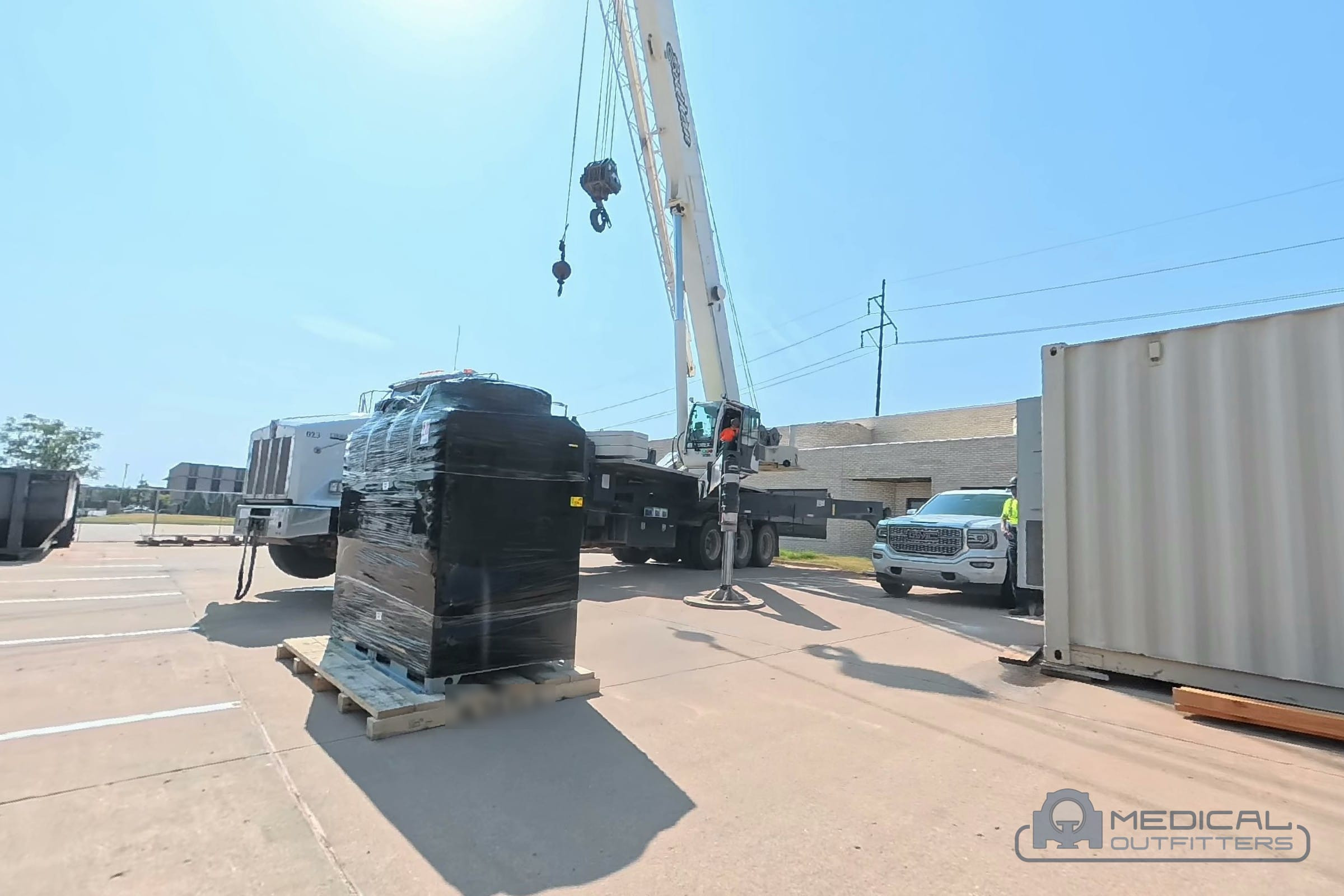
Floor and delivery path. The gantry is heavy and must travel from the truck to the room, so door widths, turns, elevators and floor loading are checked before delivery day. Our guide on how to move an MRI or CT scanner explains the rigging side.
The control room and the network. The console sits in the control room with a view of the patient, and the scanner connects to PACS, the radiology information system and the dose-tracking system before the first patient. That connection is part of the installation, not an afterthought.
Accreditation and dose standards. According to CMS, non-hospital facilities must be accredited by a CMS-designated organization (ACR, IAC, RadSite or The Joint Commission) to bill Medicare for the technical component of CT, a requirement in force since 1 January 2012. CMS Survey and Certification letter 16-19 also sets a Medicare payment reduction for CT scanners that do not meet the NEMA XR-29 dose-optimization standard: 5 percent in 2016 and 15 percent from 2017 onward. An older scanner that fails XR-29 is cheaper to buy and more expensive to bill, so the standard belongs on every used-CT checklist. The FDA regulates the equipment itself under 21 CFR 892.1750 and the radiation performance standard in 21 CFR 1020.33, while states regulate who operates it and how the room is shielded.
How Long Does a CT Machine Last?
A CT scanner does not wear out as one unit. The frame, the table and the room last for many years; the X-ray tube is a consumable rated in scan seconds and replaced during the machine’s life; and the software reaches the end of manufacturer support long before the steel does. In practice a scanner’s useful life is set by three things: whether the manufacturer still supports the platform and supplies parts, whether the scanner meets current dose standards such as XR-29, and whether its slice class still matches the exams the facility needs.
The industry benchmark comes from COCIR, the European medical imaging trade association, whose Golden Rules for a healthy installed base are that at least 60 percent of imaging equipment should be under five years old, no more than 30 percent between six and ten years, and no more than 10 percent older than ten years. Many facilities run scanners well past ten years, especially refurbished systems on well-supported platforms, but the rules explain why manufacturers and buyers treat a decade as the planning horizon.
The running costs are a large share of that decade. The Medical Outfitters CT cost guide notes that the service contract and the tube dominate the lines after the purchase price, and that together they can bring the ten-year running cost close to the purchase price itself. That is why tube condition and service terms belong in the purchase decision; the CT scanner service, repair and maintenance page covers the contract options, and a refurbished machine’s quote should state its tube history.
What a CT Scan Machine Costs
The price of a CT scan machine is set first by slice class and second by condition. Per the Medical Outfitters CT cost guide, a refurbished 16-slice system costs $85,000 to $185,000, a refurbished 64-slice $175,000 to $375,000 and a refurbished 128-slice $350,000 to $625,000, while a new scanner runs from $350,000 for a 16-slice to $2.9 million or more for the top class, all delivered, installed and warrantied. The guide puts certified refurbished systems at 40 to 60 percent below new for the same class.
Inside a class, the tube, the software licenses, the generator and the support horizon move a quote, and the gap between two quotes is usually what is in them rather than the scanner. Our ranges are all-in figures, which is why they sit above equipment-only prices published elsewhere. The three conditions a used machine is sold in also matter: as-is used (tested, sold as it stands), cosmetically refurbished (cleaned and re-covered, nothing replaced) and certified refurbished, which is the MO Select standard of inspection, testing to specification, replacement of worn parts, installation and a written warranty, described on our refurbished medical imaging equipment page.
The exam side of the same question is what the machine earns. If you want the patient price rather than the scanner price, our article on how much a CT scan costs sets out the 2026 prices by setting and payer, and the cost guide’s payback table converts a scanner price into exams per day.
Buying a CT Scan Machine With Medical Outfitters
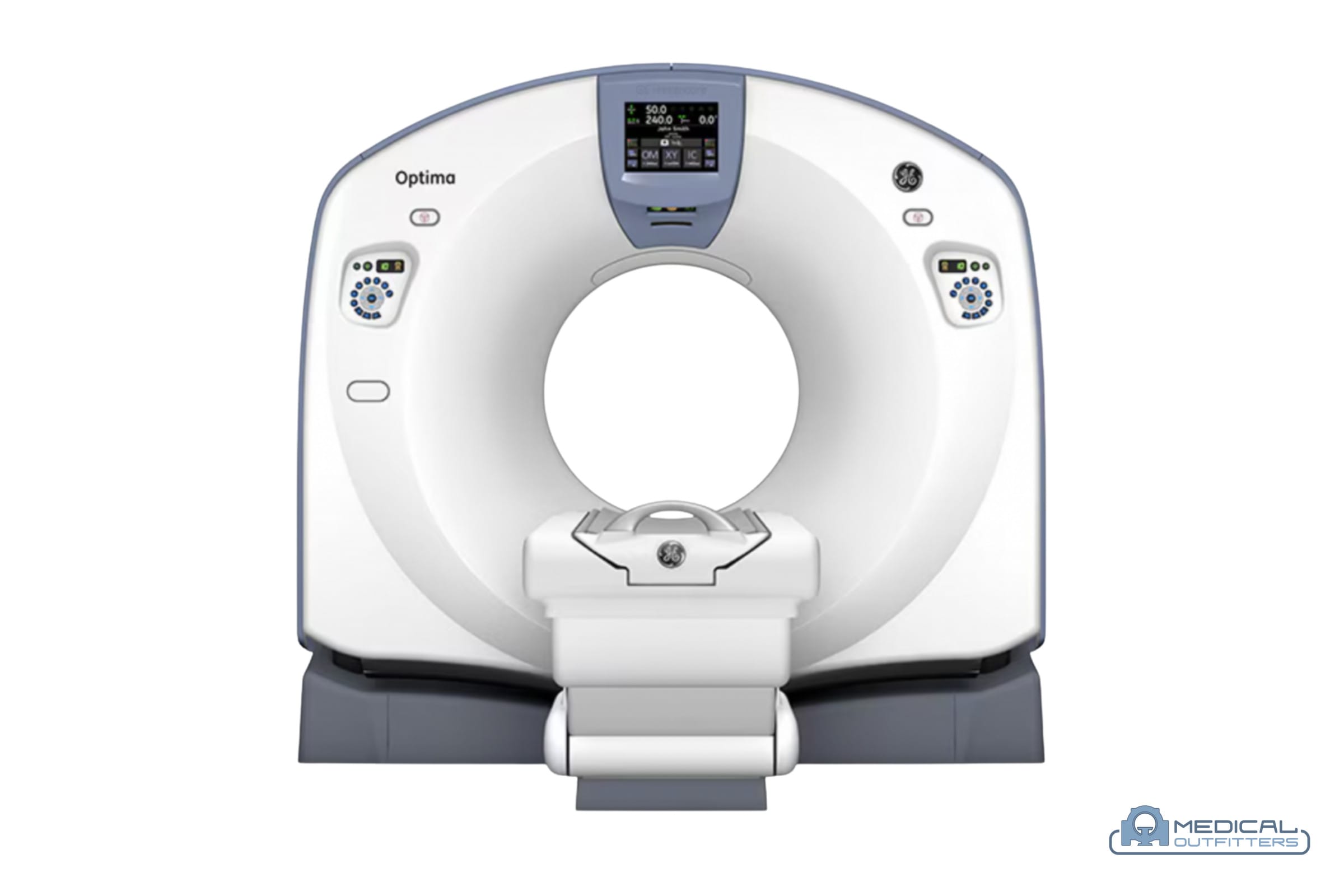
Medical Outfitters sells the Fujifilm SCENARIA View, the Supria 128 and the rest of the Fujifilm CT line new, rebuilds GE and Siemens scanners such as the GE Optima CT660 through MO Select, and delivers, installs and services them with our own crews across the United States, Puerto Rico and the Caribbean. The full inventory is on the CT scanners for sale page, prices by slice class are in the CT scanner cost guide, and Florida buyers can see delivery routes on MRI, CT and X-ray machines for sale in Florida. To match a CT scan machine to your exams, room and budget, contact Medical Outfitters.
- US Food and Drug Administration, Computed Tomography (CT): how a CT scanner works, rotation time, dose indices and the regulations that apply. https://www.fda.gov/radiation-emitting-products/medical-x-ray-imaging/computed-tomography-ct
- Fujifilm Healthcare Americas, SCENARIA View product page: aperture, rotation time, detector rows, coverage and generator. https://healthcaresolutions-us.fujifilm.com/products/diagnostic-imaging/ct/scenaria-view/
- FDA 510(k) summary K133705, GE Revolution CT: 256 detector rows, 160 mm coverage, 80 cm bore. https://www.accessdata.fda.gov/cdrh_docs/pdf13/K133705.pdf
- Smith-Bindman R. et al., Projected Lifetime Cancer Risks From Current Computed Tomography Imaging, JAMA Internal Medicine, April 2025: 93 million US CT examinations in 2023. https://doi.org/10.1001/jamainternmed.2025.0505
- IEEE Milestone, First Computerized Tomography (CT) X-ray Scanner, 1971. https://ethw.org/Milestones:First_Computerized_Tomography_(CT)_X-ray_Scanner,_1971
- Siemens Healthineers, press release on the FDA clearance of NAEOTOM Alpha, 2021. https://www.siemens-healthineers.com/en-us/press-room/press-releases/fdaclearacenaeotomalpa
- COCIR, Medical Imaging Equipment Age Profile and Density: the Golden Rules for the installed base. https://www.cocir.org/wp-content/uploads/23049_COC_Medical-Imaging_Age-Profile-Density-combined.pdf
- Medical Outfitters, CT Scanner Cost and Price Guide (2026): price bands, quote scope, CMS accreditation and XR-29. https://medicaloutfitters.com/ct-scanner-cost-and-price-guide/
- CT scanner cost and price guide (2026)
- CT scanners for sale: new Fujifilm, refurbished GE and Siemens
- CT scanner service, repair and maintenance
- Refurbished medical imaging equipment: the MO Select standard
- CT scanner types by slice count: 16, 32, 64 and 128 explained
- CT scanner manufacturers compared
- Cone beam CT vs medical CT
- How much does a CT scan cost in 2026?
- MRI vs CT scan: how the two exams differ
- Fujifilm SCENARIA View CT, sold new
- GE Optima CT660 64-slice CT price guide
- PET/CT scanner cost and price guide (2026)
- MO Mobility: mobile CT, MRI and PET imaging
- Match a CT scan machine to your room and budget
CT Scan Machines: Common Questions
What is a CT scan machine?
A CT scan machine is an X-ray system that rotates a tube and a curved array of detectors around the patient inside a ring-shaped gantry while a motorized table moves the patient through the bore. A computer reconstructs the measurements from hundreds of angles into cross-sectional slices. The FDA notes a single rotation typically takes a second or less. CT scanner, CT machine and CAT scan machine all name the same equipment.
Is a CAT scan machine the same as a CT scan machine?
Yes. CAT stands for computed axial tomography, the name used for the early scanners that imaged one axial slice at a time; CT, computed tomography, is the current name. The machine and the exam are the same. Buyers also see the terms CT scanner, multislice CT and multidetector CT (MDCT), which describe modern scanners with many detector rows, and all of them are listed by model name on the Medical Outfitters CT scanners page.
How does a CT scanner work?
According to the FDA, a motorized table moves the patient through the gantry while an X-ray source rotating around the body produces a narrow, fan-shaped beam. Detectors opposite the source record the X-rays that pass through, and a computer combines the snapshots from many angles into slices. On a helical scan the table moves during the rotation, so the beam traces a spiral and covers the scan range in a few seconds.
What are the main parts of a CT machine?
The gantry with its rotating frame and bore, the X-ray tube and high-voltage generator, the detector array, the collimators and filters that shape the beam, the slip ring that carries power and data to the rotating frame, the patient table, and the console with the reconstruction computer. A working CT suite adds a contrast injector, a workstation, the PACS connection and a shielded room with a separate control room.
What does slice count mean on a CT scanner?
Slice count is the number of image slices the scanner reads in one rotation, set by its detector rows. More rows cover more anatomy per rotation, which shortens scans and makes cardiac CT practical. In the Medical Outfitters CT cost guide, 16, 64, 128 and 256-slice scanners are four separate price classes, from $85,000 for a refurbished 16-slice to $2.9 million or more for a new top-class system.
How much does a CT scan machine cost?
Per the Medical Outfitters CT scanner cost guide, a refurbished 16-slice costs $85,000 to $185,000, a refurbished 64-slice $175,000 to $375,000 and a refurbished 128-slice $350,000 to $625,000, while a new scanner runs $350,000 to $2.9 million or more by slice class, all delivered, installed and warrantied. The room, shielding, power, injector and first service contract are quoted per project, so compare quote scope as well as price.
How long does a CT machine last?
The frame and table last many years, but the X-ray tube is a consumable rated in scan seconds and the software reaches end of manufacturer support well before the hardware wears out. COCIR's Golden Rules say no more than 10 percent of an imaging fleet should be older than ten years, which is why a decade is the usual planning horizon. Platform support, XR-29 compliance and slice class decide when a scanner should be replaced.
What does a room for a CT scan machine need?
A lead-shielded exam room sized for the gantry and table travel, a separate control room with a leaded window, a physicist's shielding design accepted by the state, dedicated three-phase power, cooling for the gantry heat load, a floor rated for the gantry and a clear delivery path. CMS requires non-hospital sites to be accredited to bill Medicare for the technical component of CT, and scanners that fail NEMA XR-29 take a 15 percent Medicare payment reduction.
Related Articles