
A closed MRI is a cylinder: the patient lies inside a tube about 60 cm across, surrounded by the magnet. An open MRI has no tunnel at all. Two magnet poles sit above and below the patient and the sides are left open. Everything else that separates the two, image quality, scan time, patient comfort, siting and running cost, follows from that one difference.
This guide is written for the person buying the system rather than the patient lying in it. It covers what an open MRI machine is and what a closed MRI machine is. It compares them on what actually decides a purchase. It also shows where wide bore fits, and what each type costs. We sell and install both, so the trade-offs below are the ones we actually talk facilities through.
What Is an Open MRI Machine?
An open MRI is a scanner built without an enclosing tunnel. The magnet is split into two poles, one above the patient and one below, held apart by a supporting column or a pair of pillars. The field runs vertically between them instead of horizontally down a bore. With the sides open, a patient can see out in every direction. A parent or clinician can stand beside the table and keep a hand on them.
Most open MRI machines use a permanent or resistive magnet rather than a superconducting one. That is why field strength is usually lower, and it is also why they need no liquid helium, no cryogen deliveries and no quench pipe. Field strengths on open systems typically run from about 0.2T to 1.2T. The AIRIS, APERTO and OASIS open MRI lines were formerly sold under the Hitachi name. Fujifilm acquired that business, so a search for a Hitachi open MRI now lands on a Fujifilm product.
Open systems we supply include the AIRIS Vento 0.3T, the APERTO Lucent 0.4T and the OASIS Velocity 1.2T, plus the Esaote G-Scan, which tilts so joints can be imaged under load.
What Is a Closed MRI?
A closed MRI machine, sometimes called an enclosed or tunnel MRI, is the familiar cylinder. A superconducting magnet cooled by liquid helium surrounds a horizontal bore, and the patient is moved into it on a table. The standard bore is around 60 cm across; wide bore systems open that to about 70 cm. The MRI bore is the single dimension that decides which patients you can physically scan.
Because superconducting magnets can hold much stronger fields, closed MRI machines are where the high field strengths live. Clinical systems are overwhelmingly 1.5T or 3T. That field strength buys the signal. Signal buys resolution, thin slices, short scan times and the full range of advanced sequences.
The trade-off is infrastructure. A superconducting system needs cryogens and a quench pipe to vent helium safely if the magnet ever loses superconductivity. Both carry siting requirements. Our guide to what an MRI quench is covers what that means in practice. The ACR guidance on MR safety sets out the zoning rules any installation has to satisfy. Closed systems we supply include the Fujifilm Echelon Smart 1.5T and the Echelon Synergy.

What an Open MRI Machine Looks Like
People ask what an open MRI machine looks like far more often than they ask how one works, and the picture explains the category faster than any description. There is no tube. The patient lies on a table between two flat magnet housings. There is clear space on both sides and a direct line of sight out. Set an image of an open MRI machine beside a closed one and the difference needs no caption.
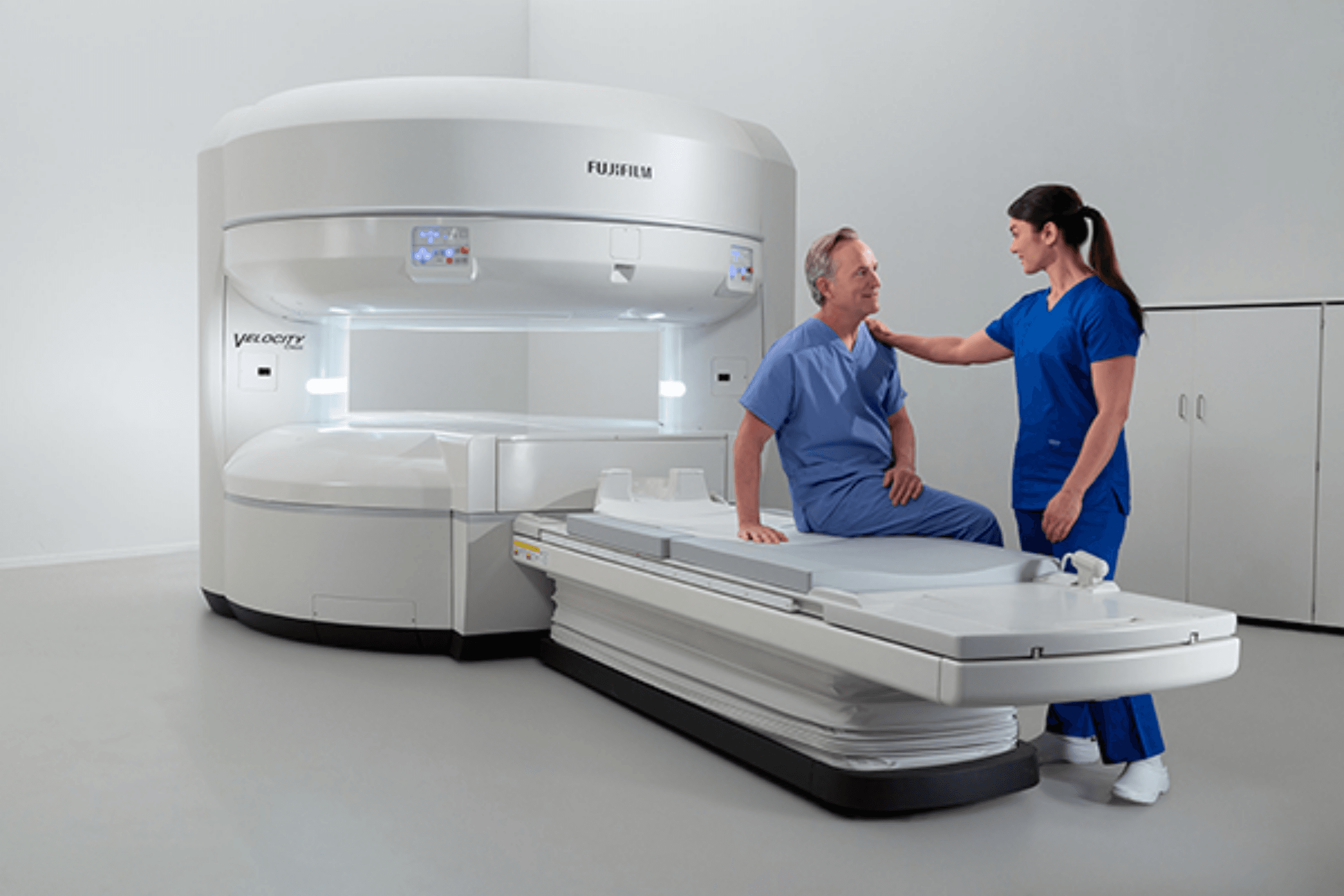
Open designs vary more than closed ones do. Some are supported on a single column at the back, some on pillars at the corners. A few are built for one job rather than general imaging. Extremity scanners take only an arm or a leg. Weight-bearing systems tilt upright, so a knee or a spine can be imaged under load.

Open MRI vs Closed MRI: The Differences That Matter
Search for closed MRI versus open MRI and almost everything written on it is aimed at the patient and stops at comfort. Framed as MRI machine open vs closed, the question changes. It is a trade between the patients you can scan, the studies you can accept, and what the room and the service contract cost.
| Factor | Open MRI | Closed MRI |
|---|---|---|
| Typical field strength | 0.2T to 1.2T | 1.5T or 3T |
| Magnet type | Usually permanent or resistive | Superconducting |
| Liquid helium | Normally none | Required |
| Quench pipe | Not needed | Required |
| Image quality | Adequate for most routine work | Higher resolution, thinner slices |
| Scan time | Longer | Shorter |
| Advanced sequences | Limited | Full range |
| Claustrophobic patients | Best option | Difficult unless wide bore |
| Large or bariatric patients | Best option | Constrained by bore |
| Weight-bearing imaging | Possible on tilting systems | Not possible |
| Patient throughput | Lower | Higher |
| System weight | Very high on permanent magnets | Lower, but needs cryogen access |
Read that table as one sentence: a closed MRI machine buys you image quality and throughput, and an open MRI machine buys you access to patients a closed system cannot scan. Which matters more depends entirely on who walks through your door.
Is an Open MRI as Good as a Closed MRI?
Not in general, no. The closed MRI vs open MRI question is really a question about field strength, and signal scales with field strength. A 0.3T open MRI starts with a small fraction of the signal a 1.5T closed system has. You can recover some of it by scanning for longer, and that is what open systems do. Longer scans carry their own cost though: more motion artefact, and fewer patients per day. The FDA overview of MRI is a good primer on how the imaging works.
The honest answer is that it depends which open MRI. The gap between a 0.3T open system and a 1.5T closed system is large and clinically obvious. The gap between a 1.2T open system and a 1.5T closed system is much narrower. For routine spine, joint and body imaging it stops being the deciding factor. High-field open MRI is a real category, not a marketing term.
Where closed systems remain clearly ahead: fine neurological detail, small musculoskeletal structures, MR angiography, spectroscopy, functional imaging and anything that depends on strong gradients or thin slices. If your referral base sends that work, an open system will not cover it whatever its field strength.
Disadvantages of Open MRI
- Lower signal Longer acquisitions and more sensitivity to patient movement
- Reduced resolution Thin slices and fine structures are harder to resolve
- Narrower coil range Fewer dedicated coils than a mainstream 1.5T platform
- Limited advanced sequences Spectroscopy and functional work are often unavailable
- Lower throughput Fewer patients per session at the same staffing cost
- Weight Permanent magnets are heavy enough to dictate which floor the room can be on
- Resale A smaller second-hand market than 1.5T closed systems
None of these rule an open MRI out. They simply mean the patient-access advantage has to be worth them, which is a question about your case mix rather than about the technology.
Open Bore and Wide Bore MRI: The Option In Between
Open bore MRI is the phrase that causes the most confusion in this whole comparison, because it gets used for two different things. An open bore MRI machine is sometimes a genuinely open system. More often it means a wide bore MRI: still a closed cylinder, but widened from roughly 60 cm to about 70 cm.
A wide bore MRI machine, listed by some manufacturers as a large bore MRI and by others as a wide open MRI, is not an open MRI. It is a closed MRI with more room in it, and that distinction matters because a wide bore machine keeps the full 1.5T or 3T field. The real question behind wide bore MRI vs regular MRI is whether the extra 10 cm costs you image quality, and it does not. A 3T wide bore MRI gives you high-field image quality and a noticeably less confining experience at the same time. Shorter magnet designs help further, because many patients can be scanned with their head outside the bore entirely. Wide bore MRI machines are now the default choice on most new 1.5T and 3T installations for exactly that reason.
For a lot of facilities weighing open against closed purely because of claustrophobia and patient size, wide bore is the better answer than either. You keep the diagnostic range and the throughput, and you solve most of the comfort problem. Wide bore does not help with weight-bearing imaging, open-sided access for paediatric or interventional work, or the largest patients. Those still point to a true open system.
What Open and Closed MRI Systems Cost
Open MRI machine cost sits well below high-field closed systems, and that gap is often what puts an open system on the shortlist in the first place. These are our system price ranges, and they match the figures in our MRI machine cost and price guide:
| System type | Refurbished | New |
|---|---|---|
| Open / low-field MRI | $300,000 to $525,000 | $600,000 to $950,000 |
| 1.5T closed MRI | $475,000 to $975,000 | $1,200,000 to $2,000,000 |
| 3T closed MRI | $1,000,000 to $1,900,000 | $2,100,000 to $3,700,000 |
Delivery, rigging, installation and any site work are quoted per project, because they depend entirely on the building and the route into it.
The two categories also diverge on running cost. An open system with a permanent magnet has no cryogen line item at all. That removes helium and quench pipe work from the operating budget for the life of the machine. A closed superconducting system carries those costs but earns more revenue per session because it scans faster.
How Quickly Can You Get One?
A refurbished system is almost always the faster route to a running service. New equipment is built to order and lead times stretch, particularly for anything shipping outside the mainland United States. A refurbished system already in stock is a matter of scheduling rather than manufacturing.
How fast depends mostly on one thing: whether the room is ready. Where a suitable room already exists, an installation is usually measured in weeks. Where the site needs structural work, shielding or a new build, the building sets the timetable, not the scanner.
We hold systems on the US mainland and outside it. That matters more than it sounds. A system already sitting where it will be installed skips a lot of the process. If timing is the constraint, tell us the deadline first and we will work backwards from it. Our current MRI inventory lists open and closed systems with what is available now.
Which One Should Your Facility Buy?
Reduced to the shortest useful form, the open vs closed MRI machine decision comes down to five cases:
- Choose a closed 1.5T if you need general diagnostic coverage, neurological or detailed musculoskeletal work, and volume
- Choose a wide bore if that describes you but claustrophobia or patient size is costing you cancelled appointments
- Choose a high-field open system if a meaningful share of your patients cannot tolerate or physically fit a bore, and your case mix is mostly spine, joints and body
- Choose a low-field or extremity open system if the work is narrow and well defined, such as orthopaedic joint imaging, and the price and siting advantages decide it
- Choose a weight-bearing open system if you are imaging joints and spines under load, because nothing closed can do it
The mistake worth avoiding is buying an open MRI purely on price and then discovering your referrers send studies it cannot support. Work backwards from the studies you are actually asked for. If you want that checked against real inventory and real siting constraints, talk to our team.
Choosing between modalities rather than between MRI formats? See our MRI vs CT comparison.
Open MRI vs Closed MRI: Common Questions
Is an open MRI as good as a closed MRI?
For most routine imaging, a modern high-field open MRI is diagnostically adequate. For fine neurological detail, small musculoskeletal structures, MR angiography and advanced sequences, a 1.5T or 3T closed system still produces better images. The gap is field strength and gradient performance, not the shape of the magnet. A 1.2T open system sits much closer to a 1.5T closed system than a 0.3T open system does.
What is the difference between open MRI and closed MRI?
A closed MRI is a cylinder. The patient lies inside a tube roughly 60 cm across, surrounded by a superconducting magnet. An open MRI has no tunnel: two magnet poles sit above and below the patient with the sides left open. That difference drives everything else, including field strength, image quality, scan time, patient comfort, siting requirements and running cost.
What are the disadvantages of an open MRI?
Lower field strength means a weaker signal, so scans take longer and fine detail is harder to resolve. Coil selection is narrower, advanced sequences may be unavailable, and throughput is usually lower. Permanent-magnet open systems are also extremely heavy, which can constrain where they are sited even though they need no cryogens.
Does an open MRI machine need helium?
Most open MRI systems use a permanent or resistive magnet and need no liquid helium. There is no cryogen supply, no quench pipe and no helium refills to budget for. Closed superconducting systems do need helium, although zero-boil-off and sealed designs have made refills far less frequent than they once were.
Is a wide bore MRI the same as an open MRI?
No. A wide bore MRI is still a closed cylinder, just a wider one, typically 70 cm across instead of 60 cm. It keeps the full 1.5T or 3T image quality while giving anxious and larger patients noticeably more room. For many facilities that is the better answer to claustrophobia than a true open system.
How much does an open MRI machine cost?
A refurbished open or low-field MRI typically runs 300,000 to 525,000 US dollars, against 475,000 to 975,000 for a refurbished 1.5T closed system. New open systems run roughly 600,000 to 950,000. Those are system prices; delivery, rigging, installation and any site work are quoted per project.
How quickly can you install an MRI system?
A refurbished system already in stock is a matter of scheduling, not manufacturing. Where a suitable room exists, installation is typically measured in weeks. New equipment is built to order and takes considerably longer. The single biggest variable is the room: if the site needs structural work or a new shielded enclosure, the building sets the timetable rather than the scanner.
What does an open MRI machine look like?
It looks like a table sitting between two flat magnet housings, one above and one below, with nothing enclosing the sides. There is no tunnel. Pictures of an open MRI machine usually show the supporting column at the back or the pillars at the corners that hold the two poles apart. Images of an open MRI machine can mislead about size. The magnet assembly is compact but very heavy, and the room still has to be planned properly.
Does it matter where a used MRI machine is currently located?
Yes, for both price and timing. A system already located where it is going to be installed skips a long stretch of the process. It usually lands cheaper and sooner than an identical machine sitting elsewhere. We hold systems on the US mainland and outside it, so it is worth asking where a given system is standing before comparing two quotes.
What does a closed MRI machine look like?
A closed MRI machine looks like a large cube or ring with a horizontal tunnel through the middle and a patient table that slides into it. From the front, the visible opening is the bore, either about 60 cm across on a standard system or about 70 cm on a wide bore one.
