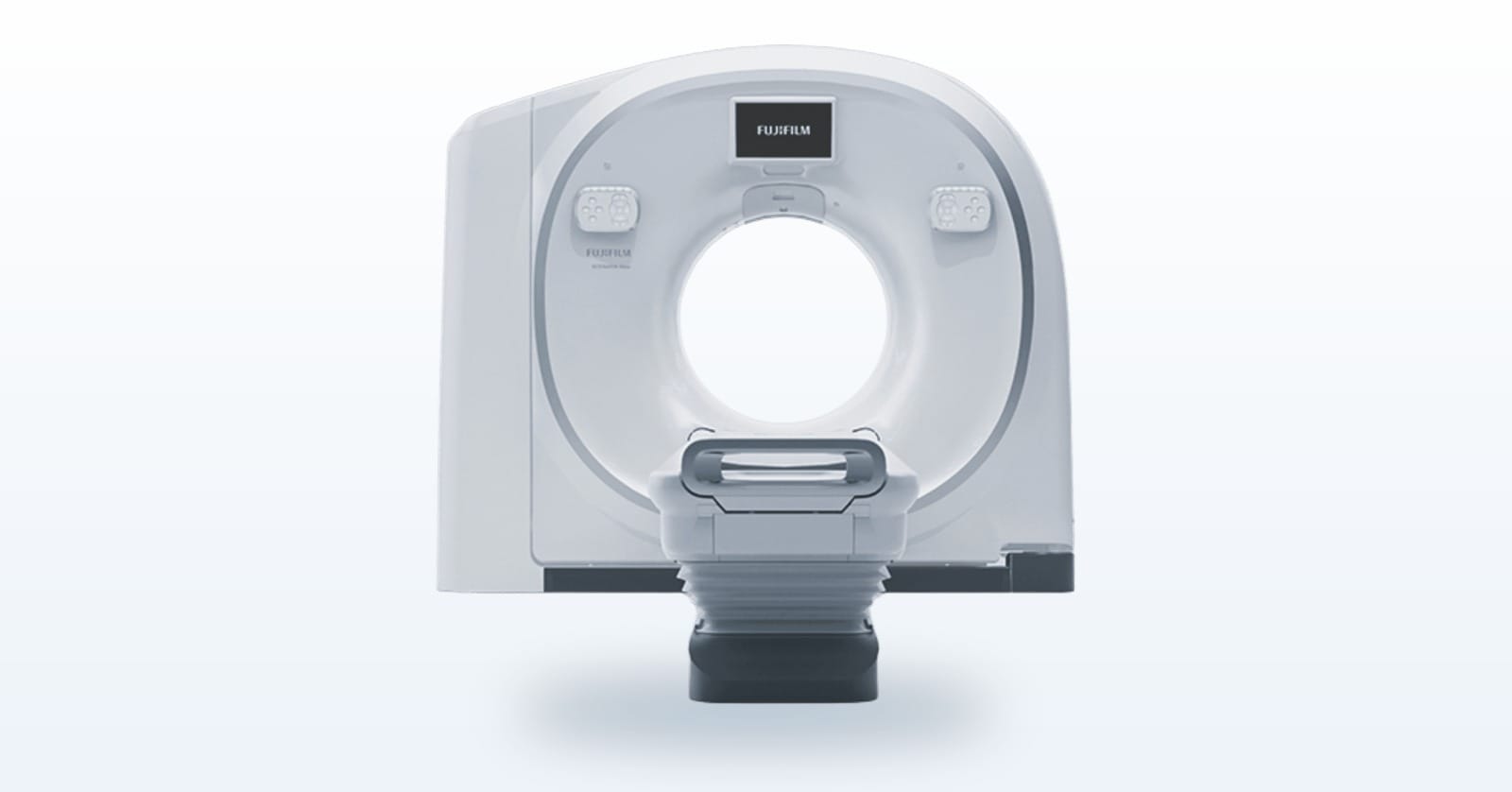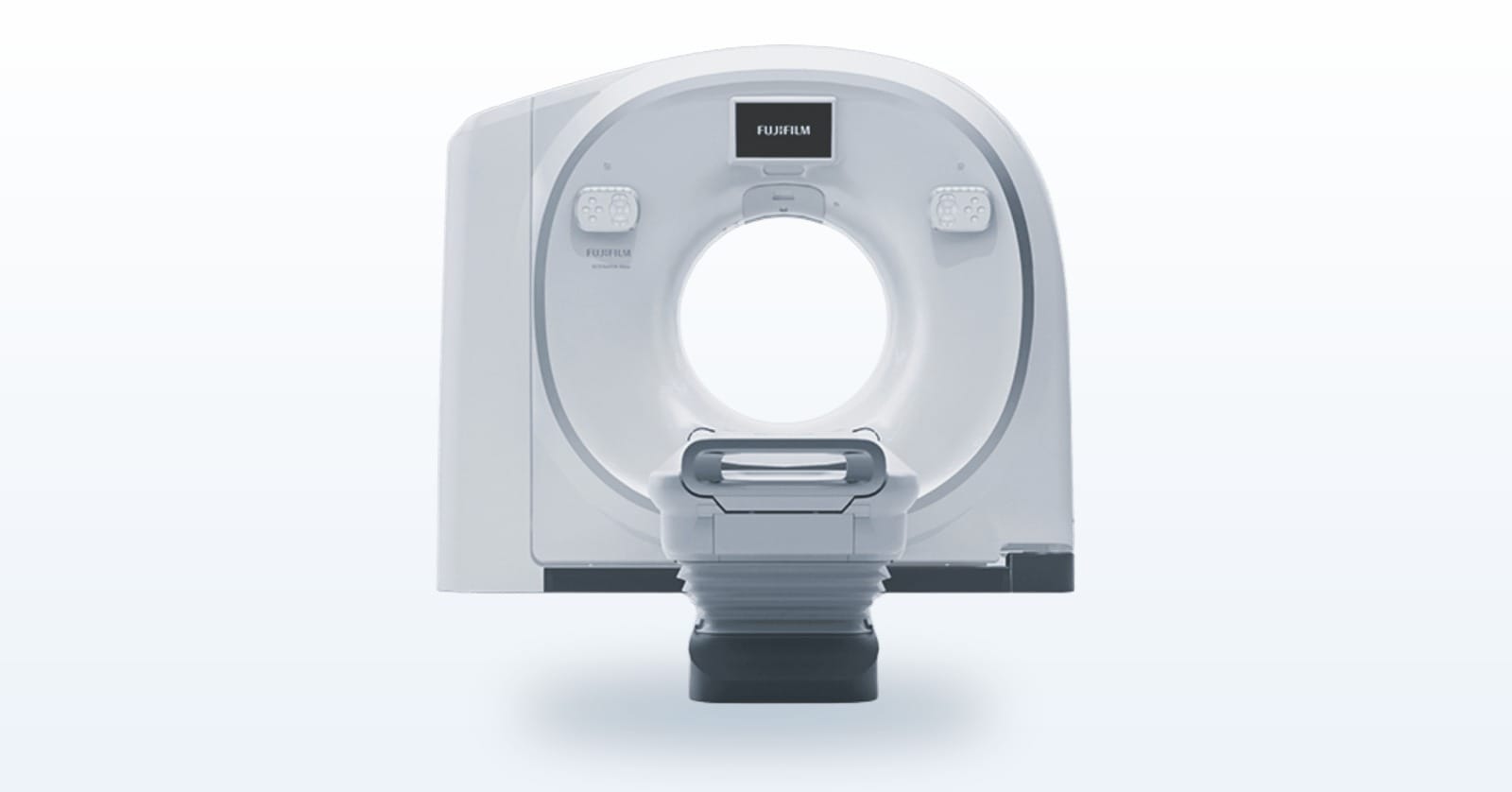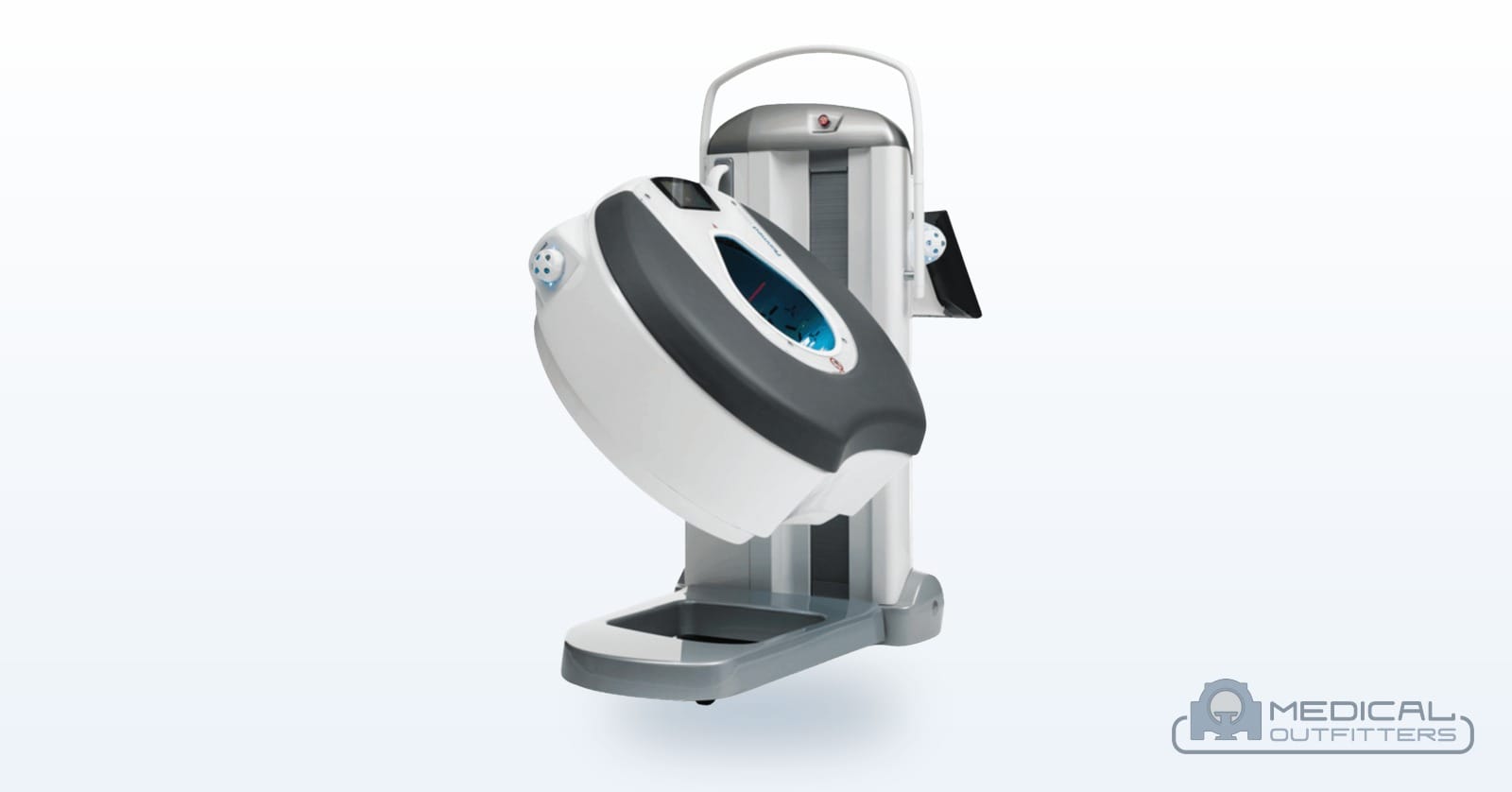
Cone beam CT vs medical CT: both are computed tomography, and they are built for different jobs. A cone beam CT machine (CBCT) uses a cone-shaped X-ray beam and a single flat-panel detector to capture a small volume, 5 to 30 cm across, in one slow rotation at low dose and very high spatial resolution. A medical CT scanner, properly a multidetector CT (MDCT), uses a fan-shaped beam and 16 to 320 rows of detectors to image the whole body helically in seconds, with the calibrated soft-tissue contrast that diagnostic radiology depends on. CBCT is a bone, tooth, airway and joint scanner. Medical CT is a whole-body diagnostic scanner.
That difference decides the purchase. A dental, ENT or orthopedic practice that wants to image the anatomy it treats, in its own office, at a dose and price it can justify, wants a cone beam CT scanner. A hospital, emergency department or imaging center that must image chest, abdomen, trauma, cancer and contrast-enhanced vessels wants a medical CT. Practices that need both usually own the CBCT and refer the rest.
This guide is for the buyer trying to tell the two apart: how each works, what the specification sheets mean, dose, image quality, siting, what a cone beam CT machine costs against a medical CT, and a decision path from the referral mix to the scanner. It draws on the cone beam and medical CT systems Medical Outfitters sells and installs.
- Beam and detector: cone beam plus flat panel for CBCT; fan beam plus multi-row detector for medical CT.
- Resolution vs contrast: CBCT resolves bone at 0.075 to 0.4 mm voxels; medical CT resolves soft tissue in calibrated Hounsfield units.
- Dose and siting: CBCT is lower dose for the same region and fits a small room on standard power, while medical CT needs a shielded room, three-phase power and, on most systems, a chiller.
- Cost: a CBCT is a fraction of a medical CT to buy, site and run.
Medical Outfitters sells new Planmed and Planmeca cone beam CT systems and new Fujifilm medical CT scanners as an authorized dealer, plus refurbished GE and Siemens CT scanners through MO Select, and installs and services them with its own engineers across the United States, Puerto Rico and the Caribbean. The systems are on our cone beam CT scanners for sale and CT scanners for sale pages.
Cone Beam CT vs Medical CT at a Glance
Read the figure as two instruments that overlap only at the edges. A CBCT’s flat-panel detector is a large square of pixels that captures a volume in one pass, which is why it resolves so finely and why scatter from that wide cone limits its soft-tissue contrast. A medical CT’s narrow fan beam and collimated detector rows reject scatter and produce grey values calibrated to water and air, which is what lets a radiologist tell a cyst from a tumour and measure contrast enhancement.
What Is Cone Beam CT? CBCT Explained
Cone beam CT, or CBCT, is a form of computed tomography built around one X-ray source that emits a cone-shaped beam and one flat-panel detector that captures the whole cone at once. The source and detector rotate once around the region of interest, typically in 10 to 40 seconds, and the hundreds of two-dimensional projections they collect are reconstructed into a three-dimensional volume. Because the beam covers the entire volume in a single rotation, there is no helical table movement and no row of detectors: the flat panel does the work.
How a cone beam CT machine works
The patient sits, stands or lies still while the gantry turns. The cone beam passes through the region, the flat panel records an image at each angle, and reconstruction software builds a volume of isotropic voxels, cubes of equal size in every direction, often 0.1 to 0.3 mm on a side. That isotropic resolution is why CBCT shows bone, teeth and airway in such detail. The trade is soft-tissue contrast: the flat panel and the wide cone scatter more radiation than a medical CT’s collimated fan beam and detector rows, so CBCT cannot separate soft tissues the way a multidetector CT does.
What cone beam CT is used for
Dental and maxillofacial imaging came first and remains the largest use: implant planning, impacted teeth, endodontics, orthodontics and jaw surgery. ENT uses CBCT for the sinuses and temporal bone. Orthopedics and podiatry use extremity CBCT such as the Planmed Verity to image the hand, wrist, elbow, foot, ankle and knee, including weight-bearing views that a conventional CT table cannot produce, and the Planmed XFI extends weight-bearing cone beam imaging to the spine, hips and shoulders. Interventional and radiation-therapy systems use cone beam acquisitions for positioning, and dedicated breast CT applies the same geometry to the breast.
Cone beam CT dose, cost and room
A CBCT exam delivers a fraction of the dose of a medical CT of the same region, because the field of view is small and the beam is on for one rotation. The machine costs a fraction of a medical CT scanner, needs a small room with light shielding and a standard or light three-phase supply, and its tube and flat panel are inexpensive to replace next to a medical CT tube. The rest of this article compares CBCT with medical CT specification by specification, then covers cost, who buys which, and which one a practice should buy.
How a Cone Beam CT Machine Works
In a cone beam CT the X-ray source and a flat-panel detector sit on opposite ends of a C-shaped arm that rotates once around the patient, in about 10 to 40 seconds, while the source pulses. The detector captures several hundred two-dimensional projections, and the reconstruction turns them into a cylinder of isotropic voxels: the same resolution in every direction, typically 0.075 to 0.4 mm depending on the field of view selected.
Because the beam is a cone, the whole volume is captured in one rotation; there is no table movement and no helical path. The field of view is a cylinder from about 5 cm across for a single tooth to about 30 cm for a skull or a lower leg, and on the largest systems, such as the Planmed XFI, considerably more. The patient sits, stands or lies still for the rotation. On extremity systems such as the Planmed Verity the patient can stand on the foot or ankle being imaged, so the joint is scanned under load, which no medical CT offers.
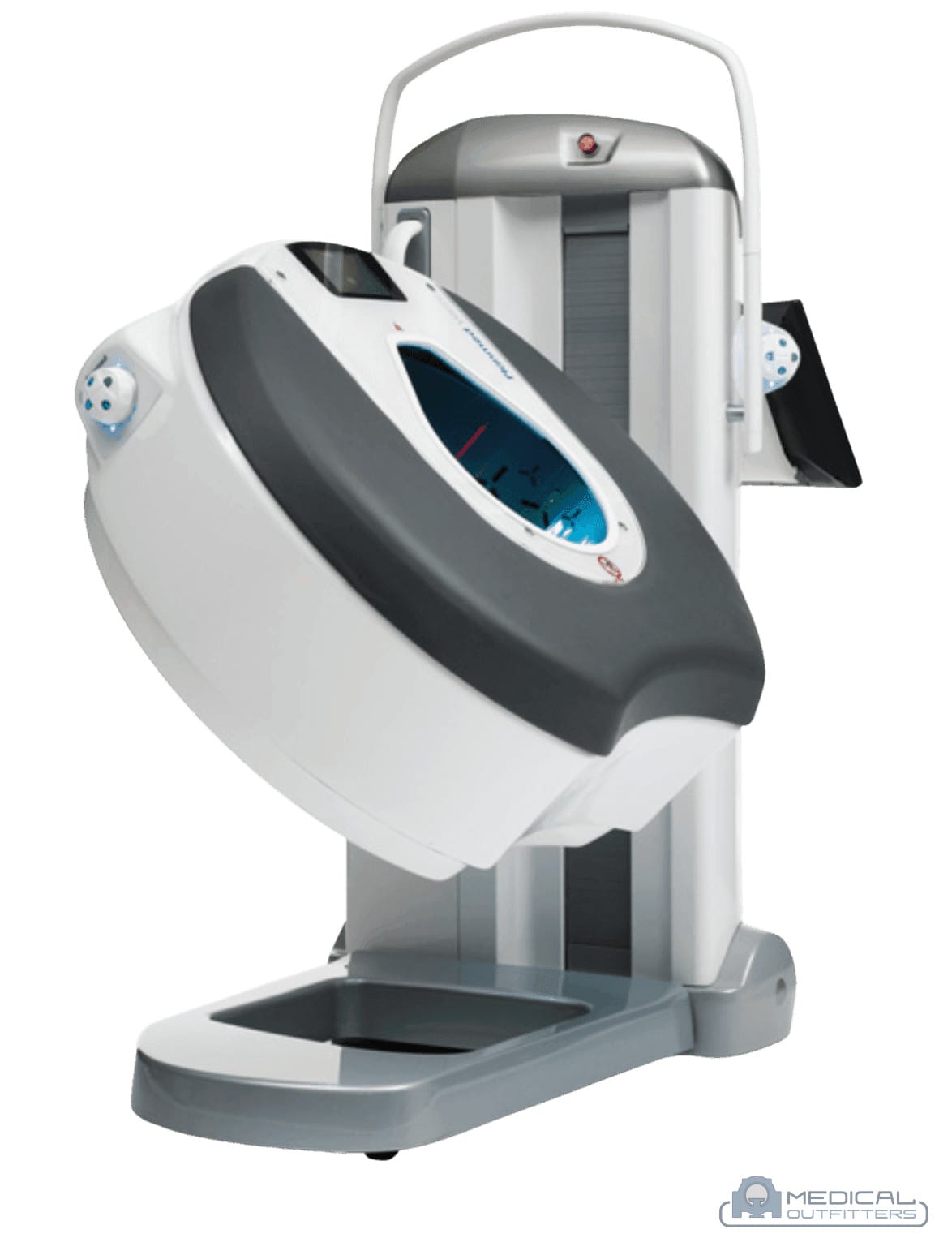
The compromises follow from the geometry. A wide cone means more scattered radiation reaching the detector, which lowers contrast and makes the grey values drift with the object; CBCT numbers are not true Hounsfield units and cannot be used for the density measurements medical CT provides. Metal, from implants and fillings, produces artifacts that reconstruction software reduces but does not remove. And a 10 to 40 second acquisition needs a still patient, which rules out the chest, the abdomen and anything that moves.
How a Medical CT Scanner Works
A medical CT scanner puts the X-ray tube and a curved bank of detector rows on a ring that rotates continuously around the patient, in 0.3 to 1 second per turn, while the table moves the patient through the bore. The beam is collimated to a fan the width of the detector array, from about 20 mm on a 16-slice scanner to 160 mm on a 320-row system. The data are reconstructed into thin slices, 0.5 to 1.25 mm, and from those into any plane or volume the radiologist wants. Our guide to CT scanner types by slice count explains what each tier does.
The narrow fan and the anti-scatter collimation on each detector row are what give medical CT its calibrated contrast. Water is 0 Hounsfield units, air is minus 1000, and every tissue between has a known value, so the scanner can measure, not just show. Add iodinated contrast and the scanner images vessels, perfusion and enhancing tumours. Add rotation speed and coverage and it freezes a beating heart. Dose is higher than CBCT for the same region but is managed with automatic exposure control and iterative reconstruction, and the whole-body coverage, contrast studies and soft-tissue detail are exactly what a cone beam system cannot do.
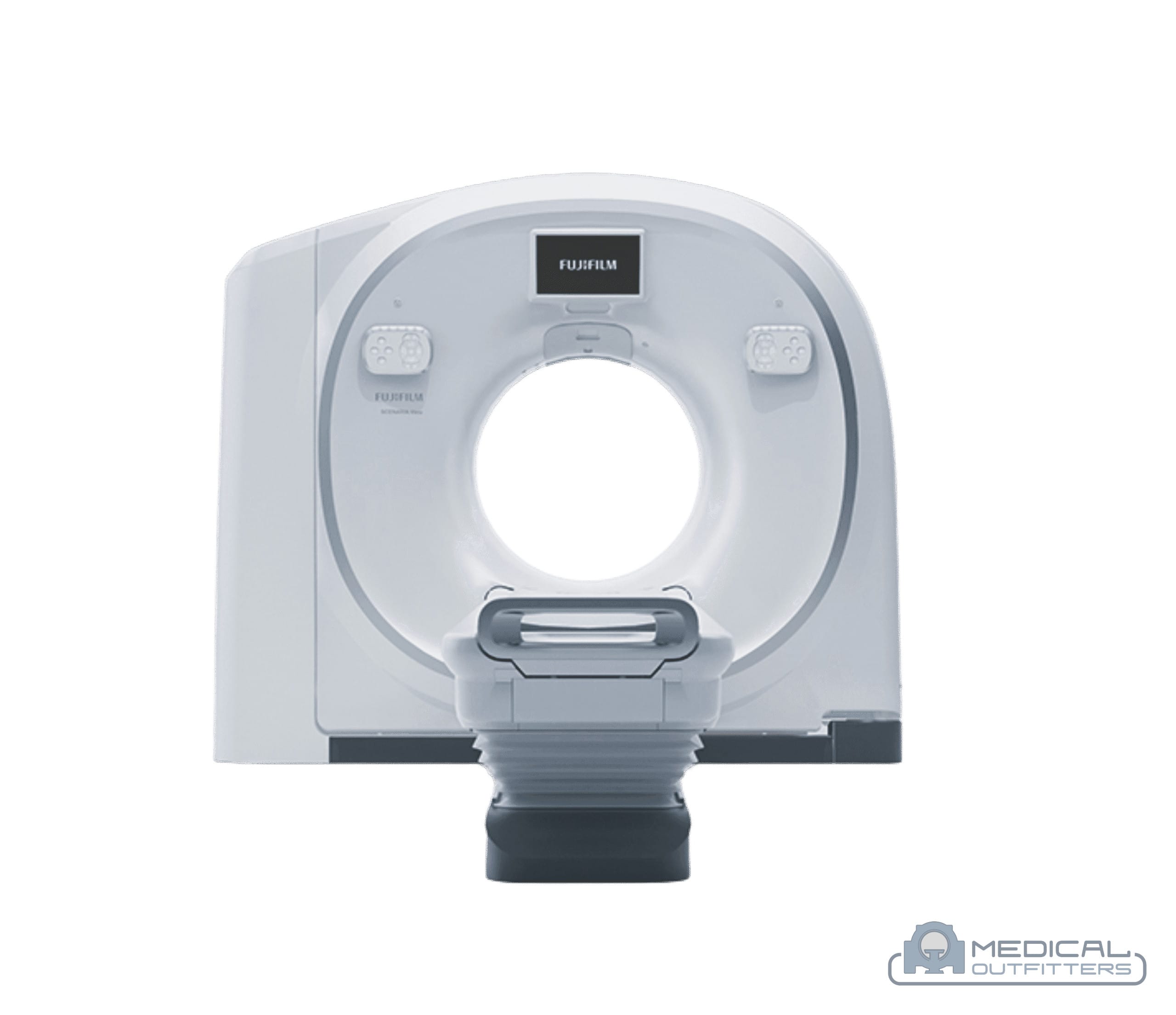
The cost of that capability is the room. A medical CT needs lead shielding sized by a physicist, three-phase power, a chiller or air-cooled condenser, a floor that carries a gantry of 1.5 to 2.5 tonnes, and a control room. The systems Medical Outfitters sells in this class, the new Fujifilm Supria 128 and SCENARIA View Focus Edition, and the refurbished GE Optima CT660 and Siemens SOMATOM Scope, are compact by medical-CT standards and still need all of that.
CBCT vs CT, Specification by Specification
| Specification | Cone beam CT | Medical CT | What it means for the buyer |
|---|---|---|---|
| Field of view | 5 to 30 cm cylinders; larger on whole-body CBCT | 50 cm, any length | CBCT images a region; medical CT images a patient |
| Spatial resolution | 0.075 to 0.4 mm isotropic | 0.3 to 0.6 mm in-plane | CBCT shows finer bone and tooth detail |
| Contrast resolution | Limited; no calibrated HU | Excellent; calibrated HU | Soft tissue, organs and contrast studies need medical CT |
| Scan time | 10 to 40 s per volume | Seconds for a whole region | Motion-sensitive anatomy needs medical CT |
| Dose | Lower for the same region | Higher; modulated and reconstructed to minimise | CBCT suits repeat and follow-up imaging in the office |
| Contrast agents | Rarely used | Routine | Vascular and oncology imaging is medical CT |
| Room and power | Small room; standard or light three-phase supply; modest lead | Shielded suite, three-phase power, chiller on most systems | CBCT fits an existing office; medical CT needs a build |
| Purchase and running cost | A fraction of medical CT | Higher purchase, service and tube costs | Total cost of ownership differs by a large multiple |
| Regulatory | State X-ray registration; physicist survey | State registration, physicist, often accreditation for Medicare billing | Both need a radiation-safety program; medical CT’s is larger |
Cone Beam CT Machine Cost vs Medical CT Cost
A cone beam CT machine costs a fraction of a medical CT scanner, and the gap widens once the room is counted. A dental or ENT CBCT needs a small room, a standard or light three-phase supply and modest lead; an extremity CBCT such as the Planmed Verity needs little more; a medical CT needs a physicist-designed shielded suite, three-phase power, a chiller and a control room before the first scan. Running costs follow the same pattern: a CBCT’s tube and flat panel are inexpensive to replace next to a medical CT’s tube, and service contracts are priced accordingly.
Within cone beam CT, the price moves with field of view, resolution, weight-bearing capability and software. The Planmeca Viso G7 price, for example, depends on the field-of-view package and the imaging software licensed with it, and the Planmed Verity and XFI are priced by configuration in the same way. Medical Outfitters quotes each cone beam and medical CT system individually; our CT scanner cost and price guide gives the industry’s broad ranges for multidetector systems by slice count and for new versus refurbished, and it is the place to start before comparing a CBCT quote against a medical CT quote.
Who Buys a Cone Beam CT Scanner, and Who Buys a Medical CT
Dental and maxillofacial
Implant planning, impacted teeth, endodontics, TMJ and orthognathic surgery were the first CBCT applications and remain the largest. A dental CBCT such as the Planmeca Viso G7 offers selectable fields of view from a single tooth to the whole skull, with resolution a medical CT cannot match and a dose a dental practice can justify for planning.
ENT and airway
Sinus, temporal bone and airway imaging are bone and air against soft tissue, exactly the contrast CBCT handles well. Office-based sinus CT on a cone beam system can replace a hospital referral for much routine surgical planning.
Orthopedics, podiatry and sports medicine
Extremity CBCT is a fast-growing application. The Planmed Verity images the foot, ankle, knee, hand, wrist and elbow at high resolution, standing when the question is alignment under load, in the practice’s own office, without the wait or the dose of a hospital CT. The Planmed XFI extends the same weight-bearing technology to the spine, shoulders, hips and the full upper and lower extremities through an 85 cm opening. Its US clearance does not include head, ENT or maxillofacial imaging.
Hospitals, emergency departments and imaging centers
Everything else: trauma, stroke, chest, abdomen and pelvis, oncology staging and follow-up, cardiac CT angiography, contrast studies, radiation-therapy planning. These need coverage, speed, soft-tissue contrast and contrast agents, which means a medical CT of 16 slices and up. Our guide to CT scanner brands compared covers the choice between new Fujifilm and refurbished GE and Siemens platforms, and the SCENARIA View page shows what a 64 or 128-slice medical CT brings to a hospital department.
Which CT Should the Practice Buy?
The decision path is short because the anatomy makes it. Teeth, sinuses, ears, airway: cone beam. Extremities, especially under load: extremity cone beam. Chest, abdomen, trauma, cancer, vessels, heart: medical CT. The harder question is usually financial rather than clinical, and there the arithmetic favours the CBCT in a specialist office and the medical CT everywhere that bills for whole-body imaging.
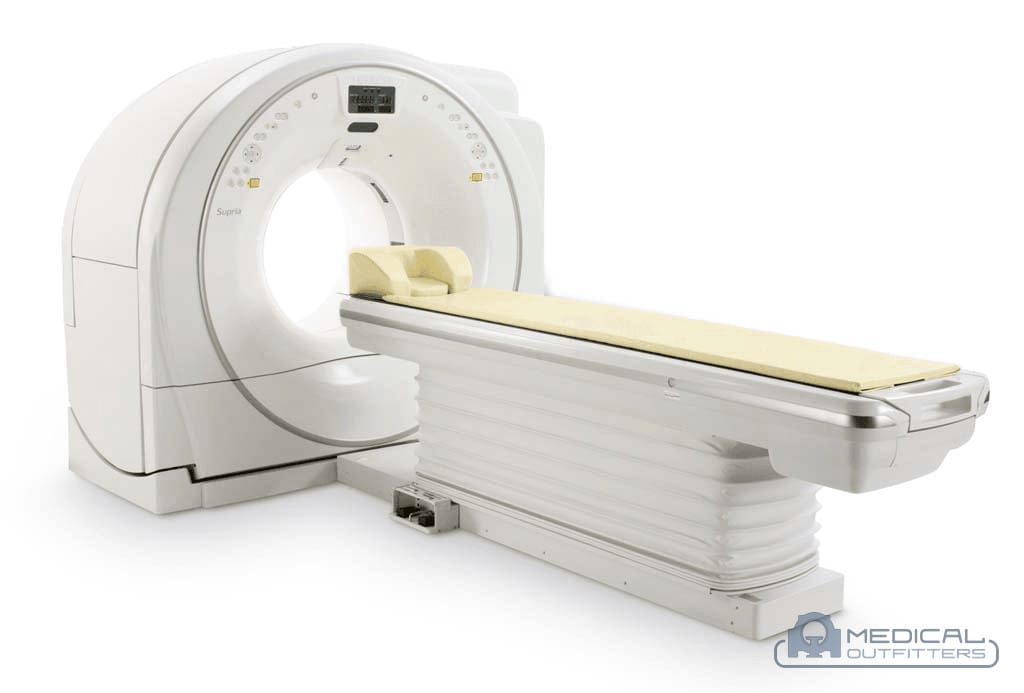
New or refurbished. Cone beam systems are usually bought new, because the technology moves quickly and the price is manageable. Medical CT is where the refurbished market is deep. In the 16 and 64-slice tiers a rebuilt GE or Siemens scanner with a documented tube and a written warranty is the value choice; in the 64 and 128-slice tiers the new Fujifilm systems are competitively priced. Our refurbished medical imaging equipment page describes what an MO Select rebuild includes.
The room. A CBCT arrives in an office, is bolted down and connected to a wall supply, and is scanning inside a week once the physicist’s shielding survey is done. A medical CT needs a suite, which is a construction project, a physicist’s plan and a rigging route. Our guide to how to move an MRI or CT scanner covers the rigging side, and the MRI vs CT scan guide covers the siting comparison with a magnet.
Medical Outfitters sells both kinds of scanner, so we have no reason to steer a practice toward the wrong one. Contact us with the exams you expect to perform and we will recommend the system, quote it, and deliver and install it, in Florida and across the United States, Puerto Rico and the Caribbean.
- Cone beam CT scanners for sale
- Medical CT scanners for sale
- Planmed Verity extremity cone beam CT
- Planmeca Viso G7 dental and ENT CBCT
- Planmed XFI weight-bearing spine and extremity cone beam CT
- Fujifilm Supria 32 CT scanner (veterinary use in the US)
- Fujifilm Supria 128 CT scanner
- Fujifilm SCENARIA View Focus Edition CT
- CT scanner cost and price guide
- CT scanner types by slice count
- CT scanner brands compared
- Ask which CT fits your practice
Cone Beam CT vs Medical CT: Common Questions
What is the difference between cone beam CT and medical CT?
A cone beam CT uses a cone-shaped X-ray beam and a flat-panel detector that capture a small volume, 5 to 30 cm, in one slow rotation at low dose. A medical CT uses a fan-shaped beam and rows of detectors that image the whole body helically in seconds with calibrated soft-tissue contrast.
Is a cone beam CT scan the same as a CAT scan?
No. Both are computed tomography, but a cone beam CT is a compact, low-dose scanner for teeth, sinuses, ears and extremities. A CAT scan in the everyday sense is a medical multidetector CT used for chest, abdomen, trauma and contrast studies.
Does cone beam CT show soft tissue?
Poorly. CBCT grey values are not calibrated Hounsfield units and the scatter from a large cone beam reduces contrast, so soft tissue, organs and contrast-enhanced vessels are the domain of medical CT. CBCT excels at bone, teeth, airways and joints.
Is cone beam CT dose lower than medical CT?
For the same anatomy, usually yes. A dental or extremity CBCT scan delivers a fraction of the dose of a medical CT of the same region, which is one reason orthopedic and ENT practices install CBCT in-house for follow-up imaging.
What does a cone beam CT scanner cost compared with a medical CT?
A cone beam CT costs a fraction of a medical CT and needs a smaller room, standard power and less lead shielding. Medical Outfitters quotes specific configurations, and our CT scanner cost guide covers the broad industry ranges for multidetector systems.
Which cone beam CT is best for orthopedics?
The Planmed Verity is built for extremities and lets the patient stand for weight-bearing foot, ankle and knee scans, which a medical CT cannot do. The Planmed XFI extends weight-bearing cone beam imaging to the spine, hips, shoulders and full extremities. Medical Outfitters supplies both as an authorized Planmed dealer.
What does CBCT stand for?
Cone beam computed tomography: a CT that uses a cone-shaped X-ray beam and a flat-panel detector to capture a volume in one rotation, rather than the fan beam and detector rows of a medical CT.
What is cone beam CT used for?
Dental implant planning, impacted teeth, endodontics and orthodontics; ENT imaging of the sinuses and temporal bone; orthopedic and podiatric imaging of the extremities, including weight-bearing views on systems such as the Planmed Verity and XFI; positioning in interventional and radiation-therapy suites; and dedicated breast CT.
Related Articles