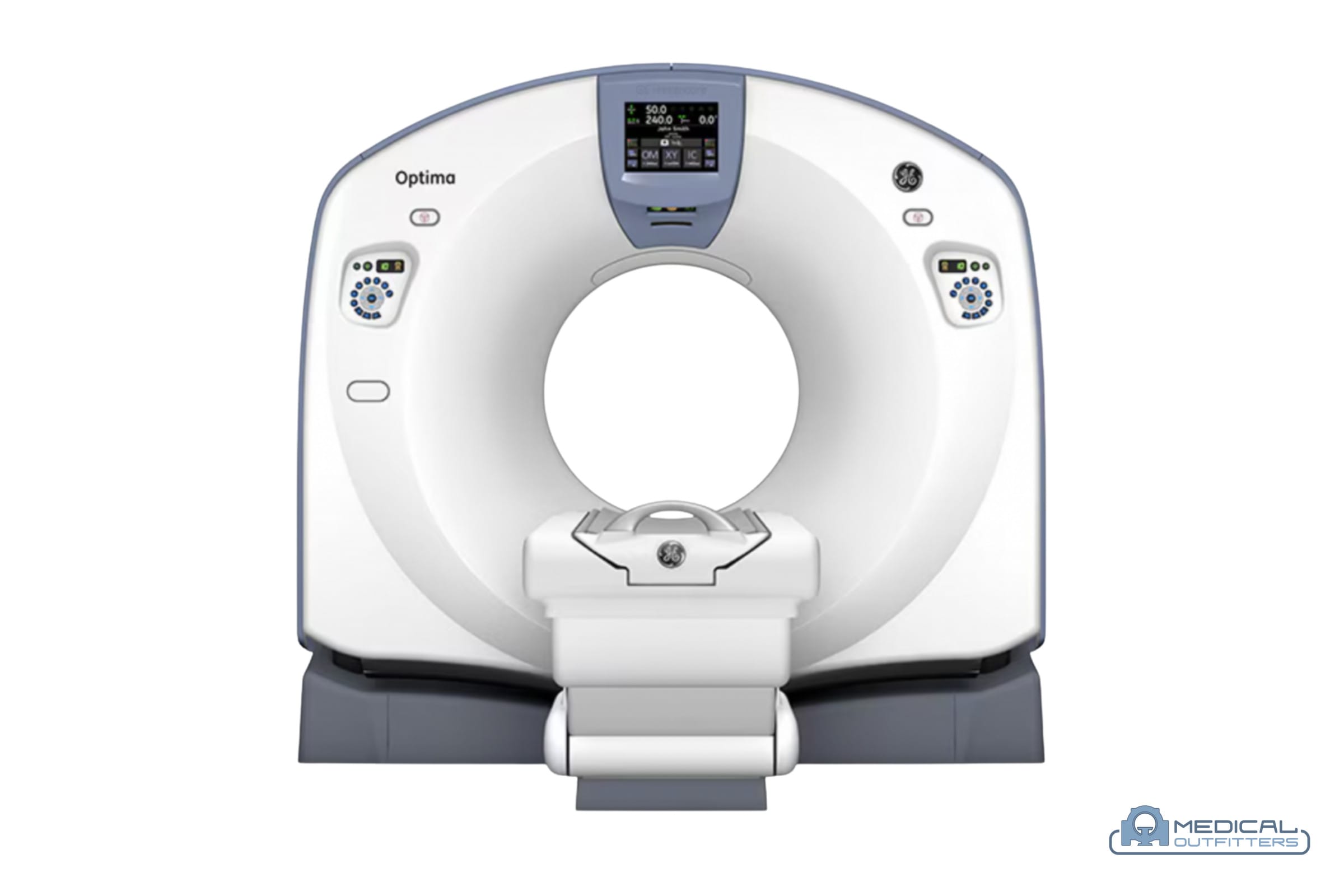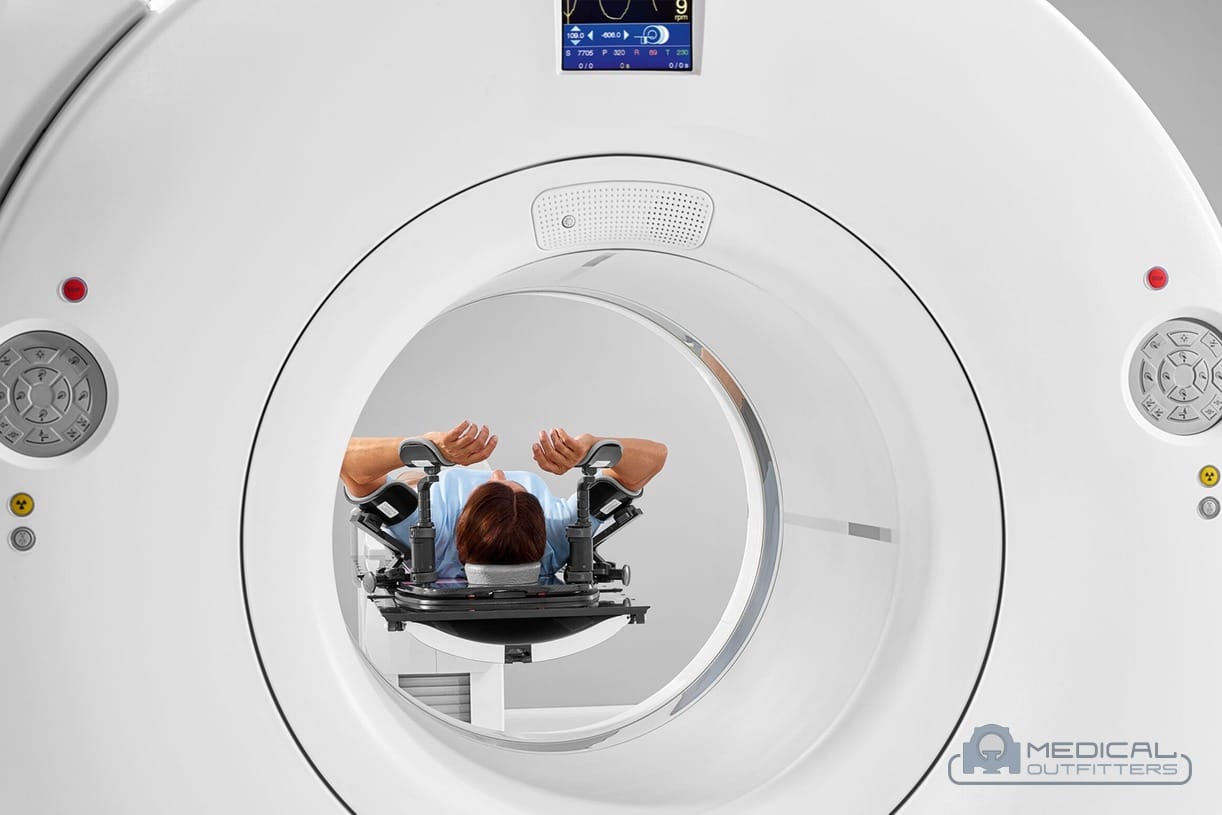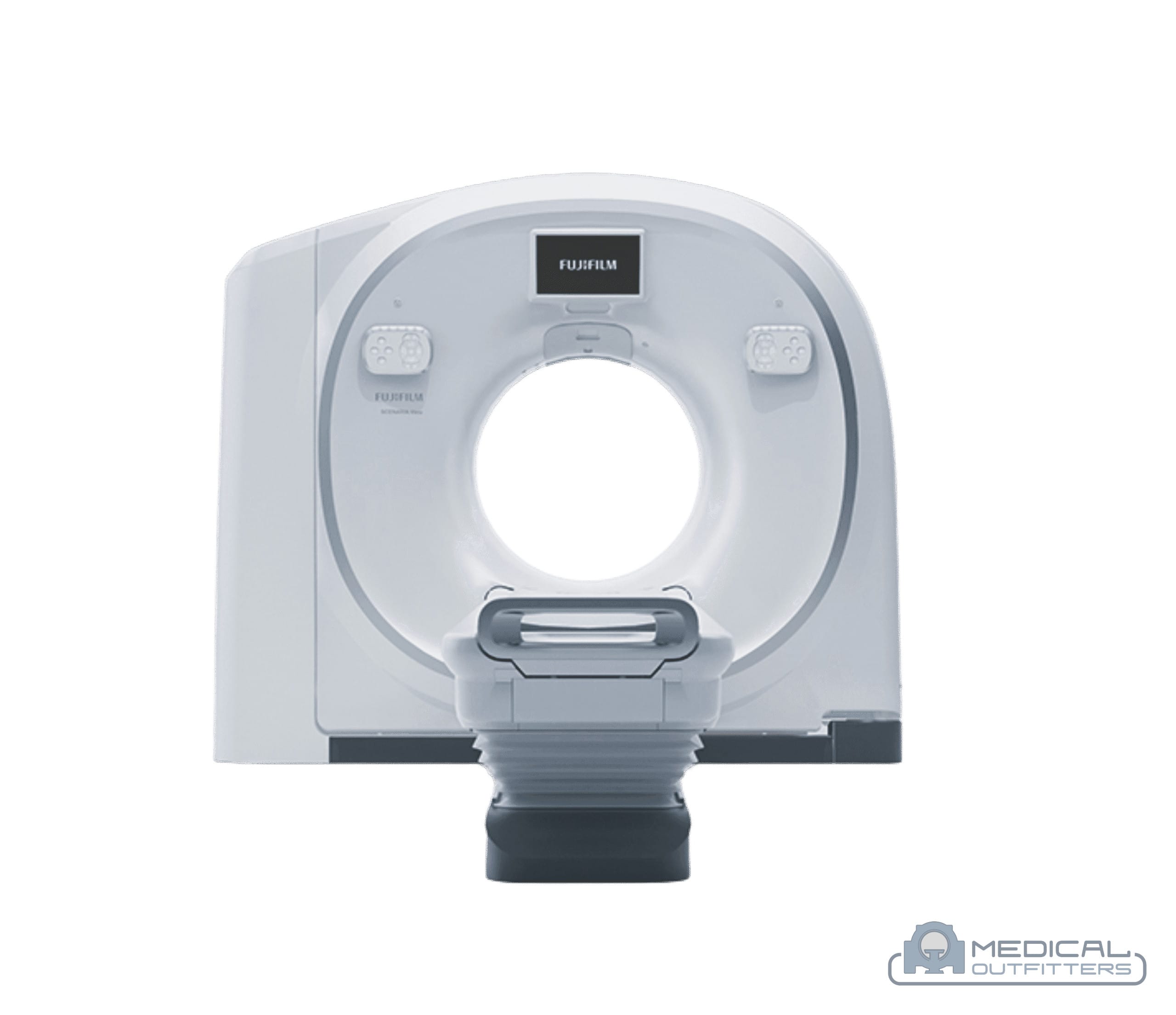
How much does a CT scan cost? The honest answer has three parts: the price depends on who is paying (Medicare, a commercial insurer or the patient in cash), where the scan is done (a freestanding imaging center, a hospital outpatient department or an emergency room) and what is scanned (a head without contrast is the cheapest common exam, an abdomen and pelvis with contrast is among the most expensive). The same CT scan of the abdomen can be billed at $400 in one building and $3,000 in another a mile away, and the difference has nothing to do with the scanner. This guide lays the 2026 numbers out by setting, by payer and by exam, explains what Medicare actually pays and why hospitals charge more, shows what contrast adds, and then turns the question around: what the scanner behind the exam costs the facility, and how many scans it takes to pay for one.
Medical Outfitters sells new Fujifilm CT scanners as an authorized dealer and refurbished GE and Siemens systems through MO Select, and installs and services them across the United States, Puerto Rico and the Caribbean. We wrote this for the people on both sides of the price: the patient or practice manager trying to understand a bill, and the facility owner or radiology manager deciding whether a scanner will pay for itself. If you are pricing the machine rather than the exam, the CT scanner cost and price guide has the full bands.
- Without insurance: about $300 to $1,000 at an imaging center and $1,200 to $3,275 at a hospital outpatient department (CoveredUSA, May 2026); the national average cash price is about $1,200 (CareRoute, 2026).
- Medicare: $106.55 for a head CT, $132.60 for a chest CT and $300.27 for an abdomen and pelvis with contrast under the 2026 physician fee schedule; the patient pays 20 percent after the $283 Part B deductible.
- With commercial insurance: negotiated rates run 150 to 300 percent of Medicare, so most insured patients owe $50 to $500 in copay or coinsurance, or the whole negotiated rate under an unmet deductible.
- Contrast: adds about $100 to $400 to the bill, because it is a separate CPT code, a separate drug charge and more staff time.
- The scanner: $85,000 to $185,000 for a refurbished 16-slice and $175,000 to $375,000 for a refurbished 64-slice, delivered and installed, per the Medical Outfitters CT cost guide; at ten exams a day the equipment line of a $275,000 scanner is recovered in roughly nine months.
How Much Does a CT Scan Cost in 2026? Prices by Setting and Exam
Start with the cash price, because it is the number most people mean when they ask. CoveredUSA’s May 2026 national pricing guide, which draws on the CMS 2026 Medicare fee schedules, hospital price-transparency files and FAIR Health data, puts a CT scan at $300 to $3,275 without insurance: about $300 to $1,000 at an independent imaging center and $1,200 to $3,275 in a hospital outpatient department. CareRoute’s 2026 cost guide, built on the same public sources plus FAIR Health consumer estimates, lands in the same place with a national average of about $1,200, a freestanding-center range of $250 to $750, a hospital outpatient range of $800 to $3,000 and an emergency-room range of $1,500 to more than $5,000 once the facility fee is added.
The exam itself moves the price next. A head CT without contrast is the cheapest common study because it is quick and needs no injection; an abdomen and pelvis with contrast is among the most expensive because it covers more anatomy, takes longer and includes the contrast agent and the IV. CareRoute’s 2026 national averages by body part are in the table below.
| CT exam (common CPT code) | Without contrast, national average | With contrast, national average | Imaging center cash range | Hospital outpatient cash range |
|---|---|---|---|---|
| Head (70450 / 70460) | $825 | $1,050 | $250 to $500 | $800 to $1,800 |
| Chest (71250 / 71260) | $900 | $1,100 | $275 to $700 | $900 to $2,500 |
| Abdomen and pelvis (74176 / 74177) | $1,100 | $1,400 | $350 to $900 | $1,200 to $3,000 |
| Spine | $1,000 | Not published | Not broken out by setting | Not broken out by setting |
| Extremity | $750 | Not published | Not broken out by setting | Not broken out by setting |
| Cardiac CT | $1,800 | Not published | Not broken out by setting | Not broken out by setting |
Source: CareRoute 2026 CT scan cost guide (national averages and setting ranges, citing the 2026 Medicare fee schedule, CMS price-transparency data and FAIR Health). Ranges are cash prices for self-pay patients; insured patients pay a share of a negotiated rate instead, which the next sections explain.
Two things in that table matter more than any single figure. First, the hospital column is roughly three times the imaging-center column for the identical scan, which the Health Care Cost Institute’s April 2026 imaging brief confirms across the country: imaging prices at hospital outpatient departments ran two to four times the prices at physician offices and freestanding sites in its 2022 claims data. Second, every price in the table is a facility’s list or cash price, not what Medicare or an insurer actually pays, and those payment rates are far lower and far more uniform. That is where the next section goes.
What Medicare Pays for a CT Scan: The Fee Schedule and the Hospital Rate
Medicare CT scan payment works two different ways depending on where the scan is done, and the two numbers anchor every other price in the market, including the cost of CT scan exams billed to commercial insurers. In a freestanding imaging center or a physician office, the scan is paid under the Medicare Physician Fee Schedule as a single global payment that covers both the technical component (the scanner, the technologist, the room and the supplies) and the professional component (the radiologist’s reading). For 2026 the fee schedule’s conversion factor is $33.4009 per relative value unit, per CMS, and the national payments compiled from it by CareRoute’s CPT lookup are $106.55 for a head CT without contrast (CPT 70450, 3.19 RVUs), $132.60 for a chest CT without contrast (CPT 71250, of which $49.43 is the radiologist’s read and $83.17 the technical component) and $300.27 for an abdomen and pelvis with contrast (CPT 74177, 8.99 RVUs). Geographic adjustments move these a few percent either way.
In a hospital outpatient department the same scan is paid under the Hospital Outpatient Prospective Payment System instead. The hospital receives an ambulatory payment classification rate for the technical side and the radiologist bills the professional component separately. CMS set the 2026 outpatient conversion factor at $91.415, an increase of 2.6 percent, and finalized the seven imaging APCs without structural change, according to the American College of Radiology’s summary of the final rule released November 21, 2025: Level 1 imaging without contrast pays $88.91, Level 2 (APC 5522, where CMS also placed low-dose lung screening CT) pays $106.81, Level 3 pays $243.77 and Level 4 pays $558.25, while imaging with contrast pays $179.20, $356.43 and $800.90 at Levels 1 to 3. Add the radiologist’s professional fee and Medicare’s total for a hospital-based CT is well above the imaging-center global rate for the same code, which is why the Medical Outfitters CT cost guide, citing CoveredUSA, puts Medicare’s payment at about $185 for a CT at an independent center and about $340 at a hospital outpatient department.
Three Medicare rules sit behind these rates and matter to anyone running a scanner. Since January 1, 2012, a non-hospital facility must be accredited by a CMS-designated body (the ACR, the IAC, RadSite or The Joint Commission) to bill Medicare for the technical component of CT, per CMS. CT scanners that do not meet the NEMA XR-29 dose-optimization standard take a 15 percent payment reduction on applicable exams, in force since 2017 under CMS Survey and Certification letter 16-19. And the 2026 fee schedule applied a 2.5 percent efficiency adjustment to the work values of non-time-based codes, which Healthcare Administrative Partners’ November 2025 analysis for AuntMinnie estimated at a net 1 percent gain for imaging centers and a 2 percent loss for radiology overall once the practice-expense changes are counted.
CT Scan Cost With Insurance: Deductibles, Coinsurance and Copays
For an insured patient the price of the scan is the negotiated rate between the facility and the insurer, and the patient’s bill is a share of that rate set by the plan design. Under Original Medicare the arithmetic is fixed: Part B pays 80 percent of the approved amount and the patient pays 20 percent after meeting the annual Part B deductible, which CMS set at $283 for 2026. On the national fee-schedule rates above, that 20 percent is $21.31 for a head CT and $60.05 for an abdomen and pelvis with contrast at an imaging center, and somewhat more at a hospital because the approved amount is higher. A Medicare Supplement plan usually covers the 20 percent; a Medicare Advantage plan replaces it with the plan’s own copay for advanced imaging, which the plan’s summary of benefits states.
Commercial insurance pays more than Medicare and passes more of it to the patient. CareRoute’s 2026 CPT guide puts typical commercial negotiated rates at 150 to 300 percent of Medicare, which for the abdomen and pelvis with contrast means about $450 to $900 at an imaging center. The Health Care Cost Institute’s April 2026 brief, using 2022 employer-sponsored insurance claims, found CT prices averaging 257 percent of Medicare nationally, with X-rays at 314 percent and MRI at 307 percent. How much of that negotiated rate reaches the patient depends on the plan:
- Copay plan, deductible met: a flat advanced-imaging copay, typically $100 to $250 per CareRoute.
- Coinsurance plan, deductible met: 20 percent of the negotiated rate, about $90 to $180 on a $450 to $900 abdomen and pelvis.
- High-deductible plan, deductible not met: the full negotiated rate, $450 to $900 at an imaging center and considerably more at a hospital, until the deductible is satisfied.
The hospital setting adds one more line. When a CT is done in a hospital outpatient department, the hospital’s facility fee is billed in addition to the professional fee and carries its own cost sharing, which CareRoute puts at $500 to $1,500 in an emergency department. That is why two insured patients with the same plan and the same scan can see bills a thousand dollars apart, and why insurers increasingly steer members to freestanding centers for scheduled CT. Prior authorization is the other practical hurdle: most commercial plans require it for CT, and a scan done without it can be denied in full, leaving the patient with the cash price.
CT Scan Cost Without Insurance: Cash Prices, Chargemasters and Your Rights
An uninsured or self-pay patient faces two very different numbers. The chargemaster price is the hospital’s list price, the one that appears on an itemized bill before any discount, and CoveredUSA’s May 2026 analysis puts the chargemaster for an abdomen and pelvis CT with contrast at $1,200 to more than $6,000, with chargemaster prices averaging 164 percent above what insurers actually pay. The self-pay or discounted cash price is what the same facility accepts from a patient paying directly, and it is usually a fraction of the list price: $300 to $1,200 at a hospital and $250 to $600 at a freestanding center for the same scan, per the same analysis. Nobody should pay a chargemaster price for a scheduled CT, and the first question to ask any facility is what its self-pay rate is.
Two federal rules give the self-pay patient leverage. Under the CMS Hospital Price Transparency rule, in force since January 1, 2021, every hospital must publish a machine-readable file of its standard charges, including its gross charge, its discounted cash price and its payer-specific negotiated rates, plus a consumer-friendly list of 300 shoppable services that CMS requires to include CT and MRI exams. Penalties for non-compliance start at $300 a day for hospitals of 30 beds or fewer and $10 per bed per day, capped at $5,500 a day, for larger hospitals. Compliance is still uneven: a study reported by Radiology Business found only 21 percent of hospitals fully compliant for the shoppable imaging exams, so the file may be hard to find, but it exists and a hospital must produce it on request.
The second rule is the No Surprises Act, in force since January 1, 2022. Any provider or facility that schedules a service for an uninsured or self-pay patient must give a written Good Faith Estimate of the expected charges, within one business day of scheduling when the appointment is three to nine business days away and within three business days when it is further out, according to CMS. If the final bill exceeds the estimate by $400 or more, the patient can take it to the federal patient-provider dispute resolution process. For a CT, the estimate should list the scan, the contrast, the radiologist’s read and any facility fee separately, and a self-pay patient comparing two sites should ask both for one.
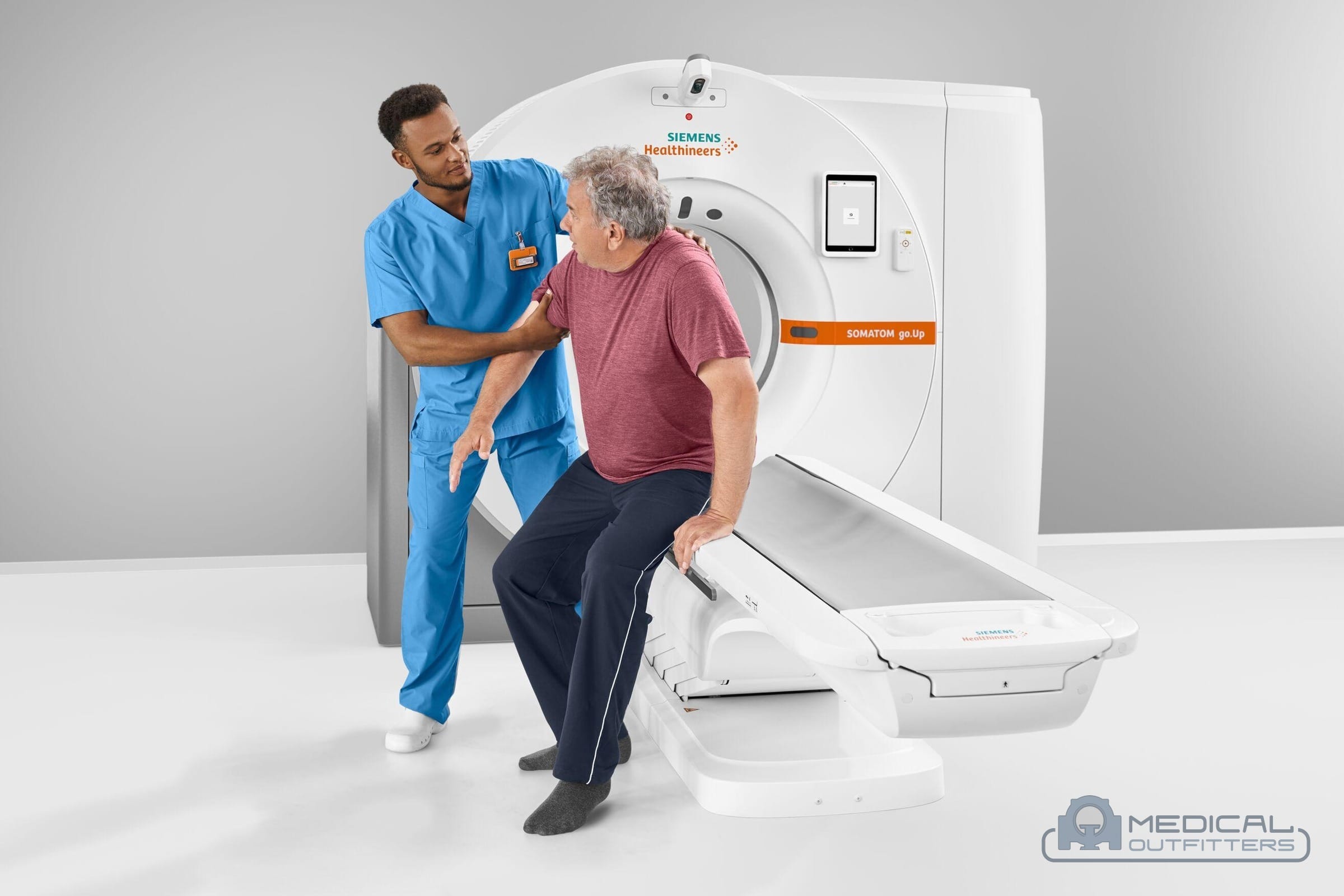
The practical sequence for a self-pay patient is short. Ask the ordering physician for the exact CPT code and whether contrast is needed. Call two or three freestanding imaging centers and the hospital and ask each for its self-pay price for that code, all-in, with the read. Ask about prompt-pay discounts, which many centers offer for payment on the day. Then book the lowest price that is accredited and that your physician will accept images from, which in the United States means any ACR, IAC, RadSite or Joint Commission accredited site.
With Contrast or Without: Why the Same Scan Has Two Prices
Every CT exam exists in a with-contrast and a without-contrast version, each with its own CPT code, and the contrast version always costs more. CoveredUSA puts the difference at roughly $100 to $400 and CareRoute at $100 to $300 on top of the base scan. The reasons are mechanical. Iodinated contrast is a drug, billed separately by the milliliter and usually at a markup. Injecting it needs an IV, a power injector and a technologist’s time, and many facilities require a recent kidney-function blood test before injecting, which adds a lab charge. The scan itself takes longer because images are acquired before and after the injection, or in several timed phases for a liver, kidney or vascular study. And Medicare pays more for the contrast code: the 2026 fee-schedule global for an abdomen and pelvis with contrast is $300.27 against $243.77 for the hospital Level 3 non-contrast APC, and the hospital APCs for imaging with contrast pay $179.20 to $800.90 against $88.91 to $558.25 without.
Whether a scan needs contrast is a clinical decision, not a financial one. Non-contrast CT is the standard for suspected stroke, head trauma, kidney stones, lung nodules and most bone and spine work, and for patients with impaired kidney function or a prior contrast reaction. Contrast is needed when the question is about blood vessels, tumors, infection or inflammation, where the agent makes the abnormality stand out against normal tissue. A patient who is quoted a with-contrast price for a question that does not need contrast can ask the ordering physician whether the non-contrast code is appropriate; a patient who needs contrast should not shop it away.
For the facility, contrast is a cost center as much as a revenue line. The agent and the injector consumables are reimbursed separately, but the injector itself, typically quoted per project alongside the scanner, the pharmacy handling and the reaction kit are overhead, and dual-energy and spectral CT platforms that can reduce contrast dose are one of the reasons a 128-slice system commands a premium over a 64-slice. Our guide to CT scanner types by slice count covers what each class adds, and the CT scanner brands comparison covers the platforms.
Why CT Prices Vary So Much From One Building to the Next
The cost of CT scan exams spreads wider than almost any other common medical service, and the imaging center vs hospital gap is only the start of it. A study of hospital price-transparency files reported by Radiology Business found a contrast-enhanced pelvic CT listed at anywhere from $193 to $14,238, a 74-fold difference for the same CPT code. A survey of non-contrast head CT prices reported by Diagnostic Imaging found a range of $392 to $2,015 at academic hospitals, averaging $1,390, against $211 to $2,200 at private practices, averaging $682. The Health Care Cost Institute found Level 1 imaging averaging $227 at hospital outpatient departments against $61 in physician offices, and Level 4 imaging $1,416 against $387, both about 3.7 times higher in the hospital. Four things explain most of it.
Site of service. The hospital outpatient payment system pays a facility fee that the physician fee schedule does not, and commercial insurers negotiate from the hospital’s higher base. A hospital also carries an emergency department, 24-hour staffing and uncompensated care in its cost structure, and its imaging prices help carry them. A freestanding center carries none of that and competes on price.
Negotiating power. A health system with most of the beds in a region negotiates higher rates from every insurer than an independent center can, and the rates are specific to each insurer, which is why the transparency files show a different price for the same scan under every plan a hospital accepts.
Geography. Medicare’s own rates vary by locality through the geographic practice cost indices, and commercial rates vary far more from market to market, which is why the transparency studies above report ranges rather than a single national price.
What is in the price. Some quotes include the radiologist’s read, the contrast and the facility fee; others leave one or more out. A low headline number that excludes the read is not a lower price. The Good Faith Estimate exists to make the components visible, and a buyer of any kind, patient or payer, should compare all-in figures only.
The trend is toward narrower spreads but higher prices. Radiology Business reported that between 2023 and 2024 the variation in negotiated imaging rates fell by more than 19 percent while the average negotiated price rose 7 percent. For a facility planning a scanner, the lesson is that reimbursement per exam is a known, slowly moving number, and that the economics are decided by volume and setting rather than by price.
What the Scanner Costs and How the Scan Pays for It
Every CT scan price above is revenue to the facility that owns the scanner, and the scanner is one of the largest capital purchases an imaging facility makes. The Medical Outfitters CT scanner cost guide puts the system price, delivered, installed and warrantied, at $85,000 to $185,000 for a refurbished 16-slice, $175,000 to $375,000 for a refurbished 64-slice, $350,000 to $625,000 for a refurbished 128-slice, and $350,000 to $2.9 million or more for a new scanner depending on slice class. The refurbished 64-slice band is the center of the refurbished market and the class the guide’s payback example is built on, because it adds coronary CT angiography and calcium scoring without the price of a premium platform. Those are Medical Outfitters all-in figures and they sit above the equipment-only prices published elsewhere; the room, the shielding, the power, the contrast injector and the first service contract are quoted per project on top.

The payback arithmetic is simple and it is the reason outpatient CT keeps moving to freestanding centers. Take the guide’s example of a refurbished 64-slice at $275,000, the middle of its band. At a blended net revenue of $150 per exam after the radiologist’s read and the contrast, the equipment line is recovered after about 1,830 exams: roughly nine months at ten exams a day, five days a week, or about seventeen months at five a day. At $100 net per exam the same scanner takes about thirteen months at ten a day. Service, the tube reserve, staff and the room sit on top of that, so the table below is the equipment line only, but it shows why a scanner that does ten scheduled exams a day is a sound investment at Medicare rates alone.
The volume threshold is not new. A financial model presented at the 2003 American Roentgen Ray Society meeting by Northwestern University’s Jonathan Berlin, reported by AuntMinnie, found that a suburban freestanding imaging center needed eight to nine CT scans a day to break even across its whole cost base, and reached payback in about 49 months at eleven a day. Reimbursement and equipment prices have both moved since, but the shape of the answer has not: a CT scanner is a volume business, the fixed costs are the scanner, the service contract and the technologist, and every exam above the break-even line is margin.
Three costs follow the purchase and decide whether the margin holds. The X-ray tube is rated in scan seconds and is the single largest service event in a scanner’s life, which is why a service contract with tube coverage costs more than one without. The service contract itself runs annually as a percentage of system value. And the accreditation, physicist surveys and daily quality checks that keep the site able to bill Medicare are staff time every year. Together, the guide notes, the running cost of a scanner over a decade can approach its purchase price, which is why the service quote belongs inside the purchase decision rather than after it. Our CT scanner service team covers systems we sold and systems bought elsewhere.
For a facility choosing between new and refurbished, the exam price settles it as often as the capital budget does. Medicare pays the same rate for a head CT, about $107 at an imaging center under the 2026 fee schedule, whether it was acquired on a new 128-slice or a refurbished 64-slice, so for routine head, chest, abdomen and spine work the refurbished system earns the same revenue per exam at a third to half of the purchase price. The new system earns its premium only where its capabilities are billed: cardiac CT angiography, dual-energy and spectral work, high-volume emergency throughput and the lowest-dose protocols. Model-level pricing for the common refurbished platforms is in our GE Optima CT660, GE LightSpeed and GE BrightSpeed price guides, and the new Fujifilm line in the SCENARIA View Focus Edition and Supria 128 listings.
Pricing the Scan and the Scanner With Medical Outfitters
If you arrived here as a patient, the short version is to ask for the CPT code, call a freestanding accredited imaging center for its self-pay price, and insist on a Good Faith Estimate. If you arrived as a facility owner or radiology manager, the exam prices on this page are your revenue side, and the CT scanner cost and price guide is the cost side: price bands by slice count, what a quote includes, and the payback table with your own volume in it. Current refurbished GE and Siemens systems and new Fujifilm scanners are in our CT scanners for sale, the MO Select refurbishment standard is described on the refurbished imaging equipment page, Florida buyers have a local inventory page, and the hybrid question is answered in the PET/CT scanner cost guide. Send us your expected exams per day and payer mix and we will run the payback on a specific system, delivered, installed and warrantied: contact Medical Outfitters.
- CoveredUSA, “CT Scan Cost (CPT 74177): Chargemaster vs Cash Price”, May 2026: cash and chargemaster ranges, Medicare payment by setting, as cited in the Medical Outfitters CT cost guide. coveredusa.org
- CareRoute, “How Much Does a CT Scan Cost in 2026?” and CPT 70450, 71250 and 74177 cost pages: national averages by body part, setting ranges, 2026 Medicare fee schedule payments and RVUs, commercial rate multiples. careroute.ai
- American College of Radiology, “CY 2026 HOPPS Final Rule Preliminary Summary”: 2026 outpatient conversion factor and the seven imaging APC payment rates. acr.org
- Health Care Cost Institute, imaging price brief, April 2026: commercial prices as a percentage of Medicare by modality and hospital outpatient versus office prices. healthcostinstitute.org
- Healthcare Administrative Partners via AuntMinnie, “Medicare updates 2026: Fee Schedule and impact on radiology”, November 14, 2025: conversion factors, efficiency adjustment and site-of-service impact. auntminnie.com
- CMS, No Surprises Act Good Faith Estimate requirements for uninsured and self-pay individuals, and the Hospital Price Transparency rule. cms.gov
- Radiology Business and Diagnostic Imaging reporting on CT price variation and hospital price-transparency compliance. radiologybusiness.com
- Medical Outfitters, CT Scanner Cost and Price Guide (2026): system price bands, payback table, accreditation and XR-29 rules. medicaloutfitters.com
- CT scanner cost and price guide (2026)
- CT scanners for sale: new Fujifilm, refurbished GE and Siemens
- CT scanner service, repair and maintenance
- Refurbished medical imaging equipment: the MO Select standard
- CT scanner types by slice count: 16, 32, 64 and 128 explained
- CT scanner manufacturers compared
- MRI vs CT scan: how the two exams differ
- GE Optima CT660 64-slice CT price guide
- GE LightSpeed CT price guide
- GE BrightSpeed CT price guide
- GE Revolution CT family price guide
- Toshiba and Canon Aquilion CT price guide
- PET/CT scanner cost and price guide (2026)
- MRI, CT and X-ray machines for sale in Florida
- Run the payback on a specific CT scanner
CT Scan Cost: Common Questions
How much does a CT scan cost in 2026?
About $300 to $3,275 without insurance, according to CoveredUSA's May 2026 national pricing guide built on the CMS fee schedules and hospital price-transparency files: roughly $300 to $1,000 at an independent imaging center and $1,200 to $3,275 in a hospital outpatient department. CareRoute's 2026 guide puts the national average cash price at about $1,200. Medicare pays $106.55 for a head CT at an imaging center under its 2026 fee schedule, and an insured patient usually owes $50 to $500 in copay or coinsurance.
How much does a CT scan cost without insurance?
Ask for the self-pay price, not the list price. CoveredUSA's May 2026 analysis puts the self-pay rate for an abdomen and pelvis CT with contrast at $250 to $600 at a freestanding center and $300 to $1,200 at a hospital, against a hospital chargemaster of $1,200 to more than $6,000 for the same exam. Head and chest CTs without contrast cost less, from about $250 at an imaging center. Under the No Surprises Act every self-pay patient is entitled to a written Good Faith Estimate before the scan.
How much does a CT scan cost with insurance?
A share of the rate your insurer negotiated, which CareRoute puts at 150 to 300 percent of Medicare, or about $450 to $900 for an abdomen and pelvis with contrast at an imaging center. With the deductible met you pay a flat copay of about $100 to $250 or 20 percent coinsurance of about $90 to $180; under an unmet high deductible you pay the full negotiated rate. A hospital adds a facility fee with its own cost sharing, so the same scan costs an insured patient more there.
How much does Medicare pay for a CT scan?
Under the 2026 Medicare Physician Fee Schedule, compiled by CareRoute from CMS data, the national global payment is $106.55 for a head CT without contrast, $132.60 for a chest CT without contrast and $300.27 for an abdomen and pelvis with contrast at an imaging center or office. In a hospital outpatient department the hospital is paid an APC rate instead, $106.81 for Level 2 imaging without contrast and $356.43 for Level 2 imaging with contrast in 2026 per the ACR's summary of the final rule, and the radiologist bills the read separately.
Why does a CT scan cost more at a hospital than at an imaging center?
Because the hospital is paid under a different system and negotiates from a higher base. Medicare pays hospitals a facility fee under the outpatient prospective payment system that freestanding centers do not receive, and commercial insurers negotiate hospital rates that the Health Care Cost Institute's April 2026 brief found two to four times the office and freestanding rate for the same imaging level. The hospital also carries an emergency department, round-the-clock staffing and uncompensated care in its prices. The scanner and the image are the same.
How much more does a CT scan with contrast cost?
About $100 to $400 more than the same exam without contrast, per CoveredUSA, or $100 to $300 per CareRoute. Contrast is a separately billed drug, it needs an IV, an injector and more technologist time, many sites require a kidney-function blood test first, and the scan takes longer because images are acquired in more than one phase. Medicare also pays more for the contrast code: $300.27 for an abdomen and pelvis with contrast under the 2026 fee schedule against $243.77 for the hospital Level 3 non-contrast rate.
How much does the CT scanner itself cost?
The Medical Outfitters CT scanner cost guide puts a refurbished 16-slice at $85,000 to $185,000, a refurbished 64-slice at $175,000 to $375,000, a refurbished 128-slice at $350,000 to $625,000 and a new scanner at $350,000 to $2.9 million or more depending on slice class, all delivered, installed and warrantied. The room, shielding, power, contrast injector and the first service contract are quoted per project. GE and Siemens systems come refurbished through MO Select; Fujifilm is sold new.
How many CT scans does it take to pay for a scanner?
Using the Medical Outfitters cost guide's example, a refurbished 64-slice at $275,000 recovers its equipment line after about 1,830 exams at $150 net revenue per exam: roughly nine months at ten exams a day, five days a week, or about seventeen months at five a day. A 2003 Northwestern University model reported by AuntMinnie put a freestanding center's full break-even at eight to nine CT scans a day. Service, the tube reserve, staff and the room sit on top, so build the service quote into the purchase decision.
Related Articles