
MRI vs CT comes down to one thing. An MRI uses a strong magnetic field and radio waves. A CT scan uses X-rays. That single difference drives every other difference between them. MRI involves no ionising radiation and shows soft tissue in far more detail. CT is much faster and better for bone, acute trauma and the chest.
You will also see a CT called a CAT scan. The two terms mean the same equipment, so the difference between an MRI and a CAT scan is the same question as MRI vs CT.
They are not competing technologies so much as complementary ones, which is why most hospitals run both. The MRI vs CT question has two different answers depending on who is asking. For a clinician it is which one answers this case. For a facility it is which machine to install first.
Medical Outfitters is a medical imaging equipment supplier based in Miami, Florida. We supply both modalities, so this page covers the clinical difference and then the part nobody writes about: what changes for the building, the budget and the staff. Current stock is in our MRI systems and CT scanners.
MRI vs CT: What Is the Difference?
The difference between MRI and CT is the physics, and everything else follows from it. A CT scan machine and an MRI machine do not image the same way at all.
| MRI | CT | |
|---|---|---|
| How it images | Magnetic field and radio waves | X-rays |
| Ionising radiation | None | Yes |
| Best for | Brain, spine, soft tissue, joints, oncology | Trauma, bone, chest and lungs, acute care |
| Typical scan time | Twenty minutes to an hour | Minutes, often seconds of actual scanning |
| Contrast agent | Gadolinium based | Iodine based |
| Patient experience | Enclosed and loud, longer | Open ring, quick |
| Main constraint | Implants and devices near the magnet | Radiation dose |
For the clinical detail behind this, the RadiologyInfo page on MRI and the RadiologyInfo page on CT are the reference patients are usually pointed to, and both are published by the ACR and RSNA.
How Does Each One Actually Work?
CT, in plain terms
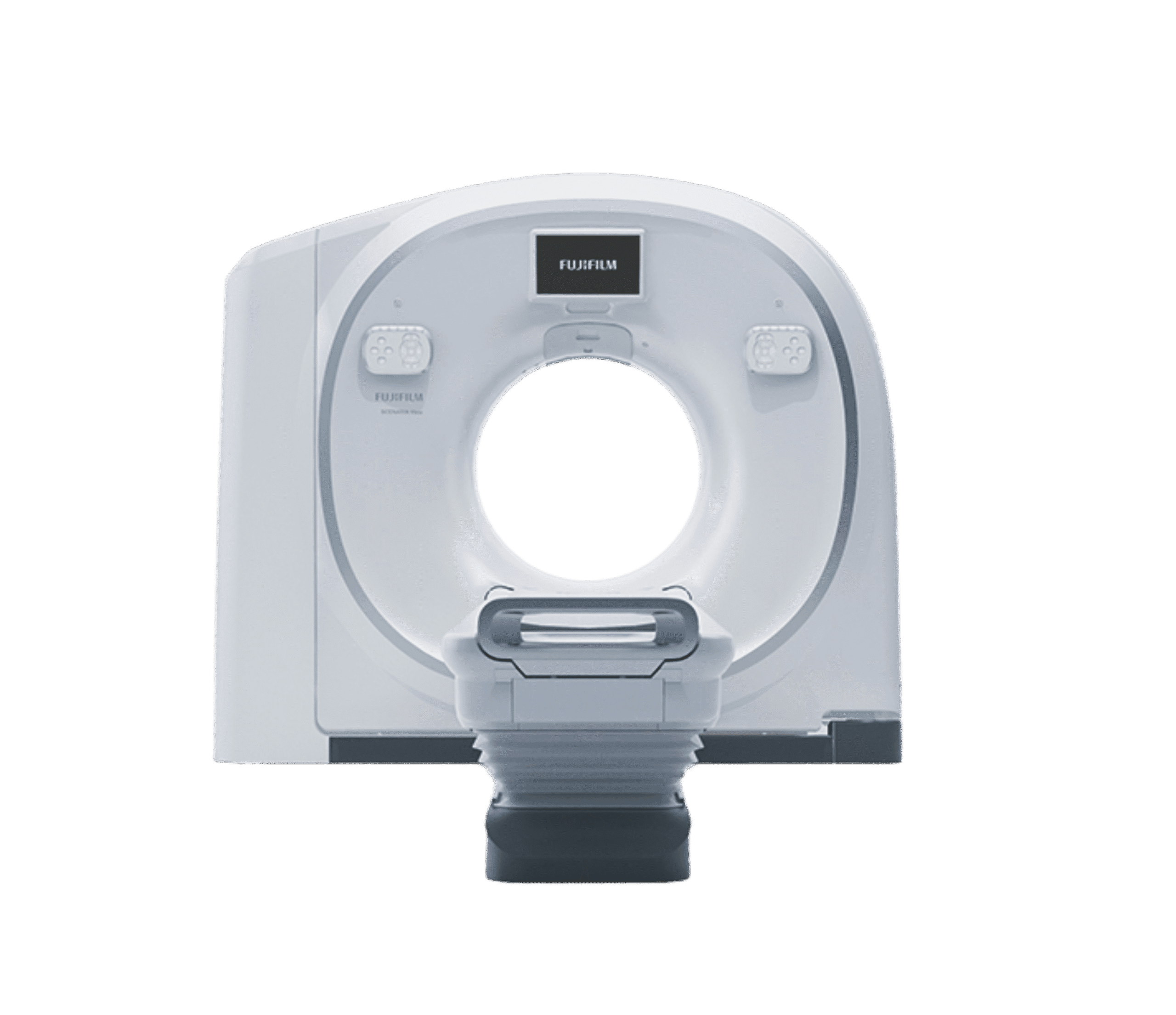
A CT scanner is an X-ray tube and a detector array facing each other inside a rotating gantry. The pair spins around the patient while the table moves through. Software reconstructs the many angles into cross sectional slices. It is fast because rotation is fast.
MRI, in plain terms
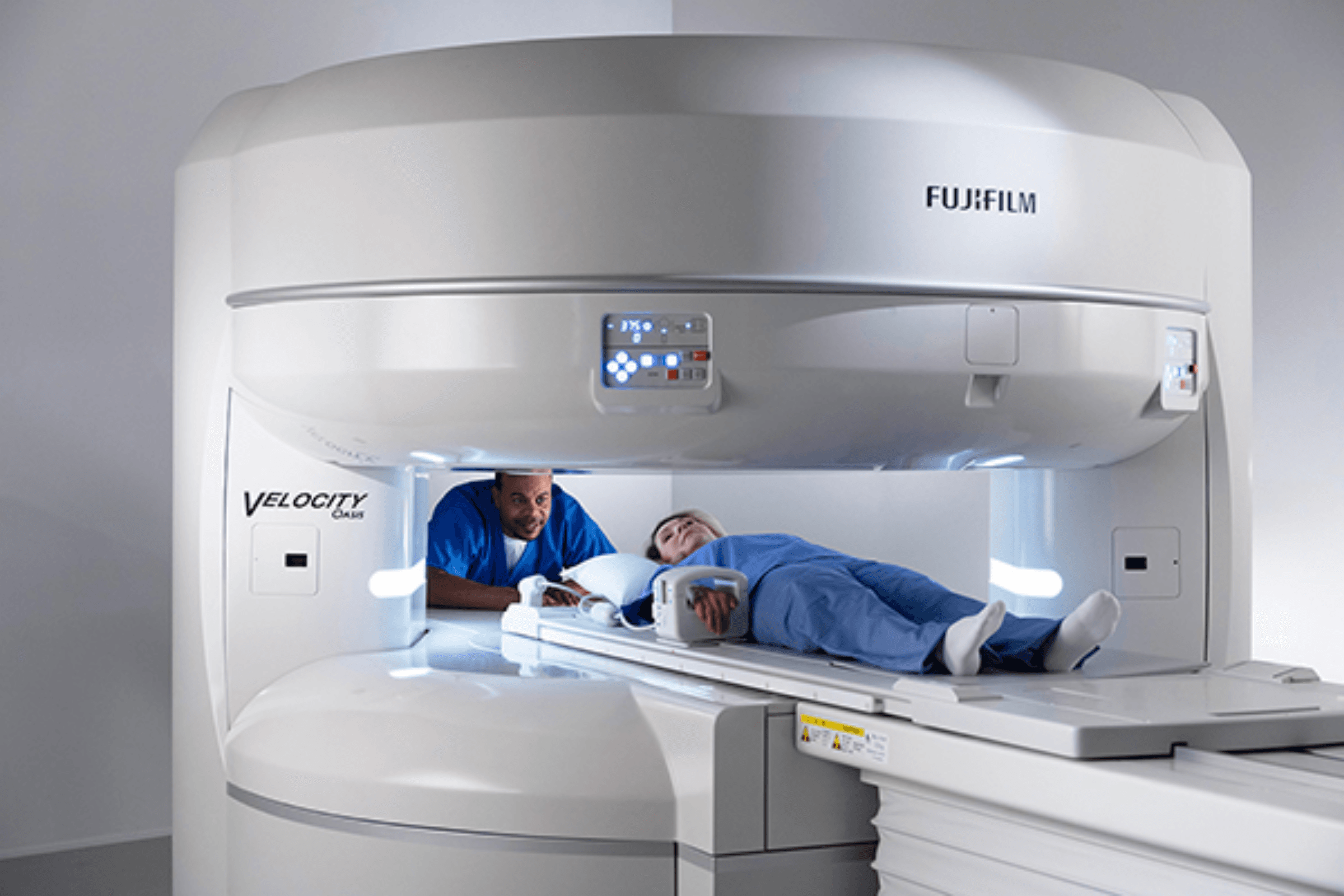
An MRI scanner is a very strong superconducting magnet, kept superconducting by liquid helium. It aligns hydrogen nuclei in the body, then radio frequency pulses knock them out of alignment. The signal they give off as they realign is what builds the image.
Because different tissues release that signal at different rates, MRI distinguishes between soft tissues that look nearly identical on a CT. Varying the timing produces different weightings, which is what our guide to T1 versus T2 imaging explains.
MRI vs CT: When Is Each One Better?
On MRI vs CT, neither is better in general. Each is better for particular questions.
- MRI is the answer for brain and spinal cord, spine, joints and ligaments, muscle, most oncology staging, pelvic and prostate work, and anything where distinguishing one soft tissue from another is the whole point
- CT is the answer for major trauma, suspected bleeds, bone and fractures, lungs and chest, abdominal emergencies, stone disease, and anything where the patient cannot hold still for long
Speed is not a minor detail. In acute care a scan that takes seconds and a scan that takes forty minutes are not equivalent options, whatever the image quality difference. That is why emergency departments are built around CT.
Two constraints decide some cases before image quality is even considered. An MRI magnetic field is always on, so implants, pacemakers and other devices have to be cleared first. And a CT delivers a radiation dose, which is justified against clinical benefit and is a bigger consideration in younger patients and in repeat imaging.
The FDA overview of MRI and the FDA overview of CT both cover those trade-offs.
MRI Contrast vs CT Contrast: What Is the Difference?
MRI vs CT contrast is a real difference. Both modalities use contrast agents, and they are not the same substance.
- MRI contrast is usually gadolinium based. It changes how tissue responds to the magnetic field, so enhancing structures stand out
- CT contrast is iodine based. It changes how much X-ray a structure absorbs, so vessels and organs separate from what surrounds them. It may be injected or swallowed depending on the study
The difference between an MRI with and without contrast is what the study is asking. Without contrast you still get excellent anatomical detail. With contrast you additionally see vascularity, inflammation and many lesions that are otherwise hard to separate from normal tissue. Kidney function is a consideration for both agents.
MRI Machine vs CT Machine: What Changes for a Facility?
This is the part MRI vs CT comparisons leave out, and it is usually what actually decides the purchase.
| CT | MRI | |
|---|---|---|
| Room | Lead shielded | RF shielded enclosure, plus a controlled magnetic fringe field zone |
| Services | Power and cooling | Power, chiller, and a quench vent to outside air |
| Consumables | Tube replacement over time | Cryogens, cold head and chiller maintenance |
| Delivery | Heavy, usually straightforward | Much heavier, often needs a crane or a wall opening |
| Throughput | High | Lower per hour |
| Purchase cost | Lower | Substantially higher |
The magnet is the difference. A CT can be switched off. An MRI magnet cannot, which is why the room, the route in and the fringe field all have to be planned before the system is ordered. It is also why a quench is a scenario a CT simply does not have. We handle installation, rigging and siting and cryogenics ourselves, and we service both modalities including systems bought elsewhere.
For projects in the islands, freight, import handling and engineer travel all have to be planned in, which our notes on installation in Puerto Rico and the Caribbean cover.
MRI vs CT: Which Should Your Facility Buy?
For most general facilities the honest answer is CT first. It is cheaper to buy, far simpler to site, faster per patient, and it covers emergency work. MRI is usually the second machine, added once volume justifies the siting cost.
The exception is a practice whose caseload is predominantly musculoskeletal, neurological or oncological. There, an MRI is not the second machine, it is the whole business, and buying a CT first would be solving the wrong problem.
- Caseload What do you actually scan, and what do you currently send out?
- Building Can the room take an MRI at all? Floor loading, the route in and the fringe field decide this before budget does
- Throughput How many patients per day does the business plan need?
- Staffing MRI needs technologists trained on it and a safety programme around the magnet
- Total cost Not just the purchase. Cryogens, service and power make an MRI more expensive to run as well as to buy
Prices by class are in our MRI machine cost guide and CT scanner cost guide. If MRI is the direction, the format decision comes next, and our guides to open versus closed MRI and wide bore systems cover it. Refurbished is worth considering on either modality, and refurbished versus OEM certified explains what the terms actually mean.
If you want this sized against your own caseload rather than in the abstract, tell us what you scan and we will tell you what fits.
MRI vs CT: Common Questions
What is the difference between an MRI and a CT scan?
The difference between MRI and CT is that an MRI uses a strong magnetic field and radio waves while a CT uses X-rays. That single difference drives everything else: MRI involves no ionising radiation and shows soft tissue in far more detail, while CT is much faster and better for bone, acute trauma and the chest.
What is the difference between an MRI and a CAT scan?
The same question, because a CAT scan and a CT scan are the same thing. CAT stands for computed axial tomography, which was the original name for the technique. So an MRI vs CAT scan comparison is an MRI vs CT comparison: magnetic field and radio waves on one side, X-rays on the other.
Is a CT scan the same as an MRI?
No. They are different technologies that produce different information. A CT scan is an X-ray based cross sectional image. An MRI is produced by a magnetic field and radio waves. They are often complementary rather than interchangeable, which is why many facilities run both.
What is the difference between a CT scan machine and an MRI machine?
A CT machine is an X-ray tube and detector array rotating inside a gantry. An MRI machine is a large superconducting magnet cooled by liquid helium, with gradient and radio frequency systems inside it. For a facility that means very different siting: a CT needs a lead shielded room, an MRI needs an RF shielded enclosure, a magnetic fringe field zone and a quench vent.
Which is better, an MRI or a CT scan?
Neither is better in general, only better for a given question. MRI is better for brain, spine, soft tissue, joints and anything where tissue contrast matters. CT is better for acute trauma, bone detail, lungs and any situation where speed matters. The referring clinician chooses based on the clinical question.
Is an MRI or a CT scan safer?
MRI uses no ionising radiation, which is its main safety advantage, particularly for younger patients and repeat imaging. MRI has its own constraints though, because the magnetic field is always on and some implants and devices are unsafe near it. CT delivers a radiation dose, which is managed and justified against the clinical benefit.
What is the difference between MRI contrast and CT contrast?
They are different agents. MRI contrast is usually gadolinium based and changes how tissue responds to the magnetic field. CT contrast is iodine based and changes how much X-ray a structure absorbs. They are not interchangeable and they have different considerations, including kidney function.
What is the difference between an MRI with and without contrast?
Contrast is injected to make blood vessels, inflammation and many lesions stand out from the tissue around them. Without contrast you still get excellent anatomical detail. Some questions can only be answered with contrast, and some are answered perfectly well without it, so the protocol is chosen for the clinical question.
How long does an MRI take compared with a CT?
A CT is typically a few minutes and the scan itself often takes seconds. An MRI usually takes twenty minutes to an hour depending on how many sequences are needed. That difference in throughput is one of the biggest practical factors when a facility is deciding what to install.
Which costs more to buy, an MRI or a CT scanner?
MRI, substantially, both to buy and to run. The magnet, the RF shielded enclosure and the cryogenic system have no equivalent on a CT. Current ranges are in our MRI machine cost guide and our CT scanner cost guide.
Which is harder to install, an MRI or a CT?
MRI, by a wide margin. A CT needs a lead shielded room, a suitable floor and power. An MRI additionally needs an RF shielded enclosure, a controlled magnetic fringe field zone, a quench vent to outside, a chiller and considerably more floor loading. MRI siting has to be planned before the system is ordered.
Can a CT scan replace an MRI?
Sometimes, and often not. For acute trauma, bone and chest imaging a CT answers the question faster. For soft tissue, brain, spine and joint detail a CT cannot match what an MRI shows. Facilities that can run only one usually choose based on their dominant caseload.
Does a CT scan use radiation and does an MRI?
A CT uses ionising radiation because it is an X-ray technique. An MRI does not. An MRI uses a strong static magnetic field, switching gradient fields and radio frequency pulses, none of which is ionising.
Should my facility buy an MRI or a CT scanner first?
For most general facilities a CT comes first. It is cheaper to buy, far simpler to site, faster per patient and it covers emergency work. MRI is usually the second machine, added once volume justifies the siting cost. The exception is a practice whose caseload is predominantly musculoskeletal, neurological or oncological.
Do you supply both MRI and CT systems?
Yes. We are Medical Outfitters, a medical imaging equipment supplier based in Miami, Florida. We supply new and refurbished MRI and CT systems and service both with our own engineers across the United States, Puerto Rico and the Caribbean.
