
Published 28 September 2026. Equipment facts were checked against manufacturer documentation and the FDA description of fluoroscopy. Written by the Medical Outfitters field engineering team.
C-Arm vs Fluoroscopy: What Is the Difference?
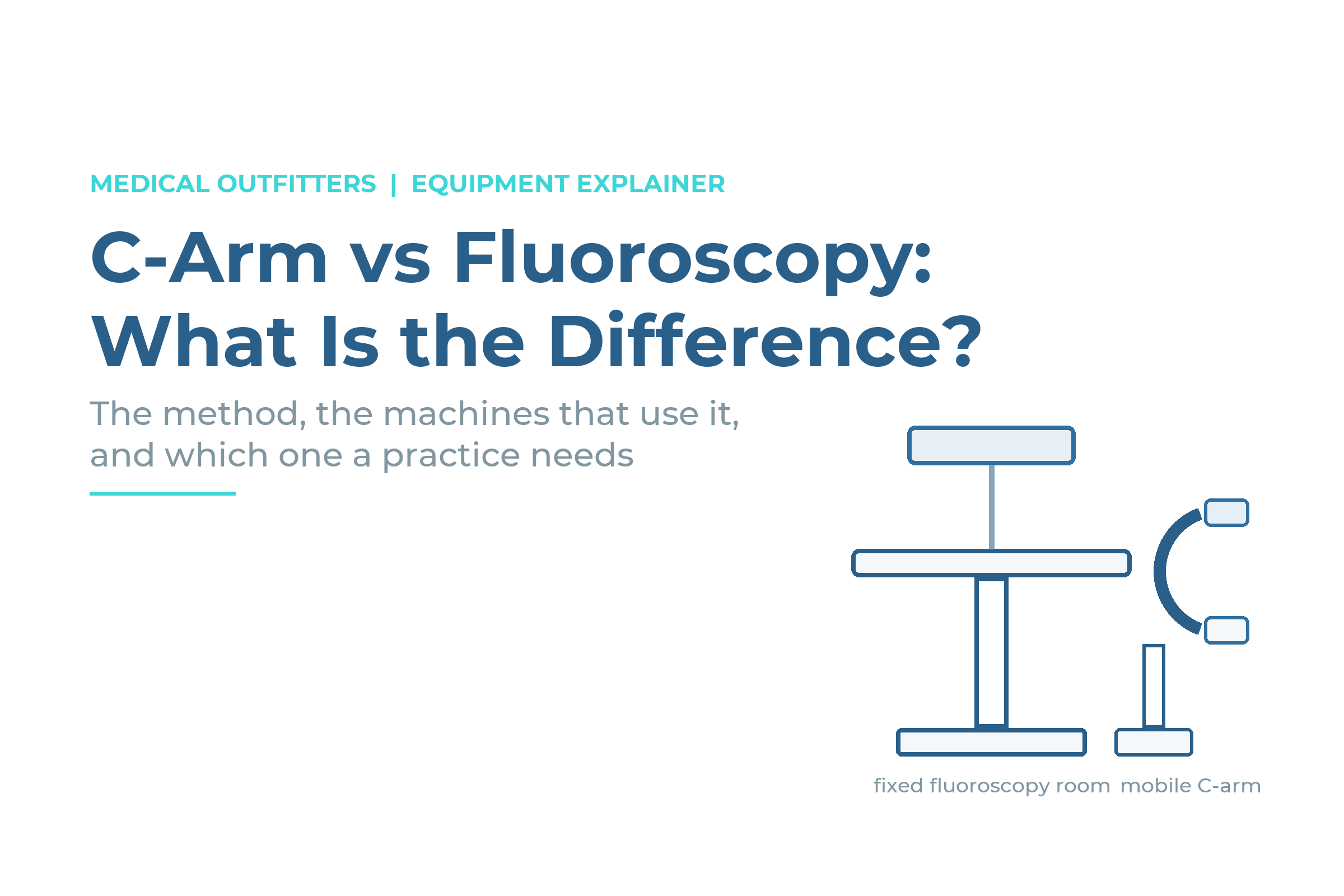
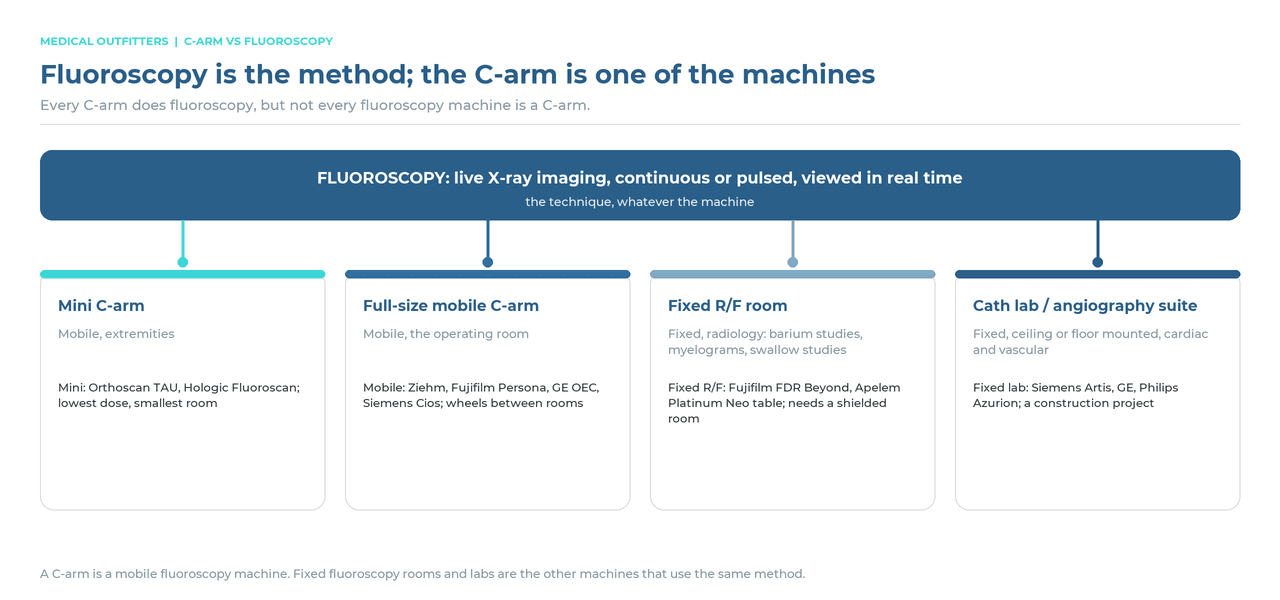
Fluoroscopy is the method: live X-ray imaging, viewed in real time on a monitor, so a clinician can watch anatomy, instruments and contrast move. A C-arm is one of the machines that does it: a mobile unit with the X-ray tube and the image detector held on a C-shaped arm, wheeled into an operating or procedure room. Every C-arm does fluoroscopy, but fluoroscopy is also done on fixed radiography and fluoroscopy rooms and in cardiac and vascular labs, which are built into a shielded room rather than rolled in. Per the U.S. Food and Drug Administration, fluoroscopy is an imaging technique that uses X-rays to obtain real-time moving images of the interior of a patient.
So the practical question behind the search is which machine you need. This explainer covers what fluoroscopy is, the machines that do it, how a mobile C-arm compares with a fixed fluoroscopy room, which one fits which procedures, what each costs, and the terms that get mixed up along the way. Purchase ranges are in the C-arm machine cost guide.
What Fluoroscopy Is
A plain X-ray is a single exposure that produces a still image. Fluoroscopy runs the X-ray tube continuously or, on modern systems, in short pulses, and shows the result on a monitor as it happens. The clinician sees a fracture being reduced, a needle reaching the target level, a catheter advancing through a vessel or contrast moving through the gut, and adjusts in real time.
How the dose is kept down
Because the beam runs for seconds or minutes rather than a fraction of a second, fluoroscopy systems are built to limit dose: pulsed fluoroscopy fires the tube a few times a second instead of continuously, last-image-hold keeps the final frame on screen with the beam off, collimation narrows the beam to the region of interest, and the technologist keeps the detector close to the patient. The operator, not the machine, controls most of the dose, which is why training and state credentialing matter on every fluoroscopy system.
Image intensifier or flat panel
Older fluoroscopy systems capture the image with an image intensifier, a vacuum tube that converts X-rays to light and then to a video signal; newer systems use a flat-panel detector, usually CMOS, that produces a rectangular image with no geometric distortion, a wider dynamic range and generally a lower dose. Both are fluoroscopy; the detector changes the image quality and the price, not the method.
The Machines That Do Fluoroscopy
- Mini C-arm. A compact mobile unit for hands, wrists, feet and ankles, with a small flat panel from 15 x 12 cm to 20 x 20 cm and the lowest dose in the category. Orthoscan TAU 1512 to TAU 2020, Hologic Fluoroscan.
- Full-size mobile C-arm. The operating-room workhorse for orthopedics, trauma, spine, pain management, urology and general surgery, with an image intensifier or a 21 to 31 cm flat panel and generators from 2.4 kW monoblocks to 15 to 25 kW rotating anodes. Ziehm Solo FD, Vision FD and Vision RFD, Fujifilm Persona CS and Persona C, GE OEC, Siemens Cios. A 3D C-arm such as the Ziehm Vision RFD 3D adds a CT-like reconstruction.
- Fixed radiography and fluoroscopy room. A shielded room in radiology with a tilting table and a large detector, for barium and swallow studies, myelograms, arthrograms and other GI and GU fluoroscopy. Fujifilm FDR Beyond, Apelem Platinum Neo remote-controlled table.
- Cardiac catheterization and angiography labs. Ceiling or floor-mounted fixed C-arms with large flat panels and high-power generators for cardiac and vascular intervention; a construction project as much as an equipment purchase. What a cath lab is covers them.
- Hybrids. The Fujifilm FDR Cross combines a mobile C-arm with a portable X-ray in one battery-powered unit.
Mobile C-Arm vs Fixed Fluoroscopy Room
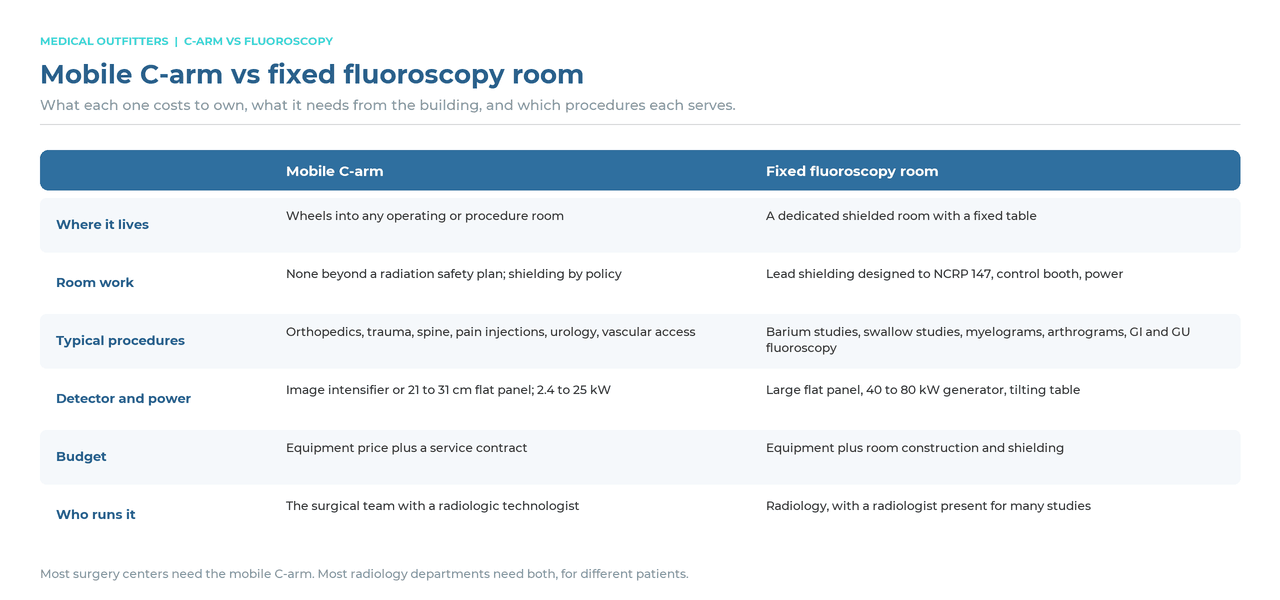
| Mobile C-arm | Fixed fluoroscopy room | |
|---|---|---|
| Where it lives | Wheels into any operating or procedure room | A dedicated shielded room with a fixed table |
| Room work | None beyond a radiation safety plan and the shielding your policy requires | Lead shielding designed to NCRP Report 147, a control booth, dedicated power |
| Typical procedures | Orthopedics, trauma, spine, pain injections, urology, vascular access | Barium and swallow studies, myelograms, arthrograms, GI and GU fluoroscopy |
| Detector and power | Image intensifier or 21 to 31 cm flat panel; 2.4 to 25 kW | Large flat panel, 40 to 80 kW generator, tilting table |
| Budget | Equipment price plus a service contract | Equipment plus room construction and shielding |
| Who runs it | The surgical team with a radiologic technologist | Radiology, with a radiologist present for many studies |
The room is the difference that matters most for the budget: a mobile C-arm can be working the week it arrives, while a fixed room is a construction project with shielding designed by a physicist, covered in what size room an X-ray machine needs.
Which One Does Your Practice Need?
- Orthopedic or podiatric office doing extremity procedures: a mini C-arm
- Surgery center or hospital operating room: a full-size mobile C-arm; a compact all-in-one unit if the rooms are small, a higher-power unit if vascular or bariatric cases are on the list
- Pain management practice: a full-size mobile C-arm, often a compact flat-panel unit
- Spine and trauma programs that check implants intraoperatively: a 3D C-arm
- Radiology department doing barium, swallow and GI studies: a fixed radiography and fluoroscopy room
- Cardiac or vascular intervention at volume: a cath lab or angiography suite
- A need with an end date: rent a C-arm rather than buy one
What Each One Costs
A mini C-arm costs $45,000 to $85,000 refurbished and $110,000 to $185,000 new; a full-size mobile C-arm $55,000 to $135,000 refurbished and $165,000 to $295,000 new; a 3D or premium vascular system $125,000 to $240,000 refurbished and $275,000 and up new, delivered, installed and warrantied, per the C-arm machine cost guide. A fixed radiography and fluoroscopy room is quoted per project on top of the room construction and shielding; the X-ray machine cost guide covers R/F rooms. Renting a mobile C-arm runs $2,000 to $12,000 a month by class, per the C-arm rental page.
Terms People Mix Up
- C-arm X-ray machine, C-arm machine, mobile fluoroscopy system: all the same equipment, a mobile C-arm
- Fluoroscope, fluoroscopy unit, fluoroscopy machine: any machine that does fluoroscopy; in a surgery center it means the C-arm, in radiology it usually means the fixed room
- Radiography and fluoroscopy (R/F) room: a fixed room that does both plain X-rays and fluoroscopy
- Image intensifier (II) and flat-panel detector (FPD): the two detector technologies; the FPD is newer, sharper and lower in dose
- Pulsed fluoroscopy: firing the tube in short pulses rather than continuously to cut dose
- Cone-beam CT, 3D C-arm: a C-arm that rotates around the patient to reconstruct a CT-like volume
Choosing between two specific used systems? The used C-arm buying guide covers the tube, detector and software checks. Ask us which machine fits your case list »
Frequently Asked Questions
- What is the difference between a C-arm and fluoroscopy?
- Fluoroscopy is the method: live X-ray imaging viewed in real time. A C-arm is one of the machines that does it, a mobile unit with the X-ray tube and detector on a C-shaped arm. Fixed radiography and fluoroscopy rooms and cath labs do fluoroscopy from a fixed, shielded installation.
- Is a C-arm a fluoroscopy machine?
- Yes. A mobile C-arm is a fluoroscopy machine, and in a surgery center or pain practice the two terms mean the same equipment. In a radiology department, fluoroscopy machine usually means the fixed room with a tilting table.
- Is fluoroscopy the same as an X-ray?
- Both use X-rays. A plain X-ray is a single exposure that produces a still image; fluoroscopy runs the tube continuously or in pulses to show moving images in real time, which is why it is used to guide procedures rather than to take a diagnostic picture.
- What procedures use a C-arm?
- Fracture reduction and joint replacement, spinal hardware placement, pain injections and nerve blocks, kidney stone and stent procedures, vascular access and, on higher-power systems, angiography. Mini C-arms cover hand, wrist, foot and ankle work.
- What is a fixed fluoroscopy room used for?
- Barium and swallow studies, myelograms, arthrograms and other GI and GU fluoroscopy, in a shielded radiology room with a tilting table and a large detector. It is built into the building rather than wheeled between rooms.
- How much does a fluoroscopy machine cost?
- A mobile C-arm, which is a fluoroscopy machine, costs $45,000 to $295,000 depending on format, detector and condition, delivered, installed and warrantied. A fixed radiography and fluoroscopy room is quoted per project on top of the room construction and shielding.
- Does a C-arm need a shielded room?
- A mobile C-arm needs a radiation safety plan, operator credentialing and the shielding your facility’s physicist and state require for the rooms it is used in; it does not need a purpose-built shielded room the way a fixed fluoroscopy room does, which is shielded to a design prepared under NCRP Report 147.
- Can I rent a fluoroscopy machine?
- Yes. Mobile C-arms rent from Medical Outfitters at $2,000 to $12,000 a month by class, delivered, set up and supported for the term. Fixed fluoroscopy rooms are not rented because they are built into a shielded room.
