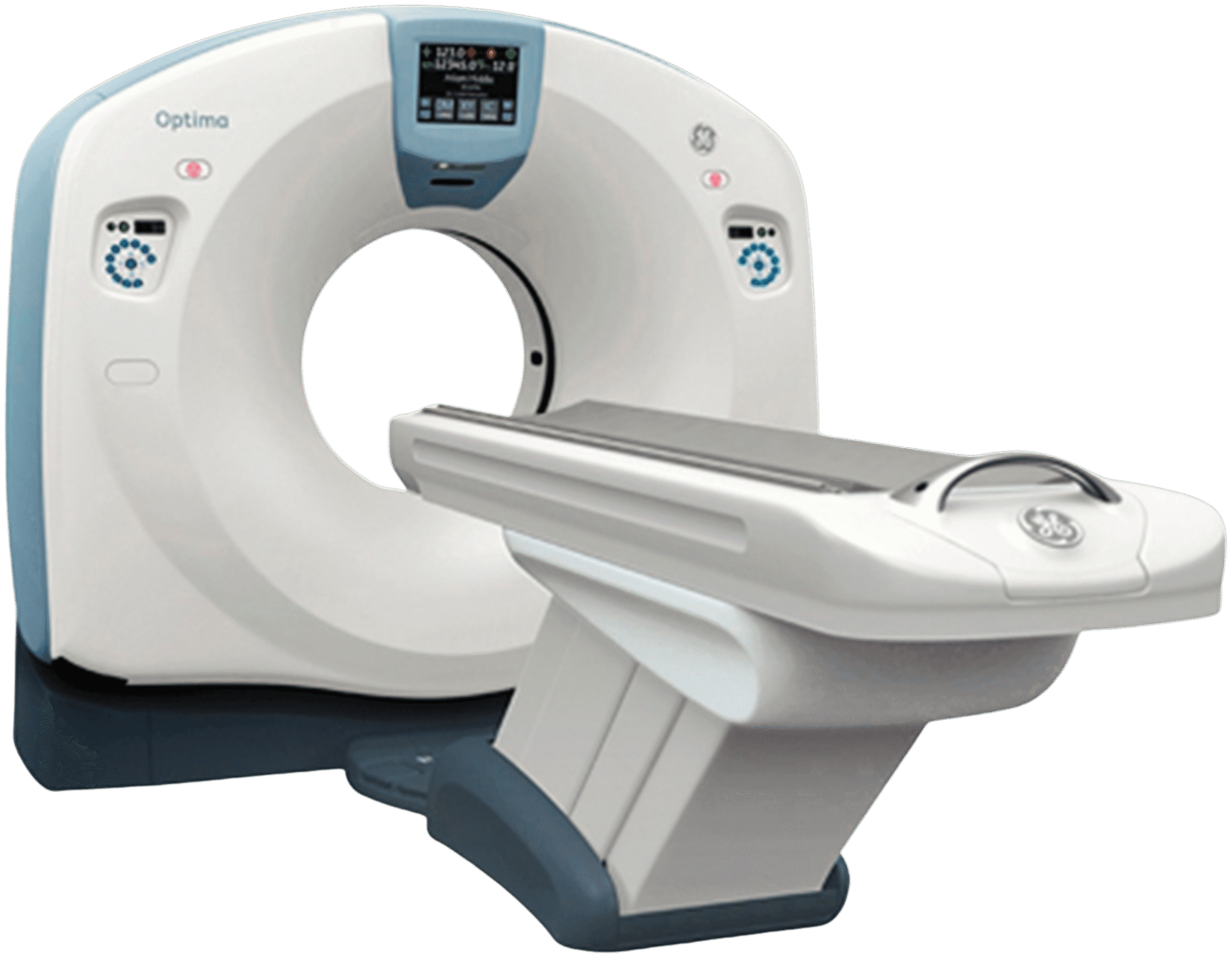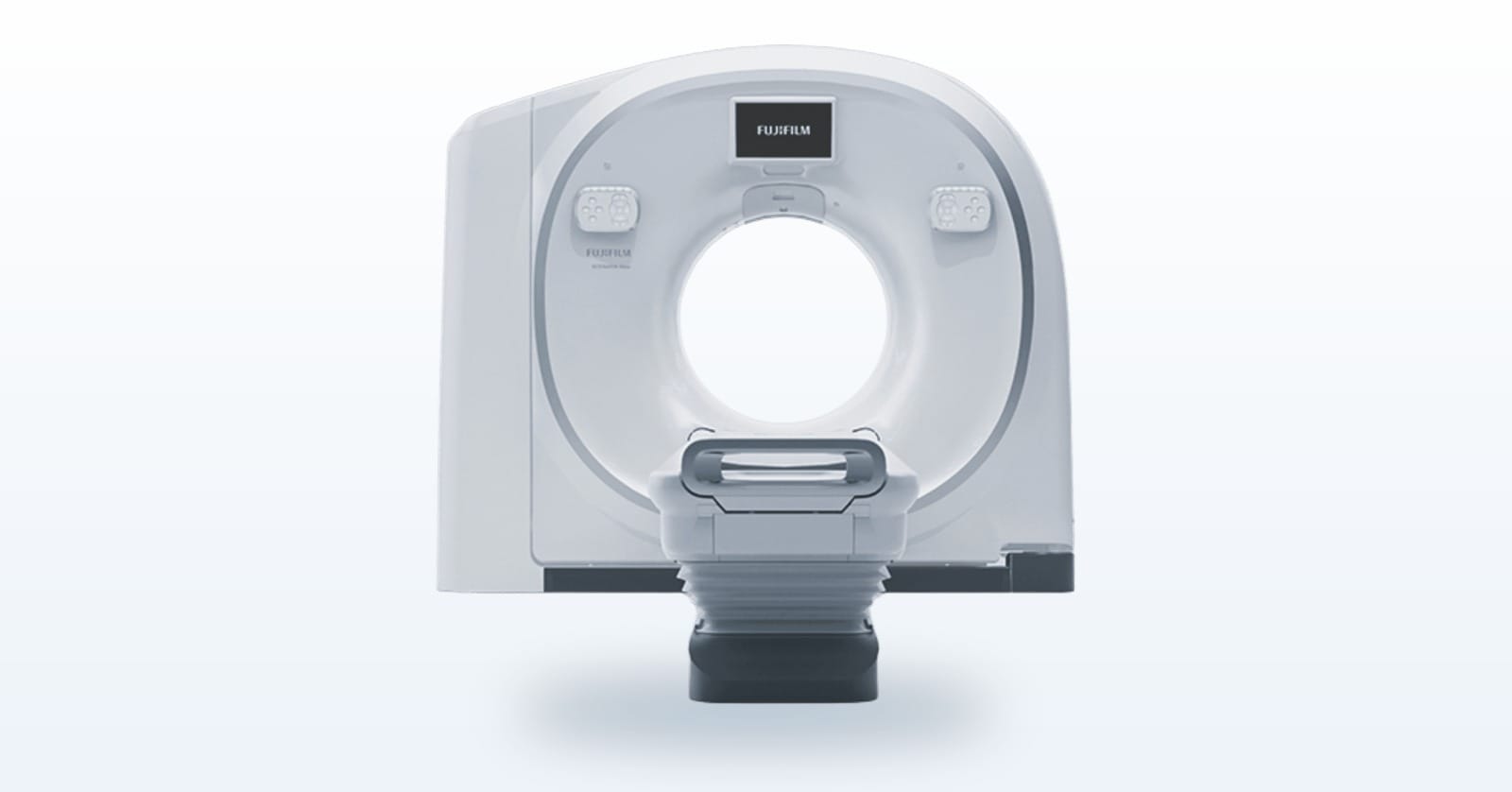
The types of CT scanners on the market are sorted by slice count: 16-slice, 32-slice, 64-slice, 128-slice, and the 256-slice and 320-row systems above them. The number is how many image slices the scanner produces in one rotation of the gantry. It sets how much of the patient is covered per turn, how fast a study finishes and which exams the scanner can do well.
The short version: a 16 slice CT scanner handles routine head, chest, abdomen and spine work at a refurbished price. A 64 slice CT scanner is the practical starting point for coronary CT angiography. A 128 slice CT scanner adds coverage, speed and low-dose headroom for cardiac, pediatric and high-volume departments. Everything above that belongs in tertiary and academic centers.
This guide is written for the people who sign off on the purchase. It explains what a slice actually is, what each tier does well, the three other numbers that decide how a scanner performs, how to read a configuration sheet, and how to match a tier to a clinic, an emergency department or a hospital.
- Slice count is coverage. Rows multiplied by row width gives millimetres per rotation: about 20 mm at 16 slices, 40 mm at 64, 80 mm at 128, 160 mm at 320 rows.
- Cardiac imaging starts at 64. Below that the coverage and rotation speed cannot freeze a beating heart.
- Most outpatient imaging needs 16 to 32. The money saved pays for the room, the shielding and the service contract.
- Rotation time, tube capacity and reconstruction software separate two scanners with the same slice count.
Medical Outfitters sells new Fujifilm CT scanners as an authorized dealer and refurbished GE and Siemens systems through its MO Select program, and installs and services them with its own engineers across the United States, Puerto Rico and the Caribbean. Every tier below is on our CT scanners for sale page.
CT Scanner Types by Slice Count at a Glance
| Tier | Coverage per rotation | What it does well | Typical buyer | Examples |
|---|---|---|---|---|
| 16-slice | About 20 mm | Routine head, chest, abdomen, spine and extremity CT; non-cardiac emergency work | Clinics, urgent care, small hospitals, second scanner | GE BrightSpeed Elite, GE LightSpeed 16, Siemens SOMATOM Scope |
| 32 to 40-slice | About 20 to 25 mm, faster rotation | Faster routine imaging, oncology follow-up, radiation-therapy planning with a wide bore | Outpatient imaging, oncology, compact rooms | Fujifilm Supria 32 |
| 64-slice | About 40 mm | Coronary CT angiography, CT perfusion, trauma protocols, high-volume general imaging | Hospitals, emergency departments, cardiac programs | GE Optima CT660, GE LightSpeed VCT, Fujifilm SCENARIA View 64 |
| 128-slice | About 80 mm | Whole-organ coverage in one or two rotations, low-dose pediatric and cardiac, throughput | Busy hospital departments, cardiac and pediatric centers | Fujifilm Supria 128, SCENARIA View 128, iStream 128 |
| 256-slice and up | 120 to 160 mm | Whole heart in one heartbeat, dynamic perfusion, dual-source and spectral techniques | Academic and tertiary centers | GE Revolution, Siemens SOMATOM Force, Canon Aquilion ONE, Philips iCT |
Two cautions before you use the table. Manufacturers count slices in different ways, so a “128-slice” scanner from one maker may have 64 physical detector rows, and a “64-slice” scanner from another may cover more anatomy per rotation. And the tier tells you what a scanner can do, not how well it does it. Both points are covered below.
What a Slice Actually Is
A CT scanner is an X-ray tube on one side of a rotating ring and a detector array on the other. Every rotation, the detector captures the X-rays that passed through the patient from every angle, and the computer reconstructs that data into cross-sectional images. The detector is not a single strip. It is a bank of parallel rows along the patient’s long axis, and each row produces one image slice per rotation: a 16-row detector produces sixteen slices, a 64-row detector sixty-four.
Multiply the number of rows by the width of each row and you get the coverage per rotation, which is the number that actually decides speed. Sixteen rows of 1.25 mm cover 20 mm. Sixty-four rows of 0.625 mm cover 40 mm. One hundred and twenty-eight rows of 0.625 mm cover 80 mm. A 320-row scanner with 0.5 mm rows covers 160 mm, which is why it can image the whole heart in a single rotation.
Why the brochure number and the row count differ
Some manufacturers shift the X-ray focal spot between two positions during each rotation, so every detector row yields two overlapping samples. A scanner with 64 physical rows is then sold as a 128-slice system and a 32-row scanner as 64-slice. The technique genuinely improves resolution along the patient axis, but it does not double the coverage per rotation. When you compare quotes, ask for the physical row count and the coverage in millimetres, not only the slice number on the brochure.
16-Slice CT Scanners
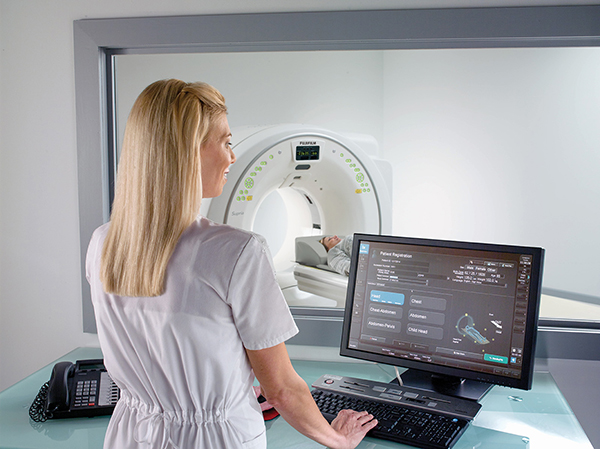
Sixteen slices is the floor for a diagnostic scanner bought today. It covers the routine list, head, sinus, cervical and lumbar spine, chest, abdomen and pelvis, extremities and kidney-stone protocols, at image quality radiologists accept without comment. A chest-abdomen-pelvis study takes a few rotations more than it would on a 64-slice system, which matters in a trauma bay and does not matter on a scheduled outpatient list.
What a 16 slice CT scanner cannot do is gated cardiac imaging. The coverage is too narrow and the rotation too slow to freeze a beating heart, so coronary CT angiography is off the table. It is also the tier where refurbished systems make the most financial sense. The GE BrightSpeed, GE LightSpeed 16 and Siemens SOMATOM Scope are proven platforms with deep parts supply, and a unit stripped, rebuilt and tested to the manufacturer specification with a fresh tube costs a fraction of a new mid-range scanner.
Who buys 16-slice: urgent care and walk-in clinics, orthopedic and ENT practices, veterinary hospitals, small rural hospitals, and any facility adding a second scanner for routine work so the main scanner stays free for cardiac and emergency studies.
32 and 40-Slice CT Scanners
The 32 to 40-slice tier is the quiet middle of the market. It scans noticeably faster than 16-slice, covers more anatomy per rotation and handles oncology follow-up and CT-guided procedures comfortably, without the cost of a cardiac-capable system. The Fujifilm Supria 32 is the example we sell most: 32 slices with a 75 cm bore in one of the smallest footprints in the class, so it fits rooms that were built for older scanners and takes bariatric patients and radiation-therapy positioning that a 70 cm bore struggles with.
If your radiologists have no cardiac ambitions and your room is tight, this tier usually beats a refurbished 64-slice system on total cost, because the tube, the service contract and the power requirements are all lighter.
64-Slice CT Scanners
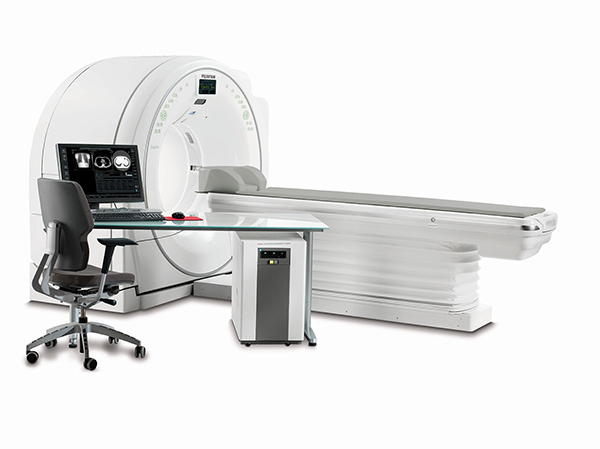
Sixty-four slices is the threshold where coronary CT angiography, CT perfusion and fast whole-body trauma protocols become practical. With 40 mm of coverage and sub-half-second rotation, the scanner can image the heart in a handful of gated rotations, run a head-to-pelvis trauma scan in seconds and support a cardiac program that was previously sent to the hospital across town. It is also the tier where the secondary market is deepest: the GE Optima CT660 and GE LightSpeed VCT 64 were sold in large numbers, which keeps refurbished pricing and parts supply favourable.
New 64 slice CT scanners remain in every major vendor’s line, and the Fujifilm SCENARIA View is offered in 64 and 128-slice configurations, so a department can buy the 64 today and know its upgrade path.
Who buys 64-slice: community hospitals, emergency departments, outpatient centers starting a cardiac CT service, and vascular and stroke programs that need perfusion and angiography.
128-Slice CT Scanners
At 128 slices the scanner covers 80 mm per rotation, so a whole heart takes one or two rotations, a pediatric chest is done before the child moves, and a busy department clears its list faster with lower dose per study. The extra coverage also improves perfusion and dynamic studies. This is the tier most new hospital purchases land on, because a 128 slice CT scanner does everything a 64 does with headroom for the next ten years.
The new systems we sell in this tier are the Fujifilm Supria 128, which keeps the compact Supria footprint, the SCENARIA View Focus Edition and the Fujifilm iStream 128. All three carry the manufacturer warranty and current dose-reduction and reconstruction software.
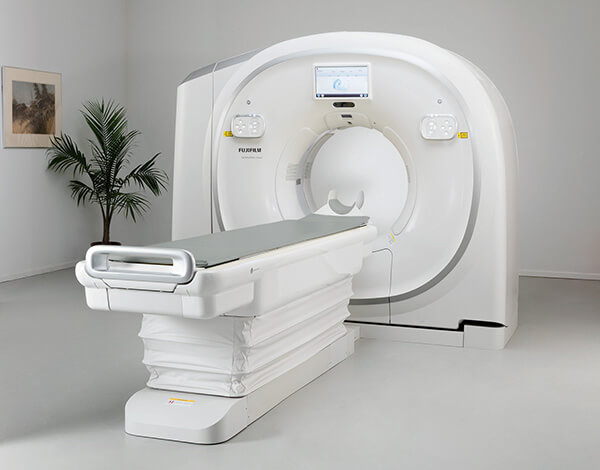
256-Slice, 320-Row and Dual-Source Systems
Above 128 slices the market splits three ways. Wide-coverage scanners with 256 or 320 rows cover 120 to 160 mm and image the entire heart or brain in a single rotation, which removes the stair-step artefacts of stitching several rotations together and allows dynamic perfusion of a whole organ. Dual-source scanners mount two tube-and-detector pairs at ninety degrees to halve the effective rotation time, which freezes fast heart rates without beta-blockers. Spectral and dual-energy scanners capture two energy levels to characterise tissue and reduce artefacts.
These systems belong in academic, tertiary and high-volume cardiac centers. For most community hospitals and every outpatient center, the clinical gain over a good 128-slice scanner does not justify the price, the room and the service contract, and they rarely appear on the refurbished market at attractive prices because their tubes and detectors are expensive to rebuild.
The Other Three Numbers That Matter
Rotation time
Coverage decides how many rotations a study needs; rotation time decides how long each one takes. Older 16-slice systems rotate in 0.5 to 1.0 seconds, modern 64 and 128-slice scanners in 0.28 to 0.35 seconds. Fast rotation is what makes gated cardiac imaging and uncooperative-patient scanning work.
Tube heat capacity and tube cost
The X-ray tube is the consumable at the heart of the scanner. A tube with high heat capacity keeps scanning through a long trauma list without cooling pauses, and every tube eventually fails and is replaced at a cost that runs well into five figures. Tube condition is the single biggest variable in a refurbished quote, and tube replacement terms should be in every service contract. Our guide to refurbished vs OEM-certified equipment explains how tube life is verified before a rebuilt scanner ships.
Reconstruction and dose software
Iterative and deep-learning reconstruction, automatic tube-current modulation and spectral filtering reduce dose by half or more at the same image quality. A 64-slice scanner with current software can produce lower-dose images than an older 128-slice scanner without it. Ask which reconstruction package is installed and whether it is licensed to the serial number you are buying, because licences do not always transfer with a used system.
How to Read a CT Configuration Sheet
Every quote for a CT scanner comes with a configuration sheet. Five lines on it tell you more than the model name.
- Detector rows and row width. Multiply them: that is the real coverage per rotation.
- Fastest rotation time. Under 0.35 seconds for cardiac work; 0.5 seconds is fine for routine outpatient imaging.
- Tube model, heat capacity and, on a used system, tube age in scan seconds or exposures.
- Bore diameter. 70 cm is standard; 75 to 80 cm for bariatric patients and radiation-therapy planning; 85 to 90 cm on dedicated RT scanners.
- Software options and their licence status: iterative reconstruction, cardiac package, dual energy, dose reporting, and whether each is licensed to this serial number.
Our CT scanner cost and price guide puts price ranges next to each of those lines, by slice count and by new versus refurbished.
Which Slice Count Does Your Facility Need?
Start from the exams you will bill for, not from the biggest scanner you can afford. Cardiac CT angiography, CT perfusion and high-volume trauma need 64 slices or more. Pediatric imaging, cardiac programs that will grow, and departments that run two shifts benefit from 128. Everything else, which is most outpatient imaging, is served well by 16 to 32 slices, and the money saved pays for the room, the shielding and the service plan.
Then check the room. A 16 or 32-slice scanner with a compact gantry fits an existing room that a 128-slice system will not, and a wide bore matters more than slices for radiation-therapy planning and bariatric patients. The MRI vs CT scan guide covers what CT siting involves compared with a magnet, and our note on clinical facility development in the US and Caribbean covers power, shielding and construction.
New or refurbished at each tier
In the 16 and 64-slice tiers the refurbished market is deep and the platforms are mature, so a rebuilt GE or Siemens system with a fresh tube and a written warranty is the value choice. In the 32 and 128-slice tiers the new Fujifilm systems are competitively priced and bring the compact footprint and current software, so new usually wins. Above 128 slices, buy new or not at all. Our refurbished medical imaging equipment page explains what an MO Select rebuild includes, and the Florida delivery and installation page covers local timelines.
CT Scanner Slice Count: Common Questions
What does the slice count of a CT scanner mean?
The slice count is the number of image slices the scanner produces in one rotation of the gantry, which usually equals the number of detector rows. Multiplied by the row width it gives the coverage per rotation: a 16-slice scanner typically covers about 20 mm per rotation, a 64-slice scanner about 40 mm and a 128-slice scanner about 80 mm. More coverage means fewer rotations, faster studies and the ability to image moving organs such as the heart.
Is a 64-slice CT scanner good enough for cardiac imaging?
Yes. Sixty-four slices with a rotation time under half a second is the accepted practical minimum for coronary CT angiography and CT perfusion. A 128-slice or wider scanner images the heart in fewer rotations, which helps with fast or irregular heart rates, pediatric patients and high volumes, but a 64-slice system supports a community cardiac program.
What is the difference between a 16-slice and a 64-slice CT scanner?
A 16-slice CT scanner covers about 20 mm per rotation and handles routine head, chest, abdomen, spine and extremity imaging. A 64-slice CT scanner covers about 40 mm per rotation, rotates faster and adds cardiac angiography, perfusion and fast trauma protocols. For scheduled outpatient work the difference in study time is modest; for an emergency department or a cardiac program it is decisive.
Why do some 64-row scanners get sold as 128-slice?
Some manufacturers shift the X-ray focal spot between two positions during each rotation so every detector row produces two overlapping samples. That doubles the marketed slice count and improves resolution along the patient axis, but it does not double the coverage per rotation. Compare scanners on physical row count and coverage in millimetres as well as the slice number.
How many slices does a small clinic or urgent care need?
Sixteen slices is enough for routine diagnostic CT in a clinic, urgent care or small hospital that does not perform cardiac imaging. A refurbished 16-slice scanner from GE or Siemens with a fresh tube and a written warranty is usually the most cost-effective route; a 32-slice compact system such as the Fujifilm Supria 32 adds speed and a 75 cm bore for a modest premium.
Does Medical Outfitters sell CT scanners in every slice tier?
Yes. We sell new Fujifilm CT scanners from 32 to 128 slices as an authorized dealer, and refurbished and used GE and Siemens scanners from 16 to 64 slices through our MO Select program. Every system is delivered, installed and serviced by our own engineers across the United States, Puerto Rico and the Caribbean.
Related Articles