Body composition DEXA scan cost is a different question from bone density scan cost, even though the same table answers both. A bone density test is a covered medical exam with a CPT code and a Medicare rate. A body composition DEXA is, almost everywhere in the United States, an elective service paid out of pocket by athletes, people on a weight loss or strength program, and patients whose physicians want a better number than a scale or a BMI chart can give. The prices come from a different market: franchised studios, mobile vans, university exercise labs, sports medicine practices and a growing number of imaging centers that sell the scan at a flat cash price. This article covers what a DEXA body composition scan measures, what named providers charged in October 2026, where to get a DEXA body composition scan, how the exam differs from a bone density scan and from a smart scale or calipers, and what the machine behind the service costs a clinic that wants to offer it.
Medical Outfitters sells new DMS Imaging Stratos bone densitometers as an authorized dealer and sources refurbished GE Lunar and Hologic systems on request through MO Select, delivered, installed and serviced across the United States, Puerto Rico and the Caribbean. We wrote this for two readers: the person pricing a scan for themselves, and the clinic owner, sports medicine physician or practice manager deciding whether a body composition service pays. If you only want the machine prices, the DEXA and bone densitometer cost guide has every band by model.
- Scan price: about $40 to $150 at dedicated providers, with mobile vans at the bottom and franchised studios and university labs at the top, per the providers’ October 2026 price pages; the Medical Outfitters DEXA guide records published prices from $40 to $374.
- What you get: fat mass, lean mass and bone mass for the whole body and each region, percent body fat, and on current systems an estimate of visceral fat, in a scan of about two to three minutes on the table per Hologic.
- Coverage: self-pay almost everywhere; the unlisted code CPT 76499 is contractor priced and almost always billed to the patient, per the Medical Outfitters DEXA guide. Most providers accept HSA and FSA cards.
- Versus a scale: in a 2006 study in Obesity, multifrequency bioelectrical impedance read 7.0 percentage points of body fat below DEXA in overweight men; the ISCD sets DEXA’s minimum precision at 2 to 3 percent.
- The machine: a body composition DEXA costs $62,000 to $85,000 refurbished for a GE Lunar Prodigy Pro, iDXA or Hologic Horizon and $125,000 to $165,000 new for a DMS Stratos DR, delivered and installed, per the Medical Outfitters DEXA cost guide.
What a DEXA Body Composition Scan Measures
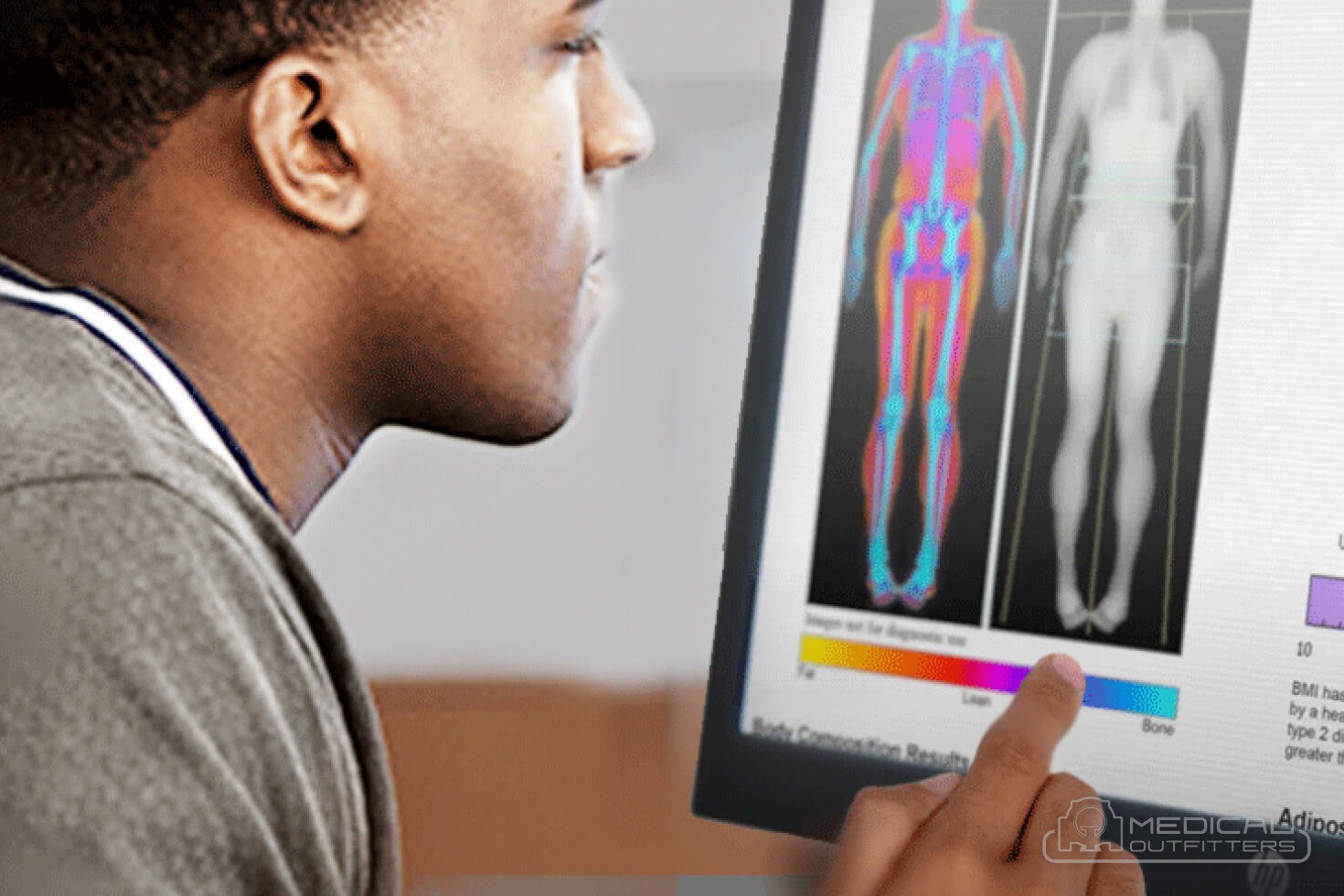
A DEXA body composition scan is a whole-body pass of the same dual-energy X-ray instrument that measures bone density at the hip and spine. The scanner sends X-rays at two energies through the body; bone, lean tissue and fat absorb the two energies in different proportions, and the software sorts every pixel into those three compartments. The result is a three-part inventory of the body, reported in grams and percentages for the whole body and for each arm, each leg and the trunk. RadiologyInfo, the patient site of the American College of Radiology and the Radiological Society of North America, notes that the whole body is sometimes scanned in children and some adults, and that the test uses less radiation than a tenth of a chest X-ray and less than a day of natural background exposure.
The International Society for Clinical Densitometry (ISCD), whose official positions set the standard for how DEXA is performed and reported, lists what an adult body composition report should contain: BMI, bone mineral density, bone mineral content, total mass, total lean mass, total fat mass and percent fat mass. The ISCD also names the reference data clinics should use for United States patients, the NHANES 1999 to 2004 survey, which covers ages 8 to 85, so a result can be shown as a percentile or a Z-score against people of the same age and sex. Hologic’s Horizon page states that its reference data draws on more than 20,000 individuals from the CDC’s NHANES study and that a scan can report up to 220 regional measurements of fat, lean mass and bone.
Three outputs explain why people pay for the scan rather than step on a scale. The first is regional lean mass: a result that shows the right leg carrying 8 percent less muscle than the left is useful to a physical therapist or a strength coach in a way that total weight never is. The second is appendicular lean mass divided by height squared, which the ISCD names as a way to define low lean mass, with sarcopenia thresholds still awaiting confirmation. The third is visceral fat. GE HealthCare’s CoreScan application, which the trade press reported as receiving FDA 510(k) clearance in June 2011, estimates visceral and subcutaneous adipose tissue mass, volume and area inside the android region of a total body scan, per GE’s June 2023 iDXA brochure. Hologic’s InnerCore, which Hologic’s technical white paper states was FDA cleared in 2011, estimates visceral fat area from the whole-body exam; the same paper says the literature puts a threshold of 100 to 160 square centimeters, depending on sex and ethnicity, at the point where visceral fat area is associated with more cardiovascular risk factors.

The ISCD is careful about how far those numbers should be pushed. Its positions describe DXA adiposity measures such as visceral adipose tissue as optional, with clinical utility it calls currently uncertain, and state that no obesity thresholds based on DXA percent fat or fat mass index have been established, even though those measures may help stratify cardiometabolic risk. A buyer of the scan should read the report the same way: precise, repeatable numbers for tracking change, not a diagnosis in themselves.
Body Composition DEXA Scan Cost in 2026: What Named Providers Charge
Because the scan is elective, there is no fee schedule to anchor it, and prices are set by each provider. Whether you search for DEXA body scan cost, body composition scan cost or DEXA body fat scan cost, the answer is the same list of published cash prices. The Medical Outfitters DEXA cost guide, which checked published prices on October 12, 2026, records a spread from $40 a scan at BodySpec’s mobile vans to $374 at a Miami clinic booked through Instalab, with dedicated clinics clustered at $75 to $150, packages bringing a repeat scan under $100, and imaging centers and concierge bookings at $150 to $230. The provider pages we read on October 26, 2026 fit that picture.
| Provider (type) | Published price | What the page says |
|---|---|---|
| BodySpec (mobile vans and pop-up events) | From $39.95 a scan | Body fat, muscle mass, bone density and visceral fat; in and out in under 15 minutes; waitlist in some cities |
| Southern Arizona Radiology Associates, Tucson (radiology group) | $75 cash | Most insurance does not cover it; a written physician order is required for visceral fat interpretation |
| Wilmington Health Radiology, North Carolina (health system) | $80 a scan | Self-pay, elective; about 20 minutes; no diagnostic order needed |
| Texas A&M University Health Services (university) | $80 a scan | Fall 2026 price for current faculty and staff only; insurance will not cover it |
| DexaFit Denver (franchised studio) | $99 single scan; $179 with a metabolic test; $159 for a couple | 2026 price page; about six minutes on the table in a 30-minute visit; HSA and FSA eligible; no membership |
| Fitnescity through Quest (network of 400+ partner locations) | From $100 | About 15 minutes on the table; price set by the local lab |
| Missouri State University Body Composition Laboratory (university lab, GE Lunar iDXA) | $100 public, $75 students and employees, plus a $3 fee | The public needs a doctor’s order; reports visceral and subcutaneous fat by region |
| Ohio State University exercise science lab (university lab) | $125 body composition; $150 with bone density | Prices effective July 1, 2025; no insurance |
| DexaFit Kansas City (franchised studio) | $149 single; $248 for two; $399 for four | Membership packages lower the per-scan price |
Sources: each provider’s own price or service page, read October 26, 2026; the Medical Outfitters DEXA cost guide for the $40 to $374 spread. Prices are the providers’ published figures on that date and change without notice.
Three patterns stand out. First, the cheapest scans are mobile: BodySpec’s model is a van or a pop-up event rather than a lease, which is how it undercuts a studio by half. Second, the franchised studios price the scan as the entry to a package; DexaFit’s Denver page shows a single scan at $99 but a DEXA plus resting metabolic rate test at $179 against $218 bought separately, and its Kansas City page shows four scans for $399, or about $100 each. Third, the medical providers are not the expensive ones: the two radiology groups in the table charge $75 and $80, below most studios, because the densitometer is already on the floor for bone density work and a body composition scan is incremental volume.
Insurance is the simplest part of the price. The Medical Outfitters DEXA guide notes that the code many providers use for a body composition DEXA, CPT 76499, is an unlisted diagnostic radiographic procedure that Medicare contractors price case by case, with no national amount, and that it is almost always billed to the patient. The Tucson, Wilmington and Texas A&M pages each say the same thing in their own words. What most providers do accept is a health savings or flexible spending card; DexaFit’s Denver page and BodySpec’s pages both state HSA and FSA eligibility.
Where to Get a DEXA Body Composition Scan
Four kinds of places offer the scan, and the type tells you most of what to expect about price, report and who reads it.
Franchised and mobile body composition providers. DexaFit’s site says its studios run in more than 40 states and that locations are independently owned, which is why its prices differ by city. BodySpec operates mobile vans and pop-up events and lists a per-city waitlist where it has not yet arrived. Fitnescity, bookable through Quest, says it has more than 400 partner locations and that purchases happen on its own site. These providers sell the scan as a fitness product: fast, same-day results, a color map and often a bundled metabolic or VO2 test. The report is generated by the DEXA software and reviewed with the client by staff; it is not a radiologist’s read.
University exercise science and body composition labs. Missouri State’s Body Composition Laboratory, Ohio State’s exercise science lab and Texas A&M’s University Health Services all publish prices, and the pattern is the same: a research-grade machine (Missouri State names a GE Lunar iDXA), a lower rate for students and employees, and conditions. Missouri State requires a doctor’s order from members of the public; Texas A&M limits the scan to current employees; Ohio State offers it free to participants in a research study. Many university labs do not scan the public at all, so the first question to ask is whether you are eligible.

Radiology groups, imaging centers and hospital wellness programs. These are the quiet bargain in the table above. Southern Arizona Radiology Associates in Tucson sells the scan for $75 cash and Wilmington Health Radiology in North Carolina for $80, both on the same densitometers they use for bone density. The difference from a studio is the clinical frame: SARA requires a written physician order before it will interpret visceral fat, and both practices are run by radiologists under state X-ray rules. If you want the result in your medical record or read by a physician, this is where to go.
Sports medicine, bariatric, endocrine and concierge practices. Here the scan is part of a treatment plan rather than a product. The ISCD’s indications for DXA body composition are clinical ones: assessing fat distribution in HIV patients on antiretrovirals associated with lipoatrophy, assessing fat and lean mass changes in bariatric surgery or medical weight loss when weight loss exceeds about 10 percent, and assessing patients with muscle weakness or poor physical functioning. A practice treating those patients may bill the scan to the patient, fold it into a program fee, or, where a payer agrees, document it under an unlisted code. The Medical Outfitters guide’s $150 to $230 band for imaging centers and concierge bookings sits at this end.
Whoever you choose, two questions matter more than the price. Which machine, so that a follow-up can be done on the same one? RadiologyInfo says follow-up DXA exams should be performed at the same institution and ideally with the same machine, because measurements from different equipment cannot be compared directly, and the ISCD states that results can only be compared between two systems of the same make and model when both were cross-calibrated with a whole-body phantom. And is the provider scanning within its rules? The ISCD names pregnancy as a contraindication to DXA body composition, lists weight over the table limit and recent contrast as limitations, and a reputable provider screens for all three before the scan.
DEXA Body Composition Scan vs Bone Density Scan: Same Table, Different Exam
The confusion between the two exams drives most of the wrong price expectations. A bone density scan images two or three small regions, the lumbar spine and one or both hips, and reports a T-score and a Z-score. It is the standard test for osteoporosis, it is covered by Medicare Part B every 24 months for qualifying patients, and its cash price runs about $100 to $200 at an imaging center, as the what is a DEXA scan explainer and the DEXA cost guide set out. A body composition scan images the whole body from head to toe and reports tissue, not T-scores, under an unlisted code that nobody reimburses as a routine matter.
| Bone density DEXA | Body composition DEXA | |
|---|---|---|
| Region scanned | Lumbar spine, hip, sometimes forearm | Whole body, analyzed by region |
| Result | BMD in g/cm², T-score, Z-score, FRAX | Fat, lean and bone mass, percent fat, visceral fat estimate |
| Time on the table | About 10 to 30 seconds per site (Hologic Horizon page) | About 2 minutes (Hologic Horizon page); as little as 3 minutes (Hologic brochure) |
| Billing | CPT 77080, Medicare national amount $39.41 in 2026 | Unlisted CPT 76499, contractor priced, usually self-pay |
| Typical patient price | $100 to $200 cash at an imaging center; $0 under Medicare for qualifying patients | $40 to $150 at dedicated providers |
| Who orders it | A physician, for screening or monitoring | Often the patient; some providers require an order |
Sources: Medical Outfitters DEXA cost guide (CPT 77080 and 76499, patient prices), Hologic Horizon DXA page and Advanced Body Composition brochure (scan times), provider pages read October 26, 2026.
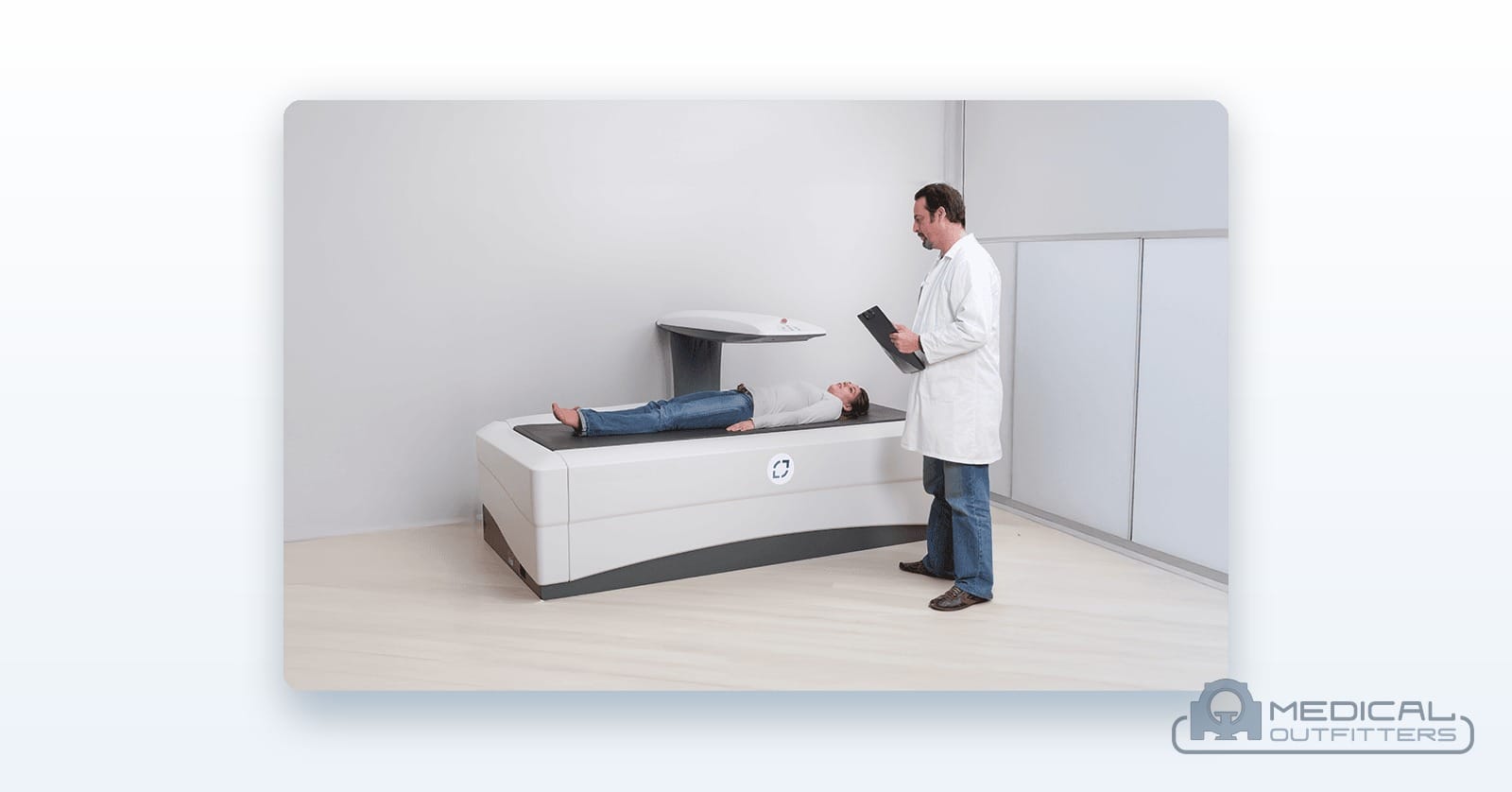
The exams share hardware but not time. Hologic’s Horizon page puts a bone density scan at about 10 to 30 seconds and a body composition assessment at about 2 minutes; its Advanced Body Composition brochure says a whole-body composition scan takes as little as three minutes. The visit is longer than the scan on either side: BodySpec promises under 15 minutes door to door, DexaFit’s Denver page describes about six minutes on an open-air table inside a 30-minute appointment, and Wilmington Health quotes about 20 minutes. The scan positions differ too. A bone density exam raises the legs on a block for the spine and turns the foot inward for the hip; a whole-body scan lies the patient flat inside the marked scan field with the arms by the sides, and tall or wide patients may need the reflection or half-body tools that both Hologic and GE describe for people who do not fit the field.
Many providers sell both from one visit. Ohio State’s lab lists $125 for body composition alone and $150 with bone density added, and DexaFit’s site says every total-body scan includes whole-body bone density with T-scores and Z-scores across spine, hip and total body. A clinic should be clear with the patient about which exam is diagnostic: the ISCD’s diagnostic sites for osteoporosis are the lumbar spine, total hip and femoral neck measured in the dedicated bone density modes, and a whole-body bone result is not a substitute for that exam when osteoporosis is the question.
DEXA vs BIA Scales vs Calipers: Why People Pay for the Table
A body composition DEXA costs money because the alternatives are either imprecise or not comparable. Bioelectrical impedance analysis (BIA), the method inside smart scales, handheld devices and gym analyzers, passes a small current through the body, measures resistance and feeds it into an equation along with height, weight, age and sex. It measures water, in effect, and infers fat and lean mass from it, which is why the reading moves with hydration, a meal, exercise or the time of day. Skinfold calipers measure subcutaneous fat at a handful of sites and feed the sum into a population equation; they say nothing about visceral fat and depend on the tester’s hands.
The studies that compare the methods against DEXA agree on the direction. In a 2006 study in the journal Obesity, Pateyjohns and colleagues measured 43 healthy overweight and obese men, aged 25 to 60 with a BMI of 28 to 43, with three bioelectrical impedance methods and DEXA. The multifrequency device read 7.0 percentage points of body fat below DEXA with limits of agreement of plus or minus 6.6 points; the same device in single-frequency mode read 1.7 points low with limits of plus or minus 7.3; and a consumer Tanita scale read 1.2 points high with limits of plus or minus 9.5. The authors judged the multifrequency method poor for individuals and the other two useful for group comparisons but limited for an individual. A 2022 study of young football players in the journal Children found the same order: against DEXA, bioelectrical impedance gave the largest underestimate of body fat percentage, with skinfolds next.
What a scale cannot do at any price is the regional and visceral work, which is what the DEXA body fat scan cost actually buys. BIA devices estimate visceral fat from an equation; a visceral fat DEXA scan estimates it from the image of the abdomen, and Hologic’s brochure states that its visceral fat area results correlate with visceral fat area measured by CT at L4/L5, the traditional reference, citing a 2012 study in Obesity. That is also the honest limit of the method: DEXA estimates visceral fat, it does not image it the way CT or MRI do, and the ISCD still calls the clinical utility of the measure uncertain.
DEXA’s own precision is the reason a repeat scan is worth paying for. The ISCD requires each facility to measure its own precision and sets the minimum acceptable precision for an individual technologist at 3 percent for total fat mass, 2 percent for total lean mass and 2 percent for percent fat mass. Multiplied by the ISCD’s 2.77 factor, those minimums give a least significant change of about 8.3 percent for total fat mass and 5.5 percent for lean mass and percent fat, which is the smallest change between two scans that can be called real with 95 percent confidence. A client who loses 2 kilograms of fat on a 30 kilogram fat mass, a 6.7 percent change, has lost less than a facility at the minimum precision can confirm; one who loses 3 kilograms has. Good programs beat the minimum, and a provider that can show its own precision study is worth more than one that quotes the manufacturer’s.
The practical rule for anyone paying for the scan: same machine, same provider, same time of day, same preparation, and no comparison of a DEXA scan body fat percentage with a scale number or a caliper number. They are different measurements of different things and the gap between them is not progress.
What a Body Composition DEXA Machine Costs a Clinic
On the clinic side, a body composition DEXA is a central densitometer with the body composition software module. The Medical Outfitters DEXA guide’s body composition DEXA scanner cost section puts the platforms that do it well at $62,000 to $85,000 refurbished, delivered, installed and warrantied, and the new DMS Stratos DR at $125,000 to $165,000. Peripheral units, the forearm and heel devices at $18,000 to $40,000 refurbished, measure bone only and cannot offer the service.
| System | How Medical Outfitters sells it | All-in price band | Body composition tools (per the OEM) |
|---|---|---|---|
| GE Lunar Prodigy Pro | Refurbished, MO Select | $62,000 to $75,000 | Total body composition; CoreScan visceral fat as a licensed option |
| GE Lunar iDXA | Refurbished, MO Select | $72,000 to $85,000 | CoreScan VAT and SAT, TBLH and neck-to-knee scans, sarcopenia and RMR tools, DXAVision workflow; 500 lb table |
| Hologic Horizon W | Refurbished, MO Select | $70,000 to $82,000 | Advanced Body Composition with InnerCore visceral fat, fat mass index, rate-of-change report; 500 lb table |
| Hologic Horizon A | Refurbished, MO Select | $75,000 to $85,000 | As Horizon W, with high-definition vertebral fracture assessment |
| DMS Imaging Stratos DR | New, authorized dealer | $125,000 to $165,000 | Nine-region body composition with color mapping, android to gynoid ratio, fat mass index, basal metabolic rate, visceral and subcutaneous fat estimate, sarcopenia; 3D-DXA femur optional |
Source: Medical Outfitters DEXA and bone densitometer cost guide for the bands; GE HealthCare’s June 2023 Lunar iDXA brochure, Hologic’s Horizon page and Advanced Body Composition brochure, and the Medical Outfitters Stratos DR listing for the tools. Hologic and GE systems are not sold new by Medical Outfitters.
The feature lists matter because the module is usually a license, not hardware. The DEXA scanner brands guide warns that body composition, vertebral fracture assessment and trabecular bone score are licensed options that must be confirmed to the serial number being bought and transfer with the sale; a refurbished Prodigy without the body composition license is a bone density machine until the OEM sells the key. GE’s brochure lists CoreScan, DXAVision and the Sports Athletics Package as separate applications on the iDXA, with DXAVision described as cutting scan time by up to 40 percent on GE’s own data. Hologic’s brochure lists InnerCore and fat mass index as part of its Advanced Body Composition assessment. DMS builds nine-region body composition into the Stratos DR and sells 3D-DXA as the option, per the Stratos DR listing, which also notes that the system carries CE marking under the EU Medical Device Regulation as a Class IIb device as of April 7, 2026, with FDA clearance pending and the US status confirmed on every quote.
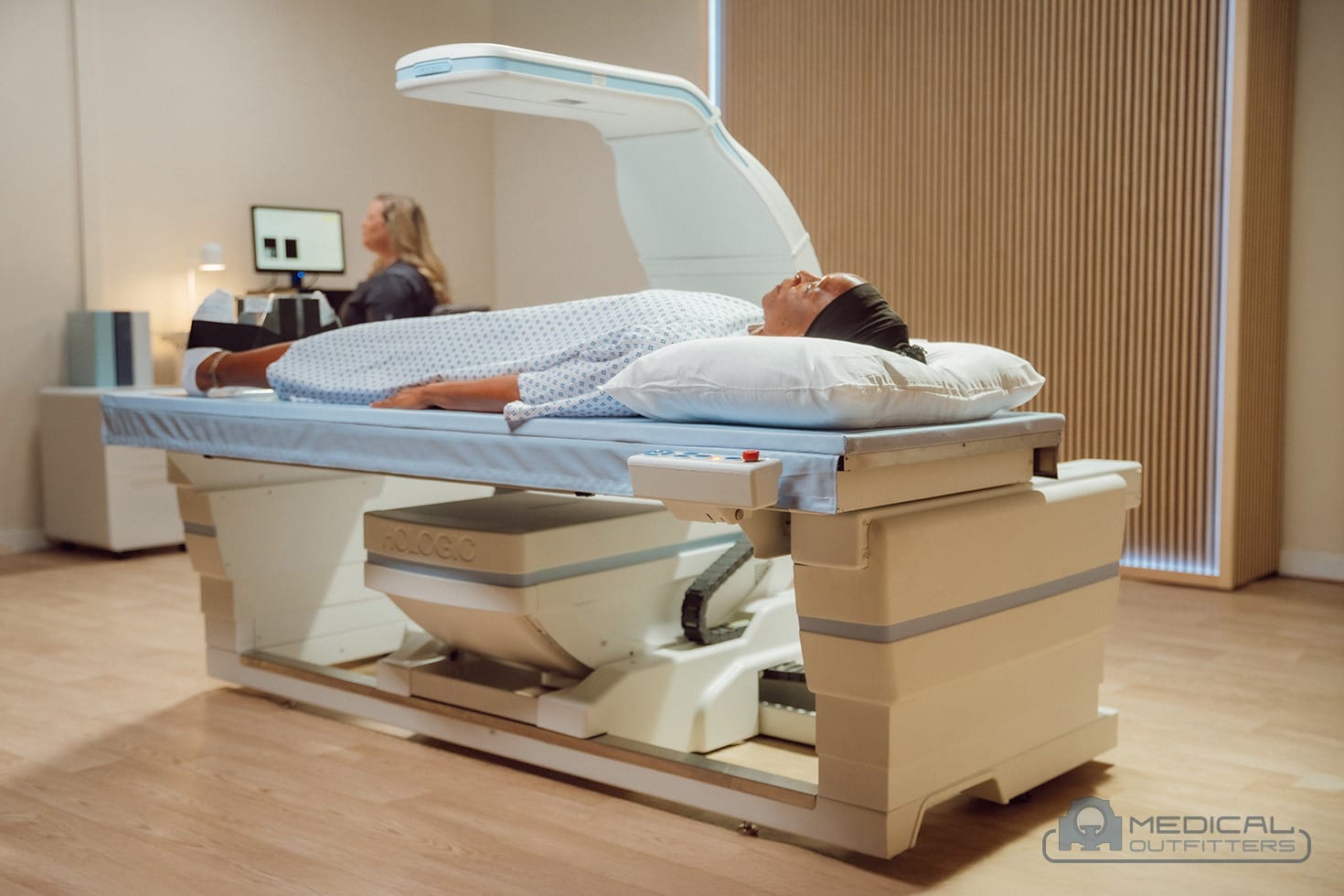
Two hardware facts decide who can be scanned. GE’s June 2023 iDXA brochure lists a maximum supported patient weight of 227 kilograms (500 pounds) and a scanner footprint of 2.87 by 1.31 by 1.25 meters; Hologic’s Horizon page states a 500 pound limit as well. The scan field is the other limit: a very tall or very broad patient may not fit, which is what Hologic’s reflection feature and GE’s half-body and neck-to-knee tools work around, and the ISCD lists weight over the table limit among the limitations of the exam. A bariatric or athletic practice should ask about both before choosing a model.
The arithmetic is the attraction. The Medical Outfitters guide works it for a $75,000 refurbished unit at about $112 a scan: 20 body composition scans a week recovers the equipment line in about 8 months, and 40 a week in about 4, before technologist time, service and space. Even at the $75 to $80 the two radiology groups above charge, a clinic that already runs the densitometer for bone density adds the service for the cost of a license and a few minutes of table time. For how that compares with every other modality, see radiology equipment cost in one table.
What It Takes to Run a Body Composition DEXA Program Well
A body composition service lives or dies on repeatability, because the customer is buying the second scan as much as the first. The ISCD’s rules are the operating manual. Each facility measures its own precision rather than quoting the manufacturer’s; the minimums for an individual technologist are 3 percent for total fat mass and 2 percent for total lean mass and percent fat. After a hardware change short of a full replacement, one technologist performs 10 whole-body phantom scans, and a difference of more than 2 percent in mean percent fat, fat mass or lean mass is a call to the manufacturer. Change in a client can be compared between two machines only if they are the same make and model and were cross-calibrated with a whole-body phantom; the ISCD notes that no phantom serves as an absolute standard across manufacturers, so switching brands means a new baseline for every client.
Preparation and screening are the next layer. The ISCD names pregnancy as a contraindication and lists recent contrast and weight over the table limit as limitations; radiopharmaceuticals can interfere with results on some manufacturers’ systems. Providers add their own consistency rules, usually a fast of a few hours, no hard training that morning, the same clothing and the same time of day for repeat visits, because the lean compartment includes water and a liter of fluid shows up as lean mass. None of that is in a regulation; it is what makes the 2 percent precision achievable in practice.
Regulation is light but real. The scan is an X-ray exam, so the densitometer is registered with the state as an X-ray device, the technologist works under the state’s rules for operating it, and a physicist’s survey is part of the installation; the Medical Outfitters DEXA guide notes that most states register a bone densitometer as an X-ray device and may ask for a shielding evaluation, which the low dose usually satisfies in a standard room. Whether a physician order is required is a matter of state law and the provider’s own policy, which is why Missouri State asks the public for a doctor’s order and Southern Arizona Radiology requires one for visceral fat interpretation while Wilmington Health does not require a diagnostic order. The dose itself is small: RadiologyInfo puts a DXA exam below a day of natural background radiation and below a tenth of a chest X-ray, and GE describes the CoreScan visceral fat result as coming from the same total body scan with no extra acquisition.
Finally, the report. The ISCD’s required elements, BMI, BMD, BMC, total mass, lean mass, fat mass and percent fat, are the floor; the color map, regional tables, visceral fat estimate and trend chart are what the client is paying to see. Hologic’s rate-of-change report and GE’s enCORE trending and color mapping exist for that reason, and DMS’s nine-region map on the Stratos DR does the same job. Price the first scan to bring people in, package the second and third, and make sure the machine that scanned them in January is the one that scans them in June.
Adding Body Composition DEXA With Medical Outfitters
For the person buying a scan, the market in 2026 is simple: about $40 to $150 self-pay, cheapest from a van or a radiology group that already owns the table, with the machine, the preparation and the provider held constant for every repeat. For the clinic, a body composition service is one of the lowest-cost additions in imaging because the densitometer is often already there and the module is a license. Start with the DEXA and bone densitometer cost guide for every band and the payback math, compare platforms in DEXA scanner brands and buying used, and look at the new DMS Stratos DR, the Stratos and the compact Stratos C, or the refurbished GE Lunar and Hologic systems in the bone densitometry category. For the room and the support, see installation and rigging and service and repairs. When you know your expected weekly volume and price point, send it to us and we will price a specific system with the body composition module.
- Medical Outfitters, DEXA and Bone Densitometer Cost and Price Guide (2026): scan prices, CPT 77080 and 76499, body composition scanner bands, payback: https://medicaloutfitters.com/dexa-bone-densitometer-cost-guide/
- International Society for Clinical Densitometry, Adult Official Positions, body composition section: indications, contraindication, precision minimums, cross-calibration, report elements, reference data: https://iscd.org/learn/official-positions/adult-positions/
- RadiologyInfo (ACR and RSNA), Bone Densitometry (DEXA, DXA): whole-body scanning, dose comparison, same-machine follow-up: https://www.radiologyinfo.org/en/info/dexa
- Pateyjohns IR et al., Comparison of three bioelectrical impedance methods with DXA in overweight and obese men, Obesity 2006;14:2064-2070: bias and limits of agreement: https://doi.org/10.1038/oby.2006.241
- Hologic, Horizon DXA System page (scan times, 500 pound limit, 220 regional measurements, NHANES reference), Advanced Body Composition brochure (InnerCore, CT correlation, three-minute scan) and Horizon technical and clinical advantages white paper (InnerCore FDA clearance, 100 to 160 cm² thresholds): https://www.hologic.com/horizondxa
- GE HealthCare, Lunar iDXA brochure, June 2023 (CoreScan VAT and SAT, DXAVision, 227 kg limit, footprint) and Lunar iDXA product page: https://www.gehealthcare.com/products/bone-and-metabolic-health/lunar-idxa
- Provider price pages read October 26, 2026: BodySpec (https://www.bodyspec.com/), DexaFit Denver (https://www.denver.dexafit.com/dexa-scan-cost-denver), Fitnescity through Quest (https://www.questhealth.com/product/fitnescity-dexa-body-composition-scan/DEXA2.html), Southern Arizona Radiology Associates (https://www.sararadiology.com/dexa-body-composition-analysis/), Wilmington Health (https://www.wilmingtonhealth.com/specialties/imaging-radiology/body-composition-scan), Missouri State University (https://www.missouristate.edu/SHS/BodyCompositionLaboratory.htm), Texas A&M University Health Services (https://uhs.tamu.edu/medical/dexa-scan.html), Ohio State University exercise science lab (https://eslab.ehe.osu.edu/?page_id=8)
- HospiMedica, June 14, 2011: GE Healthcare announces FDA 510(k) clearance of CoreScan: https://www.hospimedica.com/medical-imaging/articles/294735570/imaging-targets-obesity-related-disease.html
- DEXA and bone densitometer cost guide (2026)
- DEXA scan cost: the bone density exam with and without insurance
- Body composition DEXA scanner cost
- What is a DEXA scan? How it works, accuracy and cost
- DEXA scanner brands compared and buying used
- DEXA scan machines and bone densitometers for sale
- DMS Stratos DR: bone density and body composition
- DMS Stratos bone densitometer
- DMS Stratos C compact densitometer
- Refurbished medical imaging equipment: the MO Select standard
- Radiology equipment cost in 2026, every modality
- Installation, rigging and de-installation
- Imaging equipment service and repairs
- Price a DEXA system with the body composition module
Body Composition DEXA Scans: Common Questions
How much does a body composition DEXA scan cost?
About $40 to $150 self-pay in 2026 at dedicated providers, per their own price pages read on October 26, 2026: BodySpec's mobile vans start at $39.95, Southern Arizona Radiology charges $75 cash, Wilmington Health $80, DexaFit's Denver studio $99 and its Kansas City studio $149, and university labs $75 to $150. The Medical Outfitters DEXA cost guide records published prices from $40 to $374, with dedicated clinics clustered at $75 to $150 and packages bringing a repeat scan under $100.
Where can I get a DEXA body composition scan?
Four kinds of providers: franchised and mobile body composition companies such as DexaFit, BodySpec and the Fitnescity network bookable through Quest; university exercise science labs such as Missouri State, Ohio State and Texas A&M, which often limit access or require a doctor's order; radiology groups and health systems such as Southern Arizona Radiology and Wilmington Health that sell the scan at a cash price on their bone density machines; and sports medicine, bariatric and concierge practices that fold it into a program.
Does insurance cover a DEXA body scan?
Almost never. The Medical Outfitters DEXA guide notes that the code many providers use, CPT 76499, is an unlisted procedure that Medicare contractors price case by case with no national amount and that it is almost always billed to the patient. Provider pages say the same: Southern Arizona Radiology states most insurance does not cover it, Wilmington Health calls it self-pay and elective, and Texas A&M says insurance will not cover it. Most providers accept HSA and FSA cards.
What does a DEXA body composition scan show?
Fat mass, lean mass and bone mass for the whole body and for each arm, each leg and the trunk, plus percent body fat and, on current systems, an estimate of visceral fat around the abdominal organs. The ISCD says an adult report should include BMI, bone density, bone mineral content, total mass, total lean mass, total fat mass and percent fat, compared against NHANES reference data. Providers add a color map, regional tables, a trend chart and sometimes resting metabolic rate.
How accurate is a DEXA body fat scan compared with a smart scale?
DEXA is the reference the scales are tested against. In a 2006 study in Obesity of 43 overweight and obese men, a multifrequency bioelectrical impedance device read 7.0 percentage points of body fat below DEXA, a single-frequency mode 1.7 points below and a consumer Tanita scale 1.2 points above, all with wide limits of agreement. The ISCD sets DEXA's minimum precision at 3 percent for fat mass and 2 percent for lean mass and percent fat, so a repeat scan on the same machine can confirm a change of roughly 5 to 8 percent.
How long does a body composition DEXA take, and how much radiation is it?
The scan itself is a few minutes: Hologic's Horizon page puts a body composition assessment at about 2 minutes and its brochure says as little as three, and DexaFit's Denver page describes about six minutes on the table inside a 30-minute visit. RadiologyInfo puts a DXA exam below a day of natural background radiation and below a tenth of a chest X-ray. The ISCD names pregnancy as a contraindication, and recent contrast or a weight above the table limit as limitations.
How often should you repeat a body composition DEXA scan?
When enough can have changed for the scan to see it. At the ISCD minimum precision, the least significant change is about 8.3 percent of fat mass and 5.5 percent of lean mass or percent fat, so most providers suggest an interval of two to four months for someone on an active program and longer for maintenance. Repeat on the same machine, at the same provider and with the same preparation, because RadiologyInfo and the ISCD both state that results from different equipment cannot be compared directly.
What does a body composition DEXA machine cost for a clinic?
The Medical Outfitters DEXA cost guide puts the refurbished platforms with the body composition module at $62,000 to $75,000 for a GE Lunar Prodigy Pro, $72,000 to $85,000 for a GE Lunar iDXA, $70,000 to $82,000 for a Hologic Horizon W and $75,000 to $85,000 for a Horizon A, and the new DMS Stratos DR at $125,000 to $165,000, all delivered, installed and warrantied. The module is usually a license that must transfer with a used system. At about $112 a scan, 20 scans a week recovers a $75,000 unit in about 8 months, per the guide.
Related Articles