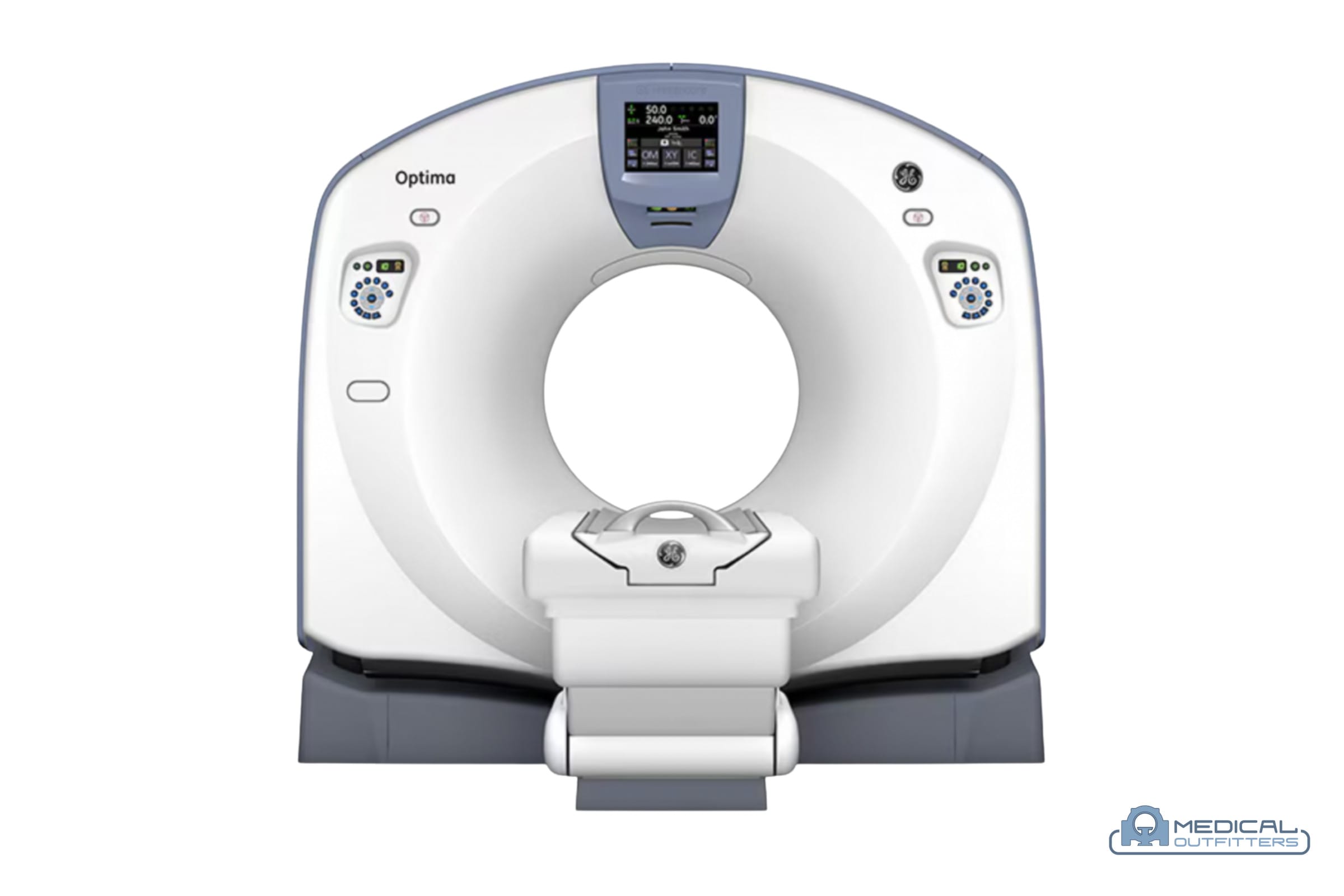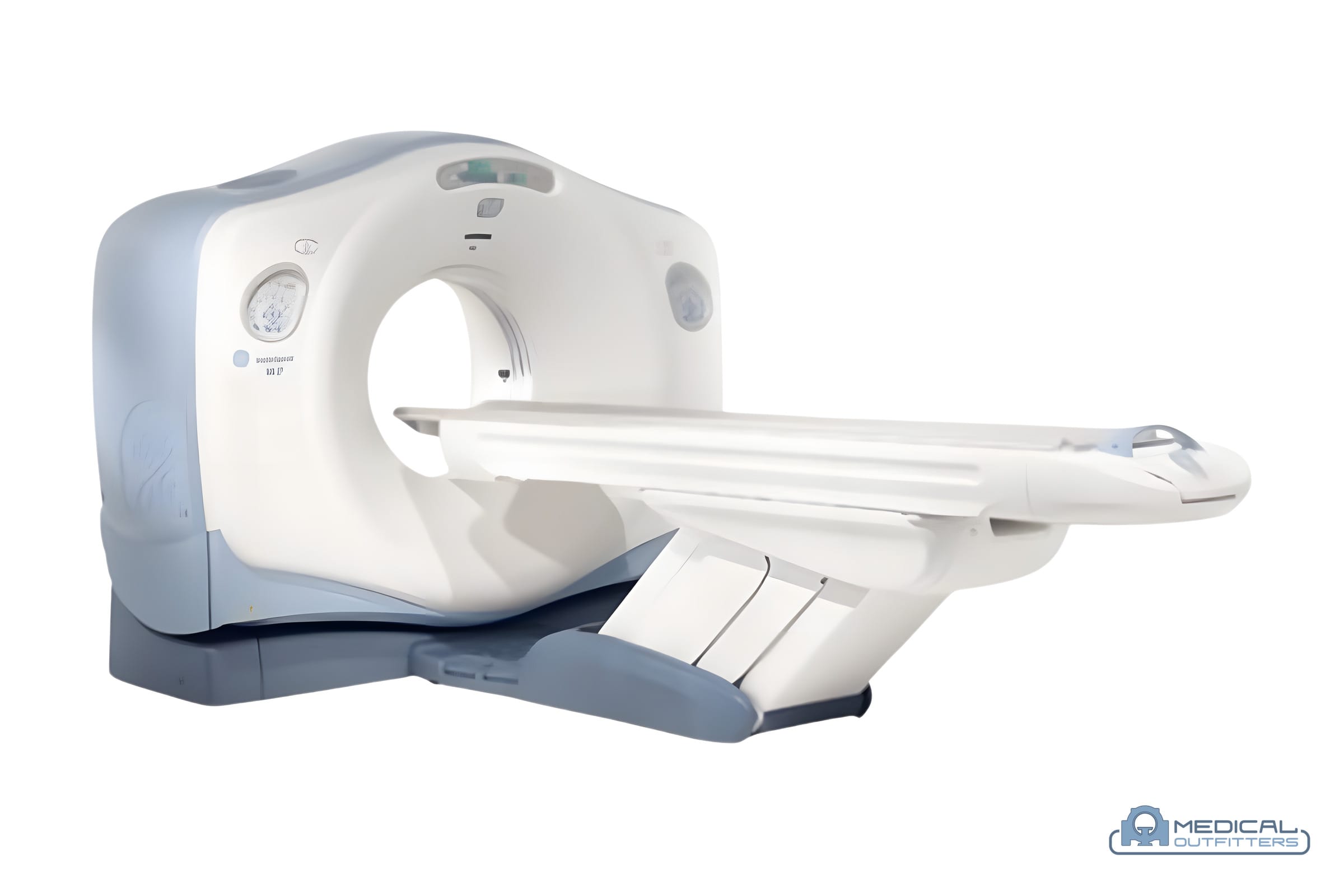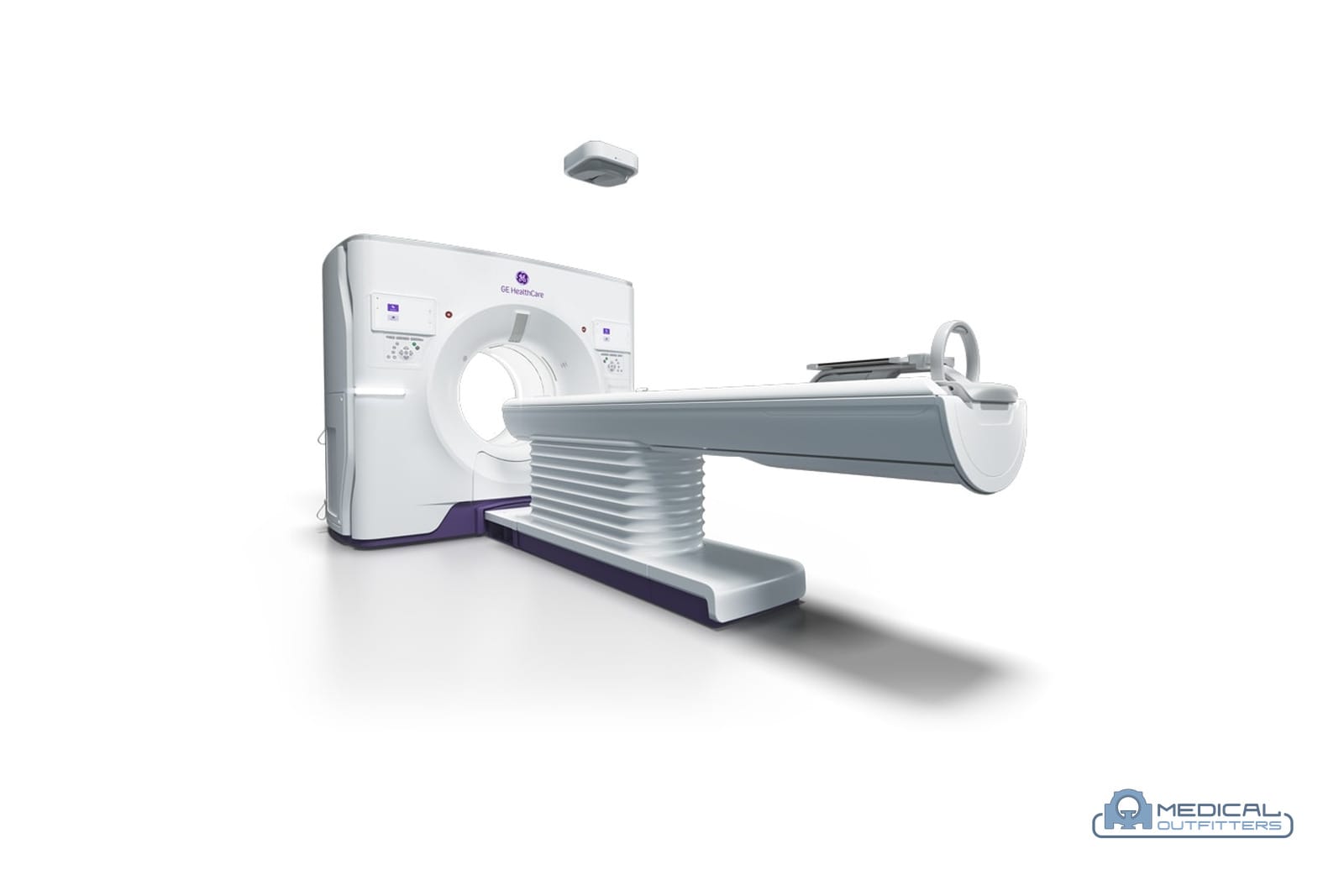
CT has more acronyms than any other imaging modality, and most of them fall into five families: the scanner and the scan technique (kVp, mAs, pitch, DAS, FOV), radiation dose (CTDIvol, DLP, SSDE, XR-29), the image and its reconstruction (HU, MPR, MIP, FBP, the vendor names for iterative reconstruction), the exams themselves (CTA, CTPA, CCTA, LDCT, HRCT) and the IT and buying vocabulary around the room (DICOM, PACS, OEM, EOL). This glossary explains each one in plain English, with what it means for the person buying, running or servicing the scanner rather than for the physicist.
Use it as a reference: each family has its own table, the dose section explains how the terms connect to one another, and the reconstruction section decodes the brand names that GE, Siemens, Philips, Canon and Fujifilm use for the same ideas. Medical Outfitters sells, installs and services CT scanners across the United States, Puerto Rico and the Caribbean, and every term here is one our engineers and sales advisers use with customers every week.
- Technique terms describe how the X-rays are made and the gantry moves: kVp, mA, mAs, pitch, rotation time, collimation.
- Dose terms describe how much radiation the scan delivers: CTDIvol per slice, DLP per exam, SSDE corrected for patient size.
- Image terms describe what you see and how it was built: Hounsfield units, windows, reformats and iterative reconstruction.
- Exam and workflow terms name the studies and the systems that move them: CTA, LDCT, DICOM, PACS.
- Buying and service terms decide what a scanner costs to own: scan seconds, tube coverage, EOL, XR-29.
CT Acronyms at a Glance
The Scanner and the Scan: Technique Terms
| Term | Stands for | What it means for you |
|---|---|---|
| CT, CAT | Computed tomography, computed axial tomography | The same thing; “CAT scan” is the older public name |
| MDCT, MSCT | Multidetector, multislice CT | Every scanner sold since the early 2000s; the number that follows is the slice count |
| Slices and channels | Reconstructed slices per rotation; physical detector channels | A 64-channel detector can reconstruct 128 slices on some platforms, so compare both; see our guide to CT scanner types by slice count |
| DAS | Data acquisition system | The electronics that read the detector; a DAS upgrade is how some scanners gain slices |
| kV, kVp | Kilovolts, kilovolt peak | Tube voltage; sets how penetrating the beam is. Lower kVp makes iodine brighter and raises noise |
| mA, mAs | Milliamperes, milliampere-seconds | Tube current and current times time; the main dose dial |
| AEC, ATCM | Automatic exposure control, automatic tube current modulation | The scanner varies mA with patient thickness; a required feature under XR-29 |
| Pitch | Table travel per rotation divided by beam width | Above 1 the beam leaves gaps covered by interpolation; higher pitch is faster and lower dose |
| Rotation time | Seconds per gantry revolution | 0.25 to 0.5 s on current scanners; cardiac work needs the fastest |
| Collimation | Beam width along the patient | Detector rows times row width, for example 64 by 0.625 mm equals 40 mm coverage |
| Helical, spiral, axial | Continuous table movement versus step and shoot | Most scans are helical; calcium scoring and some cardiac protocols are axial |
| SFOV, DFOV | Scan field of view, display field of view | How much of the bore is measured, and how much is reconstructed into the image |
| Bore, aperture | Gantry opening diameter | 70 cm is standard, 75 to 80 cm on wide-bore systems for bariatric and radiation-therapy use |
| MHU | Mega heat units | The tube’s anode heat capacity; a high MHU tube runs long protocols without cooling delays |
| Generator kW | High-voltage generator power | Sets the maximum mA at a given kVp; 60 to 120 kW on current scanners |
| Slip ring | The rotating electrical contact | What lets the gantry spin continuously; a service item |
| Bowtie filter | A shaped beam filter | Flattens the dose profile across the patient; selected per body region |
| DECT, spectral CT, PCCT | Dual-energy CT; photon-counting CT | Scanning at two energies to separate materials, or counting individual photons; see our note on contrast in the CT with contrast vs without guide |
| CBCT | Cone beam CT | A different design with a flat-panel detector; see cone beam CT explained |
Dose Terms: CTDI, CTDIvol, DLP, SSDE and XR-29
| Term | Stands for | What it means for you |
|---|---|---|
| CTDI, CTDIvol | Computed tomography dose index, volume | The standard dose from one rotation measured in a reference phantom, in milligray; the number on the console before every scan |
| DLP | Dose length product | CTDIvol times the scanned length, in milligray-centimeters; the dose of the whole exam |
| SSDE | Size-specific dose estimate | CTDIvol corrected for the patient’s actual size; closer to what the patient received |
| Effective dose, mSv | Millisieverts | A whole-body risk estimate derived from DLP; a chest CT is in the low single-digit millisieverts |
| DRL | Diagnostic reference level | A benchmark dose for a given exam, published by the ACR and others, that departments compare their protocols against |
| ALARA | As low as reasonably achievable | The principle behind every dose-reduction feature on the list |
| RDSR | Radiation dose structured report | A DICOM object the scanner creates with the dose of every exam; feeds dose-tracking software; required under XR-29 |
| XR-29, MITA Smart Dose | NEMA standard XR-29-2013 | Four features: DICOM dose reports, dose check alerts, automatic exposure control and reference adult and pediatric protocols. Under the Protecting Access to Medicare Act of 2014, Medicare paid 5 percent less for scans on non-compliant scanners in 2016 and 15 percent less from 2017; nearly every refurbished scanner Medical Outfitters sells is XR-29 compliant, and the ones that are not are sold with that stated |
| XR-25 | NEMA dose check standard | The alert and notification values the console shows when a protocol exceeds its dose threshold; part of XR-29 |
| Image Gently, Image Wisely | Pediatric and adult dose campaigns | Protocol and communication resources, not regulations |
| ACR accreditation | American College of Radiology CT accreditation | Phantom image quality and dose review every three years; required by many payers |
The four dose terms connect in a chain. The technique, kVp and mAs with the pitch and the filter, produces a CTDIvol for the protocol. CTDIvol multiplied by the scan length gives the DLP. DLP multiplied by a conversion factor for the body region gives an effective dose in millisieverts, and SSDE adjusts CTDIvol for the fact that a small patient absorbs more of the same beam than a large one. A buyer rarely needs the numbers, but a buyer does need the features that control them, which is what the XR-29 line is about.
Image Terms and the Names Vendors Give Iterative Reconstruction
| Term | Stands for | What it means for you |
|---|---|---|
| HU | Hounsfield unit | The CT number: water 0, air about minus 1,000, dense bone several hundred and up; iodine enhancement is measured in HU |
| WW, WL | Window width and window level | The display range; lung, bone and soft-tissue windows show the same data differently |
| MPR | Multiplanar reformat | Coronal, sagittal and oblique images rebuilt from the axial data |
| MIP, MinIP | Maximum and minimum intensity projection | Vessel and airway views that project the brightest or darkest voxels |
| VR, 3D | Volume rendering | The surface-shaded pictures for surgeons and patients |
| FBP | Filtered back projection | The classic reconstruction; fast, noisy at low dose |
| IR | Iterative reconstruction | Statistical or model-based reconstruction that lowers noise so dose can fall; sold under the brand names below |
| ASiR, ASiR-V, TrueFidelity | GE HealthCare | Statistical, then hybrid, then deep-learning reconstruction across the LightSpeed, Optima and Revolution generations |
| SAFIRE, ADMIRE | Siemens Healthineers | Sinogram-affirmed and advanced modeled iterative reconstruction |
| iDose4, IMR, Precise Image | Philips | Hybrid, model-based and AI reconstruction |
| AIDR 3D, AiCE | Canon Medical | Adaptive iterative dose reduction and the Advanced intelligent Clear-IQ Engine deep-learning reconstruction |
| Intelli IP, Intelli IP Quick | Fujifilm | The iterative processing on the SCENARIA View and Supria families |
| MAR | Metal artifact reduction | Software that cleans the streaks from hips, spines and dental work |
| Kernel, filter | Reconstruction algorithm sharpness | Soft kernels for soft tissue, sharp kernels for bone and lung |
| SNR, CNR, LCD | Signal-to-noise, contrast-to-noise, low-contrast detectability | The image-quality measures on the phantom; what ACR accreditation checks |
The brand names matter when comparing quotes because they are licensed options as well as technology. A refurbished scanner “with ASiR” is a different product from the same scanner without it, and the difference shows in dose and in image quality at low dose. Our comparison of CT scanner manufacturers places each vendor’s reconstruction in its model line, and the CT scanner cost guide explains how software licenses move a quote within its band.
Exam and Protocol Acronyms
| Term | Stands for | What it means for you |
|---|---|---|
| CTA | CT angiography | A contrast scan timed to the arteries; head, neck, chest, aorta, runoff |
| CTPA | CT pulmonary angiography | The scan for suspected pulmonary embolism |
| CCTA | Coronary CT angiography | ECG-gated cardiac CT; needs fast rotation and good temporal resolution |
| CAC | Coronary artery calcium score | A non-contrast, low-dose axial scan scored in Agatston units |
| HRCT | High-resolution CT | Thin-section lung imaging for interstitial disease |
| LDCT | Low-dose CT | Lung cancer screening at a fraction of the dose of a diagnostic chest CT |
| CT KUB | Kidneys, ureters, bladder | The non-contrast stone scan |
| CTU, CTC, CTE | CT urography, colonography, enterography | Organ-specific contrast protocols |
| With, without, with and without | IV contrast phases | The protocol decision explained in our guide to CT with contrast vs without |
| LOCM, IOCM | Low-osmolar, iso-osmolar contrast media | The modern non-ionic iodinated agents |
| CT sim | CT simulation | A wide-bore scanner with a flat table used to plan radiation therapy |
| PET/CT, SPECT/CT | Hybrid nuclear medicine scanners | A CT bolted to a PET or SPECT camera; see the PET/CT scanner cost guide |
Workflow, IT, Buying and Service Terms
| Term | Stands for | What it means for you |
|---|---|---|
| DICOM | Digital Imaging and Communications in Medicine | The image and communication standard; every scanner speaks it, and DICOM conformance is how you know what it can send |
| PACS, RIS, HIS, EHR | Picture archiving, radiology, hospital and electronic health record systems | Where the images and the orders live; a new scanner is integrated with all of them |
| MWL, MPPS | Modality worklist, modality performed procedure step | The DICOM services that send the patient list to the scanner and report the exam back |
| HL7 | Health Level Seven | The messaging standard between the RIS, the HIS and the scanner’s worklist |
| OEM, ISO | Original equipment manufacturer, independent service organization | Who built it and who services it; Medical Outfitters is an authorized Fujifilm dealer and an independent service organization for GE, Siemens, Philips and Canon |
| Refurbished, used, as-is | Condition tiers | Explained in our guide to refurbished vs OEM certified equipment; MO Select is Medical Outfitters’ refurbished line |
| EOL, EOS, EOGS | End of life, end of service, end of guaranteed support | The dates after which the manufacturer stops supporting a platform; the single most important date on a used scanner |
| PM, FSE | Preventive maintenance, field service engineer | The scheduled visits and the people who make them; see CT scanner service |
| Scan seconds, tube count | Tube life measures | How much of the tube’s rated life is used; explained in this guide |
| Tube coverage | Service contract term | Whether the contract pays for the tube; the biggest single variable in a CT contract price |
| 510(k) | FDA premarket notification | The clearance a scanner and its software options carry; options added later carry their own |
| CRCPD, state registration | Conference of Radiation Control Program Directors; state radiation programs | The state side of CT regulation: registration, shielding surveys and inspections |
Two of the terms in this last table decide more purchases than any of the technique or image terms. End of life, because a scanner the manufacturer no longer supports is a scanner whose parts and software are on a clock, and tube coverage, because the tube is the one bill that can equal a year of service. Both are covered in detail in our CT scanner cost and price guide, and both are stated plainly on every MO Select CT that Medical Outfitters sells.
Talk to Medical Outfitters in Plain English
Medical Outfitters sells new Fujifilm CT scanners, including the SCENARIA View and the Supria 128, and refurbished GE and Siemens systems through MO Select, with installation, calibration, training and service by our own engineers across the United States, Puerto Rico and the Caribbean. The current systems are on the CT scanners for sale page, and our model guides for the GE LightSpeed, Optima CT660, Revolution and Canon Aquilion families translate each platform’s specification sheet into the terms above. If a quote you are reading uses an acronym this page does not, ask us; we will explain it and add it here.
- CT scanner cost and price guide (2026)
- CT scanners for sale: new Fujifilm, refurbished GE and Siemens
- CT scanner service, repair and maintenance
- CT scanner types by slice count
- CT scanner manufacturers compared
- CT scan with contrast vs without
- How long does a CT tube last?
- Cone beam CT explained
- Refurbished vs OEM certified imaging equipment
- PET/CT scanner cost guide
- GE LightSpeed CT price guide
- GE Optima CT660 price guide
- GE Revolution CT price guide
- Canon Aquilion CT price guide
- Fujifilm SCENARIA View 128-slice CT
- Ask us about a term
CT Acronyms: Common Questions
What does CT stand for?
Computed tomography: an X-ray tube and detector rotate around the patient and a computer reconstructs cross-sectional images from the measurements. CAT, computed axial tomography, is the older name for the same thing; MDCT and MSCT, multidetector and multislice CT, describe every scanner sold since the early 2000s.
What is CTDIvol, and how is it different from DLP?
CTDIvol is the dose index for one rotation of a protocol, measured in a standard phantom in milligray and shown on the console before every scan. DLP, dose length product, is CTDIvol multiplied by the scanned length, in milligray-centimeters, and represents the whole exam. Effective dose in millisieverts is estimated from DLP, and SSDE corrects CTDIvol for the patient's actual size.
What do kVp and mAs mean on a CT scanner?
kVp is the tube voltage in kilovolts, which sets how penetrating the X-ray beam is; mAs is the tube current in milliamperes multiplied by the exposure time, which sets how many X-rays are produced and is the main dose dial. Automatic exposure control varies the mA with the thickness of the patient along the scan.
What is a Hounsfield unit?
The CT number assigned to each voxel, scaled so that water is 0 and air about minus 1,000; dense bone runs from several hundred to above 1,000 and soft tissues cluster between about 20 and 80. Contrast enhancement is measured as the rise in Hounsfield units after the injection.
What are ASiR, SAFIRE, iDose and AIDR?
Vendor brand names for iterative reconstruction: ASiR, ASiR-V and TrueFidelity from GE, SAFIRE and ADMIRE from Siemens, iDose4, IMR and Precise Image from Philips, AIDR 3D and AiCE from Canon, and Intelli IP from Fujifilm. All lower image noise so the dose can be reduced, and on a refurbished scanner they are licensed options that may or may not be included.
What is XR-29, and why does it matter?
NEMA XR-29-2013, the MITA Smart Dose standard, requires four features: DICOM radiation dose structured reports, dose check alerts, automatic exposure control and reference adult and pediatric protocols. Under the Protecting Access to Medicare Act of 2014, Medicare paid 5 percent less for scans on non-compliant scanners in 2016 and 15 percent less from 2017 onward, so compliance is a line on every used CT quote.
What is the difference between slices and detector channels?
Channels are the physical detector rows the scanner reads in one rotation; slices are the images it reconstructs. On some platforms a 64-channel detector reconstructs 128 slices, so a scanner marketed by its slice count should be compared on its detector channels, its coverage and its tube as well.
What do EOL and EOS mean for a used CT scanner?
End of life and end of service, the dates after which the manufacturer stops supporting a platform with parts and software. A scanner past those dates can still be serviced by an independent organization with a parts pool, but the dates are the most important ones on a used CT quote, and Medical Outfitters states them on every MO Select system.