A mobile imaging trailer lets a hospital, clinic or imaging center add an MRI, CT or PET/CT scanner without building a room for it. The scanner rides inside a shielded coach that docks against the building, plugs into power and a network, and scans patients who walk on through a lift or a ramp. Facilities use one to cover a scanner that is down for service, to carry a seasonal or trial caseload, to bridge the months while a permanent suite is built, or to share a high-cost system such as PET/CT across several sites on a weekly route. This guide explains what is inside the coach, the docking pad, power and utilities a site has to provide, what mobile MRI, CT and PET/CT each add, the state and federal rules that apply, and how facilities buy, rent or route a unit.
Medical Outfitters sells, installs and services MRI, CT, X-ray, ultrasound and mammography systems across the United States, Puerto Rico and the Caribbean, and through MO Mobility it supplies mobile MRI, CT and PET/CT coaches for short and long terms, maintained by its own engineers. This article is written for the facility owner, administrator or radiology manager weighing a mobile unit, and it keeps the focus on the equipment and the site rather than on the clinical read.
- What it is: a shielded semi-trailer coach carrying a complete MRI, CT or PET/CT scanner, about 48 feet long and 8.5 feet wide, that docks against a building.
- What the site provides: a level concrete pad, dedicated 480-volt three-phase power, a lockable disconnect, a data line and patient access, finished before the coach arrives.
- By modality: MRI carries its magnet and RF shield inside; CT draws heavy peak power; PET/CT adds a hot lab and a radioactive-materials license.
- The rules: state radiation registration, ACR accreditation of the unit, FDA and state mammography rules for mobile mammography, and oversize transport permits.
- How it is paid for: buy the coach outright, rent or lease it by the month, or take route service that brings the unit on a set schedule.
What a Mobile Imaging Trailer Is and Why Facilities Use One
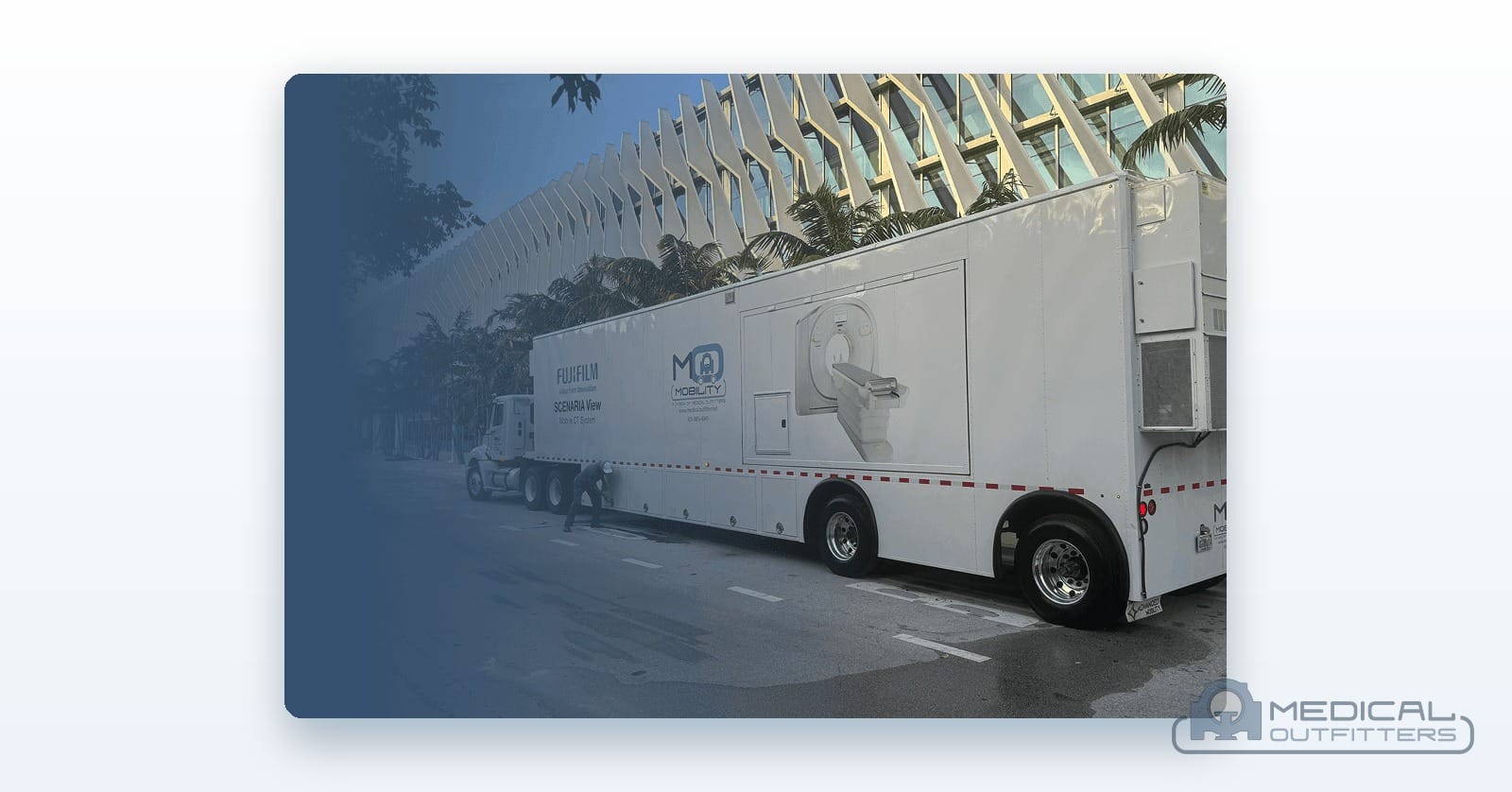
A mobile imaging trailer, also called a mobile imaging coach or unit, is a semi-trailer built around a single diagnostic scanner. The rear of the coach is the scan room, shielded and climate-controlled; a forward section holds the control console, and on some coaches a small patient prep or changing area. The whole thing is towed by a tractor, parked on a prepared pad beside the building, connected to power and the network, and leveled on hydraulic jacks so the scanner sits as still as it would on a slab inside a fixed suite.
Facilities reach for a mobile unit for four main reasons. The first is downtime: when a fixed scanner is out for a major repair or an upgrade, a mobile unit keeps the schedule running. The second is capacity: a clinic that cannot yet justify a permanent MRI can rent mobile days to test demand, or carry a seasonal peak. The third is construction: a mobile coach bridges the six to twelve months it takes to build a permanent MRI suite, so the service never stops. The fourth is sharing: a high-cost modality such as PET/CT is expensive to own for one site, so several facilities split one coach that visits each on a fixed day, which is the model behind much of the mobile PET/CT market.
The scanner inside a mobile coach is the same class of system a facility would install in a fixed room. The compromise is space and, for MRI, usually field strength: mobile MRI coaches are overwhelmingly 1.5T, because a 3T magnet and its shielding push the coach past normal road limits, while fixed suites take 3T freely. Everything else, the image quality, the coil set, the software, matches the fixed version of the same scanner.
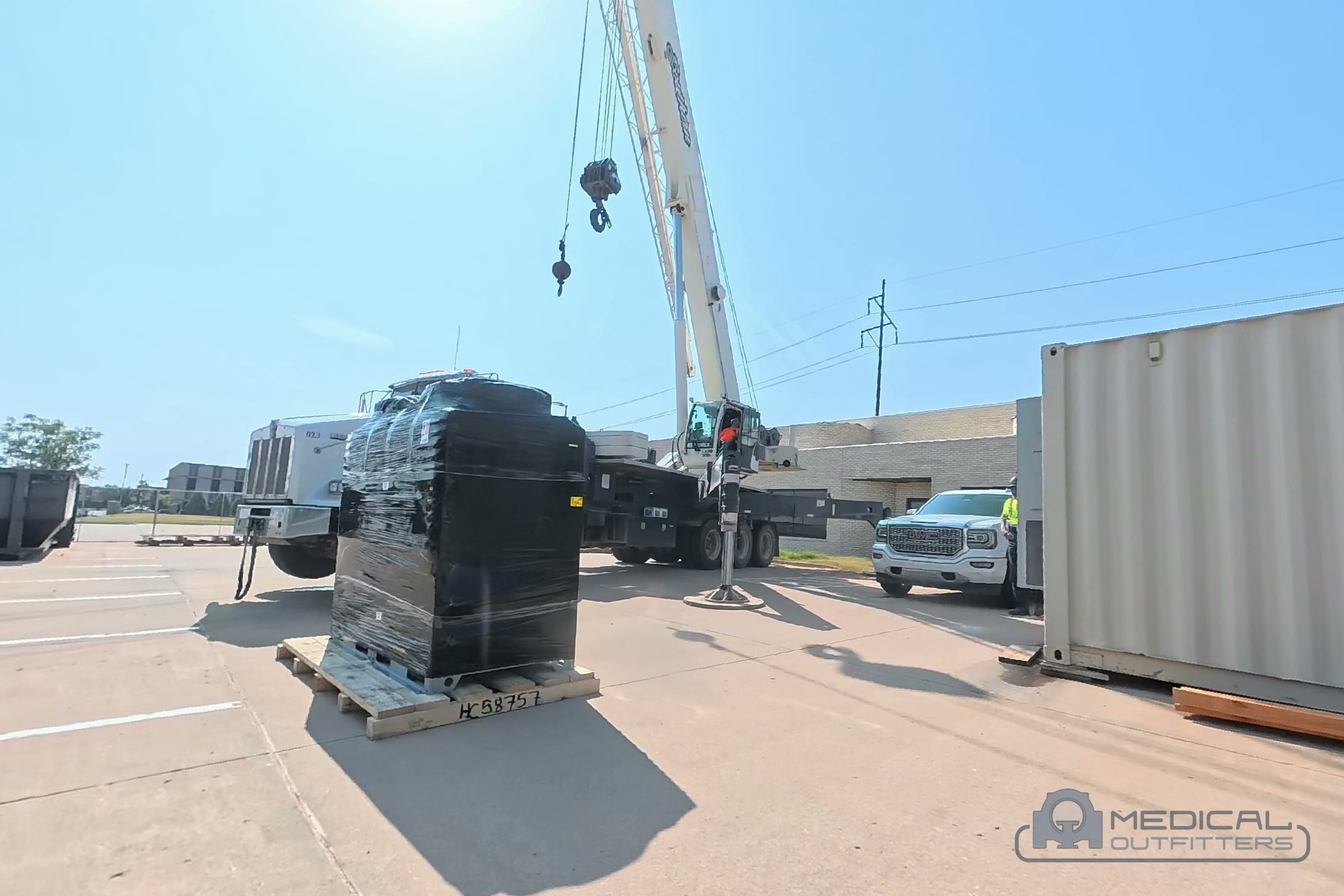
Inside the Coach: How a Mobile Imaging Trailer Is Built
A standard mobile imaging coach is about 48 feet long, 8.5 feet (102 inches) wide and 13.5 feet tall, the dimensions Medical Outfitters’ mobile MRI guide and the OEM coach planning guides give. The 8.5-foot width is not an accident: 102 inches is the federal width limit for a trailer on the National Network, per the Federal Highway Administration, so a standard coach can run the interstate without an oversize permit. Anything wider is oversize. A 10-foot-wide mobile MRI coach shown at RSNA in 2024, which Applied Radiology reported offers about 25 percent more workspace, needs special transport permits and route planning for exactly that reason. Larger 3T coaches run 53 to 60 feet long.
The coach is heavy. A loaded 1.5T unit weighs about 55,000 to 80,000 pounds depending on the magnet and the build, so the chassis, the landing gear and the pad under it are all engineered for a point load most parking lots are not. The scan room is built like a shrunken version of a fixed suite. For MRI, the magnet sits on an isolated sub-frame, and the room is lined with a radiofrequency (RF) shield, the same copper or sheet-metal enclosure a fixed MRI room’s shielding requirements call for, built into the coach walls so the scanner is not blinded by outside radio noise and does not leak its own. For CT and PET/CT, the walls carry lead or equivalent radiation shielding instead.
Because the coach is sealed and the scanner throws off heat, climate control is built in and sized for the modality. An MRI magnet and its gradients, or a CT tube under a heavy schedule, need stable temperature and humidity, and the coach’s HVAC runs whether or not the building’s does. The interior is finished to clinical standards: a cleanable scan room, a console position with a window onto the scanner, and the storage and power distribution tucked into the chassis below the floor.
The Docking Pad, Power and Utilities a Mobile Unit Needs
A mobile unit is only as good as the pad it parks on. The site work is modest next to building a room, but it is real, and it has to be finished before the coach rolls in. The controlling items are the pad, the power and the access, and they are the same whether a facility owns the coach or rents it.
| Site item | Typical requirement |
|---|---|
| Concrete pad | About 43 ft by 10 ft, level within a quarter inch over 10 ft, at least 6 inches of concrete for point loads up to roughly 60,000 lb, per OEM and provider planning guides summarized in the Medical Outfitters mobile MRI guide. Where concrete is not available, engineered steel plates can spread the load. |
| Power | Dedicated 480-volt, three-phase, 60 Hz service fused at 150 to 200 amps, typically landed on a Russellstoll-type connector, as MXR Imaging and the same MO guide specify. If no 480-volt shore power exists, a generator is used, estimated at $5,000 to $15,000 a month plus fuel. |
| Disconnect | A lockable, weatherproof disconnect within about 30 to 50 feet of the landing jacks. |
| Data | A network drop at the power connection so studies reach the facility’s PACS; mobile units are connected to the archive the same way a fixed scanner is. |
| Patient access | A wheelchair-capable lift or an ADA-compliant ramp, with a covered, level path from the building where possible. |
| Approach and parking | Roughly 60 feet for a 48-foot coach with its tractor to approach, turn and dock. |
Power is where mobile CT differs most from mobile MRI. A CT tube under a fast scan sequence draws in bursts: mobile-coach power guidance from Craftsmen Industries puts the peak demand near 120 kilowatts against an average closer to 40 kilowatts during scanning, so the service and any generator are sized for the peak, not the average. An MRI magnet, by contrast, draws a steadier load but must never lose power to its cold head, which is why shore power and the cryogen plan are written into the agreement. The data line matters as much as the power: a mobile scanner that cannot reach the facility’s PACS archive is a scanner whose images go nowhere.
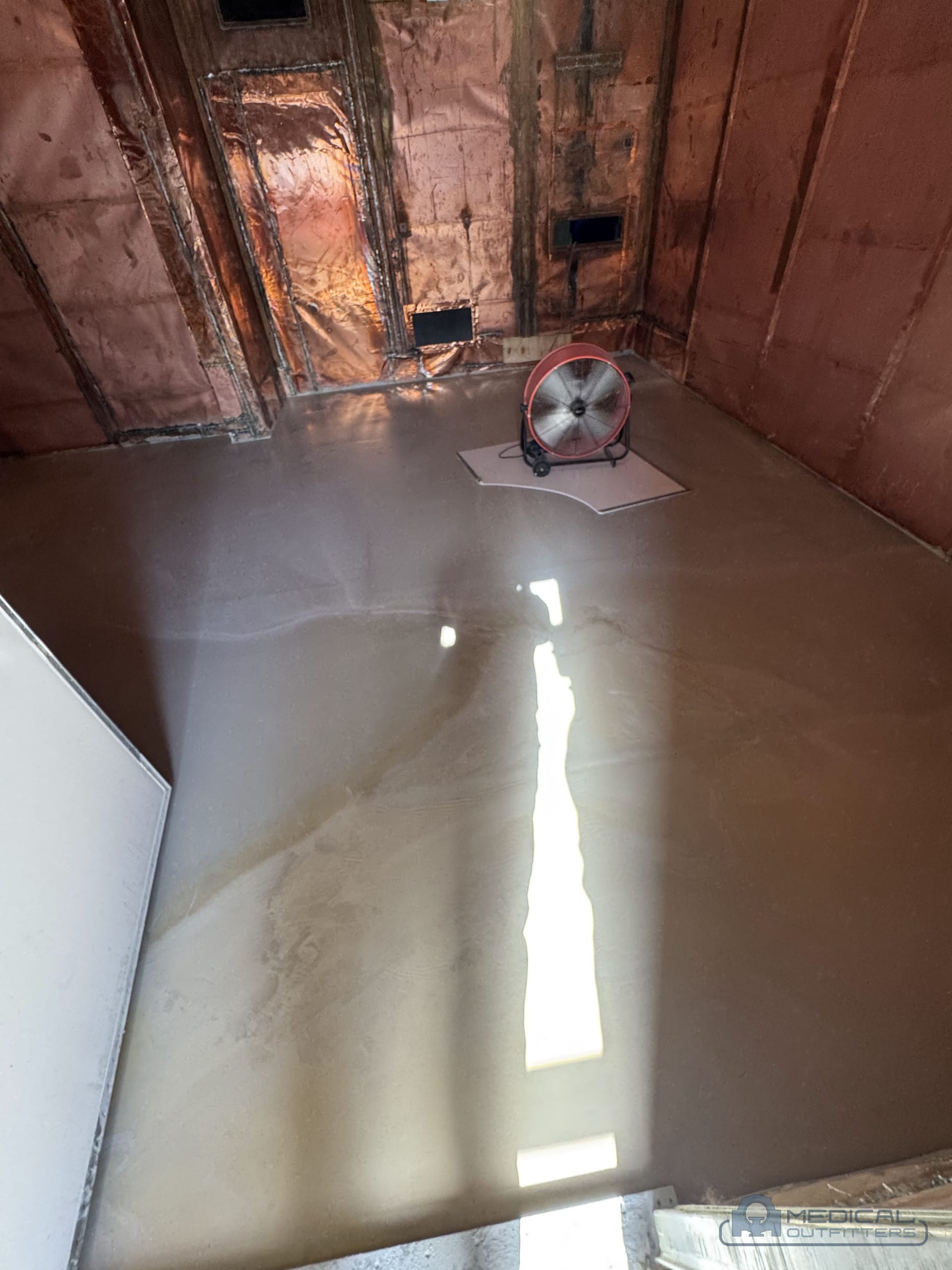
Mobile MRI, Mobile CT and Mobile PET/CT: What Each Adds
Mobile MRI. On a mobile MRI trailer the magnet and its fringe field are the defining constraint. The RF shield is built into the coach, and the magnetic 5-gauss line, the boundary the public and older implanted devices must stay outside, is engineered to stay inside the unit: on one shielded 48-foot 1.5T coach, the MO guide notes, the 5-gauss line sits within about 8 inches of the exterior up to 8 feet above grade. That is why where the coach parks matters, and why the quench pipe that vents helium in an emergency needs clear air above it. Mobile MRI is almost always 1.5T, and an open-class magnet is the exception for bariatric or claustrophobic caseloads.
Mobile CT. On a mobile CT trailer the shielding is lead rather than copper, the siting is simpler because there is no magnet, and the limiting factors are the peak electrical load and the floor loading of the gantry. A mobile CT docks and goes live quickly, which is why it is the common choice to cover a down fixed scanner or a short surge. Our CT scanner cost and price guide covers the fixed systems that ride in these coaches.
Mobile PET/CT. This is the most regulated of the three, because it uses short-lived radioactive tracers. The coach carries a hot lab for handling and measuring doses, and an exclusion zone may be marked around the unit, as GE’s Discovery IQ mobile PET/CT planning guidance describes. The radiation safety is not just an equipment question: it is a licensing one, covered below. Because a PET/CT scanner is costly to own for a single site, the mobile, shared-route model is especially common here, and the difference between PET and MRI is one facilities weigh when planning which modality to own and which to share.
State Rules, Accreditation and Transport
A mobile unit crosses jurisdictions a fixed scanner never does, so it carries more paperwork. Three layers apply. The first is state radiation registration. Most states register X-ray-producing equipment, and mobile services are registered separately from fixed sites. Texas, for example, registers mobile services on its own form, RC 226-8, through the Department of State Health Services; Maine requires a Qualified Expert to inspect mobile X-ray equipment before its first use in the state and every two years after, plus registration of the technologists, radiologists and sites served. The specific rules differ by state, so a coach that travels a region is registered in each state it scans in.
The second layer is accreditation. The American College of Radiology (ACR) accredits imaging units, and because mobile practice settings vary, the FDA has allowed the ACR flexibility in how it accredits them. The ACR’s mobile unit multi-site policy sorts the requirements by scenario: sites that share the same unit, interpreting physicians and protocols can get a reduced fee at each location while the main location completes full testing, but sites that do not share them each apply separately. Mobile mammography carries the strictest version of this, needing ACR accreditation of each unit and a provisional MQSA certificate from the FDA or the state before any patient is scanned.
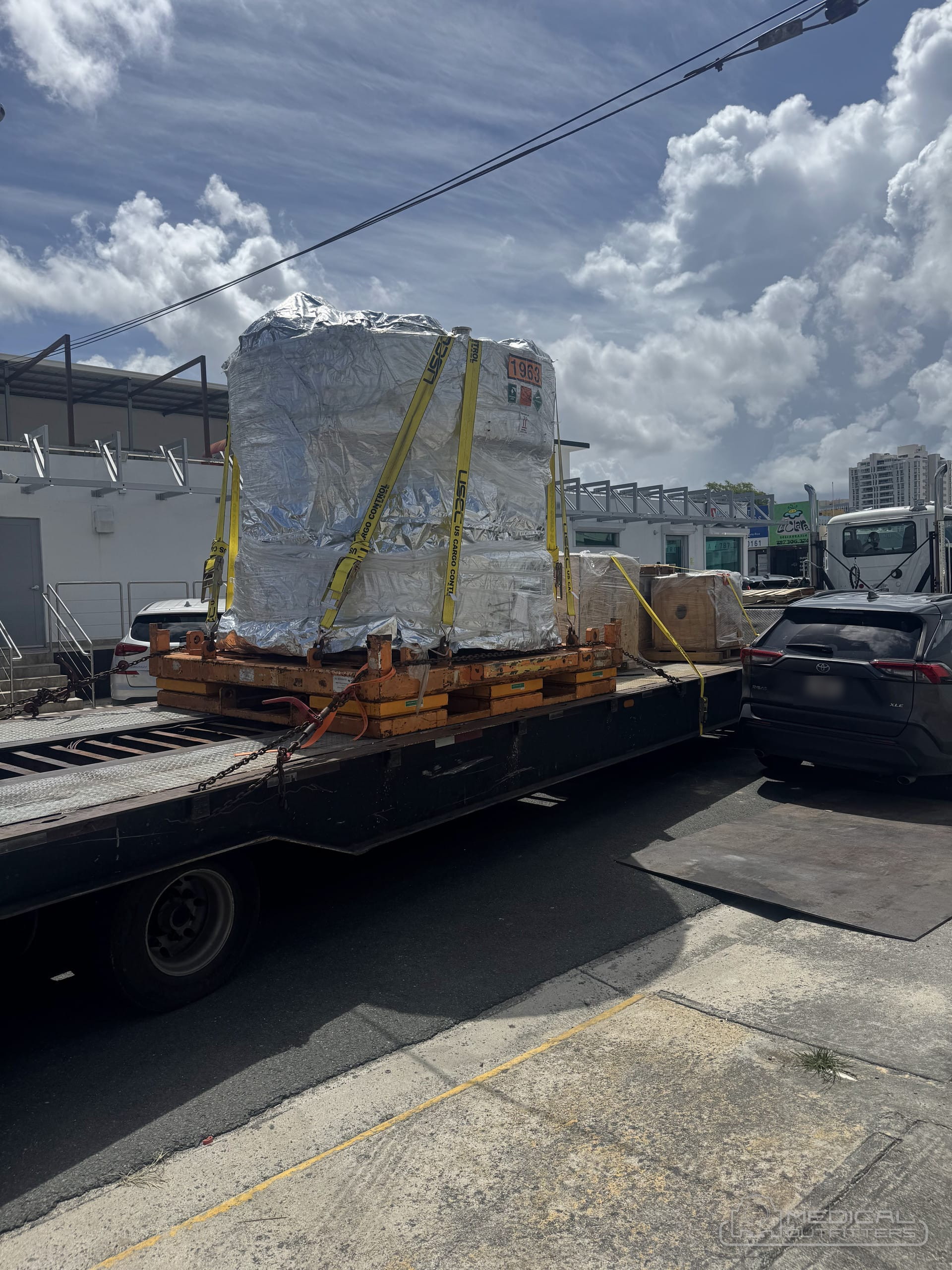
The third layer applies only to mobile PET and nuclear medicine: a radioactive-materials license. Under the Nuclear Regulatory Commission’s rules in 10 CFR Part 35, a mobile medical service provider transports doses to a client site, and PET work in a mobile van is flagged as a higher-exposure activity where shielding and waste disposal get special attention. New York State’s guidance is typical of how it works at the host site: the client facility amends its own radioactive-materials license to add the PET agents and to list the mobile coach as a location of use, and the client facility remains responsible for radiation safety on the coach. On the road, the coach is also a vehicle: at 13.5 feet tall it can be oversize on some routes, so a route survey and, for wider coaches, oversize permits are part of every move.
Buy, Rent or Route Service: How Mobile Capacity Is Paid For
There are three ways to pay for mobile imaging, and the mobile imaging services cost a facility sees follows the caseload more than anything else. The figures below for coaches and rentals are market estimates drawn from public rental reporting, which Medical Outfitters’ mobile MRI guide summarizes and quotes per project; the scanner purchase bands are Medical Outfitters’ own all-in prices. Any dollar figure here is a planning estimate, not a quote.
Buy the coach outright. A used shielded coach without a magnet runs about $50,000 to $250,000, a complete used 1.5T mobile unit as it stands about $150,000 to $500,000, and a new mobile 1.5T coach $1,000,000 to $3,000,000, each quoted per project. On top of or instead of a used coach, the scanner itself carries Medical Outfitters’ refurbished bands: a 1.5T system $475,000 to $975,000 delivered, installed and warrantied, a 3T system $1,000,000 to $1,900,000, and an open-class magnet $300,000 to $525,000, the same bands as our used and refurbished MRI machines. Buying makes sense when the unit will run for years on a steady schedule.
Rent or lease by the month. A 1.5T mobile MRI rents for roughly $25,000 to $45,000 a month in the typical case, before transport of about $3,000 to $9,000 each way, set-up and the cryogen and service terms. Renting fits downtime cover, a construction bridge or a trial, and the full rate structure, lease terms and the buy-versus-rent break-even are laid out in our guide to mobile MRI rental, lease and purchase cost.
Take route service. For PET/CT and for low-volume sites, a provider owns the coach and brings it on a fixed schedule, one day a week or a few days a month, and the site pays per day or per scan. It needs the same pad, power and data as a rental, but no capital and no ownership. Whatever the route, the pad and the power are the facility’s to build, and getting them right is what turns a parked coach into a working scanner.
Because these are good-faith estimates and not quotes, configuration, condition, transport distance, term and the cryogen and service terms move the real number, and a written quotation may be materially different.
Mobile Imaging With Medical Outfitters
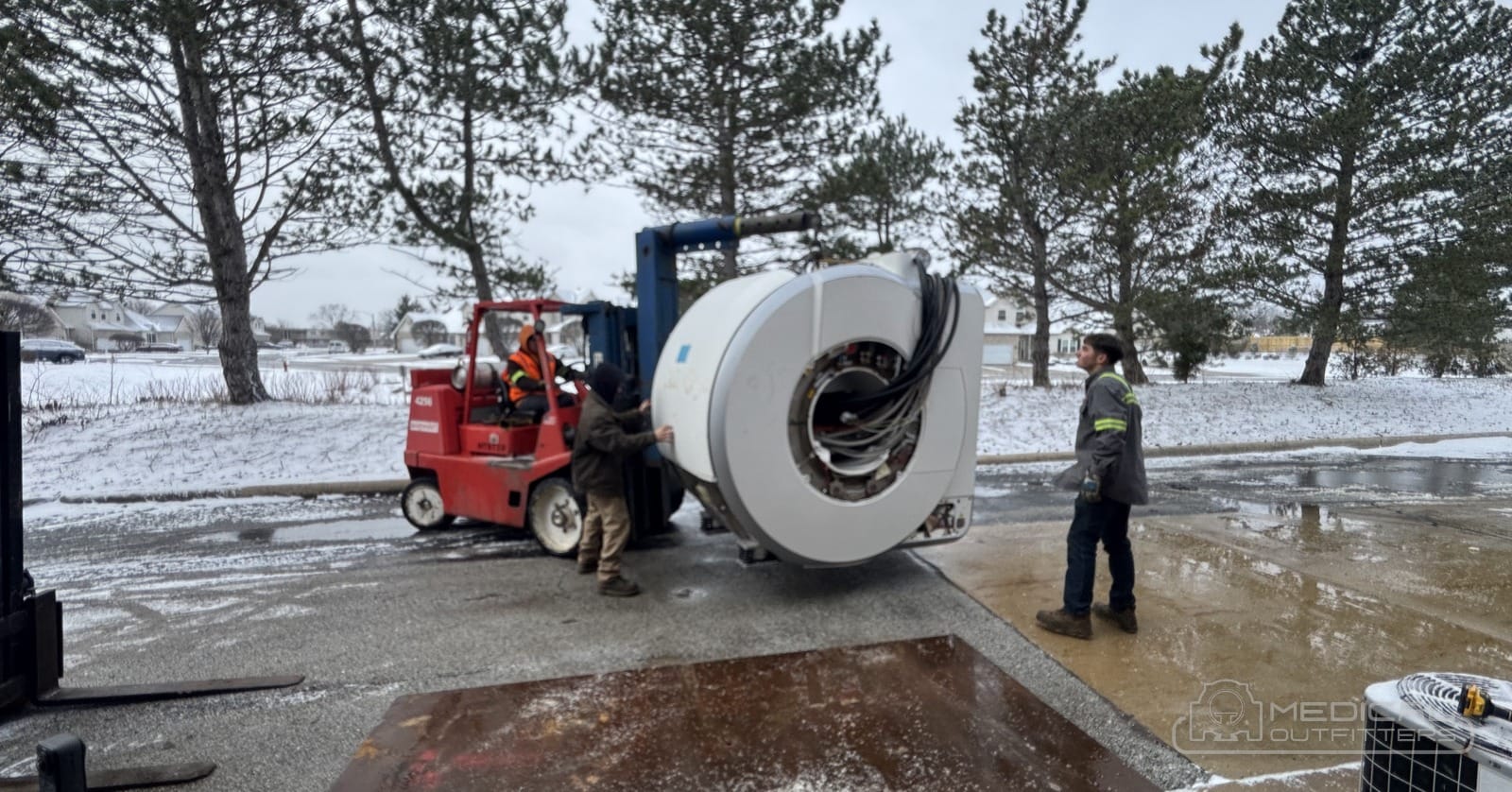
Through MO Mobility, Medical Outfitters supplies mobile MRI, CT and PET/CT coaches for short and long terms, maintained by its own engineers for the length of the agreement and quoted per project, with delivery, siting, cryogens and ongoing service handled by MO crews across the United States, Puerto Rico and the Caribbean. The same team installs permanent systems when a mobile unit has proven the caseload, pricing them through our MRI, CT and PET/CT cost guides, and refurbishing GE and Siemens systems through MO Select. For the rigging and magnet handling a permanent install involves, see how we move an MRI or CT scanner, and for the shielded room a fixed MRI needs, our guide to MRI room shielding requirements. Our MRI service team keeps both mobile and fixed systems running. To price a mobile unit, a rental or a permanent system for your site, contact Medical Outfitters.
- Medical Outfitters, mobile MRI rental, lease and purchase cost guide, for coach dimensions, weights, pad, power, 5-gauss, transport and market price ranges. medicaloutfitters.com/blog/mobile-mri-purchase-vs-rental
- Federal Highway Administration, federal truck size and weight limits, for the 102-inch National Network width. ops.fhwa.dot.gov/freight/sw/overview
- American College of Radiology, mobile unit multi-site accreditation policy. acrsupport.acr.org, mobile unit multi-site policy
- Nuclear Regulatory Commission, medical use of byproduct material FAQ, 10 CFR Part 35, for mobile medical service providers and mobile PET. nrc.gov, Part 35 FAQ
- New York State Department of Health, licensing guidance for facilities using a mobile PET service. health.ny.gov, mobile PET licensing
- Texas Department of State Health Services, registration of mobile services (RC 226-8). dshs.texas.gov, mobile services registration
- Mobile MRI rental, lease and purchase cost (2026)
- MRI machine cost and price guide (2026)
- CT scanner cost and price guide (2026)
- PET/CT scanner cost and price guide (2026)
- MRI room shielding requirements and the 5-gauss line
- How to move an MRI or CT scanner
- MRI vs PET scan: how they differ
- Used and refurbished MRI machines for sale
- MRI machines for sale: refurbished and new
- MRI machines: new, refurbished and used
- MRI service, repair and maintenance
- CT scanner service, repair and maintenance
- Price a mobile unit, a rental or a permanent system
Mobile Imaging Trailers: Common Questions
What is a mobile imaging trailer?
A mobile imaging trailer is a self-contained, shielded coach that carries a working MRI, CT or PET/CT scanner to a site on a semi-trailer chassis. A standard unit is about 48 feet long, 8.5 feet wide and 13.5 feet tall, and it docks against a building, plugs into dedicated power and a data line, and scans patients who enter through a lift or a ramp.
How big is a mobile MRI or CT trailer?
A standard mobile imaging coach is about 48 feet long, 8.5 feet (102 inches) wide and 13.5 feet tall, the figures the Medical Outfitters mobile MRI guide and OEM coach planning guides give. The 102-inch width matches the federal National Network limit so the coach runs the interstate without an oversize permit. A 3T mobile coach is longer, 53 to 60 feet, and a loaded 1.5T unit weighs about 55,000 to 80,000 pounds.
What does a site need to install a mobile imaging unit?
A level concrete pad about 43 by 10 feet with at least 6 inches of concrete for the point load, dedicated 480-volt three-phase power fused at 150 to 200 amps, a lockable weatherproof disconnect, a network drop to the facility's PACS, and patient access by an ADA lift or ramp. The work is modest next to building a room, but it must be finished before the coach arrives, and the pad level and the power sizing are the items that most often hold a go-live up.
How much does a mobile imaging trailer cost?
Market estimates the Medical Outfitters mobile MRI guide summarizes put a used shielded coach without a magnet at $50,000 to $250,000, a complete used 1.5T mobile unit at $150,000 to $500,000, and a new mobile 1.5T coach at $1,000,000 to $3,000,000, quoted per project. A 1.5T mobile MRI rents for roughly $25,000 to $45,000 a month plus transport. The refurbished scanner itself carries Medical Outfitters bands of $475,000 to $975,000 for 1.5T. These are planning estimates, not quotes.
What is the difference between mobile MRI, CT and PET/CT units?
Mobile MRI carries its magnet and an RF shield built into the coach, and its fringe field and 5-gauss line govern where it parks. Mobile CT has no magnet, uses lead shielding, and its limits are peak electrical load and floor loading. Mobile PET/CT adds a hot lab for radioactive tracers and a radioactive-materials license, which makes it the most regulated and the most commonly shared on a route across several sites.
Do mobile imaging units need a license or accreditation?
Yes. Most states register X-ray-producing equipment, and mobile services are registered separately from fixed sites and often in each state the coach travels. The American College of Radiology accredits the imaging unit, with a mobile multi-site policy that sets requirements by how units, physicians and protocols are shared. Mobile mammography is the strictest case, needing ACR accreditation of each unit and a provisional MQSA certificate before any patient is scanned.
How is a mobile PET/CT unit regulated?
Mobile PET uses short-lived radioactive tracers, so it falls under radioactive-materials licensing in addition to the usual X-ray and ACR rules. Under the Nuclear Regulatory Commission's 10 CFR Part 35, a mobile medical service provider transports doses to a client site, and PET in a mobile van is flagged as higher risk. At the host site, the facility typically amends its own radioactive-materials license to add the PET agents and list the coach as a location of use, and stays responsible for radiation safety on the coach.
Does Medical Outfitters provide mobile imaging units?
Yes. Through MO Mobility, Medical Outfitters supplies mobile MRI, CT and PET/CT coaches for short and long terms, maintained by its own engineers for the length of the agreement and quoted per project. Its crews handle delivery, siting, cryogens and ongoing service across the United States, Puerto Rico and the Caribbean, and the same team installs a permanent system through MO Select when a mobile unit has proven the caseload.