
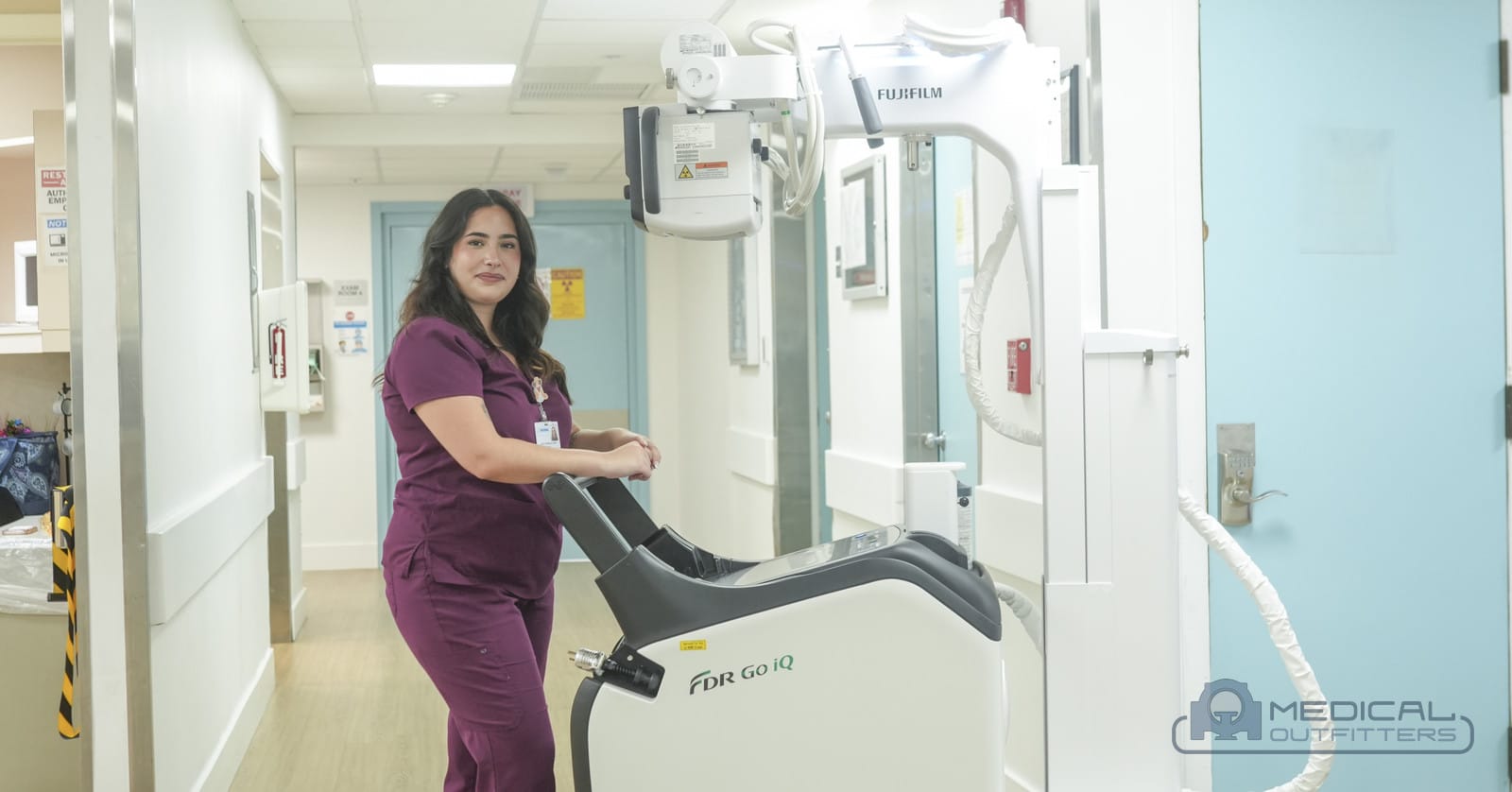
Larkin Community Hospital asked us to bring the Fujifilm FDR Go iQ to their Palm Springs Campus in Hialeah. They wanted their own technologists to try it in their own corridors. So we did, and we filmed the day. This post is what we saw and what the Larkin team told us on camera. We wrote it up for anyone weighing a mobile X-ray machine against a fixed room, or comparing portable X-ray machines from different manufacturers. For what the FDR Go iQ and the other mobile carts cost, delivered and warrantied, see the portable X-ray machine price by model in our portable X-ray machine price guide.
Before that, some context. The Palm Springs Campus is a 247-bed acute care hospital in the Larkin Health System. Its imaging department does more than 50,000 procedures a year, and a good share of that is bedside work. That is where a portable unit earns its keep or gets parked in a corner. Corridor widths, door thresholds, how many times a technologist lifts the detector in a shift, whether the radiologists like what comes back. In practice, you only find that out on the floor.
Why We Did the Demonstration on the Hospital Floor
Larkin has been a Medical Outfitters customer for years. The department already runs Carestream DRX portable units, a Fujifilm CT, a Philips CT and an Apelem fluoroscopy room that we supplied. The radiologists there also have opinions about image quality. So when the department started looking at its next mobile digital X-ray purchase, nobody needed convincing that digital radiography works. Instead, the open questions were more practical. Would a newer mobile X-ray machine fit an older building? Could it make the technologists’ day shorter? And would the radiologists notice a difference?
You cannot answer those from a spec sheet, so we brought the unit to them. The people who push the machine down the hall, angle the tube over a bed and carry the detector into an isolation room got to judge it against their own corridors and their own cases. Meanwhile, the Fujifilm specialist was standing right there when the questions came up.
What the Fujifilm FDR Go iQ Actually Is
The FDR Go iQ is Fujifilm’s current full-size portable digital radiography system. It is a self-propelled mobile X-ray machine with the generator, tube, console and detector charging all built into the one unit. So a technologist can leave the department, image a patient at the bedside and send the study to PACS without going back to a workstation.
The numbers that matter on a hospital floor, roughly in the order the Larkin team asked about them:
- It is 22.5 inches wide and weighs about 970 pounds. In a semi-private room that is the difference between turning around and reversing out.
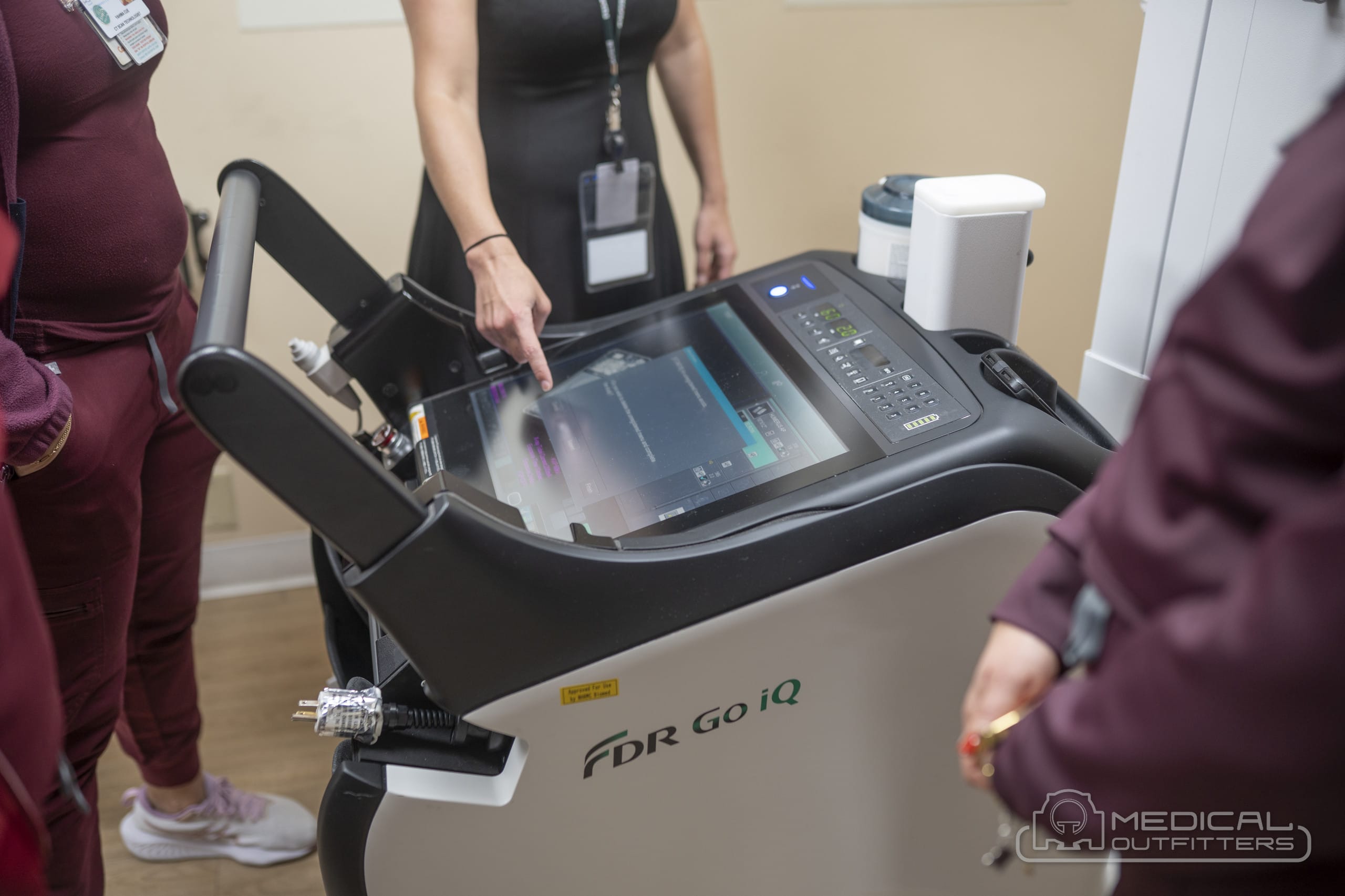
- There are two screens. The 19-inch touchscreen on the base handles the worklist, exam protocols, image review and processing. The smaller display at the tube head shows exposure settings during positioning.
- Its detectors are Fujifilm’s FDR D-EVO III wireless panels. They are glass-free and carry the Hydro AG antibacterial coating. They also use Irradiated Side Sampling, which reads the signal from the side the beam enters. Sharper image, lower dose, and light enough to slide under a patient with one hand.
- The battery gives roughly three to four hours of use per charge, with a reserve for around ten more exposures. The unit also tops up the detector on board.
- A built-in 3D camera helps with positioning at the tube head. Fujifilm also built the platform to take future AI features by software update.
- Image processing is Fujifilm’s Dynamic Visualization II, with annotation, rotation and filters handled at the console.
What the Technologists Put the Mobile DR Unit Through
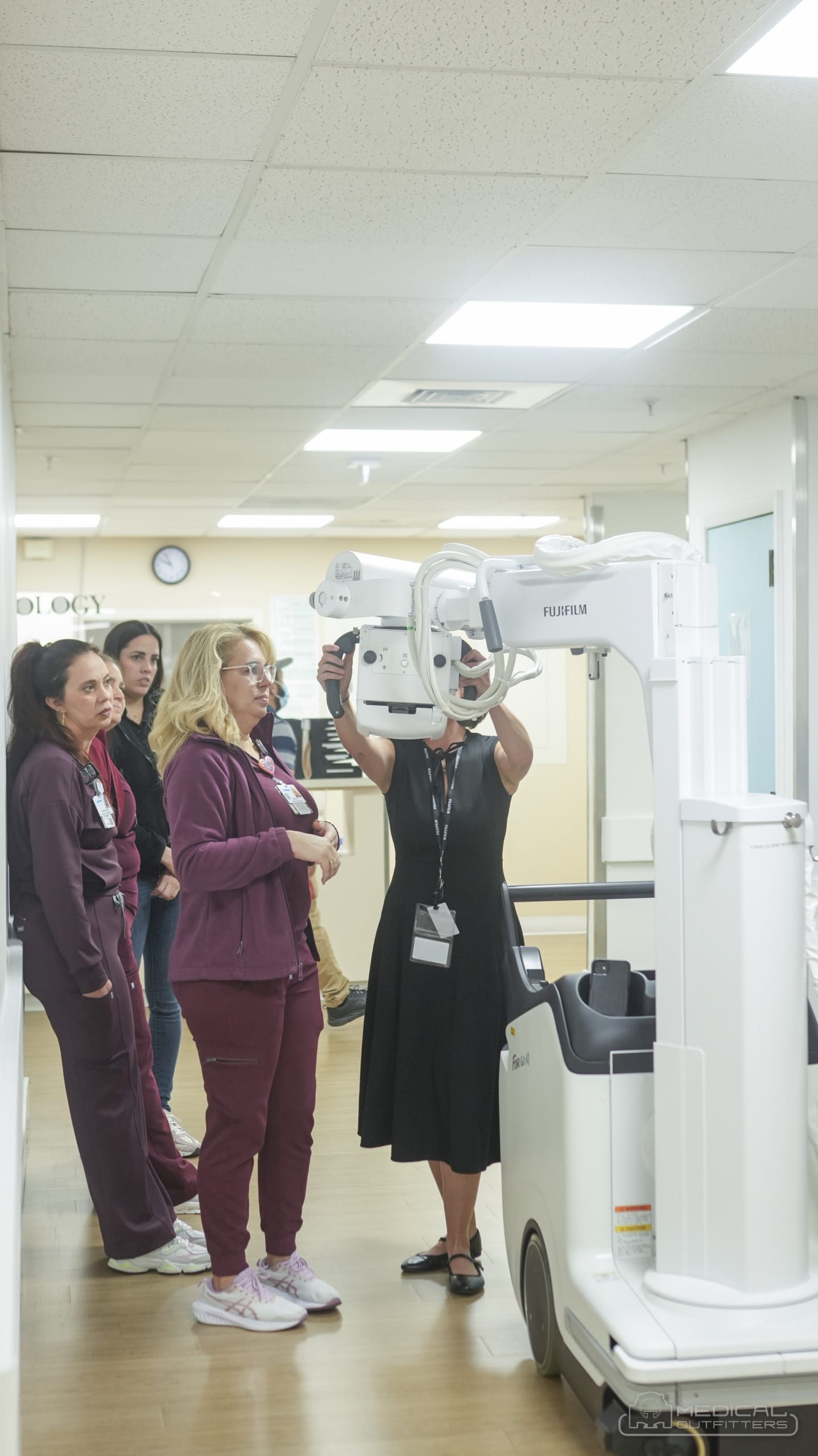
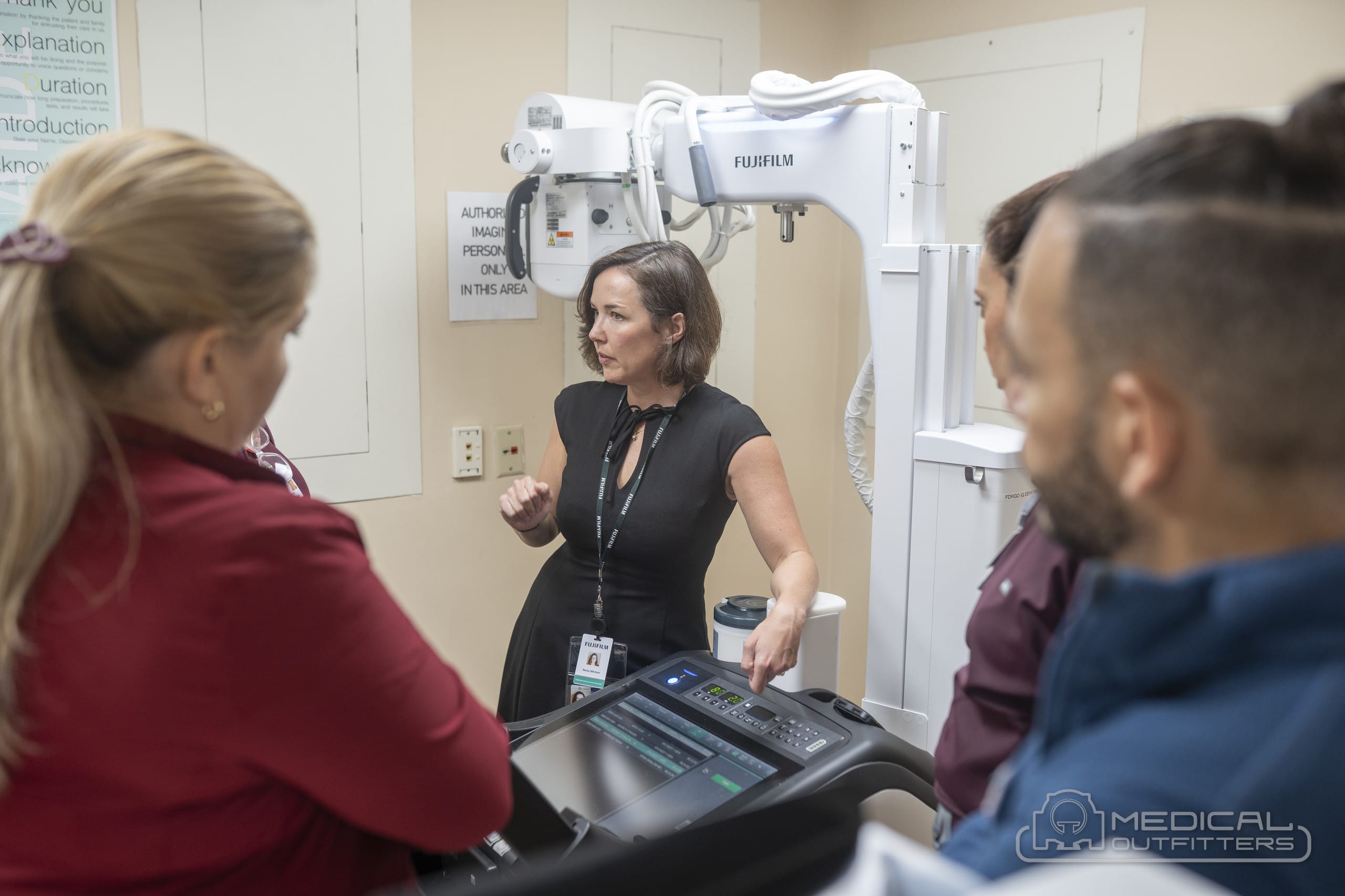
The demo ran in one of the campus X-ray rooms and the corridors around it. After one walkthrough of the unit, the team was left to drive it themselves.
The first thing they did was drive it, which is what every technologist does with a new portable. Through doorways, around corners, parked beside a bed. Then the tube arm went up and swung into a chest position and an extremity position. Next came the detector. They picked up the D-EVO III panel, compared its weight with the panels they use today, and paired it with the unit. After that, the console, which is where the demo slowed down and got interesting. Selecting a protocol, adjusting exposure at the tube head, reviewing the image, adding annotations, rotating and flipping, applying a processing filter, sending. And finally the workflow questions. How does the worklist arrive? How does a study leave for PACS? And what happens when one unit has to cover the ER, the floors and the ICU in the same shift?
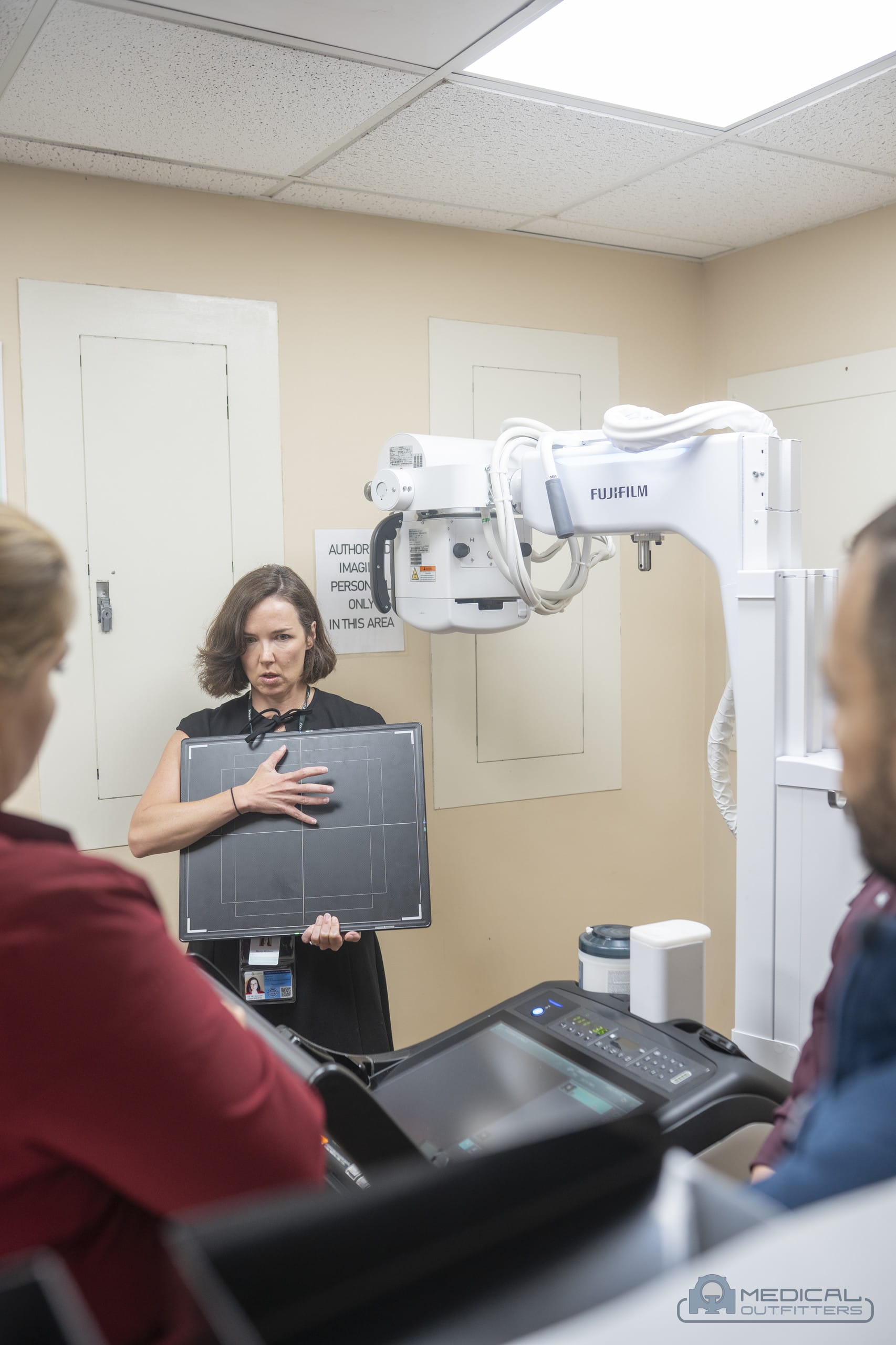
The questions were the best part of the day. None of them came from the brochure. They were about Larkin’s rooms, Larkin’s patients and Larkin’s radiologists. In fact, that is the whole reason to do a demonstration in the department.
What the Larkin Team Told Us on Camera
We also recorded short interviews during the visit. One of the radiologic technologists at the Palm Springs Campus has worked with several makes of portable digital X-ray system over the last three to four years, Fujifilm among them. So he spoke from experience:
“Throughout that time, the system proved to be extremely versatile and reliable. It offers a wide range of features that make the technologist’s job much easier. The image quality is excellent.”
What he singled out were the features that save time between the exposure and the read. “The system allows you to add annotations, perform free image rotation up to 360 degrees and optimize image presentation for the radiologist,” he said. He also pointed to the processing filters that bring out lines, tubes and anatomy, and to “multiple exam protocols and customizable projection views for each study.”
Diana, from the Larkin team, talked about volume, and about the history between the two companies:
“The image is very high quality. We do over 50,000 procedures a year, and most of them are done with the equipment purchased from the Medical Outfitters team. The radiologists have very positive reviews on the image quality, from the Carestream units, from the Fuji CT and the Philips CT.”
The fluoroscopy room we supplied does “20 to 30 fluoroscopy procedures a month,” she said. And on working with us: “They always have recommendations as to which is better for us, and their recommendations are amazing. Miguel Machuca, who represents Medical Outfitters, has always been very supportive of our team and giving us the best options.”
When a Portable X-Ray Machine Is the Right Buy, and When a Fixed Room Still Wins
A fixed digital radiography room is still the workhorse for scheduled chest, abdomen and extremity work, inpatient and outpatient. Nothing about a mobile unit changes that. A mobile X-ray machine earns its keep with the patients who cannot come to the room. That means the ventilated patient in the ICU who needs a portable chest X-ray every morning, and the trauma or isolation patient in the ED. It also means the line or tube check in the OR or in recovery and, in an older building like this one, the rooms a fixed installation will never reach. A wipeable unit with an antibacterial coating on the detector also takes some of the cleaning burden off the staff between isolation patients.
If you are comparing portable X-ray machines, these are the things we would push you to ask about. First, how wide is the unit and how tight does it turn? That decides whether it gets into semi-private rooms and older wings. Then ask what the detector weighs and whether it is glass-free. The technologist lifts it dozens of times a day, and drops are a leading cause of detector damage. Battery next: how long does it last, and does the unit charge the panel? A machine that gives out mid-shift or needs a separate charger costs you exams. Also check whether protocols, processing and annotations live on the console, so bedside work does not get redone at a workstation. Finally, ask whether the manufacturer’s representative will demonstrate it in your department. Corridors, beds and staff habits are the real test. Larkin’s were.
Price matters too. The ranges for new and refurbished portable units are in our X-ray machine cost guide, and we quote every configuration individually.
How a Mobile X-Ray Machine Demonstration at Your Facility Works
We are a Fujifilm authorized dealer, so we can bring current systems to a hospital or clinic for a working demonstration, with product specialists on hand. That includes the FDR Go iQ, the FDR nano compact X-ray cart and the FDR Xair handheld portable X-ray. For departments stretching a budget, we also sell and service refurbished mobile X-ray equipment. That includes the Carestream DRX-Revolution that Larkin already runs, alongside the rest of our X-ray machines for sale.
Of course, the demo is the small part. What a customer like Larkin Community Hospital actually gets from us is delivery, installation, applications training, and service and repair. Then there are the detector and tube replacements that keep a portable fleet running. All of it comes from the same team, across Florida, the rest of the United States, Puerto Rico and the Caribbean. If you are in South Florida, our imaging equipment in Florida page covers how fast we can be on site.
- X-ray machines for sale: new and refurbished
- Fujifilm FDR nano compact digital X-ray cart
- Carestream DRX-Revolution mobile X-ray system
- Fujifilm FDR D-EVO III wireless detector
- Fujifilm FDR Xair handheld portable X-ray
- X-ray machine cost guide
- Fluoroscopy machines for sale
- Imaging equipment service and repair
- Imaging equipment for sale in Florida
- Book a demonstration
Fujifilm, Carestream and Apelem are trademarks of their respective owners. Medical Outfitters is an authorized Fujifilm dealer.
Want to see a mobile X-ray machine on your own floor before you buy one? Contact us and we will set up an FDR Go iQ demonstration at your facility.
Questions We Get About Mobile X-Ray Machines
What is the Fujifilm FDR Go iQ?
Fujifilm's current full-size mobile digital X-ray machine. It is a self-propelled unit 22.5 inches wide with a 19-inch touchscreen console, a second display at the tube head, a built-in 3D positioning camera and glass-free FDR D-EVO III wireless detectors. Fujifilm also built it to take future AI features by software update.
Can Medical Outfitters demonstrate a mobile X-ray machine at our hospital or clinic?
Yes, and we would rather do it in your department than anywhere else. We are a Fujifilm authorized dealer, so we bring the FDR Go iQ or another portable digital radiography system to your hospital or clinic with a product specialist. Then your technologists test it in your own rooms and corridors.
How much does a mobile or portable X-ray machine cost?
It depends more on the detector, the generator and the software than on the badge on the front. In short, a new mobile digital X-ray unit and a refurbished portable X-ray machine sit in very different ranges. Our X-ray machine cost guide has the broad industry numbers, and we quote each configuration individually.
What is the difference between a mobile X-ray machine and a portable X-ray machine?
A mobile X-ray machine such as the FDR Go iQ is self-propelled, with its own generator, console and digital detector. Some people call it a mobile DR unit, and it is built for bedside imaging in hospitals. A portable X-ray machine such as the Fujifilm FDR Xair is a much smaller battery-powered handheld source. It pairs with a separate detector, which suits clinics, long-term care and field work.
Which detector does the FDR Go iQ use?
Fujifilm FDR D-EVO III wireless flat panels. They are glass-free and carry the Hydro AG antibacterial coating. They also use Irradiated Side Sampling, which reads the signal from the side the beam enters. The result is a sharper image at a lower dose, and the unit charges the panel on board.
Does Medical Outfitters service mobile X-ray machines after the sale?
Yes. Our own engineers install, train on, service and repair mobile and fixed X-ray equipment. That covers Florida, the rest of the United States, Puerto Rico and the Caribbean. Our parts division also supplies replacement detectors and tubes.
