Published 2 November 2026. The prices on this page are class estimates drawn from public PACS pricing reporting for 2025 and 2026, rounded and printed for comparison only; they are not Medical Outfitters offers. Fujifilm Synapse software and LG diagnostic displays sold by Medical Outfitters are quoted on request for each site. Product facts come from the Fujifilm and Medical Outfitters product pages read on 2 November 2026. Written by the Medical Outfitters sales and field engineering team.
A PACS system costs an estimated $2,500 to $9,500 a year on a cloud subscription for a small practice, $6,000 to $30,000 a year for an outpatient imaging center, $20,000 to $60,000 a year for a multi-site radiology group and $250,000 to $1,000,000 a year for a hospital under a multi-year enterprise agreement, comparison only. Bought outright, a perpetual license costs an estimated $20,000 to $150,000 for the software, $15,000 to $80,000 for the servers and 15 to 20 percent of the license a year in support. The figures on this page are class estimates from public pricing reporting for 2025 and 2026, rounded and printed for comparison only, not a Medical Outfitters offer; Fujifilm Synapse, sold by Medical Outfitters as an authorized Fujifilm enterprise imaging supplier, is quoted on request for each site.
This guide covers PACS cost by facility size, the pricing models, cloud and on-premise costs line by line, a five-year comparison, how Fujifilm Synapse is quoted, what a VNA, a migration, the interfaces and the workstations add, the running cost, and which PACS to buy.
- In this guide: How much does a PACS system cost? Prices by facility size
- PACS pricing models: per study, per modality, per user, subscription, enterprise and perpetual
- Cloud PACS cost line by line
- Perpetual license and on-premise cost line by line
- Subscription vs perpetual license: a five-year comparison
- Fujifilm Synapse: what Medical Outfitters sells and how it is quoted
- VNA cost
- PACS migration cost
- RIS, EHR and modality worklist integration cost
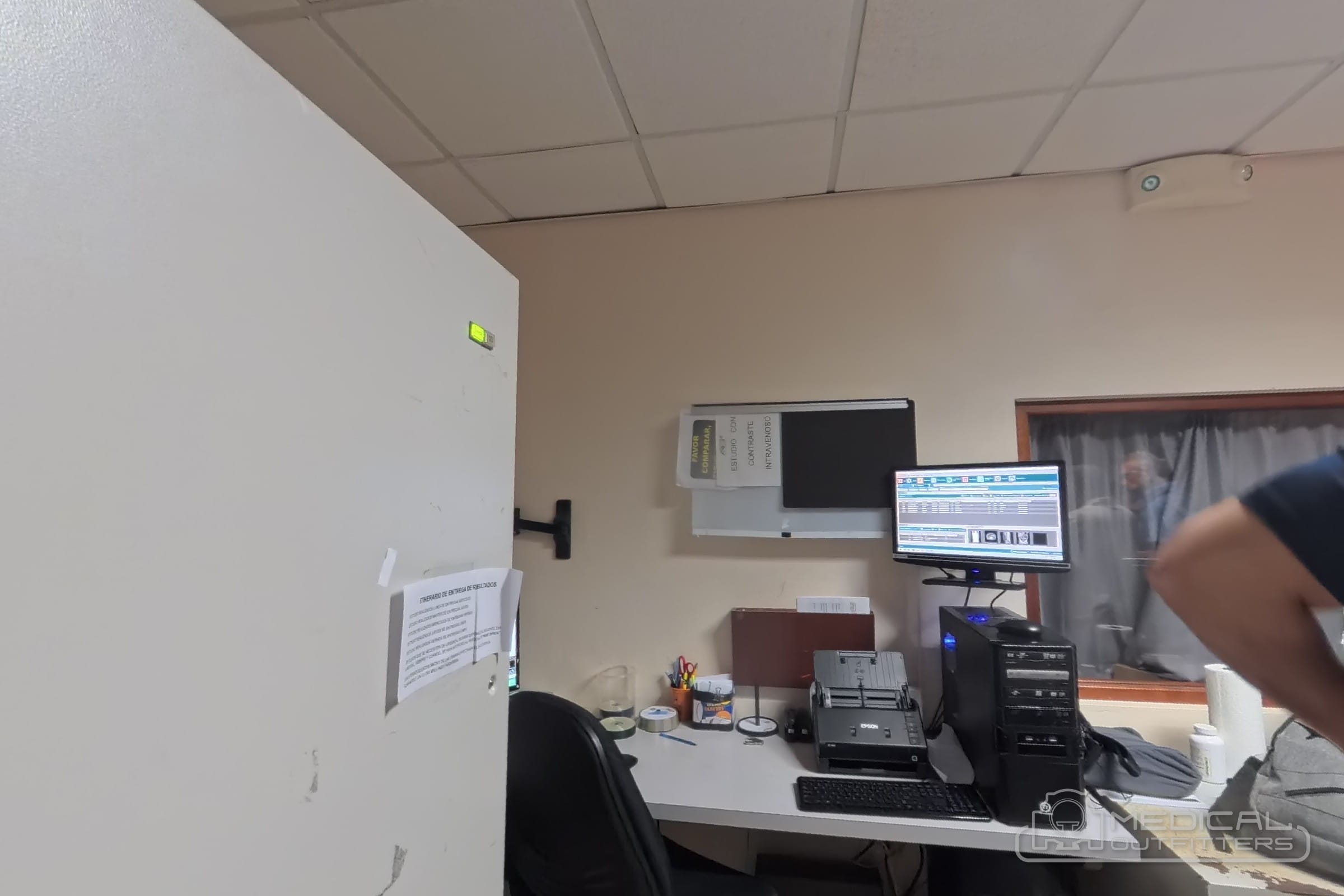
- Reading workstations and diagnostic displays
- What a PACS costs to run
- Which PACS should you buy?
- Frequently asked questions
How Much Does a PACS System Cost?
PACS system cost is set by study volume first and by the hosting model second: the same server, archive, viewer and connections are bought at volumes a hundredfold apart, as a cloud subscription or as a perpetual license on servers the facility owns. The table gives both, as class estimates from public pricing reporting, comparison only, rounded to the nearest $500 below $50,000 and $5,000 above it.
| Facility | Studies | Cloud subscription, per year | Perpetual license on premise, year one | Five-year total cost of ownership |
|---|---|---|---|---|
| Small practice or single-modality clinic | 50 to 300 a month | Estimated at $2,500 to $9,500 a year ($200 to $800 a month), comparison only | Estimated at $25,000 to $110,000 in year one, comparison only | Cloud $12,000 to $48,000; on premise $150,000 to $280,000, estimated |
| Outpatient imaging center, multi-modality | 250 to 1,000 a month | Estimated at $6,000 to $30,000 a year ($500 to $2,500 a month), comparison only | Estimated at $90,000 to $250,000 in year one, comparison only | Cloud $30,000 to $150,000; on premise $300,000 to $620,000, estimated |
| Multi-site radiology group | 1,000 to 3,000 a month | Estimated at $20,000 to $60,000 a year, comparison only | Estimated at $200,000 to $500,000 in year one, comparison only | Cloud $100,000 to $300,000; on premise $700,000 to $1,500,000, estimated |
| Hospital or health system, enterprise PACS and VNA | 3,000 to 25,000 or more a month | Enterprise agreement, estimated at $250,000 to $1,000,000 a year over a five to seven year term ($1,500,000 to $5,000,000 for the term), comparison only; larger systems run higher | Perpetual enterprise license plus a data center, quoted per enterprise | $1,500,000 to $5,000,000 and up for the term, estimated |
PACS system cost in 2026 by facility size, class estimates from public pricing reporting, comparison only; year one on premise is the license, the servers and the implementation, and the five-year figures add support, storage growth and, on premise, the IT time. Fujifilm Synapse is quoted on request and does not appear in the table.
The same question arrives as PACS system cost, PACS cost, PACS system price, PACS pricing, PACS software cost and how much does a PACS system cost, and the table answers all of them. Searches for a PACS system for small practice land on the first row, where a $200 to $800 a month subscription has replaced the server room most practices bought a decade ago. A figure quoted without the hosting model, the seats and the storage tier is not a usable number.
What a PACS quote includes
The gap between a cheap PACS quote and an expensive one is usually scope. These are the lines every quote should carry, and the lines a Medical Outfitters Synapse proposal is scoped against.
| Line | What to confirm on a PACS quote |
|---|---|
| The software | Subscription or perpetual license, the seats it covers, the modalities and sites connected, the volume or storage tier |
| Hosting and storage | Cloud or on-site servers, the long-term archive, the retention years and the disaster-recovery copy |
| Integrations | RIS, EHR, modality worklist and dose tracking, each one-time plus annual maintenance |
| Migration | The legacy archive moved in, per study or per terabyte, with RIS reconciliation where needed |
| Implementation and training | Configuration, hanging protocols, go-live support and training, one-time or per user |
| Support and upgrades | Inside a subscription; 15 to 20 percent of the license a year on a perpetual license; uptime in writing |
| Workstations and displays | Calibrated 3, 5 or 12 megapixel diagnostic displays and clinical review displays, quoted as their own lines |
| Exit terms | Data return in standard DICOM, egress charges and migration assistance at the end of the term |
Our radiology equipment cost table lists the PACS and RIS connection among the lines a complete equipment quote must carry, and every modality guide on this site, from the CT scanner cost guide to the X-ray machine cost guide, quotes that connection per project.
PACS Pricing Models: Per Study, Per Modality, Per User, Subscription, Enterprise Fee and Perpetual License
PACS pricing follows one of seven models, and most quotes mix two: a subscription with a per-study or per-modality meter inside it, or a perpetual license with a support contract and a storage line that grows. The table places each model with the published range behind it, comparison only.
| Pricing model | How it is billed | Published range, estimated |
|---|---|---|
| Per study | A fee for every study stored, by modality | Estimated at $0.10 to $2.00 per study, comparison only; radiography at the bottom, cross-sectional imaging at the top |
| Flat monthly subscription per site | A tiered monthly fee set by volume or storage, usually with unlimited users | Estimated at $200 to $2,500 a month, comparison only; entry plans with one user and capped storage start lower |
| Per modality connection | A license per scanner or DICOM gateway, with a one-time connection fee | Estimated at $100 to $250 per modality a month plus a one-time fee near $1,500 to $2,000, comparison only; often bundled |
| Per named or concurrent user | A seat price per radiologist, technologist or referring physician | Estimated at $25 to $300 per user a month, comparison only; viewer-only seats at the bottom, diagnostic seats at the top |
| Storage-based | A fee per gigabyte stored per month | Estimated at $0.01 to $0.08 per gigabyte a month, comparison only |
| Enterprise flat annual fee | Unlimited volume for one annual fee under a multi-year agreement | Quoted; six figures a year at hospital scale, comparison only |
| Perpetual license plus annual support | A one-time license, servers you own and a support contract | Estimated at $20,000 to $150,000 up front, then 15 to 20 percent of the license a year, comparison only |
PACS pricing models in 2026, class estimates from public pricing reporting, comparison only. Fujifilm offers Synapse Enterprise Imaging as a software-as-a-service subscription with the rate set by private offer; Medical Outfitters quotes Synapse on request.
Three things decide which model costs less. Volume: a per-study meter is cheap at 100 studies a month and expensive at 3,000, so the PACS cost per study falls as flat tiers take over, and an enterprise fee wins only at hospital volume. Readers: a group reading from six sites pays six times on a per-site model and once on a concurrent-seat model. Term: a multi-year commitment is discounted 5 to 15 percent, and the exit terms are the price of leaving. A PACS subscription cost that looks low on the first invoice can carry all three on the last one.
Cloud PACS Cost: Subscription Tiers, Storage, Setup and the Lines Behind the Monthly Fee
Cloud PACS cost is a monthly fee plus the lines around it: the application and the archive run in the vendor’s data center, a gateway at the site forwards the studies, and the viewers reach them through a browser, so the servers, the refresh and most of the backup problem become an operating expense. The table sets out the lines, estimated, comparison only.
| Line | Estimated range, comparison only |
|---|---|
| Subscription | Estimated at $200 to $2,500 a month for a practice or center, comparison only; enterprise cloud above $4,000 a month |
| Setup and implementation | Estimated at $1,000 to $10,000 one-time, comparison only; many vendors start near $1,500 |
| Training | Estimated at $300 to $2,000 initially, or $200 to $700 per user, comparison only |
| Storage growth | A mixed center at 300 studies a month adds about 25 GB a month and 2.1 TB over seven years; 2 TB costs about $20 to $160 a month at the storage rates, estimated |
| Study sizes | Chest X-ray 10 to 30 MB; CT 50 to 200 MB; MRI 200 to 600 MB; PET/CT 400 to 900 MB |
| Annual commitment | Discounts of 5 to 15 percent against month-to-month billing |
| Add-on modules | AI, advanced visualization, reporting and portals add 25 to 75 percent to the monthly fee |
| Egress and retrieval | Pass-through charges for retrieving the archive, API access and overages; written into the exit terms |
| Downtime | A 99.9 percent uptime commitment allows about 8.7 hours a year; 15 studies a day at a $60 professional fee is about $900 per full day down |
Cloud PACS cost lines in 2026, class estimates from public pricing reporting, comparison only.
Cloud PACS pricing is tiered on volume or storage, so the arithmetic that matters is the archive’s growth: a mixed center at 300 studies a month adds about 25 gigabytes a month, and a CT or MRI heavy site several times that. At $0.01 to $0.08 per gigabyte a month the storage line stays small for years, so the tier steps, the setup fee and the egress charge for pulling the archive back out are what to read in the contract. What cloud adds is a dependence on the connection and on the vendor’s uptime, which is why the upload bandwidth, the outage plan and the uptime commitment belong in the evaluation.
Perpetual License and On-Premise PACS Cost: Software, Servers, Support and the Refresh
A perpetual license is the way hospitals and large centers bought PACS for twenty years and the way many still do: a one-time software license, servers and storage the facility owns, an implementation project and a support contract priced as a percentage of the license every year. The table sets out the lines, estimated, comparison only.
| Line | Estimated range, comparison only |
|---|---|
| Software license, perpetual | Estimated at $20,000 to $150,000, comparison only; $20,000 to $60,000 from mid-market vendors |
| Server hardware, single site | Estimated at $15,000 to $80,000, comparison only; redundancy adds up to 20 percent, a second replicated server nearly doubles it |
| Implementation and professional services | Estimated at $5,000 to $50,000, comparison only; $50,000 and up for an enterprise |
| Annual support and upgrades | 15 to 20 percent of the license a year, estimated, comparison only; $9,000 to $12,000 a year on a $60,000 license |
| IT staffing | Half to all of an IT role at a $70,000 to $120,000 loaded cost for a center; near $21,250 over five years for a small practice; estimated, comparison only |
| Storage expansion | Estimated at $3,000 to $8,000 a year in years two to five, comparison only |
| Disaster recovery | Estimated at $10,000 to $80,000 a year to run in house for a mid-size operation, comparison only |
| Hardware refresh | Every five to seven years, estimated at $25,000 to $50,000, comparison only |
Perpetual license and on-premise PACS cost lines in 2026, class estimates from public pricing reporting, comparison only.
The license is the visible number and rarely the largest. Over five years the support contract at 15 to 20 percent a year adds 60 to 80 percent of the license on top of it, the servers are bought once and replaced once, the storage grows every year, and the IT time is a salary line a subscription hides inside the fee, which is why the published five-year total for an outpatient center on premise, $300,000 to $620,000, lands at several times the cloud figure. What the perpetual route buys is control: the archive stays in the building, the software keeps running when the vendor relationship ends, and a hospital with a data center already carries most of the fixed cost. The used CT scanner buying guide and the used MRI machine buying guide cover the console software that must keep talking to the PACS.
Subscription vs Perpetual License: A Five-Year Comparison
Subscription or perpetual license has a numerical answer once the volume is known. The comparison below takes an outpatient imaging center at 300 to 500 studies a month, one site, over five years, and builds both routes from the estimates on this page; it is illustrative and comparison only.
| Cost line, five years | Cloud subscription | Perpetual license on premise |
|---|---|---|
| Subscription | $30,000 to $150,000 ($500 to $2,500 a month for 60 months), estimated | Not applicable |
| Setup, migration of 18,000 studies, training | $2,500 to $21,000, estimated | Included below |
| Software license | Included | $60,000 to $150,000, estimated |
| Servers and installation | Included | $25,000 to $120,000, estimated |
| Support and upgrades, years two to five | Included | $36,000 to $120,000, estimated |
| Storage expansion, years two to five | Included in the tier | $12,000 to $32,000, estimated |
| IT staffing over five years | Minimal | $100,000 to $300,000 (a quarter to half of an IT role), estimated |
| Five-year total | $35,000 to $170,000, estimated | $235,000 to $720,000 computed; the published figures for the same center are $300,000 to $620,000 |
Subscription vs perpetual license over five years for an outpatient imaging center, computed from the class estimates on this page, illustrative and comparison only; the published five-year figures for the same center are in the last row as a check.
Three conclusions follow from the published five-year comparisons, which put an outpatient imaging center at $30,000 to $150,000 in the cloud against $300,000 to $620,000 on premise, estimated, comparison only. For a single site at outpatient volume the subscription costs less. The break-even moves toward the perpetual license as volume rises, because a license is bought once while a per-study or tiered fee rises with the archive, which is why hospitals and large groups still buy enterprise licenses or negotiate flat fees. And the comparison is only honest when the on-premise column carries the refresh and the IT time and the cloud column carries the setup, the migration and the exit terms; the same split runs through our CT scanner cost guide.
Fujifilm Synapse PACS Price: What Medical Outfitters Sells and How It Is Quoted
Medical Outfitters sells Fujifilm’s Synapse Enterprise Imaging software as an authorized Fujifilm enterprise imaging supplier: the Synapse Enterprise PACS, the Synapse CV cardiology PACS, the Synapse VNA, Synapse 3D and the Synapse CWM radiology information system, with the LG diagnostic displays radiologists read on. None carries a list price here. A Fujifilm Synapse PACS price is quoted on request, per site, because it follows the modules, the seats, the modalities and sites connected, the storage and the hosting; Fujifilm itself offers Synapse Enterprise Imaging as a software-as-a-service subscription with the rate set by private offer.
| Synapse product | What it is | How Medical Outfitters supplies it |
|---|---|---|
| Fujifilm Synapse Enterprise PACS | The foundation of the Synapse Enterprise Imaging platform: zero-download viewer, interoperable VNA, native 3D and the Synapse AI Platform REiLI in the Synapse 7x workflow; FDA cleared; on premise or on Synapse Cloud Services | Sold by Medical Outfitters as an authorized Fujifilm enterprise imaging software supplier; quoted on request |
| Synapse CV, the Synapse Cardiology PACS | A server-side, vendor-neutral cardiology PACS: echo, ECG, nuclear cardiology, cath, vascular, cardiac CT and MR in one viewer with automated structured reporting | Sold by Medical Outfitters as an authorized Fujifilm enterprise imaging supplier; quoted on request |
| Fujifilm Synapse VNA | A vendor neutral archive for DICOM and non-DICOM content on DICOM, DICOMweb, HL7, FHIR and XDS, with on-site and cloud storage, patented lifecycle management and a migrate-once design | Priced by storage volume, deployment and the systems connected; quoted on request through Medical Outfitters |
| Fujifilm Synapse 3D | Server-based advanced visualization with more than 50 clinical applications, sold as packages or individually, launched with one click from Synapse PACS | Priced by application package and deployment scope; quoted on request through Medical Outfitters |
| Fujifilm Synapse CWM | The web-based radiology information system: scheduling, worklists, two-click reporting, peer review, critical results and a referring physician portal; integrates through web services, DICOM, HL7 and ODBC | Sold by Medical Outfitters as an authorized Fujifilm Synapse software supplier; quoted on request |
Fujifilm Synapse products sold by Medical Outfitters, each quoted on request; product facts from the Medical Outfitters and Fujifilm product pages.
What a buyer is quoting on is the Synapse 7x platform: one server-side rendering, cloud-deployable diagnostic viewer that Fujifilm describes as uniting radiology, mammography, cardiology and enterprise imaging, released as version 7.2 in August 2022 with more than 80 workflow features. The viewer downloads nothing to the workstation and keeps protected health information on the server, Synapse Mammography is inherent in every Synapse PACS installation, and the Synapse AI Orchestrator brings more than 50 validated AI algorithms into the reading workflow. Fujifilm’s 2025 agreement with Amazon Web Services validated the Synapse Radiology PACS, Cardiology PACS, Digital Pathology PACS and VNA for cloud readiness, and the Synapse One platform introduced for RSNA 2025 bundles RIS, PACS, 3D, a physician portal, a patient portal, scheduling and revenue-cycle options on that cloud. So the Synapse PACS cost a buyer should expect is a configuration, not a number, scoped by Medical Outfitters against the facility’s modalities, VNA and reporting systems before the order is finalized.
Two notes on the rows. The Synapse VNA is priced by storage volume, deployment and the systems connected; it held Best in KLAS for VNA five consecutive years through 2024 and manages more than 80 billion objects from 1,800 facilities. Synapse 3D is sold by application package or individually, so its line on a quote is the package list, not a seat count. The cath lab post shows where Synapse CV collects the cardiology record, and the CR vs DR post shows the DICOM send every modality needs before it can talk to the PACS.
VNA Cost: What a Vendor Neutral Archive Adds and What Drives It
VNA cost has no public price list, because a vendor neutral archive is priced by what it holds and connects rather than by seat or study. A VNA separates the long-term archive from the PACS vendor: studies are stored in standard DICOM form, with non-DICOM content beside them, in an archive any PACS can read, so a facility can change its PACS, or run several, without migrating the archive or losing its priors. Larger facilities and groups buy one for that reason; a smaller site gets the same independence from a cloud archive that stores standard DICOM. What drives the price is the list below.
| Driver | What it does to a VNA price |
|---|---|
| Storage volume and retention | The objects and terabytes under management and the years each study is kept; archives never shrink |
| Connected systems | Every PACS, cardiology system, EHR and departmental source adds an interface and an identity reconciliation |
| Non-DICOM content | Video, PDF, sound and photographs from point-of-care ultrasound, dermatology, ophthalmology and wound care |
| Disaster recovery copies | A second copy on site, off site or in a cloud tier, and the lifecycle rules that move cold studies to cheaper storage |
| Migration | The legacy archives folded in, priced per study or per terabyte; a VNA is meant to be the last migration |
| Deployment | On site, on the vendor's cloud or a hybrid, each with its own hosting line |
Three figures place a VNA in a budget. Storage runs $0.01 to $0.08 per gigabyte a month in the cloud and $3,000 to $8,000 a year of expansion on premise, estimated, comparison only. Migration into the VNA runs $0.05 to $0.50 per study, so a hospital archive of a million studies is a $50,000 to $500,000 project before reconciliation, estimated, comparison only. And an enterprise VNA license is quoted inside the hospital tier of the first table. Fujifilm’s Synapse VNA, sold by Medical Outfitters, is priced by storage volume, deployment and the systems connected and quoted on request; its lifecycle management moves cold studies to cheaper tiers, including native cloud tiering in version 7.5.
PACS Migration Cost: Moving the Legacy Archive
PACS migration cost is the price of moving the legacy archive into the new system, and the line most often left off a first quote. The archive is read from the old system, cleaned, matched to the right patients and written into the new one, and the per-study rate rises with the condition of the data and the depth of the reconciliation. The table gives the class estimates, comparison only.
| Line | Estimated range, comparison only |
|---|---|
| Per study | Estimated at $0.05 to $0.50 per study, comparison only; basic migration has been reported at $0.25 to $0.45, and RIS reconciliation almost doubles it |
| Per terabyte | Estimated at $200 to $800 per terabyte, comparison only |
| Project totals | Estimated at $3,000 for a small archive, $40,000 and up for decades of imaging and $150,000 and up for a full hospital migration, comparison only |
| Worked example | An 18,000-study archive runs $900 to $9,000 per study or $360 to $1,440 per terabyte, estimated |
| Pace | About 100,000 to 150,000 studies a month, halved by cleaning or reconciliation |
| Bundling | Flat one-time fees appear in published plans, for example $1,500 for a 250 GB migration; ask for migration inside the package price |
PACS migration cost in 2026, class estimates from public pricing reporting, comparison only; the older trade figures are printed because the pace and the reconciliation rule have not changed.
Two rules keep a migration inside its estimate. Migrate what will be read: most facilities keep the years the law and the clinic require and leave the rest on a cold archive, which halves the study count and the bill. And reconcile against the RIS only where identities are in doubt, because matching every study almost doubles the cost. At 100,000 to 150,000 studies a month, a facility producing 100,000 studies a year is three to six months from a finished archive, so the go-live date is set by the archive, not by the server.
RIS, EHR and Modality Worklist Integration Cost
A PACS is bought with its connections. Orders arrive from the RIS, demographics from the hospital system, the worklist goes out to each scanner, the images come back attached to the order and the report goes to the electronic health record. Each of those is an interface, one-time to build and annual to maintain. The table gives the class estimates, comparison only.
| Interface | Estimated range, comparison only |
|---|---|
| RIS integration (HL7 orders and results) | Estimated at $5,000 to $15,000 in professional services, comparison only |
| EHR integration (HL7 or SMART on FHIR) | Estimated at $5,000 to $20,000, comparison only; a published example is a one-time $5,000 fee plus $250 a month |
| Modality worklist | About 30 hours of labor; a published example is a one-time fee from $1,800 plus $250 a month for the first modality and $100 a month for each additional; native in a RIS such as Synapse CWM |
| Complex multi-system projects | Estimated at $50,000 to more than $200,000 over 6 to 24 months, comparison only |
| Ongoing interface maintenance | About 20 percent of the integration budget a year |
| Scanner connection at installation | Conformance statements compared, addresses set, worklist pointed at the RIS, phantom studies checked; in the installation line of a scanner quote |
PACS integration cost in 2026, class estimates from public pricing reporting, comparison only; the modality worklist example is a published price list from 2021, printed as reported.
The integration budget is where a RIS earns its place: a standalone PACS needs an HL7 order feed, a worklist license per modality and a results interface to the record, while a RIS and PACS from the same platform, such as Synapse CWM with Synapse PACS, carry the worklist and the results natively and leave the EHR interface as the one line to build. On the scanner side, every system Medical Outfitters installs is connected to the facility’s PACS, RIS and dose-tracking systems as part of the installation, with the conformance statements compared, the worklist pointed at the RIS and phantom studies checked before the first patient; that work sits in the installation line of a scanner quote, as the X-ray room requirements post and the CT service page show.
Reading Workstations and Diagnostic Displays: What the Reading Room Adds
The reading workstation is the part of a PACS budget most often forgotten, and on a zero-download platform the part that changes least: the server renders the image, so the PC can be modest and the money goes into the displays. A diagnostic display is a medical device in its own right, calibrated to the DICOM grayscale standard and checked on a quality-control schedule; general radiology reads on 3 megapixel displays, mammography on 5 megapixel or a single 12 megapixel panel, clinical review on 2 megapixel. The ACR-AAPM technical standard for diagnostic interpretation displays, adopted in 2024, sets the luminance, calibration and quality-control requirements.
| Display or workstation | Estimated range, comparison only | Sold by Medical Outfitters |
|---|---|---|
| 3 megapixel diagnostic display, general radiology | Estimated at $3,000 to $7,000 per display, comparison only | LG 21HQ513D 3MP, quoted on request, new, refurbished and used |
| 5 megapixel display, mammography and breast imaging | Estimated at $6,000 to $8,500 per display, comparison only | LG 21HQ613D 5MP, quoted on request |
| 12 megapixel mammography display, 31 inch, bilateral views on one panel | No public figure; quoted per display | LG 31HN713D 12MP, quoted on request |
| 8 megapixel diagnostic display, 31.5 inch, one wide panel in place of a pair | No public figure; quoted per display | LG 32HQ713D and 32HL512D 8MP, quoted on request |
| 2 megapixel clinical review display | No public figure; quoted per display | LG 24HR513C 2MP, quoted on request |
| General radiology reading workstation: two 3MP displays, PC, worklist monitor | Estimated at $9,000 to $15,000 new and $3,500 to $8,500 refurbished, comparison only | Displays quoted on request, the PC and calibration software with them |
| Mammography reading workstation: two 5MP displays, PC | Estimated at $15,000 to $25,000 new and $6,500 to $10,500 refurbished, comparison only | Displays quoted on request |
Reading workstation and diagnostic display cost in 2026, class estimates from public display listings, comparison only; the LG displays Medical Outfitters sells as an authorized LG medical imaging display supplier are quoted on request, new, refurbished and used.
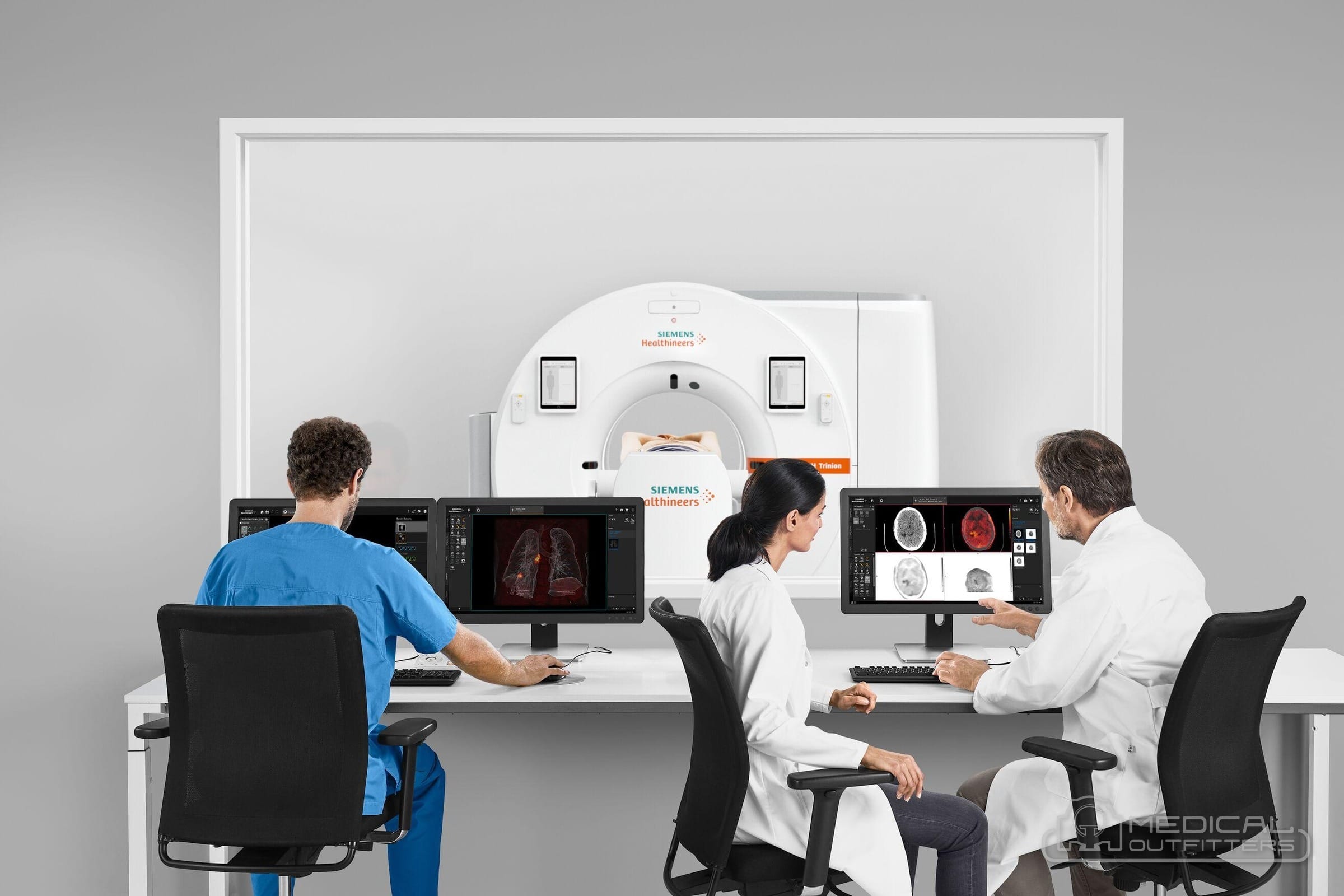
Three things set the display budget: resolution, where a 3 megapixel pair serves a general reading room, a 5 megapixel pair or a 12 megapixel panel serves mammography, and a multi-resolution display lets one station serve a mixed-modality room; calibration, where a built-in front sensor calibrates the display to DICOM Part 14 on a schedule and removes the photometer visits; and brightness, where 1,000 cd/m2 or more keeps a display inside the standard as it ages. The LG 21HQ513D 3MP, LG 21HQ613D 5MP, LG 32HQ713D 8MP and LG 31HN713D 12MP mammography display are the displays Medical Outfitters supplies, with the LG 24HR513C 2MP for clinical review; where the mammography reading station sits in a breast program’s budget is in the mammography machine cost guide.
Support, AI Add-Ons, Training and Downtime: What a PACS Costs to Run
A PACS costs money every year it runs, whichever way it was bought. On a subscription the support, the upgrades and the hosting are inside the fee and the archive’s growth steps the tier up; on a perpetual license the support contract, the storage expansion, the IT time and the refresh are separate lines. The table lists what a PACS costs to run, as class estimates, comparison only.
| Line | What it covers | How it is priced |
|---|---|---|
| Support and upgrades | Patches, upgrades, help desk and remote support | Inside a subscription; 15 to 20 percent of the license a year on a perpetual license, estimated, comparison only |
| Archive growth | The storage tier or the per-gigabyte line | $0 to $1,200 a year of tier increases on a cloud plan; $3,000 to $8,000 a year of expansion on site, estimated |
| AI add-ons | Detection, triage, denoising and quantification algorithms | Licensed per algorithm, often per study; the DICOM-based AI software Medical Outfitters supplies is quoted on request |
| Training | Go-live and new-user training | Estimated at $200 to $700 per user, or $300 to $2,000 initially, comparison only |
| Displays and calibration | Diagnostic displays on a calibration and QC schedule | Quoted per display; a built-in front sensor removes the photometer visits |
| Hardware refresh | Servers and workstations on an on-site system | Every five to seven years; $25,000 to $50,000 for the servers, estimated, comparison only |
| Downtime | Lost reads during an outage | About $900 per full day down at 15 studies a day and a $60 professional fee |
What a PACS costs to run, class estimates from public pricing reporting and the Medical Outfitters product pages, comparison only.
AI is the running-cost line that is new: detection, triage, denoising and quantification algorithms are licensed per algorithm and often metered per study. On Synapse the AI Orchestrator runs more than 50 validated algorithms inside the viewer; outside it, DICOM-based software sits between the scanner and the archive and returns the enhanced or measured study in DICOM. Medical Outfitters supplies several of those, each quoted on request: ClariCT denoising, ClariACE contrast enhancement and ClariAdipo fat analysis for CT, SwiftMR for MRI and Transpara Density for mammography. Running cost also includes the people who patch, back up and restore the system, the largest line on premise; our MRI service, CT service, X-ray service and ultrasound service teams keep the scanner side of every connection working.
Which PACS Should You Buy? Small Practice, Imaging Center and Hospital
Six things move a PACS price, and the first three decide the tier.
- Volume and modality mix. Cross-sectional studies are ten to thirty times the size of a radiograph, so CT and MRI drive storage, bandwidth and per-study fees
- Sites and readers. Every site adds a gateway and every reader a seat; concurrent licensing and a global worklist contain both
- Hosting model. Cloud turns the servers, the refresh and the backup problem into a subscription; on site keeps control and a data center bill
- Integrations and migration. Each interface is a one-time fee plus annual maintenance; the legacy archive is priced per study
- Displays and AI. Reading stations are their own lines and the ones most often forgotten; each algorithm is a license, often per study
- Term and exit. Multi-year commitments discount the rate; the exit terms decide what it costs to leave
Which PACS should a small practice, an imaging center and a hospital buy?
- Small practice, one or two modalities. A cloud subscription at $200 to $800 a month, estimated, comparison only, with the modalities connected per gateway, a web viewer for the referrers and one diagnostic station; buy the storage tier for three years of growth and confirm the setup fee and the exit terms.
- Outpatient imaging center, multi-modality. A cloud subscription at $500 to $2,500 a month, or a perpetual license at $90,000 to $250,000 in year one, estimated, comparison only. The subscription wins the five-year comparison for a single site; price the RIS with the PACS, because the worklist and results interfaces are where a separate RIS costs more than it saves.
- Multi-site radiology group. A platform with a global worklist, concurrent-seat licensing and a shared archive, at $20,000 to $60,000 a year in the cloud or $200,000 to $500,000 in year one on premise, estimated, comparison only; the sites and readers decide the model more than the volume does.
- Hospital or health system. An enterprise agreement over five to seven years, estimated at $250,000 to $1,000,000 a year for a single hospital or a small regional system, comparison only, with a vendor neutral archive, the migration priced per study, and the uptime and the exit terms written in. Fujifilm Synapse, sold by Medical Outfitters, is quoted on request at every tier.
- What completes the budget. The reading workstations, the interfaces, the migration, the training and the first year of support, which together often exceed the software line; the used imaging equipment inspection checklist covers the console and DICOM checks on a scanner that must keep talking to the PACS.
Tell us your modalities, your monthly volume and your sites and readers, and we will scope a Synapse configuration with the seats, the storage, the hosting, the interfaces and the migration in the quote. Every modality is priced side by side in our radiology equipment cost table and the 2026 imaging equipment price index.
PACS System Cost: Frequently Asked Questions
- How much does a PACS system cost?
- A PACS system costs an estimated $2,500 to $9,500 a year for a small practice on a cloud subscription, $6,000 to $30,000 a year for an outpatient imaging center, $20,000 to $60,000 a year for a multi-site group and $250,000 to $1,000,000 a year for a hospital under an enterprise agreement, comparison only. A perpetual license on premise runs $20,000 to $150,000 for the software plus $15,000 to $80,000 of servers and 15 to 20 percent a year in support, estimated. Fujifilm Synapse, sold by Medical Outfitters, is quoted on request.
- How much does a cloud PACS cost per month?
- A cloud PACS costs an estimated $200 to $800 a month for a small practice, $500 to $2,500 a month for an outpatient imaging center and more than $4,000 a month at enterprise scale, comparison only, plus a one-time setup fee of $1,000 to $10,000. The fee is tiered on volume or storage, usually with unlimited users; annual commitments are discounted 5 to 15 percent, add-on modules add 25 to 75 percent, and the egress charge belongs in the exit terms.
- What does a PACS cost per study?
- Published per-study PACS pricing runs an estimated $0.10 to $2.00 per study, comparison only, with plain radiography at the bottom and cross-sectional imaging at the top. On a flat subscription the effective cost per study falls as volume rises: a $300 a month plan is $1.50 a study at 200 studies a month and $0.30 at 1,000. Migration of a legacy archive is priced separately at $0.05 to $0.50 per study, estimated.
- Subscription or perpetual license: which costs less?
- For a single outpatient site the subscription costs less over five years on every published comparison, $30,000 to $150,000 in the cloud against $300,000 to $620,000 on premise, estimated, comparison only, because the perpetual route carries the servers, the refresh, the support contract at 15 to 20 percent of the license a year and the IT time. The break-even moves toward the license as volume rises, which is why hospitals and large groups still buy enterprise licenses or negotiate flat fees.
- How much does a PACS cost for a small practice?
- A PACS system for small practice use costs an estimated $2,500 to $9,500 a year as a cloud subscription, comparison only: $200 to $800 a month with the modalities connected per gateway, a web viewer for referring physicians and unlimited users on most plans. A diagnostic reading station adds an estimated $9,000 to $15,000 new or $3,500 to $8,500 refurbished, and a small archive migration about $3,000. An on-premise system for the same practice is estimated at $25,000 to $110,000 in year one.
- How much does a hospital PACS cost?
- A hospital PACS with a vendor neutral archive is bought under a five to seven year enterprise agreement estimated at $250,000 to $1,000,000 a year for a single hospital or a small regional system, $1,500,000 to $5,000,000 for the term, comparison only; multi-hospital systems run higher. The agreement covers the enterprise license or subscription, the archive, the interfaces, the migration at $0.05 to $0.50 per study and the support, with the uptime and the exit terms written in. Fujifilm Synapse is quoted on request through Medical Outfitters.
- What does Fujifilm Synapse PACS cost?
- A Fujifilm Synapse PACS price is quoted on request through Medical Outfitters, an authorized Fujifilm enterprise imaging supplier, because it follows the configuration: the Synapse Enterprise PACS, Synapse CV, Synapse VNA, Synapse 3D and Synapse CWM modules chosen, the seats, the modalities and sites connected, the storage under management and whether the platform runs on premise or on Synapse Cloud Services. Fujifilm also offers it as a software-as-a-service subscription with the rate set by private offer.
- What does PACS support and maintenance cost per year?
- On a perpetual license, support and upgrades cost an estimated 15 to 20 percent of the software license a year, comparison only: $9,000 to $12,000 a year on a $60,000 license, and 60 to 80 percent of the license again over five years. On a subscription the support, the upgrades and the hosting are inside the monthly fee, and the archive's growth steps the storage tier up by an estimated $0 to $1,200 a year.
- How long does a PACS last, and when should it be replaced?
- An on-premise PACS is refreshed every five to seven years with its hardware, and the software is replaced when the vendor ends support, when the viewer cannot read a new modality's objects or when the archive must be migrated anyway; a cloud subscription has no refresh and is replaced when the contract or the uptime fails the facility. The archive outlives all of them, which is the case for a vendor neutral archive: migrate once, and the next PACS reads the same studies.
- What is included in a PACS quote?
- A complete PACS quote lists the software license or subscription with the seats it covers, the hosting and storage with the retention years and the disaster-recovery copy, the interfaces to the RIS, the EHR and each modality's worklist, the migration of the legacy archive, the implementation and training, the support and upgrades with response and uptime commitments, the reading workstations and diagnostic displays, and the exit terms: data return in standard DICOM, egress charges and migration assistance.
- How much does PACS data migration cost?
- PACS migration cost is an estimated $0.05 to $0.50 per study or $200 to $800 per terabyte, comparison only: about $3,000 for a small archive, $40,000 and up for decades of imaging and $150,000 and up for a full hospital archive. Basic migration has been reported at $0.25 to $0.45 per study, and reconciling every study against the RIS almost doubles it. At 100,000 to 150,000 studies a month, a facility producing 100,000 studies a year is three to six months from a finished archive.
- What does a VNA cost?
- VNA cost is quoted by storage volume, the systems connected and the deployment rather than by seat or study; there is no public price list. Budget the storage at $0.01 to $0.08 per gigabyte a month in the cloud or $3,000 to $8,000 a year of expansion on premise, the migration at $0.05 to $0.50 per study and the enterprise license inside the hospital tier's multi-year agreement, all estimated, comparison only. Fujifilm's Synapse VNA, sold by Medical Outfitters, is quoted on request.
- How much does a radiology reading workstation cost?
- A general radiology reading workstation with two 3 megapixel diagnostic displays, a PC and a worklist monitor is estimated at $9,000 to $15,000 new and $3,500 to $8,500 refurbished, and a mammography reading station with two 5 megapixel displays at $15,000 to $25,000 new, comparison only. A single 3 megapixel display is estimated at $3,000 to $7,000 and a 5 megapixel display at $6,000 to $8,500. The LG 3MP, 5MP, 8MP and 12MP diagnostic displays Medical Outfitters sells are quoted on request, new, refurbished and used.
- Does Medical Outfitters sell PACS?
- Yes. Medical Outfitters sells Fujifilm's Synapse Enterprise Imaging software as an authorized Fujifilm enterprise imaging supplier: the Synapse Enterprise PACS, the Synapse CV cardiology PACS, the Synapse VNA, Synapse 3D and the Synapse CWM radiology information system, with LG diagnostic displays, each quoted on request. Every CT, MRI, X-ray, ultrasound and mammography system Medical Outfitters installs is connected to the facility's PACS, RIS and dose-tracking systems as part of the installation, and our service teams keep those connections working.
Medical Outfitters sells Fujifilm Synapse Enterprise PACS, Synapse CV, Synapse VNA, Synapse 3D and Synapse CWM as an authorized Fujifilm enterprise imaging supplier, with LG diagnostic and clinical review displays, each quoted on request for your site. See Fujifilm Synapse Enterprise PACS →
From a cloud subscription for a single practice to a Synapse enterprise platform with a vendor neutral archive for a hospital, Medical Outfitters helps you scope, license and deploy the right PACS, with the seats, the storage, the hosting, the interfaces, the migration and the displays in one quote. Serving the US, Puerto Rico and the Caribbean.