How much does an X-ray cost? Less than almost any other imaging test, and yet the same chest film can be billed at $30 in one building and well over $1,000 in another. Whether you searched how much does an x ray cost, how much is an x ray or the cost of an x ray without insurance, three things decide the answer: the body part and the number of views on the order (each has its own CPT code), the setting (a doctor’s office, an urgent care clinic, a freestanding imaging center, a hospital outpatient department or an emergency department), and who pays (Medicare, a commercial plan, Medicaid or you in cash). This guide lays out the 2026 numbers by body part, setting and payer, with every figure tied to its source, explains why an emergency department X-ray costs so much more, compares X-ray prices with CT and MRI, and then turns to the facility side: what the X-ray machine behind the exam costs.
Medical Outfitters sells new Fujifilm FDR digital X-ray systems as an authorized dealer and refurbished GE and Siemens radiography systems through MO Select, and installs and services them across the United States, Puerto Rico and the Caribbean. We wrote this for patients and practice managers trying to read an X-ray bill, and for clinic owners, urgent care operators and radiology managers who sit on the other side of that price. Nothing here is medical advice: whether you need an X-ray, and how many views, is a decision for your own doctor and imaging center.
- Cash price: about $50 to $1,000 without insurance and $260 on average nationally, per CoveredUSA (May 2026); CareRoute puts most outpatient X-rays at $50 to $600.
- Medicare: $25.38 for a one-view chest X-ray, $33.07 for two views and $29.73 to $42.42 for a hand, foot, knee, lumbar spine or abdomen film under the 2026 fee schedule, per the ACR.
- Setting: CoveredUSA puts urgent care at $75 to $250, a hospital outpatient department at $300 to $800 and an emergency department at $500 to $1,000 or more for the same exam.
- Hospital files: MedicalPriceCheck’s review of 300 hospital price files found a median cash price of $207 for a two-view chest X-ray, with postings from $20 to $2,976.
- The machine: a refurbished digital X-ray room runs $60,000 to $135,000 delivered, installed and warrantied in the Medical Outfitters X-ray cost guide, and Medicare pays less for X-rays taken on film or computed radiography than on digital.
How Much Does an X Ray Cost? 2026 Prices by Body Part
An X-ray is not one price because it is not one exam. Each body part has its own CPT code, and many have more than one depending on how many views are taken: a chest X-ray is CPT 71045 for one view and 71046 for two, and a lumbar spine series is 72100 for two or three views and 72110 for four or more. The code on your order sets the starting point for every price below, so the first thing to ask the ordering office is which code it sent. That is also why chest x ray cost questions have two answers: one view or two.
The table brings the published 2026 figures together for seven of the most common X-rays. Medicare’s national rates come from the American College of Radiology’s CY2026 fee schedule impact table, which lists the 2026 payment rate for every radiology code. The global rate is what an imaging center or physician office is paid for the whole exam, the radiologist’s read plus the technical side. Cash prices are national self-pay ranges at an independent imaging center or urgent care, each with its source named.
| Exam (CPT) | Medicare 2026, global | Of which, radiologist read | Cash, CoveredUSA | Cash, CareRoute |
|---|---|---|---|---|
| Chest, 1 view (71045) | $25.38 | $8.35 | Not listed by view | $30 to $75 (any 1-view X-ray) |
| Chest, 2 views (71046) | $33.07 | $10.02 | $75 to $200 | $50 to $150 |
| Hand, 3 views (73130) | $38.41 | $8.68 | $70 to $220 (hand or wrist) | $50 to $150 (hand or wrist) |
| Knee, 3 views (73562) | $42.42 | $9.35 | $80 to $275 | $50 to $175 |
| Foot, 3 views (73630) | $34.07 | $8.02 | $80 to $250 (foot or ankle) | $50 to $150 (foot or ankle) |
| Lumbar spine, 2 or 3 views (72100) | $40.08 | $10.35 | $150 to $600 (4 or more views) | $100 to $300 (4 or more views) |
| Abdomen, 1 view (74018) | $29.73 | $8.68 | Not listed | Not listed |
Sources: ACR CY2026 MPFS Final Rule Impact Tables, 7xxxx series, for Medicare; CoveredUSA (May 14, 2026) and CareRoute (May 4, 2026) for cash. The published lumbar ranges are for a four-view series, which Medicare pays at $53.44 under CPT 72110, per the ACR; neither aggregator lists an abdomen film, so that cell is left empty rather than estimated.
Two patterns stand out. First, Medicare’s rates are low and tightly bunched, from $25.38 to $42.42 across the seven codes, because a plain X-ray takes minutes of equipment time and a short read. Second, cash prices run two to six times those rates even at the low-cost sites, and several times more again in a hospital. The hospital gap, not the body part, is the largest single driver of what a self-pay patient ends up paying for an X-ray, and the next two sections explain where it comes from.
X-Ray Cost by Setting: Urgent Care, Imaging Center, Hospital and ER
For the identical exam, the building you walk into moves the price more than anything else. CoveredUSA and CareRoute both publish national self-pay ranges by setting, and the two agree on the order even where the numbers differ:
| Setting | Cash, CoveredUSA (May 2026) | Cash, CareRoute (May 2026) |
|---|---|---|
| Doctor’s office | Not listed | $50 to $200 |
| Urgent care clinic | $75 to $250 | $50 to $250 |
| Independent imaging center | $75 to $300 | $40 to $200 |
| Hospital outpatient department | $300 to $800 | $130 to $330 for a two-view chest X-ray |
| Hospital emergency department | $500 to $1,000 or more | $250 to $600 or more |
Both sources state their ranges are national estimates that vary by region; CoveredUSA notes that high-cost states such as California, New York and Hawaii typically run 30 to 50 percent above the national figures. CareRoute’s hospital outpatient figure comes from its CPT 71046 page, which describes the hospital price as an X-ray near the Medicare rate plus a facility fee of $100 to $300.
Hospital price files show how wide the hospital column really is. Under the CMS Hospital Price Transparency rule, in force since January 1, 2021, every hospital must publish a machine-readable file of its standard charges, including its discounted cash price. MedicalPriceCheck took the lowest posted cash price from each file and, in its May 2026 analysis, found a median of $207 for a two-view chest X-ray across 300 hospitals, with postings from $20 to $2,976. The one-view chest X-ray had a median of $171 across 295 hospitals, and a knee X-ray (CPT 73560, one or two views) a median of $186. MedicalPriceCheck notes that the posted hospital price usually covers only the technical charge, so the radiologist’s read can arrive as a second bill.
Urgent care x ray cost is usually the lowest walk-in price. For a non-emergency X-ray, the low-cost sites are an urgent care clinic with its own X-ray room, an independent imaging center or a physician office that takes X-rays in house. Our digital X-ray machine guide explains the equipment those sites run.
Why an X-Ray Costs More in the Emergency Department
An emergency department X-ray uses much the same equipment as an urgent care X-ray, so the price difference is not the film. It is the visit. A hospital bills an emergency department visit on top of the X-ray itself, and that facility charge carries the cost of a department open every hour of the year with physicians, nurses, a trauma bay and a CT scanner on standby. CareRoute puts the X-ray itself at $100 to $250 in an emergency department and the facility fee at $200 to $1,000 or more, for a total of $250 to $600 or more; CoveredUSA puts the emergency X-ray at $500 to $1,000 or more and says it can exceed $1,000.
The same logic applies, more mildly, to a scheduled X-ray in a hospital outpatient department. Medicare pays a hospital for the technical side of an outpatient X-ray under the Hospital Outpatient Prospective Payment System, which groups imaging into payment levels. The ACR’s summary of the 2026 final rule lists Level 1 imaging without contrast, APC 5521, at $88.91, with a 2026 outpatient conversion factor of $91.415. CoveredUSA cites Medicare’s hospital outpatient payment for a two-view chest X-ray at approximately $90, which lines up with that level. Add the radiologist’s $10.02 read from the fee schedule and Medicare pays a hospital roughly three times the $33.07 it pays an imaging center for the same chest film. Commercial insurers negotiate from those higher hospital bases: the Health Care Cost Institute found hospital outpatient imaging prices running two to four times physician-office prices in its April 2026 brief.
Three practical points follow. In a real emergency, go to the emergency department; nothing on this page is a reason to delay care, and the facility fee buys the readiness you may need. For a minor injury that your doctor or a nurse line says can wait, an urgent care clinic with X-ray on site is usually far cheaper for the same views. And for a scheduled X-ray your doctor orders, ask whether an independent imaging center is in network before booking at the hospital, because the order can usually go to either.
X-Ray Cost With Insurance, Medicare and Medicaid
Medicare. At an imaging center or physician office, Medicare pays an X-ray as one global payment under the Physician Fee Schedule: $25.38 for a one-view chest X-ray and $33.07 for two views in 2026, per the ACR’s impact table, adjusted a few percent up or down for the local cost of practice. Part B pays 80 percent of the approved amount after the annual deductible, which CMS set at $283 for 2026, and the patient pays 20 percent. On a two-view chest X-ray that is $6.61, our arithmetic on the ACR figure; CareRoute’s 71046 page gives the same $6.61. A Medicare Supplement plan usually covers the 20 percent. A Medicare Advantage plan replaces it with its own copay, which CoveredUSA puts at $0 to $75 depending on the plan and the site.
Commercial insurance. X ray cost with insurance starts from the plan’s contract. For a patient with a commercial plan, the price is the rate the facility negotiated with the insurer, and those rates sit well above Medicare. The Health Care Cost Institute’s April 2026 imaging brief, built on employer-sponsored claims, found commercial X-ray prices averaging 314 percent of Medicare, against 307 percent for MRI and 257 percent for CT. CareRoute puts the typical negotiated rate for a two-view chest X-ray at 150 to 250 percent of Medicare, usually $50 to $85. What reaches the patient depends on the plan design. CareRoute gives these common cases:
- Copay, deductible met: $10 to $50 for most outpatient X-rays, and $0 to $30 on its chest X-ray page.
- Coinsurance, deductible met: about 20 percent of the negotiated rate, $10 to $17 on a two-view chest X-ray.
- Deductible not yet met: the full negotiated rate, $40 to $150 for most X-rays and $50 to $85 for a chest X-ray.
The emergency department changes the arithmetic because the visit has its own cost sharing on top of the X-ray. One caution from CoveredUSA is worth repeating: with a high deductible not yet met, an X-ray that costs $150 cash can cost the same or more through insurance, so ask both prices.
Medicaid. CoveredUSA notes that Medicaid covers diagnostic X-rays at minimal or no cost to the patient; low-income patients who are uninsured may qualify, and the state Medicaid office decides eligibility.
X-Ray Cost Without Insurance: Cash Prices and Your Rights
X ray cost without insurance comes down to which of two very different numbers a self-pay patient is shown. The chargemaster price is the hospital’s list price, the figure printed on an itemized bill before any discount. The cash or self-pay price is what the same facility accepts from a patient paying directly, and it is usually far lower. CoveredUSA puts the self-pay discount at 30 to 60 percent off the billed charge for uninsured patients who pay up front, and lists direct-pay flat cash prices for common X-rays at $75 to $200. CareRoute adds that hospitals often reduce bills by 20 to 50 percent when asked. CareRoute’s 71046 page also lists the average provider charge for a two-view chest X-ray at $86.59, about 2.6 times the Medicare rate, from CMS utilization data for 2023.
Two federal rules give a self-pay patient leverage. The Hospital Price Transparency rule, described above, makes every hospital publish its cash prices. Under the No Surprises Act, in force since January 1, 2022, any provider that schedules a service for an uninsured or self-pay patient must give a written Good Faith Estimate of the expected charges, and if the final bill comes in $400 or more above it, the patient can dispute it through the federal process, per CMS; CoveredUSA notes the filing fee is $25. For an X-ray, the estimate should list the exam, the radiologist’s read and any facility fee separately.
The practical sequence is short, and the diagram below lays it out. Ask the ordering doctor for the exact CPT code and the number of views. Call an urgent care clinic or independent imaging center and, if you prefer, the local hospital, and ask each for its self-pay price for that code, all-in, including the read. Ask about a prompt-pay discount. Get the Good Faith Estimate in writing. Then go to the lowest all-in price at a site your doctor accepts images from.
How Much Is an X-Ray Compared With a CT Scan or MRI?
An X-ray is the least expensive of the three common imaging tests by a wide margin. CareRoute’s national comparison puts an X-ray at $50 to $300, a CT scan at $200 to $3,000 and an MRI at $400 to $3,500 without insurance. Medicare’s 2026 rates show the same order code by code, per the ACR’s impact table:
| Body area | X-ray, Medicare 2026 | CT or MRI, Medicare 2026 |
|---|---|---|
| Chest | $33.07 (two views, 71046) | $132.60 (CT without contrast, 71250) |
| Lumbar spine | $40.08 (two or three views, 72100) | $191.72 (MRI without contrast, 72148) |
| Knee | $42.42 (three views, 73562) | $204.41 (MRI without contrast, 73721) |
The tests are not interchangeable, which is why neither is simply the cheaper version of the other. An X-ray shows bone and air well and takes minutes, which makes it the usual first test for a fracture, a chest infection or a joint problem. CT adds cross-sectional detail at a higher dose, and MRI shows soft tissue such as ligaments, discs and cartilage without ionizing radiation. RadiologyInfo, the patient site of the ACR and the RSNA, lists the typical effective dose of a chest X-ray at 0.1 millisieverts, about 10 days of natural background radiation, an extremity X-ray such as a hand or foot at less than 0.001 millisieverts, and a lumbar spine X-ray at 1.4 millisieverts, against 7.7 millisieverts for a CT of the abdomen and pelvis. Doctors weigh the choice against the ACR Appropriateness Criteria, and the test that answers the question is the right one, whatever its price.
The price side of the other two tests is in our guides to how much a CT scan costs and how much an MRI scan costs. For pets, the numbers are different again, and our guide to dog X-ray cost covers what veterinary practices charge.
What the X-Ray Machine Behind the Exam Costs
Every X-ray price on this page is revenue to the clinic, urgent care or hospital that owns the room. The Medical Outfitters X-ray machine cost and price guide puts the system price, delivered, installed and warrantied, at these bands:
| System class | Refurbished | New |
|---|---|---|
| Portable or handheld DR | $12,000 to $35,000 | $30,000 to $65,000 |
| Mobile digital X-ray | $40,000 to $90,000 | $90,000 to $185,000 |
| Fixed digital radiography room | $60,000 to $135,000 | $150,000 to $275,000 |
The guide’s prices include the generator, tube and tube stand, the table and wall stand where specified, the detector and workstation, delivery, rigging, installation, calibration, applications training and the warranty; lead shielding, the control booth, electrical work, the physicist’s acceptance survey and state registration are quoted per project. A certified refurbished X-ray system typically saves 20 to 60 percent against new, per the same guide. Within the fixed-room band, the guide puts a refurbished entry floor-mounted or U-arm room at $60,000 to $95,000 and a ceiling-suspended room at $95,000 to $135,000. Mobile units, the carts urgent care chains and hospital wards wheel to the patient, are priced model by model in our portable X-ray machine price guide, where the Fujifilm FDR AQRO compact mobile unit runs $95,000 to $125,000 new and the FDR Go iQ $140,000 to $185,000 new, both sold new by Medical Outfitters.
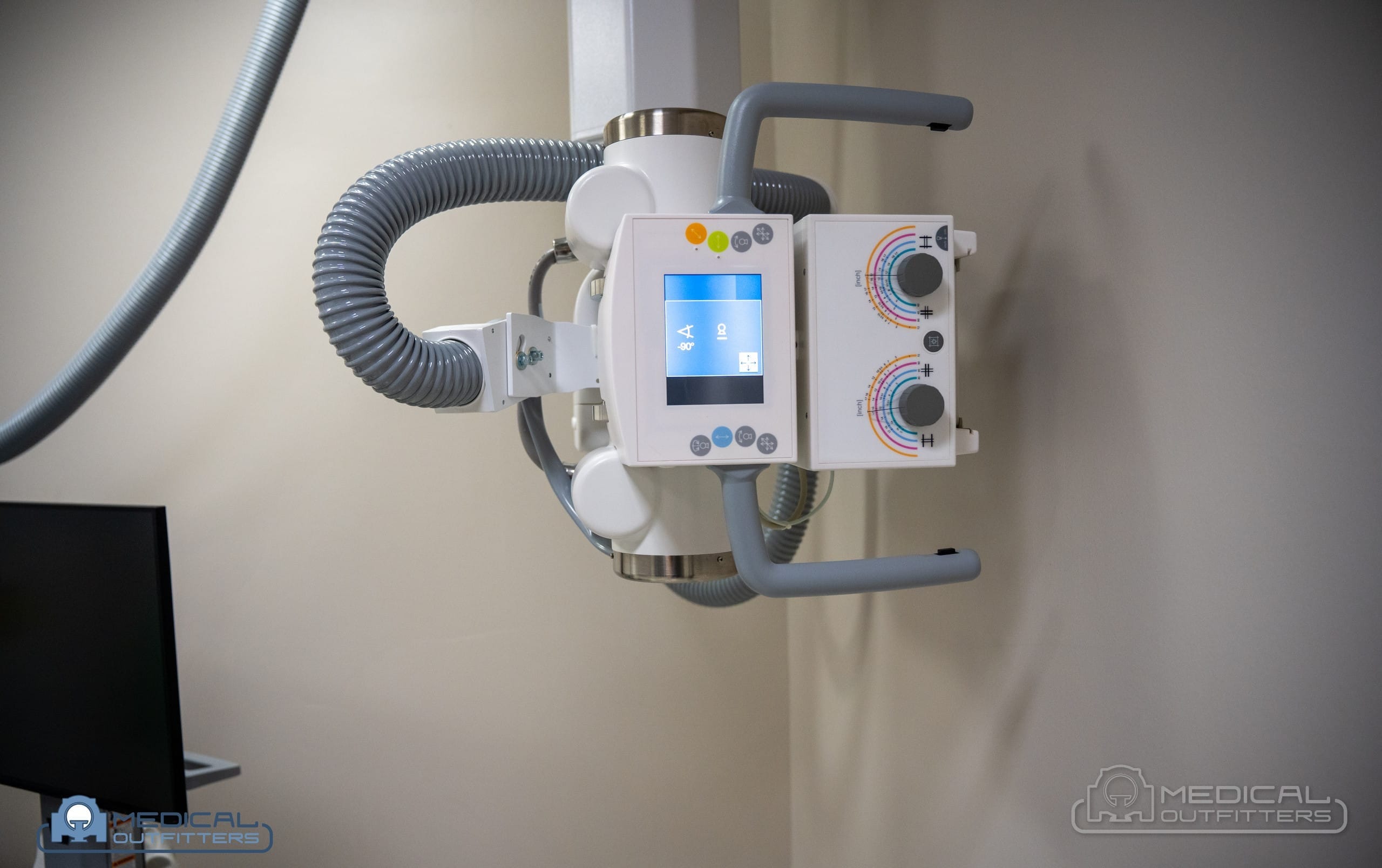
One Medicare rule ties the machine directly to the price of the exam. Under Section 502 of the Consolidated Appropriations Act of 2016, Medicare cuts the technical payment for X-rays taken on film by 20 percent, in force since January 1, 2017, and for X-rays taken with computed radiography (CR) by 7 percent from 2018 through 2022 and 10 percent from January 1, 2023, per CMS transmittals 3583 and 3820. On a two-view chest X-ray, whose 2026 technical component is $23.05 per the ACR, the CR cut is about $2.31 an exam and the film cut about $4.61, our arithmetic. Digital radiography carries no cut. Our comparison of CR vs DR X-ray covers the image quality, dose and workflow side of that switch, and the flat panel detector guide explains the part that makes a room digital.
Before a room goes in, our guide to X-ray room size and requirements covers footprint, shielding and power, and model-level pricing for refurbished GE rooms is in the GE Definium X-ray price guide.
Pricing the X-Ray and the X-Ray Room With Medical Outfitters
If you came here as a patient, the short version is to ask for the CPT code and the number of views, call an urgent care clinic or independent imaging center for its all-in self-pay price, and ask for a Good Faith Estimate; in an emergency, go to the emergency department, and let your doctor decide which test you need. If you came as a clinic owner, urgent care operator or radiology manager, the X-ray prices on this page are your revenue side and the X-ray machine cost guide is the cost side. Current systems are on our X-ray machines for sale page and in the X-ray category, the MO Select standard is described on the refurbished imaging equipment page, and our X-ray service team supports systems across the United States, Puerto Rico and the Caribbean, with the routine visits laid out in the X-ray preventive maintenance checklist. Send us your expected exams per day and the room you have, and we will price a specific system, delivered, installed and warrantied: contact Medical Outfitters.
- American College of Radiology, CY2026 MPFS Final Rule Impact Tables, 7xxxx series: 2026 global, professional and technical rates for 71045, 71046, 72100, 72110, 73130, 73562, 73630, 74018, 71250, 72148 and 73721: https://edge.sitecorecloud.io/americancoldf5f-acrorgf92a-productioncb02-3650/media/ACR/Files/Medicare-Medicaid/MPFS/CY2026-MPFS-Final-Rule-Impact-Tables-7xxxx-series.pdf
- American College of Radiology, CY 2026 HOPPS Final Rule Preliminary Summary: outpatient conversion factor and the APC 5521 rate: https://edge.sitecorecloud.io/americancoldf5f-acrorgf92a-productioncb02-3650/media/ACR/Files/Medicare-Medicaid/HOPPS/CY2026-HOPPS-Final-Rule-Preliminary-Summary.pdf
- CMS, 2026 Medicare Parts A and B Premiums and Deductibles: the $283 Part B deductible: https://www.cms.gov/newsroom/fact-sheets/2026-medicare-parts-b-premiums-deductibles
- CMS, transmittals 3583 (film, modifier FX) and 3820 (computed radiography, modifier FY): https://www.cms.gov/regulations-and-guidance/guidance/transmittals/2017downloads/r3820cp.pdf
- CoveredUSA, X-Ray Cost, May 14, 2026: national average, ranges by body part and setting, Medicare Advantage copays and self-pay discounts: https://coveredusa.org/en/cost/x-ray
- CareRoute, How Much Does an X-Ray Cost in 2026 (May 2026) and CPT 71046 (May 2026): cash ranges by body part and setting, the emergency facility fee, negotiated rates and patient cost sharing: https://www.careroute.ai/costs/xray-cost and https://www.careroute.ai/costs/cpt/71046
- MedicalPriceCheck, How Much Does an X-Ray Cost? A Data Analysis of 300 U.S. Hospitals, May 2026: hospital cash medians and ranges: https://medicalpricecheck.com/research/xray-cost/
- Health Care Cost Institute, imaging brief, April 2026: commercial X-ray prices at 314 percent of Medicare: https://healthcostinstitute.org/wp-content/uploads/2026/03/Imaging-Brief_Final.pdf
- RadiologyInfo (ACR and RSNA), Radiation Dose: effective doses by exam: https://www.radiologyinfo.org/en/info/safety-xray
- CMS, No Surprises Act key responsibilities for providers, and Hospital Price Transparency: https://www.cms.gov/files/document/nsa-key-responsibilities-providers.pdf
- X-ray machine cost and price guide (2026)
- Portable X-ray machine price guide (2026)
- X-ray machines for sale: Fujifilm FDR digital X-ray, new and refurbished
- X-ray machines: new and refurbished
- X-ray machine service, repair and maintenance
- Refurbished medical imaging equipment: the MO Select standard
- GE Definium X-ray price guide
- CR vs DR X-ray: how computed and digital radiography differ
- Digital X-ray machines explained
- What is a flat panel detector?
- What size room does an X-ray machine need?
- How much does a CT scan cost in 2026?
- How much does an MRI scan cost in 2026?
- Dog X-ray cost in 2026
- Price an X-ray system for your facility
X-Ray Cost: Common Questions
How much does an X-ray cost in 2026?
Without insurance, an X-ray costs about $50 to $1,000, with a national average near $260, per CoveredUSA's May 2026 guide; urgent care and independent imaging centers sit at the low end and hospital emergency departments at the top. Medicare's 2026 fee schedule pays $33.07 for a two-view chest X-ray and $25.38 to $42.42 for the most common films at an imaging center, per the ACR. Insured patients usually pay a copay or coinsurance.
How much does an X-ray cost without insurance?
Ask for the self-pay price, not the list price. CoveredUSA puts urgent care at $75 to $250, an independent imaging center at $75 to $300, a hospital outpatient department at $300 to $800 and an emergency department at $500 to $1,000 or more. CareRoute puts most outpatient X-rays at $50 to $600. A self-pay patient is entitled to a written Good Faith Estimate, and a bill $400 or more above it can be disputed, per CMS.
How much is a chest X-ray?
A two-view chest X-ray (CPT 71046) costs about $75 to $200 cash at an imaging center or urgent care, per CoveredUSA, and $50 to $150, per CareRoute. MedicalPriceCheck found a median hospital cash price of $207 across 300 hospital price files, with postings from $20 to $2,976. Medicare's 2026 fee schedule pays $33.07 for the two-view exam and $25.38 for a single view, per the ACR.
How much does an X-ray cost with insurance?
A share of the rate your plan negotiated. The Health Care Cost Institute found commercial X-ray prices averaging 314 percent of Medicare, and CareRoute puts a two-view chest X-ray at about $50 to $85 negotiated. With the deductible met, CareRoute puts a copay at $10 to $50 for most X-rays; with the deductible not met, you pay the full negotiated rate, $40 to $150. In an emergency department, the visit adds its own cost sharing.
What does Medicare pay for an X-ray?
At an imaging center or physician office, the 2026 fee schedule pays $25.38 for a one-view chest X-ray, $33.07 for two views, $38.41 for a hand, $42.42 for a knee and $40.08 for a lumbar spine series nationally, per the ACR. The patient pays 20 percent after the $283 Part B deductible, about $6.61 on a two-view chest X-ray. Medicare Advantage copays run $0 to $75, per CoveredUSA.
Why does an X-ray cost more in the emergency room?
Because the hospital bills an emergency department visit on top of the X-ray. CareRoute puts the X-ray itself at $100 to $250 in an emergency department and the facility fee at $200 to $1,000 or more, and CoveredUSA puts an emergency X-ray at $500 to $1,000 or more. The fee pays for a department staffed around the clock. In a real emergency, go anyway; for a minor injury, urgent care is usually cheaper.
Is an X-ray cheaper than a CT scan or MRI?
Yes, by a wide margin. CareRoute puts an X-ray at $50 to $300, a CT scan at $200 to $3,000 and an MRI at $400 to $3,500 without insurance. Medicare's 2026 rates show the same order: $33.07 for a two-view chest X-ray against $132.60 for a chest CT, and $42.42 for a knee X-ray against $204.41 for a knee MRI, per the ACR. Your doctor chooses the test that answers the question.
How much does an X-ray machine cost?
The Medical Outfitters X-ray cost guide puts a refurbished digital X-ray room at $60,000 to $135,000 and a new one at $150,000 to $275,000, a refurbished mobile digital unit at $40,000 to $90,000 and a portable or handheld DR system at $12,000 to $35,000 refurbished, delivered, installed and warrantied. Medicare cuts the technical payment 10 percent for computed radiography and 20 percent for film, per CMS, so digital pays the full rate.
Related Articles
More scan cost guides: How much does a CT scan cost? · MRI scan cost · PET scan cost · DEXA scan cost · Mammogram cost · Ultrasound cost · Echocardiogram cost