An X-ray room is the hardest-working imaging system in most facilities and the cheapest to keep running, which is exactly why its maintenance is the easiest to let slip. Good x ray maintenance is not one event but three layers: the manufacturer’s preventive maintenance visits that keep the hardware calibrated, the annual medical-physicist survey that proves the machine is within the federal dose and image limits, and the state inspection that keeps the registration current. This guide sets out the preventive maintenance checklist subsystem by subsystem, how often each task is done, the test tools and the tolerances an engineer works to, the role of the physicist and the state, how the records are kept, and what a service or preventive maintenance contract costs. It is written for the facility owner, radiology manager or administrator who signs the service agreement and has to know what is in it.
Medical Outfitters sells, installs and services digital X-ray systems across the United States, Puerto Rico and the Caribbean, and services systems it did not sell. Our engineers run the preventive maintenance visits described here to the manufacturer’s specifications with OEM parts, confirm faults against the generator logs before ordering, and keep a service log for each system. This article explains the work so you can read a quote, compare two contracts and keep your own room compliant.
- Three layers: OEM preventive maintenance, the annual physicist survey and the state inspection are different jobs with different owners.
- The checklist: generator and tube output, beam and collimation, detector and image chain, mechanics, interlocks, and software and PACS, every visit.
- How often: daily user checks, a preventive maintenance visit at the OEM interval (commonly twice a year), and an annual physicist survey and state registration.
- The tolerances: 21 CFR 1020.31 sets reproducibility, linearity and a 2 percent beam-alignment limit that the physicist confirms.
- The cost: a full-coverage contract is about 5 to 10 percent of system value a year; preventive maintenance only is a fraction of that.
Why X-Ray Maintenance Is Required, and by Whom
Three separate authorities expect an X-ray system to be maintained, and confusing them is the most common gap we find. The first is the United States Food and Drug Administration, whose performance standard for diagnostic X-ray systems, 21 CFR 1020.30 to 1020.33, sets the output, reproducibility and beam-limitation limits the machine must meet in service, not only at the factory. The second is the state radiation control program, which registers every X-ray tube and inspects facilities on a schedule that varies by state; where the manufacturer publishes no preventive maintenance schedule, state guidance such as Maryland’s defaults to a twelve-month maintenance interval, with six, twelve, twenty-four and longer options recorded per machine.
The third is the accrediting body. The Joint Commission’s imaging requirements have, since 2015, called for an annual performance evaluation of imaging equipment and acquisition workstation displays by a diagnostic medical physicist, and a revision effective in 2019 requires that evaluation of all fluoroscopic equipment at least annually. Its Environment of Care standard EC.02.04.03 also requires a facility to define in writing the activities and the frequencies for inspecting, testing and maintaining every piece of medical equipment, following either the manufacturer’s recommendations or a documented alternative equipment maintenance program. In other words, the preventive maintenance schedule is not optional paperwork: an inspector can ask to see it and the records that prove it was followed.
None of these three bodies does the hands-on work. The FDA writes the limits, the state inspects against them and the physicist measures against them once a year, but keeping the machine inside those limits between surveys is the job of the preventive maintenance visit, which is where the service engineer comes in.
The X-Ray Machine Preventive Maintenance Checklist, Subsystem by Subsystem
A preventive maintenance visit on a digital radiography room works through the system in a fixed order so nothing is missed, and the same checklist applies, scaled down, to a portable unit and, scaled up with the fluoroscopy tests, to an R/F room. These are the subsystems an engineer covers on each visit.
Generator and exposure. The engineer verifies kVp accuracy, usually within about 5 percent of the set value, exposure time, and the linearity and reproducibility of output across the mA stations, then checks the automatic exposure control so that a correct exposure index is reached without the operator chasing technique. Calibration drift here is invisible on the image until it is large, which is why it is measured rather than eyeballed.
Tube and housing. The exposure count and arc history are read from the generator, the rotor start-up and bearing sound are checked, the housing is inspected for oil weeping, and the cooling is confirmed. The tube is a consumable, and the point of logging its count at every visit is to plan the replacement rather than be surprised by it.
Collimator and beam alignment. The light field is aligned to the X-ray field, the collimator lamp and mirror are checked, and positive beam limitation, where fitted, is confirmed. The federal limit the physicist will later verify is tight: under 21 CFR 1020.31 the light and X-ray fields must agree within 2 percent of the source-to-image distance.
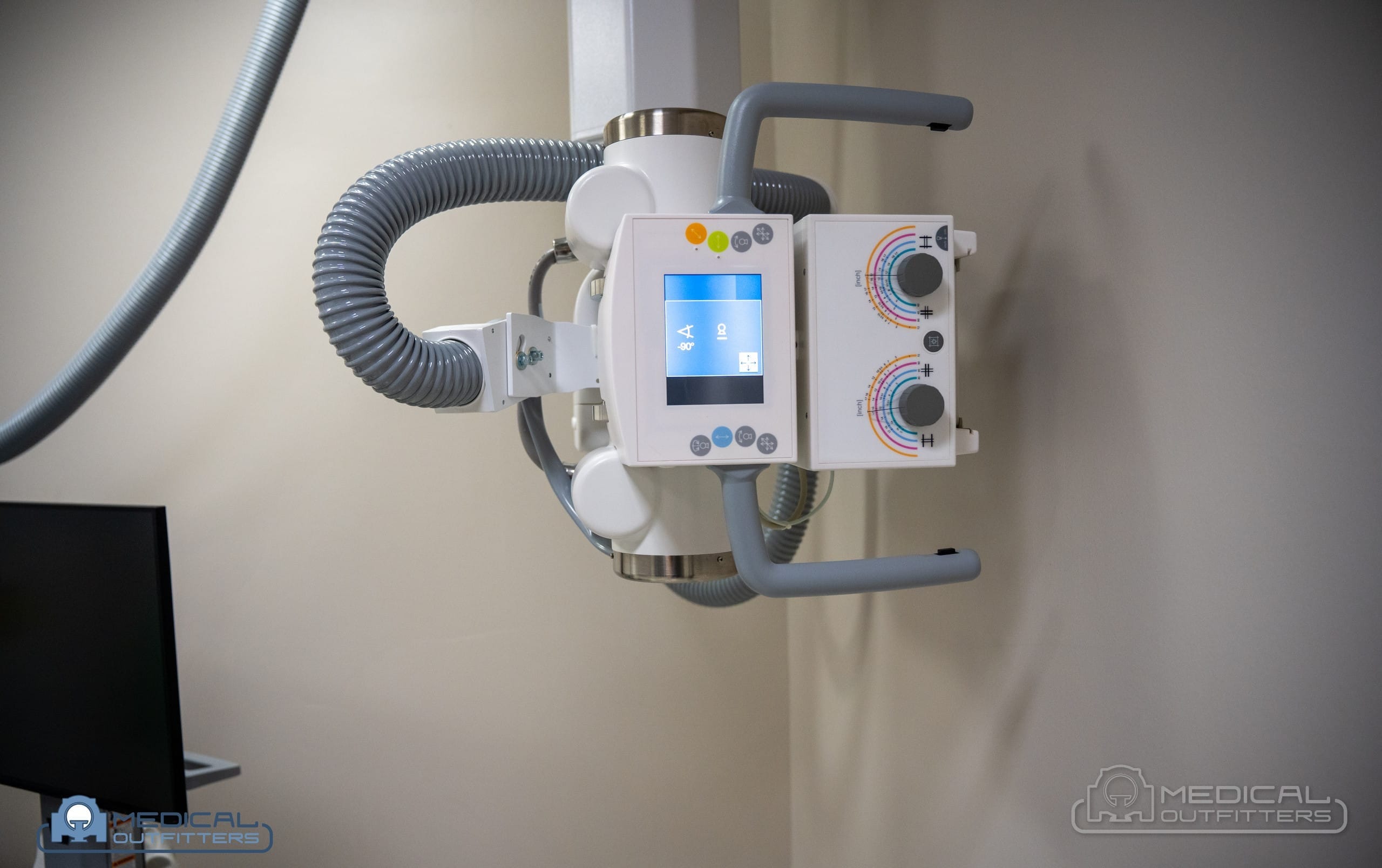
Detector and image chain. On a digital room the flat-panel detector is calibrated, its gain and offset refreshed and its defect map updated, and sample images are checked for dead pixels, banding and lag. A wireless panel’s batteries, charger and tether are checked too. A dropout that looks like a detector fault is often a cable, a battery or a stale calibration, which is why the image chain is tested as a whole.
Suspension, table and mechanics. The ceiling tube crane or floor stand, the wall stand, the table and their detents, brakes, counterweights, cables and travel limits are exercised and lubricated, and the collision sensors are tested. These are the parts a technologist touches hundreds of times a day, and a sticking detent or a worn brake is both a workflow problem and a safety one.
Interlocks, safety and connectivity. Door interlocks, exposure warning lights and audible signals, the emergency stops and the grounding are tested, and the acquisition workstation, its monitor calibration and the connection to the facility’s PACS are confirmed so finished studies land in the archive. The visit ends with a cleandown and a written report of every reading taken and every part replaced.
How Often: The X-Ray Equipment Maintenance Schedule
There is no single legal interval, because the schedule is set per machine by the manufacturer’s service manual, then confirmed against state and accreditation rules. What is consistent is that maintenance happens in layers at different frequencies, each with a different owner.
At the shortest interval are the daily and weekly checks the technologists do themselves: a visual inspection of cables and the tube head, a test exposure or a detector flat-field check, a look at the exposure index trend and a wipe-down. These catch the obvious fault before the first patient and cost nothing but a few minutes.
The preventive maintenance visit sits in the middle. Manufacturers’ service manuals typically call for a visit once or twice a year for a fixed radiography room, and the engineer works the full subsystem checklist above. Medical Outfitters schedules these visits at the manufacturer-recommended intervals, at night or during off hours where possible so the room is not lost during clinic time. A busier room or an older one may be put on a more frequent schedule; a lightly used portable may need less.
At the longest interval are the annual jobs that are not the engineer’s to do: the medical-physicist survey and the renewal of the state registration. These are once a year for most radiographic equipment, and they are covered next. The one rule that ties the layers together is the Joint Commission’s: whatever intervals you choose, they must be written down and the records kept, so the schedule itself is a compliance document.
The Annual Physicist Survey and the State Inspection
The preventive maintenance visit keeps the machine calibrated; the annual survey proves it. Under the ACR-AAPM Technical Standard for diagnostic medical physics performance monitoring, radiographic equipment is evaluated by a qualified medical physicist at acceptance, when it is installed, and then monitored at least once a year. The physicist measures output, kVp accuracy, half-value layer for beam filtration, timer accuracy, the reproducibility and linearity 21 CFR 1020.31 requires, the light and radiation field alignment to the 2 percent limit, the automatic exposure control, and, on a digital system, the detector’s signal response and image quality. The result is a signed report that the facility keeps for inspectors and accreditors.
This is deliberately a different person from the service engineer. The engineer calibrates the machine and the physicist, independent of the repair, confirms it is within the federal and professional limits, the same separation of duties that keeps a dose or image problem from being signed off by the party that caused it. On our service page we state plainly that the annual physics survey remains the physicist’s work, not part of the preventive maintenance contract.
The state inspection is the third job. Every state runs a radiation control program that registers each X-ray tube and inspects facilities, and the inspector checks the registration, the physicist reports, the maintenance records and the posted safety notices, then may take their own measurements. A current preventive maintenance log and a current physicist survey are what an inspection is looking for, which is the practical reason to keep both on schedule rather than scramble when the notice arrives.
The Test Tools and the Tolerances
Preventive maintenance and the physicist survey are measurements, not opinions, and the numbers come from calibrated instruments: a non-invasive kVp and dose meter that reads tube potential, exposure time, dose and half-value layer from a single exposure, a collimator and beam-alignment test tool, a line-pair or contrast-detail phantom for image quality, a light meter for the collimator lamp, and the detector’s own calibration software. The federal performance standard sets the hard limits the readings are judged against, and they are worth knowing because they appear on every physicist report.
| Test | What is measured | Typical limit | Source |
|---|---|---|---|
| Reproducibility | Variation in output for repeated identical exposures | Coefficient of variation no greater than 0.05 | 21 CFR 1020.31(b) |
| Linearity | Output per mAs between adjacent mA stations | Adjacent values within 0.10 times their sum | 21 CFR 1020.31(c) |
| Beam alignment | Light field against the X-ray field and receptor | Within 2 percent of the source-to-image distance | 21 CFR 1020.31(d), (e) |
| kVp accuracy | Measured tube potential against the set value | Commonly held within about 5 percent | Medical-physics QC practice |
| Half-value layer | Beam filtration, a surrogate for beam quality | At or above the regulatory minimum for the kVp | 21 CFR 1020.30; physicist survey |
A reading outside tolerance is a finding: the engineer recalibrates and the exposure is repeated, and if it cannot be brought in, the component, often the generator calibration or the tube, is the next step. The value of writing the actual numbers in the log, rather than a pass or fail tick, is that a slow drift toward a limit is visible a year before it crosses, which is when a tube or a generator board is cheapest to plan around.
Log Keeping: The Record Is Half the Job
An X-ray system’s service history is a document the facility owns, and it has three practical uses: it is what the state inspector and the accreditor ask for, it is what tells you whether a drifting reading is new or long-standing, and it is a large part of what a used system is worth when it is sold or traded. A complete log carries the date and engineer for each visit, the readings taken against each tolerance, the parts replaced with their numbers, the tube’s running exposure count, the open faults and the physicist reports and state certificates filed alongside.
The habit that pays off is logging the numbers, not the verdict. A tube’s exposure count at every visit lets the replacement be ordered before the failure; a kVp or reproducibility figure recorded each time shows the drift; a detector’s defect-map history shows whether the panel is declining. When Medical Outfitters services a system we keep this record per machine, and when we sell an MO Select refurbished X-ray system it is delivered with its service history on the paperwork, because a room with a documented tube and a clean log and an identical room without one can differ in value by the price of a tube.
What X-Ray Maintenance Costs
X-ray systems are the least expensive imaging modality to maintain, well below CT or MRI, but the contract still needs to be read rather than signed on price alone. Service agreements take four shapes: time and materials, where you pay per call; a preventive maintenance agreement that buys the scheduled visits but not the repairs; shared service, where your in-house staff do first-line work and the vendor backs them; and full service, which covers parts and labor including, or excluding, the two expensive items, the tube and the detector.
Pricing is set as an annual percentage of the system’s value. Full coverage on a digital X-ray room runs about 5 to 10 percent of system value a year, with independent service providers such as Medical Outfitters generally about 20 percent below the manufacturer’s price for the same coverage. Applying that to our own all-in value bands gives a usable range, and because these are estimates, the figures carry our standard pricing disclaimer.
| System | Typical value (refurbished, all-in) | Full-coverage contract at 5 to 10 percent |
|---|---|---|
| Portable or handheld DR | $12,000 to $35,000 | About $1,000 to $3,500 a year |
| Fixed DR room | $60,000 to $135,000 | About $3,000 to $13,500 a year |
| R/F (radiography and fluoroscopy) room | Quoted per project | Quoted per project |
A preventive maintenance only agreement, which buys the scheduled visits without the repair cover, is a fraction of the full-coverage figure, and time and materials shifts the parts risk, the tube and the detector, back onto the facility. Where a detector or a tube is covered, read how: the detector is often capped by value and may exclude drops and crushes, and the tube may be prorated by age. Refurbished replacement parts and panels, which run about 40 to 60 percent less than new, keep the repair side affordable when a contract excludes them. Our guide to the full cost of an imaging equipment service contract works through the trade-offs in detail.
X-Ray Service and Maintenance With Medical Outfitters
Medical Outfitters runs preventive maintenance to the manufacturer’s specifications on digital radiography rooms, portables and R/F systems, including ones we did not sell, with engineers available at all hours and a remote response within 30 minutes and on-site service within 2 hours for local facilities. We quote every X-ray service and maintenance contract per site, in writing, with and without the detector and the tube, keep the service log per machine, and leave the annual physics survey to your physicist. For the equipment itself, our X-ray machine cost and price guide lists the all-in value bands this article draws on, the X-ray machines for sale page and the full X-ray category show what we sell new and refurbished, and the GE Definium price guide and portable X-ray price guide cover specific lines. The detector side of digital radiography is explained in our guide to CR vs DR, the room itself in what an X-ray room needs, and a real installation in our Centro Cardiovascular fluoroscopy room project. To put a system on a maintenance schedule or price a contract, contact Medical Outfitters.

- United States Food and Drug Administration, 21 CFR 1020.31, performance standard for radiographic equipment: reproducibility, linearity and beam alignment limits. law.cornell.edu/cfr/text/21/1020.31
- ACR-AAPM Technical Standard for diagnostic medical physics performance monitoring of radiographic equipment: acceptance testing and at-least-annual evaluation by a qualified medical physicist. aapm.org/pubs/ACRAAPMCollaboration.asp
- The Joint Commission imaging requirements and Environment of Care standard EC.02.04.03: annual physicist evaluation and written inspection, testing and maintenance frequencies. ormanager.com
- State radiation control program preventive maintenance interval guidance (Maryland forms, twelve-month default where no OEM schedule exists). mde.maryland.gov radiological health
- Medical Outfitters X-ray service page: preventive maintenance scope, contract shapes and percentage-of-value pricing. medicaloutfitters.com/x-ray-service
- Medical Outfitters X-ray machine cost and price guide: all-in value bands used for the contract-cost estimates. medicaloutfitters.com/x-ray-machine-cost-guide
- X-ray machine service, repair and maintenance
- X-ray machine cost and price guide (2026)
- X-ray machines for sale: Fujifilm FDR digital X-ray, new and refurbished
- X-ray machines: rooms, portables and R/F systems
- Imaging equipment service contracts: what they cover and cost
- CR vs DR X-ray explained
- What size room does an X-ray machine need?
- GE Definium X-ray price guide (2026)
- Portable X-ray machine price guide (2026)
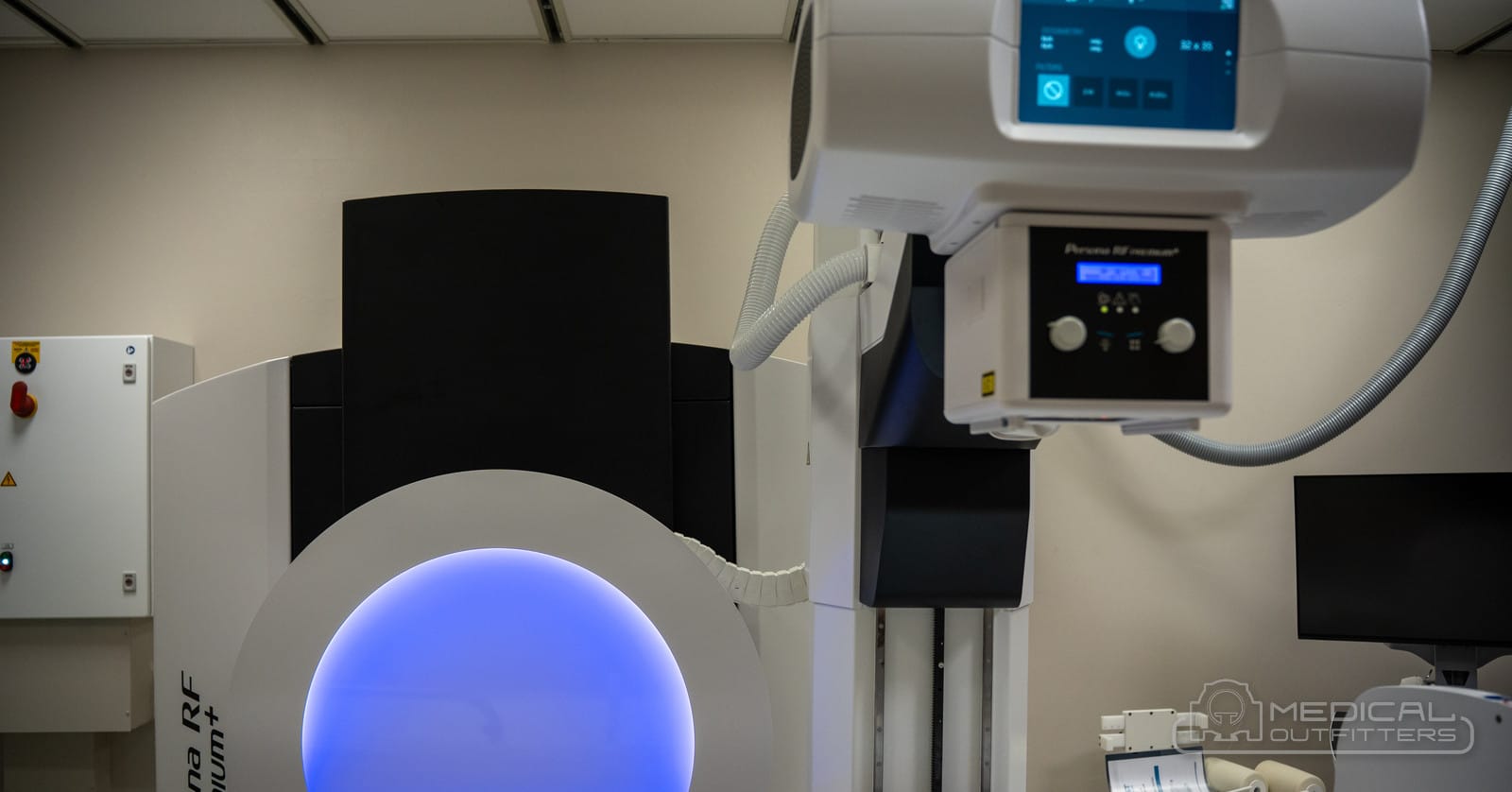
- A Fujifilm Persona RF fluoroscopy room for Centro Cardiovascular de Puerto Rico
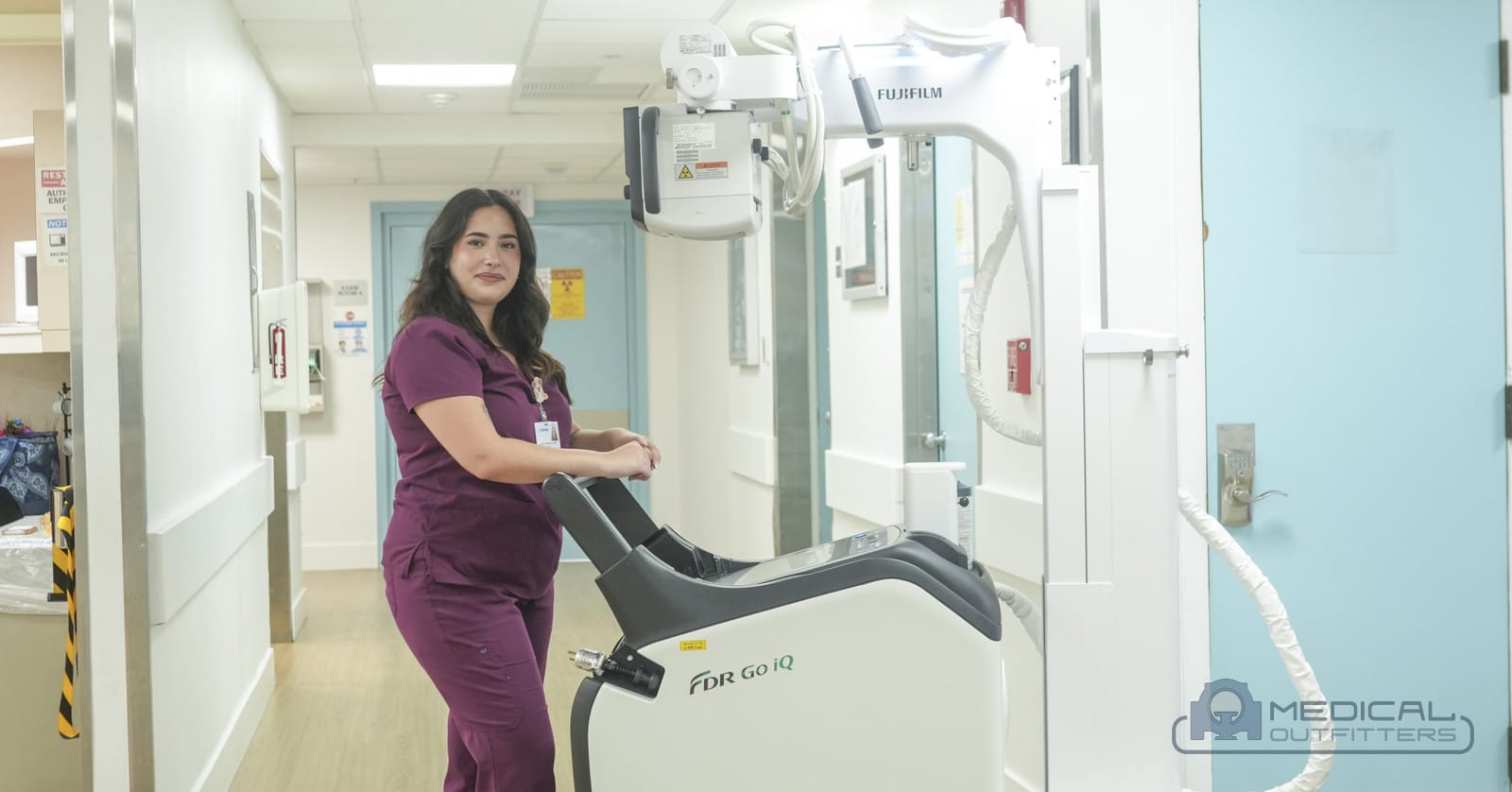
- A day with the Fujifilm FDR Go iQ mobile X-ray machine
- Refurbished medical imaging equipment
- Put a system on a maintenance schedule or price a contract
X-Ray Maintenance: Common Questions
What does X-ray preventive maintenance include?
A preventive maintenance visit is a planned service call in which an engineer tests and calibrates the generator and exposure output, the tube, the collimator and beam alignment, the digital detector and image chain, the mechanics and the safety interlocks, confirms the PACS connection, then logs every reading. It is done at the manufacturer's interval, commonly twice a year, and is separate from the annual medical-physicist survey and the state inspection.
How often should an X-ray machine be serviced?
There is no single legal interval. The manufacturer's service manual sets it, usually once or twice a year for a fixed radiography room, and state and accreditation rules confirm it. Where no manufacturer schedule exists, state guidance such as Maryland's defaults to twelve months. On top of the engineer's visits, technologists run daily and weekly checks, and a medical physicist surveys the system at least once a year.
What is on an X-ray machine preventive maintenance checklist?
Six subsystems, every visit: the generator and exposure output, including kVp accuracy and linearity; the tube, its exposure count, rotor and housing; the collimator and light to X-ray field alignment; the digital detector, its calibration and defect map; the suspension, table and wall stand with their brakes and interlocks; and the acquisition workstation, monitor calibration and PACS connection. The engineer records each reading and every part replaced in the service log.
Who is required to maintain X-ray equipment?
Three parties, with different jobs. The manufacturer or its service agent runs the preventive maintenance. A qualified medical physicist evaluates the system at installation and at least once a year under the ACR-AAPM standard and Joint Commission rules. The state radiation control program registers each tube and inspects the facility on its own schedule. The facility owns the schedule and the records and must keep them current for inspectors.
What tolerances does an X-ray machine have to meet?
The FDA performance standard, 21 CFR 1020.31, sets the main ones: output reproducibility within a coefficient of variation of 0.05, linearity between adjacent mA stations within 0.10 of their sum, and light to X-ray field alignment within 2 percent of the source-to-image distance. kVp is commonly held within about 5 percent, and the half-value layer must meet the regulatory minimum for the kilovoltage. The physicist confirms all of these each year.
How much does an X-ray service contract cost?
Pricing is an annual percentage of the system's value. Full coverage on a digital X-ray room runs about 5 to 10 percent of value a year, so roughly $1,000 to $3,500 for a portable and about $3,000 to $13,500 for a fixed room, using Medical Outfitters all-in value bands. A preventive maintenance only agreement costs a fraction of that, and independent service is generally about 20 percent below the manufacturer's price. These are estimates, not quotes.
Is the annual physicist survey part of the service contract?
No. The service engineer calibrates and repairs the machine; the medical physicist, independently, measures it against the federal and professional limits once a year and signs a report. Keeping the two separate is deliberate, so the party that repairs the system is not the one certifying it is safe. Medical Outfitters states on its service page that the annual physics survey remains the physicist's work, outside the preventive maintenance contract.
Does maintenance history matter when buying a used X-ray system?
Yes, more than almost anything else. A documented service log shows whether the readings have drifted, the parts replaced and, above all, the tube's running exposure count, which tells you how much life is left in the most expensive consumable. Two identical rooms, one with a fresh tube and a clean log and one at the end of its tube, can differ in value by the price of a tube. Every MO Select refurbished system ships with its history on the paperwork.
Related Articles