Short bore MRI is the design that most new 1.5T magnets now follow, and it is the design most patients who ask for an “open” scanner actually need. The term describes the length of the tunnel, not its width and not the field strength, and it is routinely confused with wide bore (the 70 cm diameter), with open MRI (a vertical-field magnet with open sides) and with the low-field systems that gave open MRI its reputation for slower exams. This guide separates the four. It explains what bore length and bore diameter each change for the patient and for the image, lists the published bore and length figures for the systems a buyer will actually be quoted, from the 125 cm Espree to the 179 cm magnet of the GE SIGNA Artist, reviews what the clinical studies on claustrophobia found when they compared short bore and open scanners, and ends with the buying decision: when a short wide bore 1.5T is the right magnet, and when an open or extra-wide design is.
Medical Outfitters sells new Fujifilm and Esaote MRI systems as an authorized dealer and supplies refurbished GE and Siemens short wide bore magnets through MO Select, with installation and service across the United States, Puerto Rico and the Caribbean. This explainer is for the imaging director, practice owner or hospital planner comparing bore designs for a first or replacement magnet, and for the referring physician who wants to know what to tell an anxious patient about the short bore MRI machine they are being sent to.
- Length, not width: short bore refers to the tunnel length, 125 to 157 cm on current Siemens systems versus about 150 cm on the 60 cm MAGNETOM Avanto bore used in the CLAUSTRO trial; wide bore refers to the 70 cm diameter. Most modern systems are both.
- Head out, feet first: a short magnet puts the head outside the tunnel for spine, knee, hip and many body exams, and a long table lets most exams run feet first; these two things, not the field strength, are what the patient notices.
- Image quality is unchanged: a short wide bore 1.5T is the same superconducting magnet as a closed 1.5T, with the same coils and sequences; the trade-offs are in field of view and homogeneity engineering, which the manufacturers absorbed.
- The evidence is mixed: a 55,734-patient cohort found a short, quiet bore cut claustrophobic events by about a factor of three, while a 174-patient randomized trial found no significant difference between a short bore and an open scanner.
- The models: Siemens Espree, Aera and Sola, GE Optima MR450w, SIGNA Artist and Voyager, Philips Ingenia, Fujifilm ECHELON Oval and Synergy are the short wide bore systems a buyer will meet, new or refurbished.
What Short Bore MRI Means, and What It Does Not
Every superconducting MRI is a solenoid: a cylindrical coil of superconducting wire, cooled by liquid helium, with the patient lying along its axis. The bore is the tunnel through the middle. Two numbers describe it, and together they are what a buyer means by MRI bore size. The diameter is the width of the tunnel the patient lies in, 60 cm on a conventional closed magnet and 70 cm on a wide bore magnet. The length, the MRI bore length, is how far the tunnel runs from the front cover to the back cover, and that is the number “short bore” refers to. A long tunnel surrounds the patient’s head for almost every exam; a short one leaves the head outside for any exam whose center of interest is below the chest.
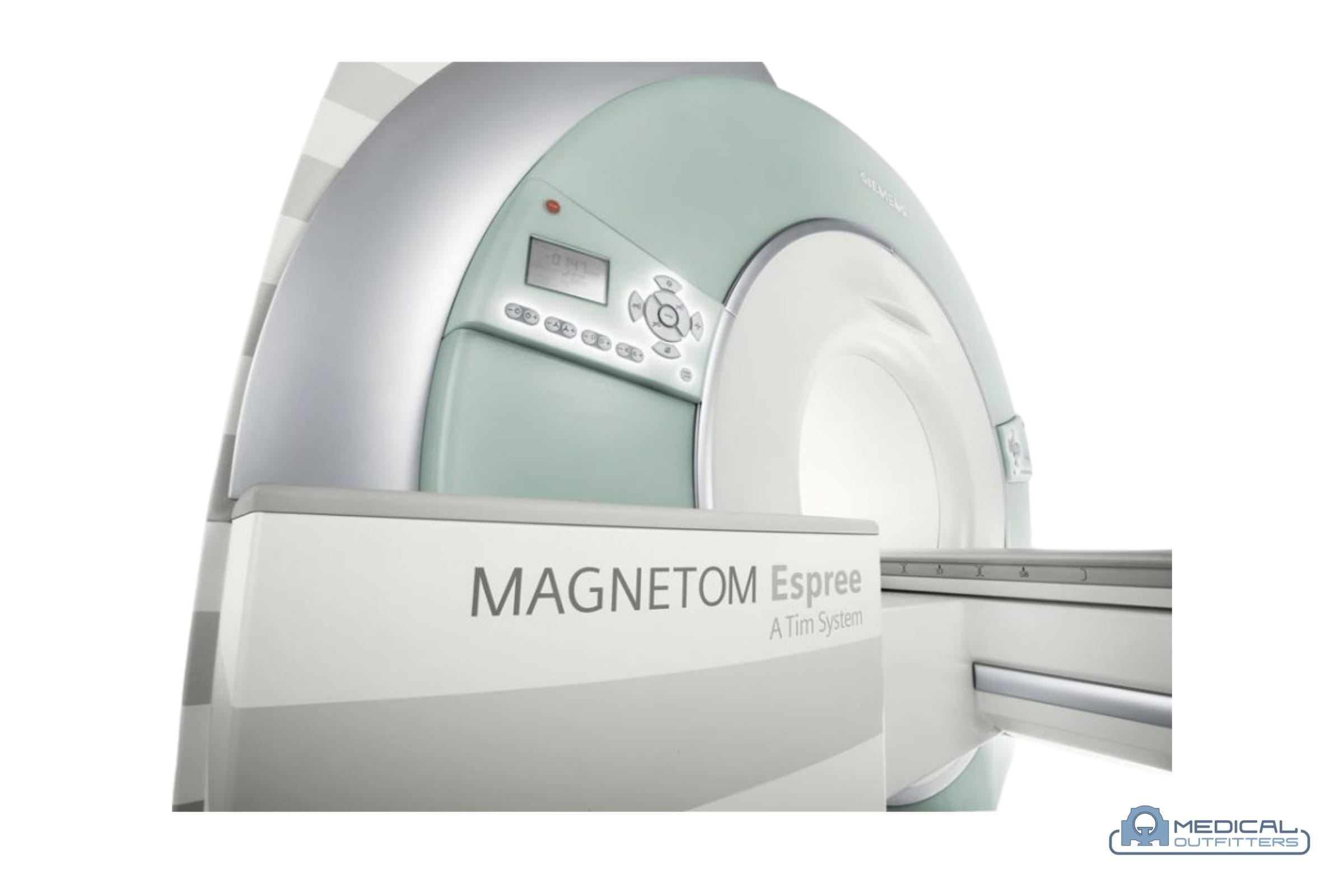
The two numbers are set by different engineering problems. Widening the bore means moving the superconducting windings and the gradient coil further from the imaging volume, which costs field strength per ampere and makes the field harder to keep uniform. Shortening the magnet means squeezing the windings that shape the field into less length, which costs field of view along the patient and makes homogeneity at the ends of the imaging volume harder to hold. Siemens solved both at once in 2004 with the MAGNETOM Espree, the first 70 cm bore MRI at 1.5T, in a system Siemens’ own refurbished-systems page still describes as having an “ultrashort system length of 125 cm (cover to cover).” Diagnostic Imaging’s report on the launch, published November 4, 2004, quoted 30 cm of headroom between the patient and the bore ceiling and the claim that 60 percent of exams could be completed with the patient’s head outside the magnet.
Because the Espree and every short wide bore that followed it kept the horizontal superconducting design, they are not open MRI systems. Siemens’ trade name for its 70 cm cylinders is Open Bore, so an open bore MRI in a Siemens brochure is a short wide bore MRI, not an open MRI. An open MRI puts the magnet above and below the patient, so the field runs vertically and the sides are open; it is a different machine, with different coils and, below 1.2T, a different image. Our comparison of wide bore vs open vs closed MRI covers that distinction for a new imaging center, and our guide to open MRI vs closed MRI covers the clinical side. This article stays with the cylinder, and with what shortening it changes.
Short Bore MRI Machine Bore Length and Diameter by Model
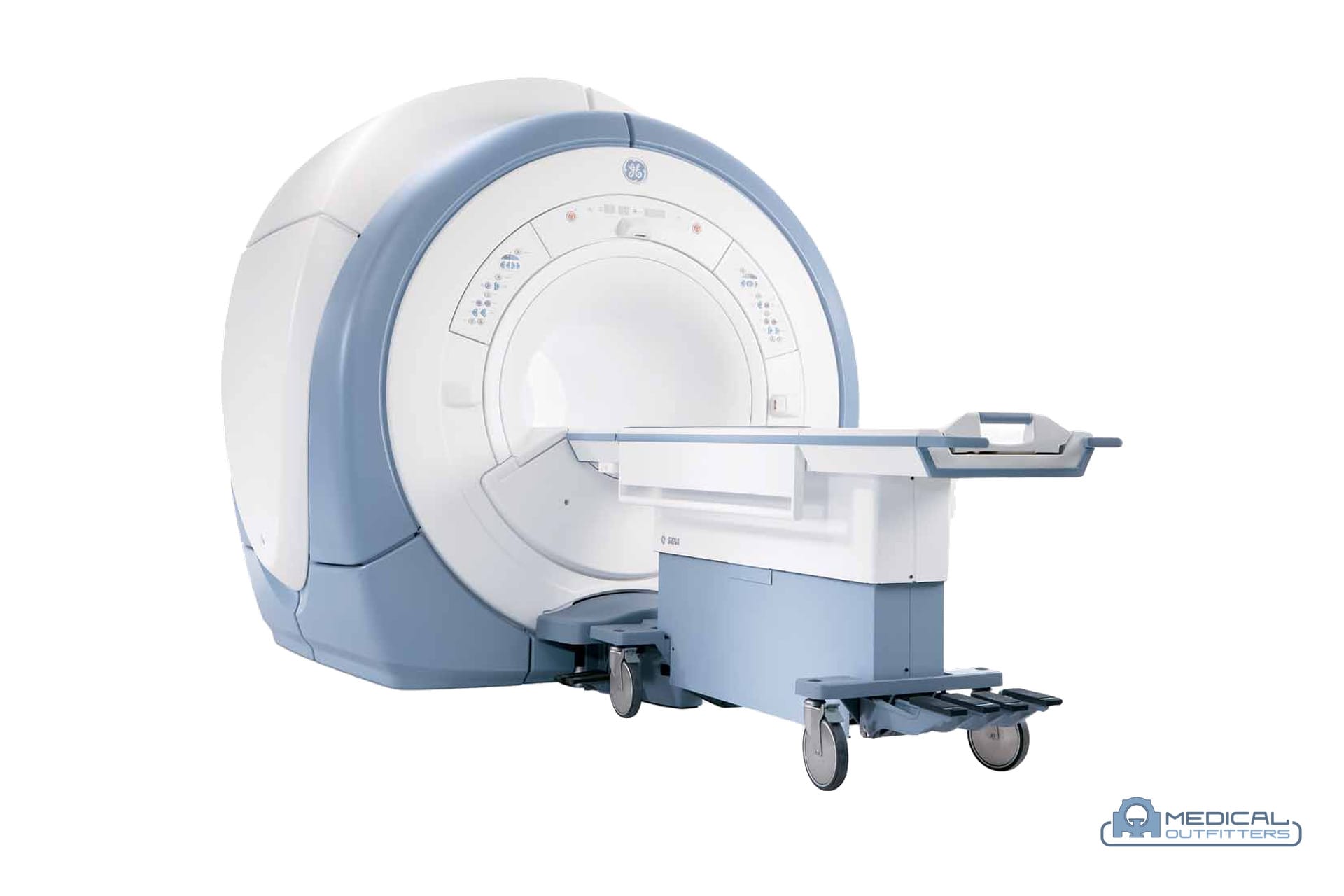
Manufacturers publish bore length in three different ways, and a buyer comparing spec sheets has to know which one is on the page. System length is cover to cover, the number the patient experiences; Siemens quotes it for the Espree (125 cm), the Aera (145 cm) and the current MAGNETOM Sola (157 cm). Magnet length is the cryostat itself, without the plastic covers, and is always shorter than the system length: Siemens lists the Aera’s magnet at 137 cm against its 145 cm system length, and GE describes the Optima MR450w’s “new 145-cm long magnet” in the August 2009 launch coverage in Imaging Technology News. Patient bore length is the length of the tunnel at full diameter before the flares begin, which is why GE’s SIGNA Artist data sheet lists a 179 cm magnet with a patient bore of 105 cm by 70 cm by 70 cm and a 76 cm patient aperture at the openings. The same data sheet says the “magnet geometry has been optimized to reduce patient anxiety by providing more space in the bore and more exams with the patient’s head out of the magnet.”
| System | Bore diameter | Length, as published | Source | How Medical Outfitters supplies it |
|---|---|---|---|---|
| Siemens MAGNETOM Espree 1.5T | 70 cm | 125 cm system length, cover to cover | Siemens Healthineers refurbished systems page | Refurbished through MO Select |
| Siemens MAGNETOM Aera 1.5T | 70 cm | 137 cm magnet, 145 cm system length | Siemens Healthineers product page | Refurbished through MO Select |
| Siemens MAGNETOM Sola 1.5T | 70 cm | 157 cm system length, cover to cover | Siemens Healthineers product page | Not sold by Medical Outfitters; Siemens’ current platform |
| GE Optima MR450w 1.5T | 70 cm | 145 cm magnet | Imaging Technology News, August 2009 | Refurbished through MO Select |
| GE SIGNA Artist 1.5T | 70 cm, 76 cm aperture | 179 cm magnet, 105 cm patient bore | GE HealthCare SIGNA Artist data sheet | Not sold by Medical Outfitters; GE’s current platform |
| Fujifilm ECHELON Oval 1.5T | 74 cm oval, 74 by 65 cm aperture | Not published on the data sheet | Fujifilm Echelon Oval data sheet | Sourced refurbished on request |
| Fujifilm ECHELON Synergy 1.5T | 70 cm | Not published on the product page | Fujifilm product page | New, as an authorized Fujifilm dealer |
| Siemens MAGNETOM Avanto 1.5T (closed) | 60 cm | 150 cm bore | Enders et al., PLoS ONE 2011 | Refurbished through MO Select, on request |
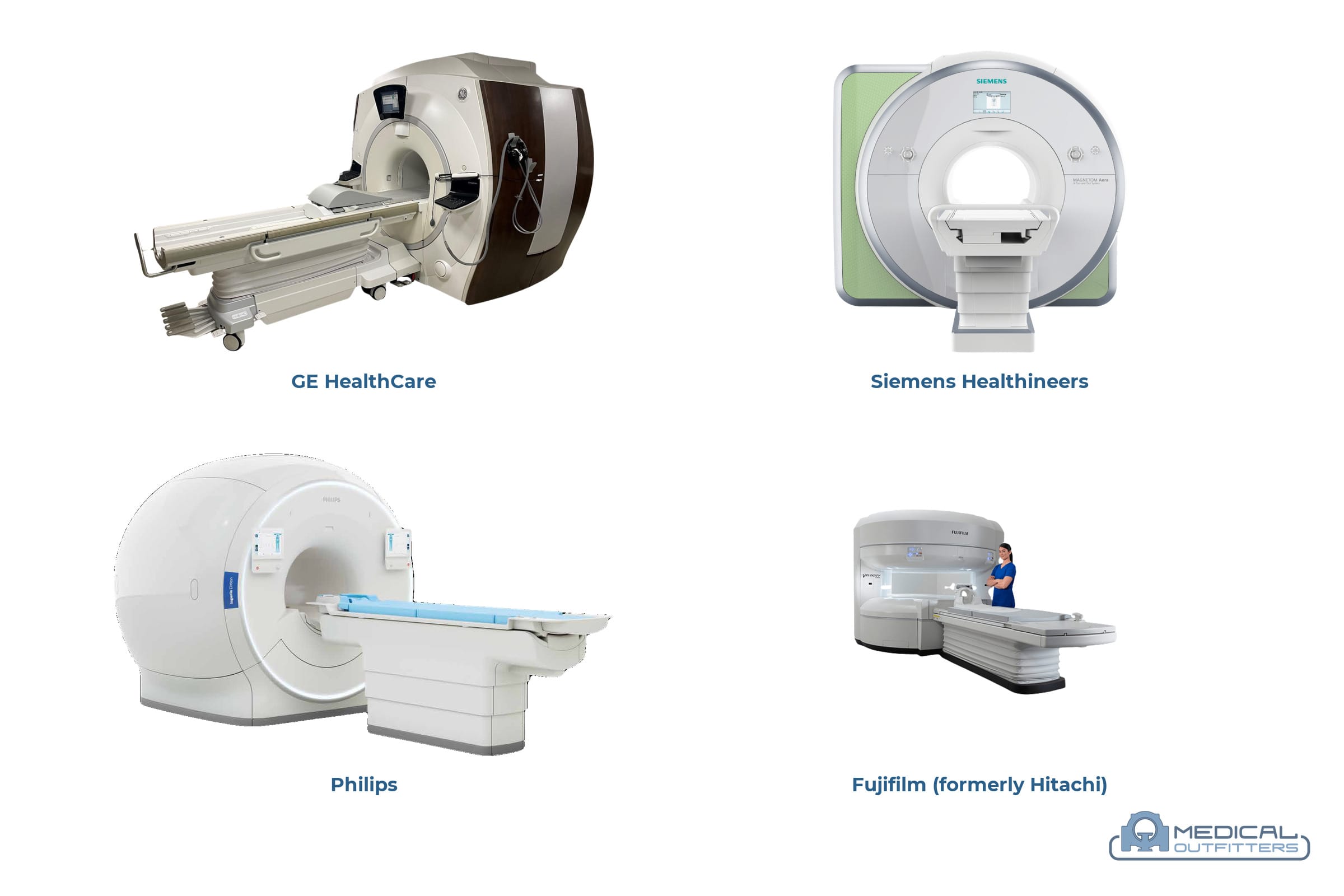
Two patterns stand out. First, the shortest system is the oldest: nothing since the Espree has matched 125 cm, because the field-of-view and homogeneity compromises that Diagnostic Imaging noted at the launch pushed the later generations back toward 145 to 157 cm, where a 50 to 55 cm field of view fits. Second, the current GE platform is not short at all by the magnet measure. The SIGNA Artist’s 179 cm magnet delivers its patient-comfort gain through the dual-flared bore and the 105 cm full-diameter section rather than through a short cryostat, which is why comparing a GE magnet length to a Siemens system length misleads. For each refurbished platform, our model guides give the configurations and the checks: the MAGNETOM Espree guide, the MAGNETOM Aera guide, the Optima MR450w guide and the Philips Ingenia guide, which notes Philips’ 95 cm tunnel diameter at both ends of the Ingenia’s 70 cm bore.
Head Out, Feet First: What a Short Bore Changes for the Patient
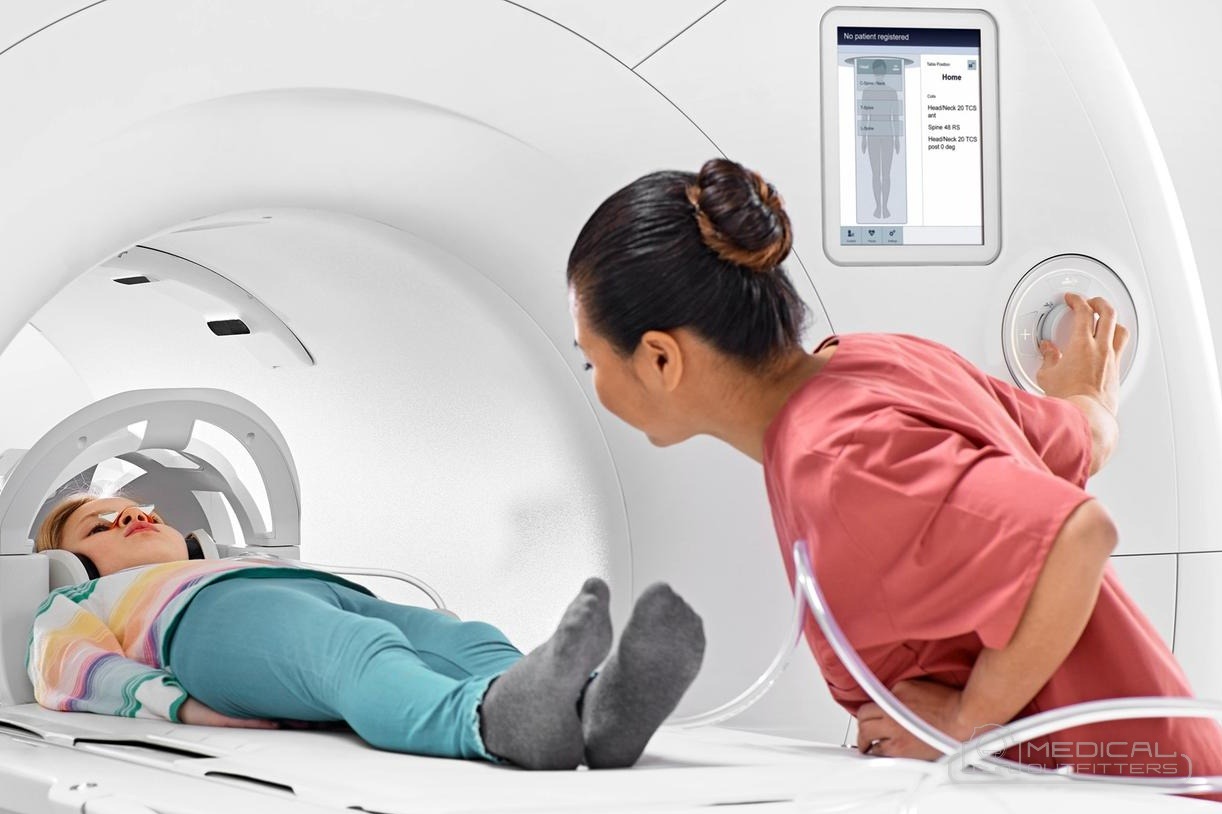
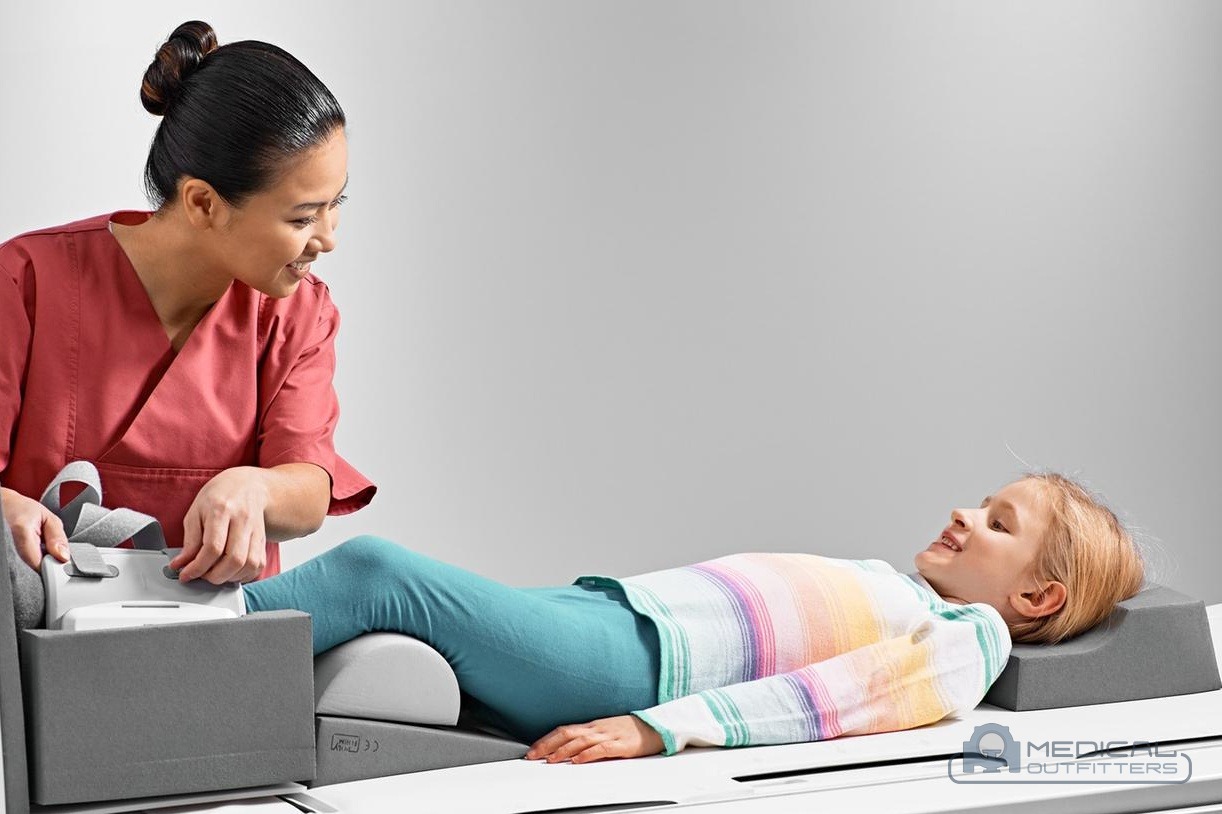
The patient does not feel field strength or gradient slew rate. The patient feels three things: whether the head is inside the tunnel, how close the ceiling is, and how loud the scan is. A short bore changes the first directly. On a 145 cm system with isocenter at the midpoint, the imaging volume sits about 72 cm from each opening, so a lumbar spine, hip, knee, ankle or prostate exam centers the region of interest at isocenter with the head at or beyond the front cover. The Espree’s 60 percent head-out figure from 2004 and GE’s “more exams with the patient’s head out of the magnet” claim for the SIGNA Artist are both statements about this geometry. Brain, cervical spine, shoulder and most chest exams still put the head inside on any cylindrical magnet, short or long; a short bore does not change that, and a facility whose schedule is mostly neuro gains less from it than an orthopedic or body practice does.
The second lever is feet-first entry, and a feet first MRI exam depends on table travel rather than magnet length. GE’s SIGNA Artist data sheet lists “head or feet first entry” in its patient comfort module and a total scannable range of 205 cm on a cradle 210.8 cm long. Fujifilm’s Echelon Oval data sheet is explicit about why that matters: the table’s 279 cm of longitudinal travel “allows patients to enter the bore in the less stressful feet-first orientation for any exam.” Head-first entry was a significant risk factor for claustrophobic events in the Dewey cohort of 55,734 patients in the Journal of Magnetic Resonance Imaging in 2007, and again in the Hudson service evaluation in Radiography in 2022, so a system that can run most exams feet first is addressing a measured cause, not a marketing one.
The third lever is the diameter, which the short bore shares with every wide bore. The 70 cm tunnel adds headroom, lets shoulders lie flat and takes bariatric patients: GE’s MR450w launch coverage quotes a table that holds up to 550 lb, and the Echelon Oval data sheet lists a 550 lb (250 kg) table and a 63 cm wide table top behind its 74 cm oval bore. Noise is the fourth and is a gradient matter: Fujifilm claims its SmartCOMFORT technology on the ECHELON Smart reduces acoustic noise by up to 96 percent, depending on imaging conditions, and the short-bore scanner in the Dewey cohort combined its short magnet with 97 percent acoustic noise reduction, which is why that study could not separate the two effects.
Short Bore MRI Claustrophobia Evidence: What the Studies Found
Claustrophobia in MRI is measured two ways: any claustrophobic reaction, and a reaction severe enough to stop the exam. Eshed and colleagues reviewed 5,798 reports from 4,821 patients scanned at 1.5T in a single year and reported in the Journal of Magnetic Resonance Imaging in 2007 that 1.97 percent of patients suffered from claustrophobia and 1.22 percent terminated the exam early because of it, with head MRI carrying the highest rate and extremity, breast and pelvic MRI the lowest. The Hudson service evaluation of a multi-center UK service from April 2019 to March 2021, published in Radiography in 2022, put the overall incidence of incomplete exams due to claustrophobia at 0.76 percent, and found that patients entering head first or having a head scan, women, and patients aged 45 to 64 were more likely to fail.
The strongest evidence that scanner design moves those rates comes from the Dewey cohort. Across 55,734 consecutive outpatients, 42,998 were scanned on a conventional magnet and 12,736 on a recently developed scanner with 97 percent acoustic noise reduction and a short bore; after logistic regression for the non-randomized design, the authors concluded that “the incidence of claustrophobia may be reduced by a factor of 3 when recently-developed MR scanners are used.” The weakness of that result is the one noted above: the short bore and the quiet gradients arrived together, so the study attributes the gain to the new design as a whole.
The one randomized trial is sobering. Enders and colleagues at the Charité in Berlin randomized 174 patients with at least mild claustrophobic tendency between a Siemens MAGNETOM Avanto, a 1.5T closed magnet with a 60 cm bore 150 cm long, and a Philips Panorama 1T open scanner with a 45 cm high, 160 cm wide aperture, and reported in PLoS ONE in 2011 that claustrophobic events occurred in 39 percent of the short-bore arm (95 percent confidence interval 28 to 50 percent) and 26 percent of the open arm (18 to 37 percent), a difference that did not reach significance (P = 0.08). Events in the short-bore group came earlier, at 3.8 minutes in the room against 8.5 minutes in the open group, and completed exams took 31.7 minutes on the closed magnet against 42.1 on the open one. The authors’ conclusion, “even recent MR cannot prevent claustrophobia,” is worth keeping in mind when a vendor sells bore geometry as a cure.
The Hudson 2022 data adds a twist that buyers of open systems should read twice: in that service, patients scanned on open systems were over three times more likely to fail because of claustrophobia than those on conventional systems, while patients on an upright scanner were half as likely. That figure says as much about which patients are referred to an open scanner as about the scanner itself, since the patients already known to be claustrophobic are the ones sent there. Taken together, the literature supports a modest claim: a short, wide, quiet bore with feet-first entry lowers the rate of failed exams in a general population, it does not eliminate them, and for the patient who has already failed a closed magnet, an open design, sedation, prone positioning (which Eshed found carried the lowest termination rate) or a combination remains the fallback.
What Short Bore Does Not Change: Field Strength, Coils and Sequences
A short wide bore 1.5T is a 1.5T. The signal available, the sequences the console runs, the diffusion, perfusion, cardiac and prostate protocols that need high field, and the coils that receive the signal are the same class of hardware as on a long 60 cm magnet of the same generation. Our guide to 1.5T vs 3T MRI explains why field strength, not bore shape, sets image quality; the bore design decides who fits in the scanner and how they feel there. GE said as much at the MR450w launch, where Imaging Technology News reported the company’s statement that the wider bore “does not compromise image quality,” and the Enders trial found that “all completed MR examinations had diagnostic image quality” on both the closed 1.5T and the open 1T.
What the manufacturers had to engineer around is visible in the specifications rather than in the images. The Espree, at 125 cm, had a more limited field of view than the premium 1.5T magnets of its day, which Diagnostic Imaging reported at the launch, and later short bores grew to 145 to 157 cm partly to recover it: GE quotes a 50 cm field of view on the MR450w and 55 cm on the SIGNA Artist, and Fujifilm a full 50 cm in all directions on the Echelon Oval. Homogeneity is specified at a diameter spherical volume and is held with per-patient active shimming, which the Echelon Oval data sheet describes as higher order shimming applied per patient. A buyer comparing a short bore to a long one should compare those two lines, field of view and homogeneity at the stated volume, and then stop worrying about the images.
Coils deserve a sentence of their own because the short bore era changed them. The 70 cm bore made room for the table-integrated posterior arrays and light anterior arrays that Siemens calls Tim 4G, GE calls GEM and later AIR, and Philips calls dStream, and those coil platforms, not the bore itself, are what a refurbished buyer is really choosing between. Our MRI manufacturers compared guide sets out the coil architecture of each brand, and our used MRI machine buying guide explains why the coil inventory on a used short bore system moves its value more than the year of manufacture does.
Short Bore MRI vs Open MRI: Which Patients Need Which
Three groups of patients drive the open-versus-short-bore decision, and they do not all point the same way. Anxious and mildly claustrophobic patients are the largest group, and the evidence above says a wide short bore MRI at 1.5T, with quiet gradients and feet-first entry, serves most of them. GE’s MR450w launch coverage put the share of US patients who are obese or claustrophobic at about one in five, which is the population the format was built for. Severely claustrophobic patients who have already failed a cylindrical magnet are a smaller group for whom an open design, or sedation, remains the route; the Enders trial’s 26 percent event rate on the open scanner says even that is not a guarantee. Bariatric patients fit a 70 cm bore up to the table limits the manufacturers publish, 550 lb on the MR450w and the Echelon Oval and 500 lb on the SIGNA Artist, and beyond the diameter and weight limits of a cylinder they need an open or extra-wide system.
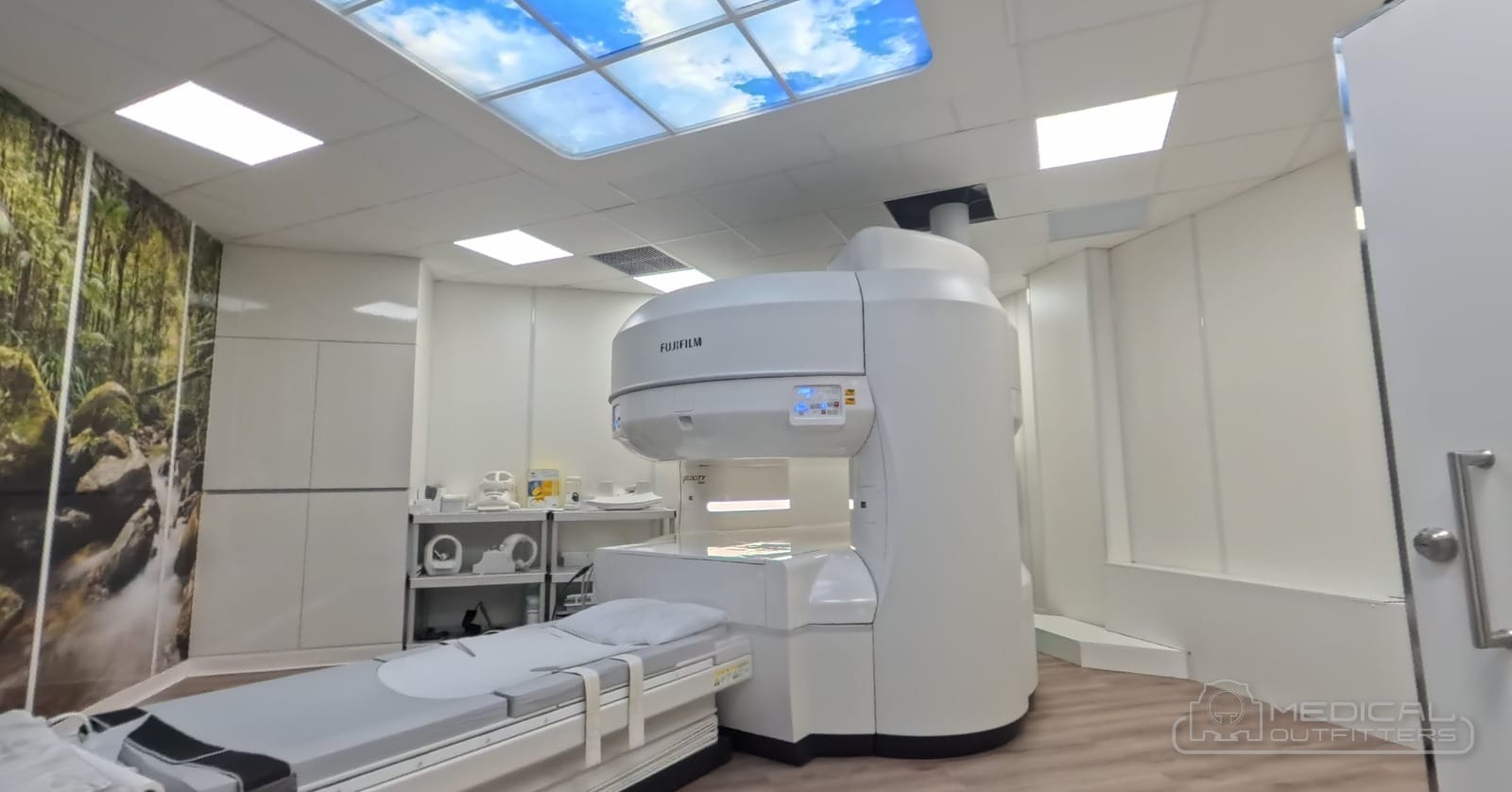
The extra-wide cylinder is the newest answer. Siemens’ MAGNETOM Free.Max pairs what Siemens calls “the world’s first 80 cm patient bore” with a 0.55T field, a system weight under 3.5 US tons and a footprint under 250 square feet, and Siemens positions it for “claustrophobic, anxious, and more corpulent patients.” It is a different trade: more space at lower field, with deep-learning reconstruction making up part of the signal. At the other end, the high-field open design has one current representative in the United States, the 1.2T Fujifilm OASIS Velocity, which Medical Outfitters sells new and has installed in Puerto Rico, and which our wide bore vs open vs closed guide treats as the open magnet a general center can build a schedule around. Below it sit the 0.3T to 0.4T permanent-magnet open systems, the Fujifilm AIRIS Vento and APERTO Lucent, which trade speed and sequences for the simplest siting and no helium.
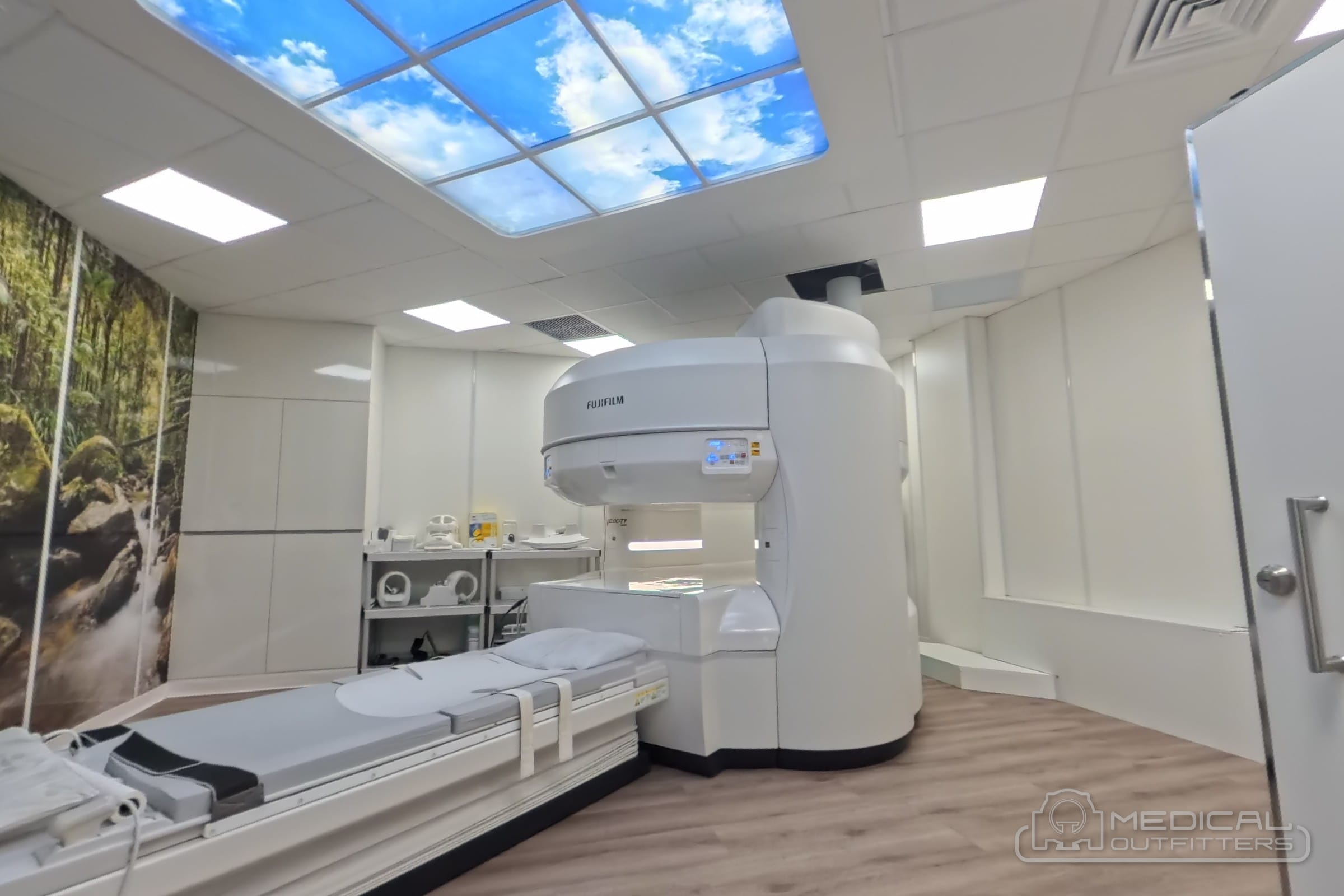
For a facility choosing one magnet, the decision usually resolves to the referral mix. A general outpatient center scanning spine, joints, body and brain buys a short wide bore 1.5T and handles its anxious patients with geometry, feet-first positioning and a quiet gradient mode. A center whose referrals will be dominated by bariatric, pediatric or previously failed claustrophobic patients, or that wants to market itself on openness, buys the 1.2T open and accepts longer exams. A hospital adding a second or third magnet to an existing fleet often buys the closed 60 cm bore because it is the least expensive refurbished platform and the anxious patients can be routed to the wide bore next door. Our guide to wide bore MRI systems lists the models for the first path, and our used and refurbished MRI machines for sale page shows what is available on each.
Room, Weight and Siting: Does a Shorter Magnet Need a Smaller Room?
Less than buyers hope. The RF-shielded room is sized by the magnet’s footprint, the table travel, the 5 gauss line and the service clearances, and shortening a cryostat by 20 or 30 cm shaves a little off the long axis without changing the shield, the quench vent, the chiller or the power. Siemens’ own figures illustrate the scale: the MAGNETOM Aera at 145 cm is listed at 4.8 tons in operation with a minimum total space requirement of 30 square meters for magnet, electronics and console room, and the longer MAGNETOM Sola at 157 cm is listed at 4.2 tons and 28 square meters, because the Sola’s newer magnet is lighter and its electronics more compact. Length and room size do not move together.
What does move is the table. A system that offers feet-first entry for every exam needs the table travel to match: 279 cm on the Echelon Oval, a 210.8 cm cradle with 205 cm of scannable range on the SIGNA Artist, and a whole-body range of 205 cm on the Espree, and that travel has to fit inside the shielded room with the table fully extended. Our guide to MRI room shielding requirements covers the RF enclosure and the 5 gauss line, our article on how much an MRI machine weighs covers floor loading by model, and the siting section of our MRI machine cost and price guide explains what the room adds to the project. That guide also makes the pricing point in one sentence: bore design decides patient comfort and the room, field strength decides the band a system prices in, and a wide bore commands a premium within its field-strength band because of demand from bariatric, oncology and anxious-patient referrals.
Buying a Short Bore MRI: New, Refurbished and What to Check
The short wide bore 1.5T is now the most common refurbished platform on the market because the hospitals that bought the Espree, Aera, MR450w and Ingenia generation between 2004 and 2015 are replacing them with the Sola, SIGNA Artist and Ambition generation. Medical Outfitters supplies the Siemens MAGNETOM Espree and Aera and the GE Optima MR450w refurbished through MO Select, inspected, cryo-tested, image quality verified, installed by our own crews and covered by a written warranty, and sources the Philips Ingenia and the Fujifilm ECHELON Oval refurbished on request. New, we sell the current Fujifilm 1.5T platform, the ECHELON Smart with SynergyDrive and the ECHELON Smart ZeroHelium, as an authorized dealer.
Four checks matter more on a used short bore MRI scanner than on a long one. First, confirm which length the seller is quoting, system or magnet, and compare like with like using the table above. Second, confirm the table rating and the travel, because the feet-first and bariatric claims depend on the table that ships with the system, and tables are swapped on the used market. Third, inventory the coils against the exams you plan to run, since the table-integrated posterior array and the anterior arrays are the expensive part of a Tim 4G, GEM or dStream system and are often sold separately. Fourth, check the software level, because the quiet gradient modes and the guided workflows that make a short bore pleasant for anxious patients arrived in later releases on every platform. Our used imaging equipment inspection checklist covers the magnet, cold head and helium checks that apply to any superconducting system, and our article on how long an MRI machine lasts covers the support horizon for each generation.
Short Bore and Wide Bore MRI With Medical Outfitters
Medical Outfitters supplies, installs and services short wide bore MRI systems across the United States, Puerto Rico and the Caribbean: refurbished Siemens MAGNETOM Espree and Aera and GE Optima MR450w through MO Select, new Fujifilm ECHELON Smart systems as an authorized dealer, and the 1.2T Fujifilm OASIS Velocity for the facility that needs an open magnet instead. Every system on our MRI machines page is delivered, sited and installed by our own engineers, and our MRI service team keeps it running afterward. For the price bands by field strength and model, read our MRI machine cost and price guide; for the design decision, our comparison of wide bore vs open vs closed MRI. To match a short bore system to your referral mix, room and budget, contact Medical Outfitters.
- Siemens Healthineers, MAGNETOM Espree eco: 70 cm Open Bore, 125 cm system length cover to cover, 205 cm whole-body range. siemens-healthineers.com
- Diagnostic Imaging, November 4, 2004, Siemens MR scanner combines high field and patient comfort: 30 cm headroom, 60 percent of exams head outside, field of view limits. diagnosticimaging.com
- Siemens Healthineers, MAGNETOM Aera and MAGNETOM Sola product pages: bore, magnet and system lengths, weights, minimum room sizes. MAGNETOM Aera, MAGNETOM Sola, MAGNETOM Free.Max
- Imaging Technology News, August 26, 2009, GE unveils new wide bore 1.5T MRI system: 145 cm magnet, 70 cm bore, 50 cm field of view, 550 lb table. itnonline.com
- GE HealthCare, SIGNA Artist 1.5T data sheet: 179 cm magnet, 105 by 70 by 70 cm patient bore, 76 cm aperture, 55 cm field of view, 227 kg table, head or feet first entry. gehealthcare.com (PDF)
- Fujifilm Healthcare Americas, Echelon Oval MRI specification data sheet: 74 cm oval bore, 74 by 65 cm aperture, 550 lb table, 279 cm travel, feet-first entry for any exam. fujifilm.com (PDF); ECHELON Synergy 70 cm bore and ECHELON Smart noise reduction from the Fujifilm product pages. ECHELON Synergy, ECHELON Smart
- Dewey M, Schink T, Dewey CF. Claustrophobia during magnetic resonance imaging: cohort study in over 55,000 patients. Journal of Magnetic Resonance Imaging 2007;26(5):1322-1327. doi.org/10.1002/jmri.21147
- Enders J et al. Reduction of claustrophobia with short-bore versus open magnetic resonance imaging: a randomized controlled trial. PLoS ONE 2011;6(8):e23494. journals.plos.org
- Eshed I et al. Claustrophobia and premature termination of magnetic resonance imaging examinations. Journal of Magnetic Resonance Imaging 2007;26(2):401-404. doi.org/10.1002/jmri.21012
- Hudson DM et al. Review of claustrophobia incidence in MRI: a service evaluation of current rates across a multi-center service. Radiography 2022;28(3):780-787. doi.org/10.1016/j.radi.2022.02.010
- Medical Outfitters, Wide-Bore vs Open vs Closed MRI, Philips Ingenia MRI price guide and MRI Machine Cost and Price Guide: design comparison, Philips bore figures and the bore-versus-band pricing rule. medicaloutfitters.com
- Wide bore vs open vs closed MRI: which should a new imaging center buy?
- Wide bore MRI systems: the models compared
- Open MRI vs closed MRI
- 1.5T vs 3T MRI: which field strength should your facility buy?
- MRI machine cost and price guide (2026)
- Siemens MAGNETOM Espree 1.5T: price, configurations and buying guide
- Siemens MAGNETOM Aera 1.5T: price, configurations and buying guide
- GE Optima MR450w 1.5T: price, configurations and buying guide
- Philips Ingenia MRI: price, configurations and buying guide
- Fujifilm ECHELON Smart with SynergyDrive: sold new
- Fujifilm OASIS Velocity 1.2T open MRI: sold new
- Used and refurbished MRI machines for sale
- MRI machines: new, refurbished and used
- MRI service, repair and maintenance
- Match a short bore MRI to your referral mix and room
Short Bore MRI: Common Questions
What is a short bore MRI?
A short bore MRI is a conventional cylindrical superconducting magnet, usually 1.5T or 3T, whose tunnel has been shortened so that more exams run with the patient's head outside it. Siemens introduced the format in 2004 with the MAGNETOM Espree, a 70 cm bore in a system 125 cm long cover to cover, and said 60 percent of exams could run with the head outside the magnet. Current short wide bore systems such as the Siemens MAGNETOM Aera (145 cm system length) and GE Optima MR450w (145 cm magnet) pair that length with a 70 cm opening and the image quality of a standard 1.5T.
Is a short bore MRI the same as a wide bore MRI?
No, although most modern systems are both. Short bore describes the length of the tunnel; wide bore describes its diameter, 70 cm instead of the conventional 60 cm. The Siemens Espree, Aera and Sola, the GE Optima MR450w and SIGNA Artist, and the Philips Ingenia are all 70 cm wide bore magnets, and their lengths run from 125 cm to 157 cm as system length or 145 cm to 179 cm as magnet length, depending on which figure the manufacturer publishes. A 60 cm bore can also be short, and a 70 cm bore can be long.
Is a short bore MRI an open MRI?
No. A short bore MRI is still a cylinder the patient lies inside; an open MRI puts the magnet above and below the patient so the sides are open and the field runs vertically. Siemens calls its 70 cm cylinders Open Bore, which is a product name, not a design class. The open designs are the 0.3T to 0.4T permanent-magnet systems such as the Fujifilm AIRIS Vento and APERTO Lucent and the 1.2T superconducting Fujifilm OASIS Velocity, which Medical Outfitters sells new and installs in Puerto Rico and the United States.
Does a short bore MRI help with claustrophobia?
The evidence says it helps but does not cure. In a cohort of 55,734 outpatients published in the Journal of Magnetic Resonance Imaging in 2007, Dewey and colleagues concluded that a recently developed scanner with a short bore and 97 percent acoustic noise reduction may reduce claustrophobia by a factor of three. In a randomized trial of 174 claustrophobia-prone patients published in PLoS ONE in 2011, Enders and colleagues found claustrophobic events in 39 percent on a short bore 1.5T and 26 percent on an open 1T scanner, a difference that was not statistically significant. Feet-first entry and head-out positioning address the head-first risk factor both studies identified.
Which MRI has the shortest bore?
The shortest bore MRI among the systems a buyer will be quoted is the Siemens MAGNETOM Espree, at 125 cm from cover to cover per Siemens Healthineers, and no later generation has matched it; the Siemens MAGNETOM Aera is 145 cm, the GE Optima MR450w has a 145 cm magnet per its 2009 launch coverage, and the current Siemens MAGNETOM Sola is 157 cm. Comparing lengths across brands needs care, because Siemens publishes system length cover to cover while GE publishes magnet length; the GE SIGNA Artist data sheet lists a 179 cm magnet with a 105 cm patient bore at full diameter.
Can you go in feet first on a short bore MRI?
Usually, yes, and it depends on the table more than the magnet. GE's SIGNA Artist data sheet lists head or feet first entry with a 205 cm scannable range, and Fujifilm's Echelon Oval data sheet says the table's 279 cm of travel allows patients to enter the bore feet first for any exam. Spine, hip, knee, ankle, pelvic and most abdominal exams run feet first with the head outside or at the opening of a short bore; brain, cervical spine and shoulder exams still put the head inside on any cylindrical magnet. Ask the facility which orientation your exam will use.
Does a short bore MRI have worse image quality?
No. A short wide bore 1.5T uses the same superconducting magnet class, coils and sequences as a long 60 cm 1.5T, and the Enders trial found all completed exams had diagnostic image quality on both the closed 1.5T and the open 1T it compared. What the manufacturers engineered around is the field of view and the homogeneity at the ends of the imaging volume: the 125 cm Espree had a more limited field of view than premium 1.5T magnets of its day, and later systems grew to 145 to 157 cm to recover a 50 to 55 cm field of view, which GE quotes on the MR450w and SIGNA Artist.
What does a short bore MRI machine cost?
Bore design does not set the price band; field strength does. A short wide bore 1.5T prices inside the 1.5T band in the Medical Outfitters MRI machine cost and price guide, and commands a premium within that band because of demand from bariatric, oncology and anxious-patient referrals. Medical Outfitters supplies the Siemens MAGNETOM Espree and Aera and the GE Optima MR450w refurbished through MO Select, delivered, installed and warrantied, and sells the Fujifilm ECHELON Smart new; the model guides linked from this article give the 2026 ranges by configuration.