Every imaging department is built from the same dozen machine types, and the differences between them decide what a facility can diagnose, what its rooms must be built to hold, what its staff must be licensed to do and what the capital budget looks like. A buyer comparing types of medical imaging equipment is really comparing four things at once: what each modality images and how (X-rays, magnetism, sound or an injected tracer), whether it uses ionizing radiation and how much, what the room needs (shielding, power, cooling, a hot lab), and what the system costs delivered, installed and warrantied. This guide covers all twelve types in one place: a comparison table, a section on each family with its typical doses from RadiologyInfo, its room requirements from the Medical Outfitters cost guides, and the refurbished and new price bands those guides publish, with links to the category and the full guide for each modality.
Medical Outfitters sells Fujifilm, Esaote, Planmed, DMS Imaging and Mammotome Neoprobe new as an authorized dealer (the Neoprobe in Puerto Rico and the Caribbean), supplies GE and Siemens systems refurbished through its MO Select program, and sources Philips, Canon and Hitachi systems refurbished on request, with installation and service across the United States, Puerto Rico and the Caribbean. This guide to diagnostic imaging equipment is written for facility owners, administrators, radiology managers and clinicians planning a new department, adding a modality or replacing a system, and it points to the detailed guide for each of the imaging equipment types.
- Twelve types: X-ray room, portable X-ray, fluoroscopy, C-arm, CT, cone beam CT, MRI, ultrasound, mammography, DEXA, PET/CT, and SPECT with gamma probes.
- Radiation: X-ray, CT, mammography, DEXA and nuclear medicine use ionizing radiation, from 0.001 mSv for a DEXA scan to 22.7 mSv for a whole-body PET/CT per RadiologyInfo; MRI and ultrasound use none.
- Rooms: ultrasound fits any exam room; X-ray, CT and mammography need a shielded room; MRI needs an RF shielded enclosure; PET/CT needs heavier shielding, a hot lab and uptake rooms.
- Prices: all-in refurbished bands in the Medical Outfitters guides run from $4,000 (handheld ultrasound) to $1,900,000 (3T MRI); new systems run from $9,000 to $4,000,000.
- Refurbished saves 40 to 60 percent versus new across the modalities, according to the guides, with the room and the service contract priced per project either way.
The Types of Medical Imaging Equipment at a Glance
The FDA sorts imaging by how the picture is made. Its medical X-ray imaging page lists radiography, fluoroscopy, computed tomography, mammography and dental cone beam CT as the exams that pass X-rays through the body, and explains that ionizing radiation “has enough energy to potentially cause damage to DNA,” which is why those rooms are shielded and those exams are justified one by one. MRI, on the FDA’s description, uses “strong magnetic fields and radio waves” and reads a signal from the protons in the body’s fat and water. Ultrasound “uses high-frequency sound waves to view inside the body,” with no ionizing radiation. Nuclear medicine, as RadiologyInfo describes it, injects a radiotracer and images where it collects, so the radiation comes from the patient rather than the machine.
The table below is the radiology equipment list a buyer asks for: the twelve imaging modalities side by side, so that a search for “what equipment is used in radiology” or for the medical imaging modalities a department should own lands on one answer. The dose column uses RadiologyInfo’s adult effective-dose values for a typical exam on that equipment; the room column summarizes the siting notes in the Medical Outfitters cost guides; the price columns are the all-in bands those guides publish for a system delivered, installed and warrantied, reviewed in September 2026. Fluoroscopy rooms, cone beam CT and gamma cameras are quoted per project on the site and have no general band.
| Equipment type | What it images | Typical dose (RadiologyInfo) | Room | Refurbished, all-in | New, all-in |
|---|---|---|---|---|---|
| Digital X-ray room (DR) | Bones, chest, abdomen, joints, spine | Chest X-ray 0.1 mSv | Shielded room, control booth, 32 to 82 kW generator | $60,000 to $135,000 | $150,000 to $275,000 |
| Portable and mobile X-ray | Bedside chest, extremities, ICU and ER | Chest X-ray 0.1 mSv | None fixed; the unit goes to the patient | $12,000 to $90,000 | $30,000 to $185,000 |
| Fluoroscopy room (R/F) | Moving images: swallow, GI, catheters, joints | Upper GI barium study 6 mSv | Shielded room, control booth | Quoted per project | Quoted per project |
| C-arm (mini, mobile, 3D) | Surgery, orthopedics, pain, vascular | Varies by procedure | Shielded OR or procedure room | $45,000 to $240,000 | $165,000 to $295,000 for a full-size mobile C-arm; mini estimated at $140,000 to $185,000 and 3D estimated at $275,000 and up, comparison only |
| CT scanner (16 to 256+ slices) | Cross-sections of the whole body, trauma, chest, abdomen, vessels | CT chest 6.1 mSv; abdomen and pelvis 7.7 mSv | Lead shielded room, control room, three-phase power, chiller | $85,000 to $1,500,000 | $350,000 to $2,900,000 and up |
| Cone beam CT | Teeth, jaws, sinuses, extremities | Dental cone beam CT 0.18 mSv | Standard shielded X-ray room | Quoted per configuration | Quoted per configuration |
| MRI (open, 1.5T, 3T) | Soft tissue, brain, spine, joints, pelvis, heart | None | RF shielded enclosure, five gauss line, quench vent, chiller | $300,000 to $1,900,000 | $600,000 to $3,700,000 |
| Ultrasound (handheld to cart) | Organs, pregnancy, heart, vessels, needle guidance | None | Any exam room | $4,000 to $90,000 | $9,000 to $200,000 |
| Mammography (2D and 3D) | Breast screening and diagnosis | 0.28 mSv (2D), 0.34 mSv (3D) | Shielded like an X-ray room; MQSA certification | $40,000 to $225,000 | $110,000 to $500,000 |
| DEXA bone densitometer | Bone mineral density, body composition | 0.001 mSv | Standard room; registered as an X-ray device | $18,000 to $85,000 | $40,000 to $165,000 |
| PET/CT | Metabolism: cancer staging, heart, brain | Whole-body PET/CT 22.7 mSv | Heavier shielding, hot lab, uptake rooms, materials license | $200,000 to $1,500,000 | $500,000 to $4,000,000 |
| Gamma camera, SPECT and gamma probes | Tracer uptake: heart, bone, thyroid, kidneys; surgical node finding | Varies by tracer | Shielded room, hot lab, materials license | Quoted per project | Neoprobe system $85,000 to $145,000 |
Two things stand out. First, the price spread inside a single type is often wider than the gap between types: a 16-slice CT and a 256-slice CT are both “a CT scanner,” but the guide bands differ by more than a million dollars. Second, the room is a second budget line that the equipment price never includes: the CT scanner cost guide, the MRI machine cost guide and the PET/CT scanner cost guide all quote shielding, electrical work, cooling and the physicist’s design per project. The sections below take each family in turn.
X-Ray Equipment: Radiography Rooms, Portable Units, Fluoroscopy and C-Arms
Digital radiography rooms. The fixed X-ray room is the most common piece of imaging equipment in any hospital or clinic: a generator, a tube on a floor stand or ceiling crane, a table, a wall stand and a flat-panel detector that turns the X-ray shadow into a digital image in seconds. The Medical Outfitters X-ray machine cost guide tiers the room by its tube support: an entry-level floor column or U-arm at $60,000 to $95,000 refurbished and $150,000 to $185,000 new, a mid-range straight arm at $70,000 to $115,000 refurbished, and a premium ceiling-suspended tube crane at $95,000 to $135,000 refurbished and $200,000 to $275,000 new. The same guide puts the generator at 32 kW for a budget room and 65 to 82 kW for a hospital room, and notes that a straight-arm system installs under an 8 ft ceiling while a tube crane needs ceiling structure for its rails. A chest X-ray delivers about 0.1 mSv, the equivalent of ten days of natural background, according to RadiologyInfo; an extremity X-ray is under 0.001 mSv. The receptor side, computed radiography cassettes against flat-panel detectors, is explained in our CR vs DR article and the whole category in digital X-ray machines explained.
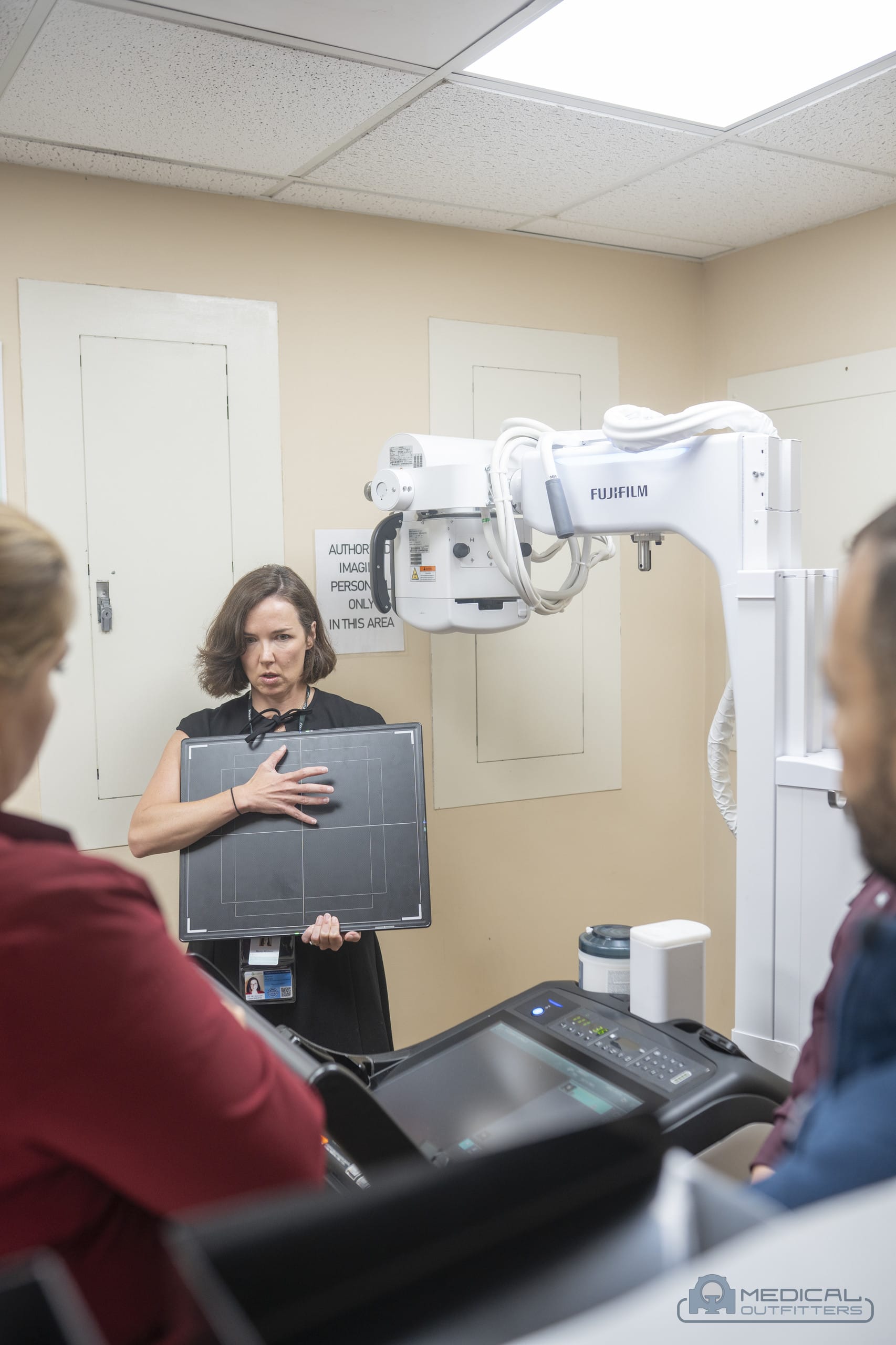
Portable and mobile X-ray. A mobile cart brings the tube and a wireless detector to the bed in the ICU, the ER or the operating room; a handheld or portable unit does the same for extremities and for clinics without a fixed room. The portable X-ray machine price guide prices portable and handheld DR at $12,000 to $35,000 refurbished and $30,000 to $65,000 new, and a full digital mobile cart at $40,000 to $90,000 refurbished and $90,000 to $185,000 new; the Fujifilm FDR Go iQ in the cover photograph is sold new by Medical Outfitters, and the GE AMX 4+ with a DR panel is listed at $45,000 to $60,000 refurbished.
Fluoroscopy rooms. Fluoroscopy, in the FDA’s words, “shows a continuous X-ray image on a monitor, much like an X-ray movie,” and is used for barium studies of the GI tract, catheter placement, stents, angiograms and orthopedic guidance. The same FDA page warns that fluoroscopy “can result in relatively high radiation doses, especially for complex interventional procedures”; RadiologyInfo puts an upper GI barium study at 6 mSv. A radiography and fluoroscopy room such as the Fujifilm Persona RF installed by Medical Outfitters at Centro Cardiovascular de Puerto Rico y del Caribe does both jobs in one shielded room; the X-ray guide quotes R/F rooms per project rather than by band. The digital fluoroscopy room category lists the current systems.
C-arms. A C-arm is fluoroscopy on wheels: the tube and detector sit at the two ends of a C-shaped arm that swings around the patient on the operating table. The C-arm machine cost guide prices a mini C-arm for extremities at $45,000 to $85,000 refurbished and an estimated $140,000 to $185,000 new, a full-size mobile C-arm at $55,000 to $135,000 refurbished and $165,000 to $295,000 new, and a 3D or premium vascular C-arm at $125,000 to $240,000 refurbished and an estimated $275,000 and up new; Fujifilm Persona C-arms are sold new, GE OEC and Siemens Cios models come refurbished through MO Select. The difference between a C-arm and a fixed fluoroscopy room is covered in C-arm vs fluoroscopy, and short-term needs in the C-arm rental page.
CT Scanners and Cone Beam CT
A CT scanner is, in the FDA’s description, a noninvasive exam that “uses specialized X-ray equipment to produce cross-sectional images of the body”: the tube and a detector array rotate around the patient, usually in a second or less, while the table moves through the gantry, and a computer reconstructs the readings into slices. CT images of organs, bone, soft tissue and blood vessels, the FDA notes, offer more detail than a standard X-ray, which is why CT is the trauma, chest and abdominal workhorse of every emergency department. The cost of that detail is dose: RadiologyInfo lists a CT of the brain at 1.6 mSv, a CT chest at 6.1 mSv, a CT abdomen and pelvis at 7.7 mSv and a coronary CT angiogram at 8.7 mSv, against 0.1 mSv for a chest X-ray.
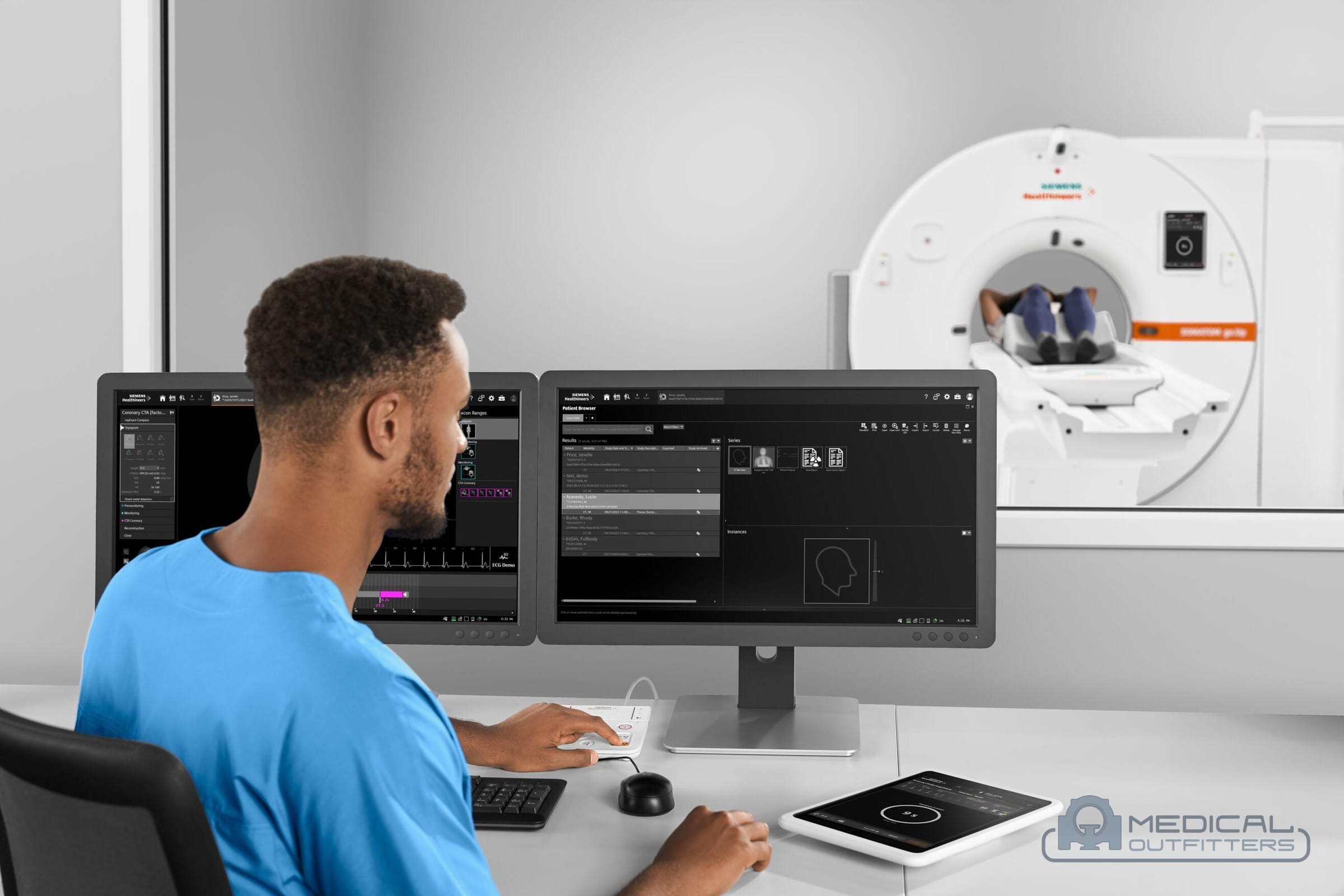
CT scanners are classed by slice count, which is the number of detector rows read in one rotation. The CT scanner cost and price guide prices a 16 to 32-slice system at $85,000 to $185,000 refurbished and $350,000 to $525,000 new, a 64-slice at $175,000 to $375,000 refurbished and $625,000 to $975,000 new, a 128-slice at $350,000 to $625,000 refurbished, and 256 slices and above at $625,000 to $1,500,000 refurbished and $1,750,000 to $2,900,000 and up new; it calls $275,000 a fair midpoint for a refurbished 64-slice system. What the slice count buys, and which class suits an outpatient center versus a cardiac program, is the subject of CT scanner types by slice count. The room, per the same guide, must be lead-shielded to a physicist’s design the state accepts, with a separate control room and a leaded window, dedicated three-phase power, a chiller or adequate HVAC and a floor that carries the gantry; an existing X-ray room often converts. Our CT room size and requirements article works through the dimensions, and the CT category lists Fujifilm systems new and GE and Siemens systems refurbished through MO Select.
Cone beam CT is the small cousin. As our cone beam CT explained article sets out, a CBCT uses a cone-shaped beam and a single flat-panel detector to capture a volume 5 to 30 cm across in one rotation of 10 to 40 seconds, at voxels of 0.075 to 0.4 mm, where a medical CT uses a fan beam, 16 to 320 detector rows, a 50 cm field of view and a rotation of 0.3 to 1 second. CBCT gray values are not calibrated Hounsfield units, so it is weak for soft tissue and contrast studies, but for teeth, jaws, sinuses, temporal bone and weight-bearing extremities it delivers bone detail at a fraction of the dose: RadiologyInfo lists a dental cone beam CT at 0.18 mSv. Planmed Verity and XFI extremity and weight-bearing systems are sold new by Medical Outfitters and listed in the cone beam category; they site in a standard shielded X-ray room and are quoted per configuration.
MRI Machines: Open, 1.5T and 3T
MRI is the one cross-sectional modality with no ionizing radiation. The FDA describes a scanner that uses “strong magnetic fields and radio waves” and reads the signal that comes “mainly from the protons in fat and water molecules in the body,” which is why MRI sees soft tissue, the brain, the spinal cord, cartilage, ligaments and the pelvis in a way CT cannot. Scanners are classed by field strength: open and low-field systems from 0.2T to 1.2T, closed and wide-bore 1.5T systems, and 3T systems for neuro, musculoskeletal and research work. Our 1.5T vs 3T MRI article compares the two main classes, and MRI manufacturers compared walks through GE, Siemens, Philips, Fujifilm, Canon and Esaote.
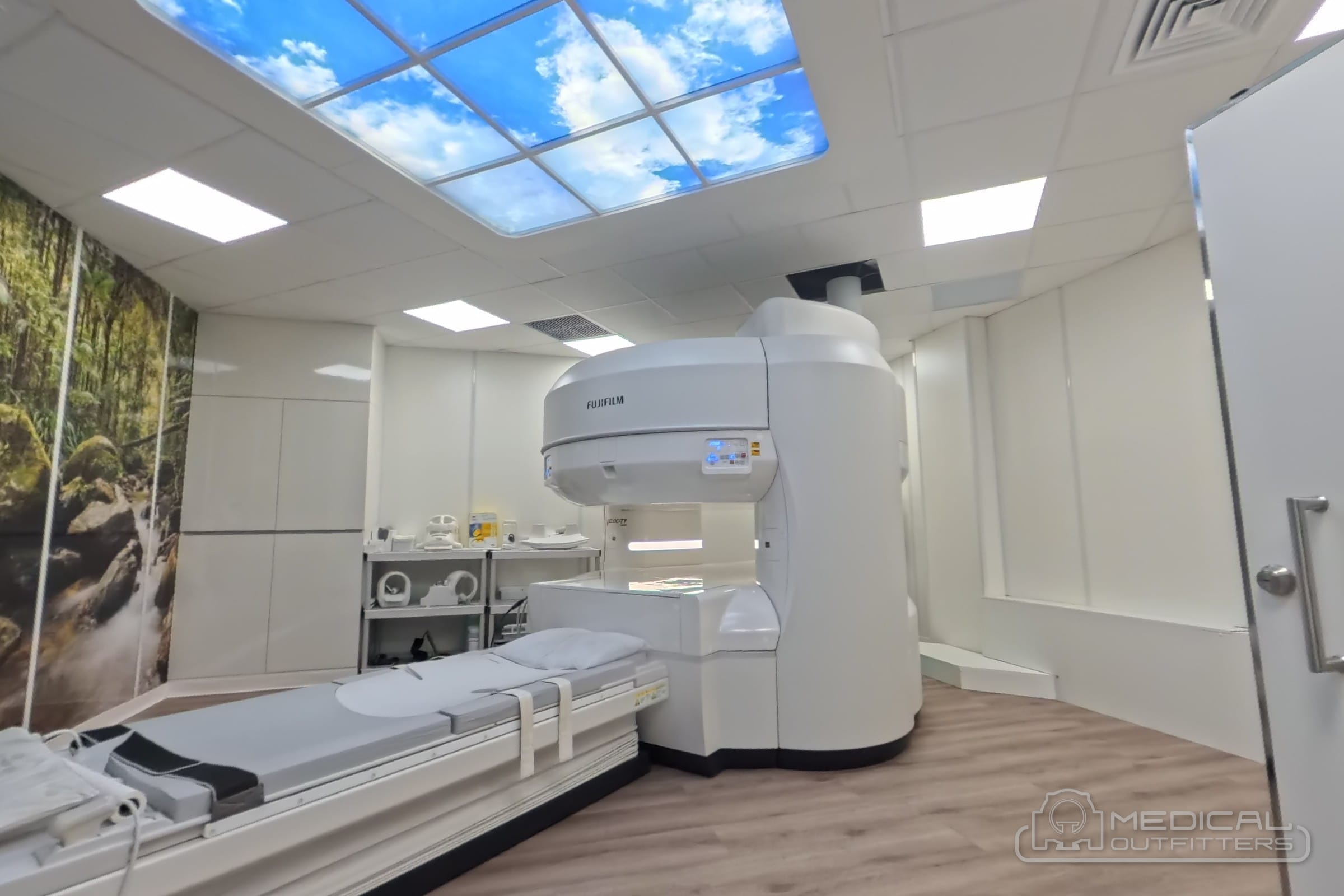
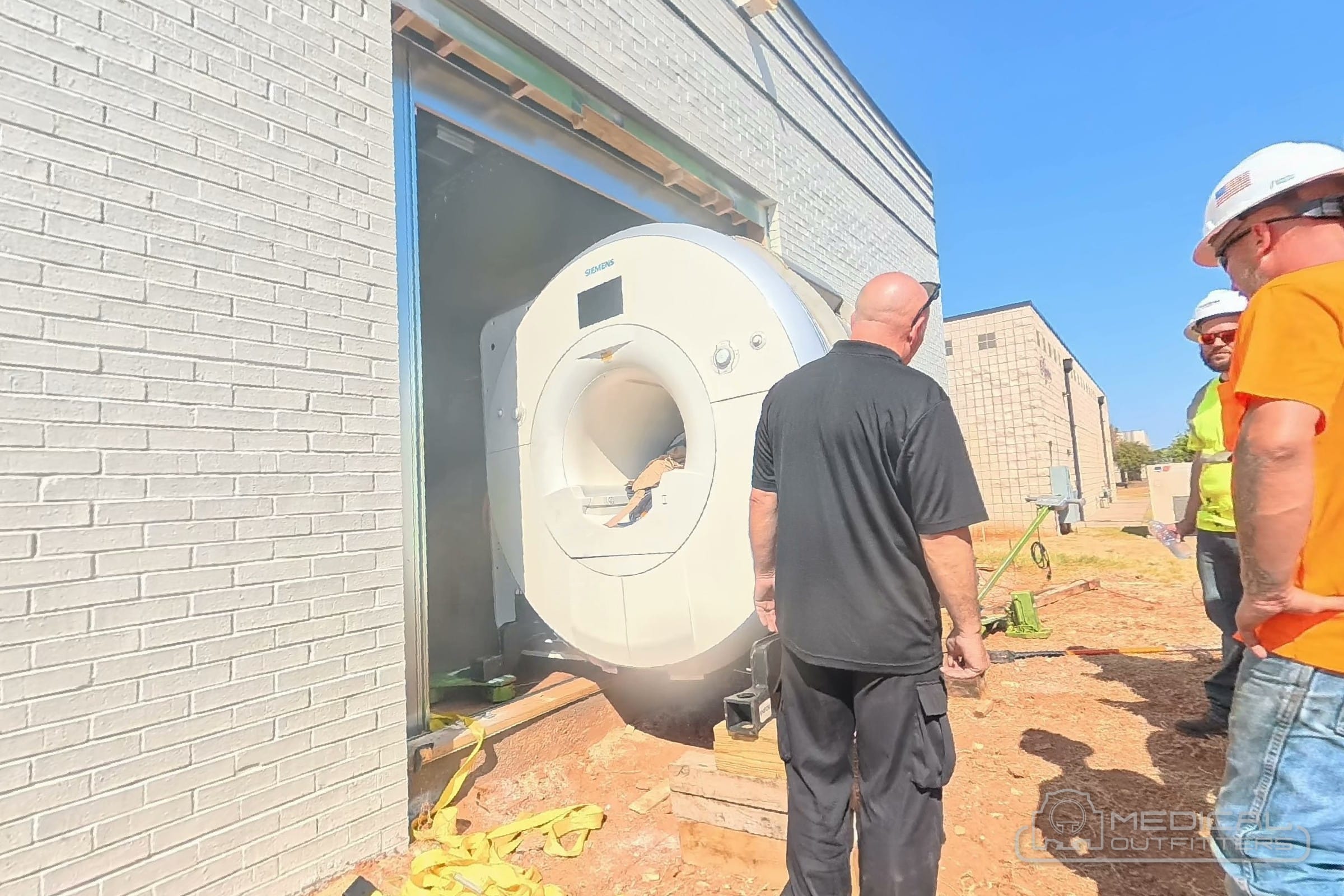
The MRI machine cost and price guide prices an open or low-field system at $300,000 to $525,000 refurbished and $600,000 to $950,000 new, a 1.5T at $475,000 to $975,000 refurbished and $1,025,000 to $2,000,000 new, and a 3T at $1,000,000 to $1,900,000 refurbished and $2,100,000 to $3,700,000 new, with the 1.2T high-field open Fujifilm Oasis Velocity at $1,600,000 to $2,225,000 new. The all-in price, per the guide, covers de-installation and freight, rigging, installation and ramp-up, applications training and a written warranty; the RF shielded enclosure, chiller and mechanical work, structural work, electrical feed and helium fill are quoted per project. The room is the largest siting job in imaging: the magnet needs an RF shielded enclosure, the five gauss line has to fall inside space the facility controls, a quench vent must route helium to outside air, and the floor must carry the weight on the model’s site planning drawing. MRI room shielding requirements, how much an MRI machine weighs and how to move an MRI or CT scanner cover the construction, the loads and the rigging. Medical Outfitters sells Fujifilm and Esaote MRI new, supplies GE and Siemens magnets refurbished through MO Select, repairs coils in-house, and has installed MRI suites in Oklahoma City, Stuart in Florida, and San Sebastian, Humacao and Caguas in Puerto Rico; the MRI category and the used MRI machines for sale page list the current systems.
Ultrasound Machines: Handheld, Portable and Cart-Based
Ultrasound is the cheapest, smallest and safest imaging equipment a facility can buy. The FDA explains that “ultrasound imaging (sonography) uses high-frequency sound waves to view inside the body,” that the image “is produced based on the reflection of the waves off of the body structures,” and that “unlike X-ray imaging, there is no ionizing radiation exposure associated with ultrasound imaging.” RadiologyInfo adds Doppler, which evaluates movement, so color Doppler shows blood flow speed and direction and spectral Doppler graphs it. Those two properties, no dose and real-time flow, make ultrasound the first look at the abdomen, the pregnancy, the thyroid, the vessels and the heart, and the guidance tool for biopsies and line placement at the bedside.
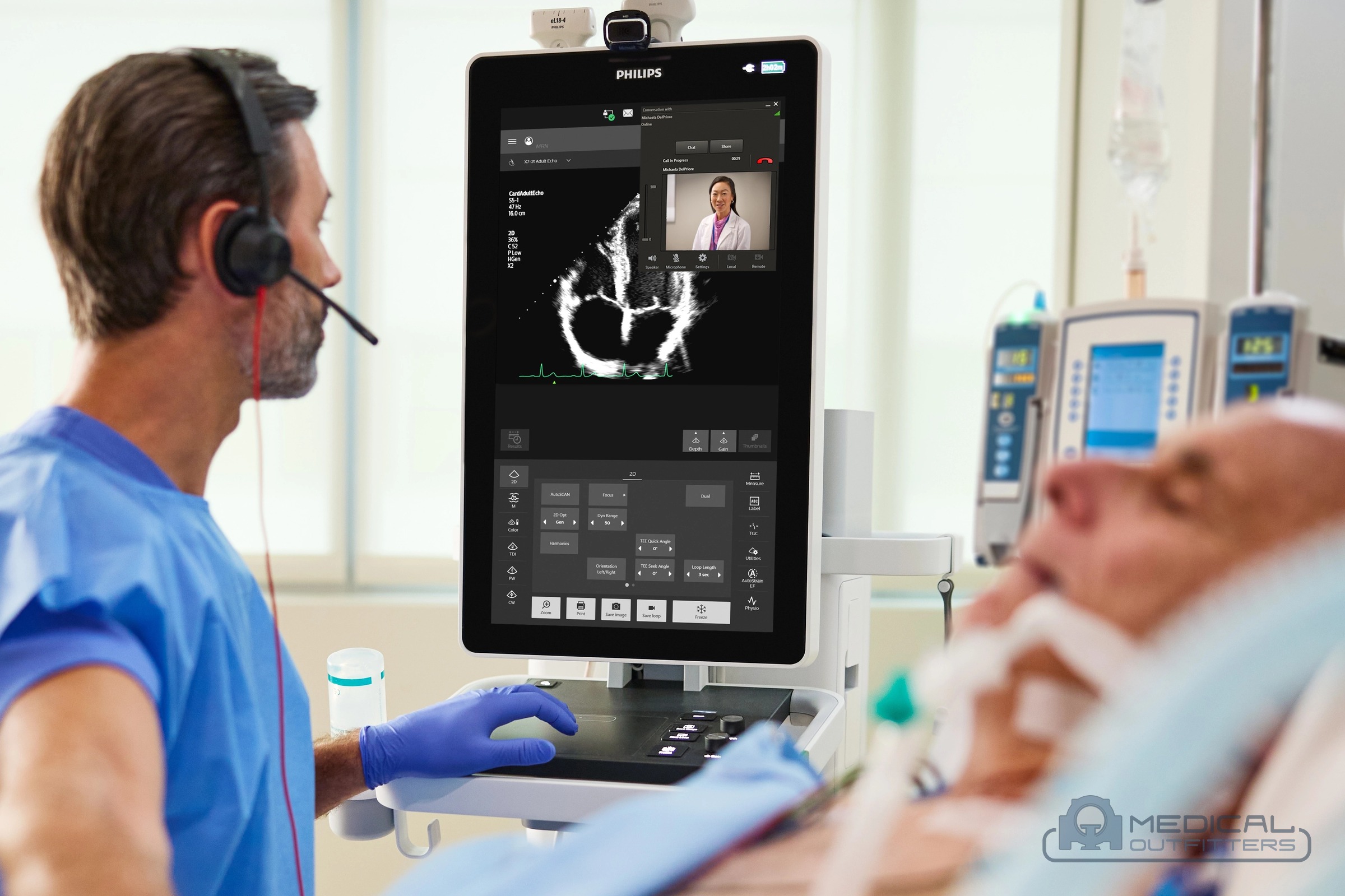
The ultrasound machine cost guide classes systems by form factor: handheld and point-of-care at $4,000 to $12,000 refurbished and $9,000 to $18,000 new, portable and compact at $15,000 to $40,000 refurbished and $35,000 to $70,000 new, and cart-based and premium at $30,000 to $90,000 refurbished and $90,000 to $200,000 new, with a cardiac cart at $35,000 to $90,000 refurbished and $140,000 to $200,000 new and a 3D/4D OB cart at $35,000 to $90,000 refurbished. The guide’s all-in figure covers a tested probe set, delivery and setup, applications training and a warranty that includes probe cover, and cart systems include the software licenses and the DICOM connection to PACS. Because the probe is the part that fails and the part that sets what the system can scan, ultrasound transducer types and how to choose an ultrasound probe are the two articles to read before the quote. Fujifilm ARIETTA and Sonosite systems are sold new and GE, Siemens and Philips carts come refurbished; the ultrasound category lists them, and the ultrasound service page covers probe testing and repair.
Mammography and DEXA Bone Densitometers
Mammography is dedicated low-energy X-ray of the breast, and in the United States it is the most regulated imaging equipment a facility can own. Under the Mammography Quality Standards Act every facility must be certified, accredited by an FDA-approved body such as the ACR every three years, inspected by the FDA annually and surveyed by a medical physicist annually, as the Medical Outfitters mammography machine cost guide summarizes. The FDA’s MQSA national statistics for October 1, 2026 count 9,137 certified facilities, 27,865 accredited units, 13,624 of them digital breast tomosynthesis units, and 45,083,719 mammography procedures a year. Tomosynthesis, the 3D mammogram, sweeps the tube through an arc and reconstructs slices; RadiologyInfo puts a screening digital mammogram at 0.28 mSv and a screening tomosynthesis exam at 0.34 mSv. The guide prices a 2D digital system at $40,000 to $95,000 refurbished and $110,000 to $225,000 new, and a 3D tomosynthesis system at $95,000 to $225,000 refurbished and $235,000 to $500,000 new, with the gantry, tube, detector, paddles, acquisition workstation, delivery, installation, calibration and applications training included and the reading workstation, PACS, CAD or AI software, shielding, biopsy add-on and accreditation fees quoted separately. Room requirements, per the guide, are similar to a diagnostic X-ray room, with space for the tomosynthesis gantry sweep. Fujifilm and Planmed systems are sold new; Hologic, Siemens and GE systems come refurbished or sourced on request; the mammography category lists them.
DEXA, dual-energy X-ray absorptiometry, is, in RadiologyInfo’s words, “today’s established standard for measuring bone mineral density,” usually at the lower spine and hips; the same page puts the dose at “less than one-tenth the dose of a standard chest x-ray” and the exam at 10 to 30 minutes, and RadiologyInfo’s dose table lists it at 0.001 mSv, the equivalent of three hours of background. Central tables scan the hip and spine and run body composition and vertebral fracture assessment; peripheral units measure the wrist, heel or finger on a bench. The DEXA and bone densitometer cost guide prices a peripheral unit at $18,000 to $40,000 refurbished and $40,000 to $70,000 new and a central system at $35,000 to $85,000 refurbished and $85,000 to $165,000 new, with the DMS Imaging Stratos line sold new at $55,000 to $165,000 and GE Lunar and Hologic tables refurbished. Most states register a bone densitometer as an X-ray device and may ask for a shielding evaluation, which the low dose usually satisfies in a standard room, per the guide. The body composition market that is filling DEXA schedules is covered in DEXA body composition scan cost, the brands in DEXA scanner brands compared, and the systems in the bone densitometry category.
Nuclear Medicine Equipment: PET/CT, SPECT, Gamma Cameras and Gamma Probes
Nuclear medicine turns imaging inside out. Instead of sending radiation through the patient, the facility injects a radiotracer, “small amounts of radioactive material combined with a carrier molecule” in RadiologyInfo’s description, and the equipment images where it collects, so the picture shows function rather than structure: blood flow in the heart, metabolism in a tumor, uptake in bone or thyroid. That changes everything about the room. The PET/CT scanner cost guide explains that PET tracers emit 511 keV photons, more penetrating than CT X-rays, so the scan room, the uptake rooms and the hot lab need a physicist’s shielding design with thicker lead or concrete than a diagnostic CT room; the site needs a radioactive materials license, a radiation safety officer, dose records and surveys; doses are received and measured in a dose calibrator in the hot lab; and injected patients rest in uptake rooms for about 45 to 90 minutes, so the number of uptake rooms, commonly two per scanner, caps daily throughput.
PET/CT. RadiologyInfo notes that “combined PET/CT scanners perform almost all PET scans today”: the CT part takes less than two minutes, the PET part 20 to 30 minutes, and the fused image pins the metabolic signal to the anatomy. The most common tracer is F-18 FDG, a glucose analogue that cancer cells take up faster than normal tissue, which is why staging, restaging and treatment response are the core PET/CT workload, with cardiac viability and brain studies alongside. RadiologyInfo lists a whole-body PET/CT at 22.7 mSv, the highest typical dose in diagnostic imaging. The guide prices an entry or older PET/CT at $200,000 to $450,000 refurbished and $500,000 to $950,000 new, a mid-tier system at $450,000 to $800,000 refurbished and $1,100,000 to $2,000,000 new, and a premium new-generation system at $800,000 to $1,500,000 refurbished and $2,200,000 to $4,000,000 new; GE Discovery and Siemens Biograph systems are rebuilt through MO Select, and Philips, Canon and United Imaging are sourced on request. What is a PET scan machine, the PET/CT scanner buying guide and time-of-flight PET explained go deeper.
Gamma cameras and SPECT. A gamma camera, as RadiologyInfo describes it, has box-shaped detector heads on a gantry around the table that detect the tracer’s energy and convert it to an image; in SPECT the heads rotate around the patient to produce three-dimensional images, and SPECT/CT adds a CT for anatomy. Imaging takes from about 20 minutes to several hours depending on the tracer, and the adult workload is cardiac perfusion, bone scans, lung, thyroid, kidney and brain studies. The nuclear medicine category quotes gamma cameras and SPECT/CT per project rather than as catalog items.
Gamma probes. The one nuclear medicine device that lives in the operating room is the handheld gamma probe, which guides the surgeon to the sentinel lymph node or the parathyroid that took up the tracer. Medical Outfitters is an authorized Mammotome dealer for the Neoprobe gamma detection system, and the Neoprobe cost and buying guide prices a complete system at $85,000 to $145,000.
How to Choose Between the Types: Clinical Question, Radiation, Room and Budget
The clinical question picks the modality before the budget does. Bone, chest and joints are X-ray work; soft tissue, brain and spine are MRI work, with CT standing in where speed matters; function, flow and the bedside belong to ultrasound; staging and metabolism belong to PET/CT. The decision figure below reduces that to three branches, and the OECD’s Health at a Glance 2025 country profile for the United States gives the scale of the installed base it feeds: 86 CT scanners, MRI units and PET scanners per million people, against an OECD average of 51.
Across all the types of radiology equipment, four practical checks follow the clinical one. Radiation decides the shielding and the licensing: ultrasound and MRI rooms need no radiation shielding at all (MRI needs RF and sometimes magnetic shielding instead), X-ray, mammography, CT and DEXA need a physicist’s shielding plan and state registration, and nuclear medicine adds a radioactive materials license and a hot lab. The room decides whether the project is a delivery or a construction job: ultrasound and a portable X-ray move into an existing exam room, a DR room or a mammography unit fits a converted X-ray room, a CT needs three-phase power and cooling, and an MRI needs an RF shielded enclosure, a chiller, a quench vent and a structural review. Throughput decides the payback: a DR room and a CT expose the patient for seconds, an MRI holds the table for a longer slot, and a PET/CT takes about a 30 minute scan after a 45 to 90 minute uptake, per RadiologyInfo and the PET/CT guide. Service decides the running cost, and imaging equipment service contracts sets out what a contract covers and costs for each modality.
Refurbished or new is the last choice, and across every modality the Medical Outfitters guides put the saving at 40 to 60 percent versus new for a system that has been stripped, renewed where needed and tested against the manufacturer specification in Medical Outfitters’ own facility before it is crated, with a warranty included rather than sold as an add-on. The brands decide the route: Fujifilm, Esaote, Planmed, DMS and Mammotome are sold new (Mammotome in Puerto Rico and the Caribbean); GE and Siemens come refurbished through MO Select; Philips, Canon and Hitachi are sourced refurbished on request. The refurbished medical imaging equipment page describes the MO Select standard, the used imaging equipment inspection checklist lists what to verify before buying any system, and radiology equipment cost keeps every band in one table.
Planning the Equipment List With Medical Outfitters
Whether the project is one modality or a whole department of radiology machines, the equipment list, the rooms and the service plan are decided together, and Medical Outfitters quotes each system delivered, installed, trained and warrantied, with its own team handling delivery, rigging and installation across the United States, Puerto Rico and the Caribbean and more than 20,000 MRI, CT and X-ray parts in stock for service. Start with the guide for the modality you are pricing: the X-ray, CT, MRI, ultrasound, mammography, DEXA, PET/CT and C-arm cost guides each carry the full band table and the siting notes summarized here. Then browse the X-ray, CT, MRI, ultrasound, mammography, bone densitometry, C-arm, cone beam and nuclear medicine categories for the systems themselves, and contact Medical Outfitters with the modalities, the rooms and the timeline for a quote on the whole list.
- FDA, Medical X-ray Imaging: the ionizing radiation definition and the list of X-ray exam types (radiography, fluoroscopy, CT, mammography, dental cone beam CT). fda.gov/radiation-emitting-products/medical-imaging/medical-x-ray-imaging
- FDA, Fluoroscopy, Computed Tomography (CT), MRI and Ultrasound Imaging pages: the descriptions of each modality quoted in this guide. fda.gov/radiation-emitting-products/medical-x-ray-imaging/fluoroscopy
- FDA, MQSA National Statistics, October 1, 2026: certified facilities, accredited units, DBT units and annual mammography procedures. fda.gov/…/mammography-quality-standards-act-mqsa-national-statistics
- RadiologyInfo (ACR and RSNA), Radiation Dose in X-Ray and CT Exams: the adult effective-dose values used throughout. radiologyinfo.org/en/info/safety-xray
- RadiologyInfo, General Nuclear Medicine, PET/CT, Bone Densitometry (DEXA) and General Ultrasound pages: how each modality works and typical exam times. radiologyinfo.org/en/info/gennuclear
- OECD, Health at a Glance 2025, United States country profile: CT, MRI and PET scanners per million population. oecd.org, Health at a Glance 2025, United States
- Medical Outfitters cost guides for X-ray, portable X-ray, C-arm, CT, MRI, ultrasound, mammography, DEXA, PET/CT and Neoprobe, reviewed September 2026: all price bands, what the all-in price includes and the siting notes. medicaloutfitters.com/blog/radiology-equipment-cost/
- Radiology equipment cost in 2026: every modality in one table
- Refurbished medical imaging equipment: the MO Select standard
- X-ray machine cost and price guide (2026)
- Portable X-ray machine price guide (2026)
- C-arm machine cost and buying guide (2026)
- CT scanner cost and price guide (2026)
- MRI machine cost and price guide (2026)
- Ultrasound machine cost and buying guide (2026)
- Mammography machine cost and buying guide (2026)
- DEXA and bone densitometer cost guide (2026)
- PET/CT scanner cost and price guide (2026)
- Neoprobe cost and gamma probe buying guide (2026)
- Cone beam CT explained: CBCT vs medical CT
- Used imaging equipment inspection checklist
- Quote an equipment list for a new department or a replacement
Types of Medical Imaging Equipment: Common Questions
What are the main types of medical imaging equipment?
X-ray equipment (radiography rooms, portable units, fluoroscopy rooms and C-arms), CT and cone beam CT, MRI, ultrasound, mammography, DEXA bone densitometers and nuclear medicine equipment (PET/CT, SPECT, gamma cameras and surgical gamma probes). The FDA groups X-ray, fluoroscopy, CT, mammography and cone beam CT as ionizing radiation exams; MRI uses magnetic fields and radio waves and ultrasound uses sound waves, with no ionizing radiation. All-in prices in the Medical Outfitters guides run from $12,000 for a refurbished portable X-ray to $4,000,000 for a new premium PET/CT.
What equipment is used in radiology?
A typical hospital radiology department runs a digital X-ray room, one or more portable X-ray units, a fluoroscopy room, a CT scanner, an MRI, several ultrasound carts, a mammography unit and a DEXA table, with C-arms in surgery and PET/CT, SPECT and gamma probes in nuclear medicine. An outpatient imaging center usually starts with X-ray, ultrasound and one cross-sectional modality, CT or MRI, and adds mammography and DEXA as screening volume grows. Every one of these radiology machines connects to the same PACS archive, and the types of imaging machines a facility owns decide which of the diagnostic imaging codes it can bill.
Which types of medical imaging equipment use radiation?
X-ray rooms, portable X-ray, fluoroscopy, C-arms, CT, cone beam CT, mammography and DEXA all use ionizing radiation produced by an X-ray tube, and nuclear medicine equipment images radiation from an injected tracer. RadiologyInfo's adult values run from 0.001 mSv for a DEXA scan and 0.1 mSv for a chest X-ray to 6.1 mSv for a CT chest, 7.7 mSv for a CT abdomen and pelvis and 22.7 mSv for a whole-body PET/CT. MRI and ultrasound use no ionizing radiation, which is why their rooms need no radiation shielding.
What is the difference between CT and MRI equipment?
A CT scanner rotates an X-ray tube and detector array around the patient and reconstructs cross-sectional slices from the transmitted X-rays, in a second or less per rotation according to the FDA, so it is fast and detailed for bone, chest, abdomen and trauma. An MRI uses a strong magnetic field and radio waves to read a signal from the body's water and fat, with no ionizing radiation, and sees soft tissue, the brain, the spinal cord and joints in more detail. CT needs a lead-shielded room; MRI needs an RF shielded enclosure, a quench vent and a controlled five gauss line.
How much does medical imaging equipment cost?
The Medical Outfitters cost guides publish all-in bands for a system delivered, installed and warrantied: a digital X-ray room $60,000 to $135,000 refurbished and $150,000 to $275,000 new, a CT $85,000 to $1,500,000 refurbished by slice class, an MRI $300,000 to $1,900,000 refurbished and $600,000 to $3,700,000 new, an ultrasound $4,000 to $90,000 refurbished, a mammography unit $40,000 to $225,000 refurbished, a DEXA $18,000 to $85,000 refurbished, a C-arm $45,000 to $240,000 refurbished and a PET/CT $200,000 to $1,500,000 refurbished and $500,000 to $4,000,000 new. Rooms, shielding and service contracts are quoted per project.
Which imaging equipment is cheapest and which is most expensive?
Ultrasound is the cheapest: the Medical Outfitters ultrasound guide prices a handheld unit at $4,000 to $12,000 refurbished and $9,000 to $18,000 new, and it needs no special room. A premium PET/CT is the most expensive, at $800,000 to $1,500,000 refurbished and $2,200,000 to $4,000,000 new in the PET/CT guide, followed by a 3T MRI at $1,000,000 to $1,900,000 refurbished and $2,100,000 to $3,700,000 new and a 256-slice CT at $625,000 to $1,500,000 refurbished. The MRI and PET/CT rooms are the most expensive to build as well.
What room does each type of imaging equipment need?
Ultrasound fits any exam room, and a portable X-ray goes to the patient. A digital X-ray room, a mammography unit and a DEXA need a shielded room designed by a physicist and registered with the state, though the DEXA's low dose usually satisfies a standard room, per the Medical Outfitters guides. A CT needs a lead-shielded scan room, a control room with a leaded window, three-phase power and a chiller. An MRI needs an RF shielded enclosure, a chiller, a quench vent and a floor that carries the magnet. A PET/CT needs heavier shielding, a hot lab, uptake rooms and a radioactive materials license.
Should a facility buy new or refurbished imaging equipment?
The Medical Outfitters guides put the saving at 40 to 60 percent versus new across the modalities for a refurbished system tested against the manufacturer specification and sold with a warranty included. The brand often decides the route: Fujifilm, Esaote, Planmed, DMS Imaging and Mammotome Neoprobe are sold new by Medical Outfitters as an authorized dealer (the Neoprobe in Puerto Rico and the Caribbean), GE and Siemens systems come refurbished through MO Select, and Philips, Canon and Hitachi systems are sourced refurbished on request. Either way the room, the shielding and the first service contract are quoted per project on top of the system price.
Related Articles
What each exam costs a patient: CT scan cost, MRI cost, PET scan cost, DEXA scan cost, mammogram cost, ultrasound cost and echocardiogram cost. For how the machines work, see the explainers on the CT scan machine, the DEXA scan, the C-arm and the cath lab.